


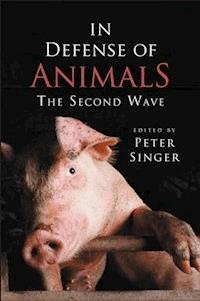
In Defense of Animals E-Book
29,95 €
Mehr erfahren.
- Herausgeber: John Wiley & Sons
- Kategorie: Geisteswissenschaft
- Sprache: Englisch
Bringing together new essays by philosophers and activists, In Defense of Animals: The Second Wave highlights the new challenges facing the animal rights movement.
- Exciting new collection edited by controversial philosopher Peter Singer, who made animal rights into an international concern when he first published In Defence of Animals and Animal Liberation over thirty years ago
- Essays explore new ways of measuring animal suffering, reassess the question of personhood, and draw highlight tales of effective advocacy
- Lays out "Ten Tips for Activists", taking the reader beyond ethical theory and into the day-to-day campaigns for animal rights
Sie lesen das E-Book in den Legimi-Apps auf:
Seitenzahl: 462
Veröffentlichungsjahr: 2013
Ähnliche




















Contents
Notes on Contributors
Introduction
References
Part I The Ideas
1 Utilitarianism and Animals
Ethics
Utilitarianism
The Advantages of Utilitarianism
Do Any Nonhumans Have Interests?
Some Rebuttals
Food
Laboratories
Wildlife
Conclusions
Reference
Further Reading
2 The Scientific Basis for Assessing Suffering in Animals
Physical Health
Physiological Signs
Behavior
“Asking” the Animals
An Objective Measure of Suffering
References
3 On the Question of Personhood beyond Homo sapiens
The Concept of Personhood
Other Hominid Persons
Ordinary Great Apes and Dolphins as Borderline Persons
The Personhood of Certain Language-Trained Animals
The Significance or Insignificance of Personhood
Notes
References
4 The Animal Debate: A Reexamination
Framing the Question: The Prevalence of Rationalization
An Ideological Resumption: Proposing Further Demotion
Confronting Reification: False Tracks and a New Perspective
Conclusion
Essential References
5 Religion and Animals
Pervasiveness of the Animal Presence Outside the World Religions
Making Religion More Animal-Friendly
Works Cited
Additional Reading
Part II The Problems
6 Speciesism in the Laboratory
The Ethical Argument
The Elements of Reform
Some Severe Experiments
Legislation
U.S. Law
British Law
The Use of Great Apes
Alternatives to Experimentation with Live Animals
The Size of the Problem
Levels of Suffering
Political Campaigning
Notes
References
7 Brave New Farm?
Factories Come … Farms Go
The Factory Formula
Factory Problems, Factory Solutions
Biotech Barnyard
Human Health Concerns
Farmers (and the Rest of Us) Are Victims Too
Laws and Standards
8 Outlawed in Europe
Sow Stalls and Tethers
Veal Crates for Calves
Laying Hens in Battery Cages
Conclusion
References
9 Against Zoos
Zoos and Their History
Animals and Liberty
Arguments for Zoos
References
10 To Eat the Laughing Animal
References
Part III Activists and Their Strategies
11 How Austria Achieved a Historic Breakthrough for Animals
The Background
The 2004 Campaign
The Victory
How We Won: Some Tactical Lessons
Why Animal Activists Should Work to Change the Law
12 Butchers’ Knives into Pruning Hooks: Civil Disobedience for Animals
April 1999, World Day for Laboratory Animals
August 2001
Winter 2003
13 Opening Cages, Opening Eyes: An Investigation and Open Rescue at an Egg Factory Farm
14 Living and Working in Defense of Animals
The State of Animals Today
The Choice for Activists
Purity vs Progress
Beyond Sound Bites, Beyond Veganism
A History of Success
Further References
15 Effective Advocacy: Stealing from the Corporate Playbook
Selling Animal Rights: Creating a Movement Others Want to Join
Four Things We Do Wrong: Four Strategies for Animal Liberation
Closing: We Are Winning
References
16 Moving the Media: From Foes, or Indifferent Strangers, to Friends
Feedback as Force
Slaughterhouse Five TV
Love–Hate Relationships
Got MADD Mothers?
Taboo Topics on the Editorial Page
“Direct Action” – Shifting the Media Focus
More Explosive Topics
Influencing the Coverage, Not the Campaigns
References
17 The CEO as Animal Activist: John Mackey and Whole Foods
18 Ten Points for Activists
Introductory Note by Peter Singer
Ten Points for Activists
A Final Word
References
Further Reading: Books and Organization Websites
Books
Animals in Research
Farmed Animals and the Meat Industry
Veganism and Vegetarianism
Organization Websites
Index
© 2006 by Blackwell Publishing Ltd
except for editorial material and organization © 2006 by Peter Singer
BLACKWELL PUBLISHING
350 Main Street, Malden, MA 02148-5020, USA
9600 Garsington Road, Oxford OX4 2DQ, UK
550 Swanston Street, Carlton, Victoria 3053, Australia
The right of Peter Singer to be identified as the Author of the Editorial Material in this Work has been asserted in accordance with the UK Copyright, Designs, and Patents Act 1988.
All rights reserved. No part of this publication may be reproduced, stored in a retrieval system, or transmitted, in any form or by any means, electronic, mechanical, photocopying, recording or otherwise, except as permitted by the UK Copyright, Designs, and Patents Act 1988, without the prior permission of the publisher.
First published 2006 by Blackwell Publishing Ltd
1 2006
Library of Congress Cataloging-in-Publication Data
In defense of animals : the second wave / edited by Peter Singer.
p. cm.
Includes bibliographical references and index.
ISBN-13: 978-1-4051-1940-5 (hard cover : alk. paper)
ISBN-10: 1-4051-1940-3 (hard cover : alk. paper)
ISBN-13: 978-1-4051-1941-2 (pbk. : alk. paper)
ISBN-10: 1-4051-1941-1 (pbk. : alk. paper)
1. Animal welfare—Moral and ethical aspects. 2. Animal rights movement.
I. Singer, Peter, 1946–
HV4711.I6 2006
179′.3—dc22
2005009479
A catalogue record for this title is available from the British Library.
The publisher’s policy is to use permanent paper from mills that operate a sustainable forestry policy, and which has been manufactured from pulp processed using acid-free and elementary chlorine-free practices. Furthermore, the publisher ensures that the text paper and cover board used have met acceptable environmental accreditation standards.
For further information on
Blackwell Publishing, visit our website:
www.blackwellpublishing.com
Notes on Contributors
Matt Ball is co-founder of Vegan Outreach, a U.S.-based organization on the cutting edge of animal advocacy since 1991. An engineer by training, he was a Department of Energy Global Change Fellow and a Research Associate in the Biology Department at the University of Pittsburgh before working full-time for Vegan Outreach. He met his wife, Anne Green, while head of Students for Animal Liberation at the University of Illinois, Urbana-Champaign. They currently live in Pittsburgh with their daughter, Ellen, one of the top leafleters for the Vegan Outreach Adopt a College program.
Martin Balluch was born in Vienna, Austria, where he studied mathematics and physics. He worked for twelve years as a research associate and lecturer at the Universities of Vienna, Austria, Heidelberg, Germany, and Cambridge, UK. He has been active for animal rights in Austria and other countries since 1985. In 1997, he dropped out of his academic career and has been a full-time activist in the Austrian animal rights movement since then. He co-founded the Austrian Vegan Society in 1999, and since 2002 has been president of the Austrian Association Against Animal Factories.
Paola Cavalieri, who lives in Milan, Italy, is the editor of the international philosophy journal Etica & Animali. She is the author of The Animal Question and the co-editor, with Peter Singer, of The Great Ape Project.
Marian Stamp Dawkins is Professor of Animal Behaviour at the University of Oxford and Fellow in Biological Sciences at Somerville College. She is the author of Animal Suffering: The Science of Animal Welfare, Through Our Eyes Only? The Search for Animal Consciousness, Unravelling Animal Behaviour, and, with Aubrey Manning, An Introduction to Animal Behaviour.
Karen Dawn has worked as a researcher and writer for various Australian publications and on ABC’s 7:30 Report. She has written for The Los Angeles Times and The Guardian, and is a contributor to Terrorists or Freedom Fighters, an anthology edited by Steve Best and Anthony Nocella. Her media monitoring service, DawnWatch.com, helps activists encourage animal-friendly coverage. Dawn hosts and co-produces the recurring series Watchdog, on Los Angeles’ KPFK radio.
David DeGrazia is Professor of Philosophy at George Washington University in Washington, D.C. He is the author of Taking Animals Seriously: Mental Life and Moral Status, Animal Rights: A Very Short Introduction, and Human Identity and Bioethics. With Thomas Mappes, he has coedited Biomedical Ethics in its fourth and subsequent editions. DeGrazia’s articles have appeared in such journals as Philosophy and Public Affairs, Bioethics, and The Hastings Center Report.
Clare Druce co-founded the pressure group Chickens’ Lib (now the Farm Animal Welfare Network) in the early 1970s, to oppose the battery system for laying hens. Since then, she has campaigned against a range of restrictive and abusive forms of animal husbandry. Her book Minny’s Dream, an adventure story for children that highlights the deprivation of hens imprisoned in cages, was published in 2004.
Mary Finelli is a farmed animal advocacy consultant with a degree in animal science. She has worked for numerous animal protection organizations since 1986, and initiated and wrote Farmed Animal Watch, a weekly news digest, from 2001 to 2004.
Bruce Friedrich joined People for the Ethical Treatment of Animals (PETA) in 1996, and is the director of their vegetarian and farmed animal campaigns. Before joining PETA, Bruce ran a shelter for homeless families and the largest soup kitchen in Washington, D.C. He has been a social justice advocate for more than twenty years.
Dale Jamieson is Professor of Environmental Studies and Philosophy at New York University, and the author of Morality’s Progress: Essays on Humans, Other Animals, and the Rest of Nature.
Philip Lymbery spent a decade working for Compassion in World Farming (CIWF), a leading European farm animal welfare organization. As CIWF’s Campaigns Director, he founded and coordinated the European Coalition for Farm Animals (ECFA). After two years as international animal welfare and campaigns consultant, Philip now works for the World Society for the Protection of Animals (WSPA) as Director of Communications.
Jim Mason grew up on a Missouri family farm. He is co-author with Peter Singer of Animal Factories: What Agribusiness is Doing to the Family Farm, the Environment, and Your Health. His book An Unnatural Order traces the roots of the dominant worldview of human supremacy over animals and nature.
Gaverick Matheny is a Fellow in Agricultural and Resource Economics at the University of Maryland. He also directs New Harvest, a nonprofit research organization developing new meat substitutes (www.New-Harvest.org).
Miyun Park directs the Farm Animals and Sustainable Agriculture program of The Humane Society of the United States, in Washington, D.C. She was previously president of Compassion Over Killing (COK), where she focused on ending cruelty to farmed animals and conducted investigations at slaughterhouses, live animal markets, and factory farms. Miyun’s advocacy efforts were featured in The New York Times, The Washington Post, The San Francisco Chronicle, and CosmoGirl! magazine, and she was the subject of an hour-length documentary produced by the Korean Broadcasting System.
Dale Peterson’s recent books include Eating Apes, Chimpanzee Travels, The Deluge and the Ark, and Storyville, USA. He has also co-authored (with Richard Wrangham) Demonic Males: Apes and the Origins of Human Violence and (with Jane Goodall) Visions of Caliban: On Chimpanzees and People.
Richard D. Ryder studied experimental psychology in animal laboratories at Cambridge University and at Columbia University, New York, before becoming a pioneer animal rights advocate in the 1960s. His Victims of Science provoked political debate when published in 1975 and led to new legislation on animal experimentation in the United Kingdom and the European Union in 1986. He has several times been Chairman of the Royal Society for the Prevention of Cruelty to Animals Council. In 1970 he coined the term “speciesism,” now in many dictionaries.
Peter Singer is Ira W. De Camp Professor of Bioethics in the University Center for Human Values at Princeton University and Laureate Professor in the Centre for Applied Philosophy and Public Ethics at the University of Melbourne. He first became well known internationally after the publication of Animal Liberation in 1975. His other books include Democracy and Disobedience, Practical Ethics, How Are We to Live?, Rethinking Life and Death, One World, Pushing Time Away, and The President of Good and Evil. He is also editor of four other titles for Blackwell: A Companion to Ethics (1991), A Companion to Bioethics (with Helga Kuhse, 1999), The Moral of the Story: An Anthology of Ethics Through Literature (with Renata Singer, 2005), and Bioethics: An Anthology (with Helga Kuhse, 2nd edn., 2006). He is president of Animal Rights International, and of the Great Ape Project.
Henry Spira (1927–98) was a merchant seaman, journalist, civil rights activist, union reformer, and high school teacher before becoming the most effective American campaigner for animals of the 1970s and 1980s.
Pelle Strindlund is a Swedish activist and writer. He is the author of Djurrätt och socialism (Animal Rights and Socialism) and I vänliga rebellers sällskap: kristet ickevåld som konfrontation och ömhet (In the Company of Amicable Rebels: Christian Nonviolence as Confrontation and Tenderness).
Paul Waldau is the Director of the Center for Animals and Public Policy at Tufts University School of Veterinary Medicine. He holds a Doctor of Philosophy degree from the University of Oxford, a Juris Doctor degree from the University of California Law School, and a Master’s degree from Stanford University in Religious Studies. He is the author of The Specter of Speciesism: Buddhist and Christian Views of Animals, and has taught “Animal Law” courses at Harvard, Yale, and Boston College law schools.
Introduction
Peter Singer
The book that follows is very different from the one that appeared under the same title twenty years ago. That work reflected the first generation of the modern animal movement – a movement that began, hesitatingly, in the 1960s, in the United Kingdom. The first sign of a new, more radical approach to combating the maltreatment of animals was the willingness of some members of the League Against Cruel Sports to engage in sabotage to stop hunting with hounds. They started using chemicals to dull the fox’s scent, or they laid false scents to mislead the dogs. By 1963, the Hunt Saboteurs Association emerged as a separate organization, freed from the constraints of the more traditional League.
At first, this new radicalism was still focused only on putting an end to hunting with hounds. But just one year after the founding of the Hunt Saboteurs Association, Ruth Harrison’s Animal Machines was published. For the first time, the British public became aware of the existence of factory farming. This system of animal production, Harrison persuasively argued, acknowledges cruelty only when profitability ceases. Unfortunately for the animals, the individual productivity of a laying hen is less significant for the profitability of egg producers than the number of hens the producers can cram inside their sheds. Thus profitability proved compatible with a vast amount of cruelty.
A dairy farmer named Peter Roberts tried to persuade the major British animal welfare organizations to take up the issue of factory farming. Getting little response, in 1967 he started Compassion in World Farming. It has now grown into an international organization and a major player in farm animal welfare issues in Europe.
Philosophy got involved in the animal question in the early 1970s, when three graduate students at Oxford – Roslind and Stanley Godlovitch, together with John Harris – edited Animals, Men and Morals, the first modern work in which philosophers – among others – discuss the ethics of our treatment of animals. The book attracted virtually no attention. I tried to remedy this situation by writing by a review essay in The New York Review of Books under the more dramatic title “Animal Liberation.” That was followed by my own book with the same title, and after that, a number of other philosophers began to write about the topic from their own ethical perspectives. As James Jasper and Dorothy Nelkin observed in The Animal Rights Crusade: The Growth of a Moral Protest, “Philosophers served as midwives of the animal rights movement in the late 1970s” (1992: 90). The metaphor is apt: philosophers were not the mother of the movement, but they did ease its passage into the world and – who knows – may have prevented it being stillborn. In his essay below, Richard Ryder, who was present at the birth, speculates on the reasons why it happened at that particular time.
In 1970 the number of writings on the ethical status of animals was tiny. Sixteen years later, when the first edition of this book appeared, it was small. In a comprehensive bibliography of writings on this subject, Charles Magel (1989) lists only 94 works in the first 1970 years of the Christian era, and 240 works from 1970 to 1988, when the bibliography was completed. The tally now must be in the thousands. Nor is this debate simply a Western phenomenon. Leading works on animals and ethics have been translated into most of the world’s major languages, including Japanese, Chinese, and Korean, and scholars, writers, and activists in many countries have contributed.
This new edition reflects the current state of the animal movement. In the last twenty years the movement has grown and matured. Hence I have not felt the need to reprint the work of well-known thinkers, like Tom Regan, Stephen Clark, and Mary Midgley, who contributed to the first edition. Their essays are now widely available in anthologies, and they have written their own books explaining their positions more fully. In this edition, I wanted to give a voice to a new generation of thinkers and activists. Only one essay, Marian Dawkins’s discussion of the basis for assessing suffering in animals, has been reprinted unchanged. Three essays – describing the situation for animals in farms, laboratories, and zoos – are revised versions of essays that appeared in the first edition. The remaining fourteen essays appear here for the first time.
The structure of the book is unchanged. We begin with essays on the ideas behind the movement. To come to grips with the crux of the ethical debate, it helps to distinguish two questions. The first revolves around the idea of “speciesism,” a term that is now in good dictionaries, but did not even exist thirty-five years ago. (It was coined by Richard Ryder, in a leaflet about experiments on animals.) Speciesism is, in brief, the idea that it is justifiable to give preference to beings simply on the grounds that they are members of the species Homo sapiens. The first issue, then, is whether speciesism itself can be defended. The second issue is whether, if speciesism cannot be defended, there are other characteristics about human beings that justify placing greater moral significance on what happens to them than on what happens to nonhuman animals.
The view that species is in itself a reason for treating some beings as morally more significant than others is often assumed but rarely defended. Some who write as if they are defending “speciesism” are in fact defending an affirmative answer to the second question, arguing that there are morally relevant differences between human beings and other animals that entitle us to give more weight to the interests of humans. The only argument I’ve come across that looks like a defense of speciesism itself is the claim that just as parents have a special obligation to care for their own children in preference to the children of strangers, so we have a special obligation to other members of our species in preference to members of other species. Advocates of this position usually pass in silence over the obvious case that lies between the family and the species. Thus in Darwinian Dominion, Lewis Petrinovich, an authority on ornithology and evolution, says that our biology turns certain boundaries into moral imperatives – and then lists “children, kin, neighbors, and species” (1999: 29). If the argument works for both the narrower circle of family and friends, and the wider sphere of the species, it should also work for the middle case: race. But an argument that supported preferring the interests of members of our own race over those of members of other races would receive a hostile reaction from most people, who are not racists. Yet if the argument doesn’t lead to the conclusion that race is a morally relevant boundary, how can it show that species is?
The late Harvard philosopher Robert Nozick, writing in 1983, argued that we can’t infer much from the fact that we do not yet have “a theory of the moral importance of species membership” – and, in particular, of the moral importance of the fact that a being is a member of the species Homo sapiens – because nobody thought that we needed such a theory, and so no one had spent much time trying to formulate one. But even as Nozick was writing this, the issue of the moral status of animals, and hence of the moral importance of species membership, had become a pressing one, both philosophically and with a broader public suddenly concerned about factory farming and experiments on animals. So over the last twenty years, many philosophers have spent a lot of time trying to formulate a theory of the moral importance of being a member of the species Homo sapiens. And yet we still do not have a satisfactory account of why membership of our species should matter so much, morally. Nozick’s comment, therefore, takes on a quite different significance. The continuing failure of philosophers to produce a plausible theory of the moral importance of species membership indicates, with increasing probability, that there is no such plausible theory.
That takes us to the second question. If species is not morally important in itself, is there something else that happens to coincide with the species boundary, on the basis of which we can justify the inferior consideration we give to nonhuman animals? Those who think that morality is based on a social contract argue that it is the lack of a capacity to reciprocate. Ethics, they say, arises out of an agreement that if I do not harm you, you will not harm me. Since animals cannot take part in this agreement, we have no direct duties to them. The difficulty with this approach to ethics is that it also means that we have no direct duties to small children, or to future generations yet unborn. If we produce radioactive waste that will be deadly for thousands of years, is it unethical to put it into a container that will last 150 years and then drop it into a convenient lake? If it is, ethics cannot be based on reciprocity.
Many other ways of marking the special moral significance of human beings have been suggested: the ability to reason, self-awareness, possessing a sense of justice, language, autonomy, and so on. But the problem with all of these allegedly distinguishing marks is, as noted above, that some humans are entirely lacking in these characteristics and few want to consign these humans to the same moral category as nonhuman animals. Moreover, as David DeGrazia argues in his essay on personhood below, some nonhuman animals possess at least some of these more advanced cognitive characteristics. So – at best – these criteria do not mark the greater moral significance of human beings as such, but rather that of most humans and some nonhumans over some humans and most nonhumans.
The animal movement is frequently parodied by those who either are wilfully misrepresenting it or do not understand its implications. So, to forestall misunderstandings, it is worth saying a little about what the rejection of speciesism does not imply. It does not mean that animals have all the same rights as you and I have. Opponents of speciesism are well aware of the existence of differences between members of our species and members of other species. Because of these differences, it would be meaningless to attribute to nonhuman animals such rights as the right to vote, to freedom of speech, or to freedom of religion. But then, it is equally meaningless to give such rights to two-year-old humans. That doesn’t mean that we should give less weight to the interests that two-year-old humans do have, like the interests in being fed, in being warm and comfortable, and in being loved.
Similarly, something that harms normal adult humans may cause much less harm, or even no harm at all, to some nonhuman animals. If I were to confine a herd of cows within the boundaries of the state of New Jersey, I would not be doing them any harm at all. Cows are satisfied with lush pasture, contact with their offspring and other members of the group, and shelter from harsh weather – all things that New Jersey can provide. Cows have no desire to stroll down New York’s Fifth Avenue, to hike in the Rockies, or to take a gondola ride in Venice. Some humans do. Hence, even if they are with their families and friends, and notwithstanding the many attractions of Newark and Trenton, confinement to New Jersey would be a hardship to those humans. The moral is: normal mature humans often have different interests from nonhuman animals.
Here is another example, more relevant to real problems about our treatment of animals. Suppose that, in order to advance medical research, we decide to perform lethal scientific experiments on normal adult humans, kidnapped at random for this purpose from public parks. Soon every adult would become fearful of being kidnapped if he or she entered a park. The resultant terror – and loss of the ability to enjoy visiting parks – would be a form of suffering additional to whatever pain was involved in the experiments themselves. The same experiments, carried out on nonhuman animals and causing a similar amount of pain during the course of the actual experiment, would cause less suffering overall, for the animals would not have the same anticipatory dread. This does not mean, I hasten to add, that it is all right to experiment on animals, but only that if the experiment is to be done at all, there is some reason, compatible with the principle of equal consideration of interests, for preferring to use nonhuman animals rather than normal adult humans.
In this example, the superior mental powers of normal adult humans would make them suffer more. In other circumstances, the nonhuman animal may suffer more because he or she cannot understand what is happening. If we capture wild animals, intending to release them later, we cannot convey to them that we do not intend to harm them. They will experience the general terror of being in a situation that is, to them, as threatening as any situation can possibly be.
The moral significance of taking life is more complex still. The traditional Judeo-Christian ethic teaches that the lives of human beings are sacred, but the lives of other beings are not. As I have argued at greater length in Practical Ethics and Rethinking Life and Death, we should not allow species to determine the wrongness of taking life. If it is wrong to take the life of a severely brain-damaged human infant, it must be at least as wrong to take the life of a dog or a pig at a comparable mental level. On the other hand, perhaps it is not wrong to take the life of a severely brain-damaged human infant, at least when the parents agree that it is better that their child should die. After all, such infants are commonly “allowed to die” in intensive-care units in major hospitals all over the world, and an infant who is “allowed to die” ends up just as dead as one who is killed. Indeed, one could argue that our readiness to put hopelessly ill nonhuman animals out of their misery is the one and only respect in which we treat animals better than we treat human beings.
We need to take a new approach to the wrongness of killing, one that considers the individual characteristics of the being whose life is at stake, rather than that being’s species. Such a view may still consider killing beings with the mental capacities of normal human adults as more serious than killing beings who do not possess, and never have possessed, such mental capacities. When we see the lives of normal human beings tragically cut short – as happened, for example, in New York on September 11, 2001 – we are saddened by the thought that these people had hopes and plans that will now never be fulfilled. We think of the young woman who had been so excited about her new career in an investment bank with offices high up in the World Trade Center, or of the clerk who had finally saved enough to put a down payment on an apartment and set the date when he would marry his childhood sweetheart. We think, too, of the loved ones left behind to grieve. A being who lacks a clear conception of the past and the (possible) future cannot have these kinds of hopes and plans. Although nonhuman animals certainly can grieve for the loss of those to whom they are close, the nature of the grief must differ in accordance with the differing mental capacities of the beings. Hence it is not a bias in favor of our own species that leads us to think that different mental capacities make a difference in these circumstances, and that, accordingly, some deaths are more tragic than others.
The rejection of speciesism therefore does not require us to say that all lives are of equal worth, or that all interests of humans and animals must be given equal weight, no matter what those interests may be. It requires us to make only the more limited and defensible claim that where animals and humans have similar interests – we might take the interest in avoiding physical pain as an example – those interests are to be counted equally. We must not disregard or discount the interests of another being, merely because that being is not human.
Part I of the book, “The Ideas,” starts with the most straightforward ethical case for a non-speciesist approach to the treatment of animals – a utilitarian argument. Gaverick Matheny sets this out clearly and succinctly, deals with some objections, and concludes by showing that even for those who would accept only a much weaker version of the principle of equal consideration of interests, there is a compelling ethical case for ceasing to treat animals as means to our ends. Marian Dawkins provides the scientific basis for one of the essential premises of Matheny’s – or virtually any – argument about how we should treat animals. She shows how scientists can gain insight into what animals feel, and into their capacity to suffer. David DeGrazia takes up the idea of “personhood” beyond the human species. His essay is part of a growing literature that explores morally significant characteristics that cross species boundaries. This line of thinking is relevant not only to issues regarding nonhuman animals, but also to life-and-death decisions for human beings: for example, for critically ill newborn infants, or for those in a persistent vegetative state. But DeGrazia concludes by reminding us that personhood is not the only morally significant characteristic, and its importance may have been overestimated.
Paola Cavalieri puts the debate about animals into a sweeping historical perspective encompassing crucial moments in philosophic thought. She starts with ancient Greece, then moves to seventeenth-century Europe, and finally looks at the last fifty years. Her contrast between the human-centered approaches taken by Heidegger and Derrida and the more egalitarian approach taken by many contemporary English-language philosophers reveals the conventional self-interest that often lurks behind what appears to be deep metaphysics. Paul Waldau looks at the major religious traditions, another source of our attitudes to animals and how we should treat them. Here too, as Waldau suggests, although different religions offer contrasting views on the existence or otherwise of a yawning moral gulf between humans and animals, everyday practices towards animals may be more similar than these different views would lead one to expect.
Part II, entitled “The Problems,” contains three revised and updated essays from the first edition, and two new essays. This section covers four areas in which animals need defense: in laboratories, in farms, in zoos, and in their own habitats. These four categories leave many others untouched: puppies and kittens bought for Christmas and then dumped when they grow into adults; circuses where animals are trained by threat and punishment to perform; and cruel sports like bull-fighting and fox-hunting. Nevertheless, each of the four topics covered here is significant in its own way. Most of the campaigning in the modern animal movement over the last thirty years has focused on animals used in laboratories and farms. In Europe both areas were targeted from the beginning of this period, with some, if still inadequate, progress. Richard Ryder’s essay indicates both the progress and the continuing abuse of animals used in research. Clare Druce and Philip Lymbery set out the European Union reforms in how farm animals may be kept. These European reforms are far in advance of anything that is happening in America – perhaps because in the United States, until quite recently, the animal movement focused almost entirely on the use of animals in research. As Jim Mason and Mary Finelli show, agribusiness regards animals as cogs in a vast production machine. This trend started in America and is still more highly developed there than anywhere else, but it has now spread all over the world.
Dale Jamieson’s essay on zoos covers an area that, because it obviously does not serve a critical human need, would seem to be more amenable to change through ethical argument. Indeed, the public will no longer accept, for public display, ways of caging animals that were common fifty years ago (although the public will continue to buy pork, chicken and veal from animals kept in much worse conditions). Some zoos have made significant efforts to improve their standards. But others have not, and Jamieson asks whether even those zoos that have improved the way they keep animals can justify their continued existence.
The final essay in this section describes a practice that will, it can safely be said, find few defenders among those who pick up this book, even those who eat meat. But I did not included Dale Peterson’s essay simply in order to shock readers. What Peterson describes is nothing more than speciesism taken to the extreme. Chimpanzees, bonobos, and gorillas are not members of our species. If, as some have maintained, that is enough to exclude them from the circle of beings who may make moral claims against us, what is wrong with treating them as edibles? If, on the other hand, we cross the species boundary and admit the nonhuman great apes to the protected circle, where is the line to be drawn between eating great apes and eating pigs or calves? The moral gulf between humans and other animals appears, from our anthropocentric perspective, too wide to leap. Yet as our knowledge of the other great apes grows, they are proving to be a bridge species, not only in genetic, behavioral, and cognitive senses, but also morally.
All of the essays in Part III, “Activists and Their Strategies,” are new and, with the exception of the final essay, which draws on the work of Henry Spira, they are all written by people who were not part of the animal movement when the first edition of this book appeared – either because they were too young, or because they were doing other things. The strategies described range from encouraging people to become vegans to committing civil disobedience, and from breaking into farms and rescuing hens to writing polite letters to newspapers. That the movement has been able to find new activists, with new ideas about how best to change the way we treat animals, is obviously an encouraging sign. So too is the fact that the authors of these essays are no longer all from English-speaking countries, as they were in the first edition. Whereas in the 1980s most people would have looked to the United Kingdom or to America for models of how to fight against the suffering of animals, now we can, with equal justification, turn to European nations like Austria and Sweden, which have in some respects become leaders in progressive reforms for animals. (To say this is not to deny the obvious fact that these nations too fall far short of the standards that a truly ethical, non-speciesist society would adopt towards animals.)
One viewpoint that is not represented in this book is the advocacy of violence in the cause of animals. The animal movement as a whole is overwhelmingly opposed to the use of violence against any sentient beings, including those who exploit animals. Considering the size of the movement, now numbering in the millions, violent incidents have been extremely rare – much more so than in the American anti-abortion movement (often misnamed the “pro-life movement”), some members of which have murdered doctors who carry out abortions. Nevertheless, threats of violence have been used, and some actual bodily assaults have occurred. The media, of course, give prominence to such events, and soon start talking about “animal rights terrorists,” a phrase that rapidly tars the entire animal movement. In July 2004 even the liberal British Guardian ran an editorial that invoked “al-Qaida terrorists” in discussing the impact of animal activists on research.
Violence and intimidation may, in the short term, achieve goals that prevent the abuse of animals. In Britain, campaigns using intimidation have been credited with preventing the building of a proposed Cambridge University primate research center, and with disrupting the building of a new animal research laboratory at Oxford University. Nevertheless, the use of such means undermines the animal movement’s ethical basis. In a democratic society, change should come about through education and persuasion, not by intimidation. Committing violent acts for political goals sets a dangerous precedent – or, to be more accurate, it follows dangerous precedents. The anti-abortion extremists who have fire-bombed abortion clinics and murdered doctors are no doubt just as sincere in their convictions as defenders of animals. It is difficult to find democratic principles that would allow one group to use intimidation and violence, and deny the same methods to the other.
Nonviolent responses to the frustrations of the democratic process carry less risk of doing damage to the fabric of civil society. Gandhi and Martin Luther King have shown that civil disobedience can be an effective means of demonstrating one’s sincerity and commitment to a just cause. Those who break the law openly and nonviolently – as Pelle Strindlund, Miyun Park, and Martin Balluch describe doing, in different ways, in the essays that follow – are more likely to gain the respect and support of the public than those who strike secretly in the dark, and use fear, rather than persuasion, to change behavior. As the essays in the last section of this book show, there are many effective, nonviolent ways of reducing, and taking steps towards eliminating, the suffering that humans inflict on animals.
References
Jasper, James, and Nelkin, Dorothy (1992) The Animal Rights Crusade: The Growth of a Moral Protest, New York: Free Press.
Magel, Charles (1989) Keyguide to Information Sources in Animal Rights, Jefferson, N.C.: McFarland.
Nozick, Robert (1983) “About Mammals and People,” New York Times Book Review, November 27, p. 11.
Petrinovich, Lewis (1999) Darwinian Dominion: Animal Welfare and Human Interests, Cambridge, MA: MIT Press.
Part I
The Ideas
1
Utilitarianism and Animals
Gaverick Matheny
In North America and Europe, around 17 billion land animals were raised and killed during 2001 to feed us. Somewhere between 50 and 100 million other animals were killed in laboratories, while another 30 million were killed in fur farms. The vast majority of these animals were forced to live and die in conditions most of us would find morally repugnant. Yet their use – and the use of comparable numbers of animals every year – has been justified by the belief that nonhuman animals do not deserve significant moral consideration. Several plausible ethical theories argue that this belief is mistaken. Utilitarianism is one such theory that condemns much of our present use of animals. If this theory is reasonable, then most of us should change the way we live.
Ethics
There is broad consensus within both religious and secular ethics that an ethical life respects virtues like fairness, justice, and benevolence. At the heart of these virtues lies a more basic principle: I cannot reasonably claim that my interests matter more than yours simply because my interests are mine. My interests may matter more to me, but I cannot claim they matter more in any objective sense. From the ethical point of view, everyone’s interests deserve equal consideration.
In the Judeo-Christian tradition, this sentiment is embodied in “The Golden Rule” attributed to Moses: “Love your neighbor as you love yourself” (Matthew 22:39) and in the Talmud, “What is hateful to you, do not to your fellow men” (Shabbat 31a). In the secular tradition, this sentiment is embodied in the “principle of equal consideration of interests”: “Act in such a way that the like interests of everyone affected by your action are given equal weight.” This phrase may lack the elegance of Scripture but conveys the same general idea. The principle of equal consideration of interests asks that we put ourselves in the shoes of each person affected by an action and compare the strengths of her or his interests to those of our own – regardless of whose interests they are. To be fair, just, and benevolent, any ethical rule we adopt should respect this principle.
Utilitarianism
Utilitarianism is an ethical theory with the rule, “act in such a way as to maximize the expected satisfaction of interests in the world, equally considered.” This rule is a logical extension of the principle of equal consideration of interests in that it says I should sum up the interests of all the parties affected by all my possible actions and choose the action that results in the greatest net satisfaction of interests. Another way of thinking about this is to imagine which actions I would choose if I had to live the lives of all those affected by me. Because the rule of utilitarianism represents a simple operation upon a principle of equality, it is perhaps the most minimal ethical rule we could derive. Utilitarianism is said to be universalist, welfarist, consequentialist, and aggregative. Each of these properties needs some explanation.
Utilitarianism is universalist because it takes into account the interests of all those who are affected by an action, regardless of their nationality, gender, race, or other traits that we find, upon reflection, are not morally relevant. The rule “act in such a way as to maximize the expected satisfaction of interests” is one we would be willing to have everyone adopt. Some writers have even claimed, forcefully, this is the only such rule.
Utilitarianism is welfarist because it defines what is ethically “good” in terms of people’s welfare, which we can understand as the satisfaction (or dissatisfaction) of people’s interests. Most of us are interested in good health, a good job, and our friends and family, among other things. We could reduce many if not all of these interests to something more general, such as an interest in a happy, pleasurable, relatively painless life. I will use the word “interests” to describe whatever it is that we value here – all those things that matter to us. We can safely say we all have an interest, at a minimum, in a pleasurable life, relatively free of pain. And from experience, we know when our happiness is decreased, as when we suffer acute pain, any other interests we may have tend to recede into the background. That being so, utilitarianism promotes an ethical rule that seeks to satisfy our interests, particularly those in a pleasurable, relatively painless life.
Utilitarianism is consequentialist because it evaluates the rightness or wrongness of an action by that action’s expected consequences: the degree to which an action satisfies interests. These consequences can often be predicted and compared accurately with little more than common sense.
Finally, utilitarianism is said to be aggregative because it adds up the interests of all those affected by an action. To make a decision, I need to weigh the intensity, duration, and number of interests affected by all of my possible actions. I choose the action that results in the greatest net satisfaction of interests – “the greatest good for the greatest number.” Utilitarian decisions thus involve a kind of accounting ledger, with our like interests serving as a common currency. This is no easy exercise. But, as we’ll see, in many of our most important moral judgments, even a rough comparison of interests is enough to make a wise decision.
The Advantages of Utilitarianism
Utlitarianism has several advantages over other ethical theories. First, its consequentialism encourages us to make full use of information about the world as it is. If you have access to the same information as I do, you can argue with me about how I ought to act. This lends utilitarianism a greater degree of empirical objectivity than most ethical theories enjoy.
Some ethical theories hold less regard for consequences than does utilitarianism and address their ethical rules either to actions themselves or to the motivations prompting them. These rules would often lead to misery if they were followed without exception. For instance, we would not have praised Miep Gies, the woman who hid Anne Frank and her family from the Nazis, had she followed the rule “never tell a lie” and turned the Franks over to the Nazis. Most of us believe the kind of deception Gies engaged in was justified, even heroic. So when should you tell a lie? When the consequences of not telling the lie are worse than the consequences of telling it. To decide otherwise would be to engage in a kind of rule worship at the expense of other people’s interests. Because we are often forced to choose between the lesser of two evils, any rule about particular actions – lying, promising, killing, and so on – can lead to terrible results.
At the same time, it would be foolhardy to live without any general principles. I would not be an efficient utilitarian if, every time I approached a stoplight, I weighed the consequences of respecting traffic laws. This would waste time and regularly lead to poor results. It would be best if I adopted “rules of thumb” that, in general, promote the greatest satisfaction of interests by guiding my actions in ordinary situations. Such rules of thumb would likely include most of our common views about right and wrong. However, in extraordinary situations, these rules of thumb should be overridden, as in the case of Miep Gies. In this way, utilitarianism supports most of our common moral intuitions while, at the same time, overriding them in important cases where following them could be catastrophic.
Utilitarianism’s aggregative properties offer additional advantages. Our moral decisions regularly benefit one individual at the expense or neglect of another. For instance, in North America and Europe, some citizens are taxed in order to provide financial support to the disabled, among others. Is it ethical to benefit one group with this tax while another suffers some expense? While such conflicts arise regularly in public policy, they also arise in our personal choices. In deciding to spend $1,000 on a piece of artwork instead of on a donation to a charity, I know a charity now has less money with which to help those in need than it would had I given it my $1,000. Is it ethical to have benefited myself while neglecting others? Utilitarianism, in allowing some exchange of costs and benefits, can help us answer questions like these, whereas many other ethical theories cannot.
Many of the moral stances implied by utilitarianism are familiar and widely accepted. Historically, utilitarians were among the most outpoken opponents of slavery and the strongest proponents of women’s suffrage, public education, public health, and other social democratic institutions. In recent years, utilitarians have advanced some of the strongest moral arguments for charity to the poor and sick. At the same time, however, utilitarianism leads us to moral views many of us do not already accept. Prominent among these are moral views regarding nonhuman animals.
Do Any Nonhumans Have Interests?
By the principle of equal consideration of interests, interests matter, regardless of whose interests they are. We can agree that we all have an interest, at a minimum, in a pleasurable life, relatively free of pain. Pleasure and pain matter to all of us who feel them. As such, it follows that we are obliged to consider, at a minimum, the interests of all those who are capable of feeling pleasure and pain – that is, all those who are sentient. We can then say that sentience is a sufficient condition for having interests and having those interests considered equally.
Are any nonhuman animals sentient? That is, are any nonhumans biologically capable of feeling pleasure and pain? There are few people today, including biologists, who seriously doubt the answer is yes. For most of us, our common sense and experience with animals, especially dogs and cats, are sufficient to let us answer affirmatively. However, our common sense and experience cannot always be trusted, and so we should look for further evidence that animals other than ourselves are sentient.
How do we know that other human beings are sentient? We cannot know for certain. My friend who shrieks after burning himself on the stove could be a very sophisticated robot, programmed to respond to certain kinds of stimuli with a shriek. But, because my friend is biologically similar to me, his awareness of pain would offer a biological advantage, his behavior is similar to my own when I am in pain, and his behavior is associated with a stimulus that would be painful for me, I have good reason to believe my friend feels pain.
We have similar reasons for believing that many nonhuman animals feel pain. Human beings evolved from other species. Those parts of the brain involved in sensing pleasure and pain are older than human beings and common to mammals and birds, and probably also to fish, reptiles, and amphibians. For most of these animals, awareness of pain would serve important functions, including learning from past mistakes.
Like my potentially robotic friend, these animals also respond to noxious stimuli much the same way we do. They avoid these stimuli and shriek, cry, or jerk when they can’t escape them. The stimuli that cause these behaviors are ones we associate with pain, such as extreme pressure, heat, and tissue damage. These biological and behavioral indications do not guarantee sentience, but they are about as good as those that we have for my human friend.
Whether invertebrates such as insects feel pain is far less certain, as these animals do not possess the same equipment to feel pain and pleasure that we have; and, by their having short life-cycles in stereotyped environments, the biological advantages of being sentient are less obvious.
That some nonhuman animals feel pain needn’t imply that their interests in not feeling pain are as intense as our own. It’s possible that ordinary, adult humans are capable of feeling more intense pain than some nonhumans because we are self-conscious and can anticipate or remember pain with greater fidelity than can other animals. It could also be argued, however, that our rationality allows us to distance ourselves from pain or give pain a purpose (at the dentist’s office, for instance) in ways that are not available to other animals. Moreover, even if other animals’ interests in not feeling pain are less intense than our own, the sum of a larger number of interests of lesser intensity (such as 100,000 people’s interests in $1 each) can still outweigh the sum of a smaller number of interests of greater intensity (such as my interest in $100,000).
So it is possible, even in those cases where significant human interests are at stake, for the interests of animals, considered equally, to outweigh our own. As we will see, however, in most cases involving animals, there are no significant human interests at stake, and the right course of action is easy to judge.
Some Rebuttals
Philosophers have never been immune to the prejudices of their day. In the past, some advanced elaborate arguments against civil rights, religious tolerance, and the abolition of slavery. Similarly, some philosophers today seek to justify our current prejudices against nonhuman animals, typically not by challenging the claim that some nonhumans are sentient, but rather by arguing that sentience is not a sufficient condition for moral consideration. Common to their arguments is the notion that moral consideration should be extended only to those individuals who also possess certain levels of rationality, intelligence, or language, or to those capable of reciprocating moral agreements, which likewise implies a certain level of rationality, intelligence, or language.
It is not clear how these arguments could succeed. First, why would an animal’s lack of normal human levels of rationality, intelligence, or language give us license to ignore her or his pain? Second, if rationality, intelligence, or language were necessary conditions for moral consideration, why could we not give moral preference to humans who are more rational, intelligent, or verbose than other humans? Third, many adult mammals and birds exhibit greater rationality and intelligence than do human infants. Some nonhuman animals, such as apes, possess language, while some humans do not. Should human infants, along with severely retarded and brain-damaged humans, be excluded from moral consideration, while apes, dolphins, dogs, pigs, parrots, and other nonhumans are included? Efforts to limit moral consideration to human beings based on the possession of certain traits succeed neither in including all humans nor in excluding all nonhuman animals.
The most obvious property shared among all human beings that excludes all nonhuman animals is our membership of a particular biological group: the species Homo sapiens. What is significant about species membership that could justify broad differences in moral consideration? Why is the line drawn at species, rather than genus, subspecies, or some other biological division? There have been no convincing answers to these questions. If species membership is a justification for excluding sentient animals from moral consideration, then why not race or gender? Why could one not argue that an individual’s membership of the biological group “human female” excludes that individual from moral consideration? One of the triumphs of modern ethics has been recognizing that an individual’s membership of a group, alone, is not morally relevant. The cases against racism and sexism depended upon this point, as the case against speciesism does now.
If a nonhuman animal can feel pleasure and pain, then that animal possesses interests. To think otherwise is to pervert the sense in which we understand pleasure and pain, feelings that matter to us and to others who experience them. At a minimum, a sentient animal has an interest in a painless, pleasurable life. And if he or she possesses this interest, then he or she deserves no less consideration of his or her interests than we give to our own. This view, while modern in its popularity, is not new. The utilitarian Jeremy Bentham held it at a time when black slaves were treated much as we now treat nonhuman animals:
The day may come when the rest of the animal creation may acquire those rights which never could have been witholden from them but by the hand of tyranny. The French have already discovered that the blackness of the skin is no reason why a human being should be abandoned without redress to the caprice of a tormentor. It may one day come to be recognized that the number of the legs, the villosity of the skin, or the termination of the os sacrum, are reasons equally insufficient for abandoning a sensitive being to the same fate. What else is it that should trace the insuperable line? Is it the faculty of reason, or perhaps the faculty of discourse? But a full-grown horse or dog is beyond comparison a more rational, as well as a more conversable animal, than an infant of a day, or a week, or even a month, old. But suppose they were otherwise, what would it avail? The question is not, Can they reason? nor Can they talk? but, Can they suffer? (1988 [1823]: 1988: 310–11)




