


Erhalten Sie Zugang zu diesem und mehr als 300000 Büchern ab EUR 5,99 monatlich.
- Herausgeber: Pushkin Press
- Kategorie: Gesellschafts- und Liebesromane
- Sprache: Englisch
Upon the death of her husband, Innocenzo Monti, Lalla Romano sought to distil the essence of their long life together. The result was In Farthest Seas: a piercingly intimate retelling of the first four years and final four months of their relationship, built from shard-like moments of connection and revelation.With precise artistry, Romano braids together seemingly minor details-the expressiveness of Innocenzo's hands, the beauty of his face in sleep, a fleeting instance of pallor-that come to reveal the barest truths of life and death. Unsparing yet tender, minimal yet monumental, In Farthest Seas is a startlingly moving elegy for a great love by a vital Italian writer.
Sie lesen das E-Book in den Legimi-Apps auf:
Seitenzahl: 183
Veröffentlichungsjahr: 2025
Das E-Book (TTS) können Sie hören im Abo „Legimi Premium” in Legimi-Apps auf:
Ähnliche


















1
‘A book for those who know that the best time to take a walk in a cemetery is when you’re wildly in love’
CATHERINE LACEY
‘Romano writes in a dreamlike present, which is to say the present that appears to us in dreams… clear and full of shadows, concrete and out of reach’
NATALIA GINZBURG
‘Perfection… the best introduction to the world of a novelist who turns away from the novel and rediscovers it in the intimate heart of her own life’
LE MONDE
‘Romano’s best book, a masterpiece: writing that scorches like a blast furnace’
L’UNITÀ 2
3
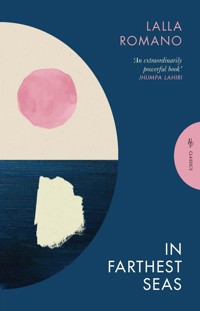
IN FARTHEST SEAS
LALLA ROMANO
TRANSLATED FROM THE ITALIAN BY BRIAN ROBERT MOORE
PUSHKIN PRESS CLASSICS
4
5
Contents
PART ONE FOUR YEARS
1
It was Silvia – she had discovered him before I did – who told me: ‘Look at his hands while he talks.’
He was standing there, legs slightly apart (with hiking boots, we were in the mountains); he was telling a story, one hand held against his chest, the other raised. His hands were big and long, his fingers together, extended; and his gesturing, almost hieratic. Maybe the story was one to laugh at, a declaration along the lines of ‘My sisters are two boneheads.’
For our tastes at the time – mine and Silvia’s – that stylization of the gesture and hands, clearly spontaneous, was attractive, exciting. And he, immediately different from our usual companions on those hikes, who were so uninspiring.
2
The information Gigi had given my parents – they hadn’t asked him for any – was the following: our new hiking companion came from Milan, he was already earning nine hundred lire a month and was the son of the Colonel of the Carabinieri.
All three pieces of information bore no interest for me. Only, I was somewhat put off by the presence of a colonel. On the Alpine Club excursions there were girls who always wanted to walk in front of everyone because ‘the daughters of colonels have to be first’.
In terms of Milan, it must have been important then, too, because it set the fashion trends. He wore a hat with a bright-coloured ribbon (everyone else’s was black) and the street kids would jeer at him. To tell the truth, on this point I sided with Cuneo’s street kids, who were provincial and conservative.
I had even been bothered by his white cloth cap, round with a turned-up brim like in the American Navy, when I saw him for the first time on the tram for Demonte. On top of that, he was playing a kind of harmonica. How young he was! I felt old and rotten.
3
The first signs that he had of our existence had been rather comical. Gigi, who had a sense of humour but was still one of Cuneo’s right-minded citizens, had started warning him: ‘The Romano girls will be there. We’ll have to behave.’
And another little incident had given him a curious idea about our family. The usual friends – I wasn’t there – were going up the Stura Valley, and just outside Demonte he noticed with surprise a little hill left partially wild and partially cultivated, encircled by an imposing wall formed by lots of concrete balusters, and on the hilltop a kind of terrace resting on four pillars adorned with creepers. ‘Why, who could all that belong to?’ he asked. ‘It’s ours,’ Silvia said, and he thought that she was trying to be funny. But Gigi confirmed it. In fact, the strange hill was ‘the Estate’ for us, and that little terrace was ‘the Pinnacle’. Up there, my father had dreamed of building a villa.
4
He had discovered them, before really discovering me. After a hike, we were returning on the tram from Demonte, and they had come down from Boves to wait for us at the Borgo station. He, through the tram window, saw them and was struck. ‘Who in the world are those two people?’ ‘They’re the Romano girls’ parents.’
He was shocked, he told me later, actually indignant that such extraordinary people could be named so nonchalantly, almost with disregard.
They were standing there, still, and smiling in silence. Her eyes, bright and deep, made her beauty mysterious; and Papà, who was older, with his handlebar moustache, certainly had a festive and indulgent air about him. They were smiling as though out of a sort of altruistic happiness, naive and at the same time noble. They seemed great people to him, like royals, and yet simple, kind.
Their unchanged presence – sudden and dizzying – appeared to him a long time after. They had been dead for years. It was once again an apparition: a dream. He told it to me right away – at night – still in the grip of fear and joy: ‘The doorbell rings, and I go to answer. It’s them, smiling as always, but soaking from the rain. “Come in,” I say, “come in and dry yourselves.” They say, “No, we have to go. We just want to tell you that everything is okay now. We’re together.” I can’t remember the exact words now, but that’s more or less what they said. And I felt a great sense 13of peace, of security. Even if it was very sad that they didn’t want to come in, and I understood that I wouldn’t see them again.’
5
On the hikes, I was the favourite of the leader, the small (in stature), energetic and amusing Gigi. And so I was invited – I alone – to climb the famous Meja with the boys.
There’s a little photograph. I’m crouched down between the two jagged edges of a couloir, my braids hanging down over my white shirt. While I was there, he (we called him Monti) handed me two tiny edelweiss flowers: ‘These are for the signorina.’
Years later he told me that I had looked like Minnehaha. I was still flattered by this. Minnehaha was the daughter of an Indian chief, and it hadn’t been all that many years since we’d grown out of Salgari’s books.
6
Our first conversation was in Boves, on what was referred to as the road of the Madonna, because it led to the church Madonna dei Boschi. Silvia walked in front of us with Detto, who was courting her a bit; he had come to accompany Detto, his friend at the time. They had gone to Venice together for the Biennale, and they showed us photos in which a girl appeared. I was always annoyed when other girls were referenced in my presence, and this time, too, their trip immediately lost all interest for me.
So, walking after dinner on that road, he spoke of Modigliani. Everyone talked about him in those days, and everyone (the foolish ones, which is to say almost everyone) acted outraged: the long necks, the flat colours, et cetera. I loved Modigliani deeply then; but he couldn’t have known this, he didn’t know anything about me. I mean that the topic wasn’t aimed at pleasing me. He spoke of Modigliani with admiration, in a grave, serious tone: and he didn’t know that ‘admiring Modigliani’ (what that meant) was truly what mattered in life, for me.
Maybe this first real exchange was somewhat similar to that other fateful one with Giovanni. But Modigliani was much more important to me than Kant had been then.
The road – the woods on one side, on the other the meadows – would have been dark, had it not been for the moon. On the way back (the two of us ahead) we had before us, unfurled in the sky, the plough of the Great Bear. For my whole life since then, it has helped me gauge my personal situation in the cosmos.
7
I was unfearing, on the bicycle. That bicycle was our habitual means of transportation. Once again the road was named for ‘the Madonna of the woods’, after the Madonna dei Boschi.
There sleeps, encircled by dreaming woods, a far-off city
began an unwritten poem.
I was near another village that was still under the shadow of the Bisalta, Cuneo’s mountain; it wasn’t really a road so much as a stony mule track. On my way back, the descent kept growing steeper and steeper, and I kept rolling faster down: the brakes had stopped working. At a sharp turn I became frightened, and I suddenly decided to throw myself to the ground. I don’t know if he was the one to lift me up; I know that he was standing there, and I, panting, leaned against his chest – sturdy but not stiff, warm and at the same time fresh. I could feel his heart beating.
The next month in Paris I had a big round bruise on my arm. My dark red dress was made of silk voile, very low cut, with drooping points at the bottom and shoulders. The dress matched the colour of my bruise. I was at the Café de Paris with Lionello Venturi; the tall and gallant violinist came over to ask me what I wanted to hear, and I suggested Veracini’s Largo(a musical choice that had to do with Boves).
8
Back from Paris, I had – seemingly out of necessity – an excuse to see him. That he worked in a bank was supremely indifferent to me; if anything, slightly comical.
I laid on the counter – it was the first time I’d set foot in a bank – my French bills, and the coins too. My nonchalance was ignorance; a grouch of a man – whom I judged ‘the manager’ – grew irritated and pushed back the coins: you couldn’t exchange those. I nonetheless had the gall to ask for him. Now I know that my assuredness was not so much for the importance I gave to my retourdeParis, as for the electrifying expectation of astonishing him, of witnessing his emotion. He appeared, pale, and astonished, yes, but, it seemed to me, painfully so. What I noticed right away, and it made him seem infinitely pitiable to me, was, on the lapel of his jacket – not one of his usual ones, but grey, a bit shabby – a few pointed pins. Almost as though his job were humble, servile, like a shop boy, a tailor’s apprentice. But once I was outside, my cruel jubilance immediately stamped out that pity. I murmured to myself, as I crossed the piazza, the words of a little song, heard who knows when: ‘You’re pale, you’re pale, you’re pale for me…’
9
I was crossing the piazza, alone, and I saw him from afar, with someone. When I was a few paces from him he broke away and came towards me. He said that they would be going – he and Gigi – to the Pagarì, if I wanted to join them. It was even better than a declaration of love: I was considered equal, and surely they hadn’t forgotten that I was a woman. It had already happened for the Meja; but this time, whose idea had it been?
The Pagarì Refuge, legendary to us all, was a tiny cabin at a three-thousand-metre altitude, held there with steel cables. (‘You mountaineers in the Maritime Alps put your cabins up on the peaks,’ the great Mezzalama once said.)
It was November, we needed to light the wood stove. He chopped wood in a little clearing and grew warm from this exertion, so that, despite the cold, his shirt gleamed white in the twilight. There was something at once adventurous, exotic (in the sense of far-away countries) and intimate in that image, as though already lived (or dreamed). It matched, or rather expressed all the risk and mystery there was in that cold light, in that solitude. In the stories by Lawrence that I had just read, I had found this; and for a moment I felt an attraction for him that was violent, secret, but I believe already tenaciously deep. It wasn’t an idea, it was a sensation: head-spinning, but not unsettling. Rather, familiar.
That night, each bundled up in thorny military blankets like three giant newborns or dead sailors about to be lowered into the sea, we lay in a row – I in the middle – on the higher 19floor, I suppose to receive a little residual warmth. From a small window some feeble light entered. In the wild wind the walls, the steel cables, everything vibrated, whistled, hissed. Motionless on their backs, my two companions had their wool brims lowered all the way down to their noses and were sleeping: or were pretending to. In the glimmering trail of light I could make out his profile, which looked funny to me. I laughed silently to myself. I was – who knows why – happy.
10
The next day we climbed – with our skis – the glacier under the Maledia, all the way to the Pagarì Pass. Up there, crouched close together for warmth, we stayed awhile: to contemplate, in the sky, a city. A city of clouds. It must have changed, as clouds do, but so imperceptibly, it seemed still, immutable. Far away, but not too far. Distinctly visible were domes, obelisks, minarets: an eastern city. Its colours were delicate, soft: orange-pink, violet.
There’s a tiny photograph (they were all that way back then), a piece of paper that’s best examined with a magnifying glass because the image is a bit blurry. Gigi took it, obviously, on the way back. There’s a narrow bridge, over a stream, made of two logs covered with brushwood and twigs, like in a valley under the Himalayas; and on that bridge, two small figures facing each other, almost as though they had crossed paths there. But they are absorbed, solitary, and just barely in relief against the reflected light. The girl, with her bag, a long skirt, skis planted next to her, looks to the side; he, skis on his shoulder, his round head in profile, pensive.
11
People used to say ‘the 8th and 9th’ and it meant two consecutive public holidays in December. The 8th and 9th of that year is one of the extremely rare dates in my interior history, almost completely devoid of chronological artefacts.
There was the usual mountain (near the border, at the end of my valley), the usual uninteresting, relaxing friends. The first evening, having stopped skiing because of the dark, the two of us – out of a kind of audacity – chose not to cage ourselves with the others in a car but to walk the road from Argentera to Bersezio. The road was icy, we were light, skis on our shoulders. Flurries of thick fog appeared and dissipated. There, our first kiss happened: suddenly. It was sweet, not fervent; a bit solemn, maybe, and not entirely without our knowing it. We’ve just broken apart when we see, coming out of that strange fog, a figure. Perhaps a magical apparition, certainly not a mystical one. A priest, with a black cassock, completely real. He greeted us, and vanished into the fog. The rather comical occurrence lightened the gravity of the moment.
Later, I was seated by the corner of the long table at the Caccia Reale, with him next to me, at the head, so that we were almost facing each other, and isolated (the others, loud, did not exist). I looked at him and met, very close to me, his golden-brown eyes. And in them a deep and warm, mysterious tenderness. A severe tenderness.
12
The next time is again in a closed space: in the room I shared with Silvia on Via Barbaroux, with the light-coloured walnut furniture that Papà had had made for us in Demonte. There was a desk in front of the window, where I sat to give Latin lessons and listen, in the unending afternoons, to the somnolent hammering of a pianola, which repeated old melancholy arias in the street. Now he is there, no doubt summoned to pose for a portrait. We embrace each other. No one will bother us, because my mother respects me, and Silvia even more so. But I am troubled; I say: ‘We should leave each other. I don’t want this story to end like the others.’ I had disappointed Giovanni, had been disappointed by Anthony, without counting the other, let’s say minor ones. Giovanni had disappeared; Anthony, at my declaration ‘I have a boyfriend’ (I’d seen him in Turin), had said, irritated, ‘You knew that I wanted to marry you.’ Irritated, not heartbroken; in any case, I hadn’t believed it. Now I didn’t want to disappoint him. And he – calm, almost as though he’d been expecting this – replied: ‘We don’t have to leave each other. We could get married.’ I rested against him, but I didn’t respond. He added: ‘I’m not at all rich; but I’ll work.’ The conversation was taking a turn that I didn’t like. The elegance of not using the word ‘poor’ wasn’t lost on me, but ‘rich’ too, despite being accompanied by a negation, was still an economic term; and I abhorred all that was practical, and even goodwill. However, again I saw the image of him chopping wood at the Pagarì, and I found anew that guarantee of a wild life, a free and far-off life. The unlikely prospect reassured me.
13
‘I’m going to San Maurizio with Monti.’ ‘Just the two of you?’ ‘Yes.’ My mother looked puzzled. I said: ‘We might get married.’ She wasn’t surprised, only replied: ‘He’s handsome.’ As if it were a valid argument. She was austere, but fanciful; and so she was free, unpredictable.
For Mamma, San Maurizio was a name from her childhood. A flat, solitary high ground, two old churches at the top. I don’t know why we had chosen it. I had never been, but I liked the name, for how she said it.
The day was grey, and it was windy and raining up there; on the way back, we came running down off the paths. I was wearing an elegant dress – for him, I imagine. I had bought it in Turin (a ‘steal’ suggested by Aunt Carola). It was long and smooth, black, made of very heavy and soft silk; it resembled women’s dresses in fourteenth-century frescos. It was worn with a paper-thin, turquoise-coloured scarf knotted around the neck. While I ran, the scarf slipped off, and the wind carried it away. We looked for it among the bushes and the rocks, uselessly. Since clothes managed to interest me almost exclusively as emblems, I was saddened by the loss of that veil.
In town, while we were crossing a piazza (a secondary one) – holding hands! – I realized that an ‘honest’ family unit, passing by at a comfortable distance, was shooting sideways glances, suspicious and icy. For all I cared…
14
Mamma said that people had commented, hinted at the situation to Papà, and that he was vexed. I knew that he was strict about these things – and not because of other people – having been a bit of a libertine in his youth. Silvia became indignant, as she always did when allegations were made against me: ‘It’s not like Lalla is Giovanna Celloni!’
This Giovanna was a classmate of hers who was said to corrupt the male boarders at the school opposite her home, showing herself nude at the window (‘moeurs de province’).
Mamma had mentioned our plan to get married, and Papà said: ‘No man at twenty can know what woman is right for him.’ The assertion was taken seriously by my suitor: he asked for a meeting.




