



0,49 €
Niedrigster Preis in 30 Tagen: 1,99 €
Niedrigster Preis in 30 Tagen: 1,99 €
Mehr erfahren.
- Herausgeber: DigiCat
- Kategorie: Geisteswissenschaft
- Sprache: Englisch
In the Great Apache Forest by James Willard Schultz is a vivid and evocative exploration of the landscapes, cultures, and struggles of the Apache people, set against the backdrop of the American West. Through rich descriptions and an immersive narrative style, Schultz captures the beauty of the natural world while deftly portraying the complexities of human relationships within it. The book emerges from Schultz's firsthand experiences and interactions, offering readers a rare glimpse into the life and customs of the Apache during a time of significant upheaval, and reflects themes of environmental stewardship, cultural preservation, and resilience. James Willard Schultz, a pioneering author and ethnographer, spent much of his life among Native American tribes, notably the Blackfeet and Apache. His intimate knowledge of their customs, spirituality, and struggles profoundly influenced his writing. Living in the American West during a time of profound cultural change, Schultz sought to bridge the gap between Indigenous and Western perspectives, advocating for understanding through his narratives, which are often infused with elements of autobiography and anthropology. This book is a must-read for those seeking to understand the intricate relationship between people and their environment, as well as for readers interested in Native American literature and culture. Schultz's lyrical prose will resonate with anyone who appreciates a well-crafted narrative that seeks to both educate and inspire empathy toward marginalized voices in history.
Das E-Book können Sie in Legimi-Apps oder einer beliebigen App lesen, die das folgende Format unterstützen:
Veröffentlichungsjahr: 2022
Ähnliche
















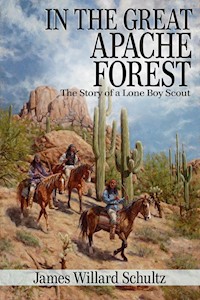


In the Great Apache Forest
Table of Contents
Introduction
In the Great Apache Forest gathers eleven connected narratives by James Willard Schultz under a single cover, presenting a sustained sequence of episodes rather than a miscellaneous sampling. The purpose of the collection is to make accessible, in one place, a coherent run of pieces that share setting, cast, and concerns, while still allowing each title to be read as a distinct installment. Read together, they offer a concentrated view of Schultz’s storytelling at its most continuous, inviting attention to recurring motifs and narrative methods across the span of the included works.
Schultz is widely known as an American writer of western and frontier-focused fiction, and the texts assembled here belong to that broad tradition. Within this volume the emphasis falls on prose adventure narratives shaped as linked tales, with each entry advancing a fresh situation and resolution while contributing to an accumulating portrait of life on the margins of settlement. The titles signal a range of situations—mountain travel, caves and shelters, theft and pursuit, community conflict, and the pressures of fire and weather—that are treated through the forward momentum of plot and the concrete rendering of landscape.
The opening pieces, beginning with Introducing the Hero and continuing through Alone on Mount Thomas and The Mountain Cave, establish the collection’s fundamental premise: survival and decision-making in demanding country. Schultz’s method is character-centered, staging his episodes around the moral weight of action under constraint. Even when events are outwardly simple, the narratives keep their tension through practical detail and the consequences that follow from choices. This emphasis on lived experience, rather than abstract commentary, anchors the volume’s realism and gives the sequence its cumulative force.
As the collection moves into The Firebugs at Work, Hunting the Deserter, and The People-of-Peace, the focus broadens from solitary endurance to the strains of group life, pursuit, and contested responsibility. These pieces highlight Schultz’s interest in how communities maintain order, how obligations are defined, and how conflict tests bonds of trust. The pacing remains brisk, but the narrative attention repeatedly returns to the human cost of disruption, whether caused by deliberate wrongdoing or by circumstances that push individuals beyond ordinary limits.
The mid-to-late titles, including The Wrongs of the Hopis and The Old Men in Rain God’s Cave, introduce disputes framed through named peoples and culturally marked places, and they should be read with careful attention to the historical and literary contexts in which such subjects are presented. In this collection’s terms, they function as episodes that expand the social and ethical terrain of the sequence, bringing questions of grievance, authority, and intergroup tension into the foreground. Schultz’s approach remains narrative rather than expository, inviting readers to consider how conflict is experienced at ground level.
The Death of Old Double Killer, The Bear Skin Is Stolen, and Catching the Firebugs continue the volume’s pattern of sharply defined incidents, where a single loss or offense can ripple outward into pursuit, reckoning, and repair. Across these later pieces, Schultz sustains his characteristic blend of action and atmosphere: the immediacy of peril balanced against the steady presence of the natural world. The result is a set of stories that reward sequential reading, as the repetition of hazards and resolutions becomes a study in endurance, reputation, and the effort to restore stability.
Taken as a whole, In the Great Apache Forest offers a concentrated encounter with Schultz’s strengths as a writer of frontier adventure: clear narrative line, vivid outdoor settings, and an abiding concern with how people navigate danger and duty. The collection’s unifying themes—survival, pursuit, communal friction, and the moral pressures of the wilderness—remain legible without requiring specialized background, while still encouraging readers to think critically about representation and perspective. Its ongoing significance lies in how it preserves a particular mode of American popular storytelling and invites renewed, attentive reading today.
Historical Context
James Willard Schultz (1859–1947) wrote the episodes later gathered as In the Great Apache Forest after decades in and around the northern Southwest, a region transformed between the 1860s and the early twentieth century by U.S. expansion, railroads, and federal Indian policy. Much of the collection is set in Arizona’s White Mountains and surrounding plateaus, an area that became a focal point of conflict and negotiation among Apache, Hopi, Navajo, Mormon settlers, cattle interests, and federal officials. The “Apache forest” itself evokes the ponderosa pine belt that drew timber and grazing enterprises, and thus law-and-order disputes that drive several narratives.
The immediate backdrop was the closing phase of the Apache Wars and the consolidation of U.S. military power in Arizona. After the 1870s reservation-era campaigns, culminating in Geronimo’s surrender in 1886, the army’s role shifted from active pursuit to policing reservation boundaries and protecting new settlements and infrastructure. Fort Apache (established 1870) and nearby posts anchored this regime in the White Mountains. Schultz’s stories echo the period’s uncertainty—desertions, cross-cultural manhunts, and uneasy alliances—while reflecting the popular turn-of-the-century appetite for frontier realism. His emphasis on scouts, trackers, and hard travel aligns with how contemporaries understood “postwar” pacification as ongoing vigilance rather than a clean ending.
Federal assimilation policy shaped daily life for the “People-of-Peace” and other Indigenous communities depicted. The Dawes Act of 1887 promoted allotment and the breakup of communal lands across much of Indian Country, while off-reservation boarding schools expanded aggressively in the 1880s–1900s. In Arizona, these pressures intersected with the growth of mission schools and the Bureau of Indian Affairs’ increasing regulation of leadership and ceremony. Schultz’s recurrent attention to kin obligations, elders, and religious practice—alongside tensions with outside authority—mirrors this era’s disruption of governance and family structures. Contemporary readers often saw such depictions as ethnographic windows, even when filtered through frontier-romance conventions.
Land and resource contests intensified after Arizona became a U.S. territory in 1863 and especially as rail connections expanded in the 1880s. Timber cutting, cattle and sheep grazing, and homesteading pushed into upland forests and water sources, prompting conflicts over range rights, springs, and access routes. Federal land administration also hardened: the Forest Reserve Act of 1891 and the creation of national forests, including Apache National Forest in 1908, brought new rules and fire policies to the White Mountains. The collection’s repeated concern with “firebugs,” arson, and the policing of backcountry reflects how conservation institutions recast local disputes as crimes against public resources.
Intertribal and intraregional politics also inform the collection, particularly stories touching Hopi grievances. Hopi villages experienced mounting pressure from neighboring Navajo expansion onto grazing lands and from federal agents seeking to reshape Hopi governance. These tensions culminated in episodes such as the 1894 imprisonment of Hopi leaders after resistance to compulsory schooling and administrative orders at Oraibi. By invoking “wrongs” and contested authority, Schultz drew on widely reported controversies that blended land disputes, religious freedom, and coercive education. Such themes resonated with Progressive Era debates about “civilization” policy, while also reinforcing the period’s tendency to frame Indigenous resistance through moralized narratives of order and disorder.
Frontier justice and vigilantism remained salient well into the 1890s–1910s, especially in remote zones where sheriffs, federal marshals, and army detachments competed or cooperated unevenly. Arizona’s territorial administration struggled with cross-jurisdictional crime involving rustling, liquor trafficking, and violence along reservation borders, complicated by the legal status of Native people under federal authority. Schultz’s pursuit plots, including deserter hunts and thefts of prized goods, echo these conditions: long distances, uncertain evidence, and reliance on trackers and local informants. Readers of the time recognized the mixture of formal law and improvisation as characteristic of the Southwest’s transition from military frontier to regulated statehood, achieved in 1912.
Schultz’s perspective was shaped by his earlier career as a trader and by his long association with Piegan Blackfeet communities in Montana, experiences that encouraged him to present Indigenous characters with individual motives and social complexity while still writing within popular magazine markets. The collection’s Southwestern setting reflects the broader national fascination with “vanishing frontier” themes, intensified after the 1890 census declaration and amplified by world’s fairs, rail tourism, and ethnographic collecting. His reliance on oral accounts and field observation appealed to audiences who valued authenticity, yet his narratives also mirrored contemporary assumptions about progress, masculinity, and wilderness. This tension influenced reception: praised for vivid realism, questioned later for romanticizing conflict and cultural difference.
Finally, the era’s shifting ideas about conservation, public lands, and Indigenous rights framed how the collection’s concerns were understood. Early twentieth-century fire suppression campaigns, the professionalization of forestry, and growing federal presence in the White Mountains redefined customary burning, hunting, and travel as regulated activities. At the same time, Indigenous petitions and reform critiques of allotment-era abuses gradually gained traction, foreshadowing policy reversals in the 1930s. Schultz’s stories, poised between older frontier disorder and newer administrative control, capture the historical moment when mountains, caves, and sacred sites became arenas for competing claims—economic, spiritual, and governmental—shaping both his themes and the contemporary sense that the Southwest’s past was being rapidly enclosed.
Synopsis (Selection)
Introducing the Hero
A framing introduction that sets up the collection’s central figure as a frontier-tested observer moving between settler and Native worlds, establishing stakes of survival and cross-cultural encounter. The tone is brisk and anecdotal, foregrounding identity, reputation, and the moral codes that will recur across the later episodes.
It signals Schultz’s signature style: plainspoken adventure narration paired with reflective attention to landscape, loyalty, and the costs of conflict. As a motif, it positions the hero’s credibility as something earned through hard experience rather than abstract ideals.
Mount Thomas Cycle (Alone on Mount Thomas; The Mountain Cave)
These linked wilderness episodes follow a high-country ordeal in which isolation and terrain become the primary antagonists, testing endurance, ingenuity, and nerve. The mood is taut and atmospheric, using mountains and stone as a stage for practical problem-solving under pressure.
Both stories emphasize recurring motifs of shelter, fire, and the thin line between confidence and overreach, while keeping the focus on immediate physical realities. The pairing highlights Schultz’s tendency to fuse adventure pacing with detailed natural observation and stoic self-reliance.
The Firebugs Arc (The Firebugs at Work; Catching the Firebugs)
This two-part pursuit centers on a destructive threat moving through forest and frontier communities, shifting the collection toward investigation and chase rather than solitary survival. The tone blends urgency with procedural clarity, tracking cause-and-effect as the danger spreads.
Across both entries, fire functions as a recurring symbol of human malice and ecological vulnerability, contrasting with earlier depictions of nature as merely harsh. The arc underscores themes of accountability and communal defense, with a tighter, more confrontational narrative drive.
Hunting the Deserter
A manhunt story built around pursuit, doubt, and the ethics of enforcing loyalty, as the search forces characters to weigh duty against circumstance. The tone is controlled and suspenseful, emphasizing distance, tracking, and the psychological strain of judgment.
It revisits Schultz’s recurring concern with honor codes and the ambiguity of “right” action under frontier pressures. The narrative style favors decisive action scenes while pausing to register the social consequences of labeling someone an outsider.
The People-of-Peace
A cultural encounter narrative that contrasts ideals of nonviolence with the realities of living amid competing claims and threats. The tone is observant and comparatively reflective, emphasizing social norms, diplomacy, and the fragility of peace.
It develops a key motif of negotiated coexistence, showing how group identity is maintained through ritual, restraint, and collective memory. Compared to the chase and survival pieces, it marks a shift toward social portraiture and moral complexity.
The Wrongs of the Hopis
A grievance-focused account that foregrounds injustice and the long-term effects of dispossession and broken understandings. The tone is more pointed and admonitory than the adventure tales, centering on harm done and the demand to recognize it.
The story reinforces the collection’s thematic throughline that conflict is not only physical but institutional and historical. It also highlights Schultz’s recurring technique of anchoring argument in specific places and lived experience rather than abstract debate.
The Old Men in Rain God’s Cave
A cave-centered gathering story where elders’ presence and memory shape the meaning of a sacred or storied place, blending setting with oral-history resonance. The tone is hushed and contemplative, emphasizing reverence, continuity, and the weight of past events.
It extends the motif of caves as both refuge and archive, contrasting human time with enduring geology. Stylistically, it leans into ceremonial pacing and attentive description, offering a quieter counterpoint to the collection’s more kinetic episodes.




