


25,99 €
Mehr erfahren.
- Herausgeber: John Wiley & Sons
- Kategorie: Wissenschaft und neue Technologien
- Serie: RGS-IBG Book Series
- Sprache: Englisch
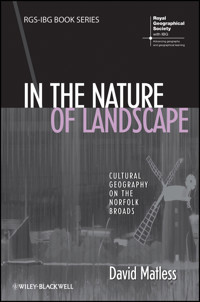
In the Nature of Landscape presents regional cultural landscape as a new direction for research in cultural geography.
- Represents the first cultural geographic study of the Norfolk Broads region of eastern England
- Addresses regional cultural landscape through consideration of narratives of landscape origin, debates over human conduct, the animal and plant landscapes of the region, and visions of the ends of landscape through pollution and flood
- Draws upon in-depth original research, spanning almost two decades of archival work, interviews, and field study
- Covers a great diversity of topics, from popular culture to scientific research, folk song to holiday diaries, planning survey to pioneering photography, and ornithology to children’s literature
- Features a variety of illustrative material, including original photographs, paintings, photography, advertising imagery, scientific diagrams, maps, and souvenirs
Sie lesen das E-Book in den Legimi-Apps auf:
Seitenzahl: 638
Veröffentlichungsjahr: 2015
Ähnliche


















CONTENTS
Cover
Series page
Title page
Copyright page
Series Editors’ Preface
List of Illustrations
Preface and Acknowledgements
List of Abbreviations
Chapter One: Cultural Geography on the Norfolk Broads
A Geographical Visit
Outline
Landscape Colloquial, Culture Resounding
Scenic Governance
Regional Cultural Landscape
The Broadland Scene
Broadland Scene
Chapter Two: Origins
Broadland with the IBG (and RGS)
Origin in Transgression
Artifice Discovered
Artifice Disputed
An Equivalent Pool
New Broads
Chapter Three: Conduct
Terry and Lydia
Regionally Self-Conscious: The Broads Discovered
Twentieth Century Pleasures
Policy Conduct
Icon I: Wherry
Emblematic Sails
Norwich Vessels
Restorative
Broadland, South Kensington
Chapter Four: Animal Landscapes
The Norfolk Room
Fauna Surveyed
Murder Most Fowl
Broadland Preserve
Species of Writing
Reserving Nature
The Public Animal
Icon and Intruder
Wings Conflicting
Chapter Five: Plant Landscapes
Plant Cultures
Becoming a Scientific Region
Science on Tour
Two Yare Valley Scientists
Plant Life in Reserve
Marsh Harvest
Succession: Experiment in Landscape
Icon II: Windmill
Mill Time
Wind Technology
Restorative
New Sails
Chapter Six: The Ends of Landscape
The Balance of Waters
The Death of Water
Broadland Drained
River Flood, Broadland Balance
Death by Water: Sea Flood
Broadland Sealand
Broadland Signs
Chapter Seven: Concluding
Definition: Regional Cultural Landscape
Provision: Geographic Particularity
Colloquial: A Geography of Voice
Six Vantage Points
References
Index
End User License Agreement
List of Illustrations
Chapter 01
Figure 1 Map of Broadland.
Figure 2 ‘Reedham Mill’, by James Stark.
Figure 3 Museum of the Broads, Stalham.
Broadland Scene
Figure 4 Broadland Scene I (Top: from Ranworth Church tower, August 2011; Bottom: Carrow Bridge, Norwich, August 2011).
Figure 5 Broadland Scene II (Top: Potter Heigham Bridge, August 2011; Bottom left: Tide gauge, Wheatfen, August 2010; Bottom right: Reedham rail swing bridge, May 2011).
Figure 6 Broadland Scene III (Top: Cantley sugar beet factory, May 2011; Bottom: Berney Arms railway station, August 2011).
Figure 7 Broadland Scene IV (Top: Norwich Yacht Station, August 2011; Bottom: Breydon Water, August 2011).
Figure 8 Broadland Scene V (Top left: Heron’s Carr, Barton Broad, May 2011; Top right: How Hill gardens, May 2011; Bottom: West Somerton staithe, August 2011).
Chapter 02
Figure 9 Bores in the Yare Valley.
Figure 10 Double-Headed Eagle Pool, Long Gores, Hickling.
Chapter 03
Figure 11 Terry Scott, Hugh Lloyd and Sue Longhurst at the launch of the MV Woppy.
Figure 12 PH Emerson, ‘The First Frost’.
Figure 13 PH Emerson, ‘A Broadman’s Cottage’.
Figure 14 ‘We Survived the Norfolk Broads’, tea towel, purchased 1993.
Figure 15 Potter Heigham, River Thurne.
Chapter 03-1
Figure 16 ‘Rockland Trader’ sculpture, at ‘Three Ways Meeting Point’, outside Vauxhall Station, Great Yarmouth.
Figure 17 Model wherry and diorama, with location map, ‘British Small Craft’ displays, Science Museum, London.
Chapter 04
Figure 18 The Norfolk Room, Castle Museum, Norwich: Top: Broadland diorama; Bottom left: Breydon diorama; Bottom right: Yare Valley diorama.
Figure 19
Broadland Adventure
.
Figure 20 ‘The Cantley Roll’.
Figure 21 ‘Alfred Nudd Awaits his Turn of the Stereoscope’; Alfred Nudd and Emma Turner.
Figure 22 ‘The Skipper of the “Moorhen”’; Arthur Patterson.
Figure 23 ‘Map of Migration Routes’, by Arthur Patterson.
Figure 24 Advertisement for the ‘Pettitt Pack’.
Figure 25 Bittern, photographed in 1911 by Emma Turner.
Figure 26 Coypu, ‘kept as a mascot by students of Joyce Lambert’, Museum of the Broads, Stalham.
Chapter 05
Figure 27 Marietta Pallis and Arthur Tansley at Barton Broad, International Phytogeographical Excursion, 1911.
Figure 28 Wheatfen nature reserve, August 2010.
Figure 29 How Hill, May 2011.
Figure 30 ‘Norfolk Marshman, Eric Edwards MBE, surveys the How Hill Reed Beds’.
Figure 31 PH Emerson, ‘Coming Home from the Marshes’.
Figure 32 PH Emerson, ‘During the Reed-Harvest’.
Figure 33 ‘Calthorpe Domain’, by Marietta Pallis, painting, probably early 1950s.
Chapter 05-1
Figure 34 ‘St Benedict’s Abbey, Norfolk’, by James Stark.
Figure 35 Berney Arms Mill and electric pumping station, August 2011.
Figure 36 ‘Wind Turbines – West Somerton’, by Nicholas Ward, 1993.
Figure 37 ‘Broadland Sunrise’, beer pump clip, Humpty Dumpty Brewery, Reedham, designed by Cherry Ann Burns-Salmond, c.2008.
Chapter 06
Figure 38 The Yarmouth Hutch Map, Norfolk Record Office, ref. no. Y/C 37/1.
Figure 39 ‘Flooded area, Horsey and district, 1938’.
Figure 40 Horsey, views out to sea and inland from the site of the 1938 sea breach, Bramble Hill.
Broadland Signs
Figure 41 Broadland Signs I (Clockwise from top left: How Hill field studies sign, May 2011 / Wildlife Sightings Box, Heron’s Carr, Barton Broad, May 2011 / Patterson Close, Great Yarmouth, August 2010 / Andrew Lees memorial plaque, outside Wickhampton church, May 2011/ Discarded RSPB tag, Strumpshaw Fen, May 2011 / Display board, The Thatch, Wheatfen nature reserve, August 2010).
Figure 42 Broadland Signs II (Clockwise from top left: Water ski sign, River Yare, Strumpshaw, May 2011 / Ranworth village sign, August 2011 / Motor Boat Racing poster, Oulton Broad, August 2011 / Potter Heigham riverside bungalow, August 2011 / Swallowtail butterflies notice, by Martin George, Strumpshaw, May 2011 / Everitt Road, Oulton Broad, August 2011).
Figure 43 Broadland Signs III (Clockwise from top left: Berney Arms railway station information board / Oulton Broad, August 2011 / Berney Arms Mill ancient monument direction sign (detail) / Wherryman’s Way marker, Berney Arms, August 2011 / Bridge over Muck Fleet, Stokesby New Road, August 2011 / Reedham Ferry, May 2011 / Wayford Bridge, August 2011).
Guide
Cover
Table of Contents
Begin Reading
Pages
ii
iii
iv
ii
vii
viii
ix
x
xi
xii
xiii
1
2
3
4
5
6
7
8
9
10
11
12
13
14
15
16
17
18
19
20
21
22
23
24
25
26
27
28
29
30
31
33
39
40
41
42
43
44
45
46
47
48
49
50
51
52
53
54
55
56
57
58
59
60
61
62
63
64
65
66
67
68
69
70
71
72
73
74
75
76
77
78
79
80
81
82
83
84
85
86
87
88
89
90
91
92
93
94
95
106
107
108
109
110
111
112
113
114
115
116
117
118
119
120
121
122
123
124
125
126
127
128
129
130
131
132
133
134
135
136
137
138
139
140
141
142
143
144
145
146
147
148
149
150
151
152
153
154
155
156
157
158
159
160
161
162
163
164
165
166
167
168
169
170
171
172
211
182
183
184
185
186
187
188
189
190
191
192
193
194
195
196
197
198
199
200
201
202
203
204
205
206
207
208
209
210
215
216
217
218
219
220
221
222
223
238
239
240
241
242
243
244
245
246
247
248
249
250
251
252
253
254
255
256
257
258
259
260
261
262
263
264
265
266
267
268
269
270
271
272
273
274
275
276
277
278
279
280
RGS-IBGBook Series
For further information about the series and a full list of published and forthcoming titles please visit www.rgsbookseries.com
Published
In the Nature of Landscape: Cultural Geography on the Norfolk BroadsDavid Matless
Geopolitics and Expertise: Knowledge and Authority in European DiplomacyMerje Kuus
Everyday Moral Economies: Food, Politics and Scale in CubaMarisa Wilson
Material Politics: Disputes Along the PipelineAndrew Barry
Fashioning Globalisation: New Zealand Design, Working Women and the Cultural EconomyMaureen Molloy and Wendy Larner
Working Lives – Gender, Migration and Employment in Britain, 1945–2007Linda McDowell
Dunes: Dynamics, Morphology and Geological HistoryAndrew Warren
Spatial Politics: Essays for Doreen MasseyEdited by David Featherstone and Joe Painter
The Improvised State: Sovereignty, Performance and Agency in Dayton BosniaAlex Jeffrey
Learning the City: Knowledge and Translocal AssemblageColin McFarlane
Globalizing Responsibility: The Political Rationalities of Ethical ConsumptionClive Barnett, Paul Cloke, Nick Clarke and Alice Malpass
Domesticating Neo-Liberalism: Spaces of Economic Practice and Social Reproduction in Post-Socialist CitiesAlison Stenning, Adrian Smith, Alena Rochovská and Dariusz Świątek
Swept Up Lives? Re-envisioning the Homeless CityPaul Cloke, Jon May and Sarah Johnsen
Aerial Life: Spaces, Mobilities, AffectsPeter Adey
Millionaire Migrants: Trans-Pacific Life LinesDavid Ley
State, Science and the Skies: Governmentalities of the British AtmosphereMark Whitehead
Complex Locations: Women’s Geographical Work in the UK 1850–1970Avril Maddrell
Value Chain Struggles: Institutions and Governance in the Plantation Districts of South IndiaJeff Neilson and Bill Pritchard
Queer Visibilities: Space, Identity and Interaction in Cape TownAndrew Tucker
Arsenic Pollution: A Global SynthesisPeter Ravenscroft, Hugh Brammer and Keith Richards
Resistance, Space and Political Identities: The Making of Counter-Global NetworksDavid Featherstone
Mental Health and Social Space: Towards Inclusionary Geographies?Hester Parr
Climate and Society in Colonial Mexico: A Study in VulnerabilityGeorgina H. Endfield
Geochemical Sediments and LandscapesEdited by David J. Nash and Sue J. McLaren
Driving Spaces: A Cultural-Historical Geography of England’s M1 MotorwayPeter Merriman
Badlands of the Republic: Space, Politics and Urban PolicyMustafa Dikeç
Geomorphology of Upland Peat: Erosion, Form and Landscape ChangeMartin Evans and Jeff Warburton
Spaces of Colonialism: Delhi’s Urban GovernmentalitiesStephen Legg
People/States/TerritoriesRhys Jones
Publics and the CityKurt Iveson
After the Three Italies: Wealth, Inequality and Industrial ChangeMick Dunford and Lidia Greco
Putting Workfare in PlacePeter Sunley, Ron Martin and Corinne Nativel
Domicile and DiasporaAlison Blunt
Geographies and MoralitiesEdited by Roger Lee and David M. Smith
Military GeographiesRachel Woodward
A New Deal for Transport?Edited by Iain Docherty and Jon Shaw
Geographies of British ModernityEdited by David Gilbert, David Matless and Brian Short
Lost Geographies of PowerJohn Allen
Globalizing South ChinaCarolyn L. Cartier
Geomorphological Processes and Landscape Change: Britain in the Last 1000 YearsEdited by David L. Higgitt and E. Mark Lee
Forthcoming
Smoking Geographies: Space, Place and TobaccoRoss Barnett, Graham Moon, Jamie Pearce, Lee Thompson and Liz Twigg
Africa’s Information Revolution: Technical Regimes and Production Networks in South Africa and TanzaniaPádraig Carmody and James T. Murphy
Peopling Immigration Control: Geographies of Governing and Activism in the British Asylum SystemNick Gill
Rehearsing the State: The Political Practices of the Tibetan Government-in-ExileFiona McConnell
Frontier Regions of Marketization: Agribusiness, Farmers, and the Precarious Making of Global Connections in West AfricaStefan Ouma
Articulations of Capital: Global Production Networks and Regional TransformationsJohn Pickles, Adrian Smith and Robert Begg, with Milan Buček, Rudolf Pástor and Poli Roukova
Origination: The Geographies of Brands and BrandingAndy Pike
Making Other Worlds: Agency and Interaction in Environmental ChangeJohn Wainwright
Everyday Peace? Politics, Citizenship and Muslim Lives in IndiaPhilippa Williams
Metropolitan Preoccupations: The Spatial Politics of Squatting in BerlinAlexander Vasudevan
In the Nature of Landscape
Cultural Geography on the Norfolk Broads
David Matless
This edition first published 2014© 2014 David Matless
Registered OfficeJohn Wiley & Sons, Ltd, The Atrium, Southern Gate, Chichester, West Sussex, PO19 8SQ, UK
Editorial Offices350 Main Street, Malden, MA 02148–5020, USA9600 Garsington Road, Oxford, OX4 2DQ, UKThe Atrium, Southern Gate, Chichester, West Sussex, PO19 8SQ, UK
For details of our global editorial offices, for customer services, and for information about how to apply for permission to reuse the copyright material in this book please see our website at www.wiley.com/wiley-blackwell.
The right of David Matless to be identified as the author of this work has been asserted in accordance with the UK Copyright, Designs and Patents Act 1988.
All rights reserved. No part of this publication may be reproduced, stored in a retrieval system, or transmitted, in any form or by any means, electronic, mechanical, photocopying, recording or otherwise, except as permitted by the UK Copyright, Designs and Patents Act 1988, without the prior permission of the publisher.
Wiley also publishes its books in a variety of electronic formats. Some content that appears in print may not be available in electronic books.
Designations used by companies to distinguish their products are often claimed as trademarks. All brand names and product names used in this book are trade names, service marks, trademarks or registered trademarks of their respective owners. The publisher is not associated with any product or vendor mentioned in this book.
Limit of Liability/Disclaimer of Warranty: While the publisher and author have used their best efforts in preparing this book, they make no representations or warranties with respect to the accuracy or completeness of the contents of this book and specifically disclaim any implied warranties of merchantability or fitness for a particular purpose. It is sold on the understanding that the publisher is not engaged in rendering professional services and neither the publisher nor the author shall be liable for damages arising herefrom. If professional advice or other expert assistance is required, the services of a competent professional should be sought.
Library of Congress Cataloging-in-Publication Data
Matless, David. In the nature of landscape : cultural geography on the Norfolk Broads / David Matless. pages cm Summary: “Covers a great diversity of topics, from popular culture to scientific research, folk song to holiday diaries, planning survey to pioneering photography, and ornithology to children’s literature”– Provided by publisher. Includes bibliographical references and index.
ISBN 978-1-4051-9081-7 (hardback) – ISBN 978-1-4051-9082-4 (paper) 1. Human geography–England–Broads, The. 2. Landscapes–England–Broads, The. 3. Broads, The (England)–Social life and customs. 4. Broads, The (England)–Historical geography. 5. Broads, The (England)–Environmental conditions. I. Title. GF552.E2M37 2014 304.209426′1–dc
232014005435
A catalogue record for this book is available from the British Library.
Cover image: Museum of the Broads, Stalham, photographed by David MatlessCover design by Workhaus
Series Editors’ Preface
The RGS-IBG Book Series only publishes work of the highest international standing. Its emphasis is on distinctive new developments in human and physical geography, although it is also open to contributions from cognate disciplines whose interests overlap with those of geographers. The Series places strong emphasis on theoretically-informed and empirically-strong texts. Reflecting the vibrant and diverse theoretical and empirical agendas that characterize the contemporary discipline, contributions are expected to inform, challenge and stimulate the reader. Overall, the RGS-IBG Book Series seeks to promote scholarly publications that leave an intellectual mark and change the way readers think about particular issues, methods or theories.
For details on how to submit a proposal please visit:
www.rgsbookseries.com
Neil Coe
National University of Singapore
Joanna Bullard
Loughborough University, UK
RGS-IBG Book Series Editors
List of Illustrations
1 Map of Broadland
2 ‘Reedham Mill’, by James Stark
3 Museum of the Broads, Stalham
4 Broadland Scene I (Top: from Ranworth Church tower, August 2011; Bottom: Carrow Bridge, Norwich, August 2011)
5 Broadland Scene II (Top: Potter Heigham Bridge, August 2011; Bottom left: Tide gauge, Wheatfen, August 2010; Bottom right: Reedham rail swing bridge, May 2011)
6 Broadland Scene III (Top: Cantley sugar beet factory, May 2011; Bottom: Berney Arms railway station, August 2011)
7 Broadland Scene IV (Top: Norwich Yacht Station, August 2011; Bottom: Breydon Water, August 2011)
8 Broadland Scene V (Top left: Heron’s Carr, Barton Broad, May 2011; Top right: How Hill gardens, May 2011; Bottom: West Somerton staithe, August 2011)
9 Bores in the Yare Valley
10 Double-Headed Eagle Pool, Long Gores, Hickling. Top: aerial view, 2006; Bottom: ground view,
11 Terry Scott, Hugh Lloyd and Sue Longhurst at the launch of the MV Woppy
12 PH Emerson, ‘The First Frost’
13 PH Emerson, ‘A Broadman’s Cottage’
14 ‘We Survived the Norfolk Broads’, tea towel, purchased
15 Potter Heigham, River Thurne
16 ‘Rockland Trader’ sculpture, at ‘Three Ways Meeting Point’, outside Vauxhall Station, Great Yarmouth
17 Model wherry and diorama, with location map, ‘British Small Craft’ displays, Science Museum, London
18 The Norfolk Room, Castle Museum, Norwich: Top: Broadland diorama; Bottom left: Breydon diorama; Bottom right: Yare Valley diorama
19Broadland Adventure
20 ‘The Cantley Roll’
21 ‘Alfred Nudd Awaits his Turn of the Stereoscope’; Alfred Nudd and Emma Turner
22 ‘The Skipper of the “Moorhen”’; Arthur Patterson
23 ‘Map of Migration Routes’, by Arthur Patterson
24 Advertisement for the ‘Pettitt Pack’
25 Bittern, photographed in 1911 by Emma Turner
26 Coypu, ‘kept as a mascot by students of Joyce Lambert’, Museum of the Broads, Stalham
27 Marietta Pallis and Arthur Tansley at Barton Broad, International Phytogeographical Excursion,
28 Wheatfen nature reserve, August
29 How Hill, May
30 ‘Norfolk Marshman, Eric Edwards MBE, surveys the How Hill Reed Beds’
31 PH Emerson, ‘Coming Home from the Marshes’
32 PH Emerson, ‘During the Reed-Harvest’
33 ‘Calthorpe Domain’, by Marietta Pallis, painting, probably early 1950s
34 ‘St Benedict’s Abbey, Norfolk’, by James Stark
35 Berney Arms Mill and electric pumping station, August
36 ‘Wind Turbines – West Somerton’, by Nicholas Ward,
37 ‘Broadland Sunrise’, beer pump clip, Humpty Dumpty Brewery, Reedham, designed by Cherry Ann Burns-Salmond, c.
38 The Yarmouth Hutch Map
39 ‘Flooded area, Horsey and district, 1938’
40 Horsey, views out to sea and inland from the site of the 1938 sea breach, Bramble Hill
41 Broadland Signs I (Clockwise from top left: How Hill field studies sign, May 2011 / Wildlife Sightings Box, Heron’s Carr, Barton Broad, May 2011 / Patterson Close, Great Yarmouth, August 2010 / Andrew Lees memorial plaque, outside Wickhampton church, May 2011/ Discarded RSPB tag, Strumpshaw Fen, May 2011 / Display board, The Thatch, Wheatfen nature reserve, August 2010)
42 Broadland Signs II (Clockwise from top left: Water ski sign, River Yare, Strumpshaw, May 2011 / Ranworth village sign, August 2011 / Motor Boat Racing poster, Oulton Broad, August 2011 / Potter Heigham riverside bungalow, August 2011 / Swallowtail butterflies notice, by Martin George, Strumpshaw, May 2011 / Everitt Road, Oulton Broad, August 2011)
43 Broadland Signs III (Clockwise from top left: Berney Arms railway station information board / Oulton Broad, August 2011 / Berney Arms Mill ancient monument direction sign (detail) / Wherryman’s Way marker, Berney Arms, August 2011 / Bridge over Muck Fleet, Stokesby New Road, August 2011 / Reedham Ferry, May 2011 / Wayford Bridge, August 2011)
Preface and Acknowledgements
The research informing this book has been undertaken over two decades or more, beginning as a sideline, moving through various divergent projects on specific themes and individuals, and coming together as a regional monograph in recent years. My thanks to the commissioning editor of the book for the RGS-IBG series, Kevin Ward, and his successor, Neil Coe, for seeing the work through to overdue publication. Their patience and comment have been appreciated. An anonymous reviewer of the manuscript also provided extensive and insightful commentary, and helped clarify empirical discussion and extend theoretical argument.
Research for the book has drawn upon many sources, and has not been without incident. In 1994 I was awarded a ‘New Lecturers’ grant from the University of Nottingham to begin some Broads research, with Norwich Central Library a key resource. The grant commenced on 1 August, and on the same day the library burned down. For the next few years the library and county Record Office had an itinerant existence before finding separate permanent homes, the library in a new building on the former site, the Record Office on the city outskirts at County Hall, now also housing the East Anglian Film Archive (formerly at UEA), drawn upon here for television and holiday promotional films; thanks to Katherine Mager for enabling access there. The Norwich library’s Norfolk Heritage Centre has re-gathered material lost in the 1994 fire, alongside the holdings which survived, and is the key resource for rare Broadland works, common texts, newspapers and ephemera. Clive Wilkins-Jones has been an especially valuable source of advice and information concerning material held in the library, while Clare Everitt facilitated the reproduction of images from the library collection. Yarmouth public library also provided source material. The papers of key Norfolk naturalists, notably EA Ellis and Robert Gurney, have been consulted at the Castle Museum, Norwich, with current and former curators Tony Irwin, Rob Driscoll and David Waterhouse providing valuable intelligence. The Museum’s displays of art and natural history remain a fine indoor introduction to the region. The archive of the Norfolk Wildlife Trust has also been a rich source of material on naturalist cultures. Richard Denyer insightfully discussed his photographic studies of Broadland, Brian Moss answered queries on his ecological studies, Peter Marren generously shared notes on the 1965 New Naturalist Broads publication, Bridget Yates pointed me towards material on the Thurne bungalows at Potter Heigham, and Peggy Rand shared private archival material on her relative Drew Miller. Stephanie Douet facilitated participation in the 2002 Field Day excursion of artists and scientists on the Broads, and the subsequent 2004 exhibition at Waxham Barn, where I collaborated with artists Anne Rook and Chloe Steele. Simon Partridge of How Hill Trust, Lesley George of Humpty Dumpty Brewery, artist Nicholas Ward, David Waterhouse of the Castle Museum, and aerial photographer Mike Page provided access to images, as did Jenny Watts of the Norfolk Record Office, and Maria Erskine of Nottingham City Museums and Galleries. Nicola Hems of the Museum of the Broads facilitated permission for the use of photographs of the Museum’s exhibits. Broadland material also occupies national collections, including the BBC Written Archives at Caversham Park, Reading, and the Post Office Archive, the Science Museum and the Linnean Society in London. I am grateful to archival staff at all of those institutions.
Research on one Broadland figure, Marietta Pallis, has been conducted with Laura Cameron, with a small grant from the British Academy generating several publications (Cameron and Matless 2003; 2011; Matless and Cameron 2006; 2007a; 2007b). Pallis sources included the Norwich Castle Museum, the British Ecological Society in London, the Northamptonshire Record Office (where Pallis’s letters are included in the collection of her friend Joan Wake), the Bodleian Library in Oxford, and the King’s Lynn Consortium of Internal Drainage Boards. Staff at all institutions were very helpful. Pallis’s private papers are held at her former home near Hickling, Dominic Vlasto kindly allowing access to documents and images, and giving insight into Pallis’s private landscape. Ivor Kemp of the Hickling Local History Group also provided valuable assistance. At a 2001 presentation on Pallis to the Group in Hickling Village Hall, questions from a primarily local audience prompted several subsequent oral history interviews, showing other dimensions of Pallis’s public and private persona. I am grateful to Laura Cameron for prompting our work on Pallis, and for all our subsequent revelatory excursions and discussions.
Interviews with key individuals also inform this book. The late Clifford Smith, Phyllis Ellis and Humphrey Boardman discussed their Broadland works and lives, while Martin George provided valuable insights into the work of the Nature Conservancy, alongside informed comment on events in the region over the past 50 years. His published work, along with that of Tom Williamson, Brian Moss and John Taylor, has been an important reference point. A key interviewee, who became both a source of research material and a commentator on research as it developed, was the late Joyce Lambert, whose role is discussed in Chapter One, but to whom I am immensely grateful for her generosity and insight. One each of the interviews with Lambert and George were conducted as part of an ESRC funded research project at the University of Nottingham with Charles Watkins and Paul Merchant on post-war cultures of nature in Norfolk and Herefordshire, which also involved interviews with other key figures in nature conversation in the counties. Archival research on Hickling conducted for that project has been drawn upon in this book, alongside some of the interview findings. Project publications are listed in the References (Watkins, Matless and Merchant 2003; 2007; Matless, Watkins and Merchant 2005; 2010).
Broadland research has over the years benefitted from discussion with colleagues at Nottingham and beyond, including Charles Watkins, Stephen Daniels, Mike Heffernan, George Revill, Daniel Grimley, Mike Pearson, Hayden Lorimer, Simon Naylor, Caitlin DeSilvey, Colin Sackett and Tim Boon. Events organised by Simon Pope, Helen MacDonald, and James Mansell and Scott Anthony, highlighted new research dimensions which shaped the direction of the work. Parts of Chapter Two were presented at the 2002 Jay Appleton lecture at the University of Hull, and I am grateful to Jay Appleton for sharing his own Norfolk memories. Tim Dee enabled the broadcast of three ‘Essay’ talks on Broadland naturalists (Ellis, Day and Pallis) on Radio 3 in 2008. An Edward Clarence Dyason Fellowship at the University of Melbourne in 2006 allowed productive discussion on regional cultural landscape with Fraser MacDonald. Many audiences have had my Broadland research presented to them over the years, and I am grateful for all comments made in response, but the first academic audience was perhaps for a seminar in the Geography department at Lampeter around 1993, organised, if memory serves, by Chris Philo. The response to that initial presentation helped convince me to pursue such work, and 20 years later here is a book.
Research has also been shaped throughout by family support. My parents, Brian and Audrey Matless, have contributed support, advice, press cuttings and excursions, and I cannot thank them enough. I hope they will enjoy reading about an area with which they are very familiar, though one which we tended to bypass in my childhood in favour of the beach. My wife, Jo Norcup, has provided love, wit, intelligence and field accompaniment, and has put up with the book’s slow finishing. The book is dedicated to her, and to our son Edwyn, whose own skills of field observation have illuminated things since 2012.
List of Abbreviations
AWA
Anglian Water Authority
BA
Broads Authority
BAAS
British Association for the Advancement of Science
CPRE
Council for the Preservation of Rural England / Council for the Protection of Rural England
EDP
Eastern Daily Press
EEN
Eastern Evening News
FoE
Friends of the Earth
GYPHC
Great Yarmouth Port and Haven Commission
IBG
Institute of British Geographers
IDB
Internal Drainage Board
IPE
International Phytogeographical Excursion
IWA
Inland Waterways Association
LLNB
Life and Landscape on the Norfolk Broads
MAFF
Ministry of Agriculture, Fisheries and Food
NC
Nature Conservancy
NCC
Nature Conservancy Council
NFU
National Farmers’ Union
NNNS
Norfolk and Norwich Naturalists’ Society
NNR
National Nature Reserve
NNT
Norfolk Naturalists Trust
NRC
Norfolk Research Committee
NT
National Trust
NWT
Norfolk Wildlife Trust
RGS
Royal Geographical Society
RSPB
Royal Society for the Protection of Birds
SBL
Sutton Broad Fresh-Water Laboratory
SSSI
Site of Special Scientific Interest
TNNNS
Transactions of the Norfolk and Norwich Naturalists’ Society
UCL
University College London
UEA
University of East Anglia
Chapter OneCultural Geography on the Norfolk Broads
A Geographical Visit
In the Nature of Landscape offers an excursion around an eastern English wetland, the Norfolk Broads. This chapter introduces the region, and gives an account of cultural geography on the Norfolk Broads, ideas from a field of enquiry put into play. For over a hundred years people have taken boat excursions on the Broads; here cultural geography goes on the Broads, investigating landscape, finding how it might shape regional understanding.
This is not the first geographical visit to the region. In 1927 Albert Demangeon’s Les Iles Brittaniques examined the Broads:
The peaty swamps, the still sheets of water hidden by reeds, the wide channels overhung by willows, and the lonely marshes frequented in winter by water-fowl exhibit Nature in all her wildness, loneliness, and melancholy. But in the summer these solitudes are full of holiday-makers, and the Bure, Ant, and Thurne, together with Wroxham, Salhouse, and Oulton Broads, are dotted with motor cruisers and sailing yachts. Away from the Broads and swamps, the ground is covered with grass and forms a rich pastoral district in which graze thousands of cattle. Green fields, grazing cattle, windmills, willow-lined channels, boats sailing among trees – all these remind one of the scenery in Holland. (Demangeon 1939: 282–3)
Demangeon shows an early twentieth century French regional geographic sensibility abroad, his passage signalling lines of enquiry followed throughout this book; the aesthetics of regional description, the geographies of regional discovery, and Broadland as a region whose ‘curious features’ are reminiscent of somewhere else (Demangeon 1939: 282; Clout 2009).1 The landscape features itemised too warrant continued geographic scrutiny; reeds and birds, marsh pastorals, cheer and melancholy, seasonal shifts.
This chapter gives an outline of region and book, conveys the possibilities of thinking through landscape and culture, examines early accounts of regional scenic governance, and considers regional cultural landscape as a term worth revisiting for its theoretical, political and poetic potential. The chapter concludes with a survey of Broadland institutions and scholarship, and an introductory Broadland tour.
Figure 1 Map of Broadland.
Source: Fowler 1970. © Jarrold-Publishing
Outline
Six rivers flow, some into one another, all waters ending in the North Sea. To make up the ‘Southern Rivers’, the Chet joins the Yare, and Yare and Waveney meet at Breydon Water. For the ‘Northern Rivers’, the Ant joins the Bure, the Thurne and Bure meet, and the Bure continues, ending in the Yare below Breydon. Only the Yare keeps its name to the sea at Yarmouth, though six river waters meet the salt; which itself moves inland upstream daily for various distances according to tide. Northern and Southern systems are gathered under the regional name of the ‘Norfolk Broads’, though the Waveney forms the Norfolk–Suffolk county boundary, the term ‘Norfolk and Suffolk Broads’ sometimes used. The broads are shallow lakes distinctive to the region, between 40 and 50 of them depending on definition, filled-up medieval peat diggings whose artificial industrial origin was figured with some surprise 60 years ago.2 Some broads sit to one side of the rivers, linked by dug channels (as with Ranworth on the Bure, or Rockland on the Yare), some occupy the river as if it had simply ‘broadened’ in its flow (as for Barton on the Ant).
The Broads appear in print in upper or lower case, and the conventions followed in this book can help clarify aspects of the region. There are many broads in the Broads, lower case individual lakes in a region named from them, otherwise termed Broadland. An individual broad achieves upper case when named, as in Rockland Broad, or Barton Broad. Deciding on a holiday, you might imagine cruising on the Broads (a regional experience), or on some broads (several points to visit). Such case conventions are followed in this book. One further element of regional nomenclature is worth noting, concerning fen/Fen. The Broads are sometimes regionally confused with the Fens, the former-wetland agricultural flatland in west Norfolk, Cambridgeshire and Lincolnshire, where rivers flow to The Wash. As a wetland, Broadland includes extensive fenland, but the Broads are not the Fens, and indeed there are few fens in the Fens.
Instructive questions of terminology also surround the status of Broadland as wetland and/or waterland. Broadland as waterland carries qualities of scenic beauty, land framing water, free open air, leisure for profit, territory for regulation. Broadland as wetland triggers a poetics and politics of habitat, a landscape neither-water-nor-land, refuge for flora and fauna (human included), or waste wanting reclamation, needing drainage (Purseglove 1988; Bellamy and Quayle 1990; Giblett 1996; Cameron 1997). In The Conquest of Nature Blackbourn (2006) traces conflicts over German water landscape, the reclamation of marsh and fen provoking both eulogy and lament concerning the transformation of landscape and German identity. Parallel regional matters of hydrology and identity shape Broadland, whether in the maintenance of grazing marsh as iconic regional landscape, contests over rights of navigation, or the defence of fen and reedbed as home for regional fauna and flora, against both human reclamation and natural succession.
Five chapters follow this one, along with two interlude studies of regional icons, the wherry and the windmill. An outline of book topography will convey the shape of argument. Chapter Two, briefer than the rest, addresses Broadland origins, but rather than begin with geological or prehistoric background, historiographic analysis emphasises contested narratives of regional landscape formation. The 1950s discovery by Joyce Lambert that the broads were flooded medieval peat diggings prompted argument over the regional standing of science, and the value of landscape features no longer deemed natural. In keeping with studies in the historical geography of science, emphasising both the geographical shaping of scientific enquiry and ‘the geographies that science makes’ (Naylor 2005: 3; Livingstone 2003; Lorimer and Spedding 2005; Matless and Cameron 2006; Cameron and Matless 2011), the chapter shows claims to regional authority shaping the reception of origin accounts. Definitions of and claims to the region shape scientific argument (Matless 2003a). Here as elsewhere the book examines ‘geographies of authority’ (Kirsch 2005), with institutions and individuals exercising claims to regional knowledge.
Chapter Three turns to conduct. From the leisure ‘discovery’ of the Broads in the late nineteenth century, sponsored by railway companies and boat-hire firms (and with an associated discovery of regional folk life), the region has been defined through contested pleasures, as either essentially a pleasure waterland, or a nature region threatened by such conduct, with particular sites, notably Potter Heigham, a focus for dispute (Matless 1994). The moral geographies of leisure, concerning conduct becoming or unbecoming a particular landscape, are shaped through guides, novels, films, posters, detective stories, children’s literature, political campaigns and policy documents, cultural geographic excursions on the Broads demanding that connections are made between such diverse sources. Policy debate has turned on the modes of conduct deemed appropriate to the region, and the scales of authority – national, regional, local – appropriate for Broadland governance. Thus the possibility of Broadland becoming a national park brought decades of argument over conduct and the geographies of authority; what kind of region should this be, and who should exercise authority over it?
Consideration of conduct in Broadland also encompasses folk life and the comic. Broadland as waterland of leisure life is shadowed by narratives of authentic regional culture. The working lives lived by those long resident, heard as manifest in folk song and dialect, have been subject to collection and performance by those beyond and within the region. The discovery of Broadland entailed the discovery of a regional folk, in keeping with wider enthusiasms for folk culture as emblematic of national and local identity. The performance of folk life, including its self-conscious articulation by local residents such as dialect artist Sidney Grapes, could mix serious cultural labour with comic effect. An emphasis on conduct in work and leisure indeed draws attention to the comic qualities of landscape, the Broads as a space of amusement, an issue perhaps neglected in recent formulations of emotional geography (Davidson, Bondi and Smith 2007). Jokes and satire, joy and laughter, shape Broadland cultural geography.
Between Chapters Three and Four, and Five and Six, come two interlude studies of regional landscape icons, the wherry and windmill. The wherry as river vessel carrying regional cargo, or pleasure craft carrying leisure visitors, has, over 200 years, stood for the regional present and past, and since the mid twentieth century been subject to heritage salvage. Another technology of air and water, the windmill, the key mechanism for drainage until the mid twentieth century, and since subject to efforts of preservation and restoration, has likewise achieved iconic Broadland status. From their depiction in early nineteenth century ‘Norwich School’ painting to their restoration by present enthusiasts, the wherry and windmill work as Broadland icons, with questions of navigation, drainage, heritage, governance and beauty condensing around them. ‘Wherry’ offers an interlude after discussions of leisure and regional life in Chapter Three; ‘Windmill’ sits between the accounts of marsh and drainage in Chapters Five and Six.
Chapters Four and Five concentrate on the human encounter with the non-human world, the animal and plant landscapes of Broadland. Non-human life shapes cultures of landscape, subject to human attention, care and exploitation, acting in accordance with or across human expectations, human and non-human subjects and objects defined through relation. The title of this book, In the Nature of Landscape, plays on Broadland’s qualities of nature, notably the prominence of the plant and animal in accounts of the region, yet also the use of nature to underwrite, indeed naturalise, human power, not least in overlapping categories of land ownership, sanctuary and reserve. The term ‘nature’ has been questioned for the impossibility of fixing categorical boundaries between the natural and cultural, and the ways in which things deemed distinctly ‘natural’ emerge from hybrid relations such that the supposedly ‘pure’ category quickly collapses under historical scrutiny (Latour 1993; Whatmore 2002). It is nevertheless worth retaining ‘nature’ and associated terms (natural history, nature study, natural science, etc) to register its complex colloquial work, whether in specialist languages of science, aesthetics and spirituality, or in vernacular and/or popular appreciation. For all its problematic conceptual status, ‘nature’ may retain powerful communicative coherence. Specific genres of writing and picturing may convey the non-human such that their practitioners become ‘nature voices’, authorities on particular species or conveyors of a general value in the natural world (Matless 2009a). The complexities of nature, for Raymond Williams ‘perhaps the most complex word in the language’ (1976: 184), are such that it happily problematises itself, as a working word impossible to erase.
Chapter Four considers Broadland’s animal landscapes, emphasising the ways in which mammals and birds have variously appeared as objects of biodiverse value, quarry for killing, creatures for careful observation, cherished regional icons, or alien intruders. The term animal landscapes carries enquiry through fields as various as marsh, river, committee room, reedbed, museum and sky (Matless, Watkins and Merchant 2005). Naturalists and nature institutions study, document and broadcast, landowners reserve nature in private, voluntary and state bodies reserve nature for public interest, specific species such as the bittern and coypu concentrate argument over Broadland life. Chapter Five concentrates on Broadland plant life, botanical and ecological study finding scientific and cultural value in Broadland flora. Cultural geographies of the non-human have tended to concentrate on the animal, giving little attention to vegetation (Head and Atchison 2009); the investigation of plant landscapes also entails movement across marsh, committee room, undergrowth, museum, reedbed. Processes of ecological succession, advancing in part through the relaxation of human marsh management, inform dispute over what Broadland’s plant landscape should be. Key sites concentrate argument, including the private Edwardian Sutton Broad Laboratory, the Wheatfen reserve established by naturalist EA Ellis, and Long Gores, home of ecologist-artist Marietta Pallis. If Chapter Three considers the collection of regional human custom, and Chapter Four the human gathering of regional fauna, here the cultural harvest of vegetation is addressed.
Chapter Six turns to the ends of landscape. Broadland’s present is shadowed not only by origin disputes but forebodings of destruction, via overgrowth by wood, aquatic transformation through eutrophication, drainage for cultivation, or flood invasion by the sea. Possible futures haunt the present; as threats, or sometimes as opportunities. Stories of flood echo the narratives of plant succession explored in Chapter Five, for some an erosion of distinctive scenery and habitat, for others the restoration of natural order. The prospects for destruction are explored through historic narratives of past floods and former estuaries, and of the region thrown in and out of balance as land and water shift. Climate change concentrates minds on a possible regional end, with senses of irreversible change, interpreted as loss, increasingly governing Broadland accounts. The Broads as waterland is set in relation to the North Sea and its underwater topography, the coast a historically shifting line, the sea bed once land, the land perhaps under future sea. The possible ends of landscape – undersea, overgrown – haunt the region, Broadland’s outline forever on hold.
Landscape Colloquial, Culture Resounding
It is in the nature of landscape, as a word, to move, between paint and ground, people and rock, vegetable and animal, profit and emotion, the wistful and the earthed. For Daniels, landscape’s potential proceeds from its ‘duplicity’, ‘not despite its difficulty as a comprehensive or reliable concept, but because of it’ (1989: 197); the implication is that ‘We should beware of attempts to define landscape, to resolve its contradictions; rather we should abide in its duplicity’ (218). Duplicity emerges in part from the historical geographies of the term, with landscape’s varying proprietal, communal and imaginal associations (Cosgrove 1984; Olwig 1996; Matless 2003b; Olwig 2008). For Wylie, ‘landscape is tension’ (2007: 1), of proximity/distance, observation/inhabitation, eye/land, culture/nature, tension making landscape a subject/object tangle. To a coinage of duplicity and tension I would add landscape as colloquial, denoting the presence of different voices, forms of attention given, and a varied cultural constitution, moving across the academic and popular, the specialist and ordinary. Thus landscape entails a colloquium of disciplines, specialisms conversing over shared interest, though in the manner of conversation sometimes talking over and past one another. Subjects from the humanities, social sciences and natural sciences chip in; this book gives a cultural geographic voice. Landscape also invites the colloquial; everyday talk of vernacular tone, skilled talk of vernacular tone, voices of other accent, quality and formality, also able to talk over and across one another, or to make deep chat. Accents of landscape, whether spoken or written, articulate multiplicity, with questions of technique and accomplishment, commonplace and slang, always pertinent, whether for broad dialect, tones of authority, Received Pronunciation, regional wisdom, formal poetics.
Sound and voice indeed register throughout this book, whether in leisure sound, regional song, scientific speech or bird call. While landscape is shaped through senses in combination, the particular qualities of sound, especially of the being-heard rather than being-seen, alert us to landscape’s shaping of and through forms of address, mark landscape as colloquial. Broadland indeed shows sound’s capacity at once to transgress and reinforce social division, to travel across open air regardless of the listener’s readiness or willingness to hear. Voices marked by accent, timbre, intonation are given different hearing in popular culture and policy argument. Vocabularies of tradition, expertise, craft and fun shape the Norfolk Broads. For some the region is to be marked by silence (a silence of nature sound with barely a human utterance); for others a jolly cacophony belongs. In A Voice and Nothing More, Mladen Dolar states that: ‘We are social beings by the voice and through the voice; it seems that the voice stands at the axis of our social bonds, and that voices are the very texture of the social, as well as the intimate kernel of subjectivity’ (Dolar 2006: 14). The texture of voice achieves political charge, with regional accent effectively ‘a norm which differs from the ruling norm’: ‘The ruling norm is but an accent which has been declared a non-accent in a gesture which always carries heavy social and political connotations’ (20). Attending to voice regionally allows scrutiny of the processes whereby voices achieve popular and official hearing, whether authority is marked by expert language spoken without evident regional connection, or by embeddedness heightened by the self-conscious performance of accent and dialect. Differences of authority are shaped by traces of region in the voice.
Dolar also argues for attention to the materiality of voice alongside the explicit meaning of words uttered, with the voice ‘the link which ties the signifier to the body’, which ‘holds bodies and languages together’ (59–60), though paradoxically ‘does not belong to either’ (72). In Broadland, we find body, language and voice interplaying in complex style, in the accounts of travellers discovering the region, in scientists’ and naturalists’ fieldwork and findings, and in dialect performers putting region into public play. Dolar’s psychoanalytic approach seeks to direct attention to the ‘object voice’ (4), the ‘material element recalcitrant to meaning’, stating of the voice: ‘it is what does not contribute to making sense’ (15). This statement should not though be taken to imply a rigid analytical division between the three senses of voice elsewhere identified by Dolar as ‘vehicle of meaning’, ‘source of aesthetic admiration’ and ‘object voice’ (4). Cultural analysis would indeed emphasise the ways in which sonic qualities such as accent and noise disturb any clear distinction of object and sense, materiality and meaning. Dolar takes his title, ‘a voice and nothing more’, from Plutarch’s account of a man plucking a nightingale and finding little to eat on the bird: ‘You are just a voice and nothing more’ (3). The phrase provides a departure point for a rewarding meditation on the constituency of voice, yet attention to culture might suggest the unrealisability of marking out voice alone. The nightingale, plucked in death as flying in life, evidently was something more; in corporeal terms the ‘nothing’ here is more a surprising ‘not much’. That Plutarch’s incident turns on an irony, of disjuncture in body and voice, meat and song, suggests less a lack than a narrative ‘something more’, culture abhorring a vacuum. The edition of Plutarch’s Moralia cited by Dolar indeed renders the passage as: ‘A man plucked a nightingale and finding almost no meat, said, “It’s all voice ye are, and nought else”’ (Plutarch 1949: 399). If ‘a voice and nothing more’ emphasises wistful reflection on the tiny carcass, the alternative foregrounds human frustration and hungry resignation. Variety in translation, between the plaintive ‘just a voice’ and the hollow bombastic ‘all voice’, further underlines vocal complexity.
Questions of voice are central, in different fashion, to Anne Whiston Spirn’s The Language of Landscape, a landscape architectural study conjoining ‘the pragmatic and the imaginative aspects of landscape language’ (1998: 11). Spirn’s rich and nuanced analysis indicates however potential cultural tensions concerning voice and landscape literacy. If Spirn offers a generous, open language of landscape, culminating in an appeal for ‘cultivating paradox’ (262), openness and paradox nonetheless carry a shadow side. When Spirn gives a general diagnosis of linguistic loss, asking whether people (in everyday life, or the professions of architecture and planning) can any longer ‘hear or see the language of landscape’ (11), the prevailing tone of generosity turns:
most people read landscape shallowly or narrowly and tell it stupidly or inadequately. Oblivious to dialogue and story line, they misread or miss meaning entirely, blind to connections among intimately related phenomena, oblivious to poetry, then fail to act or act wrongly. Absent, false, or partial readings lead to inarticulate expression: landscape silence, gibberish, incoherent rambling, dysfunctional, fragmented dialogues, broken story lines. The consequences are comical, dumb, dire, tragic. (22)
This passage comes within a pertinent critique of planning and development around a buried, canalised creek, prone to return in flood, but the tone has a striking sweep. Absent here is any reflection on the cultural constitution of landscape voice, and landscape literacy, and the shaping of formations of subject, citizen and people through such process (Matless 1999a). Attending to the landscape colloquial might conversely allow movement across fields of articulation, with landscape literacy always a matter of cultural contest, and claims for unfair dismissal of voice heard. Linguistic landscape policing might be resisted. Silence, poetry, dialogue, the fragmented, gibberish, all are heard in their fashion.
Such a hearing of voices is in keeping with attention to cultures of landscape. If the ‘culture’ to which geography (along with other disciplines) was deemed to have turned through the ‘cultural turns’ of the late twentieth century has perhaps been neglected, or taken for granted, in some recent work, its capacities and complexities still reward reflection, allowing the term to resound. Williams may have judged nature most complex, but culture was also ‘one of the two or three most complicated words in the English language’ (Williams 1976: 76). The complications of culture remain richly evident in recent deployments of cultural geographic thinking beyond geography’s disciplinary borders, as in Sanders’ work on early modern drama (Sanders 2011), and in a significant body of work on the geographies and archaeologies of material culture, as in Tolia-Kelly’s studies of landscape, race and visual culture, or DeSilvey’s constellations of landscape’s material histories (Tolia-Kelly 2010; DeSilvey 2007; 2012). The narratives of memory and place examined in and produced through such work are echoed in Hauser’s cultural histories of archaeological enquiry, where visual technology, historical imagination and impulses to collect conjoin through figures such as OGS Crawford (Hauser 2007; 2008; Johnson 2007).
The ‘culture’ in cultures of landscape variously indicates ways of life, habits of place, spheres of representation, material objects, forms of media, the province of a ‘cultured’ elite, that which is popular, that which is not nature, the modes through which nature is valued. Cultural geographic excursions into Broadland thereby necessarily move between high arts and low pursuits, ways of life and popular forms, the site of culture becoming variously the painting, the folk play, the bird photograph, the bittern, the postcard, the iconic boat, the riverside gesture, the marsh tool, the diary, the novel, the cruise, the sail, the stick of rock. Attention to cultures of landscape demands an approach both open and discriminatory, giving space to all manner of acts and artefacts, while exercising critical judgement on their enactments of power and claims to value. Culture, like landscape, entails movement across fields, sometimes obviously adjacent and conversant, sometimes ostensibly living in discrete parallel.
Cultures of landscape also denote fields of conduct. If recent geographical landscape work has brought renewed attention to direct landscape experience through phenomenological study, notably through the work of Wylie (2002; 2005; 2009), phenomenology nevertheless continues to keep culture at arm’s length. In contrast, emphasis on conduct sees culture and experience necessarily conjoin, conduct registering the rituals and conventions of landscape experience, its geographical formation and ‘historicity’. Seeking to elaborate ‘the notion of experience’ in a manner avoiding deterministic explanatory resort to economic and social context, or ‘a general theory of the human being’, Michel Foucault posits ‘the very historicity of forms of experience’, via ‘a history of thought’, where ‘thought’ is ‘what establishes the relation with oneself and with others, and constitutes the human being as ethical subject’:
‘Thought,’ understood in this way, is not, then, to be sought only in theoretical formulations such as those of philosophy or science; it can and must be analysed in every manner of speaking, doing, or behaving in which the individual appears and acts as subject of learning, as ethical or juridical subject, as subject conscious of himself and others. In this sense, thought is understood as the very form of action – as action insofar as it implies the play of true and false, the acceptance or refusal of rules, the relation to oneself and others. The study of forms of experience can thus proceed from an analysis of ‘practices’ – discursive or not – as long as one qualifies that word to mean the different systems of action insofar as they are inhabited by thought as I have characterised it here. (Foucault 1986: 334–5; also Foucault 2000: 199–205)
Such a formulation of thoughtful living usefully sidesteps polarisations of practice and representation which have informed recent geographical debate (Nash 2000; Lorimer 2005; Anderson and Harrison 2010), but also speaks to earlier humanistic geographical study, where work on landscape experience, notably that of Jay Appleton, certainly proceeded from a ‘general theory of the human being’. In The Experience of Landscape Appleton argued that landscape aesthetics could be rooted in a human behavioural preference for habitat sites combining ‘prospect’ and ‘refuge’, capacities to see and hide, spy and shelter (Appleton 1975).3 Such facets of landscape experience are present in this book, with, for example, the bird hide giving a classic site of prospect and refuge, a particular form of human observational power thereby secured, birds coming under human view unawares. The intent here though is less to present a hide as indicative of general human aesthetic preference, than to examine the cultural and historical geography of such settings, techniques and experiences.
Scenic Governance
The first combined pictorial and written account of Broadland rivers was James Stark and JW Robberds’ 1834 Scenery of the Rivers of Norfolk comprising the Yare, the Waveney, and the Bure (hereafter the Scenery) (Stark and Robberds 1834). The Scenery can serve here as a bridge between the discussions of landscape and culture above and regional cultural landscape below, and offers a chronological opening into the regional story. Stark’s pictures and Robberds’ words indicate key elements of Broadland landscape complexity, notably tensions of aesthetic and commercial value, the narration of human and natural history to inform the present, and the connections of scenic imagery and governance, with the book an intervention in aesthetic and political debate over regional identity. The Scenery also allows discussion of the place of Norwich in Broadland, the city’s centrality or peripherality dependent on the manner in which the region is defined.
The Scenery included 36 engravings from paintings by Norwich artist Stark (1794–1859), pupil of noted landscape painter John Crome. Stark would later be grouped within the ‘Norwich School’ of landscape painters, his career shuttling between Norwich and London (between 1814 and 1819, and from 1830) (Hemingway 1979; Blayney Brown, Hemingway and Lyles 2000). Robberds, a Norwich worsted manufacturer, contributed ‘Historical and Geological Descriptions’ (Edwards 1965; Hemingway 1992; Beadle 2008). The ‘scenic’ register allowed landscape art to occupy a distinct aesthetic space, while also connecting to schemes of landscape change, notably an ethos of ‘improvement’ directed to navigation and commerce. As Revill (2007) suggests in his study of William Jessop’s work on the River Trent, landscape improvement, whether for agriculture or navigation, entailed a mode of landscape governance. The Broadland rivers had been subject to improving legislation from the late seventeenth century, with navigation on the Bure above Coltishall extended to Aylsham in the 1770s, and the Ant extended by canal beyond North Walsham in the 1820s (Boyes and Russell 1977).4 The Scenery supported Norwich civic and commercial schemes under the 1827 Norwich and Lowestoft Navigation Bill to connect the city by river to Lowestoft, thereby bypassing and undercutting the port of Yarmouth, in the process enacting the slogan ‘Norwich a Port’ (Robberds 1826: iii; George 1992).
Words and pictures in the Scenery anticipated engineering works, notably the digging of the New Cut canal connecting the Yare and Waveney, and the construction of Mutford Lock for navigation between Oulton Broad and Lowestoft, and on to the sea. Landscape appreciation and commerce appear in navigational alignment, with pictures and text giving both a nostalgic record of scenes which might be lost through development, and projections of a fine future (Beadle 2008). Thus ‘Reedham Mill’ depicts the Yare riverbank with a ferry boat taking passengers from a landing stage. Trees, cottage and mill stand behind, with another mill distant through the trees. This is a sight for picturesque appreciation, but also with commercial appeal from its potential transformation: ‘the proposed ship canal will shorten the connection between the Yare and the Waveney. It is intended to commence this work where the group of cows is standing, and the mill which is perceived through the trees, marks the spot where it will join the other stream’ (Stark and Robberds 1834: no pagination). Reading the text, and spotting the mill across marshes cast in bright light, transforms pastoral scene into industrial prospect.
Figure 2 ‘Reedham Mill’, by James Stark.
Source: Stark and Robberds 1834, image courtesy of Norfolk County Council Library and Information Service
The navigation works were completed by 1833, though never achieved the expected return, traffic being further eroded by the Norwich and Yarmouth Railway, via Reedham, opening in 1844. The Norwich and Lowestoft Navigation Company was itself purchased in 1844 by railway entrepreneur Samuel Morton Peto, who sought to shape Lowestoft as port and resort through rail, extending the track from Reedham to Lowestoft by 1847, running alongside the New Cut. The navigation company was wound up in 1850, one mobility overtaken by another (Edwards 1965). Peto had acquired the Somerleyton estate in the Waveney valley, rebuilding Somerleyton Hall from 1844 as a modern mansion in Jacobean style, Peto one of several national business and political figures to remake aspects of Broadland for their own image (Pevsner 1961: 390–1; Port 2004).
Stark and Robberds’ Scenery also projected landscape through historical and geological narrative. In 1826 Robberds had published Geological and Historical Observations on the Eastern Vallies of Norfolk, and his arguments on landscape formation informed his river commentary. Robberds argued from geology, archaeology, tradition, place names and historical records that the area had been an estuary in historical times. Natural history underwrote ‘Norwich a Port’: ‘It cannot be otherwise than satisfactory to the advocates of the measure, to find, that their plans, if realised, will follow the original course of nature, by restoring what appears to have been the most frequented entrance to the ancient Gariensis’ (Robberds 1826: ‘Advertisement’).5 The Scenery presented the restoration of the ancient Lowestoft estuary entrance, avoiding Yarmouth’s difficult harbour. Stark’s pictured ‘The Mouth of the Yare’, choppy waters at a tricky harbour mouth, while ‘The Lock at Mutford Bridge’ was shown ‘as it will appear’, boats waiting for calm passage. If Yarmouth’s ‘feudal tyranny and chartered monopoly’ had barred ‘the free exercise of natural rights and advantages’, frustrating Norwich’s business, the light cast across the Reedham marshes for the course of the New Cut denotes the light of reason and improvement, ‘the more enlightened and liberal spirit of the present age’, regional rivers freed for prosperity (Stark and Robberds 1834: no pagination). Parallel questions of navigation, trade and open waters would shape discussion of Broadland governance throughout the nineteenth and twentieth centuries.
The broads and the northern rivers receive attention in the Scenery only in pictures of ‘St Benedict’s Abbey’, ‘The Island at Coltishall’, and ‘Decoy Pipe for Wild Ducks’ at Ranworth Broad, Robberds briefly discussing ‘many extensive and deep hollows, filled with water and forming numerous lakes, which are locally termed broads’. If later regional narratives are dominated by the Bure and its tributaries, this first work on Norfolk river scenery is dominated by the southern rivers, and is not framed by the term ‘Broadland’. There are broads here, but this is not ‘The Broads’, with the lakes noted only for fish, wildfowl, reed and rush, and their name a vernacular curiosity. Stark’s image of ‘St Benedict’s Abbey (On The Bure)’ (a frequent contemporary art subject, commonly termed ‘St Benet’s’, and discussed in the ‘Windmill’ section below (see Figure 34)) does however prompt Robberds to reflect on ‘at once an emblem and a monument of fading glory’, abbey ruins suggesting the grandest schemes might fail (Stark and Robberds 1834: no pagination). Improvement is shadowed by hubris, St Benet’s effectively registering buyer beware in a scenic prospectus. The New Cut would be cut, but the navigation would fail, and a train run its embankment.




