


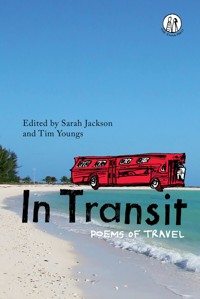
In Transit E-Book
Erhalten Sie Zugang zu diesem und mehr als 300000 Büchern ab EUR 5,99 monatlich.
- Herausgeber: The Emma Press
- Kategorie: Poesie und Drama
- Serie: The Emma Press Poetry Anthologies
- Sprache: Englisch
Travelling from one place to another is never as simple as getting from A to B. Whether you're sailing in a stately cruise liner or running for a grimy commuter train, your mode of transport affects the way you look at the things around you. Travel can even make us question who we are at home: will we be the same person at the other end of the journey? The poems in this anthology look at the ways in which travelling can change us, whether we enjoy or endure it. They take in not only day-trippers and business travellers, but characters who are forced to voyage against their will, as well as those with no choice but to stay put. Whatever your destination, this book is a companion for the journey, exploring the nuances of the strange state of being in transit.
Sie lesen das E-Book in den Legimi-Apps auf:
Seitenzahl: 57
Veröffentlichungsjahr: 2018
Das E-Book (TTS) können Sie hören im Abo „Legimi Premium” in Legimi-Apps auf:
Ähnliche




















INTRANSIT
POEMSOFTRAVEL
OTHER TITLES FROM THE EMMA PRESS
POETRYANTHOLOGIES
This Is Not Your Final Form: Poems about Birmingham
The Emma Press Anthology of Aunts
The Emma Press Anthology of Love
Some Cannot Be Caught: The Emma Press Book of Beasts
BOOKSFORCHILDREN
Moon Juice, by Kate Wakeling
The Noisy Classroom, by Ieva Flamingo
Queen of Seagulls, by Rūta Briede
The Book of Clouds, by Juris Kronbergs
PROSEPAMPHLETS
Postcard Stories, by Jan Carson
First fox, by Leanne Radojkovich
The Secret Box, by Daina Tabūna
Me and My Cameras, by Malachi O’Doherty
POETRYPAMPHLETS
Dragonish, by Emma Simon
Pisanki, by Zosia Kuczyńska
Who Seemed Alive & Altogether Real, by Padraig Regan
Paisley, by Rakhshan Rizwan
THEEMMAPRESSPICKS
The Dragon and The Bomb, by Andrew Wynn Owen
Meat Songs, by Jack Nicholls
Birmingham Jazz Incarnation, by Simon Turner
Bezdelki, by Carol Rumens
THEEMMAPRESS
First published in Great Britain in 2018 by the Emma Press Ltd
Poems copyright © individual copyright holders 2018
Selection copyright © Sarah Jackson and Tim Youngs 2018
All rights reserved.
The right of Sarah Jackson and Tim Youngs to be identified as the editors of this work has been asserted by them in accordance with the Copyright, Designs and Patents Act 1988.
ISBN 978-1-910139-94-3
A CIP catalogue record of this book is available from the British Library.
Printed and bound in Great Britain by TJ International, Padstow.
The Emma Press
theemmapress.com
Jewellery Quarter, Birmingham, UK
EDITORS’ FOREWORD
There, through the last of the sentences, just there—through the last of the sentences, the road—
—Carolyn Forché, ‘Travel Papers’ (2011)
Whether they are local or global, made by foot or by ferry, we tend to look upon journeys in terms of departure and arrival. However much we enjoy or endure it, travel is often understood simply as a means of getting from one place to another. But what happens en route? Do journeys change or confirm us? And what happens when we are forced to travel, or when we have no choice but to stay put? These questions are at the heart of this anthology. Whatever the scale of the journey, whether international or close to home, the poems in this collection explore the experience of being in transit.
Travel writing is usually thought of as a prose genre, yet the relationship between poetry and travel is deep and ancient. From Homer’s The Odyssey to Dr. Seuss’s ‘Oh, The Places You’ll Go’, movement is inherent in poetic form. As others have noted, the word ‘verse’ has its etymological roots in the turn of the plough; ‘stanza’ is a station or stopping-place. Metre is employed to convey not only the rhythms of breath and speech but also those of motion. Punctuation controls the pace of reading and the location and duration of the pause; rhyme returns us. Poems reshape the journey and are uniquely able to move through time and place in a compressed space.
In our call for this anthology, which is a collaboration between the Emma Press and Nottingham Trent University’s Centre for Travel Writing Studies, we asked for contributions that dealt with the experience of being in transit. We were especially interested in how the fact of being in motion affects our sense of identity, our relationship with others, and our perspective on our surroundings. We wanted to see how the mode of transport impacts on these factors and how it might influence the shape as well as the content of each poem.
Trains were by far the most popular means of transport in our submissions, followed by aeroplanes and then boats. There were walks, though fewer than we expected. Bicycles and motorcycles, buses and trams scarcely figured. We were surprised by how very little the car featured, considering its status as probably the most common form of mechanised transport in the industrialised West.
Several of the poems are set in the speaker’s destination but show that the journey continues long after arrival. Whatever the setting, the mode or the scale of the journey, these poems demonstrate how physical travel can open up new ways of perceiving, relating, thinking and feeling. Undertaken for reasons of leisure, work, family, forced exile or willed migration, movement reflects and helps constitute who we are.
The journey undergoes a further transition, of course, when it is crafted for the page. Whether in traditional form or in free verse, epiphanic or wholly mundane, the poetic treatment of travel both continues and recrafts it, as does each reading.
SARAHJACKSONANDTIMYOUNGS
APRIL 2018
CONTENTS
Vantage point, by Susannah Hart
Always pleasing this quarter sun, by Lila Matsumoto
Beijing, by David Tait
Catherine spread the map on the bed, by Miranda Peake
Japeth’s stuff, by William Roychowdhury
Sleeper, by Rory Waterman
Balloonist, by Peter Surkov
Family Reunion, March 2001, by Zayneb Allak
Walnuts, by Rich Goodson
Short Stay, by Susannah Hart
Square Dancing the Adriatic, by Colleen J. McElroy
South, by Zayneb Allak
Creeks and Culverts of New Zealand, by Ilse Pedler
Taverna, by Jane McKie
Alligator, by Anna Kisby
The Girls from Maynard’s, by Nick Littler
The Long Flight Home, by Shara Lessley
Travelling on the 10.21 with Tom Hardy, by Maria Taylor
[Watford Gap], by Andrew Taylor
Postcard, by Fiona Moore
West Highland, by Sharon Black
Empty Quarter, by Rosie Garland
The Sight to See, by Colleen J. McElroy
France, by Miranda Peake
Halfway to Voronezh, by Charlotte Eichler
Train to Cambridge, by Jeremy Wikeley
Epicentres, by Rory Waterman
The romance of men in boats, by Miranda Peake
Reading the Water, by Nancy Campbell
Quayside, by Rich Goodson
Men in Water, by Andy Eaton
Herring Gurl, by Rebecca Violet White
Aboard the Grey Ghost, by Simon Williams
Чайка, by Alex Toms
Stopper on the Poacher Line, by Jo Dixon
Dual Gauge, by Vicky Sparrow
Copenhagen to Stockholm, by Cliff Yates
Georg Rides the U-Bahn, by Fiona Larkin
Thirty-Eight Thousand Feet, by Claire Collison
Red-eye, by Cheryl Pearson
The Crow and the Dove Take Your Shape, by Anna Kisby
Uptown, by Jeanette Burton
Walking, by Baiba Bièole
Portrait of my father as Joseph Cornell, by Andrea Robinson
Return, by Rebecca Gethin
If You Lived Here You’d Be Home By Now, by David Tait
The Blue, by David Tait
In Dyeliva, by Peter Surkov
La Pive, by Yvonne Reddick
Gods, Cabo de São Vicente, Portugal, by Jane McKie
Little Blue Truck, by George David Clark
Acknowledgements
About the editors
About the authors
SUSANNAHHART
Vantage point
Impossible these days to believe in the sky,
the way it dissipates on contact,
its vanishing trick.
Believe rather in the bas-relief below,
in the scarcely visible contour lines
mapping the hills.




