


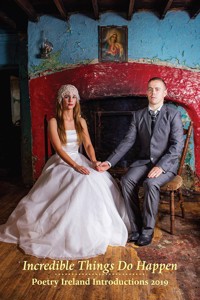
Incredible Things Do Happen: Poetry Ireland Introductions 2019 E-Book
Erhalten Sie Zugang zu diesem und mehr als 300000 Büchern ab EUR 5,99 monatlich.
- Herausgeber: Poetry Ireland
- Kategorie: Poesie und Drama
- Sprache: Englisch
Incredible Things Do Happen: Poetry Ireland Introductions 2019 is an anthology of poetry from Poetry Ireland, the national poetry organisation. This anthology features the very best of Ireland's emerging poets for 2019, as chosen by Martina Evans, award-winning poet and reviewer. Along with a pair of superb poems, each poet provides an insightful piece on a favourite - a favourite poet or prose writer or musician or artist. Featuring Andrew Rahal, Angela Finn, Anne Walsh Donnelly, Audrey Molloy, Emily S Cooper, Frank Farrelly, Jim McElroy, Mairéad Donnellan, Paul McCarrick, Lorraine McArdle, Joe Carrick-Varty, and Ruth Quinlan, along with superb photographs from Michael Croghan and Izabela Szczutkowska. Quality poems and quality prose from Poetry Ireland: connecting poetry and people.
Sie lesen das E-Book in den Legimi-Apps auf:
Seitenzahl: 79
Veröffentlichungsjahr: 2020
Das E-Book (TTS) können Sie hören im Abo „Legimi Premium” in Legimi-Apps auf:
Ähnliche




















Poetry Ireland Introductions aims to encourage excellence in the craft of poetry by raising the profile of talented, emerging poets.
The series offers poets in the early stages of their careers, writing in Irish or English, the opportunity to showcase their work through workshops and performance. The poets selected for the Introductions series participate in a workshop focused on poetic form and craft, as well as a masterclass on the art of reading and performing poetry in public, and a presentation on marketing and self-promotion for poets.
These workshops culminate in a series of public readings in partnership with International Literature Festival Dublin.
www.poetryireland.ie/writers/introductions-series
This sampler of work from the poets who read for the Poetry Ireland Introductions series in 2019 is published by Poetry Ireland in 2020
FRONT COVER IMAGE: MICHAEL CROGHAN
BACK COVER IMAGE: IZABELA SZCZUTKOWSKA
DESIGNAND TYPESETTING: MADDIEWEBER
INTRODUCTIONS READINGS CO-ORDINATOR: ELIZABETH MOHEN
PRODUCTION CO-ORDINATORS: PAUL LENEHANAND EOIN ROGERS
ALLIMAGESCOURTESYOF IZABELA SZCZUTKOWSKAAND MICHAEL CROGHAN, DUBLIN INSTITUTEOF TECHNOLOGY; SPECIALTHANKSTO ANN CURRAN (DIT)
ISBN: 978-1-902121-81-9
Contents
Martina Evans
INTRODUCTION
Andrew Rahal
MACON
NASHVILLE
FAVOURITES
Angela Finn
BURNOUT
TODAY
FAVOURITES
Anne Walsh Donnelly
PRAYERS
CÚCHULAINN
FAVOURITES
Audrey Molloy
SYMPHONYOFSKIN
MOTHERCREATURE
FAVOURITES
Emily S Cooper
INCREDIBLETHINGSDOHAPPEN
OLDLIVES
FAVOURITES
Frank Farrelly
SPEAKINGOFTHEDEAD
DREAM
FAVOURITES
Jim McElroy
HOOR
SHITHAPPENS
FAVOURITES
Mairéad Donnellan
EXHORTATION
THESYRIANVIOLINMAKER
FAVOURITES
Paul McCarrick
DEVOTIONS
NOTFACT, BUTFEELING
FAVOURITES
Lorraine McArdle
UNDERTHEKNIFE
AFAREWELLTOHIPS
FAVOURITES
Joe Carrick-Varty
LOPNUR
WHENYOULEANCLOSEANDTELLME
FAVOURITES
Ruth Quinlan
SEPARATION
MYCOLOURS, ASDEFINEDBYMEN
FAVOURITES
Notes on Contributors
Introduction
A poem, as a manifestation of language and thus essentially dialogue, can be a message in a bottle, sent out in the – not always great hope – that somewhere and sometime it could wash up on land, on heartland perhaps. Poems in this sense, too, are under way: they are making towards something.
– Paul Celan
The Poetry Ireland Introductions Series is a truly magical project, waving several wands at once. Poets get to meet their peers, workshop together, and perform on stage, before finally coming together in a celebratory booklet. Here is generous support, help, recognition, and company – all badly needed for any poet making their way. I learnt my poetic trade after I emigrated to London in 1988. When my father died later that year, the poems just came. Grief is democratic and it taught me that poetry was democratic too – I’d never expected to become a poet. My learning process, like the grieving process, was a lot of bumping around in the dark while hanging on for dear life to my books. Apart from one poetry class which I attended for a year, a young baby and a demanding hospital job meant I was mostly learning alone. Poetry was trial and an ocean of error. I didn’t enter the classroom as a teacher until after I’d published four books. Then I saw how support, encouragement, and good editing shines a light in the dark. That was twenty-two years ago, and although I must have taught nearly 1,500 students since then, I can count on one hand the number of groups I’ve taught in Ireland, each one a very special experience.
One grey February morning in 2019, the bright red Royal Mail van pulled up outside my window and I rushed to the door to help the postman staggering under the weight of three enormous bundles from Poetry Ireland – almost 1,800 poems in smaller bundles of ten, and each wrapped in a special message from the sender. The voices rose out of these bundles and accompanied me around the house for weeks, so many letters of introduction – some were trusting, confiding, telling of their hopes, their struggles, and even if the cruelty of life was mentioned, self-pity wasn’t there. I changed my mind many times as I swapped the bundles around, sometimes with great difficulty, as my two cats marked the poems as their own special beds and raged if they were moved. All of the poems were – in the words of Paul Celan – ‘under way… making towards something’. The twelve I picked were the nearest to the shore that I could see, but there were many contenders. The voices which kept rising to the top of the pile were very different from each other – they varied in style, age, gender, and humour, and when we finally sat together in the salubrious panelled room in Parnell Square, the magic began. Here were poets in deadly earnest – they were so generous with each other, even with me.
A string of publications and prizes have followed these poets in the last year, and Joe Carrick-Varty has launched a highly elegant poetry journal, bath magg, which reflects all the talented precision of his own poetry. ‘Hold it lightly’ is Joe’s favourite piece of writing advice, and it’s easy to see why. This booklet is a fine showcase for last years’ poems alongside exciting new developments, and with some generous advice and shared inspiration. I particularly liked the poets’ favourite words and phrases – fingerprints for each poet. Audrey Molloy’s ‘Rocks explode’ could be a coda for her own intense cinematic poems, Emily S Cooper’s ‘turpentine’ perfectly evokes her funny sensuous intense gaze, and Andrew Rahal’s obsession with James Wright’s hammock mirrors the deft somersaults of his witty poetry, while his favourite word is the perfectly evocative ‘foray’. Jim McElroy’s ‘gnarly’ fits his fiercely honest, fiercely visceral voice to perfection, and it comes with a moving tribute to Seamus Heaney. Angela Finn’s painterly succinct poems drenched with colour are mirrored in her observation that, ‘According to Vincent Van Gogh; the great artist is the simplifier.’ Frank Farrelly’s favourite word is ‘time’, as he is now retired and has more of it! There is a clock somewhere in every one of his fine elegiac poems – because time is his major player, whether making or missing the connections. Paul McCarrick speaks of his debt to Grace Paley, who has influenced his own highly charged demotic. He is a gifted dramatist so he knows when to silence the voice. His word suaimhneas reflects the music of stillness. Mairéad Donnellan’s word is ‘yard – a small word that has room for so many things’, bringing to mind flowers and in particular her exquisite orchid poems: how the universe can be contained in the smallest thing, how beauty can be found in untidiness. Ruth Quinlan’s crónáning is a poem in itself – the perfect onomatopoeic word evoking the intense nurturing quality of Ruth’s poetry, her bittersweet elegiacs. And Anne Walsh Donnelly isn’t fooling when she describes her poetry as ‘Bungee jumping, naked, off the Cliffs of Moher!’ It is a wild and wonderful ride with Anne, she is always surprising and nails the emotions. Her chosen word, ‘coddiwomple’, means to travel purposefully towards an as-yet-unknown destination, and that is surely the poet’s way, ‘making towards something’. Last but not least, Lorraine McArdle’s body poems are funny, moving adventures of bones, flesh, and metal. Currently, Lorraine is investigating the relationship between ‘metal’ and ‘mettle’. And perhaps this is the word that sums up this booklet best – here are twelve poets on their mettle, read and be inspired!
– Martina Evans
Photographer: Michael Croghan
ANDREW RAHAL
Andrew Rahal
MACON
– for A.C.
The peach in my hand throbs from the pit like a swollen head with tiny cloth hairs and peels of soft bruising skin
but the skin crackles, the fibres break like paint chipping off wicker end tables under sun, like the sweetened tea ripening there on the front porch.
All this groaning.
The morning I hit mom in the back of the head with a cast-iron truck, I used two hands, like I was up to bat at tee-ball practice.
Her head snapped forward and dad snapped, yelled Norm.
I cried but I hit her again and dad spun around, snagged my knee like it was catfish and I snapped again.
Good lord, she squeezed it hard that time. I cried again when she trickled onto the cloth headrest of the front passenger seat. She yelled Shit, son. Quit it.
We were only two hours out of Macon heading south when dad swerved off the road,
when his massive hand felt around my seat and between my legs, when he stepped out, taping the road surface with his left boot. Waiting for traffic to die down,
my hand shoved in his back pocket, I watched that truck fly clear across all six lanes.
When it smacked the tree it echoed back like a bag of frozen gulf shrimp falling out of a freezer and the truck fell to the shoulder-side rubble the way peaches, before they are ripe, might fall from a tree.
Andrew Rahal




