


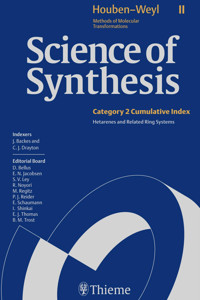
Index Volume Category 2 E-Book
1.749,99 €
Mehr erfahren.
- Herausgeber: Thieme
- Kategorie: Wissenschaft und neue Technologien
- Sprache: Englisch
Science of Synthesis provides a critical review of the synthetic methodology developed from the early 1800s to date for the entire field of organic and organometallic chemistry.
As the only resource providing full-text descriptions of organic transformations and synthetic methods as well as experimental procedures, Science of Synthesis is therefore a unique chemical information tool. Over 1000 world-renowned experts have chosen the most important molecular transformations for a class of organic compounds and elaborated on their scope and limitations.
The systematic, logical and consistent organization of the synthetic methods for each functional group enables users to quickly find out which methods are useful for a particular synthesis and which are not. Effective and practical experimental procedures can be implemented quickly and easily in the lab.// The content of this e-book was originally published in December 2007.
Das E-Book können Sie in Legimi-Apps oder einer beliebigen App lesen, die das folgende Format unterstützen:
Seitenzahl: 4193
Veröffentlichungsjahr: 2014
Ähnliche




















Science of Synthesis
Science of Synthesis is the authoritative and comprehensive reference work for the entire field of organic and organometallic synthesis.
Science of Synthesis presents the important synthetic methods for all classes of compounds and includes:
Methods critically evaluated by leading scientists
Background information and detailed experimental procedures
Schemes and tables which illustrate the reaction scope
List of All Volumes
Science of Synthesis, Houben-Weyl Methods of Molecular Transformations
Category 1: Organometallics
1 Compounds with Transition Metal—Carbon π-Bonds and Compounds of Groups 10–8 (Ni, Pd, Pt, Co, Rh, Ir, Fe, Ru, Os)
2 Compounds of Groups 7–3 (Mn ···, Cr ···, V ···, Ti ···, Sc ···, La ···, Ac ···)
3 Compounds of Groups 12 and 11 (Zn, Cd, Hg, Cu, Ag, Au)
4 Compounds of Group 15 (As, Sb, Bi) and Silicon Compounds
5 Compounds of Group 14 (Ge, Sn, Pb)
6 Boron Compounds
7 Compounds of Groups 13 and 2 (Al, Ga, In, Tl, Be ··· Ba)
8 Compounds of Group 1 (Li ··· Cs)
Category 2: Hetarenes and Related Ring Systems
9 Fully Unsaturated Small-Ring Heterocycles and Monocyclic Five-Membered Hetarenes with One Heteroatom
10 Fused Five-Membered Hetarenes with One Heteroatom
11 Five-Membered Hetarenes with One Chalcogen and One Additional Heteroatom
12 Five-Membered Hetarenes with Two Nitrogen or Phosphorus Atoms
13 Five-Membered Hetarenes with Three or More Heteroatoms
14 Six-Membered Hetarenes with One Chalcogen
15 Six-Membered Hetarenes with One Nitrogen or Phosphorus Atom
16 Six-Membered Hetarenes with Two Identical Heteroatoms
17 Six-Membered Hetarenes with Two Unlike or More than Two Heteroatoms and Fully Unsaturated Larger-Ring Heterocycles
Category 3: Compounds with Four and Three Carbon—Heteroatom Bonds
18 Four Carbon—Heteroatom Bonds: X—C≡X, X=C=X, X2C=X, CX4
19 Three Carbon—Heteroatom Bonds: Nitriles, Isocyanides, and Derivatives
21 Three Carbon—Heteroatom Bonds: Amides and Derivatives; Polyamides and Peptides; Lactams
22 Three Carbon—Heteroatom Bonds: Thio-, Seleno-, and Tellurocarboxylic Acids and Derivatives; Imidic Acids and Derivatives; Ortho Acid Derivatives
23 Three Carbon—Heteroatom Bonds: Ketenes and Derivatives
24 Three Carbon—Heteroatom Bonds: Ketene Acetals and Yne—X Compounds
Category 4: Compounds with Two Carbon-Heteroatom Bonds
25 Aldehydes
26 Ketones
27 Heteroatom Analogues of Aldehydes and Ketones
28 Quinones and Heteroatom Analogues
29 Acetals: Hal/X and O/O, S, Se, Te
30 Acetals: O/N, S/S, S/N, and N/N and Higher Heteroatom Analogues
31a Arene-X (X= Hal, O, S, Se, Te)
31b Arene-X (X= N, P)
Category 5: Compounds with One Saturated Carbon-Heteroatom Bond
34 Fluorine
35 Chlorine, Bromine, and Iodine
37 Ethers
39 Sulfur, Selenium, and Tellurium
40 Amines, Ammonium Salts, Haloamines, Hydroxylamines, Hydrazines, Triazanes, and Tetrazanes
41 Nitro, Nitroso, Azo, Azoxy, and Diazonium Compounds, Azides, Triazenes, and Tetrazenes
42 Organophosphorus Compounds (incl. RO-P and RN-P)
Category 6: Compounds with All-Carbon Functions
43 Polyynes, Arynes, Enynes, and Alkynes
44 Cumulenes and Allenes
45 Arenes, Quasiarenes, Annulenes, and Polyenes
46 1,3-Dienes
47 Alkenes
48 Alkanes
Preface
As our understanding of the natural world increases, we begin to understand complex phenomena at molecular levels. This level of understanding allows for the design of molecular entities for functions ranging from material science to biology. Such design requires synthesis and, as the structures increase in complexity as a necessity for specificity, puts increasing demands on the level of sophistication of the synthetic methods. Such needs stimulate the improvement of existing methods and, more importantly, the development of new methods. As scientists confront the synthetic problems posed by the molecular targets, they require access to a source of reliable synthetic information. Thus, the need for a new, comprehensive, and critical treatment of synthetic chemistry has become apparent. To meet this challenge, an entirely new edition of the esteemed reference work Houben–Weyl Methods of Organic Chemistry will be published starting in the year 2000.
To reflect the new broader need and focus, this new edition has a new title, Science of Synthesis, Houben–Weyl Methods of Molecular Transformations. Science of Synthesis will benefit from more than 90 years of experience and will continue the tradition of excellence in publishing synthetic chemistry reference works. Science of Synthesis will be a balanced and critical reference work produced by the collaborative efforts of chemists, from both industry and academia, selected by the editorial board. All published results from journals, books, and patent literature from the early 1800s until the year of publication will be considered by our authors, who are among the leading experts in their field. The 48 volumes of Science of Synthesis will provide chemists with the most reliable methods to solve their synthesis problems. Science of Synthesis will be updated periodically and will become a prime source of information for chemists in the 21st century.
Science of Synthesis will be organized in a logical hierarchical system based on the target molecule to be synthesized. The critical coverage of methods will be supported by information intended to help the user choose the most suitable method for their application, thus providing a strong foundation from which to develop a successful synthetic route. Within each category of product, illuminating background information such as history, nomenclature, structure, stability, reactivity, properties, safety, and environmental aspects will be discussed along with a detailed selection of reliable methods. Each method and variation will be accompanied by reaction schemes, tables of examples, experimental procedures, and a background discussion of the scope and limitations of the reaction described.
The policy of the editorial board is to make Science of Synthesis the ultimate tool for the synthetic chemist in the 21st century.
We would like to thank all of our authors for submitting contributions of such outstanding quality, and, also for the dedication and commitment they have shown throughout the entire editorial process.
October 2000
The Editorial Board
D. Bellus (Basel, Switzerland)
E. N. Jacobsen (Cambridge, USA)
S. V. Ley (Cambridge, UK)
R. Noyori (Nagoya, Japan)
M. Regitz (Kaiserslautern, Germany)
P. J. Reider (New Jersey, USA)
E. Schaumann (Clausthal-Zellerfeld, Germany)
I. Shinkai (Tsukuba, Japan)
E. J. Thomas (Manchester, UK)
B. M. Trost (Stanford, USA)
Category 2 (Hetarenes and Related Ring Systems): Cumulative Index
Preface
Product Class Overview
Structure Index
Name Reaction Index
Keyword Index
Author Index
Erratum
Abbreviations
Volume 9: Fully Unsaturated Small-Ring Heterocycles and Monocyclic Five-Membered Hetarenes with One Heteroatom
Introduction
G. Maas
9.1 Product Class 1: Oxirenes
K.-P. Zeller
9.2 Product Class 2: Thiirenes and Their Derivatives
N. Tokitoh and W. Ando
9.3 Product Class 3: Selenirenes
N. Tokitoh and W. Ando
9.4 Product Class 4: Tellurirenes
N. Tokitoh and W. Ando
9.5 Product Class 5:1 H-Azirines
K.-P. Zeller
9.6 Product Class 6: Phosphirenes
H. Heydt
9.7 Product Class 7: Three-Membered Rings with Phosphorus and One or More Heteroatoms
H. Heydt
9.8 Product Class 8: Four-Membered Rings with One or More Heteroatoms
M. Regitz and U. Bergsträßer
9.9 Product Class 9: Furans
B. König
9.10 Product Class 10: Thiophenes, Thiophene 1,1-Dioxides, and Thiophene 1-Oxides
J. Schatz
9.11 Product Class 11: Selenophenes
J. Schatz
9.12 Product Class 12: Tellurophenes
J. Schatz
9.13 Product Class 13: 1H-Pyrroles
D. StC. Black
9.14 Product Class 14: Phospholes
F. Mathey
Volume 10: Fused Five-Membered Hetarenes with One Heteroatom
Introduction
E. J. Thomas
10.1 Product Class 1: Benzo[b]furans
C. P. Dell
10.2 Product Class 2: Benzo[c]furans
P. G. Steel
10.3 Product Class 3: Dibenzofurans
K. Jones
10.4 Product Class 4: Benzo[b]thiophenes
C. M. Rayner and M. A. Graham
10.5 Product Class 5: Benzo[c]thiophenes
T. L. Gilchrist and S. J. Higgins
10.6 Product Class 6: Dibenzothiophenes
M. D. Andrews
10.7 Product Class 7: Benzo[b]selenophenes
P. J. Murphy
10.8 Product Class 8: Benzo[c]selenophenes
P. J. Murphy
10.9 Product Class 9: Dibenzoselenophenes
P. J. Murphy
10.10 Product Class 10: Benzo[b]tellurophenes
P. J. Murphy
10.11 Product Class 11: Benzo[c]tellurophenes
P. J. Murphy
10.12 Product Class 12: Dibenzotellurophenes
P. J. Murphy
10.13 Product Class 13: Indole and Its Derivatives
J. A. Joule
10.14 Product Class 14: 1H- and 2H-Isoindoles
T. J. Donohoe
10.15 Product Class 15: Carbazoles
P. T. Gallagher
10.16 Product Class 16: Indolizines
M. Shipman
10.17 Product Class 17: Benzo[b]phospholes
R. A. Aitken
10.18 Product Class 18: Benzo[c]phospholes
R. A. Aitken
10.19 Product Class 19: Dibenzophospholes
R. A. Aitken
10.20 Product Class 20: Phosphorus Analogues of Indolizines
R. A. Aitken
Volume 11: Five-Membered Hetarenes with One Chalcogen and One Additional Heteroatom
Introduction
E. Schaumann
11.1 Product Class 1:1,3-Dioxolium Salts and Annulated Analogues
H. Perst
11.2 Product Class 2:1,2-Oxathiolium Salts
H. Perst
11.3 Product Class 3:1,3-Oxathiolium Salts and Related Compounds
H. Perst and C. Klenke
11.4 Product Class 4:1,2-Oxaselenolium Salts
H. Perst
11.5 Product Class 5:1,3-Oxaselenolium Salts
H. Perst
11.6 Product Class 6:1,2-Oxatellurolium Compounds and Benzoannulated Analogues
H. Perst
11.7 Product Class 7:1,2-Dithiolium Salts and Related Compounds
C. Th. Pedersen
11.8 Product Class 8:1,3-Dithiolium Salts, Se and Te Analogues and Benzoannulated Analogues
G. Schukat and E. Fanghänel
11.9 Product Class 9: Isoxazoles
B. J. Wakefield
11.10 Product Class 10:1,2-Benzisoxazoles and Related Compounds
R. K. Smalley
11.11 Product Class 11: 2,1-Benzisoxazoles and Related Compounds
R. K. Smalley
11.12 Product Class 12: Oxazoles
G. V. Boyd
11.13 Product Class 13: Benzoxazoles and Other Annulated Oxazoles
G. V. Boyd
11.14 Product Class 14: 1,3-Oxaphospholes and Benzoannulated Analogues
D. Gudat
11.15 Product Class 15: Isothiazoles
D. W. Brown and M. Sainsbury
11.16 Product Class 16: Benzisothiazoles
D. W. Brown and M. Sainsbury
11.17 Product Class 17: Thiazoles
D. Kikelj and U. Urleb
11.18 Product Class 18: Benzothiazoles and Related Compounds
H. Ulrich
11.19 Product Class 19:1,2- and 1,3-Thiaphospholes and Benzoannulated Analogues
D. Gudat
11.20 Product Class 20: Isoselenazoles
W.-D. Pfeiffer
11.21 Product Class 21: Annulated Isoselenazole Compounds
W.-D. Pfeiffer
11.22 Product Class 22: Selenazoles
W.-D. Pfeiffer
11.23 Product Class 23: Annulated Selenazole Compounds
W.-D. Pfeiffer
11.24 Product Class 24:1,3-Selenaphospholes
D. Gudat
11.25 Product Class 25: Isotellurazoles, and Annulated Isotellurazole and Tellurazole Compounds
W.-D. Pfeiffer
Volume 12: Five-Membered Hetarenes with Two Nitrogen or Phosphorus Atoms
Introduction
R. Neier
12.1 Product Class 1: Pyrazoles
B. Stanovnik and J. Svete
12.2 Product Class 2: 1H- and 2H-Indazoles
W. Stadlbauer
12.3 Product Class 3: Imidazoles
M. R. Grimmett
12.4 Product Class 4: Benzimidazoles
M. R. Grimmett
12.5 Product Class 5: Azaindolizines with Two Nitrogen Atoms in the Five-Membered Ring
G. Hajos and Z. Riedl
12.6 Product Class 6: Azaphospholes and Azarsoles
A. Schmidpeter and K. Karaghiosoff
12.7 Product Class 7: Diphospholes
F. Mathey
Volume 13: Five-Membered Hetarenes with Three or More Heteroatoms
Introduction
R. C. Storr and T. L. Gilchrist
13.1 Product Class 1:1,2,5-Oxathiazoles, 1,2,3-Dithiazoles, and Related Compounds
N. G. Argyropoulos
13.2 Product Class 2:1,2,4-Dioxazoles, 1,2,4-Oxathiazoles, and 1,2,4-Dithiazoles
N. G. Argyropoulos
13.3 Product Class 3:1,3,2-Oxathiazoles, 1,3,2-Dithiazoles, and Related Compounds
N. G. Argyropoulos
13.4 Product Class 4:1,4,2-Oxathiazoles and Related Compounds
N. G. Argyropoulos
13.5 Product Class 5:1,2,3-Oxadiazoles
T. L. Gilchrist
13.6 Product Class 6:1,2,4-Oxadiazoles
K. Hemming
13.7 Product Class 7:1,2,5-Oxadiazoles
R. M. Paton
13.8 Product Class 8:1,3,4-Oxadiazoles
G. W. Weaver
13.9 Product Class 9:1,2,3-Thiadiazoles
D. J. Wilkins and P. A. Bradley
13.10 Product Class 10:1,2,4-Thiadiazoles
D. J. Wilkins and P. A. Bradley
13.11 Product Class 11:1,2,5-Thiadiazoles and Related Compounds
P. A. Koutentis
13.12 Product Class 12:1,3,4-Thiadiazoles
S. J. Collier
13.13 Product Class 13: 1,2,3-Triazoles
A. C. Tomé
13.14 Product Class 14: 1,2,4-Triazoles
A. D. M. Curtis
13.15 Product Class 15: Dithiaphospholes and Their Analogues
R. K. Bansal, N. Gupta, and S. J. Collier
13.16 Product Class 16: Oxazaphospholes and Thiazaphospholes
R. K. Bansal and Neelima Gupta
13.17 Product Class 17: Oxadiphospholes and Their Analogues
S. J. Collier
13.18 Product Class 18: Diazaphospholes and Diazarsoles
R. K. Bansal and Neelima Gupta
13.19 Product Class 19: Azadiphospholes and Their Analogues
S. J. Collier
13.20 Product Class 20: Triphospholes and Diphospharsoles
R. K. Bansal and Neelima Gupta
13.21 Product Class 21: Thiadiazaphospholes
S. J. Collier
13.22 Product Class 22: Triazaphospholes
R. K. Bansal and Neelima Gupta
13.23 Product Class 23: Diazadiphospholes
S. J. Collier
13.24 Product Class 24: Tetraphospholes
S. J. Collier
13.25 Product Class 25: Tetraazaphospholes
S. J. Collier
13.26 Product Class 26: Pentaphospholes and Pentarsoles
R. K. Bansal and Neelima Gupta
13.27 Product Class 27: Selenazoles and Tellurazoles Containing One or More Other Heteroatoms
R. A. Aitken
13.28 Product Class 28: Oxatriazoles
M. Begtrup
13.29 Product Class 29: Thiatriazoles
M. Begtrup
13.30 Product Class 30: Tetrazoles
A. F. Brigas
13.31 Product Class 31: Pentazoles
R. C. Storr
Volume 14: Six-Membered Hetarenes with One Chalcogen
Introduction
E. J. Thomas
14.1 Product Class 1: Pyrylium Salts
T. S. Balaban and A. T. Balaban
14.2 Product Class 2: Benzopyrylium Salts
M. Nógrádi
14.3 Product Class 3: Pyranones and Pyranthiones
K. Afarinkia and V. Vinader
14.4 Product Class 4: Benzopyranones and Benzopyranthiones
A. C. Williams and N. Camp
14.5 Product Class 5: 3-Oxidopyrylium Salts and Their Thio and Benzo-Fused Analogues
A. Nelson
14.6 Product Class 6: Thiopyrylium Salts
W.-D. Rudorf
14.7 Product Class 7: Benzothiopyrylium Salts
W.-D. Rudorf
14.8 Product Class 8: Thiopyranones and Thiopyranthiones
S. Faulkner, R. C. Whitehead, and R. J. Aarons
14.9 Product Class 9: Benzothiopyranones and Benzothiopyranthiones
A. Nelson
14.10 Product Class 10: Selenopyrylium and Benzoselenopyrylium Salts
P. J. Murphy
14.11 Product Class 11: Selenopyranones and Benzoselenopyranones
P. J. Murphy
14.12 Product Class 12: Telluropyrylium and Benzotelluropyrylium Salts
P. J. Murphy
14.13 Product Class 13: Telluropyranones and Benzotelluropyranones
P. J. Murphy
Volume 15: Six-Membered Hetarenes with One Nitrogen or Phosphorus Atom
Introduction
D. StC. Black
15.1 Product Class 1: Pyridines
D. Spitzner
15.2 Product Class 2: Pyridinones and Related Systems
P. A. Keller
15.3 Product Class 3: Quinolines
R. D. Larsen and D. Cai
15.4 Product Class 4: Quinolinones
R. D. Larsen
15.5 Product Class 5: Isoquinolines
M. Álvarez and J. A. Joule
15.6 Product Class 6: Isoquinolinones
M. Álvarez and J. A. Joule
15.7 Product Class 7: Quinolizinium Salts and Benzo Analogues
H. Ihmels
15.8 Product Class 8: Naphthyridines
P.-W. Phuan and M. C. Kozlowski
15.9 Product Class 9: Acridines
R. H. Prager and C. M. Williams
15.10 Product Class 10: Acridin-9(10H)-ones and Related Systems
R. H. Prager and C. M. Williams
15.11 Product Class 11: Phenanthridines
P. A. Keller
15.12 Product Class 12: Phenanthridinones and Related Systems
P. A. Keller
15.13 Product Class 13:1λ3-Phosphinines
F. Mathey and P. Le Floch
15.14 Product Class 14: 1λ5-Phosphinines
R. Streubel
15.15 Product Class 15: Benzo-Fused And Other Annulated Phosphinines
U. Bergsträßer
Volume 16: Six-Membered Hetarenes with Two Identical Heteroatoms
Introduction
Y. Yamamoto
16.1 Product Class 1:1,2-Dioxins and Benzo- and Dibenzo-Fused Derivatives
M. Matsumoto
16.2 Product Class 2:1,4-Dioxins and Benzo- and Dibenzo-Fused Derivatives
M. Matsumoto
16.3 Product Class 3:1,2-Dithiins
R. Sato
16.4 Product Class 4:1,4-Dithiins
R. Sato
16.5 Product Class 5:1,2-Diselenins
R. Sato
16.6 Product Class 6:1,4-Diselenins
R. Sato
16.7 Product Class 7:1,4-Ditellurins
R. Sato
16.8 Product Class 8: Pyridazines
N. Haider and W. Holzer
16.9 Product Class 9: Cinnolines
N. Haider and W. Holzer
16.10 Product Class 10: Phthalazines
N. Haider and W. Holzer
16.11 Product Class 11: Pyridazino[1,2-a]pyridazines
N. Haider and W. Holzer
16.12 Product Class 12: Pyrimidines
S. von Angerer
16.13 Product Class 13: Quinazolines
D. Kikelj
16.14 Product Class 14: Pyrazines
N. Sato
16.15 Product Class 15: Quinoxalines
S. Gobec and U. Urleb
16.16 Product Class 16: Phenazines
U. Urleb and S. Gobec
16.17 Product Class 17: Purines
F. Seela, N. Ramzaeva, and H. Rosemeyer
16.18 Product Class 18: Pyridopyridazines
M. Sako
16.19 Product Class 19: Pyridopyrimidines
M. Sako
16.20 Product Class 20: Pyridopyrazines
M. Sako
16.21 Product Class 21: Pteridines and Related Structures
T. Ishikawa
16.22 Product Class 22: Other Diazinodiazines
T. Ishikawa
16.23 Product Class 23: Diphosphinines
M. Yoshifuji and S. Ito
Volume 17: Six-Membered Hetarenes with Two Unlike or More than Two Heteroatoms and Fully Unsaturated Larger-Ring Heterocycles
Introduction
S. M. Weinreb and Y. R. Mahajan
17.1 Product Class 1: Six-Membered Hetarenes with Two Unlike Heteroatoms
17.1.1 Product Subclass 1: Two Unlike Oxygen, Sulfur, Selenium, or Tellurium Atoms
S. Yamazaki and K. Yamamoto
17.1.2 Product Subclass 2: One Oxygen and One Nitrogen or Phosphorus Atom
H. Ulrich
17.1.3 Product Subclass 3: One Sulfur, Selenium, or Tellurium Atom and One Nitrogen or Phosphorus Atom
H. Ulrich
17.2 Product Class 2: Six-Membered Hetarenes with Three Heteroatoms
17.2.1 Product Subclass 1: 1,2,3-Triazines and Phosphorus Analogues
H. Döpp and D. Döpp
17.2.2 Product Subclass 2: 1,2,4-Triazines
C. W. Lindsley and M. E. Layton
17.2.3 Product Subclass 3: 1,3,5-Triazines and Phosphorus Analogues
S. von Angerer
17.3 Product Class 3: Six-Membered Hetarenes with More Than Three Heteroatoms
M. Bohle
17.4 Product Class 4: Seven-Membered Hetarenes with One Heteroatom
17.4.1 Product Subclass 1: Oxepins
S. von Angerer
17.4.2 Product Subclass 2: Benzoxepins
S. von Angerer
17.4.3 Product Subclass 3: Thiepins and Selenium Analogues
A. L. Schwan
17.4.4 Product Subclass 4: Benzothiepins and Selenium/Tellurium Analogues
A. L. Schwan
17.4.5 Product Subclass 5: Azepines, Cyclopentazepines, and Phosphorus Analogues
M. D. Surman and R. H. Hutchings
17.4.6 Product Subclass 6: Benzazepines and Their Group 15 Analogues
J.-P. K. Meigh
17.5 Product Class 5: Seven-Membered Hetarenes with Two or More Heteroatoms
R. J. Herr
17.6 Product Class 6: Eight- and Nine-Membered Hetarenes and Heteroannulenes with One or More Heteroatoms
R. M. Borzilleri
17.7 Product Class 7: Cyclazines
Y. Tominaga
17.8 Product Class 8: Porphyrins and Related Compounds
K. M. Smith and M. G. H. Vicente
17.9 Product Class 9: Phthalocyanines and Related Compounds
N. B. McKeown
Structure Index
This index comprises a list of key structures from the Hetarenes and Related Ring Systems series.
To use the index you first need to identify the following four characteristics for the ring system you are interested in:
(1) whether the system is monocyclic, bicyclic etc. (see page header)
(2) the ring size i.e. 3-membered, 4-membered etc. (see left-hand column)
(3) the number of heteroatoms within the ring system (see number to the left of illustrated row of structures)
(4) heteroatoms are prioritized in the following order: O, S, Se, Te, N, P, As, Sb, Bi, (Zr)
Having identified the ring system of interest please refer to the number beneath the structure in order to determine the relevant volume number (small and bold) and page number within the series.
Name Reaction Index
A
Achmatowicz
– Achmatowicz oxidative ring expansion 14-643
– Achmatowicz ring expansion 14-639, 14-643
Adam’s catalyst
– Adam’s catalyst 10-745, 16-305
Akabori method
– Akabori method 12-356, 12-426
Alder-Longo reaction
– Alder-Longo approach 17-1116
Alder-Rickert cleavage
– Alder-Rickert cleavage 09-222
aldol reaction
– aldol condensation 10-104, 10-105, 10-399, 10-601, 15-692, 15-806, 15-898
– aldol process 09-477
– aldol reaction 09-477, 10-494, 13-168, 14-793f., 14-802f.
– aldol-type condensation 10-450, 10-620, 12-595
Algar-Flynn-Oyamada oxidation
– Algar-Flynn-Oyamada oxidation 14-503
Allen-Robinson reaction
– Allen-Robinson reaction 14-447
Amadori rearrangement
– Amadori rearrangement 16-1302f.
ANRORC
– ANRORC 14-11f.
– SNANRORC mechanism 15-237, 15-791
– SN-ANRORC 16-1191, 16-1209
Appel’s salt
– Appel’s salt 13-13-13-16
Arbusov reaction
– Arbusov reaction 10-450, 13-174, 14-702
– Arbusov-type transformation 10-100
Arduengo
– Arduengo-type carbene 13-734
Arnold’s reagent
– Arnold’s reagent 16-1043
Auwer’s rule
– Auwer’s rule 12-85
B
Baeyer-Villiger oxidation
– Baeyer-Villiger cleavage 10-535, 10-624
– Baeyer-Villiger oxidation 10-582, 10-617, 14-415f., 14-586f., 15-1056
– Baeyer-Villiger reaction 14-586f.
Baker’s rule
– Baker’s trans rule 16-1034
Baker-Venkataraman rearrangement
– Baker-Venkataraman rearrangement 14-407, 14-509
Balaban-Nenitzescu-Praill reaction
– Balaban-Nenitzescu-Praill reaction 14-25f.
Balz-Schiemann reaction
– Balz-Schiemann reaction 16-818, 16-894
Bamberger degradation
– Bamberger degradation 12-374
Barbier reaction
– Barbier’s method 15-1129
– Barbier-type reaction 16-281
Bartoli synthesis
– Bartoli indole synthesis 10-385
– Bartoli synthesis 10-384
Barton-Zard reaction
– Barton-Zard reaction 09-489, 09-491
Baylis-Hillman reaction
– Baylis-Hillman acetate 15-396
– Baylis-Hillman adduct 15-434, 15-500, 15-563
– Baylis-Hillman reaction 10-761, 14-410
Beckmann fragmentation
– Beckmann fragmentation 13-329f. Beckmann rearrangement
– Beckmann rearrangement 10-75, 10-258, 10-582, 10-593, 10-739f., 11-293, 11-295, 11-489, 11-582, 11-773, 11-807, 11-869, 11-985, 11-986, 12-567, 13-131, 13-186, 15-8, 15-631, 15-722, 15-724, 15-740, 15-1092, 16-775, 17-45, 17-872, 17-873, 17-875, 17-1017f.
– Beckmann-type rearrangement 17-509
Begtrup and Larsen reaction
– Begtrup and Larsen approach 12-489
– Begtrup and Larsen quaternization 12-463
Begtrup method
– Begtrup method 12-464, 12-495
– Begtrup two-stage method 12-495
Beirut reaction
– Beirut reaction 16-866, 16-925
benzoin reaction
– benzoin reaction 12-502
Bernthsen reaction
– Bernthsen condensation 15-998
– Bernthsen procedure 15-997, 15-1023
– Bernthsen reaction 15-997, 15-1023
– Bernthsen synthesis 15-997
– Bernthsen’s method 17-163, 17-164
– Bernthsen’s thiosulfate method 17-163, 17-164
Beyer modification (Doebner-von Miller reaction)
– Beyer modification 15-391
– Beyer-like reaction 15-511
Beyer-Combes synthesis
– Beyer-Combes synthesis 15-440f.
Birch reduction
– Birch reduction 10-131, 10-212, 15-189
– Birch reduction conditions 10-212
– Birch-type reduction 15-949
Bird’s aromaticity index
– Bird’s aromaticity index 10-653
Bischler synthesis
– Bischler indole synthesis 10-390
– Bischler process 10-462
– Bischler synthesis 10-390, 17-357, 17-382
Lesen Sie weiter in der vollständigen Ausgabe!
Lesen Sie weiter in der vollständigen Ausgabe!
Lesen Sie weiter in der vollständigen Ausgabe!
Lesen Sie weiter in der vollständigen Ausgabe!
Lesen Sie weiter in der vollständigen Ausgabe!
Lesen Sie weiter in der vollständigen Ausgabe!
Lesen Sie weiter in der vollständigen Ausgabe!
Lesen Sie weiter in der vollständigen Ausgabe!
Lesen Sie weiter in der vollständigen Ausgabe!
Lesen Sie weiter in der vollständigen Ausgabe!
Lesen Sie weiter in der vollständigen Ausgabe!
Lesen Sie weiter in der vollständigen Ausgabe!
Lesen Sie weiter in der vollständigen Ausgabe!
Lesen Sie weiter in der vollständigen Ausgabe!
Lesen Sie weiter in der vollständigen Ausgabe!
Lesen Sie weiter in der vollständigen Ausgabe!
Lesen Sie weiter in der vollständigen Ausgabe!
Lesen Sie weiter in der vollständigen Ausgabe!
Lesen Sie weiter in der vollständigen Ausgabe!
Lesen Sie weiter in der vollständigen Ausgabe!
Lesen Sie weiter in der vollständigen Ausgabe!
Lesen Sie weiter in der vollständigen Ausgabe!
Lesen Sie weiter in der vollständigen Ausgabe!
Lesen Sie weiter in der vollständigen Ausgabe!
Lesen Sie weiter in der vollständigen Ausgabe!
Lesen Sie weiter in der vollständigen Ausgabe!
Lesen Sie weiter in der vollständigen Ausgabe!
Lesen Sie weiter in der vollständigen Ausgabe!
Lesen Sie weiter in der vollständigen Ausgabe!
Lesen Sie weiter in der vollständigen Ausgabe!
Lesen Sie weiter in der vollständigen Ausgabe!
Lesen Sie weiter in der vollständigen Ausgabe!
Lesen Sie weiter in der vollständigen Ausgabe!
Lesen Sie weiter in der vollständigen Ausgabe!
Lesen Sie weiter in der vollständigen Ausgabe!
Lesen Sie weiter in der vollständigen Ausgabe!
Lesen Sie weiter in der vollständigen Ausgabe!
Lesen Sie weiter in der vollständigen Ausgabe!
Lesen Sie weiter in der vollständigen Ausgabe!
Lesen Sie weiter in der vollständigen Ausgabe!
Lesen Sie weiter in der vollständigen Ausgabe!
Lesen Sie weiter in der vollständigen Ausgabe!
Lesen Sie weiter in der vollständigen Ausgabe!
Lesen Sie weiter in der vollständigen Ausgabe!
Lesen Sie weiter in der vollständigen Ausgabe!
Lesen Sie weiter in der vollständigen Ausgabe!
Lesen Sie weiter in der vollständigen Ausgabe!
Lesen Sie weiter in der vollständigen Ausgabe!
Lesen Sie weiter in der vollständigen Ausgabe!
Lesen Sie weiter in der vollständigen Ausgabe!
Lesen Sie weiter in der vollständigen Ausgabe!
Lesen Sie weiter in der vollständigen Ausgabe!
Lesen Sie weiter in der vollständigen Ausgabe!
Lesen Sie weiter in der vollständigen Ausgabe!
Lesen Sie weiter in der vollständigen Ausgabe!
Lesen Sie weiter in der vollständigen Ausgabe!
Lesen Sie weiter in der vollständigen Ausgabe!
Lesen Sie weiter in der vollständigen Ausgabe!
Lesen Sie weiter in der vollständigen Ausgabe!
Lesen Sie weiter in der vollständigen Ausgabe!
Lesen Sie weiter in der vollständigen Ausgabe!
Lesen Sie weiter in der vollständigen Ausgabe!
Lesen Sie weiter in der vollständigen Ausgabe!
Lesen Sie weiter in der vollständigen Ausgabe!
Lesen Sie weiter in der vollständigen Ausgabe!
Lesen Sie weiter in der vollständigen Ausgabe!
Lesen Sie weiter in der vollständigen Ausgabe!
Lesen Sie weiter in der vollständigen Ausgabe!
Lesen Sie weiter in der vollständigen Ausgabe!
Lesen Sie weiter in der vollständigen Ausgabe!
Lesen Sie weiter in der vollständigen Ausgabe!
Lesen Sie weiter in der vollständigen Ausgabe!
Lesen Sie weiter in der vollständigen Ausgabe!
Lesen Sie weiter in der vollständigen Ausgabe!
Lesen Sie weiter in der vollständigen Ausgabe!
Lesen Sie weiter in der vollständigen Ausgabe!
Lesen Sie weiter in der vollständigen Ausgabe!
Lesen Sie weiter in der vollständigen Ausgabe!
Lesen Sie weiter in der vollständigen Ausgabe!
Lesen Sie weiter in der vollständigen Ausgabe!
Lesen Sie weiter in der vollständigen Ausgabe!
Lesen Sie weiter in der vollständigen Ausgabe!
Lesen Sie weiter in der vollständigen Ausgabe!
Lesen Sie weiter in der vollständigen Ausgabe!
Lesen Sie weiter in der vollständigen Ausgabe!
Lesen Sie weiter in der vollständigen Ausgabe!
Lesen Sie weiter in der vollständigen Ausgabe!
Lesen Sie weiter in der vollständigen Ausgabe!
Lesen Sie weiter in der vollständigen Ausgabe!
Lesen Sie weiter in der vollständigen Ausgabe!
Lesen Sie weiter in der vollständigen Ausgabe!
Lesen Sie weiter in der vollständigen Ausgabe!
Lesen Sie weiter in der vollständigen Ausgabe!
Lesen Sie weiter in der vollständigen Ausgabe!
Lesen Sie weiter in der vollständigen Ausgabe!
Lesen Sie weiter in der vollständigen Ausgabe!
Lesen Sie weiter in der vollständigen Ausgabe!
Lesen Sie weiter in der vollständigen Ausgabe!
Lesen Sie weiter in der vollständigen Ausgabe!
Lesen Sie weiter in der vollständigen Ausgabe!
Lesen Sie weiter in der vollständigen Ausgabe!
Lesen Sie weiter in der vollständigen Ausgabe!
Lesen Sie weiter in der vollständigen Ausgabe!
Lesen Sie weiter in der vollständigen Ausgabe!
Lesen Sie weiter in der vollständigen Ausgabe!
Lesen Sie weiter in der vollständigen Ausgabe!
Lesen Sie weiter in der vollständigen Ausgabe!




