


Erhalten Sie Zugang zu diesem und mehr als 300000 Büchern ab EUR 5,99 monatlich.
- Herausgeber: Books on Demand
- Kategorie: Bildung
- Sprache: Spanisch
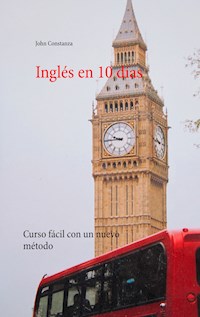
El libro contiene relatos cortos en inglés con traducción y un sencillo curso de idiomas. La primera parte comunica los conocimientos indispensables para un viaje. La segunda parte es voluntaria. Es necesario aprender primero sólo la primera parte. Con un nuevo método es posible en 10 días. Más tarde uno puede aprender la parte voluntaria y el vocabulario restante. La primera parte fue escrita para principiantes. Con la segunda parte uno puede refrescar los conocimientos de inglés.
Sie lesen das E-Book in den Legimi-Apps auf:
Seitenzahl: 78
Veröffentlichungsjahr: 2019
Das E-Book (TTS) können Sie hören im Abo „Legimi Premium” in Legimi-Apps auf:
Ähnliche
















Índice
El control aduanero.
La pronunciación.
¿Dónde está la estación?
Artículos.
La huelga.
Sustantivos.
La avería.
Adjetivos.
Primer encuentro.
Verbos.
El traje de novia.
El perfecto.
La luna de miel.
Pronombres.
La llegada en el hotel
.
Pronombres.
En el restaurante.
Espacio y tiempo.
Expresiones importantes.
Vocabulario
Primero día
Transcripsión fonética (TF) y pronunciación
Hay una buena manera de aprender la pronunciación: Si ‘Google‘ traduce un texto en español en un texto inglés, se puede escuchar el texto inglés. ll signo ‘ indica la sílaba acentuada.
Vocales
TF
como
inglés
TF
español
a
barco
but
bat
pero
(breve)
aa
más larga
park
p
aa
k
parque
(larga)
que madre
ae
perro
man
m
ae
n
hombre
e
debido
after
‘aaft
e
r
tras
(cerrada)
e
llover
let
l
e
t
dejar
(abierta)
i
más breve
kiss
k
i
s
beso
(breve)
que en si
ii
meet
m
ii
t
encontrar
(larga)
o
torre
hot
h
o
t
caliente
(breve)
oo
course
k
oo
s
curso
(larga)
oe
neuf (francés)
learn
l
oe
n
aprender
(abierta)
u
más cerrado
book
b
u
k
libro
(breve)
que burro
uu
uno
room
r
uu
m
habitación
(larga)
Diptongos
ai
baile
time
t
a
im
tiempo
au
pausa
now
n
au
ahora
ei
e cerrada
day
d
ei
día
seguida por un i débil
e
e
there
th
e
e
allá
ie
here
h
ie
aquí
oi
voy
boy
b
oi
chico
ou
show(inglés)
home
h
ou
m
casa
ue
tour
t
ue
r
vuelta
Consonantes
Un sonido sonoro está subrayado.
b
embargo
big
b
ig
grande
d
aldea
day
d
ei
día
g
gracias
go
g
ou
ir
h
jota hispano-americana
home
h
oum
casa
j
ya
yes
j
e
s
sí
k
kilo
come
k
am
venir
ng
vinculo
sing
si
ng
cantar
s
casa
see
s
ii
ver
(sorda)
s
desde
rose
rou
s
rosa
(sonora)
sch
fish (inglés)
shop
sch
op
tienda
(sorda)
tsch
chocolate
much
ma
tsch
mucho
sch
génie (francés)
dsch
job (inglés)
bridge
bri
dsch
puente
th
zapata
thick
th
ik
gordo
th
juzgado
with
wi
th
con
v
uva
very
‘
v
eri
mucho
w
como v en uva
with
w
ith
con
f, l, m, n, p, t, iquales que en español.
La pronunciación del alfabeto
A ei, B bii, C sii, D dii, E ii, F ef, G dschii,
H eitsch, I ai, J dschei, K kei, L el, M em,
N en, O ou, P pii, Q kjuu, R aar, S es, T tii,
U juu, V vii, W ‘dabljuu, X eks, Y wai, Z sed
Abreviaturas
E
ejemplo
R
regla
Sg
singular
Pl
plural
V
parte voluntaria
Por favor aprender las palabras con subrayado en el vocabulario de abrigo a bebida.
En cada capitulo, primero lea la sección de gramática y luego el cuento.
Por favor leer el siguiente texto en voz alta. Es de gran importancia: leer, hablar y escuchar el texto al mismo tiempo.
El control aduanero / The customs check
Lugar: Aeropuerto en Londres
una turista T, funcionario de aduanas F
F
Buenos días. Good afternoon (gud ‘aaftenuun). Su pasaporte, por favor. Your passport please (jur ‘paaspoot pliis). El pasaporte está caducado. The passport has expired (haes ik‘spaied).
T
He aquí mi tarjeta de identidad. This is my identity card (mai ai‘d
e
ntiti kaad). He viajado por España durante mucho tiempo. I have been travelling for a long time in Spain (ai haev biin traevling foor e long taim in spein). ¿Hay algo de nuevo en Gran Bretaña? Is there anything new in Great Britain (is th
e
er ‘
e
nithing njuu in greit‘briten)?
F
No sé nada de nuevo. I do not know anything new (ai duu not nou ‘
e
nithing njuu). ¿Tiene algo que declarar? Do you have anything to declare (duu juu haev ‘
e
nithing tuu di’kl
e
er)?
T
No tengo nada que declarar. I do not have anything to declare.
F
Abrir esta maleta. Open this case (oupen this keis). Ahora sé algo de nuevo para usted. Now I know something new for you (nau ai nou ‘samthing njuu foor juu). Ha de pagar aduana sobre esto. You have to pay duty on this (juu haev tuu pei ‘djuuti on this).
T
Pero esto es un regalo. But (bat) this is a gift.
F
¿Para quien? For whom (foor huum)?
T
Para usted. For you.
F
Muchas gracias. Thank you very much.
Segundo día
¿Dónde está la estación / Where is the station?
Lugar: Londres
un turista T, una señora S
T
Perdone, señora. Excuse me madam (ik’skjuus mii ‘maedem). ¿Me podría dar alguna información‘? Could you give me some information (kud juu giv mii sam infe’meischen)? ¿Dónde está la estación Victoria? Where is Victoria Station?
S
En el centro. In the city center (‘siti ‘s
e
nter).
T
¿Se puede ir a pie? Can I go on foot (kaen ai gou on fut)?
S
No es posible ir a pie porque la estación está a una distancia de diez kilómetros. It is not possible because the station is ten kilometres from here (t
e
n ki‘lomiters from hier).
T
¿Cómo se va a la estación de tren? How do I get to the station (hau duu ai get tuu the ‘steischen)?
S
¿Quieres viajar en autobús o en metro‘? Would you like to go by bus or by underground (wud ju laik tuu gou bai bas oor bai ‘andegraund)? Ambos conducen a la estación. Both of them go to the station (bouth of th
e
m gou tuu the ‘steischen).
T
No me importa. It’s all the same (seim) to me. Dónde hay una parada de autobús o una estación de metro? Where is
a
bus stop or
an
underground
station (w
e
er is a bas stop or an ‘andegraund ‘steischen)?
S
Allá hay una parada de autobús. There is a bus stop.
T
¿Qué autobús va a la estación? Which (witsch) bus goes (gous) to the station?
S
Tiene que coger el autobús número seis. You have to take the bus number six (‘namber ).
T
¿Cuántas paradas quedan para la estación? How many (m
e
ni) stops are (aar) there until (en’til) the station?
S
Lo siento, no lo sé. Sorry, I do not know
.
T
No importa. It does (das) not matter (‘maeter). Muchas gracias. Thank you very much (thaengk juu ‘v
e
ri matsch).
Pregunta 1 (P1): ¿
Qué regla de la gramática se puede derivar de las siguientes parolas:
a bus stop or an underground station? Respuesta R1
:
capitulo 2
(
C
2)
El artículo definido
E
El niño y las niñas van al profesor de inglés.
The
boy and
the
girls go to
the
English teacher.
TF:
The boi aend the goels gou tuu
thi
inglisch ‘tiitscher.
R
El artículo definido es siempre el mismo sin importar el género y el número del sustantivo asociado. La palabra ‘the‘ se pronuncia ‘
thi
‘ antes de las palabras que comienzan con una vocal.
V ¿Con o sin artículo?
E
La mayoría de los pianistas tuvieron éxito, pero Mary fue la más exitosa. Most (1) of the pianists were successful, but Mary was the most successful (2).
R
Most: sin artículo (1). Excepsión: En el superlativo con el artículo (2).
E
Mary toca el piano porque le encanta la música, especialmente la musica de Brahms. Mary plays the piano (1) because she likes music (2) above all the music of Brahms (3).
R
Si alguien toca un instrumento: instrumento con artículo (1).
Términos abstractos: sin artículo (2). Para una explicación más detallada del término abstracto: término con artículo (3).
E
El lunes, Mary va en autobús a Regent‘s Park, Regent Street, Piccadilly Circus y Royal Albert Hall.
On Monday (1) Mary goes by bus (2) to Regent’s Park (3), Regent Street (4), Piccadilly Circus (5) and Royal Albert Hall (6).
R
Sin artículo: días de la semana y meses, mediante transporte (2), nombres de parques (3), calles (4), plazas (5) (
R 11
) y edificios (6).
E
Despuès del concierto, Mary invita a algunos amigos al ‘Ritz‘ para la cena. After the concert Mary invites some friends to the Ritz (1) for dinner (2).
R
Nombre del hotel: con artículo (1). Comidas: sin articulo (2).
E
El proximo concierto es en Europa. En el vuelo a Suiza, Mary ve el Támesis, el océano Atlántico, el lago de Ginebra y el Mont Blanc. The next concert is in Europe (1). On the flight to Switzerland (2) Mary sees the Thames (3), the Atlantic Ocean (4), Lake Geneva (5) and Mont Blanc (6).
R
Sin artículo: continentes (1), países (2). Con artículo: ríos (3), océanos(4). Sin artículo: Lagos (5), montañas (6).
E
En el avión Mary necesita la mitad del tiempo, pero paga el doble del precio. By air Mary needs half the time but pays double the price.
R
El artículo está detrás: half y double.
El artículo indefinido
E
Un pianista europeo y un violinista estadounidense dieron un concierto de una hora.
A c
oncert (1) was given by
a Eu
ropean (2) pianist and
an A
merican (3) violinist for
an h




