


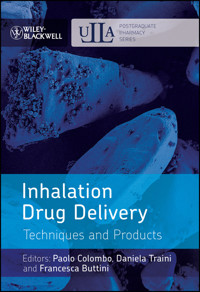
Inhalation Drug Delivery E-Book
66,99 €
Mehr erfahren.
- Herausgeber: John Wiley & Sons
- Kategorie: Wissenschaft und neue Technologien
- Serie: Postgraduate Pharmacy Series
- Sprache: Englisch
There has been a rapid evolution in the field of inhalation drug therapy, including new drugs, increased regulation and quality control, and strong pressure from generics. Inhalation Drug Therapy brings together the most current inhalation drug research, as well as practical developments and processes, into one essential guide. Focusing on inhalation products and specific equipment and techniques used in manufacturing and quality control, the book balances research with the industrial aspects of creating the drugs, and features a highly regarded author team with both academic and industry experience.
Sie lesen das E-Book in den Legimi-Apps auf:
Seitenzahl: 330
Veröffentlichungsjahr: 2012
Ähnliche




















Contents
Cover
Title Page
Copyright
List of Contributors
Series Foreword
Preface
Chapter 1: Inhalation Drug Delivery
1.1 Introduction
1.2 Brief Review of the Respiratory System and its Physiology
1.3 Deposition and the Fate of Particles in the Respiratory Tract
1.4 Deposition Mechanisms
1.5 Parameters Influencing Particle Deposition
1.6 The Clearance of Deposited Particles
1.7 Airways Geometry and Humidity
1.8 Lung Clearance Mechanisms
1.9 Local and Systemic Drug Delivery
1.10 Conclusion
References
Chapter 2: Inhalation and Nasal Products
2.1 Introduction
2.2 Dry Powder Inhalers (DPIs)
2.3 Liquid and Propellant-Based Inhalers
2.4 Nasal Formulations
2.5 Conclusion
References
Chapter 3: Formulation of Inhalation Medicines
3.1 Introduction
3.2 Pressurized Metered-Dose Inhaler (pMDI) Formulation
3.3 Dry Powder Inhaler (DPI) Formulation
3.4 Conclusion
References
Chapter 4: Novel Particle Production Technologies for Inhalation Products
4.1 Introduction
4.2 Conventional Crystallization and Milling
4.3 Specialized Milling
4.4 Solvent Precipitation
4.5 Spray-Drying and Related Droplet Evaporation Methods
4.6 Supercritical Fluid (SCF) Technology
4.7 Conclusion
Acknowledgments
References
Chapter 5: Methods for Understanding, Controlling, Predicting, and Improving Drug Product Performance
5.1 Introduction
5.2 Particle Sizing
5.3 Powder and Particulate Characterization Systems
5.4 Practical Issues in Process Control
5.5 Biopharmaceutical Powder Stability
5.6 Liquids: Solutions and Suspensions
5.7 Conclusion
References
Chapter 6: Aerodynamic Assessment for Inhalation Products: Fundamentals and Current Pharmacopoeial Methods
6.1 Introduction
6.2 Impactor/Impinger Design
6.3 Aerodynamic Assessment
6.4 Inertial Impaction and Cut-Off Diameter
6.5 Pharmacopoeial Procedure
6.6 Cascade Impactor: General Set-Up and Operation
6.7 Impactor/Impinger Characteristics
6.8 Data Analysis
6.9 Cleaning Instructions for Impactors
6.10 Test Limitations
6.11 Future Considerations
References
Chapter 7: Proteins, Peptides, and Controlled-release Formulations for Inhalation
7.1 Proteins and Peptides for Inhalation
7.2 Controlled-Release Formulations for Inhalation
References
Chapter 8: Pharmaceutical Development Studies for Inhalation Products
8.1 Introduction
8.2 Pharmaceutical Development Studies for Inhalation Products
8.3 Conclusion
Acknowledgements
References
Chapter 9: Quality of Inhalation Products: Specifications
9.1 Introduction
9.2 Inhalation-Product Specifications
9.3 Additional Quality Aspects
References
Index
This edition first published 2013. © 2013 by John Wiley & Sons, Ltd
Wiley-Blackwell is an imprint of John Wiley & Sons, formed by the merger of Wiley's global Scientific, Technical and Medical business with Blackwell Publishing.
Registered office: John Wiley & Sons, Ltd, The Atrium, Southern Gate, Chichester, West Sussex, PO19 8SQ, UK
Editorial offices: 9600 Garsington Road, Oxford, OX4 2DQ, UK
The Atrium, Southern Gate, Chichester, West Sussex, PO19 8SQ, UK
111 River Street, Hoboken, NJ 07030-5774, USA
For details of our global editorial offices, for customer services and for information about how to apply for permission to reuse the copyright material in this book please see our website at www.wiley.com/wiley-blackwell
The right of the author to be identified as the author of this work has been asserted in accordance with the UK
Copyright, Designs and Patents Act 1988.
All rights reserved. No part of this publication may be reproduced, stored in a retrieval system, or transmitted, in any form or by any means, electronic, mechanical, photocopying, recording or otherwise, except as permitted by the UK Copyright, Designs and Patents Act 1988, without the prior permission of the publisher. Designations used by companies to distinguish their products are often claimed as trademarks. All brand names and product names used in this book are trade names, service marks, trademarks or registered trademarks of their respective owners. The publisher is not associated with any product or vendor mentioned in this book. This publication is designed to provide accurate and authoritative information in regard to the subject matter covered. It is sold on the understanding that the publisher is not engaged in rendering professional services. If professional advice or other expert assistance is required, the services of a competent professional should be sought.
The contents of this work are intended to further general scientific research, understanding, and discussion only and are not intended and should not be relied upon as recommending or promoting a specific method, diagnosis, or treatment by physicians for any particular patient. The publisher and the author make no representations or warranties with respect to the accuracy or completeness of the contents of this work and specifically disclaim all warranties, including without limitation any implied warranties of fitness for a particular purpose. In view of ongoing research, equipment modifications, changes in governmental regulations, and the constant flow of information relating to the use of medicines, equipment, and devices, the reader is urged to review and evaluate the information provided in the package insert or instructions for each medicine, equipment, or device for, among other things, any changes in the instructions or indication of usage and for added warnings and precautions. Readers should consult with a specialist where appropriate. The fact that an organization or Website is referred to in this work as a citation and/or a potential source of further information does not mean that the author or the publisher endorses the information the organization or Website may provide or recommendations it may make. Further, readers should be aware that Internet Websites listed in this work may have changed or disappeared between when this work was written and when it is read. No warranty may be created or extended by any promotional statements for this work. Neither the publisher nor the author shall be liable for any damages arisingherefrom.
Library of Congress Cataloging-in-Publication Data
Colombo, Paolo, 1944-
Inhalation drug delivery : techniques and products / Paolo Colombo, Daniela Traini, and Francesca Buttini.
p. ; cm.
Includes bibliographical references and index.
Summary: “Provides students and those in industry with concise clear guide to the essential fundamentals in inhalation drug delivery”–Provided by publisher.
ISBN 978-1-118-35412-4 (hardback)
I. Traini, Daniela. II. Buttini, Francesca. III. Title.
[DNLM: 1. Administration, Inhalation. 2. Drug Delivery Systems–methods. WB 342]
615′.6–dc23
2012028075
A catalogue record for this book is available from the British Library.
Wiley also publishes its books in a variety of electronic formats. Some content that appears in print may not be available in electronic books.
List of Contributors
Francesca Buttini
Department of Pharmacy, The University of Parma, Parma, Italy
Hak-Kim Chan
Advanced Drug Delivery Group, Faculty of Pharmacy, The University of Sydney, Sydney, Australia
Gaia Colombo
Department of Pharmaceutical Sciences, The University of Ferrara, Ferrara, Italy
Paolo Colombo
Department of Pharmacy, The University of Parma, Parma, Italy
Philip Chi Lip Kwok
Department of Pharmacology and Pharmacy, LKS Faculty of Medicine, The University of Hong Kong, Hong Kong, China
David A.V. Morton
Monash Institute of Pharmaceutical Sciences, Monash University, Melbourne, Australia
Chiara Parlati
Department of Pharmacy, The University of Parma, Parma, Italy; Novartis V&D, Technology Development, Siena, Italy
Paola Russo
Department of Pharmaceutical and Biomedical Sciences, The University of Salerno, Fisciano, Italy
Rania Osama Salama
Advanced Drug Delivery Group, Faculty of Pharmacy, The University of Sydney, Sydney, Australia; Faculty of Pharmacy, Alexandria University, Egypt
Daniela Traini
Respiratory Technology, The Woolcock Institute of Medical Research & The Discipline of Pharmacology, The University of Sydney, Sydney, Australia
Wong Tin Wui
Faculty of Pharmacy, Universiti Teknologi MARA, Puncak Alam, Selangor, Malaysia
Paul M. Young
Respiratory Technology, The Woolcock Institute of Medical Research & The Discipline of Pharmacology, The University of Sydney, Sydney, Australia
Series Foreword
ULLA Postgraduate Pharmacy Series
The ULLA series is an innovative series of introductory text-books for postgraduate students in the pharmaceutical sciences.
This series is produced by the ULLA Consortium (European University Consortium for Advanced Pharmaceutical Education and Research). The Consortium is a European academic collaboration in research and teaching of the pharmaceutical sciences that is constantly growing and expanding. The Consortium was founded in 1990 and consists of pharmacy department from leading universities throughout Europe including:
Faculty of Pharmacy, Uppsala University, SwedenSchool of Pharmacy, University of London, UKLeiden/Amsterdam Center for Drug Research, University of Leiden, The NetherlandsVrije Universiteit Amsterdam, The NetherlandsSchool of Pharmaceutical Sciences, University of Copenhagen DenmarkFaculty of Pharmacy, Universities of Paris Sud, FranceFaculty of Pharmacy, University of Parma, ItalyFaculty of Pharmaceutical Sciences, Katholieke Universiteit, BelgiumThe editorial board for the ULLA series consists of several academics from these European Institutions who are all experts in their individual field of pharmaceutical science.
Previous titles include:
The titles in this ground breaking series are primarily aimed at PhD students and will also have global appeal to postgraduate students undertaking masters of diploma courses, undergraduates for specific courses, and practising pharmaceutical scientists.
Further information on the Consortium can be found at www.u-l-l-a.org
Preface
This book aims to provide a comprehensive and up-to-date understanding of the processes and mechanisms involved in inhalation drug delivery, with a strong focus on inhalation products and specific equipment and techniques used in laboratories today. It will accurately reflect the current state of our knowledge in the field of inhalation and will provide a good basis for the development of this knowledge. Theory will be covered, providing balanced new perspectives by drawing on research from a variety of fields and from industrial experience.
This book is intended as an aid to those studying pharmacy, pharmaceutical science and technology, or related subjects, at both undergraduate and postgraduate levels. Students will benefit from the concise presentation of a great deal of relevant information, and will find this book an invaluable tool for understanding the field of inhaled pharmaceutical aerosols.
1
Inhalation Drug Delivery
Daniela Traini
Respiratory Technology, The Woolcock Institute of Medical Research & The Discipline of Pharmacology, The University of Sydney, Sydney, Australia
1.1 Introduction
The lung offers a unique and challenging route for drug delivery for the treatment of local respiratory and systemic diseases. Advances in drug formulation and inhalation device design are creating new opportunities for inhaled drug delivery as an alternative to oral and parenteral delivery methods. Nebulizers, pressurized metered-dose inhalers (pMDIs), and dry powder inhalers (DPIs) have each found a niche in the quest for optimal treatment and convenient use. While nebulizers have evolved relatively independently of the drug formulations they deliver, the current generation of pMDIs and DPIs have been developed or tailored for the specific pharmaceutical being delivered, resulting in improved performance. However, the process of delivering drugs to the lung is not simple and is related to many factors associated with the inhaled product and the patient. This chapter will briefly review the anatomy and physiology of the lungs and the various parameters that influence drug deposition.
1.2 Brief Review of the Respiratory System and its Physiology
The respiratory tract comprises the conducting and the respiratory regions. The conducting region essentially consists of the nasal cavity, nasopharynx, bronchi, and bronchioles. Airways distal to the bronchioles and the alveoli constitute the respiratory region, where rapid solute exchange takes place. According to Wiebel's tracheobronchial classification [1], the conducting airways comprise the first 16 generations, and generations 17–23 include the respiratory bronchioles, the alveolar ducts, and the alveolar sacs.
Lesen Sie weiter in der vollständigen Ausgabe!
Lesen Sie weiter in der vollständigen Ausgabe!
Lesen Sie weiter in der vollständigen Ausgabe!
Lesen Sie weiter in der vollständigen Ausgabe!
Lesen Sie weiter in der vollständigen Ausgabe!
Lesen Sie weiter in der vollständigen Ausgabe!
Lesen Sie weiter in der vollständigen Ausgabe!
Lesen Sie weiter in der vollständigen Ausgabe!
Lesen Sie weiter in der vollständigen Ausgabe!




