


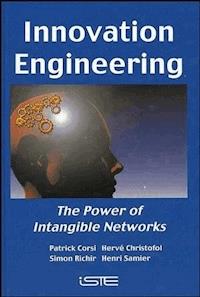
Innovation Engineering E-Book
229,99 €
Mehr erfahren.
- Herausgeber: John Wiley & Sons
- Kategorie: Wissenschaft und neue Technologien
- Sprache: Englisch
This title explores the issue of innovation engineering, a feature that is essential to the continuation of growth and development in the commercial world. Discussion is divided into three parts: Part I covers the historical basis of innovation, noting that diversity rests upon a duality between concepts in theory and applications put into practice, as well as discussing how innovation has resulted from the interaction of numerous factors, be they societal, human, managerial, organization or technological. Part II focuses on practical applications - the technologies, tools and methods employed in putting theoretical innovation into practice - while Part III looks at what factors underpin success, discussing the social and psychological aspects involved in successful innovation engineering. Consideration is also given to recent developments and systems which will assist in ensuring the continuation of this process in the future.
Sie lesen das E-Book in den Legimi-Apps auf:
Seitenzahl: 689
Veröffentlichungsjahr: 2013
Ähnliche




















Table of Contents
PART 1: The Global Innovation World: Which Visions Ahead?
Introduction
Chapter 1: Inventing the Future
1.1. Innovation
1.2. Futures thinking
1.3. Change and network
Chapter 2: Innovation Management: How to Change the Future
2.1. The innovation, beyond technique
2.2. Innovations in an era of digital networks
2.3. Shortsightedness against innovation
2.4. Innovation as a process of creation of values
2.5. Conclusion
Chapter 3: From Knowledge to Business: Virtual Encounters Propagate Innovation
3.1. Where information society mixes up our linear and local schemes
3.2. Knowledge on the move through networks: examples of innovation processes
3.3. Three laws underpinning technological evolution
3.4. How do virtual encounters ride the technology lifecycle curve?
3.5. The virtual human interface (VHI) brings a new meaning to communication
3.6. The emotional modulation opens up new business spaces
3.7. The requirements for a VHI
3.8. Bridging the digital divide: should not we replace the ill-fated WIMP interface?
Chapter 4: Value Management’s Creative-Destruction via Digitalized Innovation: The Winning Plan
4.1. Introduction
4.2. The straightjacket of selling training and certification agenda
4.3. What exactly does innovation mean?
4.4. Value management: a long history
4.5. Definitions and rigidity
4.6. Potential of “valorique” in relation to the innovation
4.7. Digital technology, networking and an ability to innovate differently
4.8. VM and digital networks
Chapter 5: Research, Innovation and Technological Development
5.1. Introduction
5.2. Science, technology and innovation: building regional capacities
5.3. Technology and global science for a better development
5.4. Innovation and economic advance
5.5. Investing in science, technology and education
5.6. Conclusion
Chapter 6: Sustainable Innovation through Community Based Collaborative Environments
6.1. Introduction
6.2. Components of collaboration
6.3. A systematic approach to collaboration
6.4. The collaborative enterprise
6.5. Innovative enterprise networks
6.6. Concurrent engineering
6.7. Adaptation of the collaboration process
6.8. Management of a collaborative project
6.9. Conclusions
Chapter 7: New Spaces for Innovation, New Challenges
7.1. Introduction
7.2. Internet waves
7.3. Strategies of innovation
7.4. Hyperspace: new dimension of innovation
7.5. Cyberenergy and cyberentropy
7.6. Conclusions
PART 2: Tooling Innovation: Which Methods to Play and How?
Introduction
Chapter 8: Knowledge Management for Innovation
8.1. Introduction
8.2. Innovation and knowledge
8.3. Reports
8.4. Knowledge: some “organizers”
8.5. Cultures, methods and tools
8.6. Key factors
8.7. Conclusions and openings
Chapter 9: Integration of Stylistics and Uses: Trends in the Innovation Process
9.1. Theories and concepts of stylistic innovation
9.2. Methods and tools of stylistic innovation
9.3. The step of stylistic monitoring and its application in designing the automobile trends panel
9.4. Conclusion
Chapter 10: Virtual Reality Technologies for Innovation
10.1. Introduction
10.2. The digital chain of conceptualization in the enterprise
10.3. Work on virtual project platforms
10.4. Virtualization of professions
10.5. What virtual environments really mean
10.6. The challenge ahead
Chapter 11: TRIZ: A New Method of Innovation
11.1. Introduction
11.2. A deterministic vision of future technologies
11.3. Conclusion
Chapter 12: C4 Innovation Method: A Method for Designing Innovations
12.1. Introduction
12.2. The approach of innovation in the commercial domain of EDF R&D
12.3. The C4 method
12.4. Diverse experimentations of the process
12.5. Some new tools to facilitate the collaboration and the contextualization; towards an instrumentation of the process: “IdéoFil” and “StoryoFil”
12.6. Conclusions
Chapter 13: Creativity World
13.1. Introduction
13.2. Reflections on creativity
13.3. A human concept
13.4. The state to being one with the environment
13.5. The age of networks
PART 3: Innovation Management:Which Factors Underpin Success?
Introduction
Chapter 14: Psychology of Innovation and Change Factors
14.1. Introduction
14.2. Innovation and research
14.3. Change in mentality
14.4. The principal cultural indicators for innovation
14.5. Conclusion
Chapter 15: Intellectual Property for Networks and Software
15.1. Introduction
15.2. State of the problems and the protagonists
15.3. The main “nodes” in intellectual property amidst the networks operated in the context of innovation
15.4. Intellectual property rights applicable to the context of networks
15.5. Copyright “software” against networks
15.6. Free software
15.7. Protection through patents for communication software and networks
15.8. Actors in the networks and intellectual property
15.9. Digital Rights Management (DRM)
15.10. When the networks themselves become tools for intellectual property
15.11. Enforcing intellectual property rights on the network scale
15.12. Conclusion: intellectual property and the networks: an advantage for innovation
Chapter 16: Innovation Scoreboard for Core Competencies Evaluation
16.1. Introduction
16.2. Locations of the immaterial capital
16.3. Competences to innovate
16.4. The key to the creation of knowledge
16.5. The valorization of innovation in terms of the scoreboard
16.6. Conclusion
Chapter 17: Financing Innovation
17.1. Needs for financing associated with innovation
17.2. Adaptation of resources to innovation: “patient” and “loseable” money
17.3. The financial system of innovation
17.4. Conclusion
Chapter 18: Innovation on the Web
18.1. Introduction
18.2. Distribution model: Open Source and software patents
18.3. An enormous base of information
18.4. Marketing and innovation on the Web
18.5. A fantastic tool for sharing
18.6. E-commerce: a soufflé fallen flat?
18.7. Conclusion
Chapter 19: Virtual Decision Support System for Innovation
19.1. Introduction
19.2. From the management of innovation to the management of design
19.3. Intermediary virtual representations in the industrial context and transmissible via the Internet
19.4. Developing a decision-making aid with joint analysis software
19.5. Implementation of the software in SME of packaging creation
19.6. Analysis of contributions of VIR with joint analysis in designing
19.7. Perspectives
19.8. Conclusion
Chapter 20: Shapes, Knowledge and Innovation
20.1. Introduction
20.3. The spatial quantification of an object
20.4. Overall finding
Bibliography
List of Authors
Index
Part of this book adapted from “L’innovation à l’ère des réseaux” published in France by Hermès Science/Lavoisier in 2004
First published in Great Britain and the United States in 2006 by ISTE Ltd
Apart from any fair dealing for the purposes of research or private study, or criticism or review, as permitted under the Copyright, Designs and Patents Act 1988, this publication may only be reproduced, stored or transmitted, in any form or by any means, with the prior permission in writing of the publishers, or in the case of reprographic reproduction in accordance with the terms and licenses issued by the CLA. Enquiries concerning reproduction outside these terms should be sent to the publishers at the undermentioned address:
ISTE Ltd6 Fitzroy SquareLondon W1T 5DXUKISTE USA4308 Patrice RoadNewport Beach, CA 92663USAwww.iste.co.uk
© ISTE Ltd, 2006
© LAVOISIER, 2004
The rights of Patrick Corsi, Simon Richir, Hervé Christofol and Henri Samier to be identified as the authors of this work have been asserted by them in accordance with the Copyright, Designs and Patents Act 1988.
British Library Cataloguing-in-Publication Data
A CIP record for this book is available from the British Library
ISBN 10: 1-905209-55-X
ISBN 13: 978-1-905209-55-2
PART 1
The Global Innovation World: Which Visions Ahead?
Introduction
This first part introduces the historical basis of innovation as well as the relationships with foresight with a view to understand what levers to act upon in order to create a new wealth. Such wealth lies in human resources, changes in individual and collective behaviors, and management styles that are associated to networked organizations and finally new creation and collaboration spaces.
Each chapter stresses some theoretical foundations that are required for a deeper understanding of innovation and is illustrated with practical cases and applications. We state that diversity in innovation always rests upon a duality between “theory” (the concepts) and “practice” (applications). The variety of the seeds to innovation, be they human, affective, technological or organizational, means it is necessary to create a method on how to put into use the proposed steps within enterprises and organizations.
We introduce foresight and innovation in order to analyze how these two disciplines cross-fertilized themselves throughout their history. Then we explain that innovation results from the interaction of societal, human, managerial, organizational, scientific and technological components.
We develop the notion of collaborative networks made of individuals, projects and enterprises in a way similar to communities of practices based on the evidence that an optimal functioning of a technological network is founded on individuals and their competencies first. On a side account, the systemic propagation of innovation will lead us towards new concepts through an analysis of enterprise cases.
We then discover new realms of innovation based on information technologies that own their own laws and therefore are characterized differently from classical innovation areas. We develop networks of innovation through their modeling, organizational and information technologies aspects while taking care of analyzing the existing and future impact on employment and remote working relationships.
Finally we shed light upon value management and the enabling the notion of “valorization” that bridges working methods and enterprise goals.
In so doing, this first part delivers a number of realistic views about innovation while decoding the intrinsic complexity of a discipline that is resolutely multi-dimensional, pluridisciplinary and, above all, intensely compelling.
Chapter 1
Inventing the Future1
“Tomorrow will not be like yesterday. It will be new and will depend on us. It is less to discover than to invent. The future of the ancient man had to be revealed. The future of the 19th century scholar could be forecast. Our future is to be built by invention and work. We have been progressively freed from material job by our machines, only to be asked to provide more and more intellectual work, really human work, that is, invention” [BER 64].
When reading this quotation from Gaston Berger, father of the French “prospective”, one immediately understands the very close link between futures thinking and innovation, thus breaking with a future-oriented thinking, which is traditionally more retrospective (projecting the past onto the future) than “prospective” (imagining new futures).
What are we talking about? Fashionable notions today, innovation and future thinking are in fact very complex objects that are not easy to categorize; the effort to explain them before describing them is seldom taken. That is why we will first undertake to define some concepts and then explain some of the basics of futures thinking.
An innovative look through futures thinking on innovation and a future-oriented contribution of innovation to futures thinking: the cross-fertilization of these two attitudes towards the future — indissolubly linked — can restore meaning and purpose to the shaping of our future.
So, first of all, we will precisely define the notion of innovation and show the profile of the innovator; then we will introduce the field of futures thinking and the notion of change. Finally, we will show what futures thinking can bring to innovation and how the former contributes to the latter in order to invent the future.
1.1. Innovation
“The problem of the future transforms itself and, to some extent, simplifies itself when, rather than over-emphasizing the prospective discoveries, one thinks on the basis of manifested needs or satisfaction of deep expectations” [BER 60].
What are we talking about when we speak of innovation today? Let’s define the nature of innovation itself before we turn to the more human-oriented profile of the innovator.
1.1.1. How should innovation be designed?
Three distinctive approaches help to encompass the topic and reveal its main points.
1.1.1.1. A change
First of all, an innovation is a change. As such, it directly engages futures thinking, which is a field of studying, creating and leading change.
The word “innovation” comes from the verb “to innovate” which means to “introduce something new” or to introduce “a new idea, method, or device”.
The introduction of this novelty goes through various different processes according to its domain. In the economy, this is the introduction within the process of production or sale of a new product, equipment or process, which presupposes a phenomenon of integration of the novelty into the existing process. In sociology, innovation is defined as a process of influence that leads to a social change and whose effect is the rejection of the existing social norms and the adoption of new ones. Within this framework, the problem is less about integrating innovation with what already exists than substituting a new system for the previous one.
Alongside these definitions are two fundamental approaches to innovation. The first one helps to distinguish between innovation and invention; the second one between two different natures of innovation: incremental innovation and radical innovation.
1.1.1.2. A contextualized process
Innovation is different from invention, although it also manifests itself in change. Yet a change occurring at the level of the object itself creates only a change “in itself”, independently of specific contexts, while the change induced by innovation modifies a set of strongly differentiated processes (e.g., from the assembly line to the final use of the product). For if invention is defined as “the action to imagining, inventing, creating something new” or “the faculty to find something, to create by imagination”, then innovation, especially in the economy, defines itself as “the whole process proceeding from the beginning of an idea until its materialization (the launching of a new product), through market research, the development of the prototype and the first steps of the production”.
Moreover, innovation can change the modes of distribution, of consumption, even the recycling of the innovative object. In doing so, innovation can extend its ramifications, induced impacts, even to its modes of payment, transportation or interpersonal communication. This is how it constitutes a process, at the opposite end of invention which is only a specific moment whose effects are limited to the object of invention.
Lesen Sie weiter in der vollständigen Ausgabe!
Lesen Sie weiter in der vollständigen Ausgabe!
Lesen Sie weiter in der vollständigen Ausgabe!
Lesen Sie weiter in der vollständigen Ausgabe!
Lesen Sie weiter in der vollständigen Ausgabe!
Lesen Sie weiter in der vollständigen Ausgabe!
Lesen Sie weiter in der vollständigen Ausgabe!
Lesen Sie weiter in der vollständigen Ausgabe!
Lesen Sie weiter in der vollständigen Ausgabe!
Lesen Sie weiter in der vollständigen Ausgabe!
Lesen Sie weiter in der vollständigen Ausgabe!
Lesen Sie weiter in der vollständigen Ausgabe!
Lesen Sie weiter in der vollständigen Ausgabe!
Lesen Sie weiter in der vollständigen Ausgabe!
Lesen Sie weiter in der vollständigen Ausgabe!
Lesen Sie weiter in der vollständigen Ausgabe!
Lesen Sie weiter in der vollständigen Ausgabe!
Lesen Sie weiter in der vollständigen Ausgabe!
Lesen Sie weiter in der vollständigen Ausgabe!
Lesen Sie weiter in der vollständigen Ausgabe!
Lesen Sie weiter in der vollständigen Ausgabe!
Lesen Sie weiter in der vollständigen Ausgabe!
Lesen Sie weiter in der vollständigen Ausgabe!
Lesen Sie weiter in der vollständigen Ausgabe!
Lesen Sie weiter in der vollständigen Ausgabe!
Lesen Sie weiter in der vollständigen Ausgabe!




