


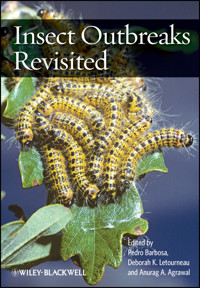
Insect Outbreaks Revisited E-Book
92,99 €
Mehr erfahren.
- Herausgeber: John Wiley & Sons
- Kategorie: Wissenschaft und neue Technologien
- Sprache: Englisch
The abundance of insects can change dramatically from generation to generation; these generational changes may occur within a growing season or over a period of years. Such extraordinary density changes or "outbreaks" may be abrupt and ostensibly random, or population peaks may occur in a more or less cyclic fashion. They can be hugely destructive when the insect is a crop pest or carries diseases of humans, farm animals, or wildlife. Knowledge of these types of population dynamics and computer models that may help predict when they occur are very important.
This important new book revisits a subject not thoroughly discussed in such a publication since 1988 and brings an international scale to the issue of insect outbreaks.
Insect Outbreaks Revisited is intended for senior undergraduate and graduate students in ecology, population biology and entomology, as well as government and industry scientists doing research on pests, land managers, pest management personnel, extension personnel, conservation biologists and ecologists, and state, county and district foresters.
Sie lesen das E-Book in den Legimi-Apps auf:
Seitenzahl: 1074
Veröffentlichungsjahr: 2012
Ähnliche




















Contents
Contributors
Preface
PART I PHYSIOLOGICAL AND LIFE HISTORY PERSPECTIVES
1 Insect Herbivore Outbreaks Viewed through a Physiological Framework: Insights from Orthoptera
1.1 Introduction
1.2 Which conditions favor the individual, and can lead to insect herbivore outbreaks?
1.3 The plant-stress paradigm
1.4 Insect herbivore outbreaks – where do we go from here?
2 The Dynamical Effects of Interactions between Inducible Plant Resistance and Food Limitation during Insect Outbreaks
2.1 Introduction
2.2 Inducible resistance and insect outbreaks
2.3 Food limitation and insect outbreaks
2.4 Interactive effects of inducible resistance and food limitation
2.5 A note on multiple drivers of outbreaks
2.6 Future directions
2.7 Concluding remarks
3 Immune Responses and Their Potential Role in Insect Outbreaks
3.1 Introduction
3.2 The insect immune response
3.3 Sources of variation in immune response associated with outbreaks
3.4 Traits or conditions associated with outbreak species
3.5 Hypotheses on insect outbreaks and the immune response
3.6 Conclusions
4 The Role of Ecological Stoichiometry in Outbreaks of Insect Herbivores
4.1 Introduction
4.2 Ecological and biological stoichiometry
4.3 Nutrient ratios and insect herbivory
4.4 The growth rate hypothesis and insect outbreaks
4.5 Variance in host plant stoichiometry and insect outbreaks
4.6 Outbreak population dynamics models incorporating stoichiometry
4.7 Impact of insect outbreaks on plant and environmental stoichiometry
4.8 Ecological stoichiometry and natural enemy regulation of outbreaks
4.9 Conclusions
PART II POPULATION DYNAMICS AND MULTISPECIES INTERACTIONS
5 Plant-Induced Responses and Herbivore Population Dynamics
5.1 Introduction
5.2 Direct induced resistance and herbivory
5.3 Plant tolerance and herbivory
5.4 Plant indirect resistance affecting arthropod community interactions
5.5 Conclusion
6 Spatial Synchrony of Insect Outbreaks
6.1 Introduction
6.2 Quantifying synchrony
6.3 Causes of spatial synchrony
6.4 The ubiquity of synchrony and its implications
7 What Tree-Ring Reconstruction Tells Us about Conifer Defoliator Outbreaks
7.1 Introduction
7.2 Methodological considerations
7.3 Reconstructions of outbreak histories
7.4 Conclusions
8 Insect-Associated Microorganisms and Their Possible Role in Outbreaks
8.1 Introduction
8.2 Microbial assemblages within Insects
8.3 Can microbial genetic contributions facilitate host insect outbreaks?
8.4 Symbiosis-facilitated insect outbreaks in new habitats
8.5 Microbial symbionts as modulators of pest population dynamics
8.6 Manipulating microbes to affect insect outbreaks
PART III POPULATION, COMMUNITY, AND ECOSYSTEM ECOLOGY
9 Life History Traits and Host Plant Use in Defoliators and Bark Beetles: Implications for Population Dynamics
9.1 Introduction
9.2 Theoretical advances
9.3 Case study 1: Macrolepidoptera
9.4 Case study 2: Diprionid sawflies (Hymenoptera: Diprionidae)
9.5 Case study 3: Bark beetles (Curculionidae: Scolytinae)
9.6 Discussion and conclusions
10 The Ecological Consequences of Insect Outbreaks
10.1 Introduction
10.2 Outbreaking insects as consumers: Does outbreak herbivory reduce plant growth?
10.3 Outbreaking insects as ecosystem engineers: How do insect outbreaks affect succession?
10.4 Outbreaking insects as competitors: Do insect outbreaks increase competition?
10.5 Outbreaking insects as resources: Do insect outbreaks increase resource availability?
10.6 Key themes and future directions
10.7 Conclusions
11 Insect Outbreaks in Tropical Forests: Patterns, Mechanisms, and Consequences
11.1 Introduction
11.2 Defining, categorizing, and detecting tropical insect outbreaks
11.3 Outbreaks in managed systems have biotic linkages to intact forests and vice versa
11.4 What taxa are likely to outbreak, and which traits predispose species to outbreak?
11.5 Likelihood of outbreaks within a stand and across transitions from dry to wet forests
11.6 The consequences of outbreaks for plant communities and species coexistence
11.7 Global change, disturbance, and outbreaks
11.8 Critical hypotheses need to be tested: A guide for future research on outbreaks
12 Outbreaks and Ecosystem Services
12.1 Introduction
12.2 Effects on provisioning services
12.3 Effects on cultural services
12.4 Effects on supporting services
12.5 Effects on regulating services
12.6 Conclusions
PART IV GENETICS AND EVOLUTION
13 Evidence for Outbreaks from the Fossil Record of Insect Herbivory
13.1 Introduction
13.2 A broad operational definition of insect outbreaks in the fossil record
13.3 The curious case of the discovery, outbreaks, and extinction of the rocky mountain grasshopper
13.4 Insect outbreaks in shallow time: The holocene spruce budworm and eastern hemlock looper
13.5 Insect outbreaks in deep time: focused folivory from four fossil floras
13.6 The macroevolutionary significance of insect outbreaks
13.7 Summary and conclusions
14 Implications of Host-Associated Differentiation in the Control of Pest Species
14.1 Introduction
14.2 Host-associated differentiation in herbivorous insect pests
14.3 Host-associated differentiation in parasitoids
14.4 Impact of host-associated differentiation in agricultural practices
14.5 Conclusions
PART V APPLIED PERSPECTIVES
15 Disasters by Design: Outbreaks along Urban Gradients
15.1 Introduction
15.2 Case studies of arthropod outbreaks along urban gradients
15.3 Features and mechanisms contributing to outbreaks
15.4 Conclusions
16 Resistance to Transgenic Crops and Pest Outbreaks
16.1 Introduction
16.2 Definitions: field-evolved resistance and outbreaks
16.3 Evidence: has resistance to Bt crops caused pest outbreaks?
16.4 Conclusion
17 Natural Enemies and Insect Outbreaks in Agriculture: A Landscape Perspective
17.1 Introduction
17.2 Landscape influences on natural enemies and herbivore suppression
17.3 Scales at which landscapes influence natural enemies and outbreaks
17.4 Interaction of predator biology and landscape traits
17.5 Managing agricultural landscapes to prevent insect outbreaks
17.6 Conclusions
18 Integrated Pest Management – Outbreaks Prevented, Delayed, or Facilitated?
18.1 Introduction
18.2 Historical development of IPM in the United States
18.3 The nature of the beast
18.4 Integrating insect suppression tactics through IPM
18.5 Conclusions
19 Insect Invasions: Lessons from Biological Control of Weeds
19.1 Introduction
19.2 Population establishment
19.3 Population growth and spatial spread
19.4 Abiotic influences on insect dynamics
19.5 Biotic interactions affecting insect dynamics
19.6 Summary
20 Assessing the Impact of Climate Change on Outbreak Potential
20.1 Introduction
20.2 Direct and indirect effects of climate warming on life history traits
20.3 Climate and expansion of outbreak range
20.4 Principles of population dynamics as related to climate change
20.5 Synthesis
Subject Index
Taxonomic Index
Colour plates
This edition first published 2012 © 2012 by Blackwell Publishing Ltd.
Blackwell Publishing was acquired by John Wiley & Sons in February 2007.Blackwell’s publishing program has been merged with Wiley’s global Scientific, Technical and Medical business to form Wiley-Blackwell.
Registered OfficeJohn Wiley & Sons, Ltd, The Atrium, Southern Gate, Chichester, West Sussex, PO19 8SQ, UK
Editorial Offices111 River Street, Hoboken, NJ 07030-5774, USA9600 Garsington Road, Oxford, OX4 2DQ, UKThe Atrium, Southern Gate, Chichester, West Sussex, PO19 8SQ, UK
For details of our global editorial offices, for customer services and for information about how to apply for permission to reuse the copyright material in this book please see our website at www.wiley.com/wiley-blackwell.
The right of the author to be identified as the author of this work has been asserted in accordance with the UK Copyright, Designs and Patents Act 1988.
All rights reserved. No part of this publication may be reproduced, stored in a retrieval system, or transmitted, in any form or by any means, electronic, mechanical, photocopying, recording or otherwise, except as permitted by the UK Copyright, Designs and Patents Act 1988, without the prior permission of the publisher.
Designations used by companies to distinguish their products are often claimed as trademarks. All brand names and product names used in this book are trade names, service marks, trademarks or registered trademarks of their respective owners. The publisher is not associated with any product or vendor mentioned in this book. This publication is designed to provide accurate and authoritative information in regard to the subject matter covered. It is sold on the understanding that the publisher is not engaged in rendering professional services. If professional advice or other expert assistance is required, the services of a competent professional should be sought.
Library of Congress Cataloging-in-Publication Data
Insect outbreaks revisited / edited by Pedro Barbosa, Deborah K. Letourneau,Anurag A. Agrawal.p. cm.Updates: Insect outbreaks / edited by Pedro Barbosa and Jack C. Shultz. San Diego :Academic Press, c1987.Includes bibliographical references and index.
ISBN 978-1-4443-3759-4 (cloth)1. Insect populations. 2. Insects–Ecology. 3. Insect pests. I. Barbosa, Pedro, 1944– II. Letourneau, DeborahKay. III. Agrawal, Anurag A. IV. Insect outbreaks.QL49.15.I572 2012595.7–dc23
2011046004A catalogue record for this book is available from the British Library.
Wiley also publishes its books in a variety of electronic formats. Some content that appears in print may not be available in electronic books.
Cover image: Caterpillar larvae of Buff-tip moth (Phalera bucephala) on oak in the UK.Photo (c) Premaphotos/naturepl.comCover design by Nicki Averill Design
Contributors
Karen C. Abbott (Lead Author)Department of Ecology and EvolutionUniversity of ChicagoChicago, IL 60637 USAAnurag A. AgrawalDepartment of Ecology and Evolutionary Biology and Department of EntomologyCornell UniversityIthaca, NY 14853 USAMatthew P. AyresDepartment of Biological SciencesDartmouth CollegeHanover, NH 03755 USAPedro BarbosaDepartment of EntomologyUniversity of MarylandCollege Park, MD 20742 USAAndrea BattistiDepartment of Environmental Agronomy and Crop ProductionUniversità di PadovaPadova, Italy 35122Spencer T. Behmer (Lead Author)Department of EntomologyTexas A&M UniversityCollege Station, TX USA 77843Christer BjörkmanDepartment of EcologySwedish University of Agricultural Sciences750 07 Uppsala, SwedenOttar N. BjørnstadDepartments of Entomology and BiologyPenn State UniversityUniversity Park, PA 16802 USAYasmin J. Cardoza (Lead Author)Department of EntomologyNorth Carolina State UniversityRaleigh, NC 27695-7613 USAYves CarrièreDepartment of EntomologyUniversity of ArizonaTucson, AZ 85721-0036 USAWalter P. CarsonDepartment of Biological SciencesUniversity of PittsburghPittsburgh, PA 15260 USALee A. Dyer (Lead Author)Department of BiologyUniversity of NevadaReno, NV 89557 USAFritzi S. GrevstadOlympic Natural Resources CenterLong Beach, WA 98631 USAKyle J. HaynesBlandy Experimental FarmBoyce VA 22620 USADan A. HermsDepartment of EntomologyOhio Agricultural Research and Development CenterThe Ohio State UniversityWooster, OH 44691 USARichard W. HofstetterNorthern Arizona UniversitySchool of ForestryFlagstaff, AZ USA 86011Anthony JoernDivision of BiologyKansas State UniversityManhattan, KS 66506-4901 USAAndré Kessler (Lead Author)Ecology and Evolutionary BiologyCornell UniversityIthaca, NY 14853 USAMaartje J. KlapwijkDepartment of EcologySwedish University of Agricultural Sciences750 07 Uppsala, SwedenJulia Koricheva (Lead Author)School of Biological SciencesRoyal Holloway University of LondonEgham, Surrey, TW20 0EX, UKConrad C. Labandeira (Lead Author)Smithsonian InstitutionWashington, DC 20013-7012 USADouglas A. LandisDepartment of EntomologyMichigan State UniversityEast Lansing, MI USA 48824Stig LarssonDepartment of Plant and Forest ProtectionSwedish University of Agricultural Sciences750 07 Uppsala, SwedenEgbert G. Leigh, Jr.Smithsonian Tropical Research InstituteApartado 0843-03092Balboa, Ancon, Republic of PanamaDeborah K. Letourneau (Lead Author)Environmental Studies DepartmentUniversity of CaliforniaSanta Cruz, CA 95064 USAAndrew M. Liebhold (Lead Author)USDA Forest ServiceNorthern Research StationMorgantown, WV 26505 USAEric M. Lind (Lead Author)Department of Ecology, Evolution, and BehaviorUniversity of MinnesotaSt. Paul, MN 55108 USAAnn M. Lynch (Lead Author)U.S. Forest ServiceRocky Mountain Research StationTucson, AZ 85721 USAPeter B. McEvoy (Lead Author)Department of Botany and Plant PathologyOregon State UniversityCorvallis, OR 97331-4501 USARaul F. Medina (Lead Author)Department of EntomologyTexas A&M UniversityCollege Station, TX USA 77843Erik H. PoelmanLaboratory of EntomologyWageningen University6700 EH Wageningen, The NetherlandsKatja PovedaGeorg August UniversitätDep. für NutzpflanzenwissenschaftenAbteilung Agrarökologie37073 Göttingen, GermanyMichael J. Raupp (Lead Author)Department of EntomologyUniversity of MarylandCollege Park, MD 20742 USAShon S. SchoolerCSIRO Entomology – IndooroopillyIndooroopilly QLD 4068, AustraliaTimothy D. Schowalter (Lead Author)Entomology DepartmentLouisiana State UniversityBaton Rouge, LA 70803 USAJ. Gwen Shlichta (Lead Author)Université de NeuchâtelInstitut de biologieLaboratoire d’entomologie évolutiveCH-2000 Neuchatel, SwitzerlandPaula M. ShrewsburyDepartment of EntomologyUniversity of MarylandCollege Park, Maryland, USAAngela M. SmilanichDesert Research InstituteUniversity of Nevada, Reno, NV 89512 USABruce E. Tabashnik (Lead Author)Department of EntomologyUniversity of ArizonaTucson, AZ 85721-0036 [email protected] E. VegaUSDA, ARSPSI, Sustainable Perennial Crops LaboratoryBeltsville, MD 20705 USABenjamin P. WerlingMichigan State UniversityDepartment of EntomologyEast Lansing, MI 48824 USAJ. Megan Woltz (Lead Author)Department of EntomologyMichigan State UniversityEast Lansing, MI 48824 USALouie H. Yang (Lead Author)Department of EntomologyUniversity of CaliforniaDavis, CA 95616 USA
Acknowledgments
The editors and authors of the book would like to express their great thanks to those who reviewed and provided such important comments and suggestions. It is clear that the quality of the chapters was significantly improved. These reviewers include Karen Abbott, Arianne Cease, Sheena Cotter, Les Ehler, Barbara Ekbom, Michael Engel, Nancy Gillette, Larry Hanks, Richard Hofstetter, Pekka Kaitaniemi, Richard Karban, Tero Klemola, Kwang Pum Lee, Andrew Liebhold, Timothy Paine, Dylan Parry, Nigel Straw, Robert Srygley, Art Woods, Michael Stastny, Toomas Tammaru, Jennifer Thaler, Nora Underwood, Stephen Wratten, Saskya van Nouhuys, W. Jan A. Volney, and an anonymous reviewer. Please keep in mind that if you enjoyed reading the chapters in this book, the credit should go to these wonderful and selfless people, listed above.
Preface
It has been more than 25 years since the publication of Insect Outbreaks (Barbosa and Schultz 1987). Over the last two decades, significant advances have been made in our understanding of certain aspects of outbreak dynamics and outbreak species. Thus, we have updated that original effort in order to present some new insights, concepts, and hypotheses and revisit older concepts. As it was with the original Insect Outbreaks book, in this new effort, Insect Outbreaks Revisited, chapters are included that are designed to expose the reader to novel and recently proposed ideas and perspectives, as well as old concepts needing reappraisal. Further, authors rigorously discuss dogma of relevance to insect outbreaks, dogma that is both tested and untested. The chapters in this edition also effectively stimulate the interest of expert or novice, and hopefully lead to a broader understanding of insect outbreaks.
This book is divided into sections which represent the level of inquiry that is taken in the chapters included in the section. Thus, chapters in the “Physiological and Life History Perspectives” section discuss the importance of nutrition, the ratios of elemental nutrients, changes in the quality and quantity of food, physiological processes such as immune responses, and thus how understanding these issues and analyses may lead to novel ways of investigating the causes and consequences of insect outbreaks. Similarly, chapters in the “Population Dynamics and Multispecies Interactions” section provide insights into regional spatial synchrony of outbreaks, perspectives on how symbionts may play a significant role in some outbreaks, the mechanisms in plants that are triggered by herbivory and their impact on outbreak dynamics, and dendrochronological analyses involving the dating of past outbreaks through the study of tree ring growth, which illustrates the lessons that can be learned from such an analysis. The latter provides a long-term perspective for understanding outbreak dynamics in forested ecosystems. Chapters in the “Population, Community, and Ecosystem Ecology” section provide a comparison of the life history traits of outbreaking and non-outbreaking species, an overview of the consequences of insect outbreaks to other members of a community, and a related chapter on the influences of outbreaks on ecosystem services. Further, there is a chapter providing an analysis of whether outbreaks are primarily a temperate or tropical phenomenon. In the “Genetics and Evolution” section, chapters explore the role of genetic differentiation in outbreaks occurring in agroecosystems, and an examination of the fossil record to determine the degree to which detectable macroevolutionary patterns of outbreaks exist and if there is any evidence of phylogenetic constraints to those relationships. Finally, chapters in the “Applied Perspectives” section use what we know about the behavior, ecology, and evolution of pest species and the habitats in which they live, as well as and how future climate change might alter critical interactions and the dynamics of outbreaks. The authors of these chapters speculate on whether there are valuable lessons to be learned from the management or mismanagement of pest species.
Reference
Barbosa, P. and Schultz, J. 1987. Insect Outbreaks. Academic Press, New York.
Part I
Physiological and Life History Perspectives
1
Insect Herbivore Outbreaks Viewed through a Physiological Framework: Insights from Orthoptera
Spencer T. Behmer and Anthony Joern
For they covered the face of the whole earth, so that the land was darkened; and they did eat every herb of the land, and all the fruit of the trees which the hail had left: and there remained not any green thing in the trees, or in the herbs of the field, through all the land of Egypt.
Exodus 10:15 (King James Version)
The Cloud was hailing grasshoppers. The cloud was grasshoppers. Their bodies hid the sun and made darkness. Their thin, large wings gleamed and glittered. The rasping whirring of their wings filled the whole air and they hit the ground and the house with the noise of a hailstorm.
On the Banks of Plum Creek (by Laura Ingalls Wilder)
1.1 Introduction
Insect herbivore outbreaks, particularly orthopteran outbreaks, have plagued humans throughout recorded history. The Egyptian locust swarm described in the Old Testament is perhaps the most famous orthopteran outbreak story. Two species, the African desert locust (Schistocerca gregaria Forskål) and the migratory locust (Locusta migratoria (Linnaeus)), still outbreak regularly throughout large expanses of Africa and the Middle East. The most likely villain in the biblical swarm was the African desert locust, based on the broad array of the food plants described in the story. In contrast to the desert locust, the migratory locust is a specialist that feeds only on grasses. However, despite its restricted diet, the migratory locust has a larger geographic range, extending from all of northern and central Africa across to eastern China. It too has greatly impacted human society throughout historical time, especially in China. Parenthetically, the Chinese character for locust is composed of two parts, insect (虫) and emperor (皇); this character combination indicates the power of locusts – it was an insect capable of threatening an emperor’s supremacy. In China’s 5000-year history, 842 locust plagues have been recorded, with the earliest ones being described in the Book of Songs (770–476 BCE). How locust outbreaks endangered regimes and changed the destiny of China is also described in two other important ancient Chinese books – Zizhi Tongjian (which covers Chinese history from 403 BCE to 959 CE, including 16 dynasties) and Ch’ien Han Shu (which covers Chinese history from 206 BCE to 25 CE).
Although the recorded histories of Australia and the Americas are more recent, orthopteran outbreaks have a long history on these continents as well. The first recorded outbreak of the Australian plague locust (Chortoicetes terminifera (Walker)) was in 1844, followed by outbreaks from the 1870s onward (including multiple outbreaks in the early 2000s, most of which were controlled by the Australian Plague Locust Commission (Hunter 2004)). In the United States, massive outbreaks of the Rocky Mountain locust (Melanoplus spretus (Walsh)) were recorded in the 1870s. The largest of the swarms covered a “swath equal to the combined areas of Connecticut, Delaware, Maine, Maryland, Massachusetts, New Hampshire, New Jersey, New York, Pennsylvania, Rhode Island and Vermont” (Riley et al. 1880), and nearly derailed westward expansion. Charles Valentine Riley, now considered one of the founding fathers of entomology in the United States, was appointed by the US government to investigate these outbreaks. His work led him to request further federal assistance, which the government provided in the form of the US Entomological Commission; this agency quickly morphed into the US Department of Agriculture that still operates today. The last known Rocky Mountain locust swarm occurred in the very early 1900s; why it disappeared remains a mystery, although some interesting hypotheses have been proposed (Lockwood 2005). The Mormon cricket (Anabrus simplex (Haldeman)) is another orthopteran species renowned for its outbreaks. Populations of Mormon crickets usually occur at low densities throughout most of their range in western North America, but population explosions that exceed more than 1 million individuals, marching in roving bands at densities of more than 100 individuals/m2, are not uncommon. In 1848 a Mormon cricket outbreak nearly thwarted the settlement of Salt Lake City, Utah, by Mormon pioneers. Although the story is controversial, Mormon folklore recounts the miracle of the gulls. Legend claims that legions of seagulls, sent by God, appeared on June 9, 1848. These seagulls saved the settler’s crops by eating all the crickets. South America and Central America also have orthopterans that show outbreak dynamics, the most notable being (Serville) and (Walker), respectively.
Lesen Sie weiter in der vollständigen Ausgabe!
Lesen Sie weiter in der vollständigen Ausgabe!
Lesen Sie weiter in der vollständigen Ausgabe!
Lesen Sie weiter in der vollständigen Ausgabe!
Lesen Sie weiter in der vollständigen Ausgabe!
Lesen Sie weiter in der vollständigen Ausgabe!
Lesen Sie weiter in der vollständigen Ausgabe!
Lesen Sie weiter in der vollständigen Ausgabe!
Lesen Sie weiter in der vollständigen Ausgabe!
Lesen Sie weiter in der vollständigen Ausgabe!
Lesen Sie weiter in der vollständigen Ausgabe!
Lesen Sie weiter in der vollständigen Ausgabe!
Lesen Sie weiter in der vollständigen Ausgabe!
Lesen Sie weiter in der vollständigen Ausgabe!
Lesen Sie weiter in der vollständigen Ausgabe!
Lesen Sie weiter in der vollständigen Ausgabe!
Lesen Sie weiter in der vollständigen Ausgabe!
Lesen Sie weiter in der vollständigen Ausgabe!
Lesen Sie weiter in der vollständigen Ausgabe!
Lesen Sie weiter in der vollständigen Ausgabe!
Lesen Sie weiter in der vollständigen Ausgabe!
Lesen Sie weiter in der vollständigen Ausgabe!
Lesen Sie weiter in der vollständigen Ausgabe!
Lesen Sie weiter in der vollständigen Ausgabe!
Lesen Sie weiter in der vollständigen Ausgabe!
Lesen Sie weiter in der vollständigen Ausgabe!




