


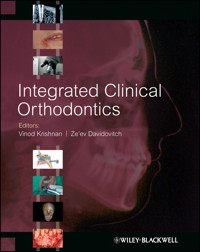
Integrated Clinical Orthodontics E-Book
125,99 €
Mehr erfahren.
- Herausgeber: John Wiley & Sons
- Kategorie: Fachliteratur
- Sprache: Englisch
Integrated Clinical Orthodontics provides an important new resource on the clinical interactions between the practice of orthodontics and other areas of clinical dentistry and medicine. Having at its heart the paradigm of patient-centred care, the book not only integrates the knowledge, skills, and experience of all the disciplines of dentistry and medicine, but also eases the work of orthodontists in arriving at an accurate diagnosis and a comprehensive treatment plan. Presented in a highly visual and practical format, Integrated Clinical Orthodontics uses clinical case presentations to illustrate the rationale and application of the integrated approach to a variety of clinical scenarios. Integrated Clinical Orthodontics covers areas of complexity in clinical orthodontics, specifically the role of the orthodontist as a member of a multidisciplinary team. The book outlines and details the management of congenital orofacial deformities, sleep disorders, esthetic smile creation and temporomandibular joint problems, and additionally and importantly includes specific protocols for effective communication with experts in other specialties.
Sie lesen das E-Book in den Legimi-Apps auf:
Seitenzahl: 1460
Veröffentlichungsjahr: 2011
Ähnliche




















Table of Contents
Cover
Title page
Copyright page
Dedicated to
Dedication
Laure Lebret and Anna-Marie Grøn: for lives committed to integrated orthodontic education
List of Contributors
Preface
1 The Increased Stature of Orthodontics
Introduction
The broadening scope of orthodontics
The orthodontic patient as a human being
The patient’s biological status – does it influence orthodontic treatment?
Conclusions
2 Effective Data Management and Communication for the Contemporary Orthodontist
Introduction
The role of information technology in the orthodontic practice
Computer-aided diagnosis and treatment planning to enhance communication
Other arenas of communication
Electronic data management
Virtual patient record for integration of specialties
Conclusion
3 Orthodontic Diagnosis and Treatment Planning: Collaborating with Medical and Other Dental Specialists
Introduction
The other side of the story
Orthodontic diagnosis from a broad perspective
The first interaction with the patient
The importance of the medical history in the orthodontic diagnosis and treatment planning
Identifying local dental abnormalities before attempting orthodontic treatment
Evaluation of the occlusion and the temporomandibular joint
Radiographic examination of the jaws
Conclusions
4 Psychosocial Factors in Motivation, Treatment, Compliance, and Satisfaction with Orthodontic Care
Introduction
Motivation for orthodontic care
Psychosocial variables influencing compliance
Conclusion
5 Nutrition in Orthodontic Practice
Introduction: the role of the orthodontist in nutrition
What is an adequate diet?
Nutrition and the orthodontic patient
Effective nutrition management of the orthodontic patient
Conclusions
6 Anomalies in Growth and Development: The Importance of Consultation with a Pediatrician
Introduction
Pervasive sucking habits and tongue thrusting
Growth-related problems
Trauma-related issues
Conclusions
7 The Benefits of Obtaining the Opinion of a Clinical Geneticist Regarding Orthodontic Patients
Introduction
Interaction with the clinical geneticist
Evolution of the clinical (medical) geneticist specialist
When to refer?
Radiographic signs
History of premature tooth exfoliation
Conditions in which premature tooth exfoliation may occur occasionally
Supernumerary teeth and hypodontia (oligodontia)
Syndromic hypodontia
Supernumerary teeth or hypodontia (oligodontia) and cancer
Failure of dental eruption
Soft and hard tissue asymmetry
Maxillary hypoplasia
Functional (neuromuscular) asymmetry
Mandibular retrognathism
Connective tissue dysplasia
Cleft lip and cleft palate
Conclusion
8 Multidisciplinary Team Management of Congenital Orofacial Deformities
Introduction
Otofacial malformations
Craniosynostoses
Achondroplasia/FGFR3 mutations
Holoprosencephalic disorders
Conclusion
9 Cleft Lip and Palate: Role of the Orthodontist in the Interdisciplinary Management Team
Introduction
Interdisciplinary team care
Members of the cleft lip and palate team and their task
Orthodontic management
Conclusions
10 What can Orthodontists Learn from Orthopaedists Engaged in Basic Research?
A common language
Bone adaptation to mechanical deformation and orthodontic tooth movement
Bone reaction to skeletal anchorage
Conclusions
11 When Should an Orthodontist Seek the Advice of an Endocrinologist?
Introduction
Growth hormone deficiency
Growth hormone excess
Thyroid disease
Hyperparathyroidism-jaw tumor syndrome
Hypophosphatasia
Rachitic disorders
Osteopetrosis
Fibrous dysplasia
Diabetes
Adrenal disorders
Turner syndrome
Conclusions
12 The Benefits of Consulting with an Ear, Nose, and Throat (ENT) Specialist Before and During Orthodontic Treatment
Introduction
The anatomical connection: the mouth in its relation with the nose, throat, and ear
Areas of interaction
Conclusion
Acknowledgments
13 Obstructive Sleep Apnea: Orthodontic Strategies to Establish and Maintain a Patent Airway
Introduction
The spectrum of obstructive sleep-disordered breathing
Decoding OSA
Respiration: effect of anatomy and sleep
OSA in children
OSA in adults
Conclusions
Acknowledgments
14 Acute and Chronic Infections Affecting the Oral Cavity: Orthodontic Implications
Introduction
Bacterial infections
Chronic infections with oral manifestations
Viral infections
Fungal infections
Parasitic infections
The oral cavity as a source for focal infections
Conclusions
15 Orthodontics and Pediatric Dentistry: Two Specialties, One Goal
Introduction
Coordinating orthodontic and pediatric dental appointments in a group or solo practitioner setting
Identifying orthodontic and pediatric dental problems earlier than later
Restoring form and function – revisiting the unilateral posterior crossbite with a functional mandibular shift
Congenitally missing maxillary lateral incisors – who does what, when, and how?
Retention considerations and beyond
Enamel demineralization during orthodontic treatment – who takes responsibility for prevention?
Conclusions
16 Dental Caries, Tooth Fracture and Exposed Dental Pulp: The Role of Endodontics in Orthodontic Treatment Planning and Mechanotherapy
Introduction
Pretreatment evaluation and early orthodontic treatment
Interactive collaboration during orthodontic treatment
Emergency orthodontic treatment in trauma cases
Immediate post-orthodontic period, and the long-term retention requirements for avoiding relapse
Conclusion
17 Pre-Prosthetic Orthodontic Tooth Movement: Interdisciplinary Concepts for Optimizing Prosthodontic Care
Introduction
Case 1: Orthodontic intrusion
Case 2: Use of dental implants for anchorage and orthodontic tooth extrusion for implant site development
Case 3: Minor tooth movement to gain canine guidance for full mouth rehabilitation
Orthodontic techniques in maxillofacial prosthodontics
Case 4: Restoration after a maxillectomy for osteomyelitis
Case 5: Prosthetic restoration of maxillectomy due to adenoid cystic carcinoma
Conclusions
Acknowledgments
18 Orthodontic Treatment in Patients Requiring Orthognathic Surgical Procedures
The importance of the sequence/checklist
Team preparation – Steps I and II
Diagnosis and patient care – Steps III–X
Presurgical – Steps XI and XII
Postsurgical – Steps XIII–XVI
Feedback – Steps XVII–XVIII
Conclusions
19 The Role of Biomedical Engineers in the Design and Manufacture of Customized Orthodontic Appliances
Introduction
Past research activities
Current research activities and potential future applications
Conclusions
20 Tissue Engineering in Orthodontics Therapy
Introduction
Tissue engineering principles
Impact of tissue engineering on orthodontics
Orthodontics and dentofacial orthopedics as clinical motivation for tissue engineering
Conclusions
Acknowledgments
21 Corticotomy and Stem Cell Therapy for Orthodontists and Periodontists: Rationale, Hypotheses, and Protocol
Introduction
Twentieth-century ‘OldThink’
Orthodontic ‘NewThink’: the age of the stem cell
Conclusions
Acknowledgment
22 The Application of Lasers in Orthodontics
Definition and laser physics
Historical perspective
Laser versus scalpel
Diode versus solid-state lasers
Choosing a proper anesthetic
Laser machine set-up
Procedures and surgical technique
Laser safety
Postsurgical management
Conclusion
23 Implant Orthodontics: An Interactive Approach to Skeletal Anchorage
Introduction
Interactive approaches
Holding the molar vertical position
Intrusion of molars
Molar uprighting
Forced eruption
Surgical placement of micro-implants
Conclusion
24 Temporomandibular Dysfunction: Controversies and Orthodontics
Temporomandibular disorders – the evolution of controversy
Orthodontics and TMD
Centric relation controversy
Functional occlusion and TMD
Asymptomatic internal derangements – need for treatment?
Controversies regarding TMD treatments
Contemporary multidisciplinary, evidence-based treatment options
Conclusion
25 Orthodontic Treatment for the Special Needs Child
Introduction
Therapeutic access
Patient management
Drawing up a tentative treatment plan
Relapse and retention
Case descriptions
Conclusion
Index
This edition first published 2012
© 2012 by Blackwell Publishing Ltd
Blackwell Publishing was acquired by John Wiley & Sons in February 2007. Blackwell’s publishing program has been merged with Wiley’s global Scientific, Technical and Medical business to form Wiley-Blackwell.
Registered office: John Wiley & Sons, Ltd, The Atrium, Southern Gate, Chichester, West Sussex, PO19 8SQ, UK
Editorial offices: 9600 Garsington Road, Oxford, OX4 2DQ, UK
The Atrium, Southern Gate, Chichester, West Sussex, PO19 8SQ, UK
2121 State Avenue, Ames, Iowa 50014-8300, USA
For details of our global editorial offices, for customer services and for information about how to apply for permission to reuse the copyright material in this book please see our website at www.wiley.com/wiley-blackwell.
The right of the author to be identified as the author of this work has been asserted in accordance with the UK Copyright, Designs and Patents Act 1988.
All rights reserved. No part of this publication may be reproduced, stored in a retrieval system, or transmitted, in any form or by any means, electronic, mechanical, photocopying, recording or otherwise, except as permitted by the UK Copyright, Designs and Patents Act 1988, without the prior permission of the publisher.
Designations used by companies to distinguish their products are often claimed as trademarks. All brand names and product names used in this book are trade names, service marks, trademarks or registered trademarks of their respective owners. The publisher is not associated with any product or vendor mentioned in this book. This publication is designed to provide accurate and authoritative information in regard to the subject matter covered. It is sold on the understanding that the publisher is not engaged in rendering professional services. If professional advice or other expert assistance is required, the services of a competent professional should be sought.
Library of Congress Cataloging-in-Publication Data
Integrated clinical orthodontics / edited by Vinod Krishnan, Ze’ev Davidovitch.
p. ; cm.
Includes bibliographical references and index.
ISBN 978-1-4443-3597-2 (hardback)
I. Krishnan, Vinod. II. Davidovitch, Zeev.
[DNLM: 1. Orthodontics–methods. WU 400]
LC classification not assigned
617.6'43–dc23
2011034246
A catalogue record for this book is available from the British Library.
Wiley also publishes its books in a variety of electronic formats. Some content that appears in print may not be available in electronic books.
ISBN 978-1-4443-9860-1 (epdf)
ISBN 978-1-4443-9861-8 (epub)
ISBN 978-1-4443-9862-5 (mobi)
My ever-inspiring family, who supported me throughout this project
My children, Jithu and Malu
My mentors, Dr Jyothindra Kumar (orthodontist) and the late Dr Ponnuswamy (anatomist), who changed the way I looked at my profession
and
All those who would love to see advancement in the ‘Science of Orthodontics’
Vinod Krishnan
My wife, for her continuous support and advice; my children, for their compassion and constructive suggestions; and my grandchildren, for their excellence in computer science
Ze’ev Davidovitch
Dedication
Laure Lebret and Anna-Marie Grøn: for lives committed to integrated orthodontic education
It is fitting to dedicate a book titled Integrated Clinical Orthodontics to two teachers whose lives were committed to interactive and integrated education: Laure Lebret and Anna-Marie Grøn. Both were full-time faculty members in the Departments of Orthodontics at the Forsyth Dental Center (initially The Forsyth Infirmary for Children and now The Forsyth Institute) and the Harvard School of Dental Medicine. The two affiliated institutions co-sponsored the orthodontic postgraduate program in an unparalleled combination until 1990. Together with Dr Coenrad F A Moorrees, the Chairman of both departments for over 40 years, they were the pillars of a unique educational program. The fact that the three of them originated from three different countries stands as an important detail in the history of a program whose graduates have spread worldwide, carrying with them the notion that professional excellence requires constant curiosity, and a search for contributing factors derived from any reasonable source. Coenrad Moorrees was born in Holland, Laure Lebret in France, and Anna-Marie Grøn in Denmark. Each was touched with difficult experiences during the Second World War.
To many generations of Harvard/Forsyth orthodontic graduates, our education was nurtured with the indelible impact of these three teachers, who were role models of civility, collegiality, scientific thinking, and productivity. Dr Moorrees departed in 2003, Dr Lebret in 2009, and one year later, Dr Grøn joined them, leaving behind a legacy of goodness, along with the hard and patient work of educating hundreds of orthodontists, many of whom became academicians, among them an unconventional number of chairpersons or program directors.
Laure Lebret and Anna-Marie Grøn were pioneer women, as dentists, orthodontists, and postgraduate teachers. Known as the important cornerstones in Coenrad Moorrees’ team, both had solid and independent cores with sharp minds and caring dispositions. They were involved with Dr Moorrees in seminal studies on the dentition and various aspects of facial growth, the most important of which was a long-term study of over 400 sets of twins, investigating the relation of facial and dental development.
In addition to co-authoring papers with Dr Moorrees and other workers on dental development, natural head position, and the mesh diagram analysis, Laure Lebret worked and published on the growth of the human palate, the reproducibility of rating stages of tooth movement, and physiological tooth migration. While tackling with Dr Moorrees the principles of diagnosis and also dental development, Anna-Marie Grøn’s role was cut in the equally demanding and meticulous research of reproducibility of rating stages of osseous development, and the prediction of the timing of tooth emergence. The research that both women engaged in was not easy, for they mastered the intricacies of, and fully understood the variations in, clinical research, let alone longitudinal investigations with thousands of collected measurements per child. Their inquiry was clean, responsible, and painfully detailed. Their publications are, currently some 40 and 50 years later, having an impact on clinical decisions for thousands of children worldwide. One particular summary of much of the combined efforts of Lebret, Grøn, and Moorrees is embedded in a paper entitled ‘Growth studies of the dentition: a review’ (Moorrees CF, Grøn AM, Lebret LM, Yen PK, Fröhlich FJ, American Journal of Orthodontics 1969; 55: 600–16). Rarely is it not referenced in a paper or chapter on dental development.
Beyond the research and organized, clear didactics, the clinical teaching of Grøn and Lebret was in line with what today is labeled evidence-based practice and critical appraisal. ‘Justify the plan’, was their modus operandi, and ‘consider the alternatives’, before you decide. They were not necessarily unique in these requests. They simply transferred their research experience into daily clinical practice. They translated the central tendencies developed by research into the individual environment, to choose and deliver sound individualized treatment. That was the educational culture they helped us go through, and later propagate on our own as we became educators.
For all the gifts of knowledge and humanity they bestowed on their students worldwide, we dedicate this book to Laure Lebret and Anna-Marie Grøn. They deserve recognition in a book built around the idea of integrated sciences in the ever-expanding world of clinical orthodontics. By honouring their memory, we acknowledge that the explorations are going on, extending from theirs, for the benefit of mankind.
Joseph G Ghafari, DMD
Ze’ev Davidovitch, DMD
List of Contributors
Nina K Anderson PhD
Clinical Instructor
Department of Developmental Biology
Harvard School of Dental Medicine
Boston, Massachusetts
USA
Neslihan Arhun DDS, PhD, MSc
Associate Professor
Department of Conservative Dentistry
Baskent University, Faculty of Dentistry
Ankara
Turkey
Ayca Arman-Ozcirpici DDS, PhD
Associate Professor
Department of Orthodontics
Baskent University, Faculty of Dentistry
Bahcelievler, Ankara
Turkey
Adrian Becker BDS, LDS, DDO
Clinical Associate Professor Emeritus
Department of Orthodontics and Center for the Treatment of Craniofacial Disorders in Special Needs Individuals
The Hebrew University-Hadassah School of Dental Medicine
Jerusalem
Israel
Nabil F Bissada DDS, MSD
Professor and Chair
Department of Periodontics
Case Western Reserve University
School of Dental Medicine
Cleveland, Ohio
USA
William A Brantley PhD
Professor and Director
Graduate Program in Dental Materials Science
Division of Restorative and Prosthetic Dentistry, College of Dentistry
and
Department of Biomedical Engineering, College of Engineering
Ohio State University
Columbus, Ohio
USA
Stella Chaushu DMD, MSc
Associate Professor and Chair
Department of Orthodontics and Center for the Treatment of Craniofacial Disorders in Special Needs Individuals
The Hebrew University-Hadassah School of Dental Medicine
Jerusalem
Israel
George J Cisneros DMD, MMSc
Professor and Chair
Department of Orthodontics
New York University College of Dentistry
New York
USA
Adriana Da Silveira DDS, MS, PhD
Chief of Orthodontics
Dell Children’s Craniofacial & Reconstructive Plastic Surgery Center
and
Adjunct Assistant Professor
Department of Biomedical Engineering
University of Texas at Austin
Austin, Texas
USA
Gunnar Dahlén BSc, DDS, PhD (Dr Odont)
Professor and Chairman
Department of Oral Microbiology
Institute of Odontology
Sahlgrenska Academy at University of Gothenburg
Gothenburg
Sweden
Ze’ev Davidovitch DMD, Cert Ortho
Professor of Orthodontics, Emeritus
Harvard University, Boston
Massachusetts
USA
and
Clinical Professor
Department of Orthodontics
Case Western Reserve University
Cleveland, Ohio
USA
Linda A DiMeglio MD, MPH
Associate Professor Section of Pediatric Endocrinology and Diabetology Riley Hospital for Children Indiana University School of Medicine
Indianapolis, Indiana
USA
Theodore Eliades DDS, MS, Dr Med, PhD
Professor and Director
Graduate Program in Dental Materials Science
Center of Dental Medicine, University of Zurich
Zurich
Switzerland
Kaj Fried DDS, PhD
Professor of Neuroscience
Karolinska Institutet
Department of Dental Medicine
Huddinge
Sweden
Joseph G Ghafari DMD
Professor and Head
Division of Orthodontics and Dentofacial Orthopedics
American University of Beirut Medical Center
Beirut
Lebanon
Donald B Giddon MA, DMD, PhD, FACD
Associate Professor of Clinical Pediatrics
Department of Developmental Biology
Harvard School of Dental Medicine
Boston, Massachusetts
USA
Nadine G Haddad MD, FAAP
Associate Professor of Clinical Pediatrics
Indiana University School of Medicine
Riley Hospital for Children
Section of Endocrinology and Diabetology
Indianapolis, Indiana
USA
James K Hartsfield Jr DMD, MS, MMSc, PhD, FACMG, CDABO
Adjunct Professor
Department of Orthodontics and Oral Facial Genetics
Indiana University School of Dentistry
and
Department of Medical and Molecular Genetics
Indiana University School of Medicine
and
Department of Orthodontics
University of Illinois at Chicago College of Dentistry
Chicago, Illinois
USA
Mark S Hochberg DMD
Program Director
Emeritus, Pediatric Dentistry, Interfaith Medical Center
and
Attending, New York Presbyterian Hospital
New York
USA
Julie Holloway DDS, MS
Program Director
Graduate Prosthodontics Program
Ohio State University College of Dentistry
Columbus, Ohio
Ohio
USA
Sarandeep Huja DDS, PhD
Program Director
Graduate Orthodontics Program
Ohio State University College of Dentistry
Columbus, Ohio
USA
Sanjivan Kandasamy BDSc, BScDent, DocClinDent, MOrthRCS, MRACDS
Clinical Associate Professor
Dental School
University of Western Australia
and
Centre for Advanced Dental Education
St Louis University
St Louis, Missouri
USA
Nina Kaukua DDS
Post Doctoral Fellow
Columbia University Medical Center
Craniofacial Regeneration Center, College of Dental Medicine
New York
USA
O P Kharbanda BDS, MDS, MOrth RCS Ed, MMEd
Professor and Head
Department of Orthodontics and Dentofacial Deformities
Centre for Dental Education and Research
All India Institute of Medical Sciences
New Delhi
India
Neal D Kravitz DMD, MS
Faculty, Washington Hospital Center
Washington, DC
and
Baltimore College of Dental Surgery
Dean’s Faculty, University of Maryland
Baltimore, Maryland
USA
Vinod Krishnan BDS, MDS, MOrth RCS (Edin)
Professor
Department of Orthodontics
Sri Sankara Dental College
Trivandrum, Kerala
India
Simone Kucska BDS, MSD
Kucska Facial Orthopedics
Sao Paulo, Brazil
and
Post-Doctoral Scholar
Los Angeles, California
USA
Anne Marie Kuijpers-Jagtman DDS, PhD
Professor of Orthodontics
Head of Department of Orthodontics and Craniofacial Biology
Head of Cleft Palate Craniofacial Unit
Radboud University Nijmegen Medical Center
Nijmegen
The Netherlands
Maria J Kuriakose BDS, PhD, Cert Ortho
Associate Professor
Department of Cleft and Craniomaxillofacial Surgery
Amrita Institute of Medical Sciences
Kochi, Kerala
India
Anthony T Macari DDS, MS
Instructor/Clinical Director
Division of Orthodontics and Dentofacial Orthopedics
American University of Beirut Medical Center
Riad El Solh
Beirut
Lebanon
Jeremy J Mao DDS, PhD
Professor and Zegarelli Endowed Chair
Columbia University
Director, Center for Craniofacial Regeneration
Senior Associate Dean for Research
Columbia University College of Dental Medicine
New York
USA
Birte Melsen DDS, Dr Odont
Professor and Chairman
Department of Orthodontics, School of Dentistry
Faculty of Health Sciences, Aarhus University
Aarhus
Denmark
Elliott M Moskowitz DDS, MSd, CDE
Clinical Professor
Department of Orthodontics
New York University College of Dentistry
New York
USA
Neal C Murphy DDS, MS
Clinical Associate Professor
Departments of Orthodontics & Periodontics
Case Western Reserve University
School of Dental Medicine
Cleveland, Ohio USA
David R Musich DDS, MS
Clinical Professor of Orthodontics
University of Pennsylvania School of Dental Medicine
Philadelphia, Pennsylvania
and
Lecturer
Department of Orthodontics
University of Illinois, School of Dentistry
Chicago, Illinois
Private practice
Schaumburg, Illinois
USA
Omur Polat Ozsoy DDS, PhD
Associate Professor
Department of Orthodontics
Baskent University, Faculty of Dentistry
Ankara
Turkey
Carole A Palmer EdD, RD, LDN
Professor
Division of Nutrition and Oral Health Promotion
Department of Public Health and Community Service
Tufts University School of Dental Medicine
Boston, Massachusetts
USA
Hyo-Sang Park DDS, MSD, PhD
Professor and Chair
Department of Orthodontics, School of Dentistry
Kyungpook National University
and
Director, Orthodontic Research Center, Kyungpook National University Hospital
Daegu
Korea
Sherry Peter BDS, MDS, FRCS
Clinical Professor
Department of Cleft and Craniomaxillofacial Surgery
Amrita Institute of Medical Sciences
Kochi, Kerala
India
Ameet V Revankar BDS, MDS
Assistant Professor
Department of Orthodontics and Dentofacial Orthopedics
SDM College of Dental Sciences and Hospital
Dharwad, Karnataka
India
Donald J Rinchuse DMD, MS, MDS, PhD
Professor and Graduate Orthodontic Program Director
Seton Hill University
Greensburg, Pennsylvania
USA
Lauren Schindler MS, RD
Senior Bariatric Dietitian
St Alexius Hospital NewStart
St Louis, MO
USA
Joseph Shapira DMD
Professor and Chair
Department of Pediatric Dentistry
The Hebrew University-Hadassah School of Dental Medicine
Jerusalem
Israel
Mete Ungor DDS, PhD
Professor
Head of Department of Endodontics
Baskent University, Faculty of Dentistry
Ankara
Turkey
Meade C Van Putten Jr, DDS, MS
Director of Maxillofacial Prosthodontics
The AG James Cancer Hospital and Solove Research Institute
Ohio State University
Columbus, Ohio
USA
Carlalberta Verna DDS, PhD
Associate Professor
Department of Orthodontics, School of Dentistry
Faculty of Health Sciences, Aarhus University
Aarhus
Denmark
Neeraj Wadhawan BDS, MDS
Research Officer
Department of Orthodontics and Dentofacial Deformities
Centre for Dental Education and Research
All India Institute of Medical Sciences
New Delhi
India
Eric Lye Kok Weng BDS, MDS, FRA CDS, FAMS
Consultant
Department of Oral and Maxillofacial Surgery Singapore
and
Assistant Director
Integrated Sleep Service
Changi General Hospital
Singapore
Mimi Yow BDS, FDS RCS, MSc (Orthodontics), FAMS
Senior Consultant
Department of Orthodontics
National Dental Centre
Singapore
and Clinical Associate Professor
Faculty of Dentistry
National University of Singapore
Singapore
Preface
The subject of this book, integrated clinical orthodontics, seemed initially to be a straightforward topic. After all, we know that we depend on each other, in all walks of life, not excluding orthodontics. Therefore, we thought that it would be helpful to try to compose a publication that would reflect clearly each area where orthodontists interact with experts in other medical specialties, in an effort to upgrade their services to their patients.
Each individual who needs, seeks, or receives orthodontic care, differs from every other individual, molecularly, functionally, and esthetically. This natural variability is reflected in the orthodontic clinic, defining the identity of the specialty whose experts could be beneficial to the orthodontist and the patient alike. Our goal has been to learn from people engaged in clinical research in different medical fields, about their experience and advice on interactions with orthodontists. These interactions stem from the simple fact that none of us knows everything, and whether we like it or not, we depend on the professional opinions of our colleagues in other specialties, whose knowledge can remedy the voids in our own.
In planning the contents of this book, we immediately realized that there are many fields of knowledge that can augment the diagnostic and therapeutic capabilities of the orthodontist. In fact, we were amazed at the large number of these specialties, clearly reflected in the number of chapters in this book, 25, each dedicated to a specialty whose members interact with orthodontists. This increasingly widening scope of orthodontics is enabled by the availability and relative ease of electronic communication, and the expanding new findings in medicine and dentistry. It becomes increasingly difficult to command all relevant information about emerging new and exciting fields, such as tissue engineering and stem cells, and becoming aware of ongoing progress in seemingly traditional fields, such as genetics, psychology, and material science. Interaction with others seems to offer the means to clarify and confirm the identity of clinical findings in the diagnostic phase, and elucidate the road ahead, in terms of treatment plans and the choice of the most suitable mechanotherapy for the individual patient.
The concept emerging from this book is that orthodontics is not merely an exercise in wire bending, but rather a specialty leaning on many others. Interactions, whenever indicated, between the orthodontist and other medical specialists are a powerful tool on the way to excellence. In short, we would like to see each and every reader of this book to think like a healthcare professional and as a conscientious member of the dental profession who wishes to bring credit upon a high calling that has lifted itself from a questionable mechanical art to a most respected and esteemed health service to humankind.
We would like to extend our heartfelt thanks to all our contributing authors, who have generously shared their valuable knowledge and wisdom for the benefit of all those who are eager to learn about the advancements in ‘science of orthodontics’. We were excited to read the manuscripts and are hopeful that the response of our esteemed readers will be the same too. Although the chapters are based on the contributors’ own work and experiences, all the information can be applied to similar settings across the world.
We would also like to express our sincere gratitude to all the staff at Wiley-Blackwell, Oxford, UK, especially Sophia Joyce, Nick Morgan, Catriona Cooper, Lucy Nash, and James Benefield, as well as Lotika Singha (copyeditor), and Anne Bassett (project manager) whose relentless efforts helped us to accomplish this laborious, but fulfilling, task.
Vinod Krishnan
Ze’ev Davidovitch
Editors
1
The Increased Stature of Orthodontics
Ze’ev Davidovitch, Vinod Krishnan
Summary
Orthodontists treat patients with orofacial anomalies, including malocclusions, by applying mechanical forces to the crowns of teeth. These forces are transmitted to the tissues surrounding the roots of the teeth, enticing their cells to remodel these tissues, thereby enabling the teeth to move to new, preferred positions. Like any other tissues and organs in the human body, dental tissues and cells are controlled by the nervous, immune, vascular, and endocrine systems, as well as by factors such as psychological stress, nutrition, medications, and local and systemic diseases. Since the jaws are integral parts of the body as a whole, orthodontic diagnosis must include detailed information on any deviation from general health norms, and these data should be reflected in the treatment plan. Therefore, when specific pathologies are identified, an interaction with the appropriate healthcare provider who is treating the patient should occur, or a referral made to another specialist. The advice obtained from these experts can have a substantial impact on the orthodontic diagnosis and treatment plan. Continuing advances in medicine and dentistry increase the scope, importance, and value of these interactions. This introductory chapter discusses the need and rationale for interactions in specific situations, and this book includes details of conditions that require advice from specific specialists. The focus on this expanding scope is derived from the notion that biology plays a pivotal role in orthodontics, and that pertinent information regarding the health status of individual candidates for orthodontic treatment might have long-lasting effects on the course and outcomes of orthodontic treatment.
Introduction
Facial esthetics, balance, and harmony, and/or their absence, have attracted attention from time immemorial, by artist and art viewer alike. Facial expressions can readily reflect various moods, emotions, and feelings, thereby conveying unspoken messages from person to person. The mouth is an essential component of this anatomical–physiological–emotional complex, by virtue of its ability to participate actively in these functions, involving its soft (cheeks, lips, and tongue) and hard (jaws and teeth) tissues. Painters, sculptors, and photographers have noted these features, and frequently, when creating images of human faces, included the rest of the body, or at least the torso, in their art work, demonstrating acceptance of the principle that the face and the rest of the body are one unit. The specialty of orthodontics is taught predominantly as a field of endeavor dedicated to the improvement of orofacial esthetics and function. Consideration of biological principles and constraints is shadowed by the desire of both the patient and his/her orthodontist to achieve noticeable improvement in the position and location of the malpositioned crown(s), ignoring the fact that the crowns are anchored in the jaws by their roots, which are surrounded by tissues that act and react like any other organ to any local or systemic factor that comes their way. This situation is similar to an iceberg, visible partially above the water surface, but invisible under it.
Lesen Sie weiter in der vollständigen Ausgabe!
Lesen Sie weiter in der vollständigen Ausgabe!
Lesen Sie weiter in der vollständigen Ausgabe!
Lesen Sie weiter in der vollständigen Ausgabe!
Lesen Sie weiter in der vollständigen Ausgabe!
Lesen Sie weiter in der vollständigen Ausgabe!
Lesen Sie weiter in der vollständigen Ausgabe!
Lesen Sie weiter in der vollständigen Ausgabe!
Lesen Sie weiter in der vollständigen Ausgabe!
Lesen Sie weiter in der vollständigen Ausgabe!
Lesen Sie weiter in der vollständigen Ausgabe!
Lesen Sie weiter in der vollständigen Ausgabe!
Lesen Sie weiter in der vollständigen Ausgabe!
Lesen Sie weiter in der vollständigen Ausgabe!
Lesen Sie weiter in der vollständigen Ausgabe!
Lesen Sie weiter in der vollständigen Ausgabe!
Lesen Sie weiter in der vollständigen Ausgabe!
Lesen Sie weiter in der vollständigen Ausgabe!
Lesen Sie weiter in der vollständigen Ausgabe!
Lesen Sie weiter in der vollständigen Ausgabe!
Lesen Sie weiter in der vollständigen Ausgabe!
Lesen Sie weiter in der vollständigen Ausgabe!
Lesen Sie weiter in der vollständigen Ausgabe!
Lesen Sie weiter in der vollständigen Ausgabe!
Lesen Sie weiter in der vollständigen Ausgabe!




