


0,49 €
Niedrigster Preis in 30 Tagen: 1,99 €
Niedrigster Preis in 30 Tagen: 1,99 €
Mehr erfahren.
- Herausgeber: Booksell-Verlag
- Kategorie: Bildung
- Sprache: Englisch
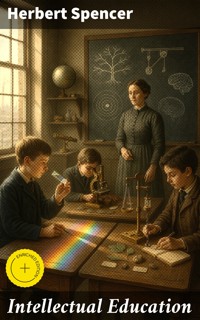
In "Intellectual Education," Herbert Spencer presents a compelling examination of the processes through which individuals develop cognitive abilities and the broader implications for society. Written in a clear, didactic style characteristic of the Victorian era, Spencer's work engages with contemporary educational philosophies while advocating for a scientific approach to learning. He meticulously dissects the interplay between knowledge and personal development, arguing for an educational system that fosters independent thought and critical reasoning, rather than rote memorization. This book is not only a conceptual exploration; it serves as a practical guide for educators and policymakers aiming to cultivate an informed citizenry. Herbert Spencer, a pivotal figure in the evolution of social and educational thought, was deeply influenced by the scientific advancements of his time and the nascent field of psychology. His empiricist approach and belief in evolution informed his advocacy for educational reform, as he perceived education as a mechanism for societal progress. Spencer's background as a philosopher and sociologist'—combined with his revolutionary views on individualism'—propelled him to address the pressing educational needs of a rapidly industrializing society. "Intellectual Education" is essential reading for anyone interested in the foundations of modern educational theory and practice. Spencer's insights remain remarkably relevant today, as they challenge readers to rethink the objectives of education in fostering intellectual independence and societal betterment. This work is an indispensable resource for educators, students of philosophy, and anyone passionate about the transformative power of education. In this enriched edition, we have carefully created added value for your reading experience: - A succinct Introduction situates the work's timeless appeal and themes. - The Synopsis outlines the central plot, highlighting key developments without spoiling critical twists. - A detailed Historical Context immerses you in the era's events and influences that shaped the writing. - An Author Biography reveals milestones in the author's life, illuminating the personal insights behind the text. - A thorough Analysis dissects symbols, motifs, and character arcs to unearth underlying meanings. - Reflection questions prompt you to engage personally with the work's messages, connecting them to modern life. - Hand‐picked Memorable Quotes shine a spotlight on moments of literary brilliance. - Interactive footnotes clarify unusual references, historical allusions, and archaic phrases for an effortless, more informed read.
Das E-Book können Sie in Legimi-Apps oder einer beliebigen App lesen, die das folgende Format unterstützen:
Veröffentlichungsjahr: 2021
Ähnliche










Intellectual Education
Table of Contents
Introduction
Against the clang of rote recitation and the haste of cram, this work champions an education that grows like a living organism, unfolding from curiosity to discipline, from sensation to thought, from personal experience to social usefulness.
Intellectual Education is regarded as a classic because it crystallizes a decisive nineteenth-century turn in educational thought: the insistence that methods be guided by knowledge of human development and by the claims of modern science. Its arguments, written with clarity and ambition, helped reframe the aims of schooling from mere scholastic display to preparation for life. As part of the enduring canon of educational literature, it continues to inform debates about curriculum, pedagogy, and the relation between learning and living, sustaining a dialogue that subsequent theorists and practitioners have repeatedly revisited.
Herbert Spencer, a prominent Victorian philosopher and social thinker, wrote this essay in the mid-nineteenth century as part of Education: Intellectual, Moral, and Physical, first published in 1861, drawing together pieces he had developed earlier in the 1850s. Here, he sets out principles for cultivating the intellect in harmony with the learner’s natural growth. He argues that instruction should rest on psychological insight and the methods of the natural sciences, and that studies should be chosen and taught with regard to their power to promote sound judgment, self-reliance, and the effective conduct of life.
The essay surveys the ends of knowledge, the order in which the mind best receives it, and the means by which teachers can foster durable understanding. It analyzes the relative worth of studies, urging attention to those that discipline observation, reasoning, and application. It emphasizes moving from the concrete to the abstract and from the simple to the complex, making careful use of the senses before advancing to symbols. Throughout, it cautions against practices that overwhelm attention or encourage verbalism, advocating instead methods that awaken interest, exercise judgment, and build coherent habits of thought.
Composed in a period of sweeping industrial and scientific expansion, the work enters a culture disputing what education should do and for whom. Classical curricula still dominated, yet new demands for scientific and technical knowledge, and for broader access to schooling, pressed urgently. Spencer speaks to this juncture by calling for a curriculum that values literature and art while granting a central place to science as a model of disciplined inquiry. He measures studies by their bearing on the activities of life, aiming to reconcile cultural cultivation with practical competence and the ethical responsibilities of citizenship.
One of the book’s enduring strengths lies in its method: a steady movement from first principles to classroom implications, argued with economy and illustrative analogies from the living world. Spencer writes with a didactic clarity that invites both assent and critique, presenting criteria that readers can test against experience. Rather than multiplying rules, he offers a framework that helps teachers and parents discriminate among competing aims and devise methods congruent with the learner’s nature. The prose, confident and orderly, reinforces the claim that education should mirror the progressive organization found in well-conducted inquiry.
The influence of this essay is felt less in any single doctrine than in the orientation it exemplifies: education anchored in psychology, respectful of development, and accountable to the realities students will face. It strengthened the case for science in the general curriculum, encouraged observational and experimental approaches in the early years, and supported a broader move away from mechanical memorization toward active learning. Across decades and across countries, its arguments supplied reformers with a vocabulary for discussing aims, sequence, and method, and provided critics of stagnant curricula with a principled alternative.
Readers encounter a set of themes that have proven remarkably resilient. Learning should begin with experience and return to it, converting sensation into ordered knowledge and skill. Instruction should secure attention by matching task to capacity, cultivating independence rather than coercion. Studies should be selected and arranged for their power to discipline the faculties and to illuminate the conditions of healthy, purposeful living. Throughout runs the conviction that education is a preparation for the whole of life, not a rehearsal of words, and that intellectual training gains meaning when integrated with moral and physical well-being.
Part of the book’s classic status rests on the controversies it stages with tact. It challenges inherited canons without dismissing humane learning, and it prizes utility without descending into narrow expediency. Critics have long debated how to balance practical studies with the reflective pleasures of art and literature, and how to interpret the measure of worth in education. By posing clear criteria and acknowledging limits, the essay invites readers to refine, adapt, or oppose its proposals, thereby perpetuating a productive argument that has kept it central to educational discourse.
For contemporary readers—teachers, parents, policy makers, and students of education—the essay offers a diagnostic lens as much as a set of recommendations. It helps one evaluate whether aims are explicit, whether content is proportioned to learners’ stages, and whether methods secure lasting comprehension rather than momentary performance. Its counsel favors guided discovery, careful progression, and thoughtful practice over haste, verbosity, or spectacle. Far from being merely prescriptive, it models how to reason from purpose to plan, enabling readers to translate principles into varied contexts without sacrificing coherence.
Its relevance today is sharpened by the conditions of modern life: the abundance of information, the speed of change, and the need for judgment amid complexity. Spencer’s insistence on prioritizing studies by their bearing on conduct, and on teaching that builds from concrete experience, speaks to concerns about distraction, superficiality, and disengagement. The essay aligns with evidence-based emphases on sequencing, cognitive load, and active learning, while also reminding us that education serves personal and social flourishing. In classrooms, workplaces, and homes, its framework helps organize learning for depth, adaptability, and humane purpose.
Intellectual Education endures because it unites a clear aim—preparation for a thoughtful life—with a disciplined method—education in step with the learner’s growth. It asks what knowledge is worth acquiring, how minds best acquire it, and why education matters beyond school. The themes it develops—curiosity cultivated into understanding, experience refined into principle, utility joined to culture—continue to resonate. For readers seeking orientation amid perennial debates, the essay offers both a map and a challenge, remaining engaging and provocative, and sustaining its place as a foundational voice in educational thought.
Synopsis
Intellectual Education is Herbert Spencer’s systematic exposition of how the mind should be cultivated and what knowledge best serves life. Written within his broader work on education, it isolates the intellectual province and argues that schooling should be guided by the general aim of preparing for complete living. Spencer sets out to determine the relative worth of different studies by reference to human needs, and to derive teaching principles from the observed order of mental development. The essay proceeds from defining aims, to ranking subjects, to methods of instruction, and to applications in particular branches, seeking a coherent rationale rather than a collection of classroom tips.
Spencer first proposes a scale for estimating the value of knowledge. He orders human activities by their urgency: direct self-preservation; securing the means of subsistence; rearing and training offspring; fulfilling social and political duties; and leisure and aesthetic pursuits. Knowledge most immediately aiding survival and effective action receives priority. From this perspective, scientific knowledge, including physiology and hygiene, stands prominent, because it informs health, work efficiency, domestic competence, and civic understanding. The hierarchy does not exclude literature or art, but places them after necessities are met. This valuation underpins his subsequent call to reframe the curriculum away from tradition and toward demonstrable service to life.
He then examines prevailing schooling, especially the classical curriculum centered on Latin and Greek, and the doctrine that such studies strengthen the mind generally. Spencer disputes the theory of a transferable mental discipline, holding instead that training is largely specific to the subject matter and habits it fosters. He argues that science better exercises observation, inference, and verification, while also yielding practical results. Memory, in his account, should be the servant of understanding, not its substitute. The indictment extends to rote learning, artificial tasks, and premature abstractions, which he views as misaligned with how knowledge is naturally acquired and organized.
From this critique, Spencer formulates guiding laws of intellectual growth. Instruction should proceed from the simple to the complex, from the concrete to the abstract, from the empirical to the rational, and from the known to the unknown. These sequences mirror the development of the individual mind and the historical advance of knowledge. He maintains that early lessons should engage the senses with real things, gradually leading to generalizations and symbols. Pleasure is treated as a sign of healthy activity; therefore, learning should be made intrinsically interesting, without coercion or needless restraint. This natural order, he contends, ensures efficiency and permanency of knowledge.
Applying these principles, Spencer emphasizes self-activity and discovery. Object lessons, experiments, and first-hand observation are preferred over verbal description. The teacher’s role is to arrange conditions, pose well-graded questions, and guide learners to find relations for themselves. Thoroughness is favored: each step should be mastered before proceeding, with new facts connected to prior ideas to secure retention. Reviews consolidate by reorganization rather than repetition alone. He recommends sparing use of rules at the outset, allowing inductive generalizations to arise from varied instances. Illustrations and diagrams should be clear and few, chosen to exemplify essentials rather than multiply incidental details.
In the sciences, Spencer recommends beginning with phenomena accessible to the senses and familiar situations. Lessons in physics, chemistry, and biology should employ simple apparatus and experiments, leading from qualitative observations to quantitative treatment where appropriate. Physiology and hygiene are singled out for their direct bearing on health. In mathematics, he urges concrete problems, visible constructions, and measurements before formal proofs and symbols, so that concepts are grounded in experience. Drawing is advocated as an aid to accurate perception and expression, supporting both scientific and artistic studies. Throughout, classification, naming, and definition are to follow acquaintance, not precede it.
For language and the humanities, Spencer advises that expression be practiced through use before systematic analysis. Children should talk, read, and write about things they know, with grammar formalities deferred until a stock of correct habit exists. Composition is to grow from narration of observed facts to more abstract themes. He suggests approaching literature when there is maturity to appreciate its content, and treating history as an inquiry into causes and effects rather than as lists of dates and kings. Geography begins with local surroundings and maps derived from actual walks, expanding outward, so that space relations are concretely apprehended.




