


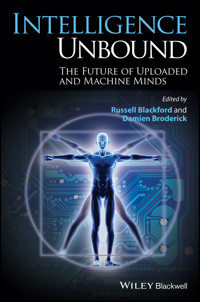
Intelligence Unbound E-Book
20,99 €
Mehr erfahren.
- Herausgeber: John Wiley & Sons
- Kategorie: Geisteswissenschaft
- Sprache: Englisch
Intelligence Unbound explores the prospects, promises, and potential dangers of machine intelligence and uploaded minds in a collection of state-of-the-art essays from internationally recognized philosophers, AI researchers, science fiction authors, and theorists.
- Compelling and intellectually sophisticated exploration of the latest thinking on Artificial Intelligence and machine minds
- Features contributions from an international cast of philosophers, Artificial Intelligence researchers, science fiction authors, and more
- Offers current, diverse perspectives on machine intelligence and uploaded minds, emerging topics of tremendous interest
- Illuminates the nature and ethics of tomorrow’s machine minds—and of the convergence of humans and machines—to consider the pros and cons of a variety of intriguing possibilities
- Considers classic philosophical puzzles as well as the latest topics debated by scholars
- Covers a wide range of viewpoints and arguments regarding the prospects of uploading and machine intelligence, including proponents and skeptics, pros and cons
Sie lesen das E-Book in den Legimi-Apps auf:
Seitenzahl: 669
Veröffentlichungsjahr: 2014
Ähnliche




















Table of Contents
Cover
Title Page
Copyright
Dedication
Notes on Contributors
Introduction I: Machines of Loving Grace (Let's Hope)
1 Machine minds or humans copied into machines?
2 Emulating the mind
3 Is my copy me?
4 Who woke up?
Notes
References
Introduction II: Bring on the Machines
1 A strange new epoch?
2 Machines that think?
3 Into the machine…?
4 Personal identity and survival
5 Contemplating the unimaginable
6 The future is coming
Notes
References
Chapter 1: How Conscience Apps and Caring Computers will Illuminate and Strengthen Human Morality
1 Introduction
2 Self-control
3 Caring
4 Fairness and moral cognition
5 Mindfulness
6 Intelligence
7 Conclusions
References
Chapter 2: Threshold Leaps in Advanced Artificial Intelligence
1 Explosive improvement
2 Scenarios of AI emergence
3 Physical growth
4 Conclusion
Acknowledgments
References
Chapter 3: Who Knows Anything about Anything about AI?
1 Introduction
2 Taxonomy of predictions
3 (Un)reliable experts
4 AI timeline predictions
5 Case studies
6 Conclusion: To know the limits of what can be known
Acknowledgments
Notes
References
Chapter 4: Nine Ways to Bias Open-Source Artificial General Intelligence Toward Friendliness
1 Introduction
2 Is open or closed AGI development safer?
3 The (unlikely) prospect of government controls on AGI development
4 Nine ways to bias AGI toward Friendliness
5 Conclusion
Notes
References
Chapter 5: Feasible Mind Uploading
1 Neural interfaces and neural prostheses
2 Iterative improvements in four main areas to achieve whole brain emulation
3 Is a computer too deterministic to house a mind?
4 A platform for iteration between model and measurement
5 Conclusions—uploaded and machine minds
References
Chapter 6: Uploading: A Philosophical Analysis
1 Uploading and consciousness
2 Uploading and personal identity
3 The argument from nondestructive uploading
4 The argument from gradual uploading
5 Where things stand
6 Uploading after brain preservation
7 Reconstructive uploading
8 Upshot
Acknowledgments
Notes
References
Chapter 7: Mind Uploading: A Philosophical Counter-Analysis
1 Introduction
2 What I am going to attempt here
3 What Chalmers says, redux
4 Consciousness, computation, and mind uploading
5 Mind uploading, personal identity, and Kirk's death by transporter
6 Conclusion
Acknowledgments
Notes
References
Chapter 8: If You Upload, Will You Survive?
1 Introduction
2 Uploading and personal identity
3 Putting metaphysics to work
4 Response to Chalmers
5 Conclusion
Notes
References
Chapter 9: On the Prudential Irrationality of Mind Uploading
1 Is mind uploading a philosophical possibility?
2 Acknowledging and responding to philosophical skepticism about computer consciousness
3 Searle's Wager
4 Why death could be so much worse for those considering uploading than it is for us now (or why D is so much worse than B)
5 Why uploading and surviving is not so much better than, and possible worse than, refusing to upload (or why A is not so much better than, and possibly worse than, C)
6 Why we shouldn't make electronic copies of ourselves
7 Conclusion
Acknowledgments
Notes
References
Chapter 10: Uploading and Personal Identity
1 Uploading: prospects and perils
2 The equivalency thesis
3 Personal identity: psychological and somatic accounts
4 Against somaticism: the big stroke
5 Against somaticism: retrospective replicas
6 No branching
7 Types and tokens
8 The type/token solution to personal identity
9 Should I upload?
Acknowledgments
Notes
References
Chapter 11: Whole Brain Emulation: Invasive vs. Non-Invasive Methods
1 Introduction
2 WBE: Proposed methods
3 Can your WBE preserve your personal identity?
4 Concluding thoughts
Acknowledgments
Notes
References
Chapter 12: The Future of Identity: Implications, Challenges, and Complications of Human/Machine Consciousness
References
Chapter 13: Practical Implications of Mind Uploading
1 Physical appearance
2 Enhanced senses
3 Travel and duplication
4 Population growth
5 Age and wealth
6 Settling the solar system
7 Artificial realities
8 Conclusion
Chapter 14: The Values and Directions of Uploaded Minds
1 Uploading as a tipping point in values
2 Enabling leaps upward in motivation hierarchies
3 Discarding entire classes of valuable objects
4 Expanding value hierarchies to include novel phenomena
5 How can we anticipate directionality, or purpose?
6 Resource availability
7 Teleology for uploads
8 Conclusion
References
Chapter 15: The Enhanced Carnality of Post-Biological Life
1 Fake fear and loathing of the flesh
2 Beyond either/or thinking
3 The distorting lens of the cyborg
4 The irony of mockery
5 Freedom from biology
6 Conclusion
References
Chapter 16: Qualia Surfing
1 Fundamentals of qualia surfing
2 Abstract qualia
3 New bodies
4 Classic uploading
5 What is our purpose?
6 Domains
7 The Utopia that came in from the cold
References
Chapter 17: Design of Life Expansion and the Human Mind
1 Beneath the surface
2 Fracturing
3 Expansion
4 Design
5 Conclusion
Notes
References
Chapter 18: Against Immortality: Why Death is Better than the Alternative
1 To be or not to be—forever?
2 The finitude of being within the infinitude of time
Notes
References
Chapter 19: The Pinocchio Syndrome and the Prosthetic Impulse
1 The Pinocchio syndrome in
Star Trek
—Data
2 The prosthetic impulse in
Star Trek
—the Borg
3 Data vs. the Borg
4 Discussion
Acknowledgments
References
Chapter 20: Being Nice to Software Animals and Babies
1 Brain emulations
2 Software animal rights
3 The moral status of animals
4 The moral status of software
5 Treating emulated animals right
6 The life and death of emulations
7 Ethics of human and animal emulations
8 Volunteers and emulation rights
9 Handling of flawed and distressed versions
10 Time and communication
11 Vulnerability and self-ownership
12 The big picture
References
Chapter 21: What Will It Be Like To Be an Emulation?
1 Why think about ems now?
2 Life among the ems
3 The culture of ems
4 Em identity
5 Inequality
6 War
7 Clans
8 Intelligence unbound
9 Conclusion
References
Afterword
References
Index
End User License Agreement
Pages
ix
x
xi
xii
xiii
1
2
3
4
5
6
7
8
9
10
11
12
13
14
15
16
17
18
19
20
21
22
23
24
25
26
27
28
29
30
31
32
33
34
35
36
37
38
39
40
41
42
43
44
45
46
47
48
49
50
51
52
53
54
55
56
57
58
59
60
61
62
63
64
65
66
67
68
69
70
71
72
73
74
75
76
77
78
79
80
81
82
83
84
85
86
87
88
89
90
91
92
93
94
95
96
97
98
99
100
101
102
103
104
105
106
107
108
109
110
111
112
113
114
115
116
117
118
119
120
121
122
123
124
125
126
127
128
129
130
131
132
133
134
135
136
137
138
139
140
141
142
143
144
145
146
147
148
149
150
151
152
153
154
155
156
157
158
159
160
161
162
163
164
165
166
167
168
169
170
171
172
173
174
175
176
177
178
179
180
181
182
183
184
185
186
187
188
189
190
191
192
193
194
195
196
197
198
199
200
201
202
203
204
205
206
207
208
209
210
211
212
213
214
215
216
217
218
219
220
221
222
223
224
225
226
227
228
229
230
231
232
233
234
235
236
237
238
239
240
241
242
243
244
245
246
247
248
249
250
251
252
253
254
255
256
257
258
259
260
261
262
263
264
265
266
267
268
269
270
271
272
273
274
275
276
277
278
279
280
281
282
283
284
285
286
287
288
289
290
291
292
293
294
295
296
297
298
299
300
301
302
303
304
305
306
307
308
309
310
311
312
313
314
315
316
317
318
319
321
322
323
324
325
326
327
328
329
Guide
cover
Table of Contents
Introduction I: Machines of Loving Grace (Let's Hope)
Chapter 1: How Conscience Apps and Caring Computers will Illuminate and Strengthen Human Morality
List of Illustrations
Figure 3.1
Figure 3.2
List of Tables
Table 3.1
Table 9.1
Intelligence Unbound
The Future of Uploaded and Machine Minds
Edited by
Russell Blackford and Damien Broderick
This edition first published 2014
© 2014 John Wiley & Sons, Inc.
Registered Office
John Wiley & Sons Ltd, The Atrium, Southern Gate, Chichester, West Sussex, PO19 8SQ, UK
Editorial Offices
350 Main Street, Malden, MA 02148-5020, USA
9600 Garsington Road, Oxford, OX4 2DQ, UK
The Atrium, Southern Gate, Chichester, West Sussex, PO19 8SQ, UK
For details of our global editorial offices, for customer services, and for information about how to apply for permission to reuse the copyright material in this book please see our website at www.wiley.com/wiley-blackwell.
The right of Russell Blackford and Damien Broderick to be identified as the authors of the editorial material in this work has been asserted in accordance with the UK Copyright, Designs and Patents Act 1988.
All rights reserved. No part of this publication may be reproduced, stored in a retrieval system, or transmitted, in any form or by any means, electronic, mechanical, photocopying, recording or otherwise, except as permitted by the UK Copyright, Designs and Patents Act 1988, without the prior permission of the publisher.
Wiley also publishes its books in a variety of electronic formats. Some content that appears in print may not be available in electronic books.
Designations used by companies to distinguish their products are often claimed as trademarks. All brand names and product names used in this book are trade names, service marks, trademarks or registered trademarks of their respective owners. The publisher is not associated with any product or vendor mentioned in this book.
Limit of Liability/Disclaimer of Warranty: While the publisher and authors have used their best efforts in preparing this book, they make no representations or warranties with respect to the accuracy or completeness of the contents of this book and specifically disclaim any implied warranties of merchantability or fitness for a particular purpose. It is sold on the understanding that the publisher is not engaged in rendering professional services and neither the publisher nor the author shall be liable for damages arising herefrom. If professional advice or other expert assistance is required, the services of a competent professional should be sought.
Library of Congress Cataloging-in-Publication Data applied for.
Hardback ISBN: 978-1-118-73641-8
Paperback ISBN: 978-1-118-73628-9
A catalogue record for this book is available from the British Library.
Cover image: Circuit board © sborisov /iStockphoto; Vitruvian Man © Devrimb /iStockphoto.
To Aubrey Townsend, who handed me the tools
Russell Blackford
To R. Daneel Olivaw, Golem XIV, Donovan's Brain, and Paul Durham, in the hope that things turn out better next time
Damien Broderick
Notes on Contributors
Nicholas Agar
is a New Zealand philosopher, based at Victoria University of Wellington. His research is focused on ethical issues arising out of the application of new technologies to human beings. His most recent books are
Humanity's End: Why We Should Reject Radical Enhancement
(2010) and
Truly Human Enhancement: A Philosophical Defense of Limits
(2014).
Michael Anissimov
is a futurist focused on such emerging technologies as nanotechnology, biotechnology, robotics, and artificial intelligence. He previously managed the Singularity Summit and worked as media director for the Machine Intelligence Research Institute, as well as co-founding Extreme Futurist Festival.
Stuart Armstrong
and Seán ÓhÉigeartaigh work at the Future of Humanity Institute of Oxford University, where they analyze the major risks facing humanity, and how these can be prevented or mitigated. Recent work has focused on the risks and ethics of AI, human biases, and the reliability of predictions.
Russell Blackford
is an Australian philosopher and literary critic. He is a Conjoint Lecturer at the University of Newcastle, NSW, and editor-in-chief of
The Journal of Evolution and Technology
. His recent books include
Freedom of Religion and the Secular State
(2012) and
Humanity Enhanced: Genetic Choice and the Challenge for Liberal Democracies
(2014).
James Bodington
is a doctoral candidate in philosophy at the University of New Mexico, where he studies twentieth-century and contemporary continental philosophy, especially philosophy of religion and philosophy of technology, with a particular emphasis on the ethical and political ramifications of technology.
Damien Broderick
holds a PhD in the literary theory of the sciences and the arts from Deakin University, and has written or edited some 60 books in several disciplines, including a number of prize-winning novels. His
The Spike
(1997, 2001) was the first general treatment of the Singularity. In 2008 he edited an original science anthology
Year Million
, on the prospects of humankind in the remote future.
David J. Chalmers
is Distinguished Professor of Philosophy and Director of the Centre for Consciousness at the Australian National University and Professor of Philosophy at New York University. He is best known for articulating what he has dubbed the “hard problem” of consciousness—explaining how physical brains and bodies give rise to “qualia,” or subjective experiences. His best-known book is
The Conscious Mind
(1996).
Joseph Corabi
is an Associate Professor of Philosophy at Saint Joseph's University. He has published numerous articles on philosophy of mind and philosophy of religion.
Linda MacDonald Glenn
is a bioethicist, healthcare educator, lecturer, consultant, and attorney. She holds faculty appointments at the Alden March Bioethics Center and California State University Monterey Bay. Her research is focused on the sociopolitical implications of exponential technologies and evolving concepts of legal personhood.
Ben Goertzel
, PhD, chief force behind the recent movement toward artificial general intelligence in the AI field, is chief scientist of financial prediction firm Aidyia Holdings and chairman of AI software company Novamente LLC and bioinformatics company Biomind LLC. His research work encompasses artificial general intelligence, natural-language processing, cognitive science, data mining, machine learning, computational finance, bioinformatics, virtual worlds, gaming, and other areas.
Kathleen Ann Goonan
is the author of
Queen City Jazz
(1994),
The Bones of Time
(1996),
Mississippi Blues
(1998),
Crescent City Rhapsody
(2000),
Light Music
(2002),
In War Times
(2007),
This Shared Dream
(2011), and
Angels and You Dogs
(2012). She is a Professor of the Practice at Georgia Institute of Technology, Atlanta, where she teaches creative writing and examines the intersection of culture, science, technology, and literature. Her website is
www.goonan.com
.
Victor Grech
is Consultant Pediatrician (Cardiology), Pediatric Department, Mater Dei Hospital, Tal-Qroqq, Malta, and author of several searching essays on the thematics of
Star Trek
.
Robin Hanson
is an Associate Professor of Economics at George Mason University and a research associate at the Future of Humanity Institute of Oxford University. He is known as an expert on prediction markets and was a principal architect of the Foresight Exchange, DARPA's FutureMAP project, and IARPA's DAGGRE project.
James J. Hughes
is the Executive Director of the Institute for Ethics and Emerging Technologies, and a bioethicist and sociologist at Trinity College in Hartford, Connecticut, where he teaches health policy. Hughes is author of
Citizen Cyborg
, and is working on a second book tentatively titled
Cyborg Buddha
.
Randal A. Koene
introduced the multidisciplinary field of whole brain emulation and is lead curator of its scientific roadmap. He is founder of the
Carboncopies.org
foundation and neural interfaces company NeuraLink Co, and Science Director of the 2045 Initiative. His publications, presentations and interviews are available at
http://randalkoene.com
.
Richard Loosemore
is a lecturer in the Department of Mathematical and Physical Sciences at Wells College. He graduated from University College London as a physicist and from Warwick University as a cognitive scientist. His background includes work in artificial intelligence, cognitive science, physics, software development, philosophy, parapsychology, and archeology.
Max More
, who received his PhD in philosophy from the University of Southern California, is a strategic philosopher recognized for his thinking on the implications of emerging technologies. More's contributions include founding the philosophy of transhumanism, developing the Proactionary Principle, and co-founding Extropy Institute. He is currently president and CEO of the Alcor Life Extension Foundation.
Seán ÓhÉigeartaigh
and Stuart Armstrong work at the Future of Humanity Institute of Oxford University, where they analyze the major risks facing humanity, and how these can be prevented or mitigated. Recent work has focused on the risks and ethics of AI, human biases, and the reliability of predictions.
Nicole Olson
is a Canadian transhumanist writer/researcher holding a bachelor's degree from the University of Alberta in philosophy and sociology.
Massimo Pigliucci
is a Professor of Philosophy at the City University of New York. His research is concerned with philosophy of science, the relationship between science and philosophy, and the nature of pseudoscience. His publications include several books, most recently
Answers for Aristotle
(2012) and
Philosophy of Pseudoscience
(co-edited with Maarten Boudry, 2013).
Joel Pitt
, PhD, is a scientist and software developer based in Wellington, New Zealand. As a scientist, he has contributed original research to molecular biology, machine learning, and ecology. As a developer he has been the CTO Demand Analytics, and currently works for Dragonfly Data Science, a science consultancy in Wellington.
Anders Sandberg
has a background in computational neuroscience and the ethics of human enhancement. Since 2008 he has been James Martin Research Fellow at the Future of Humanity Institute at Oxford University, where he is investigating neuroethics, global catastrophic risks, and applied epistemology.
Susan Schneider
is an Associate Professor of Philosophy at the University of Connecticut. She has published many articles in the fields of metaphysics and philosophy of mind as well as
The Language of Thought, The Blackwell Companion to Consciousness
(with Max Velmans), and
Science Fiction and Philosophy
.
Joe Strout
's career blends science and technology, with degrees in psychology and neuroscience, and extensive experience as a software engineer. He works now as a software consultant, developing artificial intelligence algorithms for the game industry, as well as other applications in business and medicine. His website is
http://www.ibiblio.org/jstrout/uploading
.
Iain Thomson
is Professor of Philosophy at the University of New Mexico. The author of two books,
Heidegger on Ontotheology: Technology and the Politics of Education
(2005) and
Heidegger, Art, and Postmodernity
(2011), Thomson has published dozens of articles in philosophical journals, essay collections, and reference works, and his writing has been translated into seven languages.
Natasha Vita-More
, PhD, is a Professor at the University of Advancing Technology and Founder of H+ Lab. She has appeared in over 24 televised documentaries and featured in
Wired
, the
New York Times
, and
Village Voice
. She is chair of Humanity+ and a Fellow of the Institute for Ethics and Emerging Technologies.
Mark Walker
is an Associate Professor in the Department of Philosophy at New Mexico State University, where he holds the Richard L. Hedden Chair of Advanced Philosophical Studies. His book,
Happy-People-Pills for All
(2013) argues for creating advanced pharmaceuticals to boost the happiness of the general population.
Naomi Wellington
is a postgraduate philosophy student at the Australian National University, working under the supervision of Daniel Stoljar and David Chalmers. Her academic background includes a BA with philosophy honors (H1) from Monash University. Her primary areas of interest are philosophy of mind and philosophy of neuroscience.
Introduction I
Machines of Loving Grace (Let's Hope)
Damien Broderick
1 Machine minds or humans copied into machines?
In an immensely confident but typical summary of the neurocomputational model of mind now dominant in science, Nobel Laureate Eric Kandel wrote in 2013:
This new science of mind is based on the principle that our mind and our brain are inseparable. The brain is a complex biological organ possessing immense computational capability: it constructs our sensory experience, regulates our thoughts and emotions, and controls our actions. It is responsible not only for relatively simple motor behaviors like running and eating, but also for complex acts that we consider quintessentially human, like thinking, speaking and creating works of art. Looked at from this perspective, our mind is a set of operations carried out by our brain.1
More than two decades earlier, the science fiction writer Charles Platt offered a somewhat ampler view:
A person's mind is structure as well as content. Without the structure, the content can't function. Our minds have to have the specialized architecture … in which to operate. We can store our brain data elsewhere, but when we do that, it's as nonfunctional as a videodisc without a disc player.
Lesen Sie weiter in der vollständigen Ausgabe!
Lesen Sie weiter in der vollständigen Ausgabe!
Lesen Sie weiter in der vollständigen Ausgabe!
Lesen Sie weiter in der vollständigen Ausgabe!
Lesen Sie weiter in der vollständigen Ausgabe!
Lesen Sie weiter in der vollständigen Ausgabe!
Lesen Sie weiter in der vollständigen Ausgabe!
Lesen Sie weiter in der vollständigen Ausgabe!
Lesen Sie weiter in der vollständigen Ausgabe!
Lesen Sie weiter in der vollständigen Ausgabe!
Lesen Sie weiter in der vollständigen Ausgabe!
Lesen Sie weiter in der vollständigen Ausgabe!
Lesen Sie weiter in der vollständigen Ausgabe!
Lesen Sie weiter in der vollständigen Ausgabe!
Lesen Sie weiter in der vollständigen Ausgabe!
Lesen Sie weiter in der vollständigen Ausgabe!
Lesen Sie weiter in der vollständigen Ausgabe!
Lesen Sie weiter in der vollständigen Ausgabe!
Lesen Sie weiter in der vollständigen Ausgabe!
Lesen Sie weiter in der vollständigen Ausgabe!
Lesen Sie weiter in der vollständigen Ausgabe!
Lesen Sie weiter in der vollständigen Ausgabe!
Lesen Sie weiter in der vollständigen Ausgabe!
Lesen Sie weiter in der vollständigen Ausgabe!
Lesen Sie weiter in der vollständigen Ausgabe!




