


102,99 €
Mehr erfahren.
- Herausgeber: John Wiley & Sons
- Kategorie: Wissenschaft und neue Technologien
- Serie: Wiley Series in Display Technology
- Sprache: Englisch
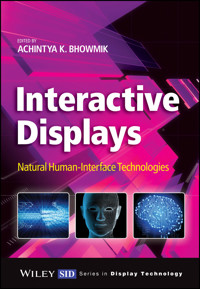
How we interface and interact with computing, communications and entertainment devices is going through revolutionary changes, with natural user inputs based on touch, voice, and vision replacing or augmenting the use of traditional interfaces based on the keyboard, mouse, joysticks, etc. As a result, displays are morphing from one-way interface devices that merely show visual content to two-way interaction devices that provide more engaging and immersive experiences. This book provides an in-depth coverage of the technologies, applications, and trends in the rapidly emerging field of interactive displays enabled by natural human-interfaces.
Key features:
- Provides a definitive reference reading on all the touch technologies used in interactive displays, including their advantages, limitations, and future trends.
- Covers the fundamentals and applications of speech input, processing and recognition techniques enabling voice-based interactions.
- Offers a detailed review of the emerging vision-based sensing technologies, and user interactions using gestures of hands, body, face, and eye gazes.
- Discusses multi-modal natural user interface schemes which intuitively combine touch, voice, and vision for life-like interactions.
- Examines the requirements and technology status towards realizing “true” 3D immersive and interactive displays.
Sie lesen das E-Book in den Legimi-Apps auf:
Seitenzahl: 834
Veröffentlichungsjahr: 2014
Ähnliche



















Table of Contents
Wiley-SID Series in Display Technology
Title Page
Copyright
About the Author
List of Contributors
Series Editor's Foreword
Preface
List of Acronyms
Chapter 1: Senses, Perception, and Natural Human-Interfaces for Interactive Displays
1.1 Introduction
1.2 Human Senses and Perception
1.3 Human Interface Technologies
1.4 Towards “True” 3D Interactive Displays
1.5 Summary
References
Chapter 2: Touch Sensing
2.1 Introduction
2.2 Introduction to Touch Technologies
2.3 History of Touch Technologies
2.4 Capacitive Touch Technologies
2.5 Resistive Touch Technologies
2.6 Acoustic Touch Technologies
2.7 Optical Touch Technologies
2.8 Embedded Touch Technologies
2.9 Other Touch Technologies
2.10 Summary
2.11 Appendix
References
Chapter 3: Voice in the User Interface
3.1 Introduction
3.2 Voice Recognition
3.3 Deep Neural Networks for Voice Recognition
3.4 Hardware Optimization
3.5 Signal Enhancement Techniques for Robust Voice Recognition
3.6 Voice Biometrics
3.7 Speech Synthesis
3.8 Natural Language Understanding
3.9 Multi-turn Dialog Management
3.10 Planning and Reasoning
3.11 Question Answering
3.12 Distributed Voice Interface Architecture
3.13 Conclusion
Acknowledgements
References
Chapter 4: Visual Sensing and Gesture Interactions
4.1 Introduction
4.2 Imaging Technologies: 2D and 3D
4.3 Interacting with Gestures
4.4 Summary
References
Chapter 5: Real-Time 3D Sensing With Structured Light Techniques
5.1 Introduction
5.2 Structured Pattern Codifications
5.3 Structured Light System Calibration
5.4 Examples of 3D Sensing with DFP Techniques
5.5 Real-Time 3D Sensing Techniques
5.6 Real-Time 3D Sensing for Human Computer Interaction Applications
5.7 Some Recent Advancements
5.8 Summary
Acknowledgements
References
Chapter 6: Real-Time Stereo 3D Imaging Techniques
6.1 Introduction
6.2 Background
6.3 Structure of Stereo Correspondence Algorithms
6.4 Categorization of Characteristics
6.5 Categorization of Implementation Platform
6.6 Conclusion
References
Chapter 7: Time-of-Flight 3D-Imaging Techniques
7.1 Introduction
7.2 Time-of-Flight 3D Sensing
7.3 Pulsed Time-of-Flight Method
7.4 Continuous Time-of-Flight Method
7.5 Calculations
7.6 Accuracy
7.7 Limitations and Improvements
7.8 Time-of-Flight Camera Components
7.9 Typical Values
7.10 Current State of the Art
7.11 Conclusion
References
Chapter 8: Eye Gaze Tracking
8.1 Introduction and Motivation
8.2 The Eyes
8.3 Eye Trackers
8.4 Objections and Obstacles
8.5 Eye Gaze Interaction Research
8.6 Gaze Pointing
8.7 Gaze Gestures
8.8 Gaze as Context
8.9 Outlook
References
Chapter 9: Multimodal Input for Perceptual User Interfaces
9.1 Introduction
9.2 Multimodal Interaction Types
9.3 Multimodal Interfaces
9.4 Multimodal Integration Strategies
9.5 Usability Issues with Multimodal Interaction
9.6 Conclusion
References
Chapter 10: Multimodal Interaction in Biometrics: Technological and Usability Challenges
10.1 Introduction
10.2 Anatomy of the Mobile Biometry Platform
10.3 Case Study: Usability Study for the Visually Impaired
10.4 Discussions and Conclusions
Acknowledgements
References
Chapter 11: Towards “True” 3D Interactive Displays
11.1 Introduction
11.2 The Origins of Biological Vision
11.3 Light Field Imaging
11.4 Towards “True” 3D Visual Displays
11.5 Interacting with Visual Content on a 3D Display
11.6 Summary
References
Index
End User License Agreement
Pages
xiii
xv
xvi
xvii
xviii
xix
xx
xxi
xxii
xxiii
xxiv
xxv
1
2
3
4
5
6
7
8
9
10
11
12
13
14
15
16
17
18
19
20
21
22
23
24
25
27
28
29
30
31
32
33
34
35
36
37
38
39
40
41
42
43
44
45
46
47
48
49
50
51
52
53
54
55
56
57
58
59
60
61
62
63
64
65
66
67
68
69
70
71
72
73
74
75
76
77
78
79
80
81
82
83
84
85
86
87
88
89
90
91
92
93
94
95
96
97
98
99
100
101
102
103
104
105
107
108
109
110
111
112
113
114
115
116
117
118
119
120
121
122
123
124
125
126
127
128
129
130
131
132
133
134
135
136
137
138
139
140
141
142
143
144
145
146
147
148
149
150
151
152
153
154
155
156
157
158
159
160
161
162
163
165
166
167
168
169
170
171
172
173
174
175
176
177
178
179
181
182
183
184
185
186
187
188
189
190
191
192
193
194
195
196
197
198
199
200
201
202
203
204
205
206
207
208
209
210
211
212
213
215
216
217
218
219
220
221
222
223
224
225
226
227
228
229
230
231
232
233
234
235
236
237
238
239
240
241
242
243
244
245
246
247
248
249
251
252
253
254
255
256
257
258
259
260
261
262
263
264
265
266
267
268
269
270
271
272
273
274
275
276
277
278
279
280
281
282
283
285
286
287
288
289
290
291
292
293
294
295
296
297
298
299
300
301
302
303
304
305
306
307
308
309
310
311
312
313
314
315
316
317
318
319
320
321
322
323
324
325
326
327
328
329
330
331
332
333
334
335
336
337
338
339
340
341
343
344
345
346
347
348
349
350
351
352
353
354
355
356
357
358
359
360
361
362
363
364
365
366
367
368
369
370
371
372
373
375
376
377
378
379
380
Guide
Cover
Table of Contents
Preface
Begin Reading
List of Illustrations
Figure 1.1
Figure 1.2
Figure 1.3
Figure 1.4
Figure 1.5
Figure 1.6
Figure 1.7
Figure 1.8
Figure 1.9
Figure 1.10
Figure 1.11
Figure 1.12
Figure 1.13
Figure 1.14
Figure 1.15
Figure 2.1
Figure 2.2
Figure 2.3
Figure 2.4
Figure 2.5
Figure 2.6
Figure 2.7
Figure 2.8
Figure 2.9
Figure 2.10
Figure 2.11
Figure 2.12
Figure 2.13
Figure 2.14
Figure 2.15
Figure 2.16
Figure 2.17
Figure 2.18.
Figure 2.19
Figure 2.20
Figure 2.21
Figure 2.22
Figure 2.23
Figure 2.24
Figure 2.25
Figure 2.26
Figure 2.27
Figure 2.28
Figure 2.29
Figure 2.30
Figure 2.31
Figure 2.32
Figure 2.33
Figure 2.34
Figure 2.35
Figure 2.36
Figure 2.37
Figure 3.1
Figure 3.2
Figure 3.3
Figure 3.4
Figure 3.5
Figure 3.6
Figure 3.7
Figure 3.8
Figure 3.9
Figure 3.10
Figure 3.11
Figure 3.12
Figure 3.13
Figure 3.14
Figure 3.15
Figure 3.16
Figure 3.17
Figure 3.18
Figure 4.1
Figure 4.2
Figure 4.3
Figure 4.4
Figure 4.5
Figure 4.6
Figure 4.7
Figure 4.8
Figure 4.9
Figure 4.10
Figure 4.11
Figure 5.1
Figure 5.2
Figure 5.3
Figure 5.4
Figure 5.5
Figure 5.6
Figure 5.7
Figure 5.8
Figure 5.9
Figure 5.10
Figure 5.11
Figure 5.12
Figure 5.13
Figure 5.14
Figure 5.15
Figure 5.16
Figure 5.17
Figure 5.18
Figure 5.19
Figure 5.20
Figure 5.21
Figure 6.1
Figure 6.2
Figure 6.3
Figure 6.4
Figure 6.5
Figure 6.6
Figure 7.1
Figure 7.2
Figure 7.3
Figure 7.4
Figure 7.5
Figure 7.6
Figure 7.7
Figure 7.8
Figure 7.9
Figure 7.10
Figure 7.11
Figure 7.12
Figure 8.1
Figure 8.2
Figure 8.3
Figure 8.4
Figure 8.5
Figure 8.6
Figure 8.7
Figure 8.9
Figure 8.8
Figure 8.10
Figure 8.11
Figure 8.12
Figure 8.13
Figure 8.14
Figure 8.15
Figure 8.16
Figure 8.17
Figure 9.1
Figure 9.2
Figure 9.3
Figure 9.4
Figure 9.5
Figure 9.6
Figure 9.7
Figure 9.8
Figure 9.9
Figure 9.10
Figure 9.11
Figure 9.12
Figure 9.13
Figure 9.14
Figure 9.15
Figure 9.16
Figure 9.17
Figure 10.1
Figure 10.2
Figure 10.3
Figure 10.4
Figure 10.5
Figure 10.6
Figure 10.7
Figure 10.8
Figure 10.9
Figure 10.10
Figure 10.11
Figure 10.12
Figure 10.13
Figure 10.14
Figure 10.15
Figure 10.16
Figure 11.1
Figure 11.2
Figure 11.3
Figure 11.4
Figure 11.5
Figure 11.6
Figure 11.7
Figure 11.8
Figure 11.9
Figure 11.10
Figure 11.11
Figure 11.12
Figure 11.13
Figure 11.14
Figure 11.15
Figure 11.16
Figure 11.17
Figure 11.18
Figure 11.19
Figure 11.20
Figure 11.21
Figure 11.22
List of Tables
Table 2.1
Table 2.2
Table 2.3
Table 2.4
Table 2.5
Table 2.6
Table 2.7
Table 2.8
Table 2.9
Table 2.10
Table 2.11
Table 2.12
Table 2.13
Table 2.14
Table 2.15
Table 2.16
Table 2.17
Table 2.18
Table 2.19
Table 2.20
Table 2.21
Table 3.1
Table 3.2
Table 7.1
Table 7.2
Table 8.1
Table 8.2
Table 8.3
Table 8.4
Table 8.5
Table 10.1
Wiley-SID Series in Display Technology
Series Editor:
Anthony
C. Lowe & Ian Sage
Display Systems: Design and Applications
Lindsay
W. MacDonald and Anthony C. Lowe (Eds.)
Electronic Display Measurement: Concepts, Techniques, and Instrumentation
Peter
A. Keller
Reflective Liquid Crystal Displays
Shin-Tson Wu and Deng-Ke Yang
Colour Engineering: Achieving Device Independent Colour
Phil
Green and Lindsay MacDonald (Eds.)
Display Interfaces: Fundamentals and Standards
Robert
L. Myers
Digital Image Display: Algorithms and Implementation
Gheorghe
Berbecel
Flexible Flat Panel Displays
Gregory
Crawford (Ed.)
Polarization Engineering for LCD Projection
Michael
G. Robinson, Jianmin Chen, and Gary D. Sharp
Fundamentals of Liquid Crystal Devices
Deng-Ke Yang and Shin-Tson Wu
Introduction to Microdisplays
David
Armitage, Ian Underwood, and Shin-Tson Wu
Mobile Displays: Technology and Applications
Achintya
K. Bhowmik, Zili Li, and Philip Bos (Eds.)
Photoalignment of Liquid Crystalline Materials: Physics and Applications
Vladimir
G. Chigrinov, Vladimir M. Kozenkov and Hoi-Sing Kwok
Projection Displays, Second Edition
Matthew
S. Brennesholtz and Edward H. Stupp
Introduction to Flat Panel Displays
Jiun-Haw Lee, David N. Liu and Shin-Tson Wu
LCD Backlights
Shunsuke
Kobayashi, Shigeo Mikoshiba and Sungkyoo Lim (Eds.)
Liquid Crystal Displays: Addressing Schemes and Electro-Optical Effects, Second Edition
Ernst
Lueder
Transflective Liquid Crystal Displays
Zhibing
Ge and Shin-Tson Wu
Liquid Crystal Displays: Fundamental Physics and Technology
Robert
H. Chen
3D Displays
Ernst
Lueder
OLED Display Fundamentals and Applications
Takatoshi
Tsujimura
Illumination, Colour and Imaging: Evaluation and Optimization of Visual Displays
Tran
Quoc Khanh and Peter Bodrogi
Interactive Displays: Natural Human-Interface Technologies
Achintya
K. Bhowmik (Ed.)
INTERACTIVE DISPLAYS
NATURAL HUMAN-INTERFACE TECHNOLOGIES
Edited by
Achintya K. Bhowmik
Intel Corporation, USA
This edition first published 2015
© 2015 by John Wiley & Sons, Ltd
Registered office: John Wiley & Sons, Ltd, The Atrium, Southern Gate, Chichester, West Sussex, PO19 8SQ, UK
Editorial offices: 9600 Garsington Road, Oxford, OX4 2DQ, UK
The Atrium, Southern Gate, Chichester, West Sussex, PO19 8SQ, UK
111 River Street, Hoboken, NJ 07030-5774, USA
For details of our global editorial offices, for customer services and for information about how to apply for permission to reuse the copyright material in this book please see our website at www.wiley.com/wiley-blackwell.
The right of the author to be identified as the author of this work has been asserted in accordance with the UK Copyright, Designs and Patents Act 1988.
All rights reserved. No part of this publication may be reproduced, stored in a retrieval system, or transmitted, in any form or by any means, electronic, mechanical, photocopying, recording or otherwise, except as permitted by the UK Copyright, Designs and Patents Act 1988, without the prior permission of the publisher.
Designations used by companies to distinguish their products are often claimed as trademarks. All brand names and product names used in this book are trade names, service marks, trademarks or registered trademarks of their respective owners. The publisher is not associated with any product or vendor mentioned in this book.
Limit of Liability/Disclaimer of Warranty: While the publisher and author(s) have used their best efforts in preparing this book, they make no representations or warranties with respect to the accuracy or completeness of the contents of this book and specifically disclaim any implied warranties of merchantability or fitness for a particular purpose. It is sold on the understanding that the publisher is not engaged in rendering professional services and neither the publisher nor the author shall be liable for damages arising herefrom. If professional advice or other expert assistance is required, the services of a competent professional should be sought.
Library of Congress Cataloging-in-Publication Data
Interactive displays / edited by Achintya K. Bhowmik.
1 online resource.
Includes bibliographical references and index.
Description based on print version record and CIP data provided by publisher; resource not viewed.
ISBN 978-1-118-70620-6 (ePub)— ISBN 978-1-118-70622-0 (Adobe PDF)— ISBN 978-1-118-63137-9
(cloth) 1. Information display systems. 2. Interactive multimedia. 3. Human-computer interaction. I.
Bhowmik, Achintya K., editor of compilation.
TK7882.I6
621.3815′422– dc23
2014016292
A catalogue record for this book is available from the British Library.
ISBN: 978-1-118-63137-9
About the Author
Dr. Achintya K. Bhowmik is the general manager and chief technology officer of the perceptual computing group at Intel Corporation, where he leads the research, development, and productization of advanced computing solutions based on natural human-interaction technologies, including visual sensing, speech recognition, biosensing, immersive displays, multimodal user interfaces and applications.
Previously, he served as the chief of staff of the personal computer group, Intel's largest business unit. Prior to that, he led the advanced video and display technology group, responsible for developing power-performance optimized multimedia processing architecture and display technologies for Intel's computing products. His previous work included high-definition display systems based on all-digital liquid-crystal-on-silicon microdisplay technology, fast electro-optic modulation in organic molecular crystals, and integrated optoelectronic circuits for high-speed communication networks.
He has been an adjunct professor at the Kyung Hee University in Seoul, Korea, teaching graduate-level courses on display technologies and image processing. He has also taught mobile sensing and computer vision at the University of California, Santa Cruz Extension. He has had 150 publications, including two books and 27 issued patents. He is a winner of the SID Distinguished Paper award.
He is the regional vice president of SID Americas, chair of the SID display electronics program committee, and a senior member of the IEEE. He is an associate editor for the Journal of the Society for Information Display, and editor for two special volumes on Advances in OLED Displays and Interactive Displays. He is on the board of directors for OpenCV, the organization behind the open source computer vision library.
List of Contributors
Achintya K. Bhowmik,
Intel Corporation, USA
Adwait Ratnaparkhi,
Nuance Communications, Inc.
Andrew Breen,
Nuance Communications, Inc.
Charles L. Ortiz,
Nuance Communications, Inc.
Corey Pittman,
University of Central Florida, Orlando, Florida
Daniël Van Nieuwenhove,
SoftKinetic Sensors, Belgium
Friedrich Faubel,
Nuance Communications, Inc.
Geoff Walker,
Intel Corporation, Santa Clara, California
Heiko Drewes,
LFE Medieninformatik, Ludwig-Maximilians-Universität, München, Germany
Holger Quast,
Nuance Communications, Inc.
Hung H. Bui,
Nuance Communications, Inc.
Jiaying Shen,
Nuance Communications, Inc.
Jim Larimer,
ImageMetrics, Half Moon Bay, California
Joseph J. LaViola Jr.,
University of Central Florida, Orlando, Florida
Kevin Farrell,
Nuance Communications, Inc.
Lazaros Nalpantidis,
Robotics, Vision and Machine Intelligence lab., Department of Mechanical and Manufacturing Engineering, Aalborg University Copenhagen, Denmark
Nikolaus Karpinsky,
Department of Mechanical Engineering, Iowa State University, Ames, Iowa
Norman Poh,
Department of Computing, University of Surrey, UK
Paul van Mulbregt,
Nuance Communications, Inc.
Peter F. Patel-Schneider,
Nuance Communications, Inc.
Peter Stubley,
Nuance Communications, Inc.
Philip J. Bos,
Kent State University, Kent, Ohio
Phillip A. Tresadern,
University of Manchester, UK
Richard Crouch,
Nuance Communications, Inc.
Rita Wong,
University of Surrey, UK
Roberto Gemello,
Nuance Communications, Inc.
Ronald M. Kaplan,
Nuance Communications, Inc.
Sarah Buchanan,
University of Central Florida, Orlando, Florida
Song Zhang,
Department of Mechanical Engineering, Iowa State University, Ames, Iowa
Tim Haulick,
Nuance Communications, Inc.
Tyler Bell,
Department of Mechanical Engineering, Iowa State University, Ames, Iowa
Vlad Sejnoha,
Nuance Communications, Inc.
William F. Ganong III,
Nuance Communications, Inc.
Series Editor's Foreword
The interactive use of machines by humans goes back thousands of years. Possibly the first vending machine was invented by Philo of Byzantium in 220 BCE. By the insertion of a coin, it would deliver a measured quantity of soap to a washstand. This was a mechanical device with an escapement movement. It was an advanced machine, certainly state of the art, but whether it had a perceptible influence on the behavioural development of society is debatable.
Moving forward more than 2200 years, we find ourselves in a markedly different situation. Just 50 years ago the first capacitive touch screen was reported. It took a further 30 years to become sufficiently developed to enter the high-end commercial market in laptop computers, point-of-sale terminals and the suchlike and hand held consumer devices. After another decade the present explosion in touch enabled devices began, at least for hand held devices, its march to ubiquity.
That is the effective starting point for this latest addition to the Wiley-SID Series in Display Technology. Written by a highly qualified group of experts in their various fields, the book covers the major means of interaction: touch, voice and vision. The first two of these are discussed in a single chapter each and vision in the next five, which reflects on the disparate nature of available or soon to be available vision technologies. There follow two chapters which present different ways in which multiple methods can be used to develop multimodal interaction with displays. The book concludes by discussing methods by which 3D images presented on a display can be made more lifelike, more akin to the way in which we observe nature with our eyes, by retaining phase information which is lost with present display systems which preserve only intensity data.
From the above, the reader will conclude that this book offers a comprehensive review of current and emerging technologies. However, it does much more than this by discussing the social impact that advanced interaction will create. Much of this will be positive, but there are some potentially negative aspects. All of these are important issues for public awareness and are worthy of debate. On the positive side are ease of use, intuitive reasoning by the computer/telephone system to predict, discuss and manage complex outcomes from a simple voice command and the enablement of users with physical disabilities who are presently debarred from full use of today's products. On the negative side is intrusion by communication systems into many more aspects of a user's life than presently occur; the mobile phone has been sceptically described as a tracking device which enables its user to make phone calls, but future systems will probe more deeply into our behaviour patterns. Security systems that rely on biometric data to verify identity are in principle more secure than present chip and PIN technology, but if such systems are compromised, then the exposure will be more widespread.
The future will offer a richer human-machine interactive experience than many who will be its users can presently imagine. Past science fiction has already been overtaken by reality. There are issues which must be debated and resolved before some of the possibilities offered by technology will become acceptable by providers and users alike. This book provides the information to inform all aspects of such a debate. It will be an important book for scientists and technologists involved in the subject and for those who develop interactive products. It will also be important to a much wider readership which has an interest in or a need to know how interactive displays will influence future societal and interpersonal behaviour.
Anthony LoweBraishfield, UK, 2014
Preface
So, what are “interactive displays”? We define them to be the displays that not only show visual information on the screens, but also sense and understand human actions and receive direct user inputs. Interactive displays that can “feel” the touch of our fingers are already ubiquitous, especially on mobile devices and all-in-one computers. Now, the addition of human-like perceptual sensing and recognition technologies is allowing the development of a new class of interactive displays and systems that can also “see”, “hear”, and “understand” our actions in the three-dimensional space in front of and around them.
We use multisensory and multimodal interface schemes to comprehend the physical world surrounding us and to communicate with each other in our daily lives, seamlessly combining multiple interaction modalities such as touch, voice, gestures, facial expressions, and eye gaze. If we want human-device interactions to approach the richness of human-human interactions, then we must endow the devices with technologies to sense and understand such natural user inputs and activities. The addition of natural human-interfaces can thus bring lifelike experiences to human-device interactions.
The ways in which we interact with computers have already gone through a transformation in recent decades, with graphical user interfaces that use a mouse and keyboard as input devices replacing the old command-line interfaces that used text-based inputs. We are now witnessing the next revolution, with the advent of natural human interfaces where the user interacts with computing devices using touch, gesture, voice, etc. The ultimate goal of implementing a human-device interface scheme is to make the interaction experiences natural, intuitive and immersive for the user. While the limitations of the technologies at hand require designers and engineers to make compromises and to settle for a subset of these goals for specific product implementations, significant advances have been taking place in recent years towards realizing this objective.
This book presents an in-depth review of the technologies, applications, and trends in the rapidly emerging field of interactive displays, focusing on natural human interfaces. The first chapter of the book starts with a review of the basics of human sensing and perception processes, and an overview of human-device interactions utilizing natural interface technologies based on the sensing and inference of touch, voice, and vision. The subsequent chapters delve into the details of each of these input and interaction modalities, providing in-depth discussion on the fundamentals of the technologies and their applications in human interface schemes, as well as combinations of them, towards realizing multisensory and multimodal interactions. The book concludes with a chapter on the fundamental requirements, technology development status, and outlook towards realizing “true” 3D interactive displays that would provide lifelike immersive interaction experiences.
I would like to thank the series editor, Anthony Lowe, for recognizing the need for a book on interactive displays as part of the Wiley-SID Series on Display Technology. I am grateful to the experts from across the industry and academia who contributed to this book. I also appreciate the support of the production staff at John Wiley.
Finally, I dedicate this book to Shida, Rohan, and Ava, without whose encouragement and support I would not have been able to undertake and complete this project.
Achintya K. BhowmikCupertino, California, USAFebruary 2014
List of Acronyms
Acronym
Meaning
Page (first appearance)
2D
Two Dimensional
10
3D
Three Dimensional
15
AAM
Active Appearance Model
317
AD
Absolute Differences
220
ADC
Analog-to-Digital Converter
40
AEC
Acoustic Echo Cancellation
127
AFE
Analog Front End
40
AG
Anti-glare
48
AI
Artificial Intelligence
109
AiO
All-in-One
28
AM
Acoustic Model
118
AMOLED
Active-Matrix OLED
88
AMR
Analog Multi-touch Resistive
31
ANN
Artificial Neural Networks
119
APR
Acoustic Pulse Recognition
32
ASIC
Application-Specific Integated Circuit
Lesen Sie weiter in der vollständigen Ausgabe!
Lesen Sie weiter in der vollständigen Ausgabe!
Lesen Sie weiter in der vollständigen Ausgabe!
Lesen Sie weiter in der vollständigen Ausgabe!
Lesen Sie weiter in der vollständigen Ausgabe!
Lesen Sie weiter in der vollständigen Ausgabe!
Lesen Sie weiter in der vollständigen Ausgabe!
Lesen Sie weiter in der vollständigen Ausgabe!
Lesen Sie weiter in der vollständigen Ausgabe!
Lesen Sie weiter in der vollständigen Ausgabe!
Lesen Sie weiter in der vollständigen Ausgabe!
Lesen Sie weiter in der vollständigen Ausgabe!
Lesen Sie weiter in der vollständigen Ausgabe!




