


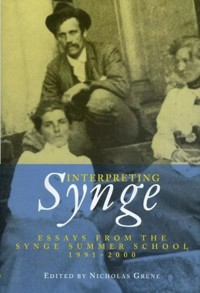
Interpreting Synge E-Book
Erhalten Sie Zugang zu diesem und mehr als 300000 Büchern ab EUR 5,99 monatlich.
- Herausgeber: The Lilliput Press
- Kategorie: Geisteswissenschaft
- Sprache: Englisch
John Millington Synge, controversial in his own time and long established as a major figure of world theatre, has nonetheless suffered relative critical neglect. Where his great contemporaries Yeats and Joyce and his outstanding successor Beckett have attracted whole industries of scholarly attention, Synge, by reason of his short life and limited output, has been relegated to the unconsidered category of minor classic. This volume of essays, arising from lectures given at the Synge Summer School by some of the most distinguished writers and scholars of Irish literature, sets about the necessary task of interpreting Synge: his relation to cultural and theatrical contexts; the significance of his plays; the distinctive quality of his language and the thematic matrices of his work. Four original poems, specially commissioned for the book, provide an imaginative counterpoint to the critical interpretation of the essays.
Sie lesen das E-Book in den Legimi-Apps auf:
Seitenzahl: 427
Veröffentlichungsjahr: 2015
Das E-Book (TTS) können Sie hören im Abo „Legimi Premium” in Legimi-Apps auf:
Ähnliche




















INTERPRETING SYNGE
Essays from the Synge Summer School 1991–2000
Edited by Nicholas Grene
THE LILLIPUT PRESS DUBLIN
Contents
Acknowledgments
This book arose out of the Synge Summer School, and my first and fullest acknowledgments must go to all those who made the School possible. I wish to acknowledge the School’s many generous donors including our major sponsors: Wicklow County Council, which originally proposed the idea for the School and has supported it unfailingly throughout, and Schering-Plough (Avondale). I want to thank my fellow committee members, who, I am sure, will not mind my picking out for special mention our irreplaceable Secretary, Irene Parsons. I have to pay tribute to the School’s many speakers, who have set such high standards of expertise, enthusiasm and engagement. And finally I need to salute the hundreds of students whose warm and lively involvement has made the School such a pleasure to direct.
In planning the book I benefited from the shrewd and experienced advice of Jonathan Williams. Brian Cliff of Emory University acted not just as research assistant; with his detailed knowledge of the subject and his sensitivity to style, he has made a major contribution to the editing of the book. I have very much appreciated, also, the skilful and critically acute copy-editing of Brendan Barrington. I acknowledge most gratefully the financial support for the volume made available from the Patrick Kavanagh Bursary of the School of English, Trinity College, Dublin.
I owe most of all to the generosity and goodwill of my contributors, without whom InterpretingSynge would not exist.
Four of the essays in this book have been previously published in other versions as follows:
R.F. Foster, ‘Good Behaviour: Yeats, Synge and Anglo-Irish Etiquette’, in PaddyandMrPunch:ConnectionsinIrishandEnglishHistory (London: Allen Lane, The Penguin Press, 1993).
Nicholas Grene, ‘Synge and Wicklow’, in Wicklow:HistoryandSociety, ed. Ken Hannigan and William Nolan (Dublin: Geography Publications, 1994).
Antoinette Quinn, ‘Cathleen ni Houlihan Writes Back: Maud Gonne and Irish National Theater’, in GenderandSexualityinModernIreland, ed. Anthony Bradley and Maryann Gialanella Valiulis (Amherst Mass.: University of Massachusetts Press in association with the American Conference for Irish Studies, 1997).
Ann Saddlemyer, ‘Synge’s Soundscape’, IrishUniversityReview, 22.1 (1992).
Grateful acknowledgment is made to the editors and publishers with whose agreement these materials appear here.
Christopher Morash’s essay is to form part of AHistoryoftheIrishTheatre, forthcoming from Cambridge University Press.
Abbreviations
The following abbreviations are used for the texts of Synge cited throughout the book:
Introduction
‘We will have a hard fight in Ireland before we get the right for every man to see the world in his own way admitted. Synge is invaluable to us because he has that kind of intense narrow personality which necessarily raises the whole issue.’1 So wrote Yeats, in a letter to the American patron John Quinn in 1905. They had their hard fight, Synge’s work did raise the whole issue, and the fight was won, in no small part due to the often belligerent and provocative championship of Yeats. Patrick Pearse, one of Synge’s most vehement critics at the time of the Playboy controversy, who had claimed then that Synge ‘railed obscenely against light, and sweetness, and knowledge, and charity’,2 by 1913 could praise him in Pearsian terms of admiration as ‘a man in whose sad heart glowed a true love of Ireland, one of the two or three men who have in our time made Ireland considerable in the eyes of the world’.3 Synge has long since been accepted as a major figure of Irish literature, of European theatre. His plays, particularly his masterpiece ThePlayboyoftheWesternWorld, continue to hold the stage around the world ninety years after his death. Yet his work has never attracted the exhaustive industry of interpretation devoted to his great contemporaries Yeats and Joyce, and his most important successor Beckett. Why?
There is a short and easy answer to the question. Synge was a late developer who died before his thirty-eighth birthday. He was granted hardly more than six years of mature writing life. For him there was to be none of that extraordinarily extended artistic development which is the distinguishing feature of Yeats, no time for growth like that of Joyce from Dubliners and APortraitoftheArtist to Ulysses and FinnegansWake, no opportunity for the creative genesis that took Beckett from MorePricksthanKicks to the Trilogy,WaitingforGodot, and beyond. Synge left only the limited and relatively homogeneous oeuvre of six achieved plays, TheAranIslands, a handful of essays, and a very slim volume of verse. No mean monument, but apparently limited as thesis-quarry.
Apart from his restricted output, in Ireland there has been another dimension to the relative neglect of Synge. In his own time, in his own country, Synge’s work occasioned fierce contention. Since then, though his stature has been widely acknowledged, there remains a legacy of unease with his work, a residue of distrust of his language and his vision of Ireland. Accompanying such remaining resistance, perhaps indeed a mutated version of it, has been an increasing feeling that his imagined Ireland, if it ever existed, belongs to a past that we want to forget. Here in Ireland at the end of the century, the Irish modernists can be claimed with pride as an internationally accredited cultural property. Synge’s drama, by contrast, is associated with a late romantic cult of the peasant, a pastoral kitsch particularly distasteful in a country bent on establishing its credentials as a fully modernized urban society. The mist that does be on the bog can stay there. And so, though lip-service is paid to Synge’s genius and the canonical status of his work is accepted, there has been no new critical monograph on Synge in fifteen years,4 and books on his work published in Ireland have been particularly rare.5
It was against such a background and to challenge this kind of neglect that the Synge Summer School was established in 1991. It took from the beginning a much broader remit than the study of Synge’s work alone; the mission of the School has been to explore the whole rich and living tradition of Irish theatre in which Synge played such a crucial role. It has, though, been one of the School’s principal aims not to rehabilitate Synge, much less to set up an adulatory shrine to his memory, but to set going again a proper critical debate on the nature and significance of his achievement. That too has been the design of the present book, published on the occasion of the tenth Synge Summer School in 2000. The appendix to the book, setting out the full range of programmes over the ten years, will demonstrate that it would have been impossible to publish a fully comprehensive proceedings of the School. Even to collect just the lectures devoted to Synge would have made for an unviably bulky volume. I decided therefore to invite ten of our speakers to contribute essays derived from their School lectures as a way to illustrate the range of possibilities for interpreting Synge that the Synge Summer School has helped to open up over its first decade. Some of the contributors took this as an opportunity to develop their arguments into fully elaborated scholarly papers; some chose to retain the immediacy of the spoken style. I have deliberately kept that diversity, have not sought to impose an editorial consistency of tone, because I wanted this book, like the School, to be hospitable to the different languages of interpretation, to accommodate the various fields of vision from which Synge can be seen. Some, but by no means all, of the writers in this volume have a background of specialist interest in Synge; the book’s success depends on the interplay established between the several interpreting voices and the particular vantage-points they represent.
The broad arrangement of the volume is into three groups of essays, the first situating Synge in a number of social, literary and theatrical contexts, the second focusing on individual works, the last concerned with patterns running through his writing as a whole. Given that the Synge Summer School is based in Rathdrum, close to where all the four Wicklow plays are based,6 it seemed logical to begin with my own essay on Synge and Wicklow. My interest in it was turned towards local history, to the county specifics of family class and position from within which Synge wrote and the details of local life which he observed and shaped into his work. Roy Foster, as an Irish cultural and political historian at present writing the definitive biography of Yeats, was in a position to take another bearing on Synge and his family background. His essay calibrates the precise differences between the background and milieux of Yeats and Synge, and demonstrates just how this contributed to the figure Synge made in the Yeatsian imagination. Frank McGuinness comes to Synge as a leading Irish playwright who has created versions of several Ibsen plays for the contemporary stage. He is therefore attuned to the echoes of Ibsen in Synge, not only in the abandoned country house play WhentheMoonHasSet, but in the achieved drama of ThePlayboy. While this underacknowledged connection to a European dramatic inheritance is uncovered in McGuinness’s ‘John Millington Synge and the King of Norway’, Angela Bourke, bringing to bear the specialist authority of an Irish-language scholar, illuminates the native communal ‘theatre’ on which Synge drew in his representations of the customs of the keen. Her careful analysis of Synge’s own observations of keening on Aran and of the tradition of the mourning woman yields a new sense of the dramatic force of RiderstotheSea and DeirdreoftheSorrows.
Such are the contexts within which Synge’s work is set in the first four essays of this book. But the distinction between text and context-related study is necessarily an artificial one, as Declan Kiberd’s detailed study of TheAranIslands makes clear. Although he does indeed give to Synge’s book the close critical attention which it deserves and has seldom had, this is in order to identify its diverse sources – from Wilde’s ‘The Soul of Man Under Socialism’ to Frazer’s TheGoldenBough – and to bring out the precise nature of Synge’s anthropologist-like relationship with Aran. Tom Paulin, reflecting on RiderstotheSea as a ‘revisionist tragedy’, re-reads the play in the light of the changes that contemporary politics have wrought on his understanding of it, and offers a juxtaposition of the play with CathleenniHoulihan and ThePlayboy in a three-way ‘imaginary production’. Antoinette Quinn’s ‘Staging the Irish Peasant Woman: Maud Gonne versus Synge’ places CathleenniHoulihan back in its original theatrical context in a sequence followed by TheShadowoftheGlen and Gonne’s play Dawn. The politics centring on the production of the Shadow are here reinterpreted as part of a continuing struggle over the representation of Irish women in which Maud Gonne played a leading role on and off the stage. Where Quinn approaches Synge’s controversial drama from within women’s studies, Christopher Morash writes about the riots over ThePlayboy as a historian of Irish theatre. His essay makes telling use of an earlier nineteenth-century theatre riot in Dublin to illustrate how the disturbances over ThePlayboy turned on changing attitudes towards audience behaviour, with their class and political implications. By contrast with this concentration on the first theatrical production of ThePlayboy, Martin Hilský is able to enlarge upon one aspect of its theatrical afterlife, its continuing popularity on the Czech stage. His commision to translate the play for the Czech National Theatre in 1995 prompted a search for an appropriate style in which to ‘re-imagine’ Synge’s language; his account of that search helps to illuminate both the texture of Synge’s stage dialect and the meanings it supports in ThePlayboy.
The two remaining essays in the volume pursue patterns of feeling and imagination that go beyond any one work of Synge and represent the informing characteristics of his writing. Anthony Roche looks at the relationship between Synge and his fiancée Molly Allgood, not just for its biographical interest but for the performative roles of woman and tramp played out in Synge’s letters to her, roles which answered to long-standing psychological preoccupations of the playwright. Roche’s essay suggests the way in which these shaped the creation of his two greatest parts for women, Pegeen Mike and Deirdre, both written for and, in a sense, with Molly. Ann Saddlemyer’s ‘Synge’s Soundscape’ was the inaugural lecture of the first Synge Summer School, so there seemed a certain appropriateness in placing this essay by the doyenne of Synge scholarship at the end of this volume. Her intimate knowledge of all Synge’s writing, his letters and notebooks as well as his finished work, has enabled her to bring out the special importance of his responsiveness to sound, the sounds of nature as of music, and how this rhythmical tuning of his ear to the world around him produces the special soundscape of his plays.
I have been writing so far as if this book were a collection of essays only. It isn’t, and is distinctively different for not being so. The Synge Summer School has been a collaborative enterprise, bringing together scholars, writers, and theatre professionals in the conviction that the exposition of literature and drama is not the exclusive preserve of the academy, that interpretation and imagination are one – not two opposed activities. It was in such a spirit that I asked four poets, all of whom had spoken or read at the School, to contribute to the book poems that would in some way or other bear upon Synge. These poems are there for readers to read: they do not stand in need of glossing from me. What I will say is that this book would be immeasurably poorer without Seamus Heaney’s ‘Glanmore Eclogue’, without Nuala Ní Dhomhnaill’s ‘Ar Oileán’ (based on Synge’s ‘On an Island’), without Gerald Dawe’s ‘Distraction’, without the envoi of Brendan Kennelly’s ‘Synge’. To set about interpreting Synge as this book does is also to imagine Synge again as these poets have.
NicholasGrene
Ballinaclash,Co.Wicklow
NOTES
1. TheLettersof W.B.Yeats, ed. Allan Wade (London, 1954), pp. 447–8.
2. ‘The Passing of Anglo-Irish Drama’, AnClaideamhSoluis, 9 February 1907.
3. Pádraic H. Pearse, PoliticalWritingsandSpeeches (Dublin, 1922), p. 145.
4. The last was Mary C. King, TheDramaof J.M.Synge (London, 1985).
5. There appears to have been nothing since Maurice Harmon’s edited collectionJ.M.Synge:CentenaryPapers1971 (Dublin, 1972) and Paul Levitt’s reference work J.MSynge:ABibliographyofPublishedCriticism (Dublin, 1974); before that one has to go back to Daniel Corkery’s polemic SyngeandAnglo-IrishLiterature (Cork, 1931) to find an Irish-published book devoted to Synge’s work.
6. Apart from TheShadowoftheGlen,TheWelloftheSaints and TheTinker’sWedding, all set in the valley of the Avonbeg, the unfinished WhentheMoonHasSetis placed within sight of Tonelagee, a mountain not far from Glendalough.
SEAMUS HEANEY
GlanmoreEclogue
NICHOLAS GRENE
OntheMargins:SyngeandWicklow
I. THE SYNGES OF WICKLOW
The Synges of Glanmore Castle in County Wicklow, like so many landed Anglo-Irish families, had come down in the world by the time of the playwright at the end of the nineteenth century. Their Wicklow property had been established in the eighteenth century following marriages with the Hatch family and was at its heyday in the time of Francis Synge (1761–1831). He owned not only Glanmore, with its fifteen hundred acres of demesne including the Devil’s Glen, but Roundwood Park as well, an estate in all of over four thousand acres. It was Francis who had the older house of Glenmouth enlarged and redesigned by Francis Johnson as what was then called Glenmore Castle, described in all its glory in Lewis’s TopographicalDictionary (1837):
Glenmore, the splendid residence of J. Synge, Esq., is a handsome and spacious castellated mansion, with embattled parapets, above which rises a lofty round tower, flanking the principal parapet, in the centre of which is a square gateway tower forming the chief entrance; it was erected by the late F. Synge, Esq., and occupies an eminence, sloping gently towards the sea, near the opening of the Devil’s Glen, and surrounded by a richly planted demesne, commanding a fine view of St George’s Channel, and the castle, town, and lighthouses of Wicklow, with the intervening country thickly studded with gentlemen’s seats.1
Unfortunately, this idyllic picture of natural beauty and civilized power was not to last. Francis’s heir John (1788–1845), known in the family as ‘Pestalozzi John’ because of his enthusiastic advocacy of the Swiss educationalist Johann Heinrich Pestalozzi, became increasingly indebted and on his death the estates were bankrupt.2 His son Francis Synge managed to buy back Glanmore but not Roundwood Park from the Commissioners of Encumbered Estates in 1850. Although in his lifetime the reduced estate of Glanmore was relatively prosperous, after his death in 1878 his widow, Editha, and her second husband Major Theodore Gardiner lived in the house only intermittently and the property suffered under erratic management. This was the state of the family fortunes which the adult John Millington Synge (1871–1909) would have known.3
He himself came from a younger branch of the Glanmore family. His father John Hatch Synge (1824–72), the seventh child of ‘Pestalozzi John’, was a barrister by profession who died when John Millington was only one, leaving his widow with five children to bring up. With an income of £400 a year derived from land investments, Mrs Synge did not live in poverty, but rather in what were known as ‘reduced circumstances’. Her older children all became comfortably settled in middle-class professions. Edward was a land agent to (among others) Lord Gormanstown and, from 1884 on, to the Synge estates in Wicklow. He was, it seems, regarded by the tenants as a hard man, at least to judge by one incident reported by Mrs Synge: ‘He heard them talking among themselves and one said “it would take a Synge to do that”’ (Stephens MS f. 478). Robert trained as a civil engineer, then emigrated to Argentina, where for a number of years he ranched with cousins on his mother’s side. Samuel, with qualifications in divinity and medicine, served as a medical missionary in China. Annie married a solicitor, Harry Stephens, and their family continued to live close to Mrs Synge. Only the youngest, ‘Johnnie’, proved a problem, horrifying the family with his aspiration, on graduating from Trinity College, of becoming a musician. ‘Harry had a talk with him the other day,’ Mrs Synge wrote Robert in January 1890, ‘advising him very strongly not to think of making it a profession. Harry told him all the men who do take to drink!’ (Stephens MS f. 586). Johnnie persisted, all the same, at first studying music in Germany, and then – equally unsatisfactorily from the family’s point of view, and equally unrewardingly – living in Paris with some ill-defined aim of becoming a writer. In Mrs Synge’s letters to her other sons, her youngest is a constant source of worry: ‘My poor Johnnie is my failure’ (April 1894); ‘Johnnie is vegetating in Paris. He calls himself very busy, but it is a busy idleness, in my opinion’ (November 1896) (Stephens MS f. 931, f. 1148).
John Synge’s failure to find a respectable and respectably paid profession was not the only cause of worry for his family. There was also his loss of faith, deeply disturbing to his mother. On both sides of his family, his religious heritage was one of evangelical Protestantism. His grandfather John Synge and his uncle Francis had both been members of the Plymouth Brethren, which had its origins in Wicklow. His mother’s father, Robert Traill, was a clergyman from Antrim who felt that he had been denied preferment in the Church because of his strongly evangelical views. Mrs Synge shared those views and it was a real grief to her when John, at the age of eighteen, declared that he no longer believed, and refused to attend church any more. Again and again over the years her letters record her prayers for him and her yearning for him to accept Jesus as his Redeemer.
Synge was at odds with his family politically as well. Although he canvassed for an Anti-Home Rule Petition in 1893,4 and as late as 1895 was of the view that Home Rule would provoke sectarian conflict,5 by 1897 he was prepared to join Maud Gonne’s Association Irlandaise in Paris and, like most Irish nationalists, he took a strongly pro-Boer position in the Boer war (Stephens MS f. 1602). He was not only nationalist but socialist in principle. ‘A radical’, he told his young nephew Edward Stephens in an unusual outburst, ‘is a person who wants change root and branch, and I’m proud to be a radical’ (Stephens MS f. 1663). Such ideas were hardly likely to be acceptable to his family. ‘He says’, reported Mrs Synge indignantly to Samuel in 1896, ‘he has gone back to Paris to study Socialism, and he wants to do good, and for that possibility he is giving up everything. He says he is not selfish or egotistical but quite the reverse. In fact he writes the most utter folly …’ (Greene and Stephens, 62).
There is nothing very unusual about a writer or artist from a conventional middle-class background diverging from his family’s political, social and religious views. What is striking about Synge’s case is that he maintained such close relations with the family in spite of his dissidence. From 1893 to 1902 he spent his winters on the Continent, but his home remained with his mother in Kingstown (Dun Laoghaire) and, with the exception of two brief periods when he took rooms in Dublin, he went on living with her until her death in 1908, not long before his own. He shared also the prolonged family holidays in Wicklow. Throughout Synge’s youth and adolescence Mrs Synge had taken a holiday house each year in Greystones and lived there as part of the tightly knit Greystones Protestant community. From 1892 on, the houses she rented were in the Annamoe area, close to Glanmore, most frequently Castle Kevin. Most years the Wicklow stay lasted from June through September, providing a family base for Robert or Samuel Synge when they were home from abroad, for the Stephenses, and for cousins and missionary friends visiting Ireland. It was from these summer periods spent with his family around Annamoe that Synge formed the impressions of Wicklow which served as the basis for his essays and plays.
The Synges came to Annamoe as something between urban summer visitors and members of the local landowning family. They no longer stayed at Glanmore, as they had during the lifetime of Francis Synge; Francis’s widow Editha and her second husband, Major Gardiner, when they were resident, lived on the hill farm of Tiglin for economy and rented out Glanmore Castle. The houses that the Synges rented were suggestive of their social position. Castle Kevin, a substantial early nineteenth-century house, home of the Frizell family, was vacant and could be rented cheaply because it was boycotted. The Synges spent in all seven summers there between 1892 and 1901. They did not seem to be troubled by the boycott, though Synge found on the doorpost of Castle Kevin (and later published) a triumphalist verse celebrating the departure of the Frizells.6 When Castle Kevin was not available, Mrs Synge rented Avonmore, a big eighteenth-century house on the Castle Kevin property, lived in by Henry Harding, a local farmer and caretaker for the Frizells. For the month of August 1897 they stayed on the Parnell estate at Avondale, not in the big house, but in the steward’s house, ‘Casino’, something which Harry Stephens felt was a social indignity. In other summers they had to be content with still less grand places to stay. In 1895 it was Duff House, a farmhouse with a beautiful situation on the southern side of Lough Dan. ‘It was with some misgivings that Mrs Synge brought her future daughter-in-law [Robert’s fiancée] there, for, as the house was owned by Roman Catholics, she feared that it would not be free from fleas’ (Stephens MS f.1022). Tomriland House, where the Synges stayed in 1902, 1903 and 1904, was just as unpretentious, but the farmers who owned it were Protestant.
In her holiday homes, as in Dublin, Mrs Synge preferred to have to do with people of her own religion. There were the Hardings with whom the Synges stayed at Avonmore; there were the Colemans who owned Tomriland; there was Willie Belton who acted as carter for the Synges when they travelled down from Kingstown and who aroused Mrs Synge’s extreme anger by getting drunk on an outing to Glendalough with her maids. ‘Is it not a dreadful thing’, she wrote to Samuel, ‘for one of our few protestants in this place to be going on in such a way?’ (Stephens MS f. 2015). One exception was their close neighbour old Mrs Rochfort, known to the family by her favourite tag ‘Avourneen’, whose talk Synge incorporated into his essay ‘The People of the Glens’ (CW II 219–20). Still it must have been a significant part of Synge’s Wicklow experience that so many of the people around him were of his family’s religion. It adds a different dimension, for example, to the famous story of Synge listening in to the talk of the servant girls. In the preface to ThePlayboyoftheWesternWorld he wrote defending the authenticity of his language:
When I was writing TheShadowoftheGlen, some years ago, I got more aid than any learning could have given me, from a chink in the floor of the old Wicklow house where I was staying, that let me hear what was being said by the servant girls in the kitchen. (CW IV 53)
The impression of the gentleman eavesdropper was unfortunate. But would the impression have been improved if he had added the detail that the girls whose talk so inspired him in Tomriland House in 1902 were Ellen the cook and Florence Massey the maid, both of whom had been brought up in a Protestant orphanage and did not necessarily come from Wicklow at all?7
If the range of Synge’s social acquaintance in Wicklow was limited, his knowledge of the countryside was not. Within a radius of some fifteen miles from Annamoe, he walked and cycled every hill and valley, generally in company with his relations or with friends of the family. He spent most of July 1898, for example, on excursions with Robert, who was a passionate fisherman; in other summers he walked with Samuel. The guests at the Synges’ holiday houses at different times included a number of younger women, Annie and Edie Harmar, sisters of Samuel’s wife, and friends of theirs, Madeleine Kerr and Rosie Calthrop. These too were Synge’s companions on long walks or cycle-rides and, interestingly, there never seems to have been any sense of impropriety at his going off unchaperoned for a day at a time with an unrelated woman of his own age. In the Wicklow essays Synge virtually always gives the impression of being alone on his journeys, but this was often not the case. Where, for example, in ‘An Autumn Night in the Hills’ he tells the story of going to fetch a pointer dog from the cottage where it had been recovering after a shooting accident, the essay ends most effectively with a description of his solitary walk back down Glenmalure (though it isn’t named as such). What he does not reveal is that the dog in question belonged to his brother-in-law Harry Stephens, who had rented shooting rights in Glenmalure, and that Harry was with him on the mission to fetch the dog home.8
In his summers in Wicklow Synge lived a double life: the social life of the family in which he played a full part (attendance at church always excepted) and the life of the imagination slowly transmuted into writing. The Synges remained a close and united family, and John Synge never tried to escape from the closeness of those bonds. As Stephens commented on John’s relations with Robert: ‘The brothers differed about almost every subject, but they never quarrelled about their differences’ (Stephens MS f. 1412). This is borne out also by Synge’s own remark on Samuel, in a letter to his fiancée Molly Allgood: ‘he is one of the best fellows in [the] world, I think, though he is so religious we have not much in common’ (CL I 224). It was Synge’s deliberate strategy to avoid subjects of dissension. Thus he adopted a ‘rule against talking to us [his nephews Edward and Francis Stephens] about religious or political theory, with which our parents would not have agreed’ (Stephens MS f. 1828). He remained deeply attached to his mother and she to him, for all their lack of understanding. So, for example, she was prepared to accept the prospect of Molly Allgood as daughter-in-law, though an ill-educated, nineteen-year-old Roman Catholic, a former shop-girl turned actress, must have offended nearly every prejudice she had. The rest of the family were less tolerant of the proposed marriage, but once again there was no outright quarrel.
Silence, repression, and instinctive family loyalty kept the Synges together. John Synge walked with Samuel, fished with Robert, shot with Harry Stephens, cycled with his in-laws and his in-laws’ cousins. Yet he looked at Wicklow as they would never have done. He was an internal drop-out within a class which he, but not they, saw as defeated and obsolete. His most telling evocation of that state of affairs is the essay ‘A Landlord’s Garden in County Wicklow’. The essay was based on a real incident in the walled garden of Castle Kevin in the summer of 1901 when Synge set himself to guard some ripening cherries against the depredations of the local boys, ending up chasing one of them round and round the garden. ‘John sent us into fits of laughter telling us the story,’ Mrs Synge commented in her account of the matter in a letter to Samuel at the time (MyUncleJohn, 144). In writing the essay Synge turned the cherries into apples, more traditional fruit for orchard-robbing, and made the garden into an eloquent emblem of the decaying fortunes of the landowning class:
A stone’s throw from an old house where I spent several summers in county Wicklow, there was a garden that had been left to itself for fifteen or twenty years. Just inside the gate, as one entered, two paths led up through a couple of strawberry beds, half choked with leaves, where a few white and narrow strawberries were still hidden away. Further on was nearly half an acre of tall raspberry canes and thistles five feet high, growing together in a dense mass, where one could still pick raspberries enough to last a household for the season. Then, in a waste of hemlock, there were some half-dozen apple trees covered with lichen and moss, and against the northern walls a few dying plum trees hanging from their nails. Beyond them there was a dead pear tree and just inside the gate, as one came back to it, a large fuchsia filled with empty nests. A few lines of box here and there showed where the flower-beds had been laid out, and when anyone who had the knowledge looked carefully among them many remnants could be found of beautiful and rare plants. (CW II 230)
This sounds a circumstantially precise description, but the substitution of the apples for the real-life cherries makes it clear that it is not literally accurate. Synge is in fact piling up the details to compound the sense of dereliction: the etiolated strawberries, the rank growth of the raspberries and thistles, the apple-trees neglected and mossed with age, the abandoned nests in the fuchsia, the ‘waste of hemlock’, the fine and exotic cultivated flowers only to be found by connoisseurs in the wilderness. It is no wonder that he entitled one draft of this essay ‘The Garden of the Dead’.9
In this one essay, Synge allowed himself a measure of the class nostalgia traditionally associated with the image of the crumbling big house – in this essay only, and a measure of it only.
Everyone is used in Ireland to the tragedy that is bound up with the lives of farmers and fishing people; but in this garden one seemed to feel the tragedy of the landlord class also, and of the innumerable old families that are quickly dwindling away. These owners of the land are not much pitied at the present day, or much deserving of pity; and yet one cannot quite forget that they are the descendants of what was at one time, in the eighteenth century, a high-spirited and highly-cultivated aristocracy. The broken green-houses and mouse-eaten libraries, that were designed and collected by men who voted with Grattan, are perhaps as mournful in the end as the four mud walls that are so often left in Wicklow as the only remnants of a farmhouse. (CW II 230–1)
Synge is commenting here, and passing judgement, on his own class and his own family. ‘Many of the descendants of these people have, of course, drifted into professional life in Dublin, or have gone abroad; yet, wherever they are, they do not equal their forefathers’ (CW II 231). His most telling condemnation he omitted from the published essay: ‘Still, this class, with its many genuine qualities, had little patriotism, in the right sense, few ideas, and no seed for future life, so it has gone to the wall’ (CW II 231).
The essay makes it clear how deliberately Synge turned away from his own class and its situation as a subject for his writing:
The desolation of this life is often of a peculiarly local kind, and if a playwright chose to go through the Irish country houses he would find material, it is likely, for many gloomy plays that would turn on the dying away of these old families, and on the lives of the one or two delicate girls that are left so often to represent a dozen hearty men who were alive a generation or two ago. (CW II 231)
This was not the material from which Synge was to create his plays, though his first drama, WhentheMoonHasSet, is concerned with something very like the country-house subject he here rejects. Instead he turned to areas of local life outside the compass of his social background and brought to them attitudes very unlike those of his family. And yet we can see in the Wicklow essays and plays, refracted and transposed, the conditioned habits of mind of his own social situation. He is relatively little concerned with the rural community as a community, with its history and evolution. He remains someone from outside looking in, looking on, interested by those on the social margins or at the extreme peripheries of the region. He effaces, in so far as is possible, himself, his family, his class, and sees value and significance in what his own people would least regard. The wildness and primitiveness of local life represent a welcome contrast to the genteel repressions of middle-class Protestant late Victorianism. Still, the melancholy strain in his observation of Wicklow, and his tendency to focus on and treasure what is at social vanishing point, are in some sort of emotional correspondence with his position as alienated member of a declining class.
II. IN WICKLOW: THE ESSAYS
Synge made his first visit to Aran in 1898 and almost immediately conceived the idea of writing a book about his experiences there. With a draft of what was to become TheAranIslands largely completed in the winter of 1900–1, he turned to doing something similar for Wicklow. The paradox of Synge’s creative development was that it took the visits to the unfamiliar landscape of Aran to enable him to see the Wicklow countryside with fresh eyes. The strangeness of Aran, and his strangeness in it, freed him from a social self-consciousness which would have been much stronger in Wicklow where he, or at least his family and family name, would have been well known and easily placed. From 1900 on he began to write up descriptive notes, interesting encounters of his Wicklow summers, and in 1901–2 he made a point of visiting fairs and races to collect material. By 1902 he seems to have had the idea of trying to gather together a book on Wicklow life.10 He never completed this project and left only the eight essays which make up the ‘In Wicklow’ section of his posthumous Works.
‘All wild sights appealed to Synge,’ said Jack Yeats, ‘and he did not care whether they were typical of anything or had any symbolical meaning at all’.11 The wilder, the rougher the sights were, the better Synge liked them. Compare, for example, his account of an occasion such as the horse-races in Arklow in August 1901 with that of the WicklowNews-Letter. The News-Letter was the Unionist county paper, and its report on the races made them a very sedate affair. Headed ‘Arklow Races’, the article gave a full list of the organizing committee, before continuing:
Favoured with delightful weather, the above races came off on Thursday, on The Green, Arklow, in the presence of an enormous multitude of holiday-makers from all parts of the country, including many from North Wexford and Dublin. The meeting was held under the Irish Racing Association rules, and it was pleasing to find that both the executive and stewards discharged their duties so satisfactorily that not a hitch occurred in the arrangements, which were excellent, and a most enjoyable day’s racing resulted. A few minor details were wanting, such as a telegraph board, refreshments saloon, &c., while a little more attention might have been paid to the levelling of a short piece of the course. However, everything passed off well, and the stewards are to be congratulated upon the grand success they achieved.12
The article concluded with a formal list of results, ending with the Farmers’ Plate. Here is Synge on the same event:
The races in Arklow […] are singularly unconventional, and no one can … watch them on the sand-hills in suitable weather, when the hay and the wooded glens in the background are covered with sunshine and the shadows of clouds, without thrilling to the tumult of humour that rises from the people.
A long course is indicated among the sand-hills by a few scattered flag-posts, and at the portion nearest the town a rough paddock and grandstand – draped with green paper – are erected with about a hundred yards of the course roped off from the crowd.
This is Synge’s version of the stewards discharging ‘their duties so satisfactorily’:
Some half dozen fishermen, with green ribbons fastened to their jerseys or behind their hats, act as stewards […] and as they are usually drunk they reel about poking the public with a stick and repeating with endless and vain iteration, ‘Keep outside the ropes’.
It is the crowd and the sideshows rather than the racing that takes Synge’s eye:
At either side a varied crowd collects and straggles round among the faded roulette tables, little groups of young men dancing horn-pipes to the music of a flute, and the numerous stalls which supply fruit, biscuits and cheap drinks. These stalls consist merely of a long cart covered by a crescent awning which rises from one end only, and gives them at a distance a curious resemblance to the cars with sails which the Chinese employ. They are attended to by the semi-gypsy or tinker class, among [whom] women with curiously Mongolian features are not rare. All these are extraordinarily prolific, and at a few paces from each stall there is usually a pile of hay and sacking and harness that is literally crawling with half-naked children.
Finally, Synge gives us what are no doubt the contestants for the Farmers’ Plate:
In the centre of the course there are a number of farmers from up the country riding about on heavy mares, sometimes bare-backed sometimes with an old saddle tied on with rope, and often with a certain dignity of costume that is heightened by the old-fashioned rustic tall hat. (CW II 197-8)13
The News-Letter description aims to regularize the event to its readers, turn the races into Fairyhouse in little; Synge’s object is to make them strange and, in his account, Arklow races are well on their way to becoming the mule-race in ThePlayboy.
Again and again in the Wicklow essays Synge gives his admiring attention to those whom the community disregards or dislikes. He attends with special interest precisely to such people, who attract hostility for their difference from the social norm. The central essay here is ‘The Vagrants of Wicklow’. The essay begins with a comment on the number of vagrants to be found in Wicklow, and takes issue with the standard tendency to deplore this:
Their abundance has often been regretted; yet in one sense it is an interesting sign, for wherever the labourer of a country has preserved his vitality, and begets an occasional temperament of distinction, a certain number of vagrants are to be looked for. In the middle classes the gifted son of a family is always the poorest – usually a writer or artist with no sense for speculation – and in a family of peasants, where the average comfort is just over penury, the gifted son sinks also, and is soon a tramp on the roadside. (CW II 202)
The nature of Synge’s interest in the vagrants is here made clear. He is obviously thinking of himself when he speaks of ‘the gifted son of a family’ in the middle classes; with ‘forty pounds a year and a new suit when I am too shabby’,14 he was much the poorest of the Synges. It is not a matter of naïve or sentimental identification with the vagrants but of a precise analogy. They are the outcasts of their class as he feels himself to be of his.
All through the essay the vagrants described evoke a variety of Synge’s imaginative preoccupations. The centenarian tramp, whom E.M. Stephens says was well known around Castle Kevin as the ‘Honest Tar’ (Stephens MS f. 1442), supplied Synge with some of the features of Martin Doul in TheWelloftheSaints, particularly in the story of his quarrel with his wife (whom he married at the age of ninety) and his fierce complaints at having had his long white hair cut off in Kilmainham Gaol, where he had been committed for assaulting her:
All his pride and his half-conscious feeling for the dignity of his age seemed to have set themselves on this long hair, which marked him out from the other people of this district; and I have often heard him saying to himself, as he sat beside me under a ditch: ‘What use is an old man without his hair? A man has only his bloom like the trees; and what use is an old man without his white hair?’ (CW II 203)
The same grotesque yet irrepressible sense of self-dignity reappears in Martin Doul’s imagination of himself with ‘a beautiful, long, white, silken, streamy beard’ and his fierce determination not to allow the Saint to take this illusion away from him.
Several of the other vagrants in the essay illustrate the antagonism between these figures and the settled community, the tramps and tinkers from the West with their ‘curious reputation for witchery and unnatural powers’, or the drunken flower-woman squaring up to the police: ‘Let this be the barrack’s yard, and come on now, the lot of you’ (CW II 207). While Synge is exhilarated by the flashpoints of defiance between the vagrants and the representatives of social order, he could find also the reflection of his own more melancholy strain:
In these hills the summer passes in a few weeks from a late spring, full of odour and colour, to an autumn that is premature and filled with the desolate splendour of decay; and it often happens that, in moments when one is most aware of this ceaseless fading of beauty, some incident of tramp life gives a local human intensity to the shadow of one’s own mood. (CW II 204)
This has Synge’s special plangent awareness of the pressure of mortality upon life, and he acknowledges that it is the ‘shadow’ of this mood of his that allows him to see the ‘local human intensity’ in the figure of the young tramp ‘suffering from some terrible disease’ that he goes on to describe. The vagrants of the essay come alive imaginatively as they correspond in their very independent being to the thoughts and feelings of the man who watches them.
Synge in Wicklow was preoccupied with the old, the odd and the mad. Many of the people who figure most prominently in the essays, in their extreme old age, represent a life that is past or passing. The vagrants, in their difference, stand for the ‘variations which are a condition and effect of all vigorous life’ (CW II 208). In ‘The Oppression of the Hills’ Synge sought to classify the several sorts of mental disturbance which he thought specific to the Wicklow mountains. The ‘peculiar climate’, with its alternation between prolonged periods of rain and an occasional ‘morning of almost supernatural radiance’, ‘acting on a population that is already lonely and dwindling, has caused or increased a tendency to nervous depression among the people, and every degree of sadness, from that of the man who is merely mournful to that of the man who has spent half his life in the mad-house, is common among these hills’ (CW II 209). With all his passionate feeling for the landscape of the hills and glens, Synge knew that life in these desolate places was not idyllic. He quotes ‘one old man who may be cited as an example of sadness not yet definitely morbid’:
‘I suppose there are some places where they think that Ireland is a sort of garden,’ he laughed bitterly, ‘and I’ve heard them say that Wicklow is the garden of Ireland. I suppose there’s fine scenery for those that likes [sic] it, but it’s a poor place in the winter and there’s no money moving in the country’.15
Such glum cynicism, however, is the least of the mental troubles that Synge saw besetting the people of the glens. He describes the hysterical




