


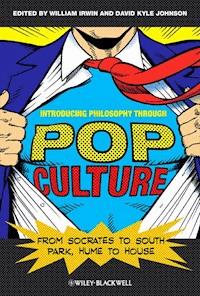
Introducing Philosophy Through Pop Culture E-Book
21,99 €
Mehr erfahren.
- Herausgeber: John Wiley & Sons
- Kategorie: Geisteswissenschaft
- Sprache: Englisch
What can South Park tell us about Socrates and the nature of evil? How does The Office help us to understand Sartre and existentialist ethics? Can Battlestar Galactica shed light on the existence of God?
- Introducing Philosophy Through Pop Culture uses popular culture to illustrate important philosophical concepts and the work of the major philosophers
- With examples from film, television, and music including South Park, The Matrix , X-Men, Batman, Harry Potter, Metallica and Lost, even the most abstract and complex philosophical ideas become easier to grasp
- Features key essays from across the Blackwell Philosophy and Pop Culture series, as well as helpful editorial material and a glossary of philosophical terms
- From metaphysics to epistemology; from ethics to the meaning of life, this unique introduction makes philosophy as engaging as popular culture itself
- Supplementary website available with teaching guides, sample materials and links to further resources at www.pop-philosophy.org
Sie lesen das E-Book in den Legimi-Apps auf:
Seitenzahl: 844
Veröffentlichungsjahr: 2011
Ähnliche




















Contents
Cover
Half Title page
Title page
Copyright page
Acknowledgments
Introduction
How to Use this Book in a Philosophy Course
Part I: What is Philosophy?
Introduction
Chapter 1: Flatulence and Philosophy: A Lot of Hot Air, or the Corruption of Youth?
The “Danger” of South Park
Oh My God! They Killed Socrates! You Bastards!
Cartman Gets a Banal Probe
Friendship Kicks Ass! The Dialogues of Kyle and Stan
An Apology for South Park: Getting in Touch with Your Inner Cartman
The Talking Cure for Our Culture
Chapter 2: The Chewbacca Defense: A South Park Logic Lesson
It Does Not Make Sense!
Dude, Listen to Reason
You’re Not Asleep Yet, Are You?
If Chewbacca Lives on Endor, You Must Acquit
The Defense Rests
Chapter 3: Wikiality, Truthiness, and Gut Thinking: Doing Philosophy Colbert-Style
My Truth (Individual Relativism)
Wikiality (Cultural Relativism)
Truthiness (Intuitionism)
A Right to Your Opinion
How to do Philosophy
Part II: Epistemology
Introduction
Chapter 4: You Know, I Learned Something Today: Stan Marsh and the Ethics of Belief
If Evidence is Lacking, So What?
Belief and Evidence
Faith vs. Reason
Prudential Reasons vs. Evidence
What’s The Harm, Dude?
Inquiry, Hard Work, and Progress
Chapter 5: Tumbling Down the Rabbit Hole: Knowledge, Reality, and the Pit of Skepticism
The Skeptical Dilemma: Cartesian Dreams and Demons
Skepticism within the Matrix
How Deep Does the Rabbit Hole Go?
Skepticism Outside the Matrix
Chapter 6: Adama’s True Lie: Earth and the Problem of Knowledge
“You’re Right. There’s No Earth. It’s All a Legend”
“I’m Not a Cylon! … Maybe, But We Just Can’t Take That Chance”
“You Have to Have Something to Live For. Let it be Earth”
Part III: Metaphysics
Introduction
Chapter 7: Mind and Body in Zion
The Matrix Scenario
Mystery and Miracles
Mind–Body Dualism
Mind–Body Materialism
Mental States: Reduction or Elimination?
The Role of Matter: Biology or Function?
Chapter 8: Amnesia, Personal Identity, and the Many Lives of Wolverine
What Is Personal Identity?
Cassandra Nova, Charles Xavier, and John Locke
Bringing It All Back to Wolverine
Jamie Madrox and Derek Parfit
Bringing It All Back to Wolverine (Again)
Be Slow to Judge
Chapter 9: Destiny in the Wizarding World
Varieties of Prophecy
Fallible Prophecies
Self-Fulfilling Prophecies
Destiny
A Rodent’s Destiny
Time Travel and Fixed Time
Chapter 10: The Terminator Wins: Is the Extinction of the Human Race the End of People, or Just the Beginning?
“Hi There … Fooled You! You’re Talking to a Machine.”
“It’s Not a Man. It’s a Machine.”
“Skynet Becomes Self-Aware at 2:14 am Eastern Time, August 29th.”
“Cyborgs Don’t Feel Pain. I Do.”
Part IV: Philosophy of Religion
Introduction
Chapter 11: Cartmanland and the Problem of Evil
There’s No God, Dude!
And That’s It?!? The Story of Job
The Sweet Milk of Our Tears
You Are Up There!
Jesus Christ and John Hick: The Soul Making Theodicy
Chapter 12: Aquinas and Rose on Faith and Reason
What Can We Know?
Chain of Truth
Rose Colored Glasses
Does Rose Really Know?
Do We Really Know?
“I have made my peace” – Rose
Does Rose Presume to Know?
To Know … and Believe
Chapter 13: “I Am an Instrument of God”: Religious Belief, Atheism, and Meaning
“A Rational Universe Explained Through Rational Means”
“That Is Sin. That Is Evil. And You Are Evil”
“You Have a Gift, Kara … And I’m Not Gonna Let You Piss That Away”
“The Gods Shall Lift Those Who Lift Each Other”
“You Have to Believe in Something”
Part V: Ethics
Introduction
Chapter 14: Plato on Gyges’ Ring of Invisibility: The Power of Heroes and the Value of Virtue
Claire’s Thumos Saved the World
Claire Is Logical; Spock Is Not
The Virtue That Sylar Lacks
Superpowers and Super-Vices
Why Claire Apologized
But Isn’t It Only Natural?
Chapter 15: The Virtues of Humor: What The Office Can Teach Us About Aristotle’s Ethics
Virtues and Vices
Wit and Virtue
David Brent: Regional Manager, Chilled-Out Entertainer, Buffoon
Gareth Keenan: Assistant (to the) Regional Manager, Territorial Army Lieutenant, Boor
Tim Canterbury: Senior Sales Clerk, Unrequited Lover, Ironic Wit
Lessons Learned
Chapter 16: Why Doesn’t Batman Kill the Joker?
Meet the Joker
Is Batman a Utilitarian or Deontologist? (Or None of the Above?)
To the Bat-Trolley, Professor Thomson!
Hush Will Love This Next Story …
Top Ten Reasons the Batmobile Is Not a Trolley …
“I Want My Lawyer! Oh, That’s Right, I Killed Him Too”
So, Case Closed – Right?
Chapter 17: Means, Ends, and the Critique of Pure Superheroes
“‘In the end’? Nothing ends, Adrian. Nothing ever ends.”
The Utilitarians Strike Back
“Even in the face of Armageddon I shall not compromise in this.”
“Who watches the watchmen?”
Part VI: Challenges to Traditional Ethics
Introduction
Chapter 18: Metallica, Nietzsche, and Marx: The Immorality of Morality
Morality and Power
Metallica and Rebellion
Metallica, Nihilism, and Nostalgia
Chapter 19: When Machines Get Souls: Nietzsche on the Cylon Uprising
Master Morality and Slave Morality
Escaping Slavery by Creating Souls
The Spiritual Move from Slave to Equal
“They Have a Plan”
Chapter 20: Being-in-The Office: Sartre, the Look, and the Viewer
Bad Faith and the Look
Pam Beesley’s Shame and the Camera’s Unwelcomed Look
David Brent’s Pride and the Welcomed Look of the Camera
The Viewer and the Look
Chapter 21: Batman’s Confrontation with Death, Angst, and Freedom
A Determined Batman?
Alfred and Appearance
Thrown into Our Worlds
Death and the Dark Knight
I Shall Become a Bat
Determinism and the Dark Knight
Chapter 22: “You Care for Everybody”: Cameron’s Ethics of Care
Beyond “Doctor Knows Best”: Feminist Ethics
“It Almost Looks Like He’s … Caring”: The Ethic of Care
Does Cameron Care Too Much?
You’re Basically “a Stuffed Animal Made by Grandma”
Chapter 23: Vampire Love: The Second Sex Negotiates the Twenty-First Century
Back in Time
The Second Sex in the Twenty-first Century
A Feminist Subtext
The Price of Existence
Chapter 24: Killing the Griffins: A Murderous Exposition of Postmodernism
Family Guy is Real
Family Guy is Serious
Family Guy Must Die! Long Live Family Guy!
Part VII: Social and Political Philosophy
Introduction
Chapter 25: Lost’s State of Nature
Lining up for Peace
Human Nature and Natural Man
Amid the Wreckage
The Longer Haul
Over or Under the Language Barrier
Confidence and the Con Men
Roles and Rules
Tit-for-Tat
Gaining Trust from the Past
Chapter 26: Laughter Between Distraction and Awakening: Marxist Themes in The Office
The Class That Dare Not Speak Its Name
Reading Marx at Work
Running Out the Clock
Downsizing Dreams
Chapter 27: The Ethics of Torture in 24: Shockingly Banal
Cultural Context of Torture
Defining Torture
Arguments for Torture
Arguments Against Torture
It’s Not That Simple
Chapter 28: Mutants and the Metaphysics of Race
Race and the X-Gene
Mutants and Biological Race
Mutants and Social Races
The Difference between Mutants and Race
Mutants as Racelike
Part VIII: Eastern Views
Introduction
Chapter 29: Zen and the Art of Cylon Maintenance
“Life is a Testament to Pain”: Suffering, Ignorance, and Interdependent Arising
“All of This Has Happened Before …”: Karma and Rebirth
“God Has a Plan for You, Gaius”: Religion, God, and Kensis
“How Could Anyone Fall in Love with a Toaster?” Cylons as Persons?
Chapter 30: The Sound of One House Clapping: The Unmannerly Doctor as Zen Rhetorician
House, Zen, and Making Sense
A Style of Behaving Ethically
A Way of Establishing Intimacy
A Path to Truth, and a Method of Healing
House Sitting
Chapter 31: The Tao of the Bat
Part IX: The Meaning of Life
Introduction
Chapter 32: Beyond Godric’s Hollow: Life after Death and the Search for Meaning
Death and Philosophy
The Approaching Battle
King’s Cross Station
Reap a Destiny
Chapter 33: Selfish, Base Animals Crawling Across the Earth: House and the Meaning of Life
“If You Talk to God, You’re Religious; If God Talks to You, You’re Psychotic”
Eternity, Anyone?
“If Her DNA Was Off by One Percentage Point, She’d Be a Dolphin”
“You Could Think I’m Wrong, but That’s No Reason to Stop Thinking”
House and the Life of Reason
Glossary
Notes on Contributors
Sources
Index
Introducing Philosophy through Pop Culture
This edition first published 2010© 2010 John Wiley & Sons Inc. except for editorial material and organization© 2010 William Irwin and David Kyle Johnson
Blackwell Publishing was acquired by John Wiley & Sons in February 2007. Blackwell’s publishing program has been merged with Wiley’s global Scientific, Technical, and Medical business to form Wiley-Blackwell.
Registered OfficeJohn Wiley & Sons Ltd, The Atrium, Southern Gate, Chichester, West Sussex, PO19 8SQ, United Kingdom
Editorial Offices350 Main Street, Malden, MA 02148-5020, USA9600 Garsington Road, Oxford, OX4 2DQ, UKThe Atrium, Southern Gate, Chichester, West Sussex, PO19 8SQ, UK
For details of our global editorial offices, for customer services, and for information about how to apply for permission to reuse the copyright material in this book please see our website at www.wiley.com/wiley-blackwell.
The right of William Irwin and David Kyle Johnson to be identified as the authors of the editorial material in this work has been asserted in accordance with the UK Copyright, Designs and Patents Act 1988.
All rights reserved. No part of this publication may be reproduced, stored in a retrieval system, or transmitted, in any form or by any means, electronic, mechanical, photocopying, recording or otherwise, except as permitted by the UK Copyright, Designs and Patents Act 1988, without the prior permission of the publisher.
Wiley also publishes its books in a variety of electronic formats. Some content that appears in print may not be available in electronic books.
Designations used by companies to distinguish their products are often claimed as trademarks. All brand names and product names used in this book are trade names, service marks, trademarks or registered trademarks of their respective owners. The publisher is not associated with any product or vendor mentioned in this book. This publication is designed to provide accurate and authoritative information in regard to the subject matter covered. It is sold on the understanding that the publisher is not engaged in rendering professional services. If professional advice or other expert assistance is required, the services of a competent professional should be sought.
Library of Congress Cataloging-in-Publication DataIntroducing philosophy through pop culture : from Socrates to South Park, Hume to House / edited by William Irwin and David Kyle Johnson.p. cm.Includes bibliographical references and index.ISBN 978-1-4443-3453-1 (pbk.)1. Philosophy and civilization. 2. Popular culture–Philosophy. I. Irwin, William, 1970–II. Johnson, David Kyle.B59.I59 2010100–dc22
2010016191
A catalogue record for this book is available from the British Library.
Acknowledgments
We would like to thank our friends and colleagues who offered feedback and advice in assembling this volume, especially Dave Baggett, Greg Bassham, and Jason Eberl. We would also like to thank Andrew Morton for permission to use his glossary definitions. Thanks are also due to Jeff Dean and a bevy of anonymous reviewers who helped us shape the volume. Kyle wishes to thank his wife Lori for her love and support. Bill wishes to thank his wife Megan and his children Daniel and Kate for making home so happy and philosophy-friendly.
Introduction
Philosophy has a public relations problem. Just the sound of the word “philosophy” scares a lot of people, conjuring images of long-dead Greeks and crusty old professors. But the stereotypes of philosophy are just that – stereotypes. They are mistaken exaggerations and overgeneralizations. Western Philosophy may have begun in Ancient Greece, but it is alive and well in contemporary America and around the globe. Some philosophy professors may be egg-headed, ivory tower intellectuals, but most are not. In fact, many philosophy professors like the same things you like: television, movies, music, and video games. We see connections between these elements of pop culture and philosophy. So this book, written by philosophy professors, takes you from pop culture to philosophy; we wade into the shallow water before swimming out deep. Each chapter focuses on a piece of pop culture, like Harry Potter or The Office, and teaches you about a particular issue in philosophy or the views of a particular philosopher. We think you’ll agree that, to paraphrase a classic Disney truism, a spoonful of pop culture helps the philosophy go down.
The idea of using examples to facilitate learning is not new to philosophy. Famously, Plato (429–347 BCE) used the story of the ring of Gyges, and Descartes (1596–1650) imagined a deceitful demon. However, most examples in philosophy are rather dry – finding people with bland names like Jones and Brown in difficult to describe circumstances, such as those in which we are potentially justified in believing that “Jones owns a Ford, or Brown is in Barcelona.” Thankfully, Hollywood writers do a much better job of creating engaging, imaginative scenarios than philosophers do. So why not use their creations to add spice to philosophy? As you’ll discover in this book, The Matrix provides a vivid way of picturing Descartes’ concerns about deception and knowledge, and South Park hilariously dramatizes the problem of evil by asking why good things (like inheriting a million dollars) happen to bad people (like Cartman). Indeed, many other insightful philosophical illustrations from pop culture await your reading.
Now, of course, you may be concerned that you’re in trouble because in addition to being clueless about philosophy you’re also clueless about The Matrix and South Park. There’s no need to worry. You don’t have to be an expert on Batman or to have seen every episode of House to benefit from this book. Even a passing acquaintance with the pop culture icon discussed in any given chapter will be enough for you to learn the philosophy to which it is connected. You can get that easily enough on the Internet. In fact, you can visit the website for this book at www.pop-philosophy.org for all kinds of helpful up-to-date links.
In sum, this book is intended to make initial connections between pop culture and philosophy that will pique your interest in the latter and lead you to study and appreciate the subject more deeply. Maybe you’ll even decide to tell your friends that philosophy has gotten a bad rap. Certainly, we believe you’ll find that philosophy is relevant, fun, and exciting.
How to Use this Book in a Philosophy Course
This book is intended to serve primarily as a supplementary text in Introduction to Philosophy courses. Introductory courses are structured in a variety of different ways depending on the professor. Some courses are questions and issues based, some are historically based. Some courses use a standard textbook; others rely on primary philosophical texts. Others mix it up and use a combination of approaches. This book is designed to go along with any of them. However, this book is not intended to cover all philosophical issues and figures in exhaustive detail. We leave that for the main text and the professor.
This book can be used in a variety of ways in the classroom. Its chapters can be used to introduce a philosophical topic unfamiliar to the student. Assigning a summary of the chapter can ensure the student reads it and is better prepared for a lecture on the topic of the chapter. Each chapter could also be used for philosophical reflection; you might consider having your students write reflection or argument papers in response to them. If you are worried about whether your students are familiar with the relevant pop culture phenomena, there is a wiki site for each pop culture phenomenon discussed (e.g., heroeswiki.com) that can provide a quick and easy summary. Other suggestions for professors on how to use this book in courses are available at www.pop-philosophy.org.
Part I
What is Philosophy?
Introduction
The word “philosophy” is often confused with the words “opinion,” “theory” or “approach” – as in, “What is your philosophy of life?” or “Our philosophy is never to be undersold!” As a result, some students have mistaken ideas about what a philosophy class is. “Can you even give a wrong answer in a philosophy class? Isn’t it just whatever you think?” Well, yes you can, and no it’s not.
The word “philosophy” comes from the Greek language and means “love of wisdom.” Philosophers seek truth and wisdom above all else. The questions for which true answers are most important, but most elusive, form the core of philosophy. What is the nature of reality? What is knowledge, and how can one attain it? Is there a God? What is the nature of good and evil? How can I live a good life? How should we govern ourselves? What is the meaning of life? So how do philosophers seek answers these questions? Are there really answers? Or is whatever anyone thinks just “true for them” because they have a “right to their opinion"? What role does philosophy play in society? And, what attitude does philosophy require?
In his chapter, William Young argues that philosophy and the TV show South Park share some common aims. Like the philosopher Socrates (469–399 BCE), South Park is charged with corrupting the youth, inappropriately challenging moral norms, and being a social nuisance. But, the accusations are unfounded for both Socrates and South Park. The accusers are actually the corruptors; for example, parents corrupt the youth when they leave their kids to be raised by television without educating them about what they are seeing. Thankfully South Park, like Socrates, teaches us to draw our own conclusions – not merely accept the consensus of the crowd – and to reach those conclusions by considering the perspectives of others. Clearly, Young argues, South Park is not mindless and harmful; the show, like philosophy, is a gadfly, “an annoying pest that goes around ‘stinging people’ with … challenging questions and critical reflections so as to keep them intellectually awake and on their toes.”
Philosophers’ appetite for truth is insatiable, but they do not always agree. To solve their disputes they use logic. In his chapter, Robert Arp takes examples from South Park to teach some of the basics of logic including the structure of arguments, the differences between good and bad arguments, and the distinction between inductive and deductive arguments. The lesson concludes with common logical fallacies, illustrated by South Park for comedic effect. In one classic episode, for example, the cartoon version of Johnnie Cochran commits the red-herring fallacy by suggesting that Chef must not have written the Alanis Morissette song “Stinky Britches” because Chewbacca spent most of his time on Endor: “If Chewbacca lives on Endor, you must acquit.”
South Park is not the only show that plays philosopher. Late night political talk shows, like The Daily Show and The Colbert Report, are gadflies as well. In his chapter, David Kyle Johnson uses Stephen Colbert to teach us about the philosophical attitude. Relativism (what Colbert calls “wikiality”) and intuitionism (what Colbert calls “truthiness”) are contrary to the endeavor of philosophy. More importantly, Johnson enlists Colbert to dispel a myth that holds back almost every philosophy course – the myth that everyone has a right to their opinion. Attempts to end philosophical discussion with appeals to “a right to my opinion” only reveal a disregard for truth and a desire to protect entrenched beliefs. Real philosophers must be willing to give up disproven beliefs and embrace the truth.
Chapter 1
Flatulence and Philosophy
A Lot of Hot Air, or the Corruption of Youth?
William W. Young III
Summary
Though Trey Parker and Matt Stone haven’t been killed for it yet (they did receive death threats after their 200th episode) the creators of South Park have faced accusations much like those that led to Socrates’ execution: the corruption of youth and the teaching of vulgar, irreligious behavior. A closer examination, however, reveals that South Park is very much within the Platonic tradition, as Kyle and Stan engage in questioning and dialogue in order to “learn something today.” Moreover, the mob mentality of the parents, along with the malicious yet mimetic evil of Cartman, demonstrates how evil emerges from thoughtlessness: a failure to ask if one can live with oneself, and a failure to put oneself in the place of others. Through its different characters, and even in its apparently mindless vulgarity, South Park shows the need for engaging in dialogue, and thinking from others’ perspectives, in order to pursue wisdom, examine life, and make it worth living.
The “Danger” of South Park
In the episode “Death,” Kyle’s mother leads a boycott of the boys’ favorite cartoon show – Terrance and Philip – because of its continuous farting, name-calling, and general “potty humor.” While the parents are up in arms over this “moral” issue, the boys wrestle with the problem of euthanasia for Stan’s grandfather, something none of the parents will discuss with them. “Death” brings together many of the central issues that have made South Park successful and controversial: vulgarity, the misplaced moral concerns of American culture, the discussion of controversial moral topics, and the criticism that South Park itself is a “disgusting” show. Since “Death” the criticism of the show has only grown – getting even bigger than Cartman’s fat ass – drawing fire for its obscene language, criticisms of religion, and emphasis upon freedom of speech.
Like the parents protesting The Terrance and Philip Show, critics of South Park make claims that are strikingly similar to those that have been leveled against Western philosophy since its beginnings. It mocks religious beliefs, leads younger folks to question accepted authority and values, and corrupts our children and culture. The “it” in the previous sentence refers to South Park, but in fact, the same criticisms formed the basis for Socrates’ (470–399 BCE) trial and execution in Athens, Greece in 399 BCE.1 So in this chapter we’ll explore the heretical possibility that people perceive South Park as dangerous precisely because it is a form of philosophy. The “danger” that South Park poses has to do with its depiction of dialogue and free thinking. In the end we will have learned something: like Socrates, South Park harms no one. Philosophy and South Park actually instruct people and provide them with the intellectual tools they need to become wise, free, and good.
Oh My God! They Killed Socrates! You Bastards!
In Plato’s (427–327 BCE) Apology, Socrates defends himself against two charges: (1) impiety (false teachings about the gods, possibly that they don’t exist) and (2) corrupting the youth of Athens. In reality, Socrates probably had as much chance of winning his case as Chef did against Johnny Cochran’s “Chewbacca” defense! What is most important about Socrates’ defense, however, is not so much what he says as how he says it. He defends himself by questioning his accuser, Meletus, leading him through a process of reasoning. For example, Socrates refutes the charge of corrupting the youth as follows:
SOCRATES:You say you have discovered the one who corrupts them, namely me, and you bring me here and accuse me to the jury … All the Athenians, it seems, make the young into fine good men, except me, and I alone corrupt them. Is that what you mean?MELETUS:That is most definitely what I mean.SOCRATES:You condemn me to a great misfortune. Tell me: does this also apply to horses do you think? That all men improve them and one individual corrupts them? Or is quite the contrary true, one individual is able to improve them, or very few, namely the horse breeders, whereas the majority, if they have horses and use them, corrupt them? Is that not the case, Meletus, both with horses and all other animals? … It would be a happy state of affairs if only one person corrupted our youth, while the others improved them. You have made it sufficiently obvious, Meletus, that you have never had any concern for our youth; you show your indifference clearly; that you have given no thought to the subjects about which you bring me to trial. (Apology, p. 30)Through the analogy with horse training, Socrates shows how illogical the accusations against him really are. Just as a majority of people would injure horses by training them, and only a few good trainers improve them, so too it is likely that a few teachers improve the virtue of the youth, while many others corrupt them. Socrates argues, further, that he is in fact the one who is teaching Athens’ youth what virtue involves, while many others – including the idiots sitting before him – corrupt them. (As you can imagine, this did not go over well with the jury.)
While showing that the accusations are groundless, this “apology” – a word that also can mean defense – demonstrates why Socrates got a death sentence of hemlock. Socrates is famous for saying “I know that I don’t know” and, actually, this is a wise insight. For Socrates, philosophy was the love and pursuit of wisdom, and this required questioning others to find out what they do or don’t know. Unfortunately, people often believe they are wiser than they are. By questioning them, Socrates would show them that they don’t know what they believe they know: “I go around seeking out anyone, citizen or stranger, whom I think wise. Then if I do not think he is, I come to the assistance of the god and show him that he is not wise” (Apology, pp. 28–9). What makes Socrates wise is his recognition of his own ignorance, through continuous questioning of himself and others. Many powerful people in Athens saw him as dangerous because his questioning and debate would undermine their bases for power.
In the town of South Park, people in positions of power believe they are teaching the children wisdom and virtue. However, as in Athens, the many people of South Park seem to make the children worse, not better. For example, Mr. Garrison “teaches” the children life lessons from re-runs of Barnaby Jones, Mrs. Broflovski always goes to crazy extremes with her “moral” outrage, Uncle Jim and Ned teach the boys to kill harmless bunnies and squirrels in “self-defense,” and the mayor panders shamelessly to voters. None of the townsfolk really talk to the children, except Chef (God rest his soul), who taught the art of making sweet, sweet love to a woman. Blindly following the crowd, from protesting The Terrance and Philip Show to boy-cotting Harbucks, to – yes – burying their heads in the sand to avoid watching Family Guy, the parents of South Park corrupt the children far more than a television show ever could. Like the Athenians, the adults don’t know as much as they believe they know. Ultimately, if television does corrupt them, it does so because they are left to it by their parents, with no one to educate them about what they are seeing. Of course, there are also cases where parents and people in powerful positions do try to discuss issues and ideas with the children. These discussions, though, support the same point, as the adult usually sounds like a bumbling idiot.
Cartman Gets a Banal Probe
One of the most significant philosophical reflections on evil in the twentieth century is Hannah Arendt’s Eichmann in Jerusalem: A Report on the Banality of Evil, a study of the trial of Adolf Eichmann for his role in the deportations of millions of European Jews to concentration camps during the Jewish Holocaust. Eichmann just followed the law of the land, whatever it happened to be, and when Hitler was making the laws, Eichmann simply carried them out.2 In the words of Arendt, Eichmann was an unreflective person, unable to think for himself and definitely unable “to think from the standpoint of somebody else” (Arendt, p. 49). What was really monstrous about Eichmann was not his vicious cruelty, but rather the way that he was not that different from so many Germans who, under Hitler, accepted and supported laws that were obviously evil and believed that they were doing what was right. Eichmann’s banality – the fact that there is nothing distinctive or exceptional about him – is precisely what makes him evil. He was one of the “crowd” who didn’t walk to the beat of a different drummer and didn’t rock the boat. He embodied complicit citizenship under a dictatorship, which speaks for its subjects and, thus, cuts off their reflective and critical thought.
Thoughtlessness leads to evil, as Arendt says, because it doesn’t let us see things from others’ perspectives. By blindly following orders, Eichmann didn’t think about what his actions were doing to others, or even what they were doing to himself. By saying he was “following the law” and “doing his duty,” he ignored how his actions sent millions to their deaths and, despite his protests, made him a murderer. Thinking, according to Arendt, requires taking another’s standpoint, reflecting on how you might be harming others, and asking if you can live with what you are doing.
While the adults in South Park blindly follow the latest fad, or what they are told, it is the children who bring out the absurdity and potential harm that lurks in such thoughtlessness. To be more accurate, it’s usually Kyle or Stan who are the reflective ones, while Cartman’s mind is as empty as the Cheesypoofs he devours daily. He is often sadistic, cruel, and evil. Like Eichmann, Cartman is probably evil because, when it comes to “authorita,” he lacks reflection and critical analysis. (And like Eichmann, he has a Nazi uniform that he has sported on occasion.) Cartman sings the Cheesypoofs song so well because all he can do is imitate what he hears on television. His evil is an imitation of the evil characters of our culture, as prepackaged as his afternoon snacks. Cartman consumes evil and imitates it as blindly and thoughtlessly as Eichmann. Most importantly, because of this thoughtlessness, Cartman is unable to see things from anyone else’s viewpoint (as illustrated most clearly in his manipulation of his mother). As Arendt says, such thoughtlessness is precisely what allows evil to emerge in modern society, and Cartman’s mindless consumption is as thoughtless as it gets.
Friendship Kicks Ass! The Dialogues of Kyle and Stan
Part of what makes South Park philosophically interesting is the contrast between Cartman’s evil stupidity and the non-conformist, reflective virtue of Kyle and Stan. Philosophers like Plato and Aristotle (384–322 BCE) have noted the importance of how critical reflection leads to harmony or balance and helps us to avoid extremes. After all, the “extremes” of thinking and acting often lead to mistaken beliefs and harmful behavior. In fact, following Plato’s lead, Aristotle put forward the idea that virtue is concerned with striking a balance or hitting the mark between two extreme viewpoints, ideas, beliefs, emotions, or actions.3South Park addresses moral issues through a discussion and criticism of established “moral” positions, both conservative and liberal, which are found to be inadequate. Kyle and Stan come to a virtuous position, in part, by negotiating and listening to these views before reaching their own conclusion through questioning and reason. Frequently, their conclusion recognizes that there is some truth to each position, but that its limited perspective is still dangerous. For example, it’s true that hybrid cars are more environmentally responsible than gas-guzzling SUVs. But when an air of moral superiority clouds one’s judgment, this “smug cloud” creates hostility and pollutes society in other ways.
How Stan and Kyle reach their conclusions is more significant than the conclusions themselves. Think of how they discuss whether it’s wrong to kill Stan’s grandpa, who wants to die. They, like Socrates, question those around them, seeking to know if the people are as wise as they believe. Their parents, Mr. Garrison, and Jesus won’t discuss or touch this issue “with a 60-foot pole.” What Kyle and Stan ultimately realize – with the help of Stan’s great-great-grandfather’s ghost – is that they shouldn’t kill his grandfather because the action would change and harm them. As it turns out, Stan’s grandfather is wrong in asking them to do this vicious action. Note that the boys reach this conclusion through living with each other, recognizing their differences, and engaging in debate. Stan and Kyle – unlike Eichmann and Cartman – learn to see things from others’ perspectives, through their ongoing conversation.
In the Apology Socrates makes the claim that a good person cannot be harmed by the actions of others. This seems false. After all, aside from being a cartoon character, what could prevent Cartman from punching out the Dalai Lama? But what Socrates means by “good” is something different than we often realize. Goodness means reflectively thinking about one’s actions and being able to live with what one has done. Despite any physical harm – torture, imprisonment, exile, or death – that may come a person’s way, no one can “hurt” a virtuous person by making him/her do something bad. Cartman, for example, couldn’t make the Dalai Lama punch him. Socrates, for his part, refused to execute an innocent person, or to try generals for “crimes” beyond the laws of the city. And, significantly, Socrates would rather die than give up the thinking and questioning that he sees as central to philosophy:
Perhaps someone might say: But Socrates, if you leave us will you not be able to live quietly, without talking? Now this is the most difficult point on which to convince some of you. If I say that it is impossible for me to keep quiet because that means disobeying the god, you will not believe me … On the other hand, if I say that it is the greatest good for a man to discuss virtue every day and those other things about which you hear me conversing and testing myself and others, for the unexamined life is not worth living for man, you will believe me even less. (Apology, p. 41)
Arendt has a similar conception of goodness. Ethics, for those (unlike Eichmann) who resisted the Nazis, was being able to look back on one’s life without shame, rather than adhering to a set of rules. Her description deserves quoting:
Their criterion [for goodness], I think, was a different one; they asked themselves to what extent they would still be able to live in peace with themselves after having committed certain deeds; and they decided that it would be better to do nothing, not because the world would then be changed for the better, but simply because only on this condition could they go on living with themselves at all. Hence, they also chose to die when they were forced to participate. To put it crudely, they refused to murder … because they were unwilling to live together with a murderer – themselves. The precondition for this kind of judging is not a highly developed intelligence or sophistication in moral matters, but rather the disposition to live together explicitly with oneself, to have intercourse with oneself, that is, to be engaged in that silent dialogue between me and myself which, since Socrates and Plato, we usually call thinking.4
Thinking, for Arendt, is a twofold process: it involves seeing things through another’s eyes, in dialogue and reflection, as well as determining whether you can live with your own actions. It is, then, both an internal and an external dialogue, and it is only through this dialogue that critical reflection and goodness become possible. Whereas Eichmann and Cartman do not critically reflect upon the consequences of actions, nor put themselves in another’s shoes, thoughtful dialogue makes us attentive to others around us, lets us live with them, and helps us attend to our own goodness. Such dialogue allows us to live with ourselves – even when, like Socrates or those who resisted the Nazis, this means we must die.
Of course, in South Park there is no Socrates to teach philosophy or help us engage in dialogue. Surrounded by ignorance and violence, the boys are on their own. While the four are friends, South Park makes a compelling point about philosophy and ethics through the particulars of the friendship of Kyle and Stan. For instance, in “Spooky Fish,” where the “evil” Cartman (who is good) arrives from a parallel universe, an evil Kyle and Stan arrive together. Their friendship – thinking from one another’s perspective – is what helps them to be good, both for themselves and for others. In Arendt’s words, to live well is to “be plural,” so that the good life is never simply one’s own.5 This probably is why Plato wrote about important philosophical issues in a dialogue format, so that it becomes clear that debate and discussion of ideas are essential to any intellectual and moral growth.
For all their faults, Kyle and Stan still debate and discuss whether certain actions are wrong. On his own, Stan will sometimes just go along with the crowd (an important exception is his refusal to kill). Through their conversations they learn goodness and engage in the “thinking” Arendt describes. Friendship, then, helps us to examine our lives. In the episode “Prehistoric Ice Man” Larry says that “living is about sharing our ups and downs with our friends,” and when we fail to do this we aren’t really living at all. If thinking and goodness only arise through real dialogue with others – through critically questioning and examining our own views – then we need more friendships like the one Kyle and Stan share.
An Apology for South Park: Getting in Touch with Your Inner Cartman
If friendships help us to critically examine the lives that we lead, then perhaps it’s no accident that the critical voice of South Park has been created by two friends – Trey Parker and Matt Stone. In the Apology Socrates likens himself to a gadfly, an annoying pest that goes around “stinging” people with his challenging questions and critical reflections so as to keep them intellectually awake and on their toes. South Park, too, serves as a gadfly, trying to wake American culture from its thoughtlessness and ignorance. The show generates discussion and debate and leads many people into discussions of ethical issues that would otherwise be passed over in silence. For a show that supposedly corrupts, it has far more of a focus on religion, ethics, and democracy than its critics would like to admit. But of course we could still ask if the way that South Park presents these issues is really necessary. For example, is it philosophically wise and necessary to use the word shit 163 times in one show? Or to have so much farting, vomiting, and violence? What philosophical goal can such vulgarity serve?
The vulgarity and crudeness of South Park are often defended on the grounds of free speech. However, a different issue is also in play. South Park often says what is not socially or morally acceptable to say – what, in Freudian terms, must be repressed. According to Freud, our thoughts and actions are shaped by what he calls “drives,” examples of which include emotions, desires, and energy that can be aggressive, hostile, and consumptive. (Freud would have a field day with Cartman’s twisted little mind, on this score.) These drives are part of our embodied being, yet, since they are dangerous and often violent, we try to control or even silence them. This control is a form of repression, but it can often have unintended consequences. Repression of a drive can lead to other sorts of unconscious, violent behavior, and such suppressed wishes form the content of dreams – our “unconscious” life.6 Repression, as a form of internal censorship, redirects but does not diminish our aggression. In spite of our intentions, this unconscious aggression often shapes who we are, how we think, and what we do.
What Freud discovered with psychoanalysis was that talking out and interpreting our dreams may serve as a way to address this repression and its associated violence. When we talk these ideas and feelings out, the repression is broken and, through the realization, we can come to terms with the desire and shape it through thinking. Representing desires lets them be expressed, and this helps us to integrate them into the structure of our lives.7 By bringing to light what had been unconscious, dream-interpretation lets us think through these aspects of ourselves.
Freud thought that jokes work much like dreams. When one person tells a joke, its spontaneous and unexpected word-form breaks through another person’s repression. Laughter is a “release of energy” that has been blocked, because we have tried to repress the wish or drive; this is why many jokes have a vulgar or obscene dimension. As Freud points out, the one who supplies it has to deny it – jokes only really work when the person telling them doesn’t laugh, so that the surprise can make others laugh.8 There is pleasure in laughing at the joke, and in telling it, as well as pleasure in freeing others from their repression.
Through its vulgarity, South Park verbalizes the drives and desires that we often repress; and, it allows us to laugh so as to reveal these inhibitions. This is what makes the show’s crudeness essential. By showing us “Token” or the conjoined fetus nurse, or saying shit over and over, it brings out the aggression and desire that we feel we cannot express. And, for things that really shouldn’t be said, Kenny says them in a muffled way, and the other boys comment on it. By verbalizing these drives, the show lets us begin to think these through – it makes it possible to analyze them, and thereby distance ourselves from them. For instance, many episodes address how outsiders are berated and subjected to racist or xenophobic slander. However, by working through these statements, the show argues that in many cases, such slander is used among friends as well – and that such verbal sparring, when so understood, need not lead to violence or exclusion. It doesn’t justify such speech, but it does create a space in which the hostility can be interpreted and analyzed.
Likewise, one can analyze all of the farting on Terrance and Philip. At least two interpretations of this show-within-the-show are possible. First, there is the issue of why the boys love such a stupid show so much. It’s not that they wish they could fart all the time. Rather, when they fart, Terrance and Philip do what is forbidden: they transgress the parents’ social prohibition. This appeals to the boys, because they wish they too could be free from parental control and regulation.
Second, regular viewers (mostly my students) have noted that Terrance and Philip is self-referential, a way for South Park to comment on itself. The opening of South Park tells us that, like Terrance and Philip, the show has no redeeming value and should be watched by no one. The stupidity and vulgarity of the cartoon is better understood, however, if we look beyond South Park. Is Terrance and Philip really more vapid, crude, and pointless than Jerry Springer or Wife Swap? Is it more mindless than Fox News, The 700 Club, or Law and Order? The answer is no. When we see Kyle, Cartman, Kenny, and Stan watching The Terrance and Philip Show, it shows us that television fulfills our wish for mindlessness. What offends the parents in South Park, and the critics of South Park, is not that the show is vulgar and pointless, but that it highlights the mindlessness of television in general.
What both of these interpretations show is that there are multiple levels of censorship that need to be questioned. On the one hand, there is the censorship that simply looks at vulgarity, and decides what can and cannot be seen, based upon social norms. South Park clearly questions this sort of censorship, saying so often what cannot be said and challenging social forms of repression. But, if part of South Park‘s message is the need for thinking, then it also questions how television, by fulfilling our wish for mindlessness, supposedly represses thinking. Of course, such mindlessness can’t simply be blamed on one’s parents, or television corporations, or two doofusses from Colorado who can’t draw straight. Like the mindless Athenians who were to blame for their own ignorance, or Eichmann’s responsibility when he thought he was just obeying the law, the mindlessness that prevents thinking is ultimately our own doing. Like Socrates, perhaps South Park – and Kyle and Stan more specifically – presents us with a way to think about what we think we really know, and through reflection move beyond our mindlessness.
The Talking Cure for Our Culture
By ceaselessly testing the limits of our culture’s tolerance, South Park asks us to examine the things we think we know, why certain words and actions are prohibited, what we desire, and what we are teaching our children. Through its provocation, it asks us to think about what is truly harmful, and what issues we really should be outraged about. Breaking the silence of our culture’s repressions could be the starting point for a Socratic dialogue that helps us to think, analyze our desires and aggression, and become good. If we take the opportunity to discuss the show, why it is funny, and what it tells us about our culture and our own desires, then the show need not be mindless, vulgar, or corrupting, but rather a path to thinking that helps us to live with one another, and with ourselves.
1 Plato, Apology, in Five Dialogues: Euthyphro, Apology, Crito, Meno, Phaedo, trans. by G. M. A. Grube (Indianapolis: Hackett Publishing, 1981). Hereafter noted as (Apology, p. “x”) in the text. Also see Xenophon, Recollections of Socrates, and Socrates’ Defense Before the Jury, trans. by Anna Benjamin (Indianapolis: Bobbs-Merrill, 1965).
2 Hannah Arendt, Eichmann in Jerusalem: A Report on the Banality of Evil (New York: Viking Press, 1964), pp. 135–50. Hereafter cited as (Arendt, p. “x”) in the text.
3 See Plato, The Republic of Plato, trans. by David Bloom (New York: Basic Books, 1991); Aristotle, Nicomachean Ethics, trans. by Terence Irwin (Indianapolis: Hackett Publishing, 1999).
4 Hannah Arendt, “Personal Responsibility Under Dictatorship,” in Responsibility and Judgment (New York: Schocken, 2003), pp. 40–1.
5 Arendt, “Some Questions of Moral Philosophy,” in Responsibility and Judgment, pp. 96–7.
6 See Sigmund Freud, The Interpretation of Dreams (New York: Avon Books, 1965), pp. 156–66.
7 For more on this issue, see Jonathan Lear, Love and Its Place in Nature: A Philosophical Interpretation of Freudian Psychoanalysis (New York: Farrar, Strauss, and Giroux, 1990).
8 Freud, Wit and Its Relation to the Unconscious, trans. by A. A. Brill (New York: Dover, 1993), pp. 261–73.
Chapter 2
The Chewbacca Defense
A South Park Logic Lesson
Robert Arp
Summary
The creators of South Park are aware of logical principles and purposely violate them to show the absurdities associated with certain beliefs, opinions, ideas, and arguments. In fact, much of South Park’s humor concerns logical violations and the contradictions and problems that result. Logic is the study of the principles of correct reasoning associated with the formation and analysis of arguments. Using examples from South Park, this chapter offers a short logic lesson as an introduction to what philosophers do when they put forward and critique arguments. Topics covered include the parts of an argument (premise and conclusion), premise- and conclusion-indicating words, deductive versus inductive arguments, good versus bad arguments, and a few common fallacies such as the famous Chewbacca Defense utilized by the cartoon Johnny Cochran in the episode “Chef Aid.”
It Does Not Make Sense!
The episode “Chef Aid” is classic South Park with its cartoon Johnnie Cochran’s “Chewbacca Defense,” a satire of Cochran’s actual closing arguments in the O. J. Simpson case. In the episode, Alanis Morissette comes out with a hit song “Stinky Britches,” which, it turns out, Chef had written some twenty years ago. Chef produces a tape of himself performing the song, and takes the record company to court, asking only that he be credited for writing the hit. The record company executives then hire Cochran. In his defense of the record company, Cochran shows the jury a picture of Chewbacca and claims that, because Chewbacca is from Kashyyyk and lives on Endor with the Ewoks, “It does not make sense.” Cochran continues: “Why would a Wookie, an eight-foot tall Wookie, want to live on Endor with a bunch of two-foot tall Ewoks? That does not make sense. If Chewbacca lives on Endor, you must acquit! The defense rests.” The jury is so convinced by Cochran’s “argument,” that not only do they apparently deny Chef’s request for credit recognition, but they also find Chef guilty of harassing a major record label, fining him two million dollars to be paid within twenty-four hours. Friends of Chef then organize “Chef Aid” to pay his fine.
We laugh at Cochran’s defense because it has absolutely nothing to do with the actual case. We laugh all the more at the absurdity when the Chewbacca Defense is also used to find Chef guilty of harassing the very record company that had produced a stolen song. The issue of Chewbacca living on Endor has absolutely nothing to do with, and is in no way logically related to, the issues of whether Chef should receive credit for the song, or whether he has harassed the record company. As rational thinkers, we recognize this, laugh at the absurdities, and wonder why anyone in their right mind would be convinced that the Chewbacca Defense and the other issues are related. In fact, logicians (people who study the principles of correct reasoning) have a term for the kind of bad thinking involved in the Chewbacca Defense. They call it a fallacy. A fallacy is faulty reasoning that inappropriately or incorrectly draws a conclusion from evidence that does not support the conclusion. To draw the conclusions that the record company is not liable for crediting Chef with writing the song and that Chef has harassed the record company based upon reasons that have to do with the Chewbacca Defense is fallacious reasoning.
Fallacious reasoning, some of it not too different from the Chewbacca Defense, is quite common. For example, suppose Principal Victoria thinks that, just because she had a bad experience with a person of a particular sex, race, creed, or color, “they must all be like that.” Or she believes since a celebrity has endorsed a particular product, then it must necessarily be good for us. Instead of seeking to become an authority in a particular matter, she blindly accepts what some tells us as “The Gospel Truth.” Or, she concludes that “there must be no true or false, right or wrong, good or bad beliefs” because “people have so many different beliefs.” However, on reflection, we can see why she’s not justified in any of these conclusions.
This chapter offers a short logic lesson as an introduction to what philosophers do when they put forward and critique arguments.1 Logic is the study of the principles of correct reasoning associated with the formation and analysis of arguments. As we’ve seen already, people don’t always abide by these principles. The creators of South Park, for the most part, are aware of these logical principles, and purposely violate them to show the absurdities associated with certain beliefs, opinions, ideas, and arguments. In fact, much of South Park‘s humor concerns logical violations and the absurdities, contradictions, and problems that result. The way people reason correctly, or incorrectly, has real consequences. It affects the policies they adhere to, the laws they make, the beliefs they are willing to die for, and the general way in which they live their lives.
For example, because of Mrs. Broflovski and the town’s belief that The Terrance and Philip Show promotes immorality, the entire community not only boycotts the show, but also sacrifices members of the community to get the producers of the show to take it off the air. This fictional morality tale parallels parts of reality, and raises questions as to whether TV promotes immorality, as well as what people are willing to do based upon their perceived connection between TV and immorality. Can we draw the general conclusion that a show like South Park, even if viewed by children, is bad for all children, from evidence that supports the fact that it’s bad for some children? Further, even if it does promote immorality, is that the kind of thing we are willing to die for? This may seem like a silly question, but the actions of the South Park townspeople get us to think about what kinds of things people are willing to believe or do based upon their faulty reasoning. Consider a somewhat parallel case. Are all Americans immoral? And even if so, should we sacrifice people so as to make our point about them being immoral by flying planes into a skyscraper? Again, how we live our lives, as well as how we affect others’ lives, depends upon whether we reason correctly or incorrectly. (You, the reader, may even find what I have said in this paragraph to be logically questionable.) In what follows, we’ll consider some basics of logic and, using examples from South Park episodes, show some differences between correct and incorrect reasoning.
Dude, Listen to Reason
Logic is the study of the principles of correct reasoning associated with the formation and analysis of arguments. So let’s define the word argument, and describe its basic components and types. Then, we can talk about correct argument formation and analysis.
An argument consists of two or more claims, one of which is called the conclusion. The conclusion is the claim in the argument that is supposed to be supported by, shown to be the case by, demonstrated by, justified by, warranted by, or proved to be the case by the premise or premises. A premise is a claim in the argument that is supposed to support, show, demonstrate, justify, warrant, or prove the conclusion. The fundamental purpose of an argument is to persuade or convince someone of the truth of one’s concluding claim. In other words, when we put forward an argument, we want others to be persuaded or convinced of the conclusion we arrived at and believe to be true, and we use another claim, or other claims, as supposed support for the truth of that conclusion.
Cochran’s fallacious argument can be rephrased, simply, like this: “Because Chewbacca lives on Endor (the premise of the argument), therefore you should acquit my client (the conclusion of the argument).” A complete argument has at least one premise and only one conclusion, but arguments usually have two or more premises. So for example, I was watching a South Park re-run last night called “Ike’s Wee Wee,” and Cartman put forward an argument for why we should be convinced drugs are bad that could be paraphrased like this: “If you do drugs, then you’re a hippie; if you’re a hippie, then you suck; if you suck, then that’s bad (all premises); So, if you do drugs, then that’s bad (conclusion).”
Arguments are composed of claims, a concluding claim (the conclusion), and at least one supporting claim (the premise). A claim is a statement, proposition, assertion, judgment, declarative sentence, or part of a declarative sentence, resulting from a person’s beliefs or opinions, which communicates that something is or is not the case about the self, the world, states of affairs, or reality in general. Claims are either true or false, and again, are the results of beliefs or opinions that people have concerning any part of what they perceive to be reality. We make our beliefs and opinions known through claims. For example, the claims “I am typing this chapter on a laptop” and “Chewbacca is a Wookie” are true, whereas the claims “I was the 40th president of the United States” and “The sun revolves around the earth” are false.
A claim is shown to be true or false as a result of evidence, which can take the forms of either direct or indirect testimony of your senses, explanations, the testimony of others, appeal to well-established theories, appeal to appropriate authority, appeal to definitions, and good arguments, among others. So, that I am typing on a laptop is shown to be true by the direct testimony of my own senses, that Chewbacca is a Wookie is true by definition of “Chewbacca,” that I was president of the US is false because of the testimony of the senses of others and authorities, and that the sun revolves around the earth is false because of indirect sensory evidence as well as the well-established heliocentric theory. Some claims are difficult, or impossible, to show true or false with evidence. Claims like “God exists,” “Abortion is always immoral,” and “I have an immortal soul” would fall into this ambiguous category. That is probably why ideas, issues, and arguments surrounding these claims are considered to be “philosophical.”
As rational, adult critical thinkers, we have beliefs or opinions that we think are true about reality as we perceive it, and we express those beliefs or opinions in written or spoken claims. But, we can’t stop there. We must convince or persuade others as to why we hold these beliefs, and when we do so, we must give a reason or set of reasons (the premises of our argument) for why we hold to a particular belief (the conclusion of our argument). So, for example, in the episode “The Passion of the Jew” Kyle believes strongly that the Jewish community in his hometown should apologize for Jesus’ death. If asked why the Jewish community in his hometown, or anyone, should be convinced or persuaded to apologize, Kyle’s argument might look like this:
Premise 1: Since Jews are known to have been partly responsible for the death of Jesus Premise 2: And, since an action like this requires that one should apologize Premise 3: And, since the Jews in South Park are part of the Jewish community
Conclusion: Therefore, the Jews in South Park should apologize for Jesus’ death
Let’s note a few things about this argument. First, it has been placed into standard form. Putting an argument in standard form means placing the premises of the argument first, the conclusion last, and clearly dividing the premise(s) and conclusion with a horizontal line. This is a handy tool because it helps make the logical form and parts of the argument clear. And, as we’ll see later, standard form makes the argument easier to analyze in terms of whether the conclusion follows from the premises as well as whether all the premises are true.
Notice the word since at the beginning of the premises and the word therefore at the beginning of the conclusion. The word since is an example of a premise-indicating word, along with words like because, for, for the reason that, and as, among others. The word therefore is an example of a conclusion-indicating word, along with words like hence, so, thus, this shows us that, we can conclude that, and we can reason/deduce/infer that, among others. Premise-indicating and conclusion-indicating words are important because they usually let us know that premises and a conclusion are coming in an argument. At times, it can be incredibly difficult to tell if someone is putting forward an argument, so you can look for these indicating words to see if there’s an argument in front of you and, further, you can identify what the conclusion and the premise(s) of the argument are. Unfortunately, these indicating words are not always present, and people sometimes place the conclusion anywhere in their argument (sometimes it’ll be the first claim, sometimes the second, sometimes the last). In such cases you must supply these words to make the structure and parts of the argument crystal clear.
You’re Not Asleep Yet, Are You?
Broadly speaking, there are two different kinds of arguments, deductive arguments and inductivearguments. In deductive arguments, the speaker intends the conclusion to follow from the premises with absolute certainty such that, if all of the premises are true, then the conclusion must be true without any doubt whatsoever. To say that a conclusion follows




