


44,99 €
Mehr erfahren.
- Herausgeber: John Wiley & Sons
- Kategorie: Wissenschaft und neue Technologien
- Sprache: Englisch
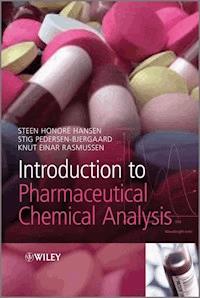
This textbook is the first to present a systematic introduction to chemical analysis of pharmaceutical raw materials, finished pharmaceutical products, and of drugs in biological fluids, which are carried out in pharmaceutical laboratories worldwide. In addition, this textbook teaches the fundamentals of all the major analytical techniques used in the pharmaceutical laboratory, and teaches the international pharmacopoeias and guidelines of importance for the field. It is primarily intended for the pharmacy student, to teach the requirements in "analytical chemistry" for the 5 years pharmacy curriculum, but the textbook is also intended for analytical chemists moving into the field of pharmaceutical analysis. * Addresses the basic concepts, then establishes the foundations for the common analytical methods that are currently used in the quantitative and qualitative chemical analysis of pharmaceutical drugs * Provides an understanding of common analytical techniques used in all areas of pharmaceutical development * Suitable for a foundation course in chemical and pharmaceutical sciences * Aimed at undergraduate students of degrees in Pharmaceutical Science/Chemistry Analytical Science/Chemistry, Forensic analysis * Includes many illustrative examples
Sie lesen das E-Book in den Legimi-Apps auf:
Seitenzahl: 794
Veröffentlichungsjahr: 2011
Ähnliche



















Contents
Cover
Title Page
Copyright
Preface
Chapter 1: Introduction to Pharmaceutical Analysis
1.1 Applications and Definitions
1.2 The Life of Medicines
1.3 The Quality of Medical Products
1.4 Summary
Chapter 2: International Pharmacopoeias, Regulations and Guidelines
2.1 Overview of Legislation
2.2 Legislation and Regulations for Industrial Production
2.3 Life Time of Drugs and Drug Substances
2.4 Pharmacopoeias
2.5 International Harmonization
2.6 Legislation and Regulations for Pharmacy Production
2.7 Summary
Chapter 3: Fundamental Chemical Properties, Buffers and pH
3.1 pH and pKa
3.2 Partition
3.3 Stereochemistry
3.4 Stability Testing
3.5 Summary
Chapter 4: Fundamentals of Pharmaceutical Analysis
4.1 What is a Pharmaceutical (Chemical) Analysis?
4.2 How to Specify Quantities and Concentrations?
4.3 Basic Laboratory Equipment
4.4 How to Make Solutions and Dilutions
4.5 Calibration of Analytical Methods
4.6 Errors, Accuracy, and Precision
4.7 Statistics
4.8 Some Words and Concepts
Chapter 5: Titrimetric Methods
5.1 Introduction
5.2 Acid–Base Titrations
5.3 Acid–Base Titrations in Non-Aqueous Media
5.4 Redox Titrations
5.5 Other Principles of Titration
5.6 Summary
Chapter 6: Introduction to Spectroscopic Methods
6.1 Electromagnetic Radiation
6.2 Molecules and Electromagnetic Radiation
6.3 Atoms and Electromagnetic Radiation
6.4 Summary
Chapter 7: UV Spectrophotometry
7.1 Principle of Quantitative Determination
7.2 Principle of Identification
7.3 Which Substances Have Strong UV Absorbance?
7.4 Instrumentation
7.5 Practical Work and Method Development
7.6 Areas of Usage and Performance
7.7 System Testing
7.8 Summary
Chapter 8: IR Spectrophotometry
8.1 IR Spectrophotometry
8.2 Instrumentation
8.3 Scope
8.4 Instrument Calibration
8.5 NIR Spectrophotometry
8.6 Applications
8.7 Summary
Chapter 9: Atomic Spectrometry
9.1 Atomic Absorption Spectrometry
9.2 Instrumentation
9.3 Applications and Performance
9.4 Practical Work and Method Development
9.5 Atomic Emission Spectrometry
9.6 Instrumentation
9.7 Summary
Chapter 10: Chromatography
10.1 General Principles
10.2 Retention
10.3 Column Efficiency
10.4 Selectivity
10.5 Peak Symmetry
10.6 Resolution
10.7 Chromatographic Techniques
10.8 Summary
Chapter 11: Chromatographic Separation Principles
11.1 General Introduction
11.2 Normal Phase Chromatography
11.3 Reversed Phase Chromatography
11.4 Hydrophilic Interaction Chromatography
11.5 Chiral Separations
11.6 Size Exclusion Chromatography
11.7 Ion Exchange Chromatography
Chapter 12: Thin-Layer Chromatography
12.1 Introduction
12.2 Apparatus
12.3 TLC Plates
12.4 Stationary Phases
12.5 Mobile Phases
12.6 Chromatographic Development
12.7 Detection
12.8 Applications of TLC
12.9 Quantitative Analysis and Instrumentation
12.10 Summary
Chapter 13: High Performance Liquid Chromatography
13.1 Introduction
13.2 The Chromatographic Separation Process
13.3 The Column
13.4 Pumps
13.5 Detectors
13.6 Injectors
13.7 Mobile Phases
13.8 Solvents for Sample Preparation
13.9 Reporting the Results
13.10 Summary
Chapter 14: Gas Chromatography
14.1 Introduction
14.2 Apparatus
14.3 Temperature
14.4 Carrier Gas
14.5 Stationary Phases
14.6 Selectivity in GC
14.7 Columns
14.8 Injection Systems
14.9 Detectors
14.10 Derivatization
14.11 The Uses of GC
14.12 More Advanced GC Techniques
14.13 Summary
Chapter 15: Capillary Electrophoresis
15.1 Principle and Theory
15.2 Electroosmotic Flow
15.3 Instrumentation
15.4 The Capillary
15.5 Sample Introduction
15.6 Capillary Zone Electrophoresis; an Example
15.7 Micellar Electrokinetic Chromatography
15.8 Chiral Separations
15.9 Coated Capillaries
15.10 Non-Aqueous CE
15.11 Summary
Chapter 16: Mass Spectrometry
16.1 Introduction
16.2 Basic Theory
16.3 Electron Ionization
16.4 Identification using Electron Ionization Spectra
16.5 Characterization of Totally Unknowns using Electron Ionization Spectra
16.6 Chemical Ionization
16.7 Electrospray Ionization
16.8 Atmospheric Pressure Chemical Ionization
16.9 High-Resolution Mass Spectrometry
16.10 Instrumentation
16.11 Chromatography Coupled with Mass Spectrometry
16.12 Quantitative GC-MS and LC-MS
16.13 Areas of Usage and Performance
16.14 Matrix-Assisted Laser Desorption/Ionization Mass Spectrometry
16.15 Inductively Coupled Plasma Mass Spectrometry
16.16 Summary
Chapter 17: Miscellaneous Chemical Techniques
17.1 Potentiometric Determination of Ions using Ion-Selective Electrodes
17.2 Paper Chromatography
17.3 Supercritical Fluid Chromatography
17.4 Gel Electrophoresis
17.5 Iso-Electric Focusing
17.6 Nuclear Magnetic Resonance Spectroscopy
17.7 Raman Spectrometry
Chapter 18: Sample Preparation
18.1 Why is Sample Preparation Required?
18.2 Main Strategies
18.3 Recovery and Enrichment
18.4 Protein Precipitation
18.5 Liquid–Liquid Extraction
18.6 Solid–Liquid Extraction
18.7 Solid Phase Extraction
18.8 Summary
Chapter 19: Analytical Chemical Characteristics of Selected Drug Substances
19.1 Amitriptyline and Mianserin
19.2 Morphine and Codeine
19.3 Ibuprofen and Naproxen
19.4 Furosemide
19.5 Paracetamol (Acetaminophen)
19.6 Neutral Drugs
Chapter 20: Quantification and Quality of Analytical Data
20.1 Peak Height and Peak Area
20.2 Calibration Methods
20.3 Validation
20.4 System Suitability
Chapter 21: Chemical Analysis of Drug Substances
21.1 What is a Pharmaceutical Raw Material, how is it Produced and why must it be Controlled?
21.2 The Pharmacopoeias – the Basis for Control of Pharmaceutical Raw Materials
21.3 Which Contaminants are Found in Raw Materials, What are the Requirements in a Maximum Content and Why?
21.4 How to Check the Identity of Pharmaceutical Raw Materials
21.5 How to Test for Impurities in Pharmaceutical Raw Materials
21.6 How to Determine the Purity of Pharmaceutical Raw Materials
21.7 How to Control Compounds for Which no Pharmacopoeia Monograph Exists
21.8 How are Ph.Eur. and USP Updated?
Chapter 22: Chemical Analysis of Final Pharmaceutical Products
22.1 Quality Control of Final Pharmaceutical Products
22.2 Monographs and Chemical Testing
22.3 Identification of the Active Pharmaceutical Ingredient
22.4 Assay of the Active Pharmaceutical Ingredient
22.5 Chemical Tests for Final Pharmaceutical Products
Chapter 23: Analysis of Drugs in Biological Fluids
23.1 Introduction
23.2 The Biological Matrix
23.3 Bioanalytical Methods
23.4 Examples
Index
This edition first published 2012
© 2012 John Wiley & Sons Ltd.
Registered office
John Wiley & Sons Ltd, The Atrium, Southern Gate, Chichester, West Sussex, PO19 8SQ, United Kingdom
For details of our global editorial offices, for customer services and for information about how to apply for permission to reuse the copyright material in this book please see our website at www.wiley.com.
The right of the author to be identified as the author of this work has been asserted in accordance with the Copyright, Designs and Patents Act 1988.
All rights reserved. No part of this publication may be reproduced, stored in a retrieval system, or transmitted, in any form or by any means, electronic, mechanical, photocopying, recording or otherwise, except as permitted by the UK Copyright, Designs and Patents Act 1988, without the prior permission of the publisher.
Wiley also publishes its books in a variety of electronic formats. Some content that appears in print may not be available in electronic books.
Designations used by companies to distinguish their products are often claimed as trademarks. All brand names and product names used in this book are trade names, service marks, trademarks or registered trademarks of their respective owners. The publisher is not associated with any product or vendor mentioned in this book. This publication is designed to provide accurate and authoritative information in regard to the subject matter covered. It is sold on the understanding that the publisher is not engaged in rendering professional services. If professional advice or other expert assistance is required, the services of a competent professional should be sought.
The publisher and the author make no representations or warranties with respect to the accuracy or completeness of the contents of this work and specifically disclaim all warranties, including without limitation any implied warranties of fitness for a particular purpose. This work is sold with the understanding that the publisher is not engaged in rendering professional services. The advice and strategies contained herein may not be suitable for every situation. In view of ongoing research, equipment modifications, changes in governmental regulations, and the constant flow of information relating to the use of experimental reagents, equipment, and devices, the reader is urged to review and evaluate the information provided in the package insert or instructions for each chemical, piece of equipment, reagent, or device for, among other things, any changes in the instructions or indication of usage and for added warnings and precautions. The fact that an organization or Website is referred to in this work as a citation and/or a potential source of further information does not mean that the author or the publisher endorses the information the organization orWebsite may provide or recommendations it may make. Further, readers should be aware that Internet Websites listed in this work may have changed or disappeared between when this work was written and when it is read. Nowarranty may be created or extended by any promotional statements for this work. Neither the publisher nor the author shall be liable for any damages arising herefrom.
Library of Congress Cataloging-in-Publication Data
Hansen, Steen, 1947–
Chemical analysis in pharmaceutical sciences / Steen Hansen, Stig Pedersen-Bjergaard, Knut Rasmussen.
p. ; cm.
Includes bibliographical references and index.
ISBN 978-0-470-66121-5 (cloth) – ISBN 978-0-470-66122-2 (pbk.)
1. Drugs–Analysis. 2. Pharmaceutical chemistry. I. Pedersen-Bjergaard, Stig. II. Rasmussen, Knut. III. Title.
[DNLM: 1. Pharmaceutical Preparations–analysis. 2. Chemistry, Pharmaceutical. 3. Drug Compounding–standards. QV 55]
RS189.H277 2012
615.1′9–dc23
2011030362
Print ISBN (Hardback): 9780470661215
Print ISBN (Paperback): 9780470661222
ePDF ISBN: 9781119953609
oBook ISBN: 9781119953647
ePub ISBN: 9781119954330
Mobi ISBN: 9781119954347
Preface
This textbook, entitled “Introduction to Pharmaceutical Chemical Analysis”, is the first textbook giving a systematic introduction to the chemical analysis of pharmaceutical raw materials, finished pharmaceutical products, and drugs in biological fluids, as carried out in the pharmaceutical laboratories worldwide. In addition to this, the textbook teaches the fundamentals of all the major analytical techniques used in the pharmaceutical laboratory and teaches the international pharmacopoeias and guidelines of importance for the field. The textbook is primarily intended for the pharmacy student, to teach the requirements in “analytical chemistry” for the 5-year pharmacy curriculum, but the textbook is also intended for analytical chemists moving into the field of pharmaceutical analysis.
The field of pharmaceutical analysis is very broad and challenging to define and limit, and therefore we have made priority to some major areas of focus. First, the textbook has a major focus on low-molecular-weight drug substances. This “low-molecular” focus was selected to limit the size of the book, but also because we have a clear ambition of linking all the discussions of the different chemical techniques and methods to the chemical properties of the drug substances. We feel this is very important for a good understanding, and this understanding is much easier to obtain for low-molecular drug substances than for macromolecules. Thus, although macromolecules, like peptides and proteins, are also used as drugs, they are not discussed in this textbook.
Second, this textbook has a major focus on pharmaceutical routine applications, including how drug substances are analyzed as raw materials prior to pharmaceutical production, how they are analyzed in finished pharmaceutical products, and how they are analyzed in patient samples following administration. This “routine” focus was also selected to limit the size of the book. Thus, applications of pharmaceutical analysis during development of new drugs and during pharmaceutical research have not been discussed. However, many of these applications are similar to the routine applications in terms of fundamental understanding, and as long as the readers understand the routine applications, they also have the best fundament to understand the more advanced applications.
Third, the textbook has a major focus on classical analytical techniques such as titration, chromatography, electrophoresis, and spectroscopy. This “classical” focus was a natural consequence of the “low-molecular” and “routine” focuses discussed above. Additionally, we feel that discussing the most important techniques comprehensively is much more valuable for the reader than mentioning all the techniques involved in pharmaceutical analysis. In future revisions however, we may include more new analytical techniques as they are gradually included as official methods in the international pharmacopoeias.
This textbook first gives a short introduction to the field of pharmacy, to the field of pharmaceutical analysis, and to the regulations and guidelines relevant for the field (Chapters 1 and 2). This is an important motivation for the reader, but is also a basis for understanding the “landscape” of pharmaceutical analysis. Then, the textbook gives a short chemistry course to make sure that the reader is at an appropriate level in terms of chemical understanding (Chapter 3). This is very important, as we try to link every discussion later in the book to chemical structures. The third part of the book (Chapters 4, 5, 6, 7, 8, 9, 10, 11, 12, 13, 14, 15, 16, 17, 18, 19, 20) describes all the analytical techniques (tools). In this part of the textbook, we basically fill up the tool box to be used in the final part. In the latter (Chapters 21, 22, 23), we describe how the different tools (analytical techniques) are used for the analysis of pharmaceutical raw materials, for the analysis of finished pharmaceutical products, and for the analysis of patient samples. Unlike many other textbooks, we have no student problems. However, we have replaced the student problems with many real examples, and for each example, we have given priority to fundamental understanding of the chemistry and to calculations. Thus, in this textbook, you learn how to calculate the concentration of a certain drug in your sample based on the number displayed on your analytical instrument. Welcome to the challenging world of pharmaceutical analysis!
Copenhagen/Oslo, April 2011
Steen Honoré Hansen Knut Einar Rasmussen Stig Pedersen-Bjergaard University of Copenhagen University of Oslo University of Oslo University of Copenhagen
Chapter 1
Introduction to Pharmaceutical Analysis
This chapter briefly reviews the life of medical products and the manufacture of medical products according to international regulations and guidelines. Based on this review the major areas and usage of pharmaceutical analysis are identified.
1.1 Applications and Definitions
The European Pharmacopeia defines a medical product as:
(a) Any substance or combination of substances presented as having properties for treating or preventing disease in human beings and/or animals; or (b) any substance or combination of substances that may be used in or administered to human beings and/or animals with a view either to restoring, correcting or modifying physiological functions by exerting a pharmacological, immunological or metabolic action, or to making a medical diagnosis.
A medical product contains a substance that is pharmacologically active and that substance is called the active ingredient (AI) or active pharmaceutical ingredient (API) defined as follows:
Any substance intended to be used in the manufacture of a medicinal product and that, when so used, becomes an active ingredient of the medicinal product. Such substances are intended to furnish a pharmacological activity or other direct effect in the diagnosis, cure, mitigation, treatment or prevention of disease, or to affect the structure and function of the body.
An herbal medical product is:
A medicinal product, exclusively containing as active ingredients one or more herbal drugs or one or more herbal drug preparations, or one or more such herbal drugs in combination with one or more such herbal drug preparation.
Drug substances are administered very rare as the pure active substance. Typically the active substance and excipients (auxiliary substances) are combined into dosage forms to produce the final medical product. An excipient is:
Any constituent of a medicinal product that is not an active substance.
Adjuvants, stabilizers, antimicrobial preservatives, diluents, antioxidants, for example, are excipients.
The dosage form can be, for example, a tablet or a capsule or syrup to be administered orally, injections that are for parenteral administration into the body, or ointments for topical administration. Figure 1.1 shows typical dosage forms.
Figure 1.1 Different dosage forms
Formulation is the process in which different chemical substances, including the active ingredient and excipients are combined to produce a final medical product. It involves developing a preparation of the drug that is both stable and acceptable to the patient. For orally taken drugs this usually involves incorporating the drug and excipients in a solid dosage form such as a tablet or a capsule or a liquid dosage forms such as a syrup. The main function of excipients is summarized as follows:
Ensure that the preparation has a shape and size that is easy to use for the patient;Ensure that the active substance is optimally adsorbed in the patient;Ensure that the preparation has an acceptable shelf life;Ensure that the preparation does not have an unpleasant taste or odor;Ensure easy production.There is a wide spectrum of different excipients, which varies widely from preparation to preparation. To illustrate this, Table 1.1 shows the excipients of a tablet and syrup which both contain paracetamol as the active ingredient. Paracetamol is both an analgesic (an = no, algesis = pain) and a antipyretic (anti = against, pyretos = fever), which means that it is used against pain and fever.
Table 1.1 Excipients of a paracetamol tablet and a paracetamol syrup.
ContentAmount (mg)FunctionTablet (weight 285 mg) Paracetamol250Active ingredient Hydroxypropyl celluloseBinder Maize starchDisintegrant TalcumGlidant Magnesium stearateLubricantSyrup (volume 1 ml) Paracetamol24Active ingredient SorbitolSweetener GlycerolSweetener PolyvinylpyrrolidoneThickening agent Saccharine sodium saltSweetener MethylparabenePreservative EthylparabenePreservative PropylparabenePreservative Sodium metabisulfiteAntioxidant Citric acidpH regulator Sodium citratepH regulator Strawberry aromaFlavoring agent WaterSolventThe tablets, which in this example, have a total weight of 285 mg contains 250 mg of paracetamol (active ingredient), while the remaining 35 mg is made up of excipients. The excipients are a disintegrating agent, a lubricant, a glidant and a binder. Binders, lubricating and gliding agents are added to facilitate manufacture. A disintegrating agent ensures rapid disintegration of the tablet in the stomach.
Paracetamol syrup, which contains 24 mg/ml of paracetamol, is composed mainly of water. In addition, it is added sweetening and flavoring agents for better taste. Antimicrobial preservatives and antioxidants are added to prevent bacterial growth and chemical degradation. In addition agents that increase the viscosity and stabilizes the pH are added.
Medical products may be divided into over the counter drugs (OTC), which may be sold directly to the consumer in pharmacies and supermarkets without restrictions, and prescription only medicine (POM) that must be prescribed by a licensed practitioner. Medical products are predominantly produced by the pharmaceutical companies, only in rare occasions are pharmaceutical products produced in hospitals and in pharmacies. New products are often patented to give the developer exclusive right to produce them. Those that are not patented or with expired patents, are called generic drugs since they can be produced by other companies without restrictions or licenses from the patent holder. According to the European Federation of Pharmaceutical Industries and Associations (EFPIA), the pharmaceutical industry in Europe employed some 630 000 people, including 110 000 in research and development, in 2009. The trade surplus was Euro 55 200 million, and Euro 26 000 million was spent on pharmaceutical research and development. The retail value of the pharmaceutical market was Euro 215 000 million, which is just under 30% of the world market.
1.2 The Life of Medicines
Figure 1.2 outlines a typical industrial production of a pharmaceutical product.
Figure 1.2 Illustration of the manufacturing of a medical product
Production starts by ordering the current active ingredient and the necessary starting materials. In some cases, the company produces some of the ingredients, but most commonly they are produced elsewhere by various industrial raw material suppliers. The raw materials arrive in relatively large quantities (1–500 kg) and are typically packed in cardboard drums or in plastic containers. Figure 1.3 shows an example of a received batch of raw material in the photo gallery from a manufacturing facility.
Figure 1.3 Photo gallery of a manufacturing facility: arrival of raw materials, weighing, sampling, tablet pressing, filling, labelling, and packaging. Reproduced with permission from Fagbokforlaget
Figure 1.4 shows an outline of some areas found in a manufacturing facility.
Figure 1.4 Outline of some areas found in a manufacturing facility
Upon arrival the raw materials are registered in the manufacturer's documentation system, tagged with internal labels and stored in a separate area of the warehouse or in a separate room where they are in quarantine until they are released for production. Samples of the raw materials are collected and analyzed to ensure that the raw materials are of satisfactory quality. This is the first of several important areas where pharmaceutical analysis are vital. We focus further on this in Chapter 21. If the results are in accordance with the specifications of the manufacturer the raw materials are labeled as released materials, and transferred to the production facility. Production starts with weighing or measuring the active ingredient and excipients in appropriate amounts for the subsequent production (see Figure 1.3). Then, the raw materials are transferred to the manufacturing machinery. Manufacture of tablets uses several types of equipment such as machinery for granulation, drying and tablet pressing (see Figure 1.3). The manufacture of liquid dosage forms is carried out in large tanks, while the production of ointments and creams are carried in large pots with agitator and heating. When the product leaves the production site samples for a comprehensive finished product control is collected. A number of analytical tests are made, and this is another important field of pharmaceutical analysis which is discussed in detail in Chapter 22. The products are in quarantine until the results of the testing show compliance with specifications. The released product is filled in appropriate containers (filling; see Figure 1.3), the containers are marked with labels (labeling; see Figure 1.3) and the containers are packed in cardboard boxes (packaging; see Figure 1.3). Assessment of the finished product embrace all relevant factors, including production conditions, results of in-process testing, a review of manufacturing (including packaging), documentation, compliance with Finished Product Specifications and examination of the final finished pack.
As shown above, the industrial production of pharmaceuticals is a comprehensive process that takes place over many different steps. Typically, production is a batch process, which means that the products are made in limited batches. Each time a batch is produced a new manufacturing process is started from the beginning with new starting materials. Between each production of a given product, the equipment is often used for the production of other products. Consequently the production facility must be cleaned thoroughly between each batch to prevent the material from an earlier production contaminating other products (cross contamination).
After leaving the manufacturer the products are sent to pharmaceutical wholesalers, which provide for their further distribution to pharmacies, hospitals or other retailers where they becomes available to the patients. Medicines have a broad scope of usage, and are used against many types of illness and pain in various parts of the body.
At the start of medication, it is common to follow a standard treatment, but it is well known that different patients may exhibit large variations in response. In such cases it is important to adjust the dosage. One example is the treatment of hypertension. The dosage may be reduced when the blood pressure is too low and the dosage may be increased when the blood pressure is too high. For other types of treatment, such as depression, psychosis and epilepsy, the measurement of effect is difficult; and in those cases therapeutic drug monitoring (TDM) is advised. In TDM blood samples are collected and analyzed to ensure that the drug level is appropriate. The analysis of drugs in biological fluids is called bioanalysis. In addition to TDM, bioanalysis is crucial in drug development programs, in forensic and toxicological analysis and in doping control testing in sports. Bioanalysis is a third major area of pharmaceutical analysis, which is discussed in Chapter 23.
1.3 The Quality of Medical Products
The purchaser of food and drink normally discovers that a product is associated with a significant quality problem if has either an abnormal taste, unusual smell or a look that seems abnormal. Medicines are, however, special. For example, there is no way patients can decide whether a tablet contains the active ingredient, whether it is the correct dosage, or whether any contaminants or degradation products are present. The patient is not in a position to recognize that a medicine is incorrect or defective. The patient literally takes medicines entirely on trust and is at the end of a chain of implicit trust which extends back through administering, dispensing, prescribing and distributing, right back to those responsible for manufacture of the product. It is therefore mandatory that the pharmaceutical industry maintains the highest standards of quality in the development, manufacture and control of medical products.
Government heath authorities are naturally concerned about the quality of medicines, and regulate the development, manufacture and marketing of medical products by a number of laws and guidelines. These are discussed in Chapter 2. The regulations and guidelines are to assure the safety, protection and well being of the consumer or patient. Two important areas are:
Marketing authorization of medical products;Manufacturing authorization of medical products.Marketing authorization, also called a license, is required before any medicine can be used to treat people. Only when the regulatory bodies are satisfied that the product works as it should, and that it is acceptably safe, is it given a marketing authorization or product license.
The regulatory system also imposes rigorous standards on manufacturers. Manufacturing authorization is required by all pharmaceutical manufacturers and ensures that only authorized manufacturers manufacture all licensed products. Competent authorities regularly inspect the activities of the manufacturers and annually collect samples of marketed medicines for assessment of quality. National Medical Control Agencies have the power to withdraw a product from the market and to suspend production. These Agencies can also prosecute a manufacturer if the law has been broken.
The holder of a manufacturing authorisation must manufacture medical products so as to ensure that they are fit for their intended use. The products should comply with the requirements of the marketing authorization and should not put patients at risk due to inadequate safety, quality or efficacy. The attainment of quality is the responsibility of the management, and it relies on a comprehensively designed and correctly implemented system of Quality Assurance (QA) incorporating Good Manufacturing Practice (GMP) and Quality Control (QC). The system should be fully documented. The basic concepts of QA, GMP and QC are inter-related, as shown in Figure 1.5.
Figure 1.5 Illustration of the QA/GMP/QC inter-relationship
Quality Assurance is a wide-ranging concept, which covers all matters that influence the quality of a product. It is the sum of all organized arrangements that are made to ensure that medical products are of the quality required for their intended use. Quality Assurance therefore incorporates GMP, which ensures that products are consistently produced and controlled to the quality standards appropriate to their intended use and as required by the Marketing Authorization. The basics of GMP are that all manufacturing processes are clearly defined, systematically reviewed and shown to be capable of consistently manufacturing products of the required quality. Quality Control is part of GMP and is concerned with sampling, specifications and testing, and with the organization, documentation and release procedures. Release procedures should ensure that the necessary and relevant tests are actually carried out and that materials are not released for use, nor products released for sale or supply, until their quality has been judged to be satisfactory. The independence of the Quality Control Department from other departments is considered fundamental. Quality Control is not confined to laboratory operations, but must be involved in all decisions that may concern the quality of a product.
According to European regulations each batch of finished product must be certified by a Qualified Person (QP) before being released for sale or supply.
Before certifying a batch the QP should ensure that at least the following requirements have been met:
The batch and its manufacture comply with the provisions of the marketing authorization.Manufacture has been carried out in accordance with GMP.The principal manufacturing and testing processes have been validated (validation is defined as the documented act of demonstrating that processes will consistently lead to the expected results).Any deviations or planned changes in production or quality control have been authorized by the persons responsible in accordance with a defined system.All the necessary checks and tests have been performed.All necessary production and quality control documentation has been completed.The QP should in addition take into account any other factors of which he is aware which are relevant for the quality of the batch.Good documentation constitutes an essential part of the quality assurance system and constitutes a vital part of batch release and certification by the QP. Clearly written documentation and standard operating procedures (SOP) prevent errors from spoken communication and permit tracing of batch history. The documentation include:
Specifications that in detail describe the requirements that must be fulfilled prior to quality evaluation;Manufacturing formulae, processing and packaging instructions;Procedures that give directions for performing operations such as cleaning, sampling testing and equipment operation;Records providing a history of each batch or product.The batch documentation shall be retained for at least one year after the expiry date of the batches.
1.4 Summary
Government health authorities have regulated the development, manufacture and marketing of medical products by a number of laws and guidelines to assure the safety, protection and well being of the patient. Market authorization is required before any medical product can be marketed and only authorized manufacturers can produce authorized products. Authorized manufacture is based on a correctly implemented system of Quality Assurance incorporating Good Manufacturing Practice and Quality Control.
Chapter 2
International Pharmacopoeias, Regulations and Guidelines
This chapter reviews a number of laws, guidelines and regulations important in the pharmaceutical production and thus also for the subject pharmaceutical analysis. The manufacture of drugs is international and therefore this chapter focuses on international affairs. But also national laws, guidelines, and regulations are important for manufacturers in order to fulfil the requirements of the relevant authorities. All these laws, guidelines and regulations are subject to regular updates and the latest edition should therefore always be consulted.
2.1 Overview of Legislation
At the end of Chapter 1 it was mentioned that drug manufacturers have to fulfil requirements given in a number of laws, guidelines and regulations that will ensure high quality of pharmaceutical preparations. Production and the related control of medicines are often governed by the following two laws on a national basis:
Law on medicinal products (Medicines Act);Law on pharmacy (Pharmacy Act).The Medicines Act regulates, among other things, the requirements for medicines, clinical trials (the testing of drugs on humans), the manufacturing process, import, wholesale sales, retail sales and the advertising of medicines. This chapter focuses on what is relevant in connection to drug development and production conducted in the pharmaceutical industry and in pharmacies. We first discuss what is applicable for Proprietary Medicinal Products manufactured industrially, while medicinal products produced in pharmacies (stock production, small-scale production) are treated at the end of this chapter.
2.2 Legislation and Regulations for Industrial Production
A key point in the Medicines Act is that all medicinal products to be sold in a country must have a marketing authorization granted by the local authorities (Ministry of Health). In the EU a common legislation is available if a pharmaceutical company wants to register its products in more than one EU country. This legislation is managed by the European Medicines Agency (EMA). In the United States the Food and Drug Administration (FDA) is the regulatory authority for the control of drugs.
The drug manufacturer or the importer of the drug is responsible for filing the application for marketing authorization. The Ministry of Health through the State Medicines Agency is responsible for evaluating the application based on the stated quality, safety and efficacy of the drug. The market authorization is granted for five years and may thereafter be renewed. The marketing authorization may be withdrawn before the expiration by the Ministry of Health if:
The product is no longer considered to meet the requirements for quality, safety or efficacy.The product does not have the specific qualitative or quantitative composition.Lesen Sie weiter in der vollständigen Ausgabe!
Lesen Sie weiter in der vollständigen Ausgabe!
Lesen Sie weiter in der vollständigen Ausgabe!
Lesen Sie weiter in der vollständigen Ausgabe!
Lesen Sie weiter in der vollständigen Ausgabe!
Lesen Sie weiter in der vollständigen Ausgabe!
Lesen Sie weiter in der vollständigen Ausgabe!
Lesen Sie weiter in der vollständigen Ausgabe!
Lesen Sie weiter in der vollständigen Ausgabe!
Lesen Sie weiter in der vollständigen Ausgabe!
Lesen Sie weiter in der vollständigen Ausgabe!
Lesen Sie weiter in der vollständigen Ausgabe!
Lesen Sie weiter in der vollständigen Ausgabe!
Lesen Sie weiter in der vollständigen Ausgabe!
Lesen Sie weiter in der vollständigen Ausgabe!
Lesen Sie weiter in der vollständigen Ausgabe!
Lesen Sie weiter in der vollständigen Ausgabe!
Lesen Sie weiter in der vollständigen Ausgabe!
Lesen Sie weiter in der vollständigen Ausgabe!
Lesen Sie weiter in der vollständigen Ausgabe!
Lesen Sie weiter in der vollständigen Ausgabe!
Lesen Sie weiter in der vollständigen Ausgabe!




