


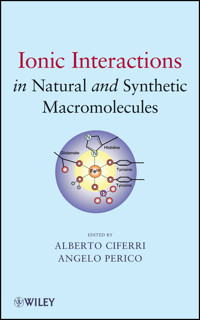
Ionic Interactions in Natural and Synthetic Macromolecules E-Book
177,99 €
Mehr erfahren.
- Herausgeber: John Wiley & Sons
- Kategorie: Wissenschaft und neue Technologien
- Sprache: Englisch
This book is a comprehensive study of the subject of ionic interactions in macromolecules. The first parts of the book review and analyze the conventional treatments of fixed charges (e.g. in polyelectrolytes and polyampholytes), including screening and condensation by mobile ions. The interaction of ions with less polar sites on the macromolecule (e.g. amide bonds), and the origin of the lyotropic effects (focusing on binding versus condensation) will also be extensively addressed. The book also explores complex micellar organizations involving charged macromolecules (e.g. DNA) and low-molecular-weight ampholytes and strong protein associations. The resulting structures are relevant to a variety of functional biological systems and synthetic analogs. The contribution of electrostatic and hydrophobic interaction to the stability of proteins and other supramolecular structures will also be analyzed. There are chapters on applications such as deionization and cosmetic formulation. This 21-chapter book is divided into three sections: * Fundamentals * Mixed Interactions * Functions and Applications
Sie lesen das E-Book in den Legimi-Apps auf:
Seitenzahl: 1552
Veröffentlichungsjahr: 2012
Ähnliche




















Table of Contents
Cover
Title page
Copyright page
PREFACE
CONTRIBUTORS
PART I: FUNDAMENTALS
CHAPTER 1 ION PROPERTIES
1.1 IONS AS CHARGED PARTICLES
1.2 SIZES OF IONS
1.3 THERMODYNAMICS OF AQUEOUS IONS
1.4 ION TRANSPORT
1.5 ION–SOLVENT INTERACTIONS
1.6 ION–ION INTERACTIONS
CHAPTER 2 IONIC INTERACTIONS IN SUPRAMOLECULAR COMPLEXES
2.1 INTRODUCTION/APPLICATIONS
2.2 SYSTEMS DOMINATED ENTIRELY BY ION PAIRING: IONOPHORES AND SO ON
2.3 ENTHALPIC VERSUS ENTROPIC CONTRIBUTIONS/HYDROGEN BOND CONTRIBUTIONS
2.4 QUANTIFICATION OF SALT BRIDGE CONTRIBUTIONS/ADDITIVITY OF BINDING INCREMENTS
2.5 SALT EFFECTS/INFLUENCE OF CONFORMATIONAL FLEXIBILITY
2.6 SYSTEMS WITH ADDITIONAL INTERACTIONS/ARTIFICIAL RECEPTORS FOR NUCLEOTIDES AND NUCLEOSIDES
2.7 SELECTIVITY IN COMPLEXES WITH ION PAIR CONTRIBUTION
2.8 CONCLUSIONS
CHAPTER 3 POLYELECTROLYTE FUNDAMENTALS
3.1 INTRODUCTION
3.2 PB EQUATION AND THE DH APPROXIMATION
3.3 EXTENDED CONDENSATION THEORY
3.4 ATTRACTION AND CLUSTERS OF LIKE-CHARGED STRONG POLYELECTROLYTES IN THE CONDENSATION APPROACH: MONOVALENT COUNTERIONS AND EFFECT OF CONDENSATION VOLUME
3.5 ATTRACTION OF LIKE-CHARGED POLYELECTROLYTES FOR MULTIVALENT COUNTERIONS: COUNTERION CORRELATION APPROACH
3.6 INTERACTIONS BETWEEN POLYELECTROLYTES AND OPPOSITELY CHARGED MACROIONS
CHAPTER 4 POLYELECTROLYTE AND POLYAMPHOLYTE EFFECTS IN SYNTHETIC AND BIOLOGICAL MACROMOLECULES
4.1 INTRODUCTION
4.2 PERSISTENCE LENGTH OF PES
4.3 PAs
4.4 PAS WITH EXCESS CHARGES
4.5 ELASTIC RESPONSE OF FLEXIBLE PES
4.6 SIMULATIONS OF COLLAPSE OF AN ISOLATED PE CHAIN
4.7 THEORY OF COLLAPSE DYNAMICS
4.8 CONCLUSIONS
ACKNOWLEDGMENTS
CHAPTER 5 MODELING THE STRUCTURE AND DYNAMICS OF POLYELECTROLYTE MULTILAYERS
5.1 INTRODUCTION
5.2 STATE OF THE ART IN THE STUDY OF PEMS
5.3 THEORETICAL AND ANALYTICAL APPROACHES TO THE MODELING OF PEMS
5.4 MODELING PEMS VIA NUMERICAL SIMULATIONS
5.5 TOWARD A BETTER PHYSICAL DESCRIPTION OF PEMS USING NUMERICAL MODELS
5.6 CHALLENGING TOPICS IN THE NUMERICAL SIMULATIONS OF PEMS
5.7 SUMMARY
ACKNOWLEDGMENTS
PART II: MIXED INTERACTIONS
CHAPTER 6 IONIC MIXED INTERACTIONS AND HOFMEISTER EFFECTS
6.1 INTRODUCTION
6.2 POLYELECTROLYTES
6.3 ION PAIRING
6.4 ASSOCIATIONS MEDIATED BY MULTIVALENT MOBILE IONS
6.5 HYDROPHOBIC POLYELECTROLYTES
6.6 POLYMERIC IONIC LIQUIDS, POLYMERS-IN-SALT SYSTEMS
6.7 HOFMEISTER EFFECTS
6.8 MAIN CONCLUSIONS
ACKNOWLEDGMENTS
CHAPTER 7 HYDROPHOBIC POLYELECTROLYTES
7.1 INTRODUCTION
7.2 HYDROPHOBIC AND HYDROPHOBICALLY MODIFIED POLYELECTROLYTES (HPE, HMPE)
7.3 SELF-ASSEMBLY OF HYDROPHOBIC POLYELECTROLYTES
7.4 STRUCTURE AND PROPERTIES OF MICELLE-LIKE AGGREGATES
7.5 SOLUBILIZATION OF NONPOLAR MOLECULES INTO PSEUDO-MICELLES
CHAPTER 8 ASSOCIATION OF POLYELECTROLYTES TO SURFACTANTS AND SUPRAMOLECULAR ASSEMBLIES: COMPETITIVE ROLE OF CHAIN RIGIDITY AND ASSEMBLY STABILITY
8.1 INTRODUCTION
8.2 CHAIN FLEXIBILITY, SURFACTANTS, AND PROTEIN ASSEMBLIES
8.3 FLEXIBLE POLYELECTROLYTES AND SURFACTANTS
8.4 RIGID POLYELECTROLYTES AND SURFACTANTS
8.5 RIGID POLYLECTROLYTES AND PROTEIN ASSEMBLIES
8.6 WORM-LIKE CHAINS, SURFACTANTS, AND PROTEIN ASSEMBLIES
8.7 SUMMARY AND CONCLUDING REMARKS
ACKNOWLEDGMENTS
CHAPTER 9 ION TRANSFER IN AND THROUGH CHARGED MEMBRANES: STRUCTURE, PROPERTIES, AND THEORY
9.1 INTRODUCTION
9.2 STRUCTURE OF CHARGED MEMBRANES
9.3 ION AND WATER TRANSFER IN IEMS
9.4 CONCENTRATION POLARIZATION IN ED
9.5 RELATIONSHIPS BETWEEN ELECTROCHEMICAL BEHAVIOR OF ION EXCHANGE MEMBRANES AND THEIR BULK AND SURFACE STRUCTURE: MEMBRANE MODIFICATION
ACKNOWLEDGMENTS
ABBREVIATIONS AND SYMBOLS
CHAPTER 10 REVERSIBLE COORDINATION POLYMERS
10.1 INTRODUCTION
10.2 ANATOMY OF A REVERSIBLE COORDINATION POLYMER
10.3 METAL–LIGAND BOND STRENGTH
10.4 LIGAND EXCHANGE KINETICS
10.5 CHAIN STOPPERS
10.6 RING–CHAIN EQUILIBRIUM
10.7 NETWORKS
10.8 SOLVENT INFLUENCE
10.9 CHARACTERIZATION OF REVERSIBLE COORDINATION POLYMERS
10.10 APPLICATIONS AND POTENTIALS
10.11 CONCLUSIONS
CHAPTER 11 STRUCTURAL AND FUNCTIONAL ASPECTS OF METAL BINDING SITES IN NATURAL AND DESIGNED METALLOPROTEINS
11.1 INTRODUCTION
11.2 CHEMISTRY OF COORDINATION COMPOUNDS: AN OVERVIEW
11.3 METAL COFACTORS AND METALLOPROTEIN FUNCTIONS
11.4 COORDINATION SITE SPECIFICITY AND METALLOPROTEIN FUNCTIONS: A LESSON FROM IRON
11.5 METALLOPROTEIN DESIGN AND ENGINEERING
11.6 CONCLUSIONS AND PERSPECTIVES
ACKNOWLEDGMENTS
CHAPTER 12 CHARGE-INDUCED EFFECTS ON ACID–BASE TITRATION AND CONFORMATIONAL STABILITY OF PROTEINS AND POLYPEPTIDES
12.1 INTRODUCTION
12.2 STUDIES OF PROTEINS
12.3 THE CONTINUUM DIELECTRIC MODEL
12.4 POLYPEPTIDE HELICES
APPENDIX 1 IONIZABLE GROUPS IN PROTEINS
APPENDIX 2 COUPLING OF BINDING AND CHEMICAL POTENTIAL
APPENDIX 3 THEORY OF THE HELIX–COIL EQUILIBRIUM IN HOMOPOLYPEPTIDES
PART III: FUNCTIONS AND APPLICATIONS
CHAPTER 13 IRON TRANSPORT IN LIVING CELLS
13.1 OVERVIEW
13.2 BACKGROUND
13.3 A COMPLEX SUITE OF IONIC AND MIXED INTERACTIONS DRIVES IRON TRANSPORT
13.4 PROTEIN–PROTEIN INTERACTIONS
13.5 PROTEIN/IRON–SMALL MOLECULE INTERACTIONS
13.6 PROTEIN–ANION INTERACTIONS
13.7 CONCLUSION
ACKNOWLEDGMENTS
GLOSSARY
CHAPTER 14 DNA–LIPID AMPHIPHILES FOR DRUG AND GENE THERAPY
14.1 INTRODUCTION
14.2 VIRAL AND NONVIRAL GENE CARRIERS
14.3 CHEMICAL STRUCTURE OF CATIONIC AMPHIPHILES
14.4 COMPLEXATION
14.5 CHARACTERIZATION OF CATIONIC LIPID CARRIER
14.6 EXTRACELLULAR BARRIERS
14.7 INTRACELLULAR BARRIER: CELL ADHESION, INTERNALIZATION, AND INTRACELLULAR TRAFFICKING
14.8 CYTOTOXICITY OF LIPOSOMES
14.9 DETERMINATION OF TRANSFECTION EFFICIENCY
ABBREVIATIONS
CHAPTER 15 POLYELECTROLYTE INTELLIGENT GELS: DESIGN AND APPLICATIONS
15.1 INTRODUCTION AND TECHNICAL OVERVIEW
15.2 MODELS OF SWELLING EQUILIBRIUM AND KINETICS
15.3 PHYSICALLY RESPONSIVE GELS
15.4 CHEMICALLY RESPONSIVE GELS
15.5 BIORESPONSIVE GELS
15.6 BIOMEDICAL APPLICATIONS
APPENDIX 1 NETWORK READJUSTMENT KINETICS
APPENDIX 2 ELECTRODIFFUSION–REACTION KINETICS
APPENDIX 3 A NONEQUILIBRIUM THERMODYNAMICS VIEW OF ELECTROMECHANICAL PHENOMENA
CHAPTER 16 IONIC POLYMER–METAL COMPOSITES FOR SENSORS AND ARTIFICIAL MUSCLES: MECHANOELECTRIC PERSPECTIVES
16.1 INTRODUCTION
16.2 MANUFACTURING
16.3 IPMC MECHANOELECTRIC MODEL
16.4 ENERGY HARVESTING APPLICATIONS
16.5 DISCUSSION AND CONCLUSION
CHAPTER 17 FUNCTIONAL LAYER-BY-LAYER POLYELECTROLYTES: ASSEMBLY STRATEGIES, CHARACTERIZATION, AND SELECTED APPLICATIONS
17.1 INTRODUCTION
17.2 USEFUL SUBSTRATES
17.3 INTERACTIONS IN MULTILAYERED LBL FILMS
17.4 SPR SPECTROSCOPY
17.5 POLYMER BRUSHES AND SIP TECHNIQUES
17.6 CONCLUSIONS
CHAPTER 18 POLYELECTROLYTES AT INTERFACES: APPLICATIONS AND TRANSPORT PROPERTIES OF POLYELECTROLYTE MULTILAYERS IN MEMBRANES
18.1 INTRODUCTION
18.2 PE MULTILAYER BUILD-UP AND MORPHOLOGY
18.3 PEM-BASED MEMBRANES
18.4 CONCLUSION
ABBREVIATIONS AND SYMBOLS
CHAPTER 19 SELF-ASSEMBLY OF POLYELECTROLYTES FOR PHOTONIC CRYSTAL APPLICATIONS
19.1 PHOTONIC CRYSTAL PROPERTIES
19.2 PHC PREPARATION AND APPLICATIONS
19.3 CONCLUSIONS
CHAPTER 20 APPLICATIONS OF CHARGED MEMBRANES IN SEPARATION, FUEL CELLS, AND EMERGING PROCESSES
20.1 INTRODUCTION
20.2 DESALINATION AND DEIONIZATION
20.3 ED CONCENTRATION
20.4 BMED
20.5 FRACTIONATION AND SEPARATION PROCESSES WITH CHARGED MEMBRANES
20.6 MEMBRANE-BASED HYBRID ZLD TECHNOLOGIES
20.7 MEMBRANE-BASED ENERGY CONVERSION TECHNIQUES
ACKNOWLEDGMENTS
LIST OF SYMBOLS
CHAPTER 21 POLYMER GEL ELECTROLYTES: CONDUCTION MECHANISM AND BATTERY APPLICATIONS
21.1 INTRODUCTION
21.2 PGES
21.3 ROUTES TO A MOLECULAR UNDERSTANDING OF IONIC CONDUCTIVITY: NMR MEASUREMENTS
21.4 COMMERCIAL ISSUES FOR PGES
21.5 SUMMARY
SYMBOLS
Index
Copyright © 2012 by John Wiley & Sons, Inc. All rights reserved
Published by John Wiley & Sons, Inc., Hoboken, New Jersey
Published simultaneously in Canada
No part of this publication may be reproduced, stored in a retrieval system, or transmitted in any form or by any means, electronic, mechanical, photocopying, recording, scanning, or otherwise, except as permitted under Section 107 or 108 of the 1976 United States Copyright Act, without either the prior written permission of the Publisher, or authorization through payment of the appropriate per-copy fee to the Copyright Clearance Center, Inc., 222 Rosewood Drive, Danvers, MA 01923, (978) 750-8400, fax (978) 750-4470, or on the web at www.copyright.com. Requests to the Publisher for permission should be addressed to the Permissions Department, John Wiley & Sons, Inc., 111 River Street, Hoboken, NJ 07030, (201) 748-6011, fax (201) 748-6008, or online at http://www.wiley.com/go/permissions.
Limit of Liability/Disclaimer of Warranty: While the publisher and author have used their best efforts in preparing this book, they make no representations or warranties with respect to the accuracy or completeness of the contents of this book and specifically disclaim any implied warranties of merchantability or fitness for a particular purpose. No warranty may be created or extended by sales representatives or written sales materials. The advice and strategies contained herein may not be suitable for your situation. You should consult with a professional where appropriate. Neither the publisher nor author shall be liable for any loss of profit or any other commercial damages, including but not limited to special, incidental, consequential, or other damages.
For general information on our other products and services or for technical support, please contact our Customer Care Department within the United States at (800) 762-2974, outside the United States at (317) 572-3993 or fax (317) 572-4002.
Wiley also publishes its books in a variety of electronic formats. Some content that appears in print may not be available in electronic formats. For more information about Wiley products, visit our web site at www.wiley.com.
Library of Congress Cataloging-in-Publication Data:
Ionic interactions in natural and synthetic macromolecules / edited by Alberto Ciferri, Angelo Perico.
p. cm.
Includes bibliographical references.
ISBN 978-0-470-52927-0
ISBN 978-1-118-16584-3 (epub)
ISBN 978-1-118-16586-7 (epdf)
ISBN 978-1-118-16587-4 (mobi)
1. Macromolecules. 2. Ion-ion collisions. 3. Supramolecular chemistry.
I. Ciferri, A. II. Perico, Angelo.
QD381.I64 2012
547'.7045723–dc23
2011041448
PREFACE
Two editions of Supramolecular Polymers (Dekker 2000 and CRC Press 2005) have dealt with the self-assembly of structures in the nano- and up-dimensional range in terms of molecular (chemical and shape) recognition and growth mechanisms. This third book is devoted to a more detailed description of how the components of chemical recognition are modulated to produce the variety of properties that characterize the supramolecular organization of functional systems and adaptive polymers. Fundamental approaches are highlighted, along with descriptions of a selected number of sophisticated applications.
Ionic interactions definitively play a primary role in the self-assembly of functional biological and synthetic systems. Theoretical features of purely ionic interactions have been extensively described in the past, and structural features of several real systems in which ionic interactions play a prevailing role have been experimentally characterized. However, in the majority of real cases, ionic interactions are modulated (reinforced or antagonized) by the occurrence of other, charge-independent interactions that produce important alterations of the structure and properties of the systems.
The first section of the book includes chapters focused on fundamental aspects of purely ionic interactions. The properties of simple salts described by Marcus are essential for the analysis of specific details of their interaction with organic substrates. Polyelectrolyte theories are presented by Perico, who places particular emphasis on the role of ion condensation and like-charge attraction on the stabilization of biological assemblies. Systems with opposite fixed charges include host–guest complexes, described by Schneider, which will facilitate quantitative comparisons with the polymeric ion pair systems such as polyampholytes, described next by Thirumalai and coworkers, and layered polyelectrolytes, described by Holm and coworkers.
The second section of the book includes chapters focused on fundamental aspects of mixed interactions. Ciferri discusses correlations of mixed systems and the role of mixed interactions in the Hofmeister effects. Polyelectrolytes with a significant number of hydrophobic groups, described by Olea, and polyelectrolyte–surfactant/protein assemblies, described by Ciferri and Perico, offer vivid evidence for the variety of supramolecular structures that are promoted by the microsegregation of apolar segments or associated proteins. Also in the second section, Nikonenko and coworkers describe the structure and properties of charged membranes resulting from the microsegregation of hydrophilic channels within a hydrophobic matrix. Metal–ion coordination for reversible polymers is discussed by Marcelis and coworkers, whereas a broader range of the ligand interaction is described by Lombardi and coworkers in terms of protein thermodynamics, and the chapter by Hermans highlights the role of charges on the conformation of helical polypeptides and proteins
The third section of the book focuses on functions and applications of various systems, and is opened by the chapter by Crumbliss and Parker Siburt on ion transport across living cells. The biological transport mechanisms are brilliant examples of the way nature has engineered a complex sequence of ionic mixed interactions for a specific function. The chapter by Chan and Wang describes DNA–lipid assemblies that generate pseudoliposomic structures used for targeted gene and drug delivery. The chapters by Chiarelli and De Rossi and by Tiwari and Kim feature stimulus-responsive intelligent gels, with emphasis on biomedical applications and muscle-like actuators. The electromechanochemical functioning of the gels entails consideration of readjustment kinetics of forces and related fluxes, which are handled by continuum mechanics approaches.
The next three chapters deal with functional layered assemblies: Knoll and coworkers describe a variety of driving interactions exploited for the formation of nanostructured films; Seantier and Deratani emphasize the sequential polycation–polyanion approach and the formation of multilayered membranes; and Cavallo and Comoretto discuss the application as photonic crystals of ordered periodic structures formed by materials having alternating refractive indices. Next, the chapter by Pourcelly and coworkers describes complex separation processes (particularly water treatments) using charged membranes, and also the membrane-based energy conversion in fuel cells technology. Efficient energy sources, such as lithium batteries, are characterized by cationic conductivity even in the absence of water. Polymer gel electrolytes, described in the final chapter by Ward and Hubbard, are intermediate between typical liquid and solid polymeric electrolytes, and allow a molecular understanding of ionic conductivity.
The goal of this book is to provide a coordinated and comprehensive representation of ionic mixed interactions, and actual or potential applications. Proper design of the molecular structure of self-assembling building blocks requires the strategic inclusion of groups that will modulate their contributions so that tailored properties and even complex functions may be produced. The unified presentation of the systems described here, characterized by different blends of ionic and ionic mixed interactions, allows the identification of general mechanisms and a correlation between, at first sight, unrelated phenomena.
The result was made possible by the dedication and patience of the contributors. Extensive discussions followed the preliminary draft, and attempts were made to reach a consensus over controversial issues. The Editors express their appreciation to all colleagues who have cooperated in the preparation of the book, to the Chemistry Department at Duke University, and to the Institute for Macromolecular Studies (ISMAC) of the National Research Council.
The editors wish to honor the memory of their late colleague Eligio Patrone for his lifelong commitment to cultural and scientific values.
ALBERTO CIFERRI
ANGELO PERICO
CONTRIBUTORS
RIGOBERTO ADVINCULA
Department of Chemistry
University of Houston
Houston, TX 77204-50031
DARIO CAVALLO
Department of Chemistry and Industrial Chemistry
University of Genoa
Via Dodecaneso 31,
16146 Genova
Italy
JUAN J. CERDÀ
Instituto de Fisica Interdisciplinar y Sistemas Complejos
IFISC (CSIC-UIB)
Universitat de les Illes Balears
E-07122 Palma de Mallorca
Spain
PEGGY P.Y. CHAN
Department of Chemical Engineering
Monash University
Clayton, Vic. 3800
Australia
PIERO CHIARELLI
Institute of Clinical Physiology CNR
Via Moruzzi 1
56124 Ghezzano (Pi)
Italy
ALBERTO CIFERRI
Department of Chemistry
Duke University
Durham, NC 27078
DAVIDE COMORETTO
Department of Chemistry and Industrial Chemistry
University of Genoa
Via Dodecaneso 31
16146 Genova
Italy
ALVIN L. CRUMBLISS
Department of Chemistry
Duke University
Durham, NC 27078
DANILO DE ROSSI
Faculty of Engineering
University of Pisa
56100 Pisa
Italy
ANDRÉ DERATANI
Institut Européen des Membranes
Université Montpellier II
CC 047 Place Eugène Bataillon
34095 Montpellier cédex 5
France
NICEL ESTILLORE
Department of Chemistry
University of Houston
Houston, TX 77204-50031
BAE-YEUN HA
Department of Physics and Astronomy
University of Waterloo
Waterloo, ON
Canada N2L 3G1
JAN HERMANS
Department of Biochemistry and Biophysics
University of North Carolina
Chapel Hill, NC 27514
CHRISTIAN HOLM
Institute for Computational Physics
Universitat Stuttgart
70569 Stuttgart
Germany
HUGH V. ST. A. HUBBARD
School of Physics and Astronomy
University of Leeds
Leeds LS2 9J
UK
KWANG J. KIM
Active Materials and Processing Laboratory
Department of Mechanical Engineering
University of Nevada
Reno, NV 89557
WOLFGANG KNOLL
AIT Austrian Institute of Technology
Donau City, Vienna
Austria
KIM DE LANGE
Laboratory of Organic Chemistry
Wageningen University
Dreijnplein 8
6703 HB Wageningen
The Netherlands
ANGELA LOMBARDI
Department of Chemistry
University of Naples Federico II
Via Cintia
80126 Naples
Italy
ORNELLA MAGLIO
Department of Chemistry
University of Naples Federico II
Via Cintia
80126 Naples
Italy
ANTONIUS T.M. MARCELIS
Laboratory of Organic Chemistry
Wageningen University
Dreijnplein 8
6703 HB Wageningen
The Netherlands
YIZHAK MARCUS
Institute of Chemistry
Edmond Safra Campus
The Hebrew University of Jerusalem
Jerusalem 91904
Israel
FLAVIA NASTRI
Department of Chemistry
University of Naples Federico II
Via Cintia
80126 Naples
Italy
VICTOR V. NIKONENKO
Department of Physical Chemistry
Kuban State University
149 Stavropolskaya St.
350040 Krasnodar
Russia
ANDRÉS F. OLEA
Departamento de Ciencias Químicas
Facultad de Ecología y Recursos Naturales
Universidad Andrés Bello
Santiago, Chile
JOS M.J. PAULUSSE
Laboratory of Organic Chemistry
Wageningen University
Dreijnplein 8
6703 HB Wageningen
The Netherlands
ANGELO PERICO
Istituto per lo Studio delle Macromolecole (ISMAC)
Consiglio Nazionale delle Ricerche (CNR)
Via De Marini 6
16149 Genova
Italy
NATALIA D. PISMENSKAYA
Department of Physical Chemistry
Kuban State University
149 Stavropolskaya St.
350040 Krasnodar
Russia
GÉRALD POURCELLY
Institut Européen des Membranes
Université Montpellier II
CC 047 Place Eugène Bataillon
34095 Montpellier cédex 5
France
BAOFU QIAO
Institute for Computational Physics
Universitat Stuttgart
70569 Stuttgart
Germany
HANS-JÖRG SCHNEIDER
FR Organische Chemie
Universität des Saarlandes
D 66041 Saarbrücken
Germany
BASTIEN SEANTIER
Institut Européen des Membranes
Université Montpellier II
CC 047 Place Eugène Bataillon
34095, Montpellier cédex 5
France
CLAIRE J. PARKER SIBURT
Department of Chemistry
Duke University
Durham, NC 27078
DAVE THIRUMALAI
Institute for Physical Sciences
University of Maryland
College Park, MD 20742
RASHI TIWARI
Sibley School of Mechanical and Aerospace Engineering
Cornell University
Ithaca , NY 14850
NGO MINH TOAN
Institute for Physical Sciences
University of Maryland
College Park, MD 20742
LISHAN WANG
Institute of Bioengineering and Nanotechnology
The Nanos 136889
Singapore
IAN M. WARD
School of Physics and Astronomy
University of Leeds
Leeds, LS2 9J
UK
ANDREY B. YAROSLAVTSEV
Kurnakov Institute of General and Inorganic Chemistry
RAS, Leninsky Prospect 31a
119991 Moscow
Russia
HAN ZUILHOF
Laboratory of Organic Chemistry
Wageningen University
Dreijnplein 8
6703 HB Wageningen
The Netherlands
Lesen Sie weiter in der vollständigen Ausgabe!
Lesen Sie weiter in der vollständigen Ausgabe!
Lesen Sie weiter in der vollständigen Ausgabe!
Lesen Sie weiter in der vollständigen Ausgabe!
Lesen Sie weiter in der vollständigen Ausgabe!
Lesen Sie weiter in der vollständigen Ausgabe!
Lesen Sie weiter in der vollständigen Ausgabe!
Lesen Sie weiter in der vollständigen Ausgabe!
Lesen Sie weiter in der vollständigen Ausgabe!
Lesen Sie weiter in der vollständigen Ausgabe!
Lesen Sie weiter in der vollständigen Ausgabe!
Lesen Sie weiter in der vollständigen Ausgabe!
Lesen Sie weiter in der vollständigen Ausgabe!
Lesen Sie weiter in der vollständigen Ausgabe!
Lesen Sie weiter in der vollständigen Ausgabe!
Lesen Sie weiter in der vollständigen Ausgabe!
Lesen Sie weiter in der vollständigen Ausgabe!
Lesen Sie weiter in der vollständigen Ausgabe!
Lesen Sie weiter in der vollständigen Ausgabe!
Lesen Sie weiter in der vollständigen Ausgabe!
Lesen Sie weiter in der vollständigen Ausgabe!
Lesen Sie weiter in der vollständigen Ausgabe!




