


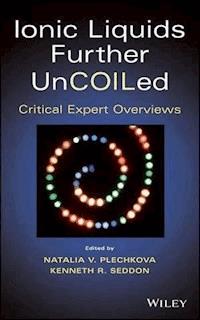
Ionic Liquids further UnCOILed E-Book
136,99 €
Mehr erfahren.
- Herausgeber: John Wiley & Sons
- Kategorie: Wissenschaft und neue Technologien
- Sprache: Englisch
Critical overviews from the front line of ionic liquids research Ionic Liquids Further UnCOILed: Critical Expert Overviews continues the discussion of new processes and developments in ionic liquid technology introduced in the first volume. Written by an international group of key academic and industrial chemists, this next book in the series includes eleven overviews of specific areas of ionic liquid chemistry including: * Physicochemical properties of ionic liquids * A patent survey * Ionic liquid membrane technology * Engineering simulations * Molecular simulations The goal of this volume is to provide expert overviews that range from applied to theoretical, synthetic to analytical, and biotechnological to electrochemical, while also offering consistent abbreviations of ionic liquids throughout the text. The value of Ionic Liquids Further UnCOILed: Critical Expert Overviews lies in the authors' expertise and their willingness to share it with the reader. Included in the book is insight into typical problems related to experimental techniques, selection of liquids, and variability of data--all of which were overseen by Professor Ken Seddon, one of the book's editors and a world leader in ionic liquids. This book is a must read for R&D chemists in industrial, governmental, and academic laboratories, and for commercial developers of environmentally sustainable processes. It offers insight and appreciation for the direction in which the field is going, while also highlighting the best published works available, making it equally valuable to new and experienced chemists alike.
Sie lesen das E-Book in den Legimi-Apps auf:
Seitenzahl: 645
Veröffentlichungsjahr: 2014
Ähnliche




















Table of Contents
Title page
Copyright page
COIL Conferences
Preface
Acknowledgements
Contributors
Abbreviations
1: Ionic Liquid and Petrochemistry: A Patent Survey
1.1 Introduction
1.2 New Formulations and Methods of Fabrication for an Improved Use of Ionic Liquids
1.3 Separation Processes Using Ionic Liquids
1.4 Use of Ionic Liquids as Additives with Specific Properties
1.5 Use of Ionic Liquids as Both Acidic Catalysts and Solvents
1.6 Applications of Ionic Liquids as Solvents for Catalytic Systems
1.7 Ionic Liquids and Biopolymers
1.8 Conclusions and Perspectives
2: Supercritical Fluids in Ionic Liquids
2.1 Introduction
2.2 Phase Behaviour of (Ionic Liquid + Supercritical Fluid) Systems
2.3 Chemical Processing in (Ionic Liquid + Supercritical Fluid) Systems
2.4 Conclusions and Outlook
3: The Phase Behaviour of 1-Alkyl-3-Methylimidazolium Ionic Liquids
3.1 Phase Transitions Linked with Conformational Changes of Cations
3.2 Suitable Equipment for the Thermal Analysis of Ionic Liquids
3.3 The Phase Behaviour of [C4mim][PF6]
3.4 Novel Phase Transition Behaviours of Room Temperature Ionic Liquids
3.5 Concluding Remarks
4: Ionic Liquid Membrane Technology
4.1 Ionic Liquids: Definitions and Properties
4.2 Structure and Morphology of Ionic Liquid Membranes
4.3 Characterisation of Ionic Liquid Membranes
4.4 Recent Applications of Ionic Liquid Membranes
4.5 Future Directions
5: Engineering Simulations
5.1 Introduction
5.2 Engineering Computations for Process Design using Ionic Liquids
5.3 Thermodynamic Models for Ionic Liquids
5.4 Conclusions
6: Molecular Simulation of Ionic Liquids: Where We Are and the Path Forward
6.1 Introduction
6.2 Goals of a Molecular Simulation
6.3 Property Predictions
6.4 Gas–Liquid, Liquid–Liquid, and Solid–Liquid Interfaces
6.5 Multi-Component Systems
6.6 Solubility in Ionic Liquids
6.7 What Needs to Be Done (and What Does Not)
6.8 Summary
Acknowledgements
7: Biocatalytic Reactions in Ionic Liquids
7.1 Introduction
7.2 Enzymes in Ionic Liquids
7.3 Single-Phase and Multiphase Systems for Biocatalysis in Ionic Liquids
7.4 Influence of Ionic Liquids on Enzyme and Substrate
7.5 Water Content and Water Activity
7.6 Impurities
7.7 Biocatalysis in Whole-Cell Systems
7.8 Environmental Impact of Ionic Liquids
7.9 Concluding Remarks and Future Aspects
8: Ionicity in Ionic Liquids: Origin of Characteristic Properties of Ionic Liquids
8.1 Introduction
8.2 Methodology
8.3 Physicochemical, Properties of [C2mim]+-Based Ionic Liquids
8.4 Transference Number and Ionicity
8.5 Correlation of Ionicity with Ionic Structures and Physicochemical Properties
8.6 Conclusions
Acknowledgement
9: Dielectric Properties of Ionic Liquids: Achievements So Far and Challenges Remaining
9.1 Introduction
9.2 A Glance at Dielectric Theory of Electrically Conducting Systems
9.3 Phenomenological Description of Dielectric Spectra of Ionic Liquids
9.4 Molecular Processes Affecting the Dielectric Response
9.5 Relation to Solvation Dynamics
9.6 The Static Dielectric Constant of Ionic Liquids
9.7 Conclusions
Acknowledgements
10: Ionic Liquid Radiation Chemistry
10.1 Introduction: What Is Radiation Chemistry?
10.2 The Relevance of Radiation Chemistry to Ionic Liquid Science and Applications
10.3 A Brief Description of Fundamental Radiation Chemistry and Ionic Liquids
10.4 Would Ionic Liquids Be Stable Enough for Spent Nuclear Fuel Recycling?
10.5 Suitability of Ionic Liquid Preparations for Radiation Chemistry Studies
10.6 Practical Importance: Applying Fundamental Ionic Liquid Radiation Chemistry to Nanoparticle Synthesis
10.7 Future Prospects
Acknowledgements
11: Physicochemical Properties of Ionic Liquids
11.1 Introduction
11.2 Melting Point
11.3 Density
11.4 Viscosity
11.5 Surface Tension
11.6 Conclusions
Acknowledgements
Index
Copyright © 2014 by John Wiley & Sons, Inc. All rights reserved
Published by John Wiley & Sons, Inc., Hoboken, New Jersey
Published simultaneously in Canada
No part of this publication may be reproduced, stored in a retrieval system, or transmitted in any form or by any means, electronic, mechanical, photocopying, recording, scanning, or otherwise, except as permitted under Section 107 or 108 of the 1976 United States Copyright Act, without either the prior written permission of the Publisher, or authorization through payment of the appropriate per-copy fee to the Copyright Clearance Center, Inc., 222 Rosewood Drive, Danvers, MA 01923, (978) 750-8400, fax (978) 750-4470, or on the web at www.copyright.com. Requests to the Publisher for permission should be addressed to the Permissions Department, John Wiley & Sons, Inc., 111 River Street, Hoboken, NJ 07030, (201) 748-6011, fax (201) 748-6008, or online at http://www.wiley.com/go/permissions.
Limit of Liability/Disclaimer of Warranty: While the publisher and author have used their best efforts in preparing this book, they make no representations or warranties with respect to the accuracy or completeness of the contents of this book and specifically disclaim any implied warranties of merchantability or fitness for a particular purpose. No warranty may be created or extended by sales representatives or written sales materials. The advice and strategies contained herein may not be suitable for your situation. You should consult with a professional where appropriate. Neither the publisher nor author shall be liable for any loss of profit or any other commercial damages, including but not limited to special, incidental, consequential, or other damages.
For general information on our other products and services or for technical support, please contact our Customer Care Department within the United States at (800) 762-2974, outside the United States at (317) 572-3993 or fax (317) 572-4002.
Wiley also publishes its books in a variety of electronic formats. Some content that appears in print may not be available in electronic formats. For more information about Wiley products, visit our web site at www.wiley.com.
Library of Congress Cataloging-in-Publication Data:
Ionic liquids further uncoiled : critical expert overviews / edited by Kenneth R. Seddon, Natalia V. Plechkova.
1 online resource.
Includes bibliographical references and index.
Description based on print version record and CIP data provided by publisher; resource not viewed.
ISBN 978-1-118-83961-4 (ePub) – ISBN 978-1-118-83971-3 (Adobe PDF) – ISBN 978-1-118-43863-3 (hardback) 1. Ionic solutions. I. Seddon, Kenneth R., 1950– editor of compilation. II. Plechkova, Natalia V., editor of compilation.
QD561
541'.372–dc23
2013043854
COIL Conferences
Preface
This is the second of three volumes of critical overviews of the key areas of ionic liquid chemistry. The first volume is entitled Ionic Liquids UnCOILed (Wiley 2013), the current volume is Ionic Liquids Further UnCOILed, and the final volume, called Ionic Liquids Completely UnCOILed, will be published later this year. The history and rationale behind this trilogy was explained in the preface to the first volume, and so will not be repeated here.
Instead, we will use this space to expand on the subtitle, constant for all three volumes: Critical Expert Overviews.
critical, adjective
Critical has two, rather different, meanings—both are implied in the subtitle of this book. These reviews are both decisively important and written by top world experts (hence the second adjective), exercising the judicious evaluation that they are uniquely qualified to do.
overview, noun
This book includes eleven critical expert overviews of differing aspects of ionic liquids. We look forward to the response of our readers (we can be contacted at [email protected]). It is our view that, in the second decade of the 21st century, reviews that merely regurgitate a list of all papers on a topic, giving a few lines or a paragraph (often the abstract!) to each one, have had their day—five minutes with an online search engine will provide that information. Such reviews belong with the slide rule, the fax machine, and the printed journal—valuable in their day, but of little value now. The value of a review lies in the expertise and insight of the reviewer—and their willingness to share it with the reader. It takes moral courage to say “the work of […] is irreproducible, or of poor quality, or that the conclusions are not valid,” but in a field expanding at the prestigious rate of ionic liquids, it is essential to have this honest feedback. Otherwise, errors are propagated. Papers still appear using hexafluorophosphate or tetrafluoroborate ionic liquids for synthetic or catalytic chemistry, and calculations on “ion pairs” are still being used to rationalise liquid state properties! We trust this volume, containing eleven excellently perceptive reviews, will help guide and secure the future of ionic liquids.
Natalia V. Plechkova
Kenneth R. Seddon
Acknowledgements
This volume is a collaborative effort. We, the editors, have our names emblazoned on the cover, but the book would not exist in its present form without support from many people. Firstly, we thank our authors for producing such splendid, critical chapters, and for their open responses to the reviewers' comments and to editorial suggestions. We are also indebted to our team of expert reviewers, whose comments on the individual chapters were challenging and thought provoking, and to Ian Gibson for producing the central image on the front cover. The backing from the team at Wiley, led by Dr. Arza Seidel, has been fully appreciated—it is always a joy to work with such a professional group of people. Finally, this book would never have been published without the unfailing, enthusiastic support from Deborah Poland and Sinead McCullough, whose patience and endurance never cease to amaze us.
N.V.P.
K.R.S.
Contributors
Norfaizah Ab Manan, QUILL Research Centre, School of Chemistry and Chemical Engineering, David Keir Building, Stranmillis Road, Belfast, BT9 5AG, UK
Didier Bernard, IFP Energies nouvelles, Rond-point de L'échangeur de Solaize, 69360 Solaize, France
Philippe Bonnet, ARKEMA Centre de Recherche Rhône-Alpes, Rue Henri Moissan, BP63, 69493 Pierre-Bénite cedex, France
Joăo G. Crespo, REQUIMTE/CQFB, Department of Chemistry, Faculdade de Ciencias e Tecnologia, Universidade Nova de Lisboa, 2829-516 Caparica, Portugal
Liangliang Guo, Beijing Key Laboratory of Ionic Liquids Clean Process, Key Laboratory of Green Process and Engineering, State Key Laboratory of Multiphase Complex System, Institute of Process Engineering, Chinese Academy of Sciences, Beijing 100190, People's Republic of China
Udo Kragl, Department of Chemistry, University of Rostock, 18051, Rostock, Germany
Maaike C. Kroon, Department of Chemical Engineering and Chemistry, Eindhoven University of Technology, Eindhoven, The Netherlands
Xingmei Lu, Beijing Key Laboratory of Ionic Liquids Clean Process, Key Laboratory of Green Process and Engineering, State Key Laboratory of Multiphase Complex System, Institute of Process Engineering, Chinese Academy of Sciences, Beijing 100190, People's Republic of China
Edward J. Maginn, Department of Chemical and Biomolecular Engineering, University of Notre Dame, 182 Fitzpatrick Hall, Notre Dame, IN 46556-5637, USA
Keiko Nishikawa, Division of Nanoscience, Graduate School of Advanced Integration Science, Chiba University, Chiba, 263-8522, Japan
Richard D. Noble, Alfred T. & Betty E. Look Professor, University of Colorado, Chemical Engineering Department, UCB 424, Boulder, CO 80309, USA
Hélène Olivier-Bourbigou, IFP Energies nouvelles, Rond-point de L'échangeur de Solaize, 69360 Solaize, France
Cor J. Peters, Chemical Engineering Program, The Petroleum Institute, P.O. Box 2533, Abu Dhabi, United Arab Emirates, and Department of Chemical Engineering and Chemistry, Eindhoven University of Technology, Eindhoven, The Netherlands
Anne Pigamo, ARKEMA Centre de Recherche Rhône-Alpes, Rue Henri Moissan, BP63, 69493 Pierre-Bénite cedex, France
David Rooney, QUILL Research Centre, School of Chemistry and Chemical Engineering, David Keir Building, Stranmillis Road, Belfast, BT9 5AG, UK
Jindal K. Shah, The Center for Research Computing, University of Notre Dame, Notre Dame, Indiana, USA
Florian Stein, Department of Chemistry, University of Rostock, 18051, Rostock, Germany
Hiroyuki Tokuda, Department of Chemistry and Biotechnology, Yokohama National University, 79-5 Tokiwadai Hodogaya-ku, Yokohama 240-8501, Japan
Masayoshi Watanabe, Department of Chemistry and Biotechnology, Yokohama National University, 79-5 Tokiwadai Hodogaya-ku, Yokohama 240-8501, Japan
Hermann Weingärtner, Physical Chemistry II, Faculty of Chemistry and Biochemistry, Ruhr-University Bochum, D-44780 Bochum, Germany
James F. Wishart, Chemistry Department, Brookhaven National Laboratory, Upton, New York, 11973-5000, USA
Suojiang Zhang, Beijing Key Laboratory of Ionic Liquids Clean Process, Key Laboratory of Green Process and Engineering, State Key Laboratory of Multiphase Complex System, Institute of Process Engineering, Chinese Academy of Sciences, Beijing 100190, People's Republic of China
Qing Zhou, Beijing Key Laboratory of Ionic Liquids Clean Process, Key Laboratory of Green Process and Engineering, State Key Laboratory of Multiphase Complex System, Institute of Process Engineering, Chinese Academy of Sciences, Beijing 100190, People's Republic of China
Abbreviations
Ionic Liquids
GNCSguanidinium thiocyanateGRTILgemini room temperature ionic liquid[HI-AA]hydrophobic derivatised amino acidILionic liquidpoly(GRTIL)polymerised gemini room temperature ionic liquidpoly(RTIL)polymerised room temperature ionic liquid[PSpy]3[PW][1-(3-sulfonic acid)propylpyridinium]3[PW12O40]·2H2ORTILroom temperature ionic liquidCations
[(allyl)mim]+1-allyl-3-methylimidazolium[1-Cm-3-Cnim]+1,3-dialkylimidazolium[C2im]+1-ethylimidazolium[C1mim]+1,3-dimethylimidazolium[C2mim]+1-ethyl-3-methylimidazolium[C3mim]+1-propyl-3-methylimidazolium[iC3mim]+1-isopropyl-3-methylimidazolium[C4mim]+1-butyl-3-methylimidazolium[i-C4mim]+1-isobutyl-3-methylimidazolium[s-C4mim]+1-secbutyl-3-methylimidazolium[tC4mim]+1-tertbutyl-3-methylimidazolium[C5mim]+1-pentyl-3-methylimidazolium[C6mim]+1-hexyl-3-methylimidazolium[C7mim]+1-heptyl-3-methylimidazolium[C8mim]+1-octyl-3-methylimidazolium[C9mim]+1-nonyl-3-methylimidazolium[C10mim]+1-decyl-3-methylimidazolium[C11mim]+1-undecyl-3-methylimidazolium[C12mim]+1-dodecyl-3-methylimidazolium[C13mim]+1-tridecyl-3-methylimidazolium[C14mim]+1-tetradecyl-3-methylimidazolium[C15mim]+1-pentadecyl-3-methylimidazolium[C16mim]+1-hexadecyl-3-methylimidazolium[C17mim]+1-heptadecyl-3-methylimidazolium[C18mim]+1-octadecyl-3-methylimidazolium[Cnmim]+1-alkyl-3-methylimidazolium[C1C1mim]+1,2,3-trimethylimidazolium[C2C1mim]+1-ethyl-2,3-dimethylimidazolium[C3C1mim]+1-propyl-2,3-dimethylimidazolium[C8C3im]+1-octyl-3-propylimidazolium[C12C12im]+1,3-bis(dodecyl)imidazolium[C1OC2mim]+1-(2-methoxyethyl)-3-methyl-3H-imidazolium[C4dmim]+1-butyl-2,3-dimethylimidazolium[C4C1mim]+1-butyl-2,3-dimethylimidazolium[C6C7O1im]+1-hexyl-3-(heptyloxymethyl)imidazolium[C2F3mim]+1-trifluoroethyl-3-methylimidazolium[C4vim]+3-butyl-1-vinylimidazolium[Dmvim]+1,2-dimethyl-3-(4-vinylbenzyl)imidazolium[C2mmor]+1-ethyl-1-methylmorpholinium[C4py]+1-butylpyridinium[C4mβpy]+1-butyl-3-methylpyridinium[C4mγpy] +1-butyl-4-methylpyridinium[C4mpyr] +1-butyl-1-methylpyrrolidinium[C6(dma)γpy] +1-hexyl-4-dimethylaminopyridinium[C1C3pip]+1-methyl-1-propylpiperidinium[C2C6pip]+1-ethyl-1-hexylpiperidinium[C8quin]+1-octylquinolinium[DMPhim]+1,3-dimethyl-2-phenylimidazolium[EtNH3]+ethylammonium[Hmim]+1-methylimidazolium[H2NC2H4py]+1-(1-aminoethyl)-pyridinium[H2NC3H6mim]+1-(3-aminopropyl)-3-methylimidazolium[Hnmp]+1-methyl-2-pyrrolidonium[HN2 2 2]+triethylammonium[N1 1 1 2OH]+cholinium[N1 1 2 2OH]+ethyl(2-hydroxyethyl)dimethylammonium[N1 1 1 4]+trimethylbutylammonium[N1 4 4 4]+methyltributylammonium[N1 8 8 8]+methyltrioctylammonium[N4 4 4 4]+tetrabutylammonium[N6 6 6 14]+trihexyl(tetradecyl)ammonium[NR3H]+trialkylammonium[P2 2 2(1O1)]+triethyl(methoxymethyl)phosphonium[P4 4 4 3a]+(3-aminopropyl)tributylphosphonium[P6 6 6 14]+trihexyl(tetradecyl)phosphonium[P8 8 8 14]+tetradecyl(trioctyl)phosphonium[Pnmim]+polymerisable 1-methylimidazolium[PhCH2eim]+1-benzyl-2-ethylimidazolium[pyH]+pyridinium[S2 2 2]+triethylsulfoniumAnions
[Ala]−alaninate[βAla]−β-alaninate[Al(hfip)4]−tetra(hexafluoroisopropoxy)aluminate(III)[Arg]−arginate[Asn]−asparaginate[Asp]−asparatinate[BBB]−bis[1,2-benzenediolato(2-)-O,O']borate[C1CO2]−ethanoate[C1SO4]−, [O3SOC1]−methyl sulfate[C8SO4]−, [O3SOC8]−octyl sulfate[CnSO4]−alkyl sulfate[(Cn)(Cm)SO4]−asymmetrical dialkyl sulfate[(Cn)2SO4]−symmetrical dialkyl sulfate[CTf3]−tris{(trifluoromethyl)sulfonyl}methanide[Cys]−cysteinate[FAP]−tris(perfluoroalkyl)trifluorophosphate[Gln]−glutaminate[Glu]−glutamate[Gly]−glycinate anion[His]−histidinate[Ile]−isoleucinate[lac]−lactate[Leu]−leucinate[Lys]−lysinate[Met]−methionate[Nle]−norleucinate[NPf2]−, [BETI]−bis{(pentafluoroethyl)sulfonyl}amide[NTf2]−, [TFSI]−bis{(trifluoromethyl)sulfonyl}amide[O2CC1]−ethanoate[O3SOC2]−, [O3SOC2]−ethylsulfate[OMs]−methanesulfonate (mesylate)[ONf]−perfluorobutylsulfonate[OTf]−trifluoromethanesulfonate[OTs]−4-toluenesulfonate, [4-CH3C6H4SO3]− (tosylate)[Phe]−phenylalaninate[Pro]−prolinate[Ser]−serinate[Suc]−succinate[tfpb]−tetrakis(3,5-bis(trifluoromethyl)phenyl)borate[Thr]−threoninate[Tos]−tosylate[Trp]−tryphtophanate[Tyr]−tyrosinate[Val]−valinateTechniques
AESAuger electron spectroscopyAFMatomic force microscopyAMBERassisted model building with energy refinementANNassociative neural networkARXPSangle resolved X-ray photoelectron spectroscopyASMAssociated-Solution ModelATR-IRattenuated total reflectance infrared spectroscopyBPNNback-propagation neural networkCADMcomputer-aided design modellingCCCole–Cole modelCCCcounter-current chromatographyCDCole–Davidson modelCEcapillary electrophoresisCECcapillary electrochromatographyCHARMMChemistry at HARvard Molecular MechanicsCOSMO-RSCOnductor-likeScreeningMOdel for Real SolventsCOSYCOrrelation SpectroscopYCPCMconductor-like polarisable continuum modelCPMDCar–Parrinello molecular dynamicsDFTdensity functional theoryDMHdimethylhexeneDRSdielectric relaxation spectroscopyDSCdifferential scanning calorimetryECSEMelectrochemical scanning electron microscopyEC-XPSelectrochemical X-ray photoelectron spectroscopyEFMeffective fragment potential methodEIelectron ionisationEMDequilibrium molecular dynamicsEOFelectro-osmotic flowEPSRempirical potential structure refinementESelectrospray mass spectrometryESI–MSelectrospray ionisation mass spectrometryEXAFSextended X-ray absorption fine structureFABfast atom bombardmentFIRfar-infrared spectroscopyFMOfragment molecular orbital methodFTIRFourier transform infrared spectroscopyGAMESSgeneral atomic and molecular electronic structure systemGCgas chromatographyGGAgeneralized gradient approximationsGLCgas–liquid chromatographyGSCgas–solid chromatographyHMheuristic methodHPLChigh-performance liquid chromatographyHREELShigh-resolution electron energy loss spectroscopyIGCinverse gas chromatographyIRinfrared spectroscopyIRASinfrared reflection absorption spectroscopyIR-VIS SFGinfrared visible sum frequency generationISSion scattering spectroscopyL-SIMSliquid secondary ion mass spectrometryMAESmetastable atom electron spectroscopyMALDImatrix-assisted laser desorptionMBSSmolecular beam surface scatteringMCMonte CarloMDmolecular dynamicsMIESmetastable impact electron spectroscopyMLRmulti-linear regressionMMmolecular mechanicsMSmass spectrometryNEMDnon-equilibrium molecular dynamicsNMRnuclear magnetic resonanceNRneutron reflectivityNRTLnon-random two liquidOPLSoptimized potentials for liquid simulationsPCMpolarisable continuum modelPDAphotodiode array detectionPESphotoelectron spectroscopyPGSE-NMRpulsed-gradient spin-echoPPRprojection pursuit regressionQMquantum mechanicsQSARquantitative structure–activity relationshipQSPRquantitative structure–property relationshipRAIRSreflection absorption infrared spectroscopyRIrefractive indexRNEMDreverse non-equilibrium molecular dynamicsRNNrecursive neural networkRP-HPLCreverse phase high-performance liquid chromatographyRSTregular solution theorySANSsmall-angle neutron scatteringSEMscanning electron microscopySFAsurfaces forces apparatusSFCsupercritical fluid chromatographySFGsum frequency generationSFMsystematic fragmentation methodSIMSsecondary ion mass spectrometrysoft-SAFTsoft statistical associating fluid theorySTMscanning tunnelling microscopySVNsupport vector networkTEMtunnelling electron microscopyTGAthermogravimetric analysisTHz-TDSterahertz time-domain spectroscopyTLCthin layer chromatographytPC-PSAFTtruncated perturbed chain polar statistical associating fluid theoryTPDtemperature programmed desorptionUHVultra-high vacuumUNIFACUNIversal Functional Activity CoefficientUNIQUACUNIversal QUAsiChemicalUPLCultra-pressure liquid chromatographyUPSultraviolet photoelectron spectroscopyUVultravioletUV-Visultraviolet-visibleXPSX-ray photoelectron spectroscopyXRDX-ray powder diffractionXRRX-ray reflectivityMiscellaneous
Å1 Ångstrom = 10−10 mACSAmerican Chemical SocietyATMSacetyltrimethylsilaneATPSaqueous two-phase systemBASF™Badische Anilin- und Soda-FabrikBASILBiphasic Acid Scavenging utilizing Ionic LiquidsBEbinding energyBILMbulk ionic liquid membraneBNLBrookhaven National Laboratoryb.pt.boiling pointBSAbovine serum albuminBTbenzothiophenecalc.calculatedCBCibacron Blue 3GACCDcharge coupled deviceCEcrown etherCEES2-chloroethyl ethyl sulphideCFC MC“continuous fractional component” Monte CarloCLMcharge lever momentumCMCcritical micelle concentrationCMPOoctyl(phenyl)-N,N-diisobutylcarbamoylmethylphosphine oxide[CnMeSO4]alkyl methyl sulfateCNTscarbon nanotubesCOILCongress on Ionic LiquidsCPUcentral processing unitCWAschemical warfare agentsddoublet (NMR)D°298bond energy at 298 K2Dtwo-dimensional3Dthree-dimensionalDBTdibenzothiopheneDCdirect currentDC18C6dicyclohexyl-18-crown-6DFDebye and FalkenhagenDHDebye–HückelDIIPAdiisopropylamine4,6-DMDBT4,6-dimethyldibenzothiopheneDMFdimethylmethanamide (dimethylformamide)DNAdeoxyribonucleic acid2DOMtwo-dimensional ordered macroporous3DOMthree-dimensional ordered macroporousDOSdensity of statesDPCdiphenylcarbonateDRAdrag-reducing agentDSSCdye-sensitised solar cellEenrichmentEDCextractive distillation columnEEexpanded ensemble approachEORenhanced oil recoveryEoSequation of stateEPAEnvironmental Protection AgencyEPSRempirical potential structure refinementeq.equivalentFCCfluid catalytic crackingFFTfast Fourier transformFIBfocussed ion beamFSEfull-scale errorftfootGDDIgeneralised distributed data interfaceGEMCGibbs ensemble Monte CarloHDShydrodesulfurisationHEMA2-(hydroxyethyl) methacrylateHOMOhighest occupied molecular orbitalHOPGhighly oriented pyrolytic graphiteHVhigh vacuumIgGImmunoglobulin GIPBEion-pair binding energyIPEInstitute of Process Engineering, Chinese Academy of Sciences, BeijingITOindium–tin oxideIUPACInternational Union of Pure and Applied ChemistryJcoupling constant (NMR)KWWKohlrausch–Williams–WattsLCEPlower critical end pointLCSTlower critical separation temperatureLEAFLaser-Electron Accelerator FacilityLF-EoSlattice-fluid model equation of stateLLEliquid–liquid equilibriaLMOGlow molecular weight gelatorLUMOlowest unoccupied molecular orbitalmmultiplet (NMR)Mmolar concentrationMBI1-methylbenzimidazoleMCHmethylcyclohexaneMDEAmethyl diethanolamine; bis(2-hydroxyethyl)methylamineMEAmonoethanolamine; 2-aminoethanolMFCminimal fungicidal concentrationsMICminimal inhibitory concentrationsMMMmixed matrix membraneMNDOmodified neglect of differential overlapm.pt.melting pointMSDmean square displacement3-MT3-methylthiopheneMWmolecular weightMWCNTsmulti-walled carbon nanotubesm/zmass-to-charge ratioNBB1-butylbenzimidazoleNCAN-carboxyamino acid anhydrideNE equationNernst–Einstein equationNESNew Entrepreneur ScholarshipNFMN-formylmorpholineNIPneutral ion pairNITneutral ion tripletNMPN-methylpyrrolidoneNOEnuclear Overhauser effectNRTLnon-random two liquidNRTL-SACnon-random two liquid segmented activity coefficientsOKEoptical Kerr effectppressurePAOpolyalphaolefinPDMSpolydimethoxysilanePEDOTpoly(3,4-ethylenedioxythiophene)PEGpoly(ethyleneglycol)PEMpolymer–electrolyte membranePENpoly(ethylene-2,6-naphthalene decarboxylate)PESpolyethersulfonepH–log10([H+]); a measure of the acidity of a solutionPIDproportional integral derivativepKb–log10(Kb)PPDDpolypyridylpendant poly(amidoamine) dendritic derivative(PR)-EoSPeng-Robinson equation of statePSpolystyrenePSEprocess systems engineeringpsi1 pound per square inch = 6894.75729 PaPTCphase transfer catalystPTFEpoly(tetrafluoroethylene)PTxpressure–temperature compositionrbond lengthRDCrotating disc contactorREACHRegistration, Evaluation, Authorisation and restriction of CHemical substances(RK) EoSRedlich–Kwong equation of stateRMSDroot mean square deviationRTroom temperaturessinglet (NMR)SentropyscCO2supercritical carbon dioxideSDSsodium dodecyl sulphateSEDStokes–Einstein–Debye equationS/Fsolvent-to-feed ratioSILMsupported ionic liquid membraneSILPsupported ionic liquid phaseSLEsolid liquid equilibriumSLMsupported liquid membranettriplet (NMR)TBP4-(t-butyl)pyridineTCEP1,2,3-tris(2-cyanoethoxy)propaneTEAtriethylamineTEGDAtetra(ethyleneglycol) diacrylateTHFtetrahydrofuranTICtoxic industrial chemicalTMBtrimethylborateTMPtrimethylpenteneTOFtime-of-flightUCEPupper critical end pointUCSTupper critical solution temperatureUHVultra-high vacuumVFTVogel−Fulcher−Tammann equationsVLEvapour–liquid equilibriaVLLEvapour–liquid–liquid equilibriaVOCsvolatile organic compoundsv/vvolume for volumew/wweight for weightwt%weight pe rcentXmolar fractionγsurface tensionδchemical shift in NMR1
Ionic Liquid and Petrochemistry: A Patent Survey
Philippe Bonnet and Anne Pigamo
ARKEMA Centre de Recherche Rhône-Alpes, Rue Henri Moissan, Pierre-Bénitecedex, France
Didier Bernard and Hélène Olivier-Bourbigou
IFP Energies nouvelles, Rond-point de L'échangeur de Solaize, Solaize, France
Abstract
Industrial applications of ionic liquids in petrochemistry have been reviewed through the US and EP granted patents published from 1990 to 2010. A Chemical Abstracts search on the STN host retrieved about 300 patents, about 130 of them found relevant and are fully analysed in this chapter. This survey has been divided into six thematic sections: new formulations and methods of fabrication for an improved use of ionic liquids; separation processes using ionic liquids; use of ionic liquids as additives with specific properties; use of ionic liquids as both acidic catalysts and solvents; applications of ionic liquids as solvents of catalytic systems; and ionic liquids and biopolymers. Our study has been complemented by a short description of the emerging areas concerning ionic liquids using the patent applications published during the past five years.
1.1 Introduction
Interest in ionic liquids has been growing rapidly worldwide, as demonstrated by the increasing number of publications and patents these last years. The applications and the prospects for ionic liquids are vast. In the chemical and petrochemical industries, numerous applications and benefits of using ionic liquids have been described. However, it is difficult to know which applications have been translated into viable industrial and commercialised processes.
As news releases and scientific publications are a part of company strategic communication, relevant information is difficult to assess. We assumed that granted patents could be one of the most relevant sources of information. From our perspective, companies generally only devote human resources, and pay all the necessary fees to have their patents granted, if they expect an actual industrial development of the claimed invention.
Lesen Sie weiter in der vollständigen Ausgabe!
Lesen Sie weiter in der vollständigen Ausgabe!
Lesen Sie weiter in der vollständigen Ausgabe!
Lesen Sie weiter in der vollständigen Ausgabe!
Lesen Sie weiter in der vollständigen Ausgabe!
Lesen Sie weiter in der vollständigen Ausgabe!
Lesen Sie weiter in der vollständigen Ausgabe!
Lesen Sie weiter in der vollständigen Ausgabe!
Lesen Sie weiter in der vollständigen Ausgabe!
Lesen Sie weiter in der vollständigen Ausgabe!
Lesen Sie weiter in der vollständigen Ausgabe!




