


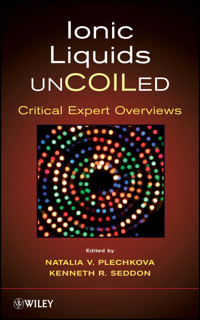
Ionic Liquids UnCOILed E-Book
144,99 €
Mehr erfahren.
- Herausgeber: John Wiley & Sons
- Kategorie: Wissenschaft und neue Technologien
- Sprache: Englisch
Ionic Liquids UnCOILed presents decisively important reviews on new processes and recent developments in ionic liquid technology with an emphasis on commercial applications in which ionic liquids are replacing, or may replace, processes currently using conventional solvents. Ranging from applied to theoretical, synthetic to analytical, and biotechnological to electrochemical, the book features eleven chapters written by an international group of key academic and industrial chemists, exercising the judicious evaluation which they are uniquely qualified to do. This book is a must for R&D chemists in industrial, governmental and academic laboratories, and for commercial developers of environmentally-friendly, sustainable processes.
Sie lesen das E-Book in den Legimi-Apps auf:
Seitenzahl: 773
Veröffentlichungsjahr: 2012
Ähnliche




















Table of Contents
Cover
Title page
Copyright page
COIL CONFERENCES
PREFACE
ACKNOWLEDGEMENTS
CONTRIBUTORS
ABBREVIATIONS
IONIC LIQUIDS
CATIONS
ANIONS
TECHNIQUES
MISCELLANEOUS
1 Electrodeposition from Ionic Liquids: Interface Processes, Ion Effects, and Macroporous Structures
1.1 INTRODUCTION
1.2 RESULTS AND DISCUSSION
1.3 CONCLUSION
2 Interfaces of Ionic Liquids (1)
2.1 INTRODUCTION
2.2 LIQUID/VACUUM AND LIQUID/GAS INTERFACES
2.3 LIQUID/LIQUID INTERFACES
2.4 SOLID/LIQUID AND ELECTRIFIED SOLID/IONIC FLUID INTERFACES
2.5 WETTING AND ELECTROWETTING CHARACTERISTICS
2.6 SUMMARY AND CONCLUSIONS
ACKNOWLEDGEMENTS
3 Interfaces of Ionic Liquids (2)
3.1 INTRODUCTION
3.2 THE SOLID–IONIC LIQUID INTERFACE
3.3 THE AIR–IONIC LIQUID INTERFACE
3.4 LIQUID–IONIC LIQUID INTERFACES
3.5 FUTURE DIRECTIONS
ACKNOWLEDGEMENTS
4 Ionic Liquids in Separation Science
4.1 BRIEF HISTORY OF THE DEVELOPMENT OF IONIC LIQUIDS AND POLYMERIC IONIC LIQUIDS IN SEPARATION SCIENCE
4.2 IONIC LIQUIDS IN CHROMATOGRAPHIC AND ELECTROPHORETIC SEPARATIONS
4.3 HIGH PERFORMANCE LIQUID CHROMATOGRAPHY
4.4 COUNTER-CURRENT CHROMATOGRAPHY
4.5 IONIC LIQUIDS IN GAS CHROMATOGRAPHY
4.6 IONIC LIQUIDS IN SUPERCRITICAL FLUID CHROMATOGRAPHY
4.7 CAPILLARY ELECTROPHORESIS AND CAPILLARY ELECTROCHROMATOGRAPHY
4.8 PLANAR CHROMATOGRAPHY
4.9 SUMMARY AND FUTURE DIRECTIONS
5 Separation Processes with Ionic Liquids
5.1 INTRODUCTION
5.2 LIQUID SEPARATIONS
5.3 EXTRACTIVE DISTILLATION
5.4 COMBINATION OF SEPARATIONS IN THE LIQUID PHASE WITH MEMBRANES
5.5 GAS SEPARATIONS
5.6 ENGINEERING ASPECTS
5.7 DESIGN OF A SEPARATION PROCESS
5.8 CONCLUSIONS
6 Theoretical Approaches to Ionic Liquids: From Past History to Future Directions
6.1 INTRODUCTION
6.2 VOLUME-BASED APPROACH
6.3 QUANTITATIVE STRUCTURE–PROPERTY RELATIONSHIP METHODS
6.4 MOLECULAR DYNAMICS SIMULATIONS
6.5 APPROACHES FROM FIRST PRINCIPLES BASED ON ab initio AND DENSITY FUNCTIONAL THEORY
6.6 Ab initio MD SIMULATIONS
6.7 OUTLOOK: TOWARDS LARGE-SCALE CALCULATIONS OF IONIC LIQUIDS FROM FIRST PRINCIPLES
7 Ionic Liquids Derived from Natural Sources
7.1 INTRODUCTION
7.2 SYNTHESIS OF AMINO ACID IONIC LIQUIDS
7.3 PHYSICOCHEMICAL PROPERTIES
7.4 AMINO ACID IONIC LIQUIDS CONTAINING DERIVATISED AMINO ACIDS
7.5 APPLICATION OF AMINO ACID IONIC LIQUIDS
7.6 CONCLUSION
ACKNOWLEDGEMENTS
8 Ionic Liquids Studied at Ultra-High Vacuum
8.1 INTRODUCTION
8.2 THE VAPOUR PHASE
8.3 THE CONDENSED PHASE
8.4 CONCLUSIONS AND OPPORTUNITIES FOR THE FUTURE
9 Pioneering Biological Processes in the Presence of Ionic Liquids: The Potential of Filamentous Fungi
9.1 INTRODUCTION
9.2 TOLERANCE OF FILAMENTOUS FUNGI TO IONIC LIQUIDS
9.3 IONIC LIQUID BIODEGRADATION BY FILAMENTOUS FUNGI
9.4 THE IMPACT OF IONIC LIQUIDS ON THE METABOLISM OF FILAMENTOUS FUNGI
9.5 CONCLUDING REMARKS
ACKNOWLEDGEMENTS
10 Use of Ionic Liquids in Dye-Sensitised Solar Cells
10.1 INTRODUCTION
10.2 IONIC LIQUIDS FOR QUASI-SOLID STATE DSSCs
10.3 VARIATIONS FROM “TRADITIONAL” DSSC STRUCTURES
10.4 CONCLUSIONS AND FUTURE DIRECTIONS
11 Phase Behaviour of Gases in Ionic Liquids
11.1 INTRODUCTION
11.2 EXPERIMENTAL TECHNIQUES
11.3 MODELLING GAS SOLUBILITY
11.4 TERNARY PHASE BEHAVIOUR
11.5 NEW DIRECTIONS
11.6 CONCLUDING REMARKS
ACKNOWLEDGEMENTS
Index
Cover Image: Courtesy of Kenneth Seddon, Natalia Plechkova, and Ian Gibson
Copyright © 2013 by John Wiley & Sons, Inc. All rights reserved
Published by John Wiley & Sons, Inc., Hoboken, New Jersey
Published simultaneously in Canada
No part of this publication may be reproduced, stored in a retrieval system, or transmitted in any form or by any means, electronic, mechanical, photocopying, recording, scanning, or otherwise, except as permitted under Section 107 or 108 of the 1976 United States Copyright Act, without either the prior written permission of the Publisher, or authorization through payment of the appropriate per-copy fee to the Copyright Clearance Center, Inc., 222 Rosewood Drive, Danvers, MA 01923, (978) 750-8400, fax (978) 750-4470, or on the web at www.copyright.com. Requests to the Publisher for permission should be addressed to the Permissions Department, John Wiley & Sons, Inc., 111 River Street, Hoboken, NJ 07030, (201) 748-6011, fax (201) 748-6008, or online at http://www.wiley.com/go/permissions.
Limit of Liability/Disclaimer of Warranty: While the publisher and author have used their best efforts in preparing this book, they make no representations or warranties with respect to the accuracy or completeness of the contents of this book and specifically disclaim any implied warranties of merchantability or fitness for a particular purpose. No warranty may be created or extended by sales representatives or written sales materials. The advice and strategies contained herein may not be suitable for your situation. You should consult with a professional where appropriate. Neither the publisher nor author shall be liable for any loss of profit or any other commercial damages, including but not limited to special, incidental, consequential, or other damages.
For general information on our other products and services or for technical support, please contact our Customer Care Department within the United States at (800) 762-2974, outside the United States at (317) 572-3993 or fax (317) 572-4002.
Wiley also publishes its books in a variety of electronic formats. Some content that appears in print may not be available in electronic formats. For more information about Wiley products, visit our web site at www.wiley.com.
Library of Congress Cataloging-in-Publication Data:
Ionic liquids uncoiled : critical expert overviews / edited by Natalia V. Plechkova, Kenneth R. Seddon.
p. cm.
Summary: “The book presents articles on topics at the forefront of ionic liquids research, ranging from applied to theoretical, from synthetic to analytical, from biotechnology to electrochemistry, from process engineering to nanotechnology”—Provided by publisher.
Includes bibliographical references and index.
ISBN 978-0-470-07470-1 (hardback)
1. Ionic solutions. 2. Ionic structure. I. Plechkova, Natalia V., 1979– II. Seddon, Kenneth R., 1950–
QD541.I56 2012
541'.3723–dc23
2012020575
COIL CONFERENCES
PREFACE
So, why the strange title for this book? Is this just a book of conference proceedings based on lectures at COIL? How is this book different from the series of volumes that were edited with Prof. Robin D. Rogers based on symposia we had organised at American Chemical Society (ACS) meetings? We will attempt here to answer these questions, and others, and hence explain the philosophy behind this book.
COIL (Congress on Ionic Liquids) was a concept that originally arose in discussions with DeChema, following on from a meeting about the Green Solvents series of conferences, which have traditionally been held in Germany. It was noticed that the number of submitted papers on ionic liquids surpassed the total of all the other papers combined. At that time, the only international meeting on ionic liquids had been a NATO Workshop, held in Crete in 2000 (Rogers, R.D., Seddon, K.R., and Volkov, S. (eds.), Green industrial applications of ionic liquids, NATO Science Series II: Mathematics, Physics and Chemistry, Vol. 92, Kluwer, Dordrecht, 2002). This was correctly interpreted as a need for a truly dedicated international meeting on ionic liquids, and so COIL was born. With the invaluable support of DeChema, the first meeting was held in Salzburg (literally, and appropriately, “Salt Castle”), and it has since moved around the world biannually, in a carefully planned progression. These meetings have been a resounding success, and their timeline is given on the opposite page. It is, unquestionably, the foremost forum for showcasing and discussing the latest advances in ionic liquids. However, we, and others, resisted the temptation to produce proceedings volumes. Although having a certain value as a time capsule, such volumes date quickly, and individual chapters are poorly cited (as they usually appear around the same time in the primary journals). Nevertheless, taken together, the COIL speakers have been a remarkable group of chemists, chemical engineers, biochemists, and biologists. Surely such a talented assembly of scientists could make a valuable contribution, en masse, to the published literature. And so this volume, Ionic Liquids UnCOILed, slowly emerged from our collective mind: “UnCOILed” because, although every principal author has presented their work as COIL lectures, the chapter content in this book has never been presented there. We wrote to each of our selected authors (and, amazingly, only one turned us down!), and set them a difficult challenge. The letter we sent out included the following text: “The concept is to select the key speakers from COIL-1, COIL-2 and COIL-3 and invite them to write critical reviews on specific areas of ionic liquid chemistry. The area we have selected for you is […]. It is important to emphasise that these are meant to be critical reviews. We are not looking for comprehensive coverage, but insight, appreciation and prospect. We want the type of review which can be read to give a sense of importance and scope of the area, highlighting this by the best published work and looking for the direction in which the field is moving. We would also like the problems with the area highlighting, for example, poor experimental technique, poor selection of liquids, and variability of data. We hope you would like to be involved in this project, as we believe these books will define the field for the next few years.” Indeed, we felt rather like Division Seven, contacting the Impossible Missions Force (in the original, more cerebral, TV series, not the recent films!), “Your mission […] should you decide to accept it . . .” However, to the best of our knowledge, the emails did not “self-destruct in five seconds,” and the acceptance rate was beyond our best expectations. We also issued guidance as to which abbreviations to use, and so there is concordance between every chapter (unlike a recent book, which contained over 25 different abbreviations for a single ionic liquid!).
The quality and size of the reviews that we received meant that we had to revert to Wiley and ask permission to produce not one, but three books! Wiley generously agreed. Thus, this will be the first of three volumes. The following ones, at six monthly intervals, will be Ionic Liquids Further UnCOILed and Ionic Liquids Completely UnCOILed. All will contain overviews of the same critical nature.
We look forward to the response of our readership (we can be contacted at [email protected]). It is our view that, in the second decade of the 21st century, reviews that merely regurgitate a list of all papers on a topic, giving a few lines or a paragraph (often the abstract!) to each one, have had their day. Five minutes with an online search engine will provide that information. The value of a review lies in the expertise and insight of the reviewer—and their willingness to share it with the reader. It takes moral courage to say “the work of […] is irreproducible, or of poor quality, or that the conclusions are not valid”—but in a field expanding at the prestigious rate of ionic liquids, it is essential to have this honest feedback. Otherwise, errors are propagated. Papers still appear using hexafluorophosphate or tetrafluoroborate ionic liquids for synthetic or catalytic chemistry, and calculations on “ion pairs” are still being used to rationalise liquid state properties! We trust that this volume, containing 11 excellently perceptive reviews, will help guide and secure the future of ionic liquids.
NATALIA V. PLECHKOVAKENNETH R. SEDDON
ACKNOWLEDGEMENTS
This volume is a collaborative effort. We, the editors, have our names emblazoned on the cover, but the book would not exist in its present form without support from many people. First, we thank our authors for producing such splendid, critical chapters, and for their open responses to the reviewers’ comments and to editorial suggestions. We are also indebted to our team of expert reviewers, whose comments on the individual chapters were challenging and thought provoking, and to Ian Gibson for his input to the cover design. The backing from the team at Wiley, led by Dr. Arza Seidel, has been fully appreciated—it is always a joy to work with such a professional group of people. Finally, this book would never have been published without the unfailing, enthusiastic support from Deborah Poland, Sinead McCullough, and Maria Diamond, whose patience and endurance never cease to amaze us.
N.V.P.K.R.S.
CONTRIBUTORS
RIHAB AL SALMAN, Clausthal University of Technology, D-38678 Clausthal-Zellerfeld, Germany
MOHAMMAD AL ZOUBI, Clausthal University of Technology, D-38678 Clausthal-Zellerfeld, Germany
JARED L. ANDERSON, Department of Chemistry, The University of Toledo, Toledo, OH, USA
ROB ATKIN, Centre for Organic Electronics, Chemistry Building, The University of Newcastle, Callaghan, New South Wales 2308, Australia
NATALIA BORISENKO, Clausthal University of Technology, D-38678 Clausthal-Zellerfeld, Germany
TIMO CARSTENS, Clausthal University of Technology, D-38678 Clausthal-Zellerfeld, Germany
ANDRÉ B. DE HAAN, Eindhoven University of Technology/Dept. of Chemical Engineering and Chemistry Process Systems Engineering, P.O. Box 513, 5600 MB Eindhoven, The Netherlands
SHERIF ZEIN EL ABEDIN, Electrochemistry and Corrosion Laboratory, National Research Centre, Dokki, Cairo, Egypt
FRANK ENDRES, Clausthal University of Technology, D-38678 Clausthal-Zellerfeld, Germany
WERNER FREYLAND, Karlsruhe Institute of Technology, Kaiserstrasse 12, D-76128 Karlsruhe, Germany
CHRISTA M. GRAHAM, Department of Chemistry, The University of Toledo, Toledo, OH, USA
ROBERT HAYES, Centre for Organic Electronics, Chemistry Building, The University of Newcastle, Callaghan, New South Wales 2308, Australia
EKATERINA I. IZGORODINA, School of Chemistry, Monash University, Wellington Rd, Clayton, Victoria 3800, Australia
JUNKO KAGIMOTO, Department of Biotechnology, Tokyo University of Agriculture and Technology, Koganei, Tokyo 184-8588, Japan
PETER LICENCE, School of Chemistry, The University of Nottingham, NG7 2RD, UK
KEVIN R.J. LOVELOCK, School of Chemistry, The University of Nottingham, NG7 2RD, UK
WYTZE (G.W.) MEINDERSMA, Eindhoven University of Technology/Department of Chemical Engineering and Chemistry Process Systems Engineering, P.O. Box 513, 5600 MB Eindhoven, The Netherlands
HIROYUKI OHNO, Department of Biotechnology, Tokyo University of Agriculture and Technology, Koganei, Tokyo 184-8588, Japan
MARIJA PETKOVIC, Instituto de Tecnologia Química e Biológica, Universidade Nova de Lisboa, Av. da República, 2780-157, Oeiras, Portugal
JENNIFER M. PRINGLE, ARC Centre of Excellence for Electromaterials Science, Monash University, Wellington Road, Clayton, Victoria 3800, Australia
ALEXANDRA PROWALD, Clausthal University of Technology, D-38678 Clausthal-Zellerfeld, Germany
MARK B. SHIFLETT, DuPont Central Research and Development, Experimental Station, Wilmington, Delaware 19880, USA
CRISTINA SILVA PEREIRA, Instituto de Tecnologia Química e Biológica, Universidade Nova de Lisboa, Av. da República, 2780-157, Oeiras, Portugal, and Instituto de Biologia Experimental e Tecnológica (IBET), Apartado 12, 2781-901, Oeiras, Portugal
DEBORAH WAKEHAM, Centre for Organic Electronics, Chemistry Building, The University of Newcastle, Callaghan, NSW 2308, Australia
AKIMICHI YOKOZEKI, 32 Kingsford Lane, Spencerport, New York 14559, USA
ABBREVIATIONS
IONIC LIQUIDS
GNCS
guanidinium thiocyanate
[HI-AA]
hydrophobic derivatised amino acid
IL
ionic liquid
poly(RTILs)
polymerisable room temperature ionic liquids
[PSpy]
3
[PW]
[1-(3-sulfonic acid)propylpyridinium]
3
[PW
12
O
40
]·2H
2
O
CATIONS
[1-C
m
-3-C
n
im]
+
1,3-dialkylimidazolium
[C
n
mim]
+
1-alkyl-3-methylimidazolium
[Hmim]
+
1-methylimidazolium
[C
1
mim]
+
1,3-dimethylimidazolium
[C
2
mim]
+
1-ethyl-3-methylimidazolium
[C
3
mim]
+
1-propyl-3-methylimidazolium
[C
4
mim]
+
1-butyl-3-methylimidazolium
[C
5
mim]
+
1-pentyl-3-methylimidazolium
[C
6
mim]
+
1-hexyl-3-methylimidazolium
[C
7
mim]
+
1-heptyl-3-methylimidazolium
[C
8
mim]
+
1-octyl-3-methylimidazolium
[C
9
mim]
+
1-nonyl-3-methylimidazolium
[C
10
mim]
+
1-decyl-3-methylimidazolium
[C
11
mim]
+
1-undecyl-3-methylimidazolium
[C
12
mim]
+
1-dodecyl-3-methylimidazolium
[C
13
mim]
+
1-tridecyl-3-methylimidazolium
[C
14
mim]
+
1-tetradecyl-3-methylimidazolium
[C
15
mim]
+
1-pentadecyl-3-methylimidazolium
[C
16
mim]
+
1-hexadecyl-3-methylimidazolium
[C
17
mim]
+
1-heptadecyl-3-methylimidazolium
[C
18
mim]
+
1-octadecyl-3-methylimidazolium
[C
8
C
3
im]
+
1-octyl-3-propylimidazolium
[C
12
C
12
im]
+
1,3-bis(dodecyl)imidazolium
[C
4
dmim]
+
1-butyl-2,3-dimethylimidazolium
[C
4
C
1
mim]
+
1-butyl-2,3-dimethylimidazolium
[C
6
C
7O1
im]
+
1-hexyl-3-(heptyloxymethyl)imidazolium
[C
4
vim]
+
3-butyl-1-vinylimidazolium
[D
mvim
]
+
1,2-dimethyl-3-(4-vinylbenzyl)imidazolium
[(allyl)mim]
+
1-allyl-3-methylimidazolium
[P
n
mim]
+
polymerisable 1-methylimidazolium
[C
2
mmor]
+
1-ethyl-1-methylmorpholinium
[C
4
py]
+
1-butylpyridinium
[C
4
m
β
py]
+
1-butyl-3-methylpyridinium
[C
4
m
γ
py]
+
1-butyl-4-methylpyridinium
[C
4
mpyr]
+
1-butyl-1-methylpyrrolidinium
[C
2
C
6
pip]
+
1-ethyl-1-hexylpiperidinium
[C
8
quin]
+
1-octylquinolinium
[H
2
NC
2
H
4
py]
+
1-(1-aminoethyl)-pyridinium
[H
2
NC
3
H
6
mim]
+
1-(3-aminopropyl)-3-methylimidazolium
[Hnmp]
+
1-methyl-2-pyrrolidonium
[N
1 1 2 2OH
]
+
ethyl(2-hydroxyethyl)dimethylammonium
[N
1 1 1 4
]
+
trimethylbutylammonium
[N
4 4 4 4
]
+
tetrabutylammonium
[N
6 6 6 14
]
+
trihexyl(tetradecyl)ammonium
[P
2 2 2(1O1
)]
triethyl(methoxymethyl)phosphonium
[P
4 4 4 3a
]
+
(3-aminopropyl)tributylphosphonium
[P
6 6 6 14
]
+
trihexyl(tetradecyl)phosphonium
[S
2 2 2
]
+
triethylsulfonium
ANIONS
[Ala]
−
alaninate
[
β
Ala]
−
β
-alaninate
[Arg]
−
arginate
[Asn]
−
asparaginate
[Asp]
−
aspartate
[BBB]
−
bis[1,2-benzenediolato(2-)-
O,O
′]borate
[C
1
CO
2
]
−
ethanoate
[C
1
SO
4
]
−
methylsulfate
[CTf
3
]
−
tris{(trifluoromethyl)sulfonyl}methanide
[Cys]
−
cysteinate
[FAP]
−
tris(perfluoroalkyl)trifluorophosphate
[Gln]
−
glutaminate
[Glu]
−
glutamate
[Gly]
−
glycinate
[His]
−
histidinate
[Ile]
−
isoleucinate
[lac]
−
lactate
[Leu]
−
leucinate
[Lys]
−
lysinate
[Met]
−
methionate
[Nle]
−
norleucinate
[NPf
2
]
−
bis{(pentafluoroethyl)sulfonyl}amide
[NTf
2
]
−
bis{(trifluoromethyl)sulfonyl}amide
[O
2
CC
1
]
−
ethanoate
[O
3
SOC
2
]
−
ethylsulfate
[OMs]
−
methanesulfonate (mesylate)
[OTf]
−
trifluoromethanesulfonate
[OTs]
−
4-toluenesulfonate, [4-CH
3
C
6
H
4
SO
3
]
−
(tosylate)
[Phe]
−
phenylalaninate
[Pro]
−
prolinate
[Ser]
−
serinate
[Suc]
−
succinate
[Thr]
−
threoninate
[Trp]
−
tryphtophanate
[Tyr]
−
tyrosinate
[Val]
−
valinate
TECHNIQUES
AES
Auger electron spectroscopy
AFM
atomic force microscopy
ANN
associative neural network
ARXPS
angle resolved X-ray photoelectron spectroscopy
ATR-IR
attenuated total reflectance infrared spectroscopy
BPNN
back-propagation neural network
CCC
counter-current chromatography
CE
capillary electrophoresis
CEC
capillary electrochromatography
COSMO-RS
CO
nductorlike
S
creening
MO
del for Real Solvents
COSY
CO
rrelation
S
pectroscop
Y
CPCM
conductor-like polarisable continuum model
CPMD
Car–Parrinello molecular dynamics
DFT
density functional theory
DRS
direct recoil spectroscopy
DSC
differential scanning calorimetry
DSSC
dye-sensitised solar cell
ECSEM
electrochemical scanning electron microscopy
EC-XPS
electrochemical X-ray photoelectron spectroscopy
EFM
effective fragment potential method
EI
electron ionisation
EOF
electro-osmotic flow
EPSR
empirical potential structure refinement
ES
electrospray mass spectrometry
ESI–MS
electrospray ionisation mass spectrometry
EXAFS
extended X-ray absorption fine structure
FAB
fast atom bombardment
FMO
fragment molecular orbital method
GC
gas chromatography
GGA
generalized gradient approximations
GLC
gas–liquid chromatography
GSC
gas–solid chromatography
HM
heuristic method
HPLC
high performance liquid chromatography
HREELS
high resolution electron energy loss spectroscopy
IGC
inverse gas chromatography
IR
infrared spectroscopy
IRAS
infrared reflection absorption spectroscopy
IR-VIS SFG
infrared visible sum frequency generation
ISS
ion scattering spectroscopy
L-SIMS
liquid secondary ion mass spectrometry
MAES
metastable atom electron spectroscopy
MALDI
matrix-assisted laser desorption
MBSS
molecular beam surface scattering
MIES
metastable impact electron spectroscopy
MLR
multi-linear regression
MM
molecular mechanics
MS
mass spectrometry
NMR
nuclear magnetic resonance
NR
neutron reflectivity
PDA
photodiode array detection
PES
photoelectron spectroscopy
PPR
projection pursuit regression
QM
quantum mechanics
QSAR
quantitative structure–activity relationship
QSPR
quantitative structure–property relationship
RAIRS
reflection absorption infrared spectroscopy
RI
refractive index
RNN
recursive neural network
RP-HPLC
reverse phase-high performance liquid chromatography
SANS
small angle neutron scattering
SEM
scanning electron microscopy
SFA
surfaces forces apparatus
SFC
supercritical fluid chromatography
SFG
sum frequency generation
SFM
systematic fragmentation method
SIMS
secondary ion mass spectrometry
STM
scanning tunnelling microscopy
SVN
support vector network
TEM
tunnelling electron microscopy
TGA
thermogravimetric analysis
TLC
thin layer chromatography
TPD
temperature programmed desorption
UHV
ultra-high vacuum
UPLC
ultra-pressure liquid chromatography
UPS
ultraviolet photoelectron spectroscopy
UV
ultraviolet
UV-Vis
ultraviolet-visible
XPS
X-ray photoelectron spectroscopy
XRD
X-ray powder diffraction
XRR
X-ray reflectivity
MISCELLANEOUS
Å
1 Ångstrom = 10
−10
m
ACS
American Chemical Society
ATPS
aqueous two-phase system
BE
binding energy
BILM
bulk ionic liquid membrane
b.pt.
boiling point
BSA
bovine serum albumin
BT
benzothiophene
calc.
calculated
CB
Cibacron Blue 3GA
CE
crown ether
CLM
charge lever momentum
CMC
critical micelle concentration
CMPO
octyl(phenyl)-
N,N
-diisobutylcarbamoylmethylphosphine oxide
COIL
Congress on Ionic Liquids
CPU
central processing unit
d
doublet (NMR)
D
°
298
bond energy at 298 K
2D
two-dimensional
3D
three-dimensional
DBT
dibenzothiophene
DC18C6
dicyclohexyl-18-crown-6
4,6-DMDBT
4,6-dimethyldibenzothiophene
DMF
dimethylmethanamide (dimethylformamide)
2DOM
two-dimensional ordered macroporous
3DOM
three-dimensional ordered macroporous
DOS
density of states
DPC
diphenylcarbonate
DRA
drag-reducing agent
DSSC
dye-sensitised solar cell
E
enrichment
EDC
extractive distillation column
EOR
enhanced oil recovery
EPA
Environmental Protection Agency
EPSR
empirical potential structure refinement
eq.
equivalent
FCC
fluid catalytic cracking
FFT
fast Fourier transform
FIB
focused ion beam
FSE
full-scale error
ft
foot
GDDI
generalised distributed data interface
HDS
hydrodesulfurisation
HEMA
2-(hydroxyethyl) methacrylate
HOMO
highest occupied molecular orbital
HOPG
highly oriented pyrolytic graphite
HV
high vacuum
IgG
immunoglobulin G
IPBE
ion pair binding energy
ITO
indium-tin oxide
IUPAC
International Union of Pure and Applied Chemistry
J
coupling constant (NMR)
LCST
lower critical separation temperature
LLE
liquid–liquid equilibria
LUMO
lowest unoccupied molecular orbital
m
multiplet (NMR)
M
molar concentration
MBI
1-methylbenzimidazole
MCH
methylcyclohexane
MD
molecular dynamics
MDEA
methyl diethanolamine; bis(2-hydroxyethyl)methylamine
MEA
monoethanolamine; 2-aminoethanol
MFC
minimal fungicidal concentrations
MIC
minimal inhibitory concentrations
MNDO
modified neglect of differential overlap
m.pt.
melting point
3-MT
3-methylthiophene
MW
molecular weight
m/z
mass-to-charge ratio
NBB
1-butylbenzimidazole
NCA
N
-carboxyamino acid anhydride
NES
New Entrepreneur Scholarship
NFM
N
-formylmorpholine
NIP
neutral ion pair
NIT
neutral ion triplet
NMP
N
-methylpyrrolidone
NOE
nuclear Overhauser effect
NRTL
non-random two liquid
ocp
open circuit potential
p
pressure
PDMS
polydimethoxysilane
PEDOT
poly(3,4-ethylenedioxythiophene)
PEG
poly(ethyleneglycol)
PEN
poly(ethylene-2,6-naphthalene decarboxylate)
PES
polyethersulfone
pH
−log
10
([H
+
]); a measure of the acidity of a solution
p
K
b
−log
10
(
K
b
)
PPDD
polypyridylpendant poly(amidoamine) dendritic derivative
PS
polystyrene
psi
1 pound per square inch = 6894.75729 Pa
PTC
phase transfer catalyst
PTFE
poly(tetrafluoroethylene)
PTx
pressure–temperature–composition
r
bond length
RDC
rotating disc contactor
REACH
Registration, Evaluation, Authorisation and restriction of CHemical substances
RMSD
root-mean-square deviation
RT
room temperature
s
singlet (NMR)
S
entropy
scCO
2
supercritical carbon dioxide
SDS
sodium dodecyl sulfate
S/F
solvent-to-feed ratio
SILM
supported ionic liquid membrane
SLM
supported liquid membranes
t
triplet (NMR)
TBP
4-(
t
-butyl)pyridine
TCEP
1,2,3-tris(2-cyanoethoxy)propane
TEGDA
tetra(ethylene glycol) diacrylate
TMB
trimethylborate
TOF
time-of-flight
UCST
upper critical solution temperature
UHV
ultrahigh vacuum
UV
ultraviolet
VLE
vapour–liquid equilibria
VLLE
vapour–liquid–liquid equilibria
VOCs
volatile organic compounds
v/v
volume for volume
w/w
weight for weight
wt%
weight per cent
γ
surface tension
δ
chemical shift in NMR
X
molar fraction
1
Electrodeposition from Ionic Liquids: Interface Processes, Ion Effects, and Macroporous Structures
FRANK ENDRES, NATALIA BORISENKO, RIHAB AL SALMAN, MOHAMMAD AL ZOUBI, ALEXANDRA PROWALD, and TIMO CARSTENS
Clausthal University of Technology, Clausthal-Zellerfeld, Germany
SHERIF ZEIN EL ABEDIN
Electrochemistry and Corrosion Laboratory, National Research Centre, Dokki, Cairo, Egypt
ABSTRACTIn this chapter, we discuss the prospects and challenges of ionic liquids for interfacial electrochemistry and electrodeposition processes. In contrast to aqueous or organic solutions, ionic liquids form surprisingly strongly adhering solvation layers that vary with the applied electrode potential and that alter the tunnelling conditions in a scanning tunnelling microscopy (STM) experiment. Different cation–anion combinations can have an impact on the fundamental electrochemical processes, and the purity of ionic liquids is a key factor in interfacial electrochemistry. It is also shown that ionic liquids have a high potential in the making of three-dimensional ordered macroporous structures of semiconductors.
1.1 INTRODUCTION
Until about the year 2000, most papers dealing with electrochemistry or electrodeposition in or from ionic liquids used systems based on aluminium(III) chloride and 1,3-dialkylimidazolium ions, which were first reported in 1982 [1]. Although Walden reported in his paper from 1914 [2] on liquids that we often call today “air and water stable ionic liquids,” a community of about 10–20 groups worldwide investigated AlCl3-based liquids from 1948 onwards, which can only be handled under the conditions of an inert-gas dry box. One can speculate about the reasons, but one explanation might be that these liquids are (still) relatively easy to produce: mix carefully water-free aluminium(III) chloride with a well-dried organic halide (e.g., 1-butyl-3-methylimidazolium chloride) in a glove box and, depending on the ratio of the components, a Lewis acidic or a Lewis basic liquid is obtained. As aluminium(III) chloride adsorbs and reacts with water, even under the conditions of a dry box, some ageing takes place, which produces less defined oxochloroaluminates(III) by hydrolysis. As aluminium can be easily electrodeposited from these liquids, a common purification method is to perform a refining electrolysis with an aluminium anode and a steel cathode, leading to clear and well-defined electrolytes. A major review on these liquids was written by Hussey [3], and his article well summarises the prospects of these liquids, which were mainly used as electrolytes for the electrodeposition of aluminium and its alloys, and a few other metals [4]. One can say that, in 2000, there seemed to be no more surprises with these liquids and that electrochemical processes seemed to be well understood, except for, maybe, a few unusual observations (mainly reported in meetings), for example, that aluminium deposition is rather problematic if tetraalkylammonium ions are used instead of imidazolium ions. Furthermore, there was practically no understanding of the interfacial electrochemical processes. As these liquids can only be handled under the conditions of a dry box, scanning tunnelling or atomic force microscopy experiments (STM/AFM), which are well suited for such purposes, were extremely demanding. Nevertheless, one of the authors of this chapter (FE) and Freyland showed in a pioneering, but hardly cited, paper [5] that STM experiments can be performed in aluminium(III) chloride-based ionic liquids and that the surface of highly oriented pyrolytic graphite (HOPG) can be resolved atomically. In subsequent papers, it was shown that the surface and the initial deposition steps on Au(111) as a well-defined model surface can be probed in these liquids. Underpotential phenomena that can lead to alloying, sub-monolayer island deposition, and Moiré patterns [6–9] were found. Later results showed that the Au(111) surface seemed to be resolved atomically in a limited potential régime [10]. Although the latter result was a good step forward, the question remained as to why atomic resolution is much more difficult in ionic liquids than in aqueous solutions, where even atomic processes in real time were demonstrated [11].
Lesen Sie weiter in der vollständigen Ausgabe!
Lesen Sie weiter in der vollständigen Ausgabe!
Lesen Sie weiter in der vollständigen Ausgabe!
Lesen Sie weiter in der vollständigen Ausgabe!
Lesen Sie weiter in der vollständigen Ausgabe!
Lesen Sie weiter in der vollständigen Ausgabe!
Lesen Sie weiter in der vollständigen Ausgabe!
Lesen Sie weiter in der vollständigen Ausgabe!
Lesen Sie weiter in der vollständigen Ausgabe!
Lesen Sie weiter in der vollständigen Ausgabe!
Lesen Sie weiter in der vollständigen Ausgabe!




