


0,49 €
Mehr erfahren.
- Herausgeber: Quickie Classics
- Kategorie: Geisteswissenschaft
- Sprache: Englisch
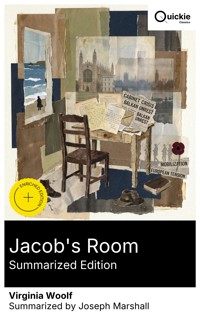
Published in 1922, Jacob's Room is Woolf's first fully modernist experiment, composing Jacob Flanders through a mosaic of voices, objects, and rooms. Impressionistic vignettes move from a Cornish shore to Cambridge and London; syntax is elliptical, focalization fluid, so identity appears as pattern rather than possession. Classical allusion, letters, and precise things weave memory and time under the Great War's gathering shadow; the empty room is elegy and critique. Breaking with Edwardian materialism (Bennett, Wells, Galsworthy), it stands among 1922's modernist landmarks. Woolf, a central figure in the Bloomsbury Group, co-founded the Hogarth Press and, in Modern Fiction, argued the novel should register the mind's "luminous halo." Grief for her brother Thoby and the nation's postwar losses, together with Roger Fry's post-impressionist aesthetics, shaped the book's episodic design. It enacts the new psychology she sought. Readers drawn to modernism's audacity, the poetics of absence, and the ethics of remembrance will find Jacob's Room inexhaustible. It rewards close, recursive reading and invites reflection on how a life is assembled from other people's sentences—an invitation few novels extend with such intelligence. Quickie Classics summarizes timeless works with precision, preserving the author's voice and keeping the prose clear, fast, and readable—distilled, never diluted. Enriched Edition extras: Introduction · Synopsis · Historical Context · Author Biography · Brief Analysis · 4 Reflection Q&As · Editorial Footnotes.
Das E-Book können Sie in Legimi-Apps oder einer beliebigen App lesen, die das folgende Format unterstützen:
Veröffentlichungsjahr: 2026
Ähnliche












Jacob's Room (Summarized Edition)
Table of Contents
Introduction
Gathering the scattered traces a life leaves in rooms, letters, and glances, Jacob's Room probes how a person can be everywhere felt and yet never fully grasped, testing the boundary between presence and absence, intimacy and anonymity, the living individual and the incomplete figure assembled by other people's perceptions, by places haunted with prior meanings, and by history's encroaching pressures, so that what seems coherent dissolves into facets, errant details, half-heard voices, and pauses that ring louder than speech, inviting readers to attend not to certainty about who Jacob is but to the subtle experience of almost knowing.
First published in 1922 by the Hogarth Press, this modernist novel unfolds across early twentieth-century England and parts of Europe, following the rhythms of seaside towns, university life at Cambridge, and the crowded streets and drawing rooms of London. Its era is one of accelerated change, with industrial pace and imperial reach giving way to uncertainty and strain as the decade advances toward crisis. Woolf sets her experiment within recognizably social spaces while loosening the novel's inherited conventions, placing Jacob at the center and simultaneously at an oblique angle, a figure whose environment, acquaintances, and artifacts tell the story as much as any plot.
The premise is disarmingly simple: the reader meets Jacob as a child and accompanies his passage into adulthood, though rarely from Jacob's own mind and almost never through conventional scene-setting. Instead, voices drift in and out, and attention settles on seemingly marginal objects, overheard remarks, or the texture of light on a wall. The narrator moves with elastic grace, observing, withholding, circling back. The tone can be amused, tender, or severe, but a quiet elegiac current runs underneath. The result is a reading experience closer to listening than surveillance, a composition made of echoes, intervals, and sudden, luminous arrivals.
Among the book's central themes is the instability of identity, especially as it is refracted through other people's expectations, class positions, and desires. Rooms, streets, libraries, theaters, and trains act as frames that both contain and blur the self. Time's passage is felt less through event than through atmosphere: the way fashions alter, phrases fade, and a summer turns. The novel asks how memory constructs a person after the fact, and how language reaches toward what continually recedes. It weighs the ethics of attention, suggesting that to look closely is to honor, yet to possess is to misrepresent.
Woolf situates Jacob within institutions and rituals that shaped his generation: schoolboy camaraderie, undergraduate talk at Cambridge, professional routines, travel, and social calls that map a country's hierarchies. The novel faithfully registers the textures of urban life and the countryside, the bustle of shops and omnibuses, as well as the quieter cadences of reading, walking, and looking. Political rumblings and public rhetoric hum at the edges, forming a background that grows more insistent as years pass. Without relying on dramatic revelation, the book traces how private formation interlocks with public circumstance, observing how culture equips and constrains its citizens.
Formally, Jacob's Room represents a decisive departure from the solid architectures of nineteenth-century realism, replacing linear scaffolding with a constellation of fragments, recurring images, and shifting focal points. Woolf uses free indirect style, lyrical description, and purposeful gaps to let inference do narrative work, trusting readers to assemble a portrait from residues. The approach foregrounds the limits of narration itself, asking what a novel can and cannot make present. It is an experiment that clears space for the daring of later works, while remaining remarkably approachable through its sensory richness, wit, and humane curiosity about how people register one another.
For contemporary readers, the novel matters because it models attention in an age of distraction and offers a grammar for thinking about identity assembled from impressions, platforms, and partial archives. Its meditation on presence and absence speaks to practices of remembrance, whether personal or civic, and to debates about how stories honor lived complexity. The book's formal openness invites ethical reflection without prescribing conclusions, rewarding rereading and conversation. Reading Jacob's Room today is to consider how we piece together others and are pieced together in turn, and to recognize the quiet care required to hold what cannot be fully held.
Synopsis
First published in 1922, Jacob’s Room marks Virginia Woolf’s turn toward a modernist portrait built from fragments, scenes, and shifting perspectives. Rather than a continuous biography, the novel assembles glimpses of Jacob Flanders as he moves through early twentieth-century England and Europe. Observers—family members, friends, acquaintances, and passersby—offer impressions that rarely settle into a definitive image. The narration privileges atmosphere, the textures of places and objects, and the spaces around events, inviting readers to sense a life indirectly. Through this method, Woolf examines how memory and social observation construct identity, and how what remains unsaid or unseen can carry as much weight as what is shown.
The opening chapters linger on Jacob’s childhood by the sea in Cornwall, where his mother, Betty Flanders, manages a busy household and writes letters that stitch together daily concerns. The coast’s rocks, tides, and churchyards are rendered with attention to mood rather than plot, and Jacob appears within this landscape as a curious, sometimes solitary figure among brothers and neighbors. Voices overlap as local routines and seasonal shifts frame his early years. Woolf emphasizes the delicate way a boy’s outline is drawn by those around him, establishing the theme that a person’s presence is often approached obliquely, through place, gesture, and the perceptions of others.
As Jacob grows older, his schooling leads to Cambridge, where he studies the classics and wanders through courts, libraries, and lecture halls. The friendship with Richard Bonamy becomes central, giving the narrative a vantage on Jacob’s tastes, hesitations, and ambitions. Conversations about art, politics, and conduct surface in fragments, while formal dinners, society calls, and student rituals provide backdrops. Woolf resists a conventional interior portrait, allowing glimpses of character to emerge through habits and glimpses, maintaining the novel’s focus on social context and atmosphere. Jacob’s attraction to Greek literature and ideals becomes a recurrent chord, suggesting both intellectual aspiration and a measure of distance from modern life.
After university, Jacob settles into rooms in London, and the motif of his room grows in significance: books piled on tables, boots by the hearth, letters, bills, and souvenirs that imply a pattern of living without spelling it out. The city’s drawing rooms, restaurants, and museums and libraries form a circuit he moves through, alternately engaged and detached. At a gathering, the well-connected Clara Durrant notices him, her perspective adding another angle to the composite portrait. Woolf sets the metropolis’s speed and social choreography against Jacob’s elusive inwardness, using glances, missed connections, and the press of crowds to show how identity disperses in urban life.
Jacob’s encounters with women highlight the novel’s method of seeing him indirectly. Florinda, a dancer living precariously at the city’s margins, experiences his charm and reserve with mixed feeling. Fanny Elmer, an aspiring artist, considers both his sensitivity and his opacity. Clara Durrant embodies a world of decorum and expectation that frames Jacob differently again. These relationships do not resolve into a single account of intimacy; instead, they demonstrate how class, gender, and habit shape what can be perceived or said. Woolf’s narration, attentive to details of rooms, clothes, and pauses, suggests emotional possibilities and limits without fixing them in a final, authoritative perspective.
Travel carries Jacob across the Continent, culminating in Greece, where the presence of antiquity offers a counterpoint to modern dislocation. Letters trace the journey’s social fabric—acquaintances met en route, cafés and museums, the traffic of stations and harbors—while the ruins and landscape press forward larger questions about time and permanence. The Acropolis and classical sculpture, so long his intellectual touchstones, are glimpsed not as tidy answers but as occasions for contrast: solid forms in a world of movement. Woolf continues to avoid direct psychological exposition, letting scenery, schedules, and chance meetings mark the rhythm of a young man’s evolving outlook.
Back in London, years accumulate as Jacob’s circle ages into professions and responsibilities. Newspapers and conversations register a more unsettled climate, as international tensions gather in the background of parties and lectures. Jacob’s connection with Bonamy persists, defined by talk, silences, and the exchange of books and opinions. The furnishings of Jacob’s room change with each season—new volumes appear, letters arrive and are stacked—so that domestic detail becomes a ledger of time. Woolf shows careers beginning and friendships stretching over longer distances, while keeping Jacob partially withheld, a figure whose intentions are sensed in outlines, never quite declared in the scenes that surround him.




