


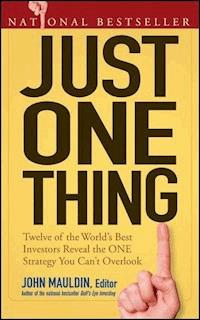
Just One Thing E-Book
15,99 €
Mehr erfahren.
- Herausgeber: John Wiley & Sons
- Kategorie: Fachliteratur
- Sprache: Englisch
In Just One Thing, author John Mauldin offers an incomparable shortcut to prosperity: the personal guidance of an outstanding group of recognized financial experts, each offering the single most useful piece of advice garnered from years of investing. Conversational rather than technical in tone, each contributor’s personal principle for success is illustrated with entertaining and illuminating real-life stories.
Sie lesen das E-Book in den Legimi-Apps auf:
Seitenzahl: 355
Veröffentlichungsjahr: 2011
Ähnliche




















CONTENTS
Introduction
Chapter 1: Signposts in the Fog
Investing in the Fog
You can’t Make Money Standing in the Sunshine
The Importance of Spotting the Signposts in the Fog
Picking the Right Signposts
A Glance Back at Satisfaction and Rewards
Chapter 2: The “Not-So-Simple” (But Really Utterly So) Rules of Trading
Never Add to a Losing Position
Invest on the Side that is Winning
Don’t Hold on to Losing Positions
Go Where the Strength is
Making “Logical” Plays is Costly
Think Like a Fundamentalist; Trade Like a Technician
Understand the Environment
The Rule that Sums up the Rest
Chapter 3: The Triumph of Hope over Long-Run Experience: Using Past Returns to Predict Future Performance of a Money Manager
Identifying Noise in Market Decision Making
Dealing with the Noise Problem
Performance Studies
Reasons Past Performance Fails as an Investing Tool
Why Do Investors Rely on Past Performance?
How Should You Use Performance Data?
Chapter 4: The Long Bond
Investments Must Make Money
Be Nonconsensus and Long-Term
The Late 1970S
Monetary or Fiscal Policy?
Distrust in Government
My Fearless Forecast
No Straight Line
Real Money
The Long (Unlaunched) Bond
Hang in There
Consistency is Important
Why Buck the Trend?
Risk and Maturity
The Complexity of Stocks
Cocktail Party Prattle
The Pros Don’t Like Bonds
The Test of History
Where Do Bonds Go from Here?
Chapter 5: Risk is Not a Knob
Risky Business
Modern Portfolio Misunderstandings
Risk Misconceptions
Expected Returns and Probable Returns
Measuring Risk
Absolute Probabilities
Short-Term and Long-Term
Volatility Gremlins
Portfolio Management
Front Stage: Your Assumptions
In Conclusion: Caveat Investor
Chapter 6: Psychology Matters: An Investors’ Guide to Thinking about Thinking
Are You Spock or McCoy?
The Primacy of Emotion
Emotions: Body or Brain?
Emotion: Good, Bad, or Both?
Self-Control is Like a Muscle
Plasticity as Salvation
The Biases We Face
Conclusions
Chapter 7: The Means are the Ends
Keynesian Meddling in the Twentieth Century
Morality as an Economic Tool
Chapter 8: The 2 Percent Solution
Assessing the Strength of Capitalization-Weighted Investing
Investing in Equal-Weighted Indexes: A Better Alternative
Getting the 2 Percent Of Alpha
Conclusion
Chapter 9: The Outsider Trading Scandal
The Value of Information
The Dearth of Inside Information
The Fallacy of Imbalance Fears
The Investor’s Challenge
Chapter 10: The Winner’s Rule
That One Most Important Thing
Becoming an Invaluable Employee
Being an Effective Mentor
Nice Guys Finish Best
Chapter 11: Rich Man, Poor Man
The Power of Compounding
The Trick is to Beat Time
In the Markets, Hope is the Dangerous Siren Song
There is no Substitute for Action
Chapter 12: The Millennium Wave
The Innovation Cycle
Secular Bull and Secular Bear Markets
Human Psychology
Surfing the Millennium Wave
Demography is Destiny
The Globalization Wave
A New World Order
What this Means for Investors
Index
Copyright © 2006 by John Mauldin. All rights reserved.
Published by John Wiley & Sons, Inc., Hoboken, New Jersey.
Published simultaneously in Canada.
No part of this publication may be reproduced, stored in a retrieval system, or transmitted in any form or by any means, electronic, mechanical, photocopying, recording, scanning, or otherwise, except as permitted under Section 107 or 108 of the 1976 United States Copyright Act, without either the prior written permission of the Publisher, or authorization through payment of the appropriate per-copy fee to the Copyright Clearance Center, Inc., 222 Rosewood Drive, Danvers, MA 01923, (978) 750-8400, fax (978) 646-8600, or on the Web at www.copyright.com. Requests to the Publisher for permission should be addressed to the Permissions Department, John Wiley & Sons, Inc., 111 River Street, Hoboken, NJ 07030, (201) 748-6011, fax (201) 748-6008, or online at http://www.wiley.com/go/permissions.
Limit of Liability/Disclaimer of Warranty: While the publisher and author have used their best efforts in preparing this book, they make no representations or warranties with respect to the accuracy or completeness of the contents of this book and specifically disclaim any implied warranties of merchantability or fitness for a particular purpose. No warranty may be created or extended by sales representatives or written sales materials. The advice and strategies contained herein may not be suitable for your situation. You should consult with a professional where appropriate. Neither the publisher nor author shall be liable for any loss of profit or any other commercial damages, including but not limited to special, incidental, consequential, or other damages.
For general information on our other products and services or for technical support, please contact our Customer Care Department within the United States at (800) 762-2974, outside the United States at (317) 572-3993, or fax at (317) 572-4002.
Wiley also publishes its books in a variety of electronic formats. Some content that appears in print may not be available in electronic books. For more information about Wiley products, visit our Web site at www.wiley.com.
Library of Congress Cataloging-in-Publication Data:
Mauldin, John.
Just one thing : twelve of the world’s best investors reveal the one strategy you can’t overlook / John Mauldin.
p. cm.
Includes bibliographical references.
ISBN-13: 978-0-471-73873-2 (cloth)
ISBN-10: 0-471-73873-5 (cloth)
1. Investments—Handbooks, manuals, etc. I. Title: Twelve of the world’s best investors reveal the one strategy you can’t overlook. II. Title.
HG4527.M365 2006
332.67'8—dc22
2005025979
INTRODUCTION
“Just One Thing,” I told Them.
“Give me the one best investing concept that you want to pass on to your kids.”
One of the great things about working in my field is that I get to run around with some very smart people. I get to pick their brains and learn from the best. If you could get a chance to sit down with a Gartman or Kessler or any of the other contributors to this book you would undoubtedly leap at the chance. What one thing could each of them tell you that would make a difference in your investing life? It’s impossible to calculate the value of one idea if it helps us become better investors, or saves us the pain of losses.
I asked the contributors to share their insights. The authors of these chapters have all learned a lot along the way. “Why not,” I thought, “ask them to share the wealth of their wisdom?” And so I did. There were no rules, so that’s why the chapters vary in length and topic.
What I wanted to get was material that would be readable and accessible to the average investor. Nothing is more frustrating to me than a great idea I can’t understand. I asked them to make it something that will give readers an “aha” moment. Just share it with us.
Now, I could guess what a few of them would write about before I asked. Mark Finn was going to write about the problems of past performance. He is absolutely brilliant on that (and a lot of other things), which is why he gets big institutions to keep coming back for his consulting. And you knew that Dennis Gartman would write on his Rules of Trading. Gartman has forgotten more about trading than most of us will ever know. Which, he would tell you, is why he writes his rules down so he can remember them and follow them! You break these rules, you are gonna lose. If you want to trade, you need these near your desk.
But I didn’t know how some of the other contributors could narrow their advice down to Just One Thing. That was hard. But they have all done a great job.
Okay, Andy Kessler gives us two. But when you turn $100 million into a cool $1 billion and get out at the top, two ideas are a good thing. Kessler shows how investing in what everyone knows is how to get just average returns (or less!). Better, he says, to invest like you are walking in a fog.
Gary Shilling shows us the value of one really good idea. George Gilder tells us that in fact inside information is the best information. Want to average almost 3 percent a year better on your funds? Rob Arnott writes compellingly that the way index (and many mutual) funds are currently constructed is inefficient, and he offers a new way to invest. This powerful analysis could be worth a lot to you.
Bill Bonner first tells us that we need to start with a principle if we want to succeed and then shows us his idea as to what that is. Mike Masterson looks at the same thought, but comes away with an entirely different take.
James Montier gives us a very thorough overview of the latest research on the human foibles in investing. He is an expert on the psychology of investing, having literally written the book on the subject. This chapter is one you will want to read and reread and come back to often.
Richard Russell, who has been writing since 1958 and is the dean of economics writers, gives us his thoughts on time, hope, and the power of compounding. Anytime Richard talks, we should listen. Ed Easterling shows us that “risk is not a knob to be turned for greater returns.” “The first step toward making money is not losing it,” he writes, and shows us how to avoid unnecessary risk while making it our friend when we do encounter it.
And finally, I weigh in with a few thoughts on the power of change in our future. The pace of change is accelerating, and we need to know not only what is changing but how to take advantage of it. The best investments of the next 20 years will be those that are a part of the process of change.
I am proud of this book and the work my friends have done to bring you their one best idea. I believe you will find many nuggets you can use in your own life and investing. As to the order of the chapters, it was just too much to decide who should be first and then second and so on; each chapter deserves to be a lead chapter. So I let the way they were organized in my inbox be the prime factor. You can start at the beginning or in the middle or the end, but read them all.
And Just One More Thing: There are a lot of great ideas in the next few hundred pages, but you have to put them into practice. So as you read, think about how you will put the principles, tips, and ideas to use in your personal life. And that will make this book be a very good thing.
CHAPTER 1
Signposts in the Fog
by Andy Kessler
Andy Kessler is a modern-day Investment Renaissance Man. He does it all. He was a research analyst and investment banker for some of the biggest firms on Wall Street. He wrote about his experiences in his first book, Wall Street Meat. He then went on to co-found Velocity Capital Management, a hedge fund that raised $80 million. Kessler turned it into a cool $1 billion in a matter of five years, and then got out at the top! He chronicled those days in the book Running Money. He now writes Wall Street Journal op-eds, as well as articles for Forbes and Wired, and appears frequently on CNBC, CNN, Fox News, and Dateline NBC. And he stays in top physical shape by keeping up with his four sons!
His latest book, How We Got Here, talks about industrial development, from the steam engine through the Internet. Andy lives in Northern California with his wife and four sons and is working on a mysterious new project, which he promises to share with me once he has it figured out. You can find out more about Andy at www.andykessler.com, where you can also get a free download of his latest book.
—John Mauldin
Years ago, I decided to climb Mount Washington, dragging a reluctant friend, Paul, along with me. It was a beautiful August morning in New Hampshire, not a cloud in the sky, birds chirping—couldn’t be better. Paul ran marathons and had already run eight miles that morning but agreed to my “little hike.” He still had his running clothes on; I was sporting a fresh Blue Öyster Cult T-shirt.
We parked the car and found the trailhead. Next to the usual warnings about poison ivy and rabid squirrels hung a huge sign that read, “STOP. The area ahead has the worst weather in America. Many have died there from exposure, even in the summer. Turn back now if the weather is bad.”
Lesen Sie weiter in der vollständigen Ausgabe!
Lesen Sie weiter in der vollständigen Ausgabe!
Lesen Sie weiter in der vollständigen Ausgabe!
Lesen Sie weiter in der vollständigen Ausgabe!
Lesen Sie weiter in der vollständigen Ausgabe!
Lesen Sie weiter in der vollständigen Ausgabe!
Lesen Sie weiter in der vollständigen Ausgabe!
Lesen Sie weiter in der vollständigen Ausgabe!
Lesen Sie weiter in der vollständigen Ausgabe!
Lesen Sie weiter in der vollständigen Ausgabe!
Lesen Sie weiter in der vollständigen Ausgabe!
Lesen Sie weiter in der vollständigen Ausgabe!




