


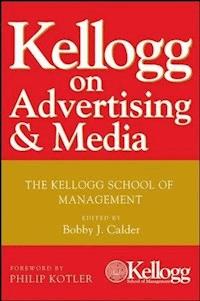
Kellogg on Advertising and Media E-Book
19,99 €
Mehr erfahren.
- Herausgeber: John Wiley & Sons
- Kategorie: Fachliteratur
- Sprache: Englisch
In Kellogg on Advertising and Media, members of the world's leading marketing faculty explain the revolutionized world of advertising. The star faculty of the Kellogg School of Management reveal the biggest challenges facing marketers today- including the loss of mass audiences, the decline of broadcast television advertising, and the role of online advertising- and show you how to advertise successfully in this new reality. Based on the latest research and case studies, this book shows you how to find and engage audiences in a chaotic media climate.
Sie lesen das E-Book in den Legimi-Apps auf:
Seitenzahl: 532
Veröffentlichungsjahr: 2012
Ähnliche




















Contents
Title
Copyright
Foreword
Introduction
Chapter 1: Media Engagement and Advertising Effectiveness
What is Engagement?
Identifying Media Experiences
Metrics for Measuring Media Experiences and Engagement
Engagement and Advertising Effectiveness
Potential Negative Effects of Engagement
Engagement with the Brand
Future of Brands
Appendix
Chapter 2: Making TV a Two-Way Street: Changing Viewer Engagement through Interaction
History of TV and Viewer Engagement
Making TV a Two-Way Street
iTV: The Engagement Builder
TV Interactivity = Viewer Engagement
Chapter 3: Advertising in the World of New Media
Technological Advancement
Migration to Digital Content
View of the Past
View of the Future
Media Mix Changes
Chapter 4: Reinvention of TV Advertising
Evolving TV Landscape
Leveraging Enhanced TV Advertising
Marketing Impact of Enhanced TV Advertising
Conclusion
Chapter 5: Developments in Audience Measurement and Research 123
Changing World of Media and Measurement
New Developments in Audience Measurement
Political Economy of Audience Measurement
Chapter 6: Rethinking Message Strategies: The Difference between Thin and Thick Slicing
Traditional Approaches to Effective Communication
Measuring Effects of Conscious Processing
Advertising Directed at Unconscious Processing
Measuring Effects of Unconscious Processing
Conclusion
Chapter 7: Managing the Unthinkable: What to Do When a Scandal Hits Your Brand
What is a Scandal?
Framework for Managing a Scandal
Spillover Brands
Conclusion
Appendix
Chapter 8: Managing Public Reputation
Concepts, Framework, and Processes
Conclusion
Chapter 9: The Contribution of Public Relations in the Future
Credibility
Public Relations as a Broader View of the Market
Accountability and Measured Performance
Conclusion
Chapter 10: Using THREE I Media in Business-to-Business Marketing
Personal Selling Cycle in B-to-B Organizations
Expanding the Role of Marketing in B-to-B with Multimedia
New Enabling Role of Smart and Rich Multimedia—THREE I
THREE I Case Examples
Conclusion
Chapter 11: Communicating with Customers
Companies Need Both an Advertising Strategy and a Commitment Strategy
Managing Communication through Commitments
Designing a Commitment Strategy
Role of Internal Communications
Commitments and Integrated Marketing
Appendix
Chapter 12: Changing the Company
Marketing and Operating Systems
Marketing 1.0/2.0/3.0
Marketing Research and Development
Compensation
Chapter 13: The Integration of Advertising and Media Content: Ethical and Practical Considerations
Historical Perspective on Advertising and Media
Moving On
A Way Forward
Where to Draw the Line
The Fork in the Road
About the Contributors
Index
Copyright © 2008 by Kellogg Graduate School of Management. All rights reserved.
Published by John Wiley & Sons, Inc., Hoboken, New Jersey.
Published simultaneously in Canada.
No part of this publication may be reproduced, stored in a retrieval system, or transmitted in any form or by any means, electronic, mechanical, photocopying, recording, scanning, or otherwise, except as permitted under Section 107 or 108 of the 1976 United States Copyright Act, without either the prior written permission of the Publisher, or authorization through payment of the appropriate per-copy fee to the Copyright Clearance Center, Inc., 222 Rosewood Drive, Danvers, MA 01923, (978) 750-8400, fax (978) 646-8600, or on the web at www.copyright.com. Requests to the Publisher for permission should be addressed to the Permissions Department, John Wiley & Sons, Inc., 111 River Street, Hoboken, NJ 07030, (201) 748-6011, fax (201) 748-6008, or online at http://www.wiley.com/go/permissions.
Limit of Liability/Disclaimer of Warranty: While the publisher and author have used their best efforts in preparing this book, they make no representations or warranties with respect to the accuracy or completeness of the contents of this book and specifically disclaim any implied warranties of merchantability or fitness for a particular purpose. No warranty may be created or extended by sales representatives or written sales materials. The advice and strategies contained herein may not be suitable for your situation. You should consult with a professional where appropriate. Neither the publisher nor author shall be liable for any loss of profit or any other commercial damages, including but not limited to special, incidental, consequential, or other damages.
For general information on our other products and services or for technical support, please contact our Customer Care Department within the United States at (800) 762-2974, outside the United States at (317) 572-3993 or fax (317) 572-4002.
Wiley also publishes its books in a variety of electronic formats. Some content that appears in print may not be available in electronic books. For more information about Wiley products, visit our web site at www.wiley.com.
Library of Congress Cataloging-in-Publication Data:
Kellogg on advertising and media / edited by Bobby J. Calder.
p. cm.
Includes bibliographical references and index.
ISBN 978-0-470-11986-0 (cloth)
1. Advertising media planning. 2. Advertising. I. Calder, Bobby J. II. J.L. Kellogg Graduate School of Management.
HF5826.5.K46 2008
659.1’11—dc22
2007052392
Foreword
PHILIP KOTLER
Media-based advertising has been first among equals for the traditional Ps of marketing for over a hundred years. Indeed the advertising agency model of translating a company’s marketing strategy into carefully crafted messages that are inserted into media vehicles that reach the targeted consumer with appropriate frequency has perhaps been the most defining characteristic of modern marketing. The product/brand manager works with the agency account, creative, and media specialists to communicate to the consumer the benefits of the product. It is a world that generations of marketers have grown up in.
All this is changing. Today, the standard approach to advertising faces many challenges. The most obvious is consumer overload. The sheer amount of advertising “clutter” has grown to be a burden on consumers. Estimates vary but it is clear that consumers are exposed to thousands of messages a day. At the very least, this means that consumers process ads in an ever more cursory way. Certainly companies attempt to make their ads stand out more, but this is an increasingly uphill battle.
Even more challenging is the fact that consumers themselves are changing. Consumers engage more and more in ad avoidance. They actively seek to limit their exposure to advertising. Digital video recorders (DVRs) are only the tip of the iceberg of this phenomenon. Younger consumers engage in surfing behavior specifically intended to decrease the burden of information overload. They want to take in only information that they actively select. A new millennial generational cohort of consumers may even have trained itself to be fairly oblivious to the advertising around them. And the messages that manage to get through may be subjected to a more critical eye based on a sophisticated, not to say cynical, consciousness of potential manipulation by marketers. It is coming to be as likely for an ad to be posted on YouTube for comment, or ridicule, as it is for the ad to elicit a really strong intention to buy the product.
There is a great need to rethink the traditional approach to advertising. There is a need to think through basic issues such as how to design messages that do not necessarily depend on the consumer consciously processing the message’s content. There is a need to think about information that consumers get not from ads but from media coverage of companies and products. There is a need to think about the relative effectiveness of ads carried on traditional media versus ads carried on new digital media. There is a need to think about how ads can be customized to be more relevant to individual consumers. There is a need to think about how ads can be more interactive, facilitating more two-way communication. In general, there is a need to think about how the consumers’ engagement with the medium affects their response to advertising. All of these issues and more are explored in this book.
This book reflects a continuing interest at the Kellogg School in the future of marketing and advertising. And the realization that changes in media management and media technology will play a profound role in this future. Our MBA program has both a major in marketing and a major in media management. Students frequently combine the two. We have a Media Management Center for research studies that is jointly affiliated with the Kellogg School of Management and the Medill School of Journalism. We have developed relationships with experts in a variety of companies for dialogues about the future of marketing and advertising. The variety of companies represented by contributors to this book reflects this.
It is important to remember that this book is not intended to be the last word on marketing and advertising. Quite the contrary, our hope is that it is among the first words on the change that is taking place and what the future might look like. The book does not present a pat, business trade book approach, telling you how things should be done. The reader is invited to think along with us.
Introduction
Advertising and Media
BOBBY J. CALDER
Not too long ago, this title would have signaled the discussion of narrow issues in the backwaters of marketing. Today, it is the new frontier. The past was cheap media and relatively easy advertising. The future? Well, the future is worth thinking about, but not predicting. That is what this book is about.
Throughout most of the twentieth century, consumers and companies had a bargain. In return for cheap, easily accessible media, consumers agreed to look at ads. It was not a bad deal for either side. It made a company’s job of communicating and building brands easier and consumers got cheap information and entertainment. The highpoint was three TV networks that came over the air for free with the turn of a 1 to 13 dial. All the consumer had to do was sit back and watch the ads go by. From there, TV began to fragment into hundreds of networks and the cable bill became a major consumer expenditure. The change was not overnight, the official date will have to wait for hindsight, but the era of cheap media and relatively easy advertising was over. If you are reading this, you have probably gotten the word.
It is difficult to sort out cause from effect, but the changes are clear. Most visible is the decline in network TV viewing and ad avoidance with digital video recorders (DVRs). No longer is the sine qua non of marketing communications the 30-second TV spot. Marketers are increasingly turning to online and mobile advertising, alternative media, product placement, branded entertainment (integration), and other “marketing services” such as customer relationship management (CRM) and direct marketing. Advertising agencies now generate more revenue from these than from traditional media—more than 50 percent at Omnicom, Interpublic, and WPP. But traditional media are taking on new life as well. ESPN is a TV network but it is also a magazine, online site, radio network, mobile network, and more. It is a media brand. And like National Geographic and many others, it offers myriad ways of communicating with consumers. Technology is the wild card in the deck. A hypermedia environment is likely to compound any corporate missteps.
Most marketers have a sense of being in uncharted territory. This book is an effort to explore the new landscape and to help point out some promising directions. The overarching theme is the search for “engagement.” Most marketers today face strong competition from products that are well positioned and at parity in quality. The job of marketing communications is increasingly to find ways of not just delivering a brand benefit message but also of engaging the consumer, of getting the consumer to feel the brand is relevant to their lives. What the new landscape offers, the good news, is an abundance of promising directions for achieving this.
In the first chapter, Ed Malthouse and I examine in some detail the concept of engagement and its connection to media. We argue that engagement is not another marketing buzzword. There are those who would like to see it as a buzzword, probably so they can move on to the next one, but it is not. Whether you call it engagement or something else, the challenge marketing faces is to promote not only a liking for the brand but a sense of engagement with it. It is not a new challenge, but it is one that today has more urgency for more brands. We present an approach to measuring engagement and show the relationship of media engagement to advertising effectiveness.
Mike Schreiber of NBC Universal, and a Kellogg graduate, then looks at how TV is moving from a lean-back medium to be more of a lean-forward medium. The development of interactive TV offers considerable promise in this regard. Marketers in the future may be able to engage consumers with their brands as much with the old medium of TV as with online and other new media.
Scott Berg of Hewlett Packard makes the case for moving on to the new media. He provides insight into the opportunities and the potential pitfalls. Engagement will come from burning your boats and learning to use online and other new media.
Claudio Marcus of Visible World, and another Kellogg graduate, adds a different dimension. He and his company are pioneers in customizing video for TV and online. Commercials no longer need to be static. Tailored ads can be dynamically designed to fit specific consumers. A path to greater engagement lies in moving away from treating consumers as a mass audience.
Jim Webster, against this backdrop, reviews the evolving field of audience measurement. Accountability is the watchword among marketers today. It is essential for measurement to keep pace with changes in the advertising and media landscape.
Angela Lee revisits the core advertising discipline of message design. She points out that in the past advertisers assumed that consumers were processing and absorbing brand messages. Increasingly, we must face the possibility that consumers do not dwell on brand messages. It may be better to design messages intended for less conscious processing by consumers.
The next three chapters look at the company’s larger environment. Michelle Roehm and Alice Tybout turn to marketing communications in a world of hypermedia. They provide specific advice as to what a company should do when confronted with a crisis situation. Then Daniel Diermeier considers how a company should manage its corporate reputation on an ongoing basis by monitoring all of the media communications surrounding it. Clarke Caywood calls for an expanded role for public relations in recognizing that marketing communications should be targeted at a wide variety of stakeholders in a highly interdependent world.
Jim Newcomb of Boeing, and a Kellogg graduate, shows that the use of sophisticated media can bring increased engagement with B-to-B products as well. He points out that marketing typically does not extend very deeply into the personal selling process that is at the core of B-to-B. Marketing can play a greater role, however, by using intensive and immersive media.
Charles Spinosa and David Le Brocquy of Vision Consulting join me in contending that the search for engagement will require more than an advertising strategy. Companies need a parallel commitment strategy that uses contacts between employees and customers, and even employees with each other, to turn the brand promise into something that is enacted by employees. This requires more than CRM or internal communications. It requires commitment conversations with the customer. The organization itself becomes an interactive medium of marketing communication.
Julie Roehm, who has led change efforts at companies like Ford and Wal-Mart, gives advice on how to get organizations to face change. Perhaps the biggest obstacle to taking advantage of the new advertising and media landscape is to get the company to embrace marketing change.
Finally, Richard Kolsky and I take up the relationship between advertisers and media companies. Very often there has been a wall limiting the interaction of advertisers and content providers. Yet, this flies in the face of the current trend toward advertising and media content integration, as in product placements. We try to provide an approach to dealing with both the practical and the ethical issues that arise from closer relationships between journalistic and artistic content providers and advertisers.
This book is thus intended to provide a road map to the emerging new world of advertising and media. It is not a list of prescriptions or predictions. It is a map of potential paths to greater consumer engagement.
CHAPTER 1
Media Engagement and Advertising Effectiveness
BOBBY J. CALDER, EDWARD C. MALTHOUSE
In an era of extreme advertising clutter and consumer avoidance, perhaps no other recent concept has captured more interest from marketers than engagement. This interest is symptomatic of changes in the field. Traditionally, marketers have thought about advertising as a process of translating a brand, expressed as a benefit, a promise to the consumer, a value proposition, or a positioning in the consumer’s mind into a message that is delivered to the consumer through some medium. This advertising will be effective to the extent that the consumer values the brand idea and the message does a good job creatively of communicating the idea. Two things are critical, the quality of the brand and the quality of the message. The media used is more of a tactical matter of achieving the desired reach and frequency against the consumer target group. The present interest in engagement brings something new to this picture.
You can think about engagement in two ways. One way, and the focus here, is on engagement with the advertising medium. If the journalistic or entertainment content of a medium engages consumers, this engagement may affect reactions to the ad. In the past, the medium was thought of as being only a vehicle for the ad, a matter of buying time or space to place the ad to expose the audience to it—a matter of buying eyeballs. But this ignores the fact that the medium provides a context for the ad. If the media content engages consumers, this in turn can make the ad more effective. Another way of thinking about engagement is in terms of engagement with the advertised brand itself. We return to this at the end of the chapter; the focus here is on how engagement with the medium affects advertising effectiveness.
The Advertising Research Foundation (ARF) defines engagement as follows: “Engagement is turning on a prospect to a brand idea enhanced by the surrounding media context” (ARF 2006). This definition highlights the synergy between the brand idea and media context as the key issue for marketers. What is not clear from the definition is what engagement is, as opposed to what it might do.
What Is Engagement?
We all know what engagement feels like. It embodies a sense of involvement. If a person is engaged with a TV program, he or she is connected with it and relates to it. But the concept is hard to pin down beyond this. Ultimately, we need not only to pin it down but also to measure it.
Let’s start with what engagement is not. Our conceptualization of engagement is different from others who often characterize it in ways that we regard as the consequences of engagement. Marc (1966), for example, defines engagement as “how disappointed someone would be if a magazine were no longer published.” Syndicated market research often asks whether a publication is “one of your favorites,” whether a respondent would “recommend it to a friend” or is “attentive.” Many equate engagement with behavioral usage. That is, they define engaged viewers or readers as those who spend substantial time viewing or who read frequently.
Lesen Sie weiter in der vollständigen Ausgabe!
Lesen Sie weiter in der vollständigen Ausgabe!
Lesen Sie weiter in der vollständigen Ausgabe!
Lesen Sie weiter in der vollständigen Ausgabe!
Lesen Sie weiter in der vollständigen Ausgabe!
Lesen Sie weiter in der vollständigen Ausgabe!
Lesen Sie weiter in der vollständigen Ausgabe!
Lesen Sie weiter in der vollständigen Ausgabe!
Lesen Sie weiter in der vollständigen Ausgabe!
Lesen Sie weiter in der vollständigen Ausgabe!
Lesen Sie weiter in der vollständigen Ausgabe!
Lesen Sie weiter in der vollständigen Ausgabe!
Lesen Sie weiter in der vollständigen Ausgabe!
Lesen Sie weiter in der vollständigen Ausgabe!




