


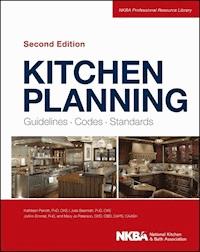
Kitchen Planning E-Book
92,99 €
Mehr erfahren.
- Herausgeber: John Wiley & Sons
- Kategorie: Geisteswissenschaft
- Serie: NKBA Professional Resource Library
- Sprache: Englisch
The leading resource for student and professional kitchen designerscompletely revised and updated
Kitchen Planning is an essential reference for any designer working in the kitchen field, containing everything a professional needs to know to design kitchens that are convenient, functional, and efficient, and that meet the needs of today's lifestyles. Based on the National Kitchen and Bath Association's Kitchen and Bathroom Planning Guidelines and the related Access Standards, this book presents the best practices developed by the Association's committee of professionals through extensive research.
This Second Edition has been completely revised and redesigned throughout, with new full-color photographs and illustrations and a special emphasis on client needs, research, and references to industry information. Features include:
- New and expanded information on universal design and sustainable design
- The 2012 edition of the NKBA Planning Guidelines with Access Standards and up-to-date applications of the 2012 International Residential Code®
- New information about storage, cabinet construction, and specifying cabinets
- Metric measurement equivalents included throughout
- A companion website with forms and teaching resources for instructors
Sie lesen das E-Book in den Legimi-Apps auf:
Seitenzahl: 787
Veröffentlichungsjahr: 2013
Ähnliche




















Contents
Cover
Title Page
Copyright
Sponsors
Gold Sponsors
About the National Kitchen & Bath Association
Preface
Acknowledgments
Chapter 1: Kitchen History, Research, and Trends
A BRIEF HISTORY OF THE KITCHEN
KITCHEN DESIGN RESEARCH
MAJOR KITCHEN TRENDS THROUGH THE 2000S
DEMOGRAPHIC AND POPULATION TRENDS
HOUSING TRENDS AND CONSUMER PREFERENCES
CURRENT AND CONTINUING DESIGN TRENDS
SUMMARY
REVIEW QUESTIONS
REFERENCES
Chapter 2: Infrastructure Considerations
CODES
STRUCTURAL ISSUES
DOORS AND WINDOWS
PLUMBING
NOISE
SUMMARY
REVIEW QUESTIONS
Chapter 3: Environmental and Sustainability Considerations
SUSTAINABLE DESIGN AND BUILDING
CHOOSING SUSTAINABLE PRODUCTS
GREEN BUILDING PROGRAMS
SUSTAINABLE CERTIFICATION PROGRAMS
ENERGY ISSUES AND BUILDING CODES
WATER
WATER QUALITY STANDARDS
EFFICIENT AND SUSTAINABLE USE OF WATER
AIR QUALITY
SOURCE CONTROL
MOISTURE AND INDOOR AIR QUALITY
WASTE MANAGEMENT IN THE HOME
SUMMARY
REVIEW QUESTIONS
Chapter 4: Human Factors and Universal Design Foundation
ANTHROPOMETRY
ERGONOMIC AND UNIVERSAL DESIGN
ACCESS CODES, LAWS, AND STANDARDS
SUMMARY
REVIEW QUESTIONS
REFERENCES
Chapter 5: Assessing Needs
THE DESIGN PROCESS
INTERVIEWING THE CLIENT
GETTING TO KNOW YOUR CLIENT
GETTING TO KNOW YOUR CLIENT’S HOME (FORM 2)
ACTIVITIES IN THE KITCHEN
STORAGE IN THE KITCHEN
YOUR CLIENT’S KITCHEN (FORMS 5 AND 6)
THE JOB SITE
PREPARING THE CLIENT
READY FOR THE DESIGN PROGRAM?
SUMMARY
REVIEW QUESTIONS
Chapter 6: Kitchen Planning
LOCATION AND TYPES OF KITCHENS
THE CENTER CONCEPT
GENERAL KITCHEN DESIGN
SINK CENTER
REFRIGERATION CENTER
COOKING CENTERS
COMBINING CENTERS
STORAGE
SERVING AND DINING
THAT’S ENTERTAINING
A KITCHEN WHERE YOU NEED IT
SUMMARY
REVIEW QUESTIONS
Chapter 7: Mechanical Planning
ELECTRICAL PLANNING
GAS
HEATING
COOLING
WATER HEATING
VENTILATION
LIGHTING
SUMMARY
REVIEW QUESTIONS
Chapter 8: Accessibility in Practice
UNIVERSAL DESIGN VERSUS ACCESSIBILITY: FURTHER CLARIFICATION
CHARACTERISTICS OF SPECIFIC USERS
ADDRESSING DIFFERENCES
ACCESS DESIGN CONSIDERATIONS
SUMMARY
REVIEW QUESTIONS
Chapter 9: More Than a Kitchen
THE FAMILY FOYER OR MUDROOM
HOME PLANNING CENTER
A LAUNDRY AREA
A CRAFT/HOBBY AREA
A GARDENING AREA
SOCIAL SPACES
SUMMARY
REVIEW QUESTIONS
Chapter 10: Putting It All Together
THE DESIGN PROCESS
THE DESIGN PROGRAM
THE DESIGN DRAWING
A SAMPLE DESIGN DRAWING
PUTTING IT ALL TOGETHER'A SAMPLE PROJECT
SUMMARY
REVIEW QUESTIONS
Appendix A: Kitchen Planning Guidelines with Access Standards
KITCHEN PLANNING GUIDELINE 1
KITCHEN PLANNING GUIDELINE 2
KITCHEN PLANNING GUIDELINE 3
KITCHEN PLANNING GUIDELINE 4
KITCHEN PLANNING GUIDELINE 5
KITCHEN PLANNING GUIDELINE 6
KITCHEN PLANNING GUIDELINE 7
KITCHEN PLANNING GUIDELINE 8
KITCHEN PLANNING GUIDELINE 9
KITCHEN PLANNING GUIDELINE 10
KITCHEN PLANNING GUIDELINE 11
KITCHEN PLANNING GUIDELINE 12
KITCHEN PLANNING GUIDELINE 13
KITCHEN PLANNING GUIDELINE 14
KITCHEN PLANNING GUIDELINE 15
KITCHEN PLANNING GUIDELINE 16
KITCHEN PLANNING GUIDELINE 17
KITCHEN PLANNING GUIDELINE 18
KITCHEN PLANNING GUIDELINE 19
KITCHEN PLANNING GUIDELINE 20
KITCHEN PLANNING GUIDELINE 21
KITCHEN PLANNING GUIDELINE 22
KITCHEN PLANNING GUIDELINE 23
KITCHEN PLANNING GUIDELINE 24
KITCHEN PLANNING GUIDELINE 25
KITCHEN PLANNING GUIDELINE 26
KITCHEN PLANNING GUIDELINE 27
KITCHEN PLANNING GUIDELINE 28
KITCHEN PLANNING GUIDELINE 29
KITCHEN PLANNING GUIDELINE 30
KITCHEN PLANNING GUIDELINE 31
Glossary
Resources
Index
Cover photographs: (left) Design by Peter Ross Salerno, CMKBD, photograph by Peter Rymwid(right) Design by Tracey Scalzo, CMKBD, photograph by Tom Harper
Cover design: Anne Michele Abbott
This book is printed on acid-free paper.
National Kitchen & Bath Association687 Willow Grove StreetHackettstown, NJ 07840Phone: 800-THE-NKBA (800-843-6522)Fax: 908-852-1695Website: NKBA.org
Copyright © 2013 National Kitchen and Bath Association. All rights reserved.
Published by John Wiley & Sons, Inc., Hoboken, New Jersey.
Published simultaneously in Canada.
No part of this publication may be reproduced, stored in a retrieval system, or transmitted in any form or by any means, electronic, mechanical, photocopying, recording, scanning, or otherwise, except as permitted under Section 107 or 108 of the 1976 United States Copyright Act, without either the prior written permission of the Publisher, or authorization through payment of the appropriate per-copy fee to the Copyright Clearance Center, Inc., 222 Rosewood Drive, Danvers, MA 01923, 978-750-8400, fax 978-646-8600, or on the web at www.copyright.com. Requests to the Publisher for permission should be addressed to the Permissions Department, John Wiley & Sons, Inc., 111 River Street, Hoboken, NJ 07030, 201-748-6011, fax 201-748-6008, or online at http://www.wiley.com/go/permissions.
Limit of Liability/Disclaimer of Warranty: While the publisher and author have used their best efforts in preparing this book, they make no representations or warranties with the respect to the accuracy or completeness of the contents of this book and specifically disclaim any implied warranties of merchantability or fitness for a particular purpose. No warranty may be created or extended by sales representatives or written sales materials. The advice and strategies contained herein may not be suitable for your situation. You should consult with a professional where appropriate. Neither the publisher nor the author shall be liable for damages arising herefrom.
For general information on our other products and services, or technical support, please contact our Customer Care Department within the United States at 800-762-2974, outside the United States at 317-572-3993 or fax 317-572-4002.
Wiley publishes in a variety of print and electronic formats and by print-on-demand. Some material included with standard print versions of this book may not be included in e-books or in print-on-demand. If this book refers to media such as a CD or DVD that is not included in the version you purchased, you may download this material at http://booksupport.wiley.com.
For more information about Wiley products, visit our Web site at http://www.wiley.com.
Library of Congress Cataloging-in-Publication Data:
Beamish, Julia. Kitchen planning : guidelines, codes, standards / Julia Beamish, Ph.D., CKE, Kathleen Parrott, Ph.D., CKE, JoAnn Emmel, Ph.D., Mary Jo Peterson, CKD, CBD, CAPS.—Second Edition. pages cm Includes index. ISBN 978-1-118-36762-9 (cloth); 978-111-8-40458-4 (ebk.); 978-111-8-40462-1 (ebk.); 978-111-8-40464-5 (ebk.); 978-111-8-40466-9 (ebk.); 978-111-8-40468-3 (ebk.); 978-111-8-43860-2 (ebk.) 1. Kitchens. I. Parrott, Kathleen R. (Kathleen Rose), 1950- II. Emmel, JoAnn. III. Peterson, Mary Jo. IV. Title. TH4816.3.K58B43 2013 690’.44—dc23 2012026250
978-1-118-36762-9
Printed in the United States of America
Sponsors
The National Kitchen and Bath Association recognizes with gratitude the following companies whose generous contributions supported the development of this second edition of Kitchen Planning:
PLATINUM SPONSORS
WWW.FISHERPAYKEL.COM
WWW.FRANKE.COM
WWW.JENNAIR.COM
WWW.MASCO.COM
GOLD SPONSORS
DORNBRACHT
KWC
About the National Kitchen & Bath Association
As the only nonprofit trade association dedicated exclusively to the kitchen and bath industry, the National Kitchen & Bath Association (NKBA) is the leading source of information and education for all professionals in the field.
The NKBA's mission is to enhance members' success and excellence, promote professionalism and ethical business practices, and provide leadership and direction for the kitchen and bath industry worldwide.
A nonprofit trade association with more than 50,000 members in North America and overseas, it has provided valuable resources for industry professionals for more than 50 years. Its members are the finest professionals in the kitchen and bath industry.
The NKBA has pioneered innovative industry research, developed effective business management tools, and set groundbreaking design standards for safe, functional, and comfortable kitchens and baths.
The NKBA provides a unique, one-stop resource for professional reference materials, seminars and workshops, distance-learning opportunities, marketing assistance, design competitions, consumer referrals, employment and internship availabilities, and opportunities to serve in leadership positions.
Recognized as the kitchen and bath industry's education and information leader, the NKBA provides development opportunities and continuing education for professionals of all levels of experience. More than 200 classes, as well as a certification program with three internationally recognized levels, help kitchen and bath professionals raise the bar for excellence.
For students entering the industry, the NKBA offers Accredited and Supported Programs, which provide NKBA-approved curriculum at more than 50 learning institutions throughout the United States and Canada.
The NKBA helps members and other industry professionals stay on the cutting edge of an ever-changing field through the Association's Kitchen & Bath Industry Show (KBIS¯), one of the largest trade shows in the country.
The NKBA offers membership in 11 different industry segments: dealers, designers, manufacturers and suppliers, multibranch retailers and home centers, decorative plumbing and hardware, manufacturer's representatives, builders and remodelers, installers, fabricators, cabinet shops, and distributors. For more information, visit NKBA.org.
Preface
Kitchens continue to change as new products are introduced to the market, new regulations affect energy and water consumption, and people change in their abilities, cooking preferences, and lifestyles. Therefore, a book on kitchen design needs to be updated periodically, and that is what the National Kitchen and Bath Association (NKBA) has undertaken in conjunction with Wiley publishing. Some of the changes include expanded information on sustainability and environmental issues and more information about universal design, including applications for a variety of users.
In this revised edition, we have maintained an organization similar to that of the original edition. We start with an overview of the history of the kitchen, including the history of research that has been conducted about the design of the kitchen. We also discuss current consumer trends.
We then continue with information about the infrastructure of the home and point out things to consider before the design process begins. The revised section on environmental concerns includes great information on building green and conserving water.
We next approached the design of the kitchen with the understanding that a key component of any designed space is the user, so we discuss universal design and ergonomics. Gathering information about the client and their home is a key first step to pulling things together and planning a great kitchen and is included in the next chapter. Sample forms are provided to assist you.
The next section covers kitchen planning principles and presents each of the NKBA Kitchen Planning Guidelines within the context of a step-by-step consideration of the tasks and activities that occur in the centers in the kitchen. Diagrams and illustrations help explain these basics, and information has been added to help you specify cabinets. We also expand on kitchen planning, including sections on dining, butler's pantries, catering kitchens, outdoor kitchens, and outpost kitchens. The next chapter on mechanical planning continues to highlight some of the technical planning requirements related to systems in the kitchen.
An expanded section on universal design and accessible design provides an in-depth look at the NKBA Kitchen Access Standards and discusses how they can be incorporated into designs when required by the client. In addition, we provided ideas for designing spaces related to kitchens, such as planning centers, laundries, craft, hobby, and social areas. We also walk you through the process of developing the kitchen plan, based on client needs and planning guidelines.
We organized and presented this book as if we were talking to a new designer, just starting a career. At the same time, we offered information, ideas, suggestions and tips for the more experienced kitchen designer. We firmly believe we can all learn something new—as we certainly did in revising this book!
We included many drawings, diagrams, and dimensioned plans to aid you in understanding the concepts presented. We added and updated many photographs to show how the content is integrated into “real-life” settings and to spark ideas of your own.
There are many worksheets and checklists to use in your work and with your clients. Feel free to use them as is or to adapt them to be useful to you.
Our goal and hope continues to be that this book will help you to be a better designer—more creative and more knowledgeable. This is not the type of book that you read cover to cover. It is a book to be used!
We hope that we find this book on a shelf near your drawing board or computer. We hope this book will be in your studio, office, or showroom—wherever you are at your creative best. We envision a book that gets worn from your use, with your comments written in the margin and “sticky notes” coming out in all directions.
Enjoy design and making people comfortable and safe in their homes!
Acknowledgments
The NKBA gratefully acknowledges the following Peer Reviewers of this book:
1
Kitchen History, Research, and Trends
The kitchen and its place in family life have changed throughout history in conjunction with the evolving lifestyles, economic conditions, values, and attitudes of its users. The overall look, feel, location, and relative importance of the kitchen in the home have been emblematic not only of the era, but also of the particular circumstances of the families they served.
So a brief walk through the history of kitchens will help the designer understand the ever-changing and complex interconnection between this room and the various roles it plays in domestic life. Research conducted by various groups has provided valuable guides for designing efficient, functional, and accessible kitchens. As the demographics and attitudes of our society change, so will the kitchen, to keep up with the needs of the users.
Learning Objective 1: Describe how evolving lifestyles have affected trends over time.
Learning Objective 2: Explain how kitchen design research has contributed to the NKBA Planning Guidelines.
A BRIEF HISTORY OF THE KITCHEN
The history of the modern kitchen begins with the need for a place of family food preparation, usually centered on a source of heat and light, which was the hearth (fireplace). This source has changed over time, but for ages the open fire in a hearth reigned supreme. It also served as the sole heat source for the home until late in the seventeenth century. This meant that most family living and activities took place in the one room that contained the fireplace.
The first known kitchen separated from the living area was in thirteenth-century Flanders, along the coast of what is now Belgium. Flemish kitchens contained tables on trestles for food preparation. Horizontal boards placed above the table provided a place to store kitchen utensils. These storage elements developed into display dressers used in fifteenth-century Flanders, where the number of shelves on the dresser was an indicator of social rank. Many of these concepts were eventually brought to North America and incorporated into the early colonial kitchens.
The Colonial Kitchen
The colonists in North America brought many ideas for kitchen design from Europe. Although eventually established as a separate room in many homes, the early colonial kitchen was equipped with perhaps the only heat source in the home, a hearth, and it served as the focus of the family activity. Because it was the most comfortable room in the home, the kitchen was often used for family bathing as well.
Role of the Hearth in the Eighteenth-Century Kitchen
The typical eighteenth-century kitchen was large, and often included a 6-foot wide and 4-foot deep walk-in fireplace (Figure 1.1). The fireplace contained massive wrought andirons with racks for toasting bread, spits for cooking meats, and iron hooks for pots, which were transferred into and out of the fire with lug poles. Beehive ovens were built into the sidewall of the hearth and were used for baking. A trestle table or bench, a storage chest, a corner cupboard, and occasionally a separate worktable were included in the kitchen. These early kitchens were dirty, inefficient, and unsafe, especially for the cook. Long skirts would brush up against the hot embers in the fireplace and catch on fire, and as a result, burns became the second most common cause of death among women, second only to childbirth.
Figure 1.1 Colonial kitchens were not only messy places in which to work, but they were also dangerous because the cook was so close to the embers used for cooking.
Photo by Jack E. Boucher. Library of Congress, Prints and Photographs Division, Historic American Buildings Survey or Historic American Engineering Record, HABS VA-1422-7 (CT)
In wealthier households, the kitchen was used only by servants and was often located on the lower level or in a separate building. A summer kitchen—common in the warmer southern colonies, where the heat from cooking was not desirable during warm weather—often consisted of a lean-to or annex to the main house, which kept extra heat out of the house. Eventually, the fireplaces developed a separate chimney, which helped exhaust the excess heat and allowed cooking during hot weather without heating up the house.
Later in the century, wood and coal cast iron stoves, which enclosed the fire and transferred heat through the metal became available. These stoves were less of a fire hazard but provided less heated area for cooking. Benjamin Franklin designed one such stove, which was built to fit into the fireplace.
Most kitchens of the period were enclosed with unadorned wood panels, but by the second quarter of the eighteenth century, paint was used—more as a preservative than for decorative purposes. As paint became more popular, stenciling, marbling, and graining techniques were used on walls, woodwork, and cabinetry to add a decorative touch to the once plain kitchen.
The Modern Kitchen
The modern kitchen has been influenced by two major trends that roughly coincide with the nineteenth and twentieth centuries. The nineteenth century brought industrialization with social and technological changes. In the twentieth century, standardization surfaced with a focus on work simplification and efficiency.
Houses and the kitchens associated with them changed as the country evolved into an industrialized nation. During this time, numerous new products were developed, and the role of women and family life was redefined. In addition, democracy, joined with the industrial age and the rising middle class, discouraged the formation of a permanent servant class, so live-in household help was less available or often not reliable. This meant that the woman of the home had to take on many new roles and activities to manage the house and its occupants.
Lesen Sie weiter in der vollständigen Ausgabe!
Lesen Sie weiter in der vollständigen Ausgabe!
Lesen Sie weiter in der vollständigen Ausgabe!
Lesen Sie weiter in der vollständigen Ausgabe!
Lesen Sie weiter in der vollständigen Ausgabe!
Lesen Sie weiter in der vollständigen Ausgabe!
Lesen Sie weiter in der vollständigen Ausgabe!
Lesen Sie weiter in der vollständigen Ausgabe!
Lesen Sie weiter in der vollständigen Ausgabe!
Lesen Sie weiter in der vollständigen Ausgabe!
Lesen Sie weiter in der vollständigen Ausgabe!
Lesen Sie weiter in der vollständigen Ausgabe!
Lesen Sie weiter in der vollständigen Ausgabe!




