


6,99 €
Mehr erfahren.
- Herausgeber: No Exit Press
- Kategorie: Gesellschafts- und Liebesromane
- Sprache: Englisch
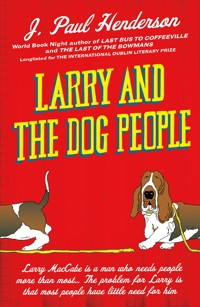
Larry MaCabe is a man who needs people more than most . . . The problem for Larry is that most people have little need for him. Larry MacCabe is a retired academic, a widower, and until a chance meeting with the administrator of a care home, also friendless. At her suggestion, he adopts a Basset Hound and joins her one Saturday at the local park. He becomes a regular visitor, and for the first time in his life the member of a gang. While his new companions prepare for the annual Blessing of the Animals service on the Feast Day of St Francis, Larry puts the finishing touches to a conference paper he's due to present in Jerusalem and arranges a house-sitter. Neither the service nor his visit to Israel go to plan, and on his return Larry is charged with conspiring to blow up a church and complicity in the deaths of four people. All that stands between him and conviction is a personal injury lawyer - and things for Larry aren't looking good...
Das E-Book können Sie in Legimi-Apps oder einer beliebigen App lesen, die das folgende Format unterstützen:
Veröffentlichungsjahr: 2017
Ähnliche


















Praise for Last Bus to Coffeeville
‘exceptionally good… the characters and plot are fantastic and I really couldn’t praise it enough’ – Bookseller
‘I found myself laughing out loud with the characters. I really enjoyed this story’ – Jane Brown, Book Depository
‘A wonderful cast of eccentric people in the best tradition of old-time American writers like Capote and Keillor. I was enthralled throughout and recommend it to anyone who wants a feel-good read’ – New Books Magazine
‘There is heartbreak… black humour… and the charm of The Unlikely Pilgrimage of Harold Fry’ – Daily Mail
‘A fascinating and poignant novel’ – Woman’s World
‘… the shimmering humour and life values Henderson explores are certainly something you wouldn’t want to miss’ –The Star Online
‘A funny road trip story… but this brave debut novel also tackles sensitive issues and does so in a confident manner’ – We Love This Book
‘Deftly handled with an offbeat humour and a deal of worldly compassion’ – Sunday Sport
‘J. Paul Henderson is someone to watch out for’ – The Bookbag
‘One of the best feel-good books I have ever read!’ – culturefly.co.uk
‘An interesting delight… a brilliant debut’ –Our Book Reviews Online
‘It’s rare to find a first novel that has as sure a touch as this one, with the writing being a combination of Bill Bryson travelogue with humour from James Thurber and Garrison Keillor * * * * *’ – Goodreads
‘If The Hundred-Year-Old Man Who Climbed Out of the Window and Disappeared was a book you enjoyed then I’m sure this book will delight and entertain you just as much’ – Library Thing
‘This is a book well worth reading * * * * *’ – Shelfari
‘Overall I thought the book flowed beautifully and I thoroughly enjoyed it. There will inevitably be comparisons with The Hundred-Year-Old Man – and I’m certain that if you enjoyed that book you will love this one too * * * * *’ – Goodreads
Praise forThe Last of the Bowmans
‘An amiably weird take on family life’ – Daily Mail
‘There were some bittersweet moments, some strange moments and some outright funny moments… a lovely, surprising read’ – Novel Kicks
‘laugh-out-loud funny’ – Reviewed The Book
‘The black comedy mixed with a bittersweet and compassionate drama frequently reminded me of the late, great David Nobbs in style’ – Shiny New Books
‘There’s a rich vein of surreal black comedy throughout The Last of the Bowmans’ – The Book Bag
‘A quirky story using black humour to help us feel connected to and to understand events that we could all at some time have to face’ – Helen Appleby, Library Thing
‘This was a gorgeous little story… you will not want to stop reading’ – Sarah, Goodreads
‘This is an enthralling tale full of eccentric characters whose stories are cleverly woven together’ – Anna Elliot, Waterstones
For the Bassets: Hope, Mic, Bert, Rachel and Martine (1983 to the present)
Contents
Kapitel 1
Kapitel 2
Kapitel 3
Kapitel 4
Kapitel 5
Kapitel 6
Kapitel 7
Kapitel 8
Kapitel 9
Kapitel 10
Kapitel 11
Copyright
Oct 5, 2015. Explosions Rock Georgetown Church
Three people were killed and seventeen injured when a dog and pipe organ exploded in the Church of Latter-Day Lutherans yesterday, the Feast Day of St Francis of Assisi. Congregants were gathered for the annual Blessing of the Animals and a large number of pets also died in the blast.
Oct 8, 2015. Body Found in East Village
Police investigating the St Francis Day Massacre raided a house in the East Village of Georgetown yesterday and recovered the body of a man in his late sixties. Another man, thought to be in his early thirties and severely injured, was taken to Georgetown University Hospital where he remains in a critical condition. The FBI is anxious to talk to Laurence MacCabe, the owner of the property.
Oct 21, 2015. Georgetown Man Arrested
Laurence MacCabe, an emeritus professor of Georgetown University, was arrested yesterday and taken to Metropolitan Police Headquarters. He is being held in connection with the bombing of the Church of Latter-Day Lutherans and the deaths of two men found in the East Village. He is also being questioned in relation to the July shooting of Lydia Flores.
1
The Lonely Professor
Larry MacCabe was a man who needed people more than most. The problem for Larry was that most people had little need for him. It was an equation without solution.
Larry wasn’t a bad man. On the contrary, he was an innately nice person. He liked people, enjoyed their company and could find something of interest in anyone he met. People such as Larry, however, who tend toward friendship with the multitude rather than the few, often fall into the category of being a friend of everyone and a friend of no one. Niceness, too, is often accompanied by dullness, and this was certainly true of Larry who had amassed the quality in spades. He created no controversy, avoided argument at all costs and never spoke badly of anyone, living or dead. On first meeting, or in short bursts, Larry’s company was easy enough to bear but never willingly sought, and that he and his wife had been invited to functions rather than more intimate gatherings when she’d been alive, told a story.
In many ways Larry’s presence in a room was no more disturbing than the magnolia paint that coated its walls, and in all likelihood he would have remained a part of life’s invisible filler but for one thing: he got on people’s nerves. It wasn’t his physical appearance that agitated them – his jug ears and large forehead, for instance, or the unfortunate tic that caused him to blink every thirty seconds – but the fact that he talked too much, and invariably about subjects that were of little interest to anyone but himself.
Larry assimilated information as easily as blotting paper absorbs ink, and nothing, absolutely nothing, escaped his interest. His mother had been overwhelmed by the facts and figures he’d trotted out as a child and wondered, largely on account of his large forehead, if her son was a genius. Larry’s father, who for a time had worried that Larry’s forehead was a manifestation of hydrocephalus, was happy to agree with this prognosis but suggested that it might be better for them – and certainly for him – if Larry took his burgeoning knowledge outside the house and shared it instead with the neighbourhood kids. ‘I don’t know about you,’ he’d said, ‘but that boy’s chatter is about to drive me up the wall. I don’t need to know how a kettle works, and I sure as hell don’t want to hear another word on tic-borne diseases! I mean, I love the kid and all, but, well… you know what I mean.’ His wife did, but maternal instincts dictated that she sprang to Larry’s defence. ‘I think he’s interesting,’ she’d said. ‘God in Heaven, woman!’ her husband had exclaimed. ‘Jesus Christ Himself wouldn’t find Larry interesting. You’ve got to stop kidding yourself!’
A compromise of sorts was worked out. While Larry’s mother was allowed to encourage her son’s pursuit of knowledge and affirm the interesting nature of his conversation, she was also to stipulate that it would be better if he shared it with his friends rather than his father. It was important, she told him, that his father’s mind remained blank: ‘We don’t want him coming home from the production line with any missing fingers, do we?’ Effectively, Larry’s parents washed their hands of their son’s peccadillo, and in doing so unwittingly unleashed it on an unsuspecting world, in much the same way as Larry had described the letting loose of rabbits and camels in Australia.
Larry’s contemporaries proved as unreceptive to his enthusiasms as did his parents. Until this time they’d considered him a regular kid – one of them. Sure, he was a geek kid, all that blinking and everything, but a geek kid whose forehead came in handy for noughts and crosses when no one had paper. Once Larry started to hold forth, however, their opinion of him quickly changed. They didn’t want to hear about the workings of a washing machine or the theory of continental drift. They weren’t in school, for God’s sake! And who in God’s name cared if the state capital of North Dakota was Bismarck or the capital of Niue, Alofi? His conversation, they also noted, was structured rather than spontaneous and always accompanied by bullet points: one, two, three; firstly, secondly, thirdly. They started to avoid him, leave him to his own devices rather than encourage him to share in theirs and, if cornered, would simply drift away and leave Larry mid-sentence.
If someone in Larry’s younger years had actually mentioned to him that he talked too much or told him once in a while to shut the fuck up, then Larry might have learned to moderate his discourse and embrace the accepted to-and-fro of conversation. But surprisingly, considering the innate cruelty of children, no one ever did, and Larry’s stunted personal skills were such that he never even realised there was a problem. The clues, however, were always there: he stopped being invited to parties, never got a second date with a girl and eventually no dates at all. He went to the Senior Prom with his mother and, for a person who supposedly liked the company of others, found himself spending an inordinate amount of time alone in his room, reading books or playing solitaire.
Larry’s attributes, however, if not fitting him well for society at large were eminently suitable for a career in academia, where one-sided discourse was the rule and audiences captive. No one, therefore, was in the least surprised when he took a position in the history department of a well-known university after completing his doctorate. There he taught the same course – The Emergence of Modern America – for thirty-seven years, and during that time became the country’s – and therefore the world’s – leading authority on the Desert Land Act of 1877, probably the dullest piece of legislation to have ever rolled over Capitol Hill.
The intention of the act was to help settlers acquire and reclaim land in the western desert areas of the United States. On the understanding that the land was to be irrigated and brought to cultivation within three years, the government sold single tracts of 640 acres to prospective small farmers at a special price of eight hundred dollars. Although well intentioned the legislation was ill-conceived and idealistic, for there was little economic opportunity for the common man in these areas. Cattle companies, irrigation companies and speculators moved into the void, and when it became apparent that the act was benefitting special interests rather than the intended small family man there were calls for the law to be repealed. The Desert Land Act, however, remained on the statute book, a silent acknowledgement that practical men in the land of the free had every right to utilise poorly drawn laws.
While most historians shared the opinion that the act deserved no more than a footnote in American history, Larry viewed it as a representation of the American story in microcosm, and to his way of thinking – and his alone – Bill Clinton was as much a product of its passage as he was of Hope, Arkansas. There was, however, another reason for Larry’s interest in the Desert Land Act, and one he wisely kept to himself. In the same way that squirrels are lured by nuts, he was drawn to sand!
The aberrational spell was cast in California when Larry was sixteen months old. He and his parents had gone to Santa Monica for a vacation and it was here, on the beach, that Larry took his first mouthful of sand. Until the gritty nature of his bowel movements and the developing diaper rash had been recognised for what they were, Larry had been eating this new-found source of food by the handful. It gave him goose bumps, soothed his gums, and he relished its textured and salty taste. Larry’s parents naturally tried to discourage this practice, and on subsequent visits to the beach encouraged him to take an interest in sand as a building material or hiding place rather than a three-course meal. Larry’s father dug holes with him, built castles with defensive moats that filled with water when the tide came in, buried small coins and pieces of inexpensive jewellery his wife wore to the beach and then sat back while Larry went in search of lost treasure. At the time these diversions appeared to work, but Larry’s pica-esque behaviour never fully abated and in later life, when backs were turned or no one present, he continued to take the occasional pinch of sand whenever he visited a beach or made research trips to western desert areas.
Longevity of service in the department and a stream of published articles in scholarly journals secured Larry the title of professor but no real friendships, and on the occasion of his retirement only two people showed up for his send-off: the head of department who had to be there and who spent most of his time detailing the reasons why others couldn’t, and a janitor named Clive, whose job it was to clean the room after the party ended.
Though disappointed by the turnout Larry was pleased to see Clive there. He had fond memories of their conversations over the years – especially their discussions of cleaning products and Clive’s mop technique – and he’d always found the janitor a ready and interested listener. But like most people Larry talked to, that was all Clive ever was – a listener. He’d never encouraged these conversations and on occasion had locked himself in the storage room and pretended not to hear Larry’s knocks on the door: ‘Clive? Clive? You in there? Walmart’s got a new floor polish in stock and I think it’s better than the one you’re using. Clive? Clive?’ If by any chance Larry was still in the corridor when he exited the closet, Clive would simply tell Larry that he had an ear infection and couldn’t hear a damn thing. ‘No point trying to talk to me now, Professor MacCabe: I’m as deaf as a post.’
When the head of department made his own excuses and left the room – a CT scan, he explained to Larry a little too cheerfully – a shiver ran down Clive’s spine. It was now just the two of them, and it would only be a matter of time before Professor MacCabe started banging on about the Desert Land Act again. He looked at his watch.
‘The Head’s a good man, Clive. We got a good one when we got him – even though he is a mediaevalist. I don’t know whether you know this, Clive, but the mediaeval period dates from the collapse of the Western Roman Empire in the fifth century and runs through to the fifteenth. Of course it’s subdivided into other ages – early, high and late, for instance – but not one of them has a Desert Land Act! That’s my real interest, you know, even though most people do think it’s a dry old subject.’ He waited for Clive to register the joke, which Clive had probably done a thousand times before, and when no smile was forthcoming he continued. ‘Get it, Clive? Desert? Dry? It’s an old joke but it still cracks me up. My students loved it. Humour’s always the best way to connect with people, don’t you think?’
Clive thought that he’d connect better with Professor MacCabe if the man was dead, but said nothing and instead gave a weak smile. Then a thought struck him. ‘Tell me, Professor MacCabe. Once you retire,’ which by his watch was in about three minutes, ‘will you still hold any sway in the department?’
‘None whatsoever, Clive. By tomorrow morning I’ll be a yesterday’s man. You’ll probably see me on campus from time to time, because I still have work on the Desert Land Act to do, but it’s a labour of love now – a lot like you polishing floors…’
Clive glanced at his watch and walked out of the room: the three minutes were up and tomorrow morning he’d use his mop any damn way he pleased!
Larry returned home that evening with a small box of personal belongings and set it down on the kitchen counter. ‘It was a lovely send-off, Helen,’ he told his wife, ‘and there’ll be more than one person in the department sorry to have missed it. You know how it is though – dental appointments, family emergencies, research trips – it’s like herding cats trying to get everyone in the same room these days. Clive was there though, the janitor I’ve told you about: the one who can’t stop talking and just about chews my ear off every time he sees me.’ He paused for a moment when he remembered Clive’s abrupt departure from the room, but quickly gathered himself. ‘Did I ever tell you how I got the job in the first place? How they’d been let down by their first choice of candidate and didn’t have time for another round of interviews…’
Helen, whose eyes were increasingly glassy these days, smiled at her husband and occasionally nodded, but otherwise appeared to be in another room as he described his last day at the office. ‘How does macaroni and cheese sound?’ she asked out of nowhere.
‘It sounds wonderful, dear, but just let me finish the story and then I’ll start dinner.’
Unlike her husband Helen MacCabe was as quiet as the proverbial church mouse, in many ways the complementary yin to Larry’s yang. As she attached little importance to most things in life, she consequently thought there was little point in talking about them or holding opinions of any kind for that matter, and while more than happy for Larry to talk, at no time felt it necessary to actually listen to him. Although in her own way she loved Larry, like all things in life she attached little importance to him and sometimes wondered if she’d married him simply to escape her parents. Having never expected much from life, however, Helen’s marriage to Larry had been no more disappointing than a birthday card with no money inside, but while quite happy to be with him herself she could easily understand why others went out of their way to avoid him.
Helen wasn’t academically inclined and had gone to college only to please her parents. There she’d graduated unspectacularly with a degree in Liberal Arts and then gone to work as a cashier in the bank where Larry deposited his cheques on a Friday lunchtime. A plain and unworldly soul, she’d mistaken his winks and incessant chatter about abaci, sand tables and slipsticks as acts of romantic interest and come to the conclusion that Larry was about to ask her out. When he didn’t she determined to take matters into her own hands and ask him out. By nature, however, Helen was timid, and was only able to contemplate such an act after taking two of her mother’s anti-anxiety pills, which one Friday morning she did – about an hour before Larry walked into the bank. By the time he was standing in front of her Helen was completely relaxed though yawning heavily. Straightaway she asked him to the bank’s annual picnic and Larry readily accepted. With the aid of another cashier he then escorted her to the staff lounge where she spent the rest of the afternoon asleep on the floor.
It turned out that Larry and Helen had a lot in common: he’d never had a girlfriend and she’d never had a boyfriend. To make up for lost time they decided to marry in what most people would have considered haste, and two years later – and a year after they’d mastered the act of sex – Helen gave birth to twins: Rutherford and Grover – the Christian names of Larry’s two favourite presidents. As Helen thought names were unimportant she was happy for Larry to decide them, and only smiled when he told her they now had a balanced ticket. (Rutherford Hayes was a Republican and Grover Cleveland a Democrat, he would have explained to her if she’d thought it important enough to ask.)
Although fully intending to be present at the birth of his children, Larry had inadvertently embroiled himself in a conversation with one of the hospital’s elevator attendants and missed the actual delivery. It appeared to Larry that the attendant had been more than interested to learn that the first elevator had been built by Archimedes in 236BC, and encouraged by the man’s reaction he’d gone on to explain the differences between various types of hoist mechanisms. ‘You see there’s a traction elevator with its worm gears, Gary – it is okay if I call you Gary, isn’t it – okay then, so where were we? Worm gears, that’s right…’ It was only after he’d got to describing the self-ascending climbing elevator with its own propulsion system that he remembered his actual reason for being in the hospital: his wife was doing a bit of propelling herself!
Two years after Larry retired Helen died. She rose from bed one morning and immediately felt strange: light-headed and slightly nauseous. She returned to bed and stayed there for three days, refusing to see a doctor. Her malaise, she told Larry, was too vague to be of any importance and she fully expected to be back on her feet by the end of the week. On the fourth morning Larry brought her coffee and two slices of toast and placed the tray on the bedside table. He then ran errands for the next three hours, errands that would have taken another person only thirty minutes. Larry’s problem, however, was that he never stopped talk… (His talking was endless.)
Larry returned to the house just before midday and sat down at the end of his wife’s bed. He talked to Helen for two hours, telling her about the operation of the Desert Land Act in California and Nevada and how, when the act had been drawn up, it had addressed surface water and agricultural uses only and never given a second thought to ground water or the fact that water might be used for recreational purposes. He then looked at his watch and told her he’d leave her to get some rest. He kissed her gently on the forehead and only then did it dawn on him that something was wrong: his wife was cold as a block of ice. He then noticed the untouched coffee and toast.
The subsequent autopsy revealed nothing untoward, and the coroner ruled that Helen’s death had been natural. He noted, however, that her liver had been at a more advanced stage of deterioration than would normally have been expected of a woman her age, and also expressed dismay that a well-educated man like Professor MacCabe had conducted a conversation with a corpse for two hours. Those who knew Larry, however, showed no such surprise and at least one thought he should have been charged with manslaughter for having talked his wife to death.
Larry and Helen had been married for thirty-one years when she died and her departure hit him hard. He’d loved Helen and instinctively known that she too had loved him. He could never remember a time when she’d actually told him this, but he’d known. Larry had always known. For how could a wife of thirty-one years not love her husband? And how could a mother of estranged children not love their estranged father? And, come to think of it, where the hell were Rutherford and Grover these days? Larry had no idea if they were alive or dead.
The twins were in fact alive, but it was debatable if they were well. Rutherford and Grover had grown up in a house full of their father’s words and eventually been overpowered by them. When they were small and the words in the house only ankle deep, the boys had paddled and splashed in them untroubled, but as they’d grown older and the words from their father’s mouth continued to fall, they became anxious. By the time they were seven the level of words in the house had reached their knees, by twelve their waists and by fifteen their chests. Increasingly the boys struggled to wade through their father’s outflows and by their eighteenth birthdays, fearing they would drown, left home for college and decided never to return. There they became reclusive and some would say strange. They avoided people, made no friends and rarely spoke to each other. They graduated at the top of their respective classes, shook hands at the campus gates and parted company forever, each determined to pursue a life as free from words as possible. Rutherford became a Trappist monk in rural Oregon, and Grover went to live among the Kodiak bears in Alaska.
‘Not even a postcard,’ Larry ruminated as he stared at a photograph of Helen and the two boys. And then he started to cry, big blobs of tears that splashed on the protective glass. ‘Who am I going to talk to now, Helen?’ he groaned. ‘There’ll never be another person like you.’
Despite the fact that Helen had remained mute most evenings, Larry had always considered his wife the perfect conversationalist. She’d sit quietly in her chair as he recounted his day – out of interest for what he was saying, he’d always supposed – sipping from, and occasionally refilling, a tumbler of what Larry had assumed was iced water. (That Helen had been largely comatose and living on another planet during these conversations only dawned on Larry after he discovered a slew of empty vodka bottles in the back garden, buried close to the rhododendrons.)
For the first time in his life Larry felt completely alone. The silence of the house deafened him, his own company threatened him and he feared he would never adapt to life as a single person. He needed someone to talk to, someone to listen to him and affirm his existence. And as his sex drive had crashed years ago this companion would in all likelihood be a man; the last thing he wanted was to get involved with a woman still revved up and ready to go.
This thought led him to his next-door neighbour, a retired plastic surgeon called Dr Young and one of the few people Larry actually disliked. In his opinion Dr Young had a poor set of ethics for a doctor and an even worse set of morals for a man, trawling as he did through the divorce and death notices in the town’s newspaper for the names of recent widows and divorcees he’d previously encountered in a professional capacity. ‘I built these women,’ he’d once bragged to Larry. ‘And I know exactly what I’m going to find once I get their damned clothes off and into their pants. It’s payback time, MacCabe. Know what I mean?’ A lascivious grin had then crossed his face and a small piece of tongue poked through his teeth. His manner had made Larry squirm, and on the occasions he’d later seen Dr Young with a woman on his arm, he was unable to escape the thought that the women looked more like the victims of a fire than the beneficiaries of a doctor’s scalpel.
‘Larry, Larry, old son,’ he said to himself in the shaving mirror one morning. ‘You’ve got to get a grip on yourself. There’s a world out there and it’s waiting for you. You’ve another twenty years left in you yet, and there are people out there wanting to meet you. Now get your tail in gear and get on out there!’
But where? The university might have been the obvious choice, but Larry tended not to go there these days. It wasn’t just the fact that its sidewalks and corridors parted like the Red Sea whenever he visited the campus, but the uncomfortable truth that he was, at least for the time being, as estranged from the Desert Land Act as he was from Rutherford and Grover. The coroner’s words still rang in his ears: how could a well-educated man like you, Professor MacCabe, have conducted a conversation with a corpse for two hours? Why, he wondered, had he been telling his wife about the Desert Land Act when he could have been saving her life? He’d watched her die and found it hard to forgive himself, and even harder to forgive the Desert Land Act which, ultimately, he held more responsible for her death than he did himself. (Larry was being too hard on both himself and the act: Helen had died during the night. Not only had Larry talked to a dead corpse, he’d also slept with one – and for more than any two hours.)
It was then Larry remembered a man living further down the street, a widower by the name of Cotton who was close to his age and educated to a similar level. He recalled bumping into Mr Cotton shortly after the man’s bereavement and was pleased to think that in a small way his detailing of the concept of reincarnation had alleviated his neighbour’s grief. ‘Who knows, Mr Cotton,’ he’d said. ‘That pigeon on the roof over there might well be your wife.’ He remembered the man pointing to the pigeon droppings on his car and Helen tugging at his sleeve. ‘Not now, Larry,’ she’d whispered.
He decided to pay Mr Cotton a visit and one day knocked on his door. He introduced himself, reminded the man that they’d met shortly after his wife died and suggested, now that his own wife was dead, that they start meeting for coffee on a regular basis. Mr Cotton had no intention of becoming Larry’s best friend simply because they enjoyed widowhood. He well remembered their conversation on reincarnation and Larry’s effrontery to suggest that his wife had returned to earth as a pigeon, and as far as he was concerned that conversation had been one too many. (If such a notion did have validity, his wife would have returned to earth as a princess or a Mother Teresa figure with conjugal rights, and not some damn scavenger.) He also recalled that it had taken him fifteen minutes to extricate himself from Larry’s gibbering and that the man’s incessant blinking had brought on one of his optical migraines – and one that had lasted far longer than its usual twenty minutes. ‘I don’t mean to be rude, Mr MacCabe, but I think I have more in common with a parrot than I do you.’ He then – rather rudely, Larry thought – shut the door in his face.
In the weeks that followed Larry struggled with lonesomeness. He switched on the television, turned on the radio and filled the house with disembodied voices. He cleaned the house, pottered in the garden, spoke to spiders and talked to birds, counted the number of stairs in the house (27), the number of windows (14) and the pairs of socks in his drawer (28). Occasionally, he called talk radio stations but rarely got through, and if he did get through was invariably cut off before he could finish saying what he’d intended. He took aimless taxi rides for the sake of conversing with cabdrivers, phoned companies whose stickered vehicles asked for feedback on their drivers only to find that the people answering his calls weren’t in the least bit curious as to what he thought, and certainly not interested in pursuing any other conversations. He visited garden centres and asked about plants, asked if there was any horticultural reason for empty vodka bottles to be placed close to rhododendron shrubs. He made unnecessary appointments with doctors and dentists, had tradesmen call at the house to discuss renovations that would never take place and ate out in cafes and restaurants and attempted to draw waiters and other customers into idle conversation.
It was only after colliding with an eighty-three-year-old woman in a supermarket he frequented on an unnecessarily daily basis that he hit upon the idea of becoming a voluntary worker in a retirement home. It was without doubt a win-win situation, and he kicked himself for not having thought of this before. Starved of company, and more often than not unable to walk, old people represented the perfect captive audience and one that would be glad of his or any company. Immediately he contacted the nearest residential centre and arranged to visit the home for three hours daily. He told the care administrators that he expected no recompense for his services and that brightening the lives of senior citizens was compensation in itself. The administrators thought Larry a saint and were overjoyed to accept his offer. Three weeks later, however, they changed their minds and banned him from the premises.
It was mid-way through the third week of Larry’s visits that the managers started to become alarmed. They noticed that those residents who weren’t deaf became agitated whenever Larry walked into the room, and on a closer examination of the people he talked to on a regular basis discerned an actual deterioration. These old-timers described Larry either as a man sent by the Devil to torment them or as a crazy person meaning them harm. Either way, Larry didn’t come out of these discussions looking too good, and on the Friday morning the head of the residential care centre called him to her office.
Although a tough administrator Ms Parker was a kindly person, and having spent a lifetime caring for sorrowful souls recognised in Larry many of their traits. She didn’t tell him that the old people there thought he was an emissary of the Devil or a lunatic on the prowl – descriptions she thought more suited to some of them than Larry – but did make it clear that his services would no longer be required at the centre. Larry was dumbfounded by the news. ‘I know most of the old folk here are challenged, Ms Parker – that’s what we say these days, isn’t it: challenged – but I know for a fact that Frank’s always glad to see me. He nods away at everything I say.’ Ms Parker tactfully explained that Frank had Parkinson’s disease and nodded at everyone.
For once in his life Larry decided to save his breath. Ms Parker, he realised, wasn’t about to change her mind. Dejectedly he stood up, and Ms Parker walked with him to the door. They shook hands and she watched as Larry walked to his car with his shoulders slumped. It was then a thought struck her and she called after him. ‘I know it’s none of my business, Professor MacCabe, but have you ever thought about getting a dog?’
Larry thought about what Ms Parker had said. It was true that dogs had a reputation for being man’s best friend, but having been bitten six times by six different dogs he was unsure if a dog was ever likely to be his best friend. The first occasion had been on a lake shore in Maryland. He’d been skimming stones at the time, and for no apparent reason a Bluetick Coonhound had jumped up and bitten him on the arm. He remembered the incident less for the discomfort of the bite and more for his father sucking the wound and spitting his blood on the ground. ‘That’s snakes, Dad,’ he’d said. ‘You only do that if a snake’s bitten you.’ His father had ignored the comment – just as he had his son’s succeeding recitation of the twenty species of venomous snakes living in the United States – and, after a few more sucks, taken Larry for what would be the first of many tetanus shots. He was subsequently bitten by a German Shepherd (butt), a West Highland White Terrier (ankle), a Rough Collie (thigh), a McNab (calf) and a Plott Hound (hand).
The only bite Larry could ever understand from a dog’s point of view was the one delivered by the Rough Collie. Then he’d been in a Greek restaurant looking for the restroom and misinterpreted a server’s sideways nod of the head to indicate that he should climb a nearby flight of stairs. Though wondering why no sign pointed to the restrooms being this way, he’d followed the waiter’s advice and eventually found himself standing at the open door of the owners’ living quarters. By then he’d been desperate and called to anyone who might have been inside. When no answer was forthcoming, and rationalising that the proprietors of the establishment would have no issue with him using their private facilities after he’d already paid for two of their early-bird specials, he’d ventured through the door and into the apartment. It was then, seemingly out of nowhere, that a Collie had appeared and sunk its teeth deep into his thigh. Larry had stumbled back down the stairs but mentioned nothing of the incident to the owners. Instead he’d returned to the table where Helen was sitting and asked if it was okay if they stopped by the hospital for a tetanus shot on the way home. ‘Not again, Larry!’ Helen had sighed.
This was the downside of Larry’s experiences with dogs. On the upside he had no lasting fear of dogs and had been assured by a doctor that he had enough anti-tetanus serum in his system to last a lifetime. He also remembered the many times he’d stroked and patted dogs without consequence, and after careful consideration decided that the bark of a dog in the house was preferable to unremitting silence. It was, in other words, a gamble worth taking.
Larry’s first dog was a mutt, a mongrel borne of other mongrels, its lineage as crooked as a barrel of fish hooks. It was, however, the only dog in the pound to have shown any interest in Larry: it had wagged its tail, licked his fingers and rolled on its back. Unbeknownst to Larry, the dog was a veteran of pounds, a recidivist; it knew all the ropes, all the tricks, and recognised a ticket out of there when it saw one. The dog’s name was Loop and its fur, Larry noted, was the colour of desert sand. (Had Loop been human he would have hung out on street corners, whistled at passing girls and rolled dice; he would have smoked stogies, pared his nails with a flick-knife and drunk neat bourbon.)
‘I’ll take him!’ Larry said to the young girl who’d accompanied him on his tour of the pound. ‘You’re sure, Professor MacCabe? Loop can be a bit of a handful,’ she replied. Larry’s mind, however, was made up. He left the pound with Loop, and as the gates closed behind them the dog turned its head and appeared to give the girl a wink.
As Larry had never owned a dog before he had no idea how to control one, and the pound assistant’s warning that Loop could be a bit of a handful turned out to be an understatement – has deep-seated behavioural problems might have been a more accurate description. The dog barked incessantly, ran from room to room knocking over lamps and small tables and drank from the toilet bowl. It chased its tail for long periods, dug up the garden and chewed cushions, made Larry’s favourite armchair its own and slept uninvited on his bed. And when Larry and Loop went for walks through the neighbourhood it was the dog that decided the pace and direction, one minute idling at a bush and the next straining at the leash and dragging Larry helter-skelter down the street. (Loop, however, preferred to wander the streets alone, and when opportunity presented itself – which invariably it did, considering that Larry’s yard was far from escape-proof – it ran riot through the neighbourhood, terrorising cats and small children, dumping its faeces on lawns and urinating on the wheels of parked cars.)
Even though Larry was in thrall to the dog, he loved its company. Loop brought life to the house, made the bricks and mortar a home again and provided him with an audience. He talked to Loop as enthusiastically as he’d talked to Helen: ‘Blah, blah, blah,’ he would say; ‘Ruff, ruff, ruff,’ the dog would reply. They were oblivious to each other’s meaning, often talked at the same time and at cross purposes, but it mattered little. Each in their own way had suffered abandonment, and a bond of mutuality grew between them.
Whenever Larry returned from an errand Loop would be there to greet him, wagging his tail and licking him on the face. Larry, after all, was the man who’d sprung him from jail, put a roof over his head and supplied him with food. He recognised Larry as a meal ticket and became protective of him. If anyone came too close when they were out on their walks – especially Dr Young who Loop sensed to be a particular threat – he would growl, bare his teeth and demand a wide berth. (Ironically, this was the one thing Larry hadn’t wanted. He’d hoped that having a dog would lead to conversations with other dog owners or people drawn to the innocence of animals.)
Only once did Loop bite Larry and that, Larry was convinced, had been an accident. It happened early in their relationship when they were still learning each other’s ways and misunderstandings were inevitable. That day Larry had returned to the house with a stick of shortbread in his mouth – put there while he unlocked the door – and Loop, mistaking it for a dog biscuit, had jumped to retrieve it and accidentally bitten Larry on the chin. The wound wasn’t sufficiently serious for stitches but it did make shaving difficult, and for the first time in his life Larry let the whiskers there grow.
Although the presence of Loop enriched Larry’s life it had the opposite effect on the neighbourhood. The neighbours quickly tired of his barking and chaotic wanderings, but fearing a simple complaint to Professor MacCabe would entail an hour’s lecture on the history of dogs, mentioned nothing of the matter to him and only muttered amongst themselves. Things came to a head, however, after Loop, on one of his unofficial walks, bit Dr Young on the rump.
The retired plastic surgeon waited for Larry to return to the house and then banged on his door.
‘That dog of yours is a menace, MacCabe! He’s a danger to the neighbourhood!’
‘You mean Loop?’ Larry said somewhat incredulously. ‘Loop’s not dangerous, Dr Young, he’s just playful.’
‘You call these teeth marks playful?’ Dr Young shouted, lowering his trousers and showing Larry a perfect imprint of Loop’s teeth.
‘You’re sure it was Loop that bit you?’ Larry asked, slightly off-put by the wide expanse of dimpled flesh in front of him. ‘He’s never bitten anyone before.’
‘Of course it was Loop! My eyes aren’t as good as they were but they sure as hell know Loop when they see him. And what kind of damn fool logic says that just because he hasn’t bitten anyone before he hasn’t bitten me now? There’s a first time for everything, MacCabe. Check it out with the people of Hiroshima or Nagasaki if you don’t believe me. Ask them if they ever doubted it was us who dropped atomic bombs on them just because we’d never dropped atomic bombs on them before. Use your goddamn common sense, man: who else is it going to be? You got the dog from the pound, for fuck’s sake. Did it never cross your mind that there was probably a good reason why someone dumped him there in the first place?’
Larry could hear Loop barking in the backyard and was perplexed. ‘I don’t understand it, Dr Young. What were you doing in my garden?’
‘I wasn’t in your damned garden! Your dog was out on the street, shitting and pissing like it always is.’
Larry was aware that Loop had escaped from the backyard on a couple of occasions, but had no idea it was a regular occurrence. (It had certainly never cropped up in any of their evening conversations.)
‘Well if that is the case, Dr Young, I’m very sorry. But a dog bite is nothing like an atomic bomb. I’ve had six of them myself – seven if you count the one on my chin – and it’s a lot less painful than being stung by a wasp. Anyway, I’ll make sure it won’t happen again.’
‘Damn right it won’t happen again. I’m having your dog put down! And just because you’ve got hair growing round your mouth these days doesn’t mean you can talk to me like a…!’
A passing laundry truck backfired and Larry misheard the last of the sentence.
‘I’m sorry, Dr Young, I didn’t realise I was,’ he apologised. ‘I’ve never even read Kant. Look, can’t we settle this in a more civilised manner – man to man? After all, we are both doctors.’
‘No!’ Dr Young said. ‘And as far as I’m concerned there’s only one doctor in this conversation and that’s me. In my book a PhD counts for nothing! I’m off for a tetanus shot now and I’ll be sending you the bill. Make sure you pay it!’
That night Loop was put down, and the next day a hastily scribbled note pushed through Dr Young’s letter box. Dear Dr Young: One day, I hope someone puts you down. Yours sincerely, Larry K MacCabe (Professor).’
Dr Young thought it was a hoot and had the letter framed.
It was Ms Parker who once again rode to Larry’s rescue. He was walking across the parking lot of a supermarket when she saw him, struggling with three large sacks of dog food and apparently in the process of making a delivery. One of the sacks fell from his grip and she called out to him. ‘Professor MacCabe! Professor MacCabe! Wait there and I’ll give you a hand.’ Larry turned and smiled, and then rested on his haunches while Ms Parker finished loading groceries into the trunk of her car.
‘I’m afraid this old beanpole body of mine isn’t as strong as it once was,’ Larry smiled. ‘By rights it should be me helping you.’
Ms Parker took hold of one of the bags, and while they walked, Larry told her of Loop and how he was hoping to get a credit for the unopened sacks of dog food he’d bought. ‘I don’t suppose you have time for a cup of coffee, do you?’ he asked, once the matter had been resolved. ‘It would be nice to talk to someone.’
Ms Parker looked at her watch and then searched her conscience. ‘Sure, Professor MacCabe,’ she said after a moment’s hesitation. ‘I’ll be glad to have coffee with you.’
They walked to a small coffee house close to the supermarket and Larry told her the full story.
‘That’s simply awful,’ Ms Parker said. ‘What kind of a man has a dog put down!’
‘A plastic surgeon,’ Larry explained. ‘I don’t know if all plastic surgeons are like Dr Young, though.’
‘I’m sure they’re not,’ Ms Parker replied for want of anything more interesting to say. ‘Incidentally, I think the beard suits you. It makes you look distinguished. Like Trotsky.’
‘Trotsky!’ Larry exclaimed. ‘No wonder people have been avoiding me. They’ll have been thinking I’m a communist!’
Resolving to shave his beard when he returned home, an uncomfortable thought struck him – had Ms Parker been flirting with him when she’d mentioned his beard, trying to hitch a ride on his broken-down old wagon? He enjoyed her company but, for reasons mentioned, didn’t want to risk the possibility of any sexual shenanigans. He sought to clarify the situation. ‘Your husband won’t mind you being here, will he?’
‘I don’t have a husband, Professor MacCabe. Alice is my life partner.’
Table of Contents
1
2
3
4
5
6
7
8
9
10
11
Copyright
Landmarks
Cover




