


111,99 €
Mehr erfahren.
- Herausgeber: John Wiley & Sons
- Kategorie: Wissenschaft und neue Technologien
- Sprache: Englisch
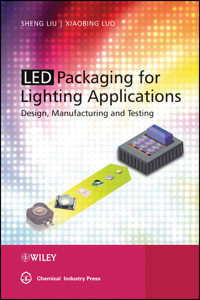
Since the first light-emitting diode (LED) was invented by Holonyak and Bevacqua in 1962, LEDs have made remarkable progress in the past few decades with the rapid development of epitaxy growth, chip design and manufacture, packaging structure, processes, and packaging materials. LEDs have superior characteristics such as high efficiency, small size, long life, low power consumption, and high reliability. The market for white LED is growing rapidly in various applications. It has been widely accepted that white LEDs will be the fourth illumination source to substitute the incandescent, fluorescent, and high-pressure sodium lamps. With the development of LED chip and packaging technologies, the efficiency of high power white LED will broaden the application markets of LEDs while changing the lighting concepts of our lives. In LED Packaging for Lighting Applications, Professors Liu and Luo cover the full spectrum of design, manufacturing, and testing. Many concepts are proposed for the first time, and readers will benefit from the concurrent engineering and co-design approaches to advanced engineering design of LED products. * One of the only books to cover LEDs from package design to manufacturing to testing * Focuses on the design of LED packaging and its applications such as road lights * Includes design methods and experiences necessary for LED engineers, especially optical and thermal design * Introduces novel LED packaging structures and manufacturing processes, such as ASLP * Covers reliability considerations, the most challenging problem for the LED industry * Provides measurement and testing standards, which are critical for LED development, for both LED and LED fixtures * Codes and demonstrations available from the book's Companion Website This book is ideal for practicing engineers working in design or packaging at LED companies and graduate students preparing for work in industry. This book also provides a helpful introduction for advanced undergraduates, graduates, researchers, lighting designers, and product managers interested in the fundamentals of LED design and production. Color version of selected figures can be found at www.wiley.com/go/liu/led
Sie lesen das E-Book in den Legimi-Apps auf:
Seitenzahl: 569
Veröffentlichungsjahr: 2011
Ähnliche


















Contents
Cover
Title Page
Copyright
Foreword by Magnus George Craford
Foreword by C. P. Wong
Foreword by B. J. Lee
Preface
Acknowledgments
About the Authors
Chapter 1: Introduction
1.1 Historical Evolution of Lighting Technology
1.2 Development of LEDs
1.3 Basic Physics of LEDs
1.4 Industrial Chain of LED
1.5 Summary
References
Chapter 2: Fundamentals and Development Trends of High Power LED Packaging
2.1 Brief Introduction to Electronic Packaging
2.2 LED Chips
2.3 Types and Functions of LED Packaging
2.4 Key Factors and System Design of High Power LED Packaging
2.5 Development Trends and Roadmap
2.6 Summary
References
Chapter 3: Optical Design of High Power LED Packaging Module
3.1 Properties of LED Light
3.2 Key Components and Packaging Processes for Optical Design
3.3 Light Extraction
3.4 Optical Modeling and Simulation
3.5 Phosphor for White LED Packaging
3.6 Collaborative Design
3.7 Summary
References
Chapter 4: Thermal Management of High Power LED Packaging Module
4.1 Basic Concepts of Heat Transfer
4.2 Thermal Resistance Analysis of Typical LED Packaging
4.3 Various LED Packages for Decreasing Thermal Resistance
4.4 Summary
References
Chapter 5: Reliability Engineering of High Power LED Packaging
5.1 Concept of Design for Reliability (DfR) and Reliability Engineering
5.2 High Power LED Packaging Reliability Test
5.3 Rapid Reliability Evaluation
5.4 Summary
References
Chapter 6: Design of LED Packaging Applications
6.1 Optical Design
6.2 Thermal Management
6.3 Drive Circuit and Intelligent Control Design
6.4 Summary
References
Chapter 7: LED Measurement and Standards
7.1 Review of Measurement for LED Light Source
7.2 Luminous Flux and Radiant Flux
7.3 Measurement for Luminous Intensity
7.4 LED Chromaticity Coordinates
7.5 Dominant Wavelength Determination Algorithm
7.6 LED Color Purity
7.7 Color Temperature and Correlated Color Temperature of Light Source
7.8 Automatic Sorting for LEDs
7.9 Measurement for LED Road Lights
7.10 Summary
References
Appendix: Measurement Method for Integral LED Road Lights Approved by China Solid State Lighting Alliance
1 Scope
2 Normative References
3 Definitions
4 Main Measurement Items
5 General Requirements and Equipment Requirements for Measurment
6 Measurement Methods
Index
This edition first published 2011
© 2011 Chemical Industry Press. All rights reserved.
Published by John Wiley & Sons (Asia) Pte Ltd, 1 FusionopolisWalk, #07-01 Solaris South Tower, Singapore 138628, under exclusive license by Chemical Industry Press in all media and all languages throughout the world excluding Mainland China and excluding Simplified and Traditional Chinese languages.
For details of our global editorial offices, for customer services and for information about how to apply for permission to reuse the copyright material in this book please see our website at www.wiley.com.
All Rights Reserved. No part of this publication may be reproduced, stored in a retrieval system or transmitted, in any form or by any means, electronic, mechanical, photocopying, recording, scanning, or otherwise, except as expressly permitted by law, without either the prior written permission of the Publisher, or authorization through payment of the appropriate photocopy fee to the Copyright Clearance Center. Requests for permission should be addressed to the Publisher, John Wiley & Sons (Asia) Pte Ltd, 1 Fusionopolis Walk, #07-01 Solaris South Tower, Singapore 138628, tel: 65-66438000, fax: 65-66438008, email: [email protected].
Wiley also publishes its books in a variety of electronic formats. Some content that appears in print may not be available in electronic books.
Designations used by companies to distinguish their products are often claimed as trademarks. All brand names and product names used in this book are trade names, service marks, trademarks or registered trademarks of their respective owners. The Publisher is not associated with any product or vendor mentioned in this book. This publication is designed to provide accurate and authoritative information in regard to the subject matter covered. It is sold on the understanding that the Publisher is not engaged in rendering professional services. If professional advice or other expert assistance is required, the services of a competent professional should be sought.
Library of Congress Cataloging-in-Publication Data
Liu, S. (Sheng), 1963-
LED packaging for lighting applications : design, manufacturing and testing / Sheng Liu, Xiaobing Luo.
p. cm.
Includes bibliographical references and index.
ISBN 978-0-470-82783-3 (hardback)
1. Light emitting diodes–Design and construction. 2. Light emitting diodes–Computer simulation. 3. Electronic packaging. 4. Electric lighting–Equipment and supplies. I. Luo, Xiaobing, 1974- II. Title.
TK7871.89.L53L58 2011
621.3815′22–dc23
2011015480
Print ISBN: 978-0-470-82783-3
ePDF ISBN: 978-0-470-82784-0
oBook ISBN: 978-0-470-82785-7
ePub ISBN: 978-0-470-82840-3
Mobi ISBN: 978-1-118-08295-9
Foreword
By Magnus George Craford
LEDs have been commercially available for nearly 50 years but for most of that time they were low power and relatively inefficient devices that were primarily used for indicator applications. Initially LEDs were red only, but these were soon followed by green and yellow devices and finally about 15 years ago by blue and, with phosphors, white devices. During these years the efficiency increased by a factor of 10 every 10 years. Ten years ago high power (one watt) white LEDs were introduced with efficiencies high enough that there began to be serious discussion about using LEDs for solid state lighting (SSL) applications. Over the last decade performance has continued to increase from about 20 lumens/watt to over 100 lumens/watt today. The power handling capacity of packages has increased, with packages which can handle over 10 watts now available. There is no longer any question about whether LEDs will be important for SSL. I believe the only question is when LEDs will dominate all lighting applications. China has been one of the leaders in pushing for the rapid adoption of LEDs in order to save energy and to provide improved illumination for its vast population. Over the next decade we are sure to see an explosion of new applications, and new package types to enable those applications. A critical issue is to develop packages and systems that enable efficient and reliable solutions to lighting problems. If systems are unreliable it will slow down the adoption of LEDs to the detriment of everyone. There are many books about LEDs but most of them focus on the chip and epitaxial materials technology. Books of this type focusing on packaging and applications are badly needed to help engineers and scientists use LEDs in the most effective manner possible, and to ensure the rapid adoption of efficient LED technology around the world.
The authors Professors Sheng Liu and Xiaobing Luo have done a thorough job of discussing the optical design, thermal management, and reliability of high power LEDs and systems. System reliability is only as good as the weakest link and it is critical for system designers to understand all aspects of the system. The authors have also adopted experience gained in silicon technology to the field of high power LEDs. I am happy to see this book completed and feel that it will be an important addition to our field.
Dr. Magnus George Craford Recipient of the 2002 USA National Medal of Technology Member of Academy of Engineering of the USA IEEE Life Fellow Former Chief Technology Officer Solid State Lighting Fellow Philips Lumileds Lighting Palo Alto, California, USA
Foreword
By C. P. Wong
Design is a multi-disciplinary activity that relies on the expertise of the engineering profession and is supported by the methodology and innovations developed within the fields of science. The integration of science, engineering, and end applications has produced remarkable changes in the end users. This system integration can be demonstrated by the evolution of understanding of solid state physics and compound semiconductors, the development of epitaxial layers, the design of LED devices, and the applications to packaged modules and light fixtures.
The most popular methodology of design is named Design for X (DFX, here X refers to manufacturing, assembly, testing, reliability, maintenance, environment, and even cost), which has been widely adopted by those multinational and many small high tech start-up companies. The design methodology is being adjusted to meet the requirements of a full life cycle, so called “concept/cradle-to-grave” product responsibilities, coined by Dr. Walter L. Winterbottom of Ford Science Lab.
An LED packaging module and the related application systems, like any other electronic systems, involve a lot of manufacturing processes from epitaxial growth to chip manufacturing to packaging and to final fixture assembly, and extensive reliability testing for extended life goals of many critical products such as those used for road lighting, automotive lighting, and so on. Defects in terms of dislocations, voids, cracks, delaminations, and microstructure changes can be induced in any step and may interact and grow in subsequent steps, imposing extreme demands on the fundamental understanding of stressing and physics of failures. Currently, the testing programs have been extensive to assure reliability during the product development. An iterative, build-test-fix-later process has long been used in new product development; significant concerns are being raised as cost effective and fast time-to-market needs may not be achievable with such an approach. In terms of high reliability, system hardware design, manufacturing and testing are costly and time consuming, severely limiting the number of design choices within the short time frame, and not providing enough time to explore the optimal design. With the current situation of three to six months for each generation of LED devices, it is challenging to achieve truly optimal and innovative products with so many constraints in design. Design procedure must be modified and DFX must be used so as to achieve integrated consideration of manufacturing processes, testing, and operation.
Professors Sheng Liu and Xiaobing Luo have been promoting the new design method in the past many years to help assist in material selection, manufacturing yield enhancement, and appropriate rapid reliability assessment when the packaging module and system are subjected to uncertainties of material selection, process windows, and various service loadings. All these issues must be addressed prior to hardware buildup and test. The authors have demonstrated excellent examples for optical, thermal, and reliability aspects. Application of specific LED packaging (ASLP) is indeed an example of a careful design and consideration of packaging integration. Its three-in-one, four-in-one and five-in-one modules conceived by the authors' group are very likely to be widely used by this fast growing industry. They will be popular choices in terms of performance and cost for those traditional light fixture companies, as they represent the true nature of integration in microelectronics, MEMS, and optoelectronics/LED, to name a few fields. Detailed modeling of manufacturing processes such as wire bonding for LED has been shown to be important and the co-design of the LED chip and packaging indeed show the importance of concurrent consideration of traditionally divided product chains and provides a new direction for further improvement of optical performance.
This book focuses on LED packaging for lighting applications and illustrates the importance of packaging and the power of integration in the packaging modules and lighting application systems by the authors' pioneering efforts. Packaging has been ignored from the whole system development in the past and the authors explore four functions of packaging in this book: powering, signal distribution in terms of both optical and electrical signals and quality, thermal management, and mechanical protections. The authors describe their contributions in detail and provide guidance to those in the field and present a design approach that must ultimately replace the build-test-fix-later process if the efficiencies and potential cost benefits of high power LED based systems are to be fully realized.
C.P. Wong IEEE Fellow Member of Academy of Engineering of the USA Former Bell Labs Fellow Regents' Professor, Georgia Institute of Technology, Atlanta, GA 30332
Foreword
By B. J. Lee
Since the invention of the light-emitting diode (LED) by Holonyak and Bevacqua in 1962, the LED has experienced great breakthroughs particularly with the invention of nitride blue LED in the early 1990s by Nakamura from Nichia Corporation of Japan. Ever since then, the average LED usage in each household has grown more than tenfold.
There was no LED industry until mid-1960s. Nevertheless, the worldwide LED device production values have reached $7 billion in year 2008. It is estimated that the compound annual growth rate will be more than 20% for LED applications in the next 10 years. This LED revolution has been affecting the lives of many people around the world. In 2005, global lighting consumed 8.9% of total electric power in a whole year and contributed 0.63% of the GDP, according to Dr. Jeff Tsao from Sandia National Laboratories of the USA. In 2050, the contribution to GDP can reach as high as 1.65%.
The LED chip cannot operate by itself without connection to outside driver circuits. Light, as an optical power coming out of the LED chip, must be extracted efficiently. In order to maintain a good efficacy through a whole temperature range, the generated heat from LED chips must be dissipated as efficiently and as quickly as possible. Finally, mechanical protection must be adopted to prevent the chip from being damaged or being gradually degraded in subsequent testing or operations in harsh environments. While chip manufacturers are making efforts to improve the optical, electrical, and thermal performances of LED chips by various approaches, including better light extraction, improved crystal quality, uniform current spreading, and using substrate with good thermal conductivity, the corresponding packaging technologies must be developed to make use of these chip improvements. Collaborative designs between chip manufacturers and packaging vendors are thus required to take advantage of each others' progress, which has been mostly ignored among LED communities.
In addition, optical design has been playing an important role in improving the LED efficacy. How light can be re-directed efficiently out of the active layers becomes crucial. It involves light extraction, phosphor coating, and secondary optics. More and more emerging applications require certain light emission patterns, which is posing the demand for a matched secondary optical lens along with the original first level optics. Due to the point source characteristics of the LED chip, the glare issue has prompted the LED community to develop highly efficient secondary lenses to reduce the glare effect. In the meanwhile, the cost pressure is always there when compared to the traditional lighting sources, so the functional integration (either monolithically or in a hybrid way) seems to be essential.
Reliability has been the focus of LED industries. LED has been regarded as a more reliable light source compared with traditional light sources. To make LED worthy of the fame, systematic reliability monitoring will be needed before the products are shipped out. Usually, reliability tests are very costly and time-consuming. Therefore, rapid reliability evaluation will be an alternative. It will be difficult to develop a more efficient reliability evaluation method if there still exists poor failure analysis methods, lack of the appropriate test methodology and standards, and shortage of an effective approach to evaluate the safety of the lighting fixtures.
Based on all these issues, there was an urgent need, both for industry and for academy, for a comprehensive book covering the current state-of-the-art technologies in the design of LED packaging for solid state lighting applications. This book has been written in such a way that readers can quickly learn about the fundamental theories and problem-solving techniques, as well as understand the design trade-offs, and finally make accurate system-level decisions.
Dr. Sheng Liu and Dr. Xiaobing Luo have done a significant amount of work and brought together all the useful information from the latest technical publications related to LED packaging. They have together written this technical book entitled LED Packaging for Lighting Applications, an informative book for both industrial and academic users. It is appropriate to be used either as an introductory book for those who are just entering this field or as an up-to-date reference for those who have been engaged in LED packaging and lighting module/system development for some time.
This book covers the subject of LED packaging and related lighting applications on several key topics – high power packaging development trends, optical design of high power LED packaging modules with the focus on the integration of secondary optics into the device packaging, thermal management, reliability engineering including the analysis of failure mechanisms and method of quick evaluation, advanced design of LED packaging applications, and, in the final chapter, an introduction to standards and measurement methods including LED street lights. I am also delighted to find that both authors have made significant efforts to discuss the connection between chip level design (such as surface roughening and color uniformity) and packaging efficiency. I would like to join the authors in hoping that this book will attract the attentions of engineers and applied scientists working in this field, as well as faculty and students, to become aware of the design challenges that must be overcome in order to provide the best products to the market. Let us work together to achieve a greener Earth by lighting the Earth by LED.
B. J. Lee Chairman, Epistar Corporation
Preface
Eight years ago, when the first author was a newcomer in LED packaging, he thought that LED packaging must be easier than integrated circuit (IC) packaging, as there were only two input/output (IO) terminals for most LED packaging, while for IC packaging, IOs tended to be in the hundreds and thousands and there were already many different packaging types such as plastic packaging, ball grid array, flip-chip, wafer level packaging, chip-scale packaging, and so on. After visiting many leading packaging houses and going through details of packaging in our laboratory and at those collaborating companies, he found that the packaging of LED was not that easy. According to the classical definition of conventional IC packaging, there are four major functions of a packaging: powering, signal distribution, thermal management, and mechanical protection. Powering has actually become a bottleneck for the claimed long life of the LED. What is also unique about the packaging is that light and color associated with light are new. Thermal management is also challenging due to the requirement for a lower junction temperature, which is related to both the chip design and packaging design. Mechanical protection is also important due to the natural use of those materials with poor adhesion and possible poor material handling in the early stage of process development. We began to be very interested in high power LED packaging in 2005 and have spent a lot of efforts since then. It has been the belief that the knowledge learned in the past 20 years in IC packaging can be applied to LED packaging and in particular the concept of system in packaging (SiP), which is still a hot research topic in IC packaging and a useful industrial practice as well, can be further developed in LED packaging. This book intends to assemble what we have learned in the past few years into a useful reference book for both the LED and IC packaging communities, with the hope that the results to be presented are going to benefit engineers, researchers, and young students.
Therefore, this book focuses on solid state lighting by light emitting diode (LED) and it is intended for design engineers, processing engineers, application engineers, and graduate students. It is also helpful for art designers for buildings, roadways, and cities. This book provides quantitative methods for optical, thermal, reliability modeling and simulation so that predictive quantitative modeling can be achieved. It proposes Application Specific LED Packaging (ASLP) to integrate the secondary optics into the first level device and modules. This book also further develops System in Packaging (SiP) for LED modules and applications and provides a co-design approach for the rapid design of module and lighting systems so as to minimize the time to market for LED products. Fundamental research is also presented to satisfy the interests of the active researchers.
Since the first light-emitting diode (LED) was invented by Holonyak and Bevacqua in 1962, the field has experienced great breakthroughs particularly in the early 1990s by Nakamura from Nichia Corporation of Japan. Nakamura successfully prepared high-brightness blue and green LED in GaN-based materials. LEDs have made remarkable progress in the past four decades with the rapid development of epitaxy growth, chip design and manufacture, packaging structure, processes, and packaging materials. White LEDs have superior characteristics such as high efficiency, small size, long life, dependable, low power consumption, high reliability, to name a few. The market for white LED is growing rapidly in various applications such as backlighting, roadway lighting, vehicle forward lamp, museum illumination, and residential illumination. It has been widely accepted that solid state lighting, in terms of white LEDs, will be the fourth illumination source to substitute the incandescent lamp, fluorescent lamp, and high pressure sodium lamp. In the next five to eight years, with the development of the LED chip and packaging technologies, the efficiency of high power white LED will reach as high as 160 lm/W to 200 lm/W, which will broaden the application markets of LEDs furthermore and will also change the lighting concepts of our life.
There are already five books on this topic available to readers. They are Introduction to Light Emitting Diode Technology and Applications by Gilbert Held in 2008, Light-Emitting Diodes by E. Fred Schubert in 2006, Introduction to Solid-State Lighting by Arturas Zukauskas, Michael S. Shur, and Remis Gaska in 2002, Introduction to Nitride Semiconductor Blue Lasers and Light Emitting Diodes by Shuji Nakamura, and Shigefusa F. Chichibu in 2000, and Power Supplies for LED Driving by Newnes in 2008. However, all of them allocated a very small section to LED packaging and there is no book focusing on high power LED packaging for applications. The authors thought that this might be due to the highly proprietary nature of high power LEDs. In addition, there are no books dedicated to reliability engineering and standards. In recent years, China has been pushing hard for many demonstration projects in LED. Many lessons have been learned and there is an urgent need for both reliability and standards for both modules and light fixtures. Both authors feel obligated to explore these subjects and contribute to this community by sharing their recent findings so as to promote the healthy development of high power LED packaging and their applications. Chapter 1 provides an introduction of LED. Chapter 2 provides the fundamentals and development trends of high power LED packaging, demonstrating that LED development follows a similar trend to IC packaging. Optical design of high power LED packaging module is discussed in Chapter 3, with the focus on the importance of integration of secondary optics into the device packaging level and more integration of other functions to form more advanced modules. Chapter 4 is devoted to the basic concepts in thermal management. Chapter 5 is devoted to the reliability engineering of high power packaging with the preference of physics of failure based modeling and sensors based prognostics health management for LED systems and more robust models with more physical variables and integration of processing, testing, and field operation. Chapter 6 is devoted to the design of LED packaging applications to sufficient details. Chapter 7 provides an introduction to standards and measurement methods for some applications.
We hope this book will be a valuable source of reference to all those who have been facing the challenging problems created in the ever-expanding application of high power LEDs. We also sincerely hope it will aid in stimulating further research and development on new packaging materials, analytical methods, testing and measurement methods, and even newer standards, with the objective of achieving a green environment and eco-friendly energy saving industry.
The organizations that know how to learn about the design and manufacturing capabilities of high power LED packaging with high reliability have the potential to make major advances in developing their own intellectual properties (IP) in packaging and applications, to achieve benefits in performance, cost, quality, and size/weight. It is our hope that the information presented in this book may assist in removing some of the barriers, avoid unnecessary false starts, and accelerate the applications of these techniques. We believe that the design of high power LED packaging for applications is limited only by the ingenuity and imagination of engineers, managers, and researchers.
Sheng Liu, PhD, ASME Fellow ChangJiang Scholar Professor School of Mechanical Science and Engineering and Wuhan National Laboratory for Optoelectronics Huazhong University of Science and Technology Wuhan, Hubei, China XiaoBing Luo, PhD, Professor School of Energy and Power Engineering and Wuhan National Laboratory for Optoelectronics Huazhong University of Science and Technology Wuhan, Hubei, China
Acknowledgments
Development and preparation of LED Packaging for Lighting Application was facilitated by a number of dedicated people at John Wiley & Sons, Chemical Industry Press, and Huazhong University of Science and Technology. We would like to thank all of them, with a special mention for Gang Wu of Chemical Industry Press and James W. Murphy of John Wiley & Sons. Without them, our dream of this book could not have come true, as they have solved many problems during this book's preparation. It has been a great pleasure and fruitful experience to work with them in transferring our manuscript into a very attractive printed book.
The material in this book has clearly been derived from many sources including individuals, companies, and organizations, and we have attempted to acknowledge the help we have received. It would be quite impossible for us to express our appreciation to everyone concerned for their collaboration in producing this book, but we would like to extend our gratitude. In particular, we would like to thank several professional societies in which we have published some of the material in this book previously. They are the American Society of American Engineers (ASME) and the Institute of Electrical and Electronic Engineers (IEEE) for their conferences, proceedings, and journals, including ASME Transactions on Journal of Electronic Packaging, IEEE Transactions on Advanced Packaging, IEEE Transactions on Components and Packaging Technology, and IEEE Transactions on Electronics Packaging Manufacturing. Many important conferences such as the Electronic Components and Technology Conference (ECTC), and the International Conference on Electronic Packaging Technology & High Density Packaging (ICEPT–HDP) are also acknowledged for allowing the reproduction of some of their publication materials.
We would also like to acknowledge those colleagues who have helped review some chapters in the manuscript. They are Professor Ricky Lee of Hong Kong University of Science and Technology, Professor Dexiu Huang and Professor Liangshan Wang of Huazhong University of Science and Technology (HUST), Professor Jiangen Pan of Everfine Optoelectronics of China, and Dr. Shu Yuan of HK ASTRI. We would like to thank them for their many suggestions and comments which contributed tremendously to this book. Their depth of knowledge and their dedication have been demonstrated throughout the process of reviewing this book.
We would also like to thank Huazhong University of Science and Technology (HUST), Wuhan National Laboratory for Optoelectronics, the School of Mechanical Science and Engineering, and the School of Energy and Power Engineering for providing us with an excellent working environment to make this book possible. Without being able to recruit outstanding students with cross-disciplinary background, it would have been impossible to include the high quality of information regarding optics, thermal management, materials processes, reliability, and intelligent control. To the best knowledge of the authors, HUST is one of the very few schools which have implemented this new policy, which was initiated by President Peigen Li to allow one faculty to recruit students from different schools or departments. We would like to express our appreciation to those who have worked in LED for many years, such as Mr. Zhijiang Dong, and Dr. Caixia Jin of Wuhan AquaLite Company. We also appreciate the help from Guangdong Real Faith Opto Inc. and Guangdong Real Faith Lighting Fixtures Inc. for collaborating in our research and providing us with many packaging module samples and light fixture prototypes. In particular, our thanks go to Mr. Chunxiao Jin, and his engineers for many useful discussions in the industrial implementation of Application Specific LED Packaging (ASLP).
We would like to register our thanks to our outstanding students for their work in contributing material to this book. They include Kai Wang, Zhongyuan Liu, Fei Chen, Shengjun Zhou, Zhaohui Chen, Zhangming Mao, Han Yan, and Pei Wang.
We also appreciate the Chinese Electronics Society and its Electronic Manufacturing and Packaging Branch led by Professor Keyun Bi for providing us with many technical and academic exchange opportunities.
We would also like to acknowledge the support of many funding agencies in the past years such as the USA National Science Foundation, USA SRC (Semiconductor Research Corporation), National Natural Science Foundation of China, The Ministry of Science and Technology of China, Hubei Department of Science and Technology, Wuhan Science and Technology Bureau, Guangdong Department of Science and Technology, Foshan Bureau of Science and Technology, and Nanhai Bureau of Science and Technology. The authors also appreciate an excellent learning environment created by China Solid State Lighting Alliance in the past few years by organizing many activities and conferences. The authors are delighted to have worked with outstanding people such as Ms. Ling Wu, Dr. Jiming Li, Mr. Jun Yuan, Mr. Yubo Fan, Mr. Bo Geng, and many office assistants involved in conference and training under Ms. Ling Wu's leadership, and those other members of the National Expert Committee for SSL. Sheng Liu enjoyed working with them during the past years and learned a lot in different aspects of SSL by many stimulating discussions. Working and socializing with them has been a privilege and a pleasant experience.
Finally, Sheng Liu would like to thank his parents, Mr. Jixian Liu and Ms. Yanrong Shen, his wife, Bin Chen, and his daughter Amy Liu, his son Aaron Liu, and XiaoBing Luo would like to thank his parents, Mr. Junsheng Luo and Ms. Daxiang Shen, his wife, Ling Deng, and his daughter Yanran Luo for their love, consideration, and patience in allowing them to work on many weekends and late nights for this book. It is the authors' simple belief that the contribution of this book to the LED lighting and packaging industry is worthwhile, in this rapid development of solid state lighting, and will continue to be worthwhile to our civilization for so many years to come. The authors would like to dedicate this book to their families.
Sheng Liu, PhD, ASME Fellow Chang Jiang Scholar Professor School of Mechanical Science and Engineering and Wuhan National Laboratory for Optoelectronics Huazhong University of Science and Technology Wuhan, Hubei, China XiaoBing Luo, PhD, Professor School of Energy and Power Engineering and Wuhan National Laboratory for Optoelectronics Huazhong University of Science and Technology Wuhan, Hubei, China
About the Authors
Sheng Liu is a Changjiang scholar professor of Mechanical Engineering at Huazhong University of Science and Technology and he has a dual appointment at Wuhan National Laboratory for Optoelectronics. He was once a tenured faculty at Wayne State University. He has over 19 years of experience in LED/MEMS/IC packaging. He has extensive experience in consulting with many leading multinational and Chinese companies. He won the prestigious White House/NSF Presidential Faculty Fellow Award in 1995, ASME Young Engineer Award in 1996, NSFC Overseas Young Scientist Award in 1999 in China, IEEE CPMT Exceptional Technical Achievement Award in 2009, and Chinese Electronic Manufacturing and Packaging Technology Society Special Achievement Award in 2009. He has been an associate editor of IEEE Transaction on Electronic Packaging Manufacturing since 1999 and an associate editor of Frontiers of Optoelectronics in China since 2007. From 2006 to 2010, he was one of the 11 National Committee Members in LED at the Ministry of Science and Technology of China. He obtained his PhD from Stanford University in 1992, his MS and BS degrees from Nanjing University of Aeronautics and Astronautics in 1986 and 1983 respectively. He was an aircraft designer at Chengdu Aircraft Company for two years. He is currently also an ASME Fellow. He has filed and owned more than 100 patents in China and in the USA, and has published more than 400 technical articles, given more than 100 keynotes and invited talks, edited more than nine proceedings in English for the ASME and the IEEE.
Xiaobing Luo is a professor in Huazhong University of Science and Technology (HUST), Wuhan, China. He works at the School of Energy and Power Engineering and Wuhan National Lab for Optoelectronics in HUST. He received his PhD in 2002 from Tsinghua University, China. From 2002–2005, he worked in the Samsung Advanced Institute of Technology (SAIT) in Korea as a senior engineer and obtained SAIT Best Researcher Award in 2003. In September 2005, he was back in China and became an associate professor. In November 2007, he became a full professor after exceptional promotion. His main research interests are LED and electronics packaging, heat and mass transfer, and MEMS. He has published more than 50 papers, applied and owned 40 patents in the USA, Japan, Korea, Europe, and China.
Chapter 1
Introduction
1.1 Historical Evolution of Lighting Technology
In the history of human development, lighting sources have experienced numerous changes initially from collecting natural fire sources to making fire by drilling wood. The development of lighting has witnessed the progress of human history. Fire plays an important role in human history in that it provides humans with food, warmth, and brightness. The use of fire follows the tremendous progress of human civilization. Prior to the eighteenth century, fire had always been a lighting tool for humans, the form of which developed from torch, animal oil lamp, and vegetable oil lamp to the candle, and later to the widely used kerosene lamp. Humans have never stopped exploring new lighting methods. During the use of oil lamps, the wick developed from grass to cotton to multi-strand cotton. Around the third century BC, people made candles with beeswax. In the eighteenth century, candles had been made with paraffin, and mass production of candles was enabled by using machines. In the ninteenth century, the British invented the gas lamp that was originally used as a street lamp. Because of its flickering flame, and the harmful gases that would be produced when it was extinguished, the gas lamp was not very safe and was very dangerous for indoor uses. However, through improvements, the gas lamp replaced the kerosene lamp in tens of thousands of households. These light sources all depended on the flames of the burning materials to provide light. In the eighteenth century, the invention of electricity greatly promoted the development of society, bringing new opportunities for the provision of lighting. In 1809, David Humphrey in Britain invented the arc light, using an electrical light source that was produced by the separation of two contacting carbon rod electrodes after electrifying the electrodes in the air [1]. It was used in public and was the first electric light source for practical lighting before the invention of the incandescent lamp. However, because burning produced a hissing sound and the light was too bright, it was not appropriate for indoor lighting. In 1877, a Russian invented the electric candle by modifying the structure of the arc light, but its performance was not improved. At that time, many scientists began to explore a new, safe, and warm light source.
Lesen Sie weiter in der vollständigen Ausgabe!
Lesen Sie weiter in der vollständigen Ausgabe!
Lesen Sie weiter in der vollständigen Ausgabe!
Lesen Sie weiter in der vollständigen Ausgabe!
Lesen Sie weiter in der vollständigen Ausgabe!
Lesen Sie weiter in der vollständigen Ausgabe!
Lesen Sie weiter in der vollständigen Ausgabe!
Lesen Sie weiter in der vollständigen Ausgabe!




