


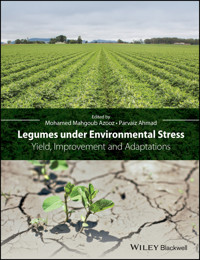
Legumes under Environmental Stress E-Book
148,99 €
Mehr erfahren.
- Herausgeber: John Wiley & Sons
- Kategorie: Fachliteratur
- Sprache: Englisch
Legumes under Environmental Stress
Legumes under Environmental Stress
Yield, Improvement and Adaptations
Leguminous crops have been found to contribute almost 27% of the world’s primary crop production. However, due to environmental fluctuations, legumes are often exposed to different environmental stresses, leading to problems with growth and development, and ultimately, decreased yield.
This timely review explains the transcriptomics, proteomics, genomics, metabolomics, transgenomics, functional genomics and phenomics of a wide range of different leguminous crops under biotic and abiotic stresses, and their genetic and molecular responses. Amongst others the text describes the effect of nutrient deficiency, pesticides, salt and temperature stress on legumes.
Importantly, the book explores the physiobiochemical, molecular and omics approaches that are used to overcome biotic and abiotic constraints in legumes. It looks at the exogenous application of phytoprotectants; the role of nutrients in the alleviation of abiotic stress; and the microbial strategy for the improvement of legume production under hostile environments.
Key features:
- demonstrates how to mitigate the negative effect of stress on leguminous crops, and how to improve the yield under stress
- the most up-to-date research in the field
- written by an international team of active researchers and practitioners across academia, industry and non-profit organisations
This volume is a valuable and much-needed resource for scientists, professionals and researchers working in plant science, breeding, food security, crop improvement and agriculture worldwide. In universities it will educate postgraduate and graduate students in plant science and agriculture; it will also benefit those in scientific institutions and in biotech and agribusiness companies, who deal with agronomy and environment.
Sie lesen das E-Book in den Legimi-Apps auf:
Seitenzahl: 1083
Veröffentlichungsjahr: 2014
Ähnliche




















CONTENTS
Cover
Title page
Copyright page
List of contributors
Preface
About the editors
Chapter 1: Legumes and breeding under abiotic stress: An overview
1.1 Introduction
1.2 Legumes under abiotic stress
1.3 Breeding of cool season food legumes
1.4 Breeding of cool season food legumes under abiotic stress
1.5 Breeding of warm season food legumes
1.6 Breeding of warm season food legumes under abiotic stress
1.7 Biotechnology approaches
1.8 Conclusions and future prospects
References
Chapter 2: Salt stress and leguminous crops: Present status and prospects
2.1 Introduction
2.2 Effects of salinity
2.3 Responses of plants to salinity
2.4 Lessons from studies of the leguminous crops
2.5 Omics technologies for understanding salt stress responses in legumes
2.6 Conclusions and future prospects
References
Chapter 3: Nutrient deficiencies under stress in legumes: An overview
3.1 Introduction
3.2 Environmental stresses and crop growth
3.3 Effects of nutrient deficiency
3.4 Methods to control nutrient deficiency
3.5 Micronutrient deficiency in plants
3.6 Roles of macronutrients in growth of legumes
3.7 Storage proteins in legumes and effect of nutritional deficiency
3.8 Protective mechanisms triggered in legumes under stress
3.9 Conclusion
References
Chapter 4: Chickpea: Role and responses under abiotic and biotic stress
4.1 Introduction
4.2 Origin and occurrence
4.3 General botany
4.4 Nutritional uses
4.5 Abiotic stress
4.6 Chickpea and abiotic stress: The ‘omics’ approach
4.7 Biotic stress
4.8 Breeding of chickpea for biotic stress
4.9 Conclusion and future prospects
References
Chapter 5: Chickpea and temperature stress: An overview
5.1 Introduction
5.2 Impacts on productivity
5.3 Impacts on nutritional and processing quality
5.4 Breeding for tolerance to temperature stresses
5.5 Conclusions
References
Chapter 6: Effect of pesticides on leguminous plants: An overview
6.1 Introduction
6.2 Uptake, metabolism and persistence of pesticides
6.3 Effects of pesticides on leguminous plants
6.4 Pesticide tolerance in legumes
6.5 Conclusion
References
Chapter 7: Oxidative stress and antioxidant defence systems in response to pesticide stress
7.1 Introduction
7.2 Fate of pesticides in plants, soil and water
7.3 Pyrethroids: mode of action
7.4 Oxidative stress and ROS production in plants
7.5 Conclusion and future prospects
References
Chapter 8: Legume-rhizobia symbiotic performance under abiotic stresses: Factors influencing tolerance behaviour
8.1 Introduction
8.2 Symbiotic association: A specific plant-microbe interaction
8.3 Legume-rhizobia symbiosis: A vulnerable association under osmotic stresses
8.4 Nodulation process and symbiotic performance variability
8.5 Variability of symbiotic partners’ input to symbiosis resilience
8.6 Effect of osmotic stress on nodule integrity and functioning
8.7 Future prospects
References
Chapter 9: Microbial strategies for the improvement of legume production in hostile environments
9.1 Introduction
9.2 Abiotic stresses affecting legume crop productivity
9.3 Improving legume yield by inoculation with rhizobacteria
9.4 Biomechanisms regulating growth and development
9.5 Conclusions and future prospects
References
Chapter 10: Role of abscisic acid in legumes under abiotic stress
10.1 Introduction
10.2 Effect of abiotic stress on ABA biosynthesis, catabolism and transport
10.3 Perception of ABA in legumes under abiotic stress
10.4 ABA mediating whole-legume responses to abiotic stress
10.5 ABA regulation of leaf expansion under abiotic stress
10.6 ABA as a regulator of nodulation under abiotic stress
10.7 ABA and assimilate accumulation under abiotic stress
10.8 ABA mediating the expression of abiotic stress-responsive genes
10.9 Concluding remarks and future prospects
References
Chapter 11: Exogenous application of phytoprotectants in legumes against environmental stress
11.1 Introduction
11.2 Importance of legumes
11.3 Legume responses to environmental stresses
11.4 Application of phytoprotectants for enhancing stress tolerance
11.5 Conclusion and future perspectives
11.6 Acknowledgements
References
Chapter 12: Genetic and molecular responses of legumes in a changing environment
12.1 Introduction
12.2 Legumes: a botanical treasure
12.3 Environmental threats to legumes
12.4 Genetic and molecular responses to salt stress
12.5 Genetic and molecular responses to drought
12.6 Genetic and molecular responses to extremes in temperatures
12.7 Plant defence mechanisms and their efficiency
12.8 Conclusion and future prospects
References
Chapter 13: Omics approaches and abiotic stress tolerance in legumes
13.1 Introduction
13.2 Omics: Solutions to abiotic stress in legumes?
13.3 Transcriptomics
13.4 Proteomics
13.5 Metabolomics
13.6 Genomics
13.7 Transgenomics
13.8 Functional genomics
13.9 Phenomics
13.10 Conclusions and future prospects
References
Chapter 14: MicroRNA-mediated regulatory functions under abiotic stresses in legumes
14.1 Introduction
14.2 MicroRNAs (miRNAs): Small but significant
14.3 Micro-RNA identification and functional diversity in legumes
14.4 MicroRNA expression profiling under abiotic stresses in legumes
14.5 MicroRNAs play important roles in nodulation and symbiosis in legumes
14.6 MicroRNA-mediated approaches for functional genomics in legumes
14.7 Conclusions and future prospects
References
Chapter 15: Biotechnology approaches to overcome biotic and abiotic stress constraints in legumes
15.1 Introduction
15.2 Legumes and their importance
15.3 Legumes in stressed environments
15.4 Host defence mechanisms
15.5 Disease and stress checkpoints
15.6 Biotechnology in legumes
15.7 Molecular approaches to improving legume defences
15.8 Integration of GM legumes in current agricultural systems
15.9 Conclusion and future prospects
References
Chapter 16: Gene pyramiding and omics approaches for stress tolerance in leguminous plants
16.1 Introduction
16.2 Approaches to incorporate stress tolerance mechanisms
16.3 Conclusions
References
Chapter 17: Combating phosphorus deficiency on alkaline calcareous soils by adsorption isotherm technique for legume crops in arid environments
17.1 Introduction
17.2 Methodology
17.3 Results and discussion
17.4 Conclusions
References
Index
End User License Agreement
List of Tables
Chapter 02
Table 2.1 List of leguminous crops (pulses) as classified by FAO (1994).
Table 2.2 Summary of leguminous crops genome sequence information.
Table 2.3 Summary of proteomic publications in leguminous crops.
Chapter 03
Table 3.1 List of important nutrients required for plant growth.
Table 3.2 Effects of nutrient deficiency on plant development.
Chapter 06
Table 6.1 Effect of pesticides on nodulation by symbiotic bacteria in legumes.
Chapter 09
Table 9.1 Germination of various soybean genotypes 2, 6 and 10 days after sowing in Petri dishes at different concentrations of NaCl.
Table 9.2 Mean squares from analysis of variance for various plant traits of 29 genotypes of chickpea at three concentrations of NaCl.
Table 9.3 Effect of salinity on shoot and root length of chickpea genotypes (seedlings were grown in a gnotobiotic sand system for 3 weeks).
Chapter 11
Table 11.1 Nutritional composition (per 100 g of edible parts) of the major pulses.
Table 11.2 Amount of nitrogen fixation in soil by different pulse crops.
Table 11.3 Yield reduction due to different abiotic stress in legumes.
Table 11.4 Protective effects of phytoprotectants on the growth and physiology of legumes grown under environmental stresses.
Chapter 12
Table 12.1 Metabolites produced by legumes in response to salt stress.
Table 12.2 Signalling cascade and effector elements activated in response to environmental stress factors.
Table 12.3 Genetic bases for induction of tolerance to environmental stress factors.
Chapter 15
Table 15.1 Biotic and abiotic stress response factors.
Table 15.2 Genetically modified legumes and the genes manipulated for enhancing abiotic stress resistance.
Table 15.3 Biotechnology tools applied to leguminous plants for stress resistance.
Chapter 16
Table 16.1 A summary of proteomic analysis of legume plants under variable stresses.
Table 16.2 Various molecular markers used for genomic analysis in stressed legumes.
Chapter 17
Table 17.1 Some basic physical and chemical properties of the three soils.
Table 17.2 P sorption parameters of the Freundlich model.
Table 17.3 Model and linear parameters of the Freundlich equation.
Table 17.4 P doses by Freundlich adsorption model for the three soils.
Table 17.5 Green fodder yield in five cuttings of berseem (1st crop) on sandy clay loam soil.
Table 17.6 Green fodder yield in five cuttings of berseem (1st crop) on clay loam soil.
Table 17.7 Green fodder yield in five cuttings of berseem (1st crop) on sandy loam soil.
Table 17.8 Dry matter (%) of berseem on the three soils.
Table 17.9 P concentration (%) of berseem on the three soils.
Table 17.10 Crude protein (%) of berseem on the three soils.
Table 17.11 Crude fibre (%) of berseem on the three soils.
Table 17.12 Model-based P rates for mung bean for sandy clay loam soil.
Table 17.13 Model-based P rates for mung bean for clay loam soil.
Table 17.14 Model-based P rates for mung bean for sandy loam soil.
Table 17.15 Effect of applied P on grain yield (Mg/ha) of mung bean on the three soils.
Table 17.16 Effect of applied P on protein content of mung bean on the three soils.
Table 17.17 Model-based P rates for berseem for sandy clay loam soil.
Table 17.18 Model-based P rates for berseem for clay loam soil.
Table 17.19 Model-based P rates for berseem for sandy loam soil.
Table 17.20 Effect of applied P on green fodder yield (Mg/ha) of berseem on the three soils.
Table 17.21 Effect of applied P on dry matter (%) of berseem on the three soils.
Table 17.22 Effect of applied P on P concentration (%) of berseem on the three soils.
Table 17.23 Effect of applied P on crude protein (%) of berseem on the three soils.
Table 17.24 Effect of applied P on crude fibre (%) of berseem on the three soils.
List of Illustrations
Chapter 02
Figure 2.1 Effect of salt stress and responses of plant.
Chapter 03
Figure 3.1 Mechanism of stress.
Figure 3.2 Stressor dose and stress effect relationship in plants.
Figure 3.3 Phases of stress and their consequences on the plant.
Figure 3.4 Emission spectrum of
Saccharum officinarum
plant under intense salinity.
Chapter 05
Figure 5.1 Heat-sensitive genotype anther structural abnormalities: anther stained with Alexander’s stain. (a) Locule number changed (ICC 4567). (b) Anther epidermis wall is thickened (ICC 4567). (c) Anther shows fertile and sterile pollen grain (ICC 5912). Fertile – red in colour; sterile – green in colour. Scale: 10 μm.
Figure 5.2 Effect of high temperatures on the pollen germination on the stigma. (a) Heat-tolerant: ICC 15614 – pollen germination on the stigma. (b) Heat-sensitive: ICC 10685 – no pollen germination on the stigma.
Figure 5.3 Comparison of seed size under heat stress. Larger seeds (left side) from non-stressed and smaller seeds (right side) from heat-stressed conditions.
Chapter 06
Figure 6.1 Effect of pesticide stress on nodulation and nitrogenase activity of nitrogen-fixing bacteria.
Chapter 07
Figure 7.1 Structural formulae of
cis
- and
trans
-permethrin.
Chapter 09
Figure 9.1 The effect of NaCl concentration on the colonization of
Mezorhizobium
sp. in the rhizosphere of
Glycyrrhiza uralensis
.
Chapter 10
Figure 10.1 Abscisic acid (ABA) biosynthesis and catabolism pathways. The steps from zeaxanthin to xanthoxin in
de novo
ABA synthesis occurring in plastids are shown. Xanthoxin moves from the plastids to the cytoplasm and is converted to ABA. In the catabolic pathways, ABA is inactivated through either oxidation or conjugation. Hydroxylation as well as hydrolysis of ABA-GE is shown with the corresponding enzymes. Postulated pathways are shown by broken lines and the confirmed pathways are shown as solid lines. ER, endoplasmic reticulum; PA, phaseic acid; DPA, dihydrophaseic acid; ABA-GE, ABA glucosyl ester.
Chapter 11
Figure 11.1 Major pulse crops grown in South Asia.
Figure 11.2 Root system of
Sesbania aculeata
containing nodules, organs formed in leguminous plants that help to fix N in soil. They are a product of successful interactions between the host plant and the soil bacteria,
Rhizobium
spp.
Figure 11.3 Glutathione-mediated toxic metal and xenobiotic detoxification in plant cells. AsA, ascorbic acid; GPX, glutathione peroxidase; GSH, glutathione; GST, glutathione-
S
-transferase; PC, phytochelatin, PCS, phytochelatin synthase; ROS, reactive oxygen species.
Figure 11.4 Possible mechanisms of NO-induced oxidative stress protection.
Chapter 12
Figure 12.1 Series of cellular changes in response to saline stress.
Figure 12.2 Physiological and biochemical responses to moderate drought.
Figure 12.3 Cellular changes involved in developing cold tolerance in legumes.
Chapter 13
Figure 13.1
Figure 13.2
Chapter 15
Figure 15.1 Importance of legumes in various sectors.
Figure 15.2 Legume response to biotic and abiotic stress factors.
Figure 15.3 Biotechnology intervention pathway for stress resistance in legumes.
Chapter 16
Figure 16.1 General steps of marker-assisted selection (MAS).
Figure 16.2 Example of gene pyramiding scheme accumulating six target genes. P1–P6: founding parents; H: hybrids.
Figure 16.3 Demonstration of phenomena of stress acclimatization by plants at the transcriptional level. ABA, abscisic acid; LEA, late embryogenesis abundant; ROS, reactive oxygen species.
Guide
Cover
Table of Contents
Begin Reading
Pages
iii
iv
vii
viii
ix
x
xi
xii
xii
1
2
3
4
5
6
7
8
9
10
11
12
13
14
15
16
17
18
19
20
21
22
23
24
25
26
27
28
29
30
31
32
33
34
35
36
37
38
39
40
41
42
43
44
45
46
47
48
49
50
51
53
54
55
56
57
58
59
60
61
62
63
64
65
67
68
69
70
71
72
73
74
75
76
77
78
79
81
82
83
84
85
86
87
88
89
90
91
92
93
94
95
96
97
98
99
100
101
103
104
105
106
107
108
109
110
111
112
113
114
115
116
117
118
119
120
121
122
123
124
125
126
127
128
129
130
131
133
134
135
136
137
138
139
140
141
142
143
144
145
146
147
148
149
150
151
152
153
154
155
156
157
158
159
160
161
162
163
164
165
166
167
168
169
170
171
172
173
174
175
176
177
178
179
180
181
182
183
184
185
186
187
188
189
190
191
192
193
194
195
196
197
199
200
201
202
203
204
205
206
207
208
209
210
211
212
213
214
215
216
217
218
219
220
221
222
223
224
225
226
227
228
229
230
231
232
233
234
235
236
237
238
239
240
241
242
243
244
245
247
248
249
250
251
252
253
254
255
256
257
258
259
260
262
263
264
265
266
267
268
269
270
271
272
273
274
275
276
277
278
279
280
281
282
283
285
286
287
288
289
290
291
292
293
294
295
296
297
298
299
301
302
303
304
305
306
307
308
309
310
Legumes under Environmental Stress
Yield, Improvement and Adaptations
EDITED BY
Mohamed Mahgoub Azooz
South Valley University, Egypt
Parvaiz Ahmad
S.P. College, Srinagar, J&K, India
This edition first published 2015. © 2015 by John Wiley & Sons, Ltd.
Registered OfficeJohn Wiley & Sons, Ltd, The Atrium, Southern Gate, Chichester, West Sussex, PO19 8SQ, UK
Editorial Offices9600 Garsington Road, Oxford, OX4 2DQ, UKThe Atrium, Southern Gate, Chichester, West Sussex, PO19 8SQ, UK111 River Street, Hoboken, NJ 07030-5774, USA
For details of our global editorial offices, for customer services and for information about how to apply for permission to reuse the copyright material in this book please see our website at www.wiley.com/wiley-blackwell.
The right of the author to be identified as the author of this work has been asserted in accordance with the UK Copyright, Designs and Patents Act 1988.
All rights reserved. No part of this publication may be reproduced, stored in a retrieval system, or transmitted, in any form or by any means, electronic, mechanical, photocopying, recording or otherwise, except as permitted by the UK Copyright, Designs and Patents Act 1988, without the prior permission of the publisher.
Designations used by companies to distinguish their products are often claimed as trademarks. All brand names and product names used in this book are trade names, service marks, trademarks or registered trademarks of their respective owners. The publisher is not associated with any product or vendor mentioned in this book.
Limit of Liability/Disclaimer of Warranty: While the publisher and author(s) have used their best efforts in preparing this book, they make no representations or warranties with respect to the accuracy or completeness of the contents of this book and specifically disclaim any implied warranties of merchantability or fitness for a particular purpose. It is sold on the understanding that the publisher is not engaged in rendering professional services and neither the publisher nor the author shall be liable for damages arising herefrom. If professional advice or other expert assistance is required, the services of a competent professional should be sought.
Library of Congress Cataloging-in-Publication Data
Azooz, M. M. Legumes under environmental stress : yield, improvement and adaptations / Mohamed Mahgoub Azooz, Parvaiz Ahmad. pages cm Includes bibliographical references and index.
ISBN 978-1-118-91708-4 (cloth)1. Legumes–Effect of stress on. 2. Legumes–Yields. 3. Legumes–Adaptation. I. Ahmad, Parvaiz. II. Title. SB177.L45A96 2015 633.3–dc23
2014025842
A catalogue record for this book is available from the British Library.
Wiley also publishes its books in a variety of electronic formats. Some content that appears in print may not be available in electronic books.
List of contributors
Mohammad Abass AhangerSchool of Studies in BotanyJiwaji UniversityGwaliorIndia
Fakiha AfzalAtta-ur-Rahman School of Applied BiosciencesNational University of Sciences and Technology (NUST)IslamabadPakistan
Parvaiz AhmadDepartment of BotanyS.P. CollegeSrinagarJammu and KashmirIndia
Shakeel AhmadDepartment of AgronomyBahauddin Zakariya UniversityMultanPakistan
Md. Mahabub AlamLaboratory of Plant Stress ResponsesDepartment of Applied Biological ScienceKagawa UniversityKagawaJapan
Mohammad AliInstitute of BiotechnologyBahauddin Zakariya UniversityMultanPakistan
Saroj AroraDepartment of Botanical and Environmental SciencesGuru Nanak Dev UniversityAmritsarIndia
Sadia ArshadAtta-ur-Rahman School of Applied BiosciencesNational University of Sciences and Technology (NUST)IslamabadPakistan
Mohamed Mahgoub AzoozDepartment of BotanyFaculty of ScienceSouth Valley UniversityQenaEgypt
Lesen Sie weiter in der vollständigen Ausgabe!
Lesen Sie weiter in der vollständigen Ausgabe!
Lesen Sie weiter in der vollständigen Ausgabe!
Lesen Sie weiter in der vollständigen Ausgabe!
Lesen Sie weiter in der vollständigen Ausgabe!
Lesen Sie weiter in der vollständigen Ausgabe!
Lesen Sie weiter in der vollständigen Ausgabe!
Lesen Sie weiter in der vollständigen Ausgabe!
Lesen Sie weiter in der vollständigen Ausgabe!
Lesen Sie weiter in der vollständigen Ausgabe!
Lesen Sie weiter in der vollständigen Ausgabe!
Lesen Sie weiter in der vollständigen Ausgabe!
Lesen Sie weiter in der vollständigen Ausgabe!
Lesen Sie weiter in der vollständigen Ausgabe!
Lesen Sie weiter in der vollständigen Ausgabe!
Lesen Sie weiter in der vollständigen Ausgabe!
Lesen Sie weiter in der vollständigen Ausgabe!
Lesen Sie weiter in der vollständigen Ausgabe!
Lesen Sie weiter in der vollständigen Ausgabe!
Lesen Sie weiter in der vollständigen Ausgabe!
Lesen Sie weiter in der vollständigen Ausgabe!




