


Erhalten Sie Zugang zu diesem und mehr als 300000 Büchern ab EUR 5,99 monatlich.
- Herausgeber: Luath Press
- Kategorie: Gesellschafts- und Liebesromane
- Sprache: Englisch
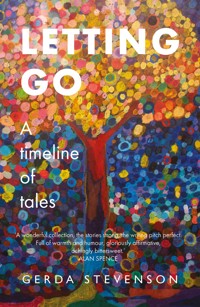
The twelve stories in Letting Go take us on a journey through landscape, language and turbulent times, from the mid-19th century to the present day, and into the future. Stevenson's array of characters from many walks of life and nationalities – including a traveller, a wood carver, chicken farm workers, a nurse, an architect and a magician – meet and part, some becoming reacquainted. Themes exploring identity, creativity and the environment, echo and connect throughout the different narratives, sometimes carried in snatches of song. The author leads us outward from her native Scottish Borders to Edinburgh, Glasgow and the Gàidhealtachd, south to England, across the Atlantic to Apartheid South Africa and, finally, to the melting Arctic.
Sie lesen das E-Book in den Legimi-Apps auf:
Seitenzahl: 234
Veröffentlichungsjahr: 2021
Das E-Book (TTS) können Sie hören im Abo „Legimi Premium” in Legimi-Apps auf:
Ähnliche



















GERDA STEVENSON is an award-winning writer, actor, theatre director and singer-songwriter. She has worked on stage, television, radio, film and in opera, throughout the UK and abroad, and is a recipient of Scottish Arts Council and Creative Scotland writers’ bursaries. Her stage play, Federer Versus Murray, directed by the author, toured to New York in 2012, and was published there by Salmagundi. In 2014 she was nominated as Scots Singer of the Year for the MG Alba Scots Trad Music Awards, following the launch of an album of her own songs Night Touches Day. She has written extensively for radio, including original plays and dramatisations of Scottish novels. Her poetry collections, If This Were Real (Smokestack Books, 2013), and Quines: Poems in Tribute to Women of Scotland (Luath Press, 1st edition 2018, 2nd edition 2020) have been published in Rome by Edizioni Ensemble in Italian translations by Laura Maniero, 2017 and 2021, respectively. She wrote the biographical introduction and a series of poems for the book Inside & Out: The Art of Christian Small, (Scotland Street Press, 2019). She collaborated with Scottish landscape photographer Allan Wright on their book Edinburgh, for which she wrote the introduction and a sequence of twenty-two poems (Allan Wright Photographic, 2019). In 2021, she directed a film of George Mackay Brown’s play The Storm Watchers, for the St Magnus International Festival. A seasoned performer, she won a BAFTA Best Film Actress award for her role in Margaret Tait’s feature film Blue Black Permanent, and is the founder of Stellar Quines, Scotland’s leading women’s theatre company.
By the same same author:
Poetry:
If This Were Real (Smokestack Books, 2013)
Se Questo Fosse Vero / If This Were Real (Edizioni Ensemble, Rome, 2017)
Quines: Poems in Tribute to Women of Scotland (Luath Press, 1st edition 2018, 2nd edition 2020)
Quines: Tributo poetico a donne della Scozia (Edizioni Ensemble, 2021)
Inside & Out: The Art of Christian Small, with an introduction and poems by Gerda Stevenson (Lyne Press, 2018; Scotland Street Press, 2019)
Edinburgh (Allan Wright Photographic, 2019)
Plays for stage:
Pentlands at War, a community play, co-written with the Pentlands Writers’ Group (Scottish Borders Council Library Services, 2006)
Federer Versus Murray (Salmagundi, USA, 2012)
For children:
The Candlemaker and Other Stories, illustrated by the author (Kahn & Averill, 1987)
First published 2021
ISBN: 978-1-80425-007-5
The author’s right to be identified as author of this book under the Copyright, Designs and Patents Act 1988 has been asserted.
Typeset in 10.5 point Sabon by
Main Point Books, Edinburgh
© Gerda Stevenson 2021
Contents
Graves
Bella Day
Letting Go
Colour
The Apple Tree
Chromosomes and Chocolate
A Day Off
Merryland Street
The Fiver
The Grail
A Botanical Curiosity for Eve
Skeleton Wumman
Acknowledgements
Scots Glossary
In memory of Marilyn Imrie, inspirational catalyst, collaborator, and encourager.
Graves
SARAH WAS PERCHED on top of a ladder, leaning against the gallery, paintbrush in hand. The vestry door opened below, and an autumn gust swept into the quiet kirk, billowing her long skirts. A man entered in a cloud of leaves.
‘Hello?’ she called down to him, flustered, trying to smooth the air from her petticoats without getting paint everywhere.
He looked up at her. ‘Thought ye were an angel, there, missus!’
She observed him from her perch. He was broad shouldered, but slim, with a tousie mass of black hair. His face, as their eyes met, had an open look about it, she thought, like a moorland road. ‘Can I help?’ she asked.
‘I’m in hopes ye can,’ he said, scanning the pews.
She wrapped the paintbrush in a cloth, laid it on the gallery ledge, and with her back to him, descended the ladder, one hand holding up her skirts to avoid tripping. She was sure his eyes were examining every inch of her exposed ankles and shins.
‘Never seen a leddy up a ladder afore,’ he smiled, and offered his hand, which she didn’t take, as she stepped onto the floor from the last rung. ‘No yin o the gentry at ony rate.’ He surveyed the gallery, where she’d been highlighting the biblical texts in gold leaf. ‘Bonnie wood-work. Some skill, yon carvin.’
‘Thank you,’ she said, glad of the compliment.
‘Whit – ye done it yersel? Aa thae vines? Aa thae wee falderals o thistles and wheat and…?’ His words tailed off in amazement.
‘Not all by myself – my sister too.’
He took hold of her hands. She pulled away, but he held on with firmness, and turned them over in his, as if appraising a set of priceless new tools. She was well into her twenties, but no man had ever touched her, let alone held her like this. His skin was dark as peat against hers, and sent a shiver through her stomach.
‘Fine fingers ye have, missus – strang and canny, yet gentle wi it. And yer palms – like tough, white silk.’
‘Our father’s a surgeon,’ she replied, extracting herself at last from his grip.
‘So I’ve heard. And tae the Queen hersel.’
‘Yes. People say we get it from him, the precision of the scalpel.’
‘Weel, wood is a kind o flesh, that’s true. I work wi willow masel. Baskets.’
‘Ah,’ she said. ‘You’re a hawker?’
‘That’s no why I’m here.’
‘Are you looking for someone, then?’
‘I am.’ He seemed to be hinting she should know. His breath quickened.
‘Well?’ she prompted.
He pinned her with his eyes. ‘For the man that killed ma mither.’
They stood in silence for a moment as she tried to take this in.
‘But… but why here?’
‘Weel, nae maiter,’ he sighed, as if suddenly dismissing the subject. ‘Are ye needin ony baskets? I’ve a few in ma cairt.’
‘Oh, so you are a hawker!’
‘I hae tae earn a livin,’ he said simply.
Politeness prevailed as she recovered her composure: ‘I’d like to see your baskets, yes,’ and she moved towards the door.
‘Naw, naw!’ he called over his shoulder, sweeping past her. ‘I’ll bring them in. Nae pynt staunin aboot in the cauld. The deil’s fair blawin up a bleester oot there!’
Sarah doubted he was looking for his mother’s killer – more likely a sales strategy to elicit sympathy. He returned with four baskets – two on each arm.
‘These are well made,’ she said, fingering the firm weave. ‘I like this one – perfect for gathering mushrooms. My old basket’s a bit battered with use.’
‘The right season fur it,’ he nodded.
‘It is. The birch woods over the burn are full of chantarelles and ceps right now.’
‘Horn o plenty’s the best – yon black curly yin. Grows unner beech trees.’
‘Trumpet of Death, the French call it.’
‘Daith?’ he repeated, a glimmer of challenge in his smile.
‘Yes. Trompette de la Mort,’ she found herself elaborating, though somehow wished she hadn’t.
‘Should be life,’ he replied. ‘They’re full o goodness – a hale meal in a single bite.’
She’d only a few coppers in her skirt pocket to pay for the basket, but he accepted what she had, and agreed to bring another of the same design a day or two later for her sister. He was camped in the hills, he said, doing seasonal work as a navvy on the new reservoir, which would power the paper mills in the nearby town. ‘There’s three hunner o us workin up there. Irish, maistly, an a hantle o us traivellers.’
Sarah had heard something of this, and with dismay. The reservoir was once a small loch, her childhood playground on unforgettable summer days. Father used to fish there, and sometimes, as a treat, when Mother was well enough, he hired a carter to take the family with him. The housekeeper prepared a hamper, and Mother spread the feast on a linen cloth, white as a cloud, its lace edges fluttering like moths in the grass. The girls stripped to their camisoles and bloomers, and swam in the clear water under a blue sky. ‘I know that place,’ she told the traveller. ‘I used to swim out to a small island there.’
‘The yin wi the seven graves?’
‘Yes – like stone beds,’ she said, intrigued and delighted that he seemed so familiar with a part of the world she loved. The graves had appeared one year after a huge storm washed the topsoil away.
‘They’ll be unner watter soon, when the dam’s finished.’
‘My sister and I used to lie in them, and pretend we were dead – a sin, I’m sure!’
‘Could be,’ he agreed. ‘Daith’s no juist a game.’
She blushed then, at her faux pas in returning to the subject, but blundered on, flustered. ‘Ancient burial kists, my father told us.’
‘Oh, aye,’ he said with a dark look. ‘Yer faither wud ken aa aboot graves.’
Four days passed, and still he hadn’t come with the promised second basket. Sarah tried, but couldn’t put this man and their meeting from her mind. He’d unsettled her. She found it hard to concentrate.
Time was her own these days, since her sister Margaret had married, and the church project hers to complete. Father was away in London most of the year. Mother spent much of her time in bed – always had done, though the sisters were never quite sure why. ‘The curse,’ Mrs Pennel, the housekeeper would say mysteriously, with no further explanation, like that time, when they were young girls, and wandered into the laundry. Mrs P was rubbing strips of linen in a basin of reddish-pink water that looked like blood. ‘Awa wi ye!’ she called, shooing them out of the door. ‘Ye’re ower young fur kennin the curse!’
Every month, the strips would hang like fillets of pale skin pegged on a line in the laundry – never outside with the rest of the washing. Sarah thought she was going to die when, as a girl of thirteen, she woke up one morning to find her bed sheet blotted with scarlet.
‘The curse,’ said Mrs P. ‘Comes tae us aa, lassie. Noo, oot ye get!’ and she pulled the stained sheet from under her. ‘Awa and gie yersel a wash, and I’ll fetch the strips fur ye.’
When she handed them to her, Sarah wondered if they were the same ones they’d seen her scrubbing that day in the laundry. They did look faintly pink. She shuddered at the thought of her mother’s diluted blood, dried particles locked into those linen threads, lurking there and mingling with her own. You could never wash blood away, no matter how hard you tried, especially from these tattered emblems of shame.
‘I suppose a dish of chanterelles might tempt my appetite,’ Mother sighed wanly, propped up against a huge pile of pillows banked like clouds. Sarah had brought the new basket up to the bedroom to show her.
But she didn’t want to miss the traveller calling by. So, despite her fractured concentration, and her guilt at not responding to her mother’s wistful hint, Sarah decided against foraging for the time being, and got on with her work. She climbed the ladder to measure up the West window in preparation for designing the final ivy border. And she still had the gilding of the texts around the gallery to complete. There were eleven in all, each set in an oak panel, carved with images from nature – abundant grapes hanging from tendrils for I am the vine – ye are thebranches, and sheaves of wheat for Give us this day our daily bread. The last was her favourite – mournful willows bending around the words Weep with them that weep. They expressed well the tender exhortation of the text, she felt, and reminded her of the song Mrs P always sang when she was ironing:
Why weep ye by the tide, lady,
Why weep ye by the tide,
I’ll wad ye tae ma youngest son,
And ye shall be his bride.
And ye shall be his bride, lady,
Sae comely tae be seen.
The last line of the melody had a weeping downward flow, like her carved willows:
But aye she loot the tears doonfaa
For Jock o Hazeldean.
A whole week passed, then two. The weather was fine, and Sarah decided to head for the woods. But inviting as they were, birch leaves kindling to an autumn blaze, she passed them by, her basket empty, and made for the hills, up to the reservoir. After a couple of miles, an unfamiliar sound filtered through the still air – almost industrial, she thought, as she drew nearer – a cacophony of ringing metal, the rumble of wheels, and voices calling – singing, even. As she rounded the last bend in the track, she saw a crowd of men digging. Horses were pulling carts loaded with huge stones. The march of progress, she thought ruefully, watching her childhood idyll being ripped apart and restructured by an army. The reality was much more shocking than she’d imagined. A group of women and children sang as they stamped the ground rhythmically in a muddy basin gouged out of the loch-side.
‘That’s the overflow,’ said a voice at her shoulder. She swung round, and there he was – her traveller, spade in hand. ‘I spied ye comin up the hill, yer hat bobbin aa the way. I thocht it micht be you.’
She hadn’t seen him approach, so intent she’d been on the scene. ‘What are those women and children doing?’
‘Trampling the grun – puddle clay, we cry it – watterproof when it’s spreid oot flat tae mak a clean surface. They’re aa fitted wi shoon fur the job, by the consortium, ken – the mill owners. First and last thae fowk’ll ever see o guid leather on their feet.’
Tents were pitched close to the loch, smoke coiling from workers’ camp fires.
‘Do you have family here?’ she asked, with the sudden realisation that he might be married.
‘I’m on ma ain,’ was his oblique response. ‘I havenae made it doon tae see ye this past week – the foreman’s giein a real push wi the wark while the weather’s braw. But I’ve got yer basket.’
‘I mustn’t hold you back.’
‘Naw, naw, I can tak a wee break, shairly,’ and he led her to his tent, a hazel bender, with blankets neatly wrapped round the frame. A fire burned outside under a tripod of carefully cut sticks, a steaming pot hanging from them on a willow loop. He opened the door flap, and she glanced inside. His make-shift home was arranged with simple care – a narrow bed of straw, a wooden box next to it, and various tools. A pile of baskets lay in one corner.
‘Come in,’ he said, beckoning her. ‘Choose the yin ye fancy.’
She hesitated. This tent was his bedroom. A whistle went up from a lad walking past with a spade on his shoulder. ‘Entertainin the gentry, are we now, Duncan?’ he teased, with an Irish lilt, and gave her a wink.
She blushed scarlet, and turned away. ‘I must be getting back,’ she told the traveller. ‘I don’t need another basket, really.’
He followed her along the track, until a shout from the foreman called him to his work. ‘Guid tae see ye, miss… sorry – I dinnae ken yer name.’ He took her hand. ‘As ye juist heard tell, I’m Duncan.’
‘Sarah.’ Her cheeks reddened again – why on earth had she been so familiar as to give him her Christian name!
‘Well, Sarah. I hope it winnae be lang till next we meet.’
That dark inquisition behind his eyes troubled and thrilled her. She blushed even deeper, and scurried off down the hill, stopping by the woods to fill her basket with chanterelles. Their golden heads nestling among tree roots in the dappled leafy light calmed her hectic mind. She knelt down and pushed her fingers into the damp moss to feel for each stem’s base, gently lifting the fluted flesh from its bed. Her senses tingled with pleasure.
Another week went by. All she could think of was Duncan. Until now, she’d assumed her life was set in stone: the unmarried eldest daughter, her sickly mother’s companion, and local upholder of her absent father’s reputation. Her sister Margaret had always been the one to draw attention – lively, confident and beautiful with her long auburn plaits and wide set, sky blue eyes. Everything about her was vibrant. Sarah, her father once said, cuttingly, was ‘a mousy brown creature of the shadows’; though Mother offered the dubious consolation that her tall stature and mysterious grey eyes were saving graces.
The congregation frowned on the sisters’ wood carving, deemed an unsuitable occupation for women. But Sarah loved it – the pungent smell of wood shavings in the shed where she worked next to the house, set out with all the tools she needed. Her own domain. It filled her with satisfaction, though dangerously close to pride – the alchemy of graven images. She knew this was why it wasn’t talked of at home. But the minister, now Margaret’s husband, had approved the project. He’d seen and praised the carving practised by the sisters since their teens, when he was a frequent visitor. Locally he was considered to be suspiciously liberal, tolerated only because of his standing. Sarah liked him, and the church carving went ahead largely due to his endorsement. After several years it was now nearing completion, though over the last eighteen months the work had been entirely Sarah’s. Since her marriage, Margaret had lost all interest in their joint endeavour. An uncomfortable distance had crept into the sisters’ relationship, and Sarah struggled sometimes with resentment.
The low chime of the grandfather clock in the hall was the loneliest sound she could think of, especially when she sat on her own every evening, served by Mrs P at the huge mahogany dining table. She watched her fingers articulating the ranks of heavy silver cutlery, and remembered how Duncan had held her hands in his, and admired them, when they first met. She found herself examining the white skin of her slender wrists peeping through her lace cuffs. There was no mirror in the house – vanity couldn’t be countenanced – but right now she wished there was – a full length one. Thinking of Duncan made her want to see herself without clothes on. A new moistness seeped between her thighs – pleasureable – different from the shameful monthly bleed.
One night, when she was getting ready for bed, she took the candle to the darkened window, and looked at her naked body reflected in the glass. The curve of her breasts, the sweep of waistline down to hips and thighs pleased her – a sin, she knew it, but was it so very different from the way the shapes she’d carved in the church gave her pleasure? She wondered if her brother-in-law, the minister, had ever seen her sister like this. She was certain her father had never looked at her mother unclothed. She couldn’t imagine it possible, although he must have seen many naked bodies in the anatomy class at medical school. Strange, it occurred to her, that given her father’s profession, the human body and its functions were never discussed at home.
Duncan wanted something from her, she could see that in his eyes, although she couldn’t fathom what it might be. Was it really to do with his mother’s death, or could it be herself he wanted – this naked vision, gleaming in the dark glass?
The last carved ivy vine now fringed the lower half of the West window. Sarah was pleased with the flowing lines – the tendrils appeared to grow with a lovely grace towards the apex of the arch. Her work was finished, and she’d been at a loose end for days. At night she was restless – couldn’t sleep.
A harvest moon hung like a blood orange above the hills. She decided to take a walk before bed, down the brae to the kirk graveyard. From above the wall, before she entered, she could already see the obelisk that soared at the centre, the monument proclaiming her ancestor’s pre-eminence – part of an imposing stone enclosure with its own elaborate iron gate. She read the names – lawyers, medics, their wives and daughters. She’d be buried there herself one day, she supposed.
‘Shairly ye’re no thinkin o leavin us?’
She spun round to find Duncan at her shoulder again, reading her thoughts, it seemed.
‘Will we sit doon on yon grave?’ he asked, pointing to one that lay outside her family’s enclosure, flat like a bed on stone supports. The image of a couple was carved on its surface – a young man and woman holding hands in their last, eternal sleep. No names marked their short lives, and Sarah had always wondered who they were. Some said brother and sister, but she was certain they were lovers. Duncan took her hand: ‘Come on, I’m shair they’ll no mind!’
She sat next to him on the cold grave in the moonlight.
‘What is it you want from me?’ she asked, her heart beating so loud she was sure he must hear it.
‘Och,’ he sighed, as if expelling a dead weight from his core, ‘I thocht I kent, but I’m no sae shair noo. I’m that weary o it aa.’
‘Is it about your mother?’
‘Aye. It is.’
‘I’m sorry.’
‘Well, it wis, but noo… did ye ken yer faither warked wi thon anatomist, Dr Knox in Edinburgh toon? The yin that bocht the bodies frae the burkers – the grave snatchers?’
She’d heard rumours, she told him, that was all. She’d once asked her mother about it. But the question was ignored, the frosty response simply that her father was a baronet.
‘And whan they ran oot o graves tae herry, the burkers, as we cry them, they took tae murderin fowk – traivellers, they went fur, ma fowk, and sauld them tae the medics. Your faither wis in chairge o gettin the bodies frae the burkers, and peyin fur them.’
‘My father – payed for…?’
‘Aye. That’s richt.’
‘And your mother – she was…?’
Her father knew the Commandments. He’d seen the panel she and Margaret had carved in the gallery – the words Thou Shalt Not Kill featured there. He’d even praised the finesse of their representation. He was trained to preserve life – not collude in its obliteration. Oh, she was familiar with the arguments – how could surgeons learn the science without the raw material to practice on? Perhaps that’s how he’d seen this man’s mother. Raw flesh. The biblical texts she’d carved splintered into meaningless fragments in her mind.
‘I’ve hud a kind o mission since I wis a bairn, when I lost ma mither tae the burkers. I’ve askit the hale country ower whaur Maister Knox and yer faither micht be fund. But they’re aye in London toon, I’m tellt; and I hae mair chance o findin gowd in a midden.’
‘I’m sorry – I really am,’ she said, hating herself for emphasising what she felt was such an inadequate response.
He looked her straight in the eye. ‘I heard yer faither’s faimily bide hereaboots, so I cam tae hae it oot wi you insteid.’
She felt implicated somehow, by association, and wondered whether her sister knew about this horror. They sat in silence till it occurred to her that the timing of his appearance tonight was strange. ‘Why have you come so late?’
‘I’m leavin the wark at the reservoir.’
‘What – leaving tonight?’
‘Aye. It’s a slave business they’re runnin up there. I’m ma ain maister. I’m movin on.’
She was sure he was looking at her with something more like gladness than accusation. ‘Why did you not have it out with me sooner, that day in the kirk, when you first came here?’
‘Och, lass,’ he said. ‘Ye took the wund oot ma sails.’
‘How? I don’t understand.’ She’d been the one with the wind in her sails that day, she remembered, the way it went blowing up her petticoats when he opened the kirk door!
‘Wi yer bonnie carvin, that’s how, an yer bonnie face.’
She wanted to say she’d go with him, leave this place and join him on the open road. She felt certain he’d say ‘Yes’, that this was what he wanted of her now. The words of Mrs Pennel’s song came to her, the final verse:
They socht her baith by bower and haa,
The lady wasnae seen,
She’s ower the border and awa
Wi Jock o Hazeldean.
Her mother would be calling, as she always did, last thing at night, asking her to rearrange the pillows, to read a passage from the bible.
He took her hands in his, just as he’d done on the day they first met, turning them over, her palms white in the moonlight. It was as if he was reacquainting himself with every detail of something precious he’d lost and found, and was about to lose again. Then he let them go and stood up. ‘Weel, that’s me, lass. I’ll be on ma way.’
She watched him leave the graveyard, heard him call ‘gee up’ to his horse, heard the hooves and cart wheels fading on the night air.
‘Wait!’ she called after him, and she ran and ran, all the way down the road till she caught up with him. ‘Please – wait!’
‘Whoa!’ he called, and the horse stopped.
‘I want to come with you,’ she heard herself say, breathless with running, clutching the shaft of the cart.
‘Are ye shair, lass?’ was all he asked.
‘Yes,’ she said.
He held out his hand, and pulled her up next to him.
‘I’m sure. I’ve finished with everything here.’
Bella Day
SEE ROSEHIPS? i used tae go doon the Deanfoot Road every dinnertime tae pick them, for the vitamin C, tae send them awa for the syrup. Daein ma bit for the war. Funny, tae think o thae fat red rubies, full o lifeblood, ripenin in the sun, while bombs were drappin, and blood runnin oot oor lads in spates.
I’d get a roll frae Haldane’s, or sometimes frae Russell the Bakers. It’s aye quiet at dinnertime, the village goes dead sleepy. Just the chug, chug, o the trains goin up and doon the moor tae the munitions store at Macbiehill. And the birds. I like the soond o the geese best. Maks me think o far awa places. I’d like tae go tae a far awa place. Used tae wish I wis on a silver beach in the sun, when I wis workin in MacFarlane’s Drapers. It’s that dark in there. Dark wood o the coonter and the shop cupboards. And Miss MacPhail. She wis aye that nippy wi me:
‘Now don’t you dare be back late, Mary! I want the floor swept and washed this afternoon. And the glass doors dusted down.’
‘Right-oh, Miss MacPhail.’
It wis nice tae get oot. The roll could hae done wi a bit butter, though. And a banana would hae been just dandy – lang wedges sliced in the middle – but we hadnae seen a banana for years, no since the rations came in. There wis a guid crop o rosehips, mind. They’d reached their best that day, ripened full and fat, and I wis fillin up ma broon paper poke.
‘Buon giorno, signorina!’
I nearly jumped oot ma skin! A dark-haired man wis sittin by the roadside, eatin a cooked tattie. I hadnae seen him – he wis leanin back in the sun, by a rose bush, near the gate tae Robinsland Farm.
‘Che bella giornata!’
‘Eh – whit?’ I didnae ken whit he wis on aboot. Made nae sense. He waved his airms at the blue sky, and smiled at me.
‘Bella.’
Bella. I’d heard it afore – a lassie’s name.
‘Bella. Like you!’
‘Oh… aye.’ The penny drapped. I went red as a rosehip. ‘So it is. It’s a bella day.’




