


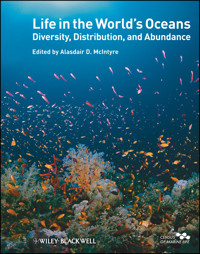
Life in the World's Oceans E-Book
175,99 €
Mehr erfahren.
- Herausgeber: John Wiley & Sons
- Kategorie: Fachliteratur
- Sprache: Englisch
Life in the World's Oceans: Diversity, Abundance and Distribution is a true landmark publication. Comprising the synthesis and analysis of the results of the Census of Marine Life this most important book brings together the work of around 2000 scientists from 80 nations around the globe. The book is broadly divided into four sections, covering oceans past, oceans present, oceans future and a final section covering the utilisation of the data which has been gathered, and the coordination and communication of the results. Edited by Professor Alasdair Mcintyre, Marine Life is a book which should find a place on the shelves of all marine scientists, ecologists, conservation biologists, oceanographers, fisheries scientists and environmental biologists. All universities and research establishments where biological, earth and fisheries science are studied and taught should have copies of this essential book on their shelves. * A true landmark publication * One of the most important marine science books ever published * Contributions from many world leading researchers * Synthesis of a huge amount of important data * Represents the culmination of 10 years' research by 2000 scientists from 80 countries
Sie lesen das E-Book in den Legimi-Apps auf:
Seitenzahl: 1110
Veröffentlichungsjahr: 2011
Ähnliche




















Contents
Foreword
Introduction
Acknowledgements
Contributors
The Scientific Steering Committee of the Census of Marine Life
PART I Oceans Past
Chapter 1 Marine Animal Populations: A New Look Back in Time
1.1 Introduction
1.2 The Background
1.3 The HMAP Projects
1.4 Conclusions
Acknowledgments
References
PART II Oceans Present – Geographic Realms
Chapter 2 Surveying Nearshore Biodiversity
2.1 Introduction
2.2 The Status of Regional Nearshore Biodiversity Knowledge
2.3 Historical Knowledge of Global Nearshore Biodiversity
2.4 Closing Information Gaps
2.5 NaGISA’s Major Findings
2.6 Remaining Questions
2.7 Conclusions
Acknowledgments
References
Chapter 3 Biodiversity Knowledge and its Application in the Gulf of Maine Area
3.1 Introduction
3.2 Environmental and Biogeographic Setting and History of Human Use
3.3 Objective, Approaches, and Progress
3.4 Perspectives on Generating and Using Biodiversity Information
3.5 Future Directions
Acknowledgments
References
Chapter 4 Coral Reef Biodiversity
4.1 Introduction
4.2 Background: The “Known" before the Census
4.3 The Census of Coral Reef Ecosystems Approach
4.4 CReefs Results
4.5 Gaps in Knowledge
4.6 Advancing Knowledge
4.7 Conclusions
Acknowledgments
References
Chapter 5 New Perceptions of Continental Margin Biodiversity
5.1 Introduction: Diversity Re-examined as Slope Complexity is Disclosed
5.2 Roles of Habitat Heterogeneity in Generating and Maintaining Continental Margin Biodiversity CO MARGE Questions and Strategies
5.3 Spatial Trends in Biodiversity
5.4 Human Influence on Continental Margin Ecosystems
5.5 Achievements and Perspectives: The Unknown Aspects of Margin Biodiversity
Acknowledgments
References
Chapter 6 Biodiversity Patterns and Processes on the Mid-Atlantic Ridge
6.1 Introduction
6.2 Discoveries
6.3 Knowledge Gaps
6.4 Recommendations
6.5 Conclusions
Acknowledgments
References
Chapter 7 Life on Seamounts
7.1 Introduction: A History of Seamount Research
7.2 A Global Census of Marine Life on Seamounts (CenSeam)
7.3 What Factors Drive Community Composition and Diversity on Seamounts?
7.4 What are the Impacts of Human Activities on Seamount Community Structure and Function?
7.5 Knowledge Transfer to Stakeholders
7.6 Moving Beyond 2010: Emerging Issues
7.7 Moving Forward: The Next Decade of Seamount Research
Acknowledgments
References
Chapter 8 Diversity of Abyssal Marine Life
8.1 Introduction
8.2 Abyssal Plains
8.3 The CeDAMar Rationale
8.4 Finding Answers: Methods and Programs of CeDAMar
8.5 Major Results
8.6 Remaining Challenges and New Questions
8.7 Moving On
Acknowledgments
References
Chapter 9 Biogeography, Ecology, and Vulnerability of Chemosynthetic Ecosystems in the Deep Sea
9.1 Life Based on Energy of the Deep
9.2 Finding New Pieces of the Puzzle (2002–2010)
9.3 Limits to Knowledge
9.4 Human Footprints in Deep-Water Chemosynthetic Ecosystems
9.5 Conclusions
Acknowledgments
References
Chapter 10 Marine Life in the Arctic
10.1 Introduction
10.2 The Background
10.3 ArcOD Activities
10.4 Unknown Aspects
10.5 Into the Future
Acknowledgments
References
Chapter 11 Marine Life in the Antarctic
11.1 Introduction
11.2 The Background
11.3 CAML Projects: Advancing Knowledge
11.4 Blueprint for the Future
11.5 Conclusions
Acknowledgments
References
PART III Oceans Present – Global Distributions
Chapter 12 A Global Census of Marine Microbes
12.1 Introduction
12.2 Challenges of a Microbial Census
12.3 Highlights of ICoMM Investigations
12.4 A Census of Microbial Lipids
12.5 Viewing Microbial Diversity through a Community Lens
12.6 Marine Microbes and Their Roles in a Changing Ocean
12.7 New Questions
12.8 Outlook
Acknowledgments
References
Chapter 13 A Census of Zooplankton of the Global Ocean
13.1 Introduction
13.2 Historical Perspective
13.3 Approaches to the Study of Marine Zooplankton
13.4 Results from CMarZ
13.5 Significance and Impacts
13.6 Challenges and Opportunities for the Future
Acknowledgments
References
PART IV Oceans Present – Animal Movements
Chapter 14 Tracking Fish Movements and Survival on the Northeast Pacific Shelf
14.1 Introduction
14.2 Contributions from the POST Array to Marine Science
14.3 Interdisciplinary Studies a s a Model for Future Research: Sockeye Salmon
14.4 Summary and New Directions
14.5 Summary
Acknowledgments
References
Chapter 15 A View of the Ocean from Pacific Predators
15.1 Large Pelagic Species in the Marine Ecosystems of the North Pacific
15.2 Tagging of Pacific Predators, 2000–2008
15.3 Limitations to Knowledge of Marine Top Predators
15.4 The Future of Marine Biologging
15.5 Conclusions
Acknowledgments
References
PART V Oceans Future
Chapter 16 The Future of Marine Animal Populations
16.1 Introduction
16.2 Biodiversity Patterns and their Drivers
16.3 Long-term Trends in Abundance
16.4 Animal Movements
16.5 Concluding Remarks
Acknowledgments
References
PART VI Using the Data
Chapter 17 Data Integration: The Ocean Biogeographic Information System
17.1 Introduction
17.2 List of Acronyms
17.3 The Data Sharing Challenge
17.4 Development of OBIS
17.5 Using OBIS
17.6 Future of OBIS
Acknowledgments
References
Index
Alasdair D. McIntyre
The many Census scientists who contributed to this volume dedicate it to the memory of Alasdair McIntyre who passed away near its completion. Some of us knew him for many years, while others for only a few, but we all greatly appreciated his wisdom, wit, and perpetual curiosity. His contributions to marine science have been many and he was one of the first to propose an international study of marine biodiversity. Alasdair will be greatly missed.
This edition first published 2010 © 2010 by Blackwell Publishing Ltd
Blackwell Publishing was acquired by John Wiley & Sons in February 2007. Blackwell’s publishing programme has been merged with Wiley’s global Scientific, Technical, and Medical business to form Wiley-Blackwell.
Registered office
John Wiley & Sons Ltd, The Atrium, Southern Gate, Chichester, West Sussex, PO19 8SQ, United Kingdom
Editorial offices
9600 Garsington Road, Oxford, OX4 2DQ, United Kingdom 2121 State Avenue, Ames, Iowa 50014–8300, USA
For details of our global editorial offices, for customer services and for information about how to apply for permission to reuse the copyright material in this book please see our website at www.wiley.com/wiley-blackwell.
The right of the author to be identified as the author of this work has been asserted in accordance with the UK Copyright, Designs and Patents Act 1988.
All rights reserved. No part of this publication may be reproduced, stored in a retrieval system, or transmitted, in any form or by any means, electronic, mechanical, photocopying, recording or otherwise, except as permitted by the UK Copyright, Designs and Patents Act 1988, without the prior permission of the publisher.
Wiley also publishes its books in a variety of electronic formats. Some content that appears in print may not be available in electronic books.
Designations used by companies to distinguish their products are often claimed as trademarks. All brand names and product names used in this book are trade names, service marks, trademarks or registered trademarks of their respective owners. The publisher is not associated with any product or vendor mentioned in this book. This publication is designed to provide accurate and authoritative information in regard to the subject matter covered. It is sold on the understanding that the publisher is not engaged in rendering professional services. If professional advice or other expert assistance is required, the services of a competent professional should be sought.
Library of Congress Cataloging-in-Publication Data
Life in the world’s oceans: diversity, distribution, and abundance/edited by Alasdair D. McIntyre. p. cm.
Includes bibliographical references and index.
ISBN 978-1-4051-9297-2 (hardback: alk. paper) 1. Marine animals. 2. Marine ecology. 3. Biodiversity. 4. Census of Marine Life (Program) 5. Zoological surveys. 6. Oceanography. I. McIntyre, A. D. QH541.5.S3L54 2010 577.7-dc22
2010005814
Foreword
The Census of Marine Life is about the total richness of the sea:
The Census of Marine Life is the book of oceans' nature.
This book reports total richness.
It reports richness of diversity, the richness of what.
It is about kinorhynchs, tardigrades, rotifers, gastrotrichs, and tantulocarids housed in Arctic polynyas.
It is about Antarctic actiniarians, pycnogonids, tunicates, and holothurians.
It is about the golden V kelp in the Aleutian Islands.
It is about polychaetes, bivalves, and isopods of the continental margins.
It is about sturgeon and salmon, sea turtles and pinnipeds, otters and sirenia.
It is about filter feeders.
It is about radiolaria and hydrozoa.
It is about lanternfishes and pearlfishes and roundnose grenadiers.
It is about a black, benthopelagic lobate ctenophore and a large pelagic worm with ten long cephalic tentacles.
It is about 10,000 crabs.
It is about 5,000 to 19,000 unique types of bacteria in each gram of sand.
It is about Upper Turonian diatoms.
This is a book about vastness and deepness.
It reports richness of distributions, the richness of where.
It is about the Western and Eastern Pacific, and about South American seas.
It is about Caribbean, European, and Polar seas and Indian and Atlantic oceans.
It is about the abyssal plains and basins beneath half of Earth's surface.
It is about the Porcupine Abyssal Plain.
It is about the canyons of the margins.
It is about large shallow banks and gravelly shorelines.
It is about Lizard Island and Ningaloo Reef.
It is about the architecture of seamounts.
This is a book of journeys.
It is about leatherback turtles tagged on their nesting beaches in Indonesia crossing Pacific longitudes to feed off central California.
It is about sooty shearwaters flying Pacific latitudes from New Zealand to the Bering Sea.
It is about water columns 5,000 meters high.
It is about the planet's busiest commute, the nightly rise of life from hundreds of meters deep to feed nearer the surface in the safety of darkness.
It is about circumpolar currents.
This is a book that explores abundance, the richness of how much.
It is about the northerly flowing Kuroshio Current along the southern Japanese coast characterized by high biodiversity but low biomass.
It is about shimmering shoals of herring swirling in numbers beyond counting.
This is a book about past richness.
It is about Greek merchants trading fish from the Black Sea and the Russian rivers to the Greek and later the Roman market.
It is about the decline of marbled rock cod and mackerel ice fish west of the Antarctic Peninsula.
This is a book of lost reefs.
This is a book about life and death.
It is about juvenile salmon and adult sturgeon.
It is about immature specimens carrying sperm packages.
It is about the loneliness of reproductive isolation.
It is about mass mortality.
It is about small dead coral heads.
It is about prey fields patrolled by marine hunters.
It is about fidelity to birthplace.
This is a book of paradoxes, where extreme is normal and rare is common.
This is a book of contrasts.
It is about the cosmopolitan and the local.
It is about glaciation and boiling seafloor geysers where metal would melt yet animals live.
It is about ancient assemblages and modern benthos.
It is about swimmers and drifters and sitters.
This is a book of mysteries.
It is about oceanic barriers to gene flow.
It is about trophic subsidies to carnivores.
It is about the immense volume of ocean still unexplored.
It is about 20 million marine microbes that might remain to be described.
It is about cryptic species.
It is a book of powerful prostheses.
It is a book of ships and sledges and gliders and pyrotags.
It is a book of attached identity cards and different mesh sizes.
It is a book that filters a million cubic meters of seawater.
It is a book of blue-water divers.
It is a book where yellow dots are actual observations of lionfish.
This book reports the known, unknown, and unknowable of the first Census of Marine Life.
This book is about the richness of 3.5 billion years.
Jesse H. Ausubel
Alfred P. Sloan Foundation
Introduction
Reflecting upon the successes of the Census of Marine Life over the past decade, I am recalling how my contemporaries and I first became interested in marine biodiversity. As an undergraduate, I had a small National Science Foundation grant to study the macrofaunal invertebrates in samples taken to examine sediment transport processes either side of a sand-mud transition at the edge of the Labrador Current off what is now the Cape Cod National Seashore. The leader of the expedition, John Zeigler, wanted to know how wave activity controlled sediment transport and the location of the transition from sandy to muddy sediments on the seafloor, and Howard Sanders wanted to know what lived either side of this transition. Except for the specimens from Vineyard Sound described by the great naturalist A.E. Verrill, most of the organisms belonged to undescribed species. Subsequently, in graduate school at Duke University, this experience led me to study bottom life either side of another sand-mud transition on the continental slope off North Carolina and, subsequently, to a career identifying and describing the diversity of life on continental shelves and coral reefs and in the deep sea.
In the 1980s, concern about loss of species diversity in all environments greatly increased with the realization that diversity of life in rain forests and coral reefs must be protected and studied. E.O. Wilson and Peter Raven were and still are articulate advocates for maintaining the diversity of life on the planet. In parallel with the efforts to protect terrestrial biodiversity, marine scientists met under the auspices of the International Association for Biological Oceanography and the UNESCO Working Group on High Diversity Marine Ecosystems. Participants at the meetings included leading marine biologists, such as Bruno Battaglia (Italy), Pierre Lasserre (France), Ramon Margalef (Spain), Alasdair McIntyre (UK), Tim Parsons (Canada), and Howard Sanders (USA). In 1990 Pierre Lasserre, Alasdair McIntyre, Carleton Ray (USA), and I wrote "A Proposal for an International Programme of Research: Marine Biodiversity and Ecosystem Function" (Grassle et al. 1991). When Diversi- tas, the international program of biodiversity science, was established in 1991, this marine program was incorporated (Ray & Grassle 1991). US support for marine biodiversity began with the establishment of the National Research Council's Committee on Biological Diversity in Marine Systems, chaired by Cheryl Ann Butman (now Zimmer) and James Carlton. Following a workshop attended by 54 leading US marine scientists, Butman and Carlton wrote Understanding Marine Biodiversity: A Research Agenda for the Nation (Committee on Biological Diversity in Marine Systems 1995), one of the most widely read reports published by the National Academy Press. However, this did not lead immediately to a program of research. Colleagues in Woods Hole urged me to talk with Jesse Ausubel at the Rockefeller University, who, unknown to me at the time, was also a program manager at the Alfred P. Sloan Foundation. Starting with initial discussions of the feasibility of a Census of the Fishes, Jesse built strong support within the marine biology community for a broader research approach, and I became the first chair of the Census of Marine Life Steering Committee.
With strong initial commitment, and sustaining support from the Alfred P. Sloan Foundation, this initiative will achieve its goal of a comprehensive Census of Marine Life by the end of 2010. Research on species diversity started with Evelyn Hutchinson's question in 1959: "Why are there so many kinds of animals?" (Hutchinson 1959). Hutchinson estimated there might be about 1 million species globally and, of these, three-quarters were insects. At that time, ocean life was very poorly known and only a very small proportion of species were thought to live in the ocean. Now, with nearly a decade of support from the Census, a rich diversity of previously unknown marine species has been discovered and previously unknown habitats are being described. The deep- sea floor is no longer considered a desert, characterized by a paltry diversity of species.
Marine scientists are at present unable to provide good estimates of the total number of species in any of the three domains of life that flourish in the ocean (Archaea, Bacteria, and Eukarya). From their molecular signatures, animals are in a relatively well-defined supergroup that also includes the fungi. There are at least five and probably more supergroups. If we consider only the kingdom Ani- malia, the number of species may be knowable, but it will probably take at least another decade of the Census before we can defensibly estimate the total number of marine species.
Before the Census, most marine biologists studying life in the ocean worked chiefly in shallow water or on continental shelves, where the prime scientific interest was food chains leading to harvestable populations of fish or shellfish. To achieve an estimate of the diversity, distribution, and abundance of life in the ocean in 10 years, the Census has endeavored to sample the full range of marine taxa from pole to pole and surface to abyssal depths. The products of the Census in 2010 constitute a quantum leap toward a full assessment of life in the oceans, and others are already planning for the second Census in the next decade. It is hard to recall how little we knew just 10 years ago and to predict how much we will learn in the next decade.
To provide the context for studying present-day life in the ocean, the History of Marine Animal Populations (HMAP) project of the Census has asked what lived in the ocean? Changes in the abundance and size of harvested marine populations are being documented from many sources, including records of fish catches, sales and shipping records, writings, photographs, and even restaurant menus. The Future of Marine Animal Populations (FMAP) project recognizes that predictions about future marine life depend on knowing what is being lost from unprotected marine habitats and the rates of recovery following their greater protection.
To learn about the many species in the present ocean, the Census drew together 14 teams of scientists specializing in diverse geographic environments or subject areas:
Coastal areas: Natural Geography in Shore Areas (NaGISA), Census of Coral Reef Ecosystems (CReefs), Gulf of Maine Area (GoMA), and Pacific Ocean Shelf Tracking (POST).
Deep-sea floor: Continental Margin Ecosystems on a Worldwide Scale (COMARGE) and Census of Diversity of Abyssal Marine Life (CeDAMar).
Central waters: Census of Marine Zooplankton (CMarZ) and Tagging of Pacific Predators (TOPP).
Deep-sea floor and Central waters: Patterns and Processes of the Ecosystems of the Northern Mid-Atlantic (MAR- ECO), Global Census of Marine Life on Seamounts (CenSeam), and Biogeography of Deep -Water Chemosyn- thetic Ecosystems (ChEss).
Polar regions: Arctic Ocean Diversity (ArcOD) and Census of Antarctic Marine Life (CAML).
Microbial life: International Census of Marine Microbes (ICoMM).
The Census has exceeded expectations and lived up to the goals set in the 1995 report, Understanding Marine Biodiversity: A Research Agenda for the Nation. The Census has enlisted oceanographers, ecologists, statisticians, and marine biologists to conduct research on a global array of topics:
Ocean-scale distribution and abundance of marine species using the latest in oceanographic technologies and taxonomic expertise.Causes and consequences of changes in marine biological diversity.Tracks of individual marine species in estuaries, coastwide, and oceanwide settings.Effects of human activities on life in the ocean.Previously intractable, oceanwide biodiversity patterns, processes, and consequences.Predictions regarding future effects of human activities on marine biodiversity to facilitate use of the sea for societal needs while minimizing impacts on nature.Development of partnerships between ecology and taxonomy.Reinvigoration of the field of marine taxonomy and systematics, developing the Ocean Biogeographic Information System (www.iobis.org), and collaborating on the World Register of Marine Species (www.marinespecies.org).The Census has discovered many new species and previously unknown habitats, especially in the deep sea and on coral reefs. Many of the species are rare and most are represented only by single individuals in samples. The new Census datasets are, or will soon be, maintained in the Ocean Biogeo- graphic Information System (OBIS). At the time of this writing, OBIS contains more than 22 million distribution records representing more than 100,000 species.
The Census brings together many things I have wanted to see happen for marine biodiversity throughout my career in marine science, involving more focused scientific effort and better communication to the world of why marine biodiversity matters. This book represents the distillation of the labors of many people who have fostered my original idea to put marine biodiversity in the foreground of the scientific landscape. The Census has been developed and nurtured by fellow architects Jesse Ausubel and the other inspired members of the Scientific Steering Committee now chaired by Ian Poiner (see list on page xix), who guided the project leaders and were the builders who so aptly constructed all of the projects, through the many skilled scientific workers who actually did all of the complex work. The International Secretariat at the Consortium for Ocean Leadership, including senior scientists Ron O'Dor and Patricia Miloslavich and program managers Cynthia Decker, in the early years, and Kristen Yarincik, have been instrumental for the Census. We have had spectacular success with public outreach through the Education and Outreach Team, led by Sara Hickox, and the many contributions of Darlene Trew Crist are especially noted. The Mapping and Visualization Team, led by Pat Halpin, has created a wide range of wonderful and insightful illustrations for many Census projects. And the Synthesis Group, led by Paul Snelgrove and managed by Michele DuRand, has helped to bring together the many activities in the Census so that the sum is even greater than its many wonderful parts. My longtime friend and colleague Alasdair McIntyre, who passed away as this book was nearing completion, worked with the project leaders and authors of these chapters to distill the efforts of thousands of superb scientists into a single volume that will provide an excellent resource for scientists interested in marine biodiversity.
This volume is one of a suite of products of the first decadal Census of Marine Life. Census researchers have documented their new vision of life in the ocean in more than 2,500 scientific papers and about 30 books so far. There are many products for a variety of audiences. For those interested in what was learned about life in the global ocean from a national and regional perspective, I direct you to the online PLoS ONE collection of papers "Marine Biodiversity and Biogeography - Regional Comparisons of Global Issues". A book by my former student Paul Snel- grove, Discoveries of the Census of Marine Life: Making Ocean Life Count, details the Census findings and explains the implications of what has been learned for both a scientific and interested public audience. A richly illustrated narrative, World Ocean Census, written by Census colleagues Darlene Trew Crist, Gail Scowcroft, and James M. Harding, Jr, introduces the work of the Census to the public. Lastly, there is a delightful photographic guide to marine life written by Census colleague Nancy Knowlton, Citizens of the Sea: Wondrous Creatures from the Census of Marine Life. Separately and collectively, these documents serve as a tribute to the hard work, dedication, and true scientific achievements of the more than 2,600 scientists from more than 80 nations who accomplished this novel and important scientific endeavor known as the Census of Marine Life.
Fred Grassle
Apnl 2010
References
Committee on Biological Diversity in Marine Systems (1995) Understanding Marine Biodiversity: A Research Agenda for the Nation. Washington, DC: National Academy Press. 114 pp.
Grassle, J.F., Laserre, P., McIntyre, A.D. & Ray, G.C. (1991) Marine Biodiversity and Ecosystem Function: A Proposal for an International Programme of Research. Biology International, Special Issue 23.
Hutchinson, G.E. (1959) Homage to Santa Rosalia, or why are there so many kinds of animals? American Naturalist93, 145–159.
Ray, G.C. & Grassle, J.F. (1991) Marine biological diversity. BioScience41, 453–457.
Acknowledgments
Many individuals and organizations have contributed to the production of this book, more than could be fully named. First and foremost must be Jesse Ausubel and the Alfred P. Sloan Foundation, whose vision and support made the Census of Marine Life possible. The Census Steering Committee was chaired initially by Fred Grassle and later by Ian Poiner, and within the organization the International Secretariat at the Consortium for Ocean Leadership played a major coordinating role. The Synthesis Group, managed by Michele DuRand, was central to ensuring success of the book. The contribution of the Education and Outreach Team was much appreciated, while thanks are due to Jesse Cleary from the Mapping and Visualization Team for guaranteeing the quality of the illustrations, and to Catherine McIntyre for, among other things, copy-editing. The input of reviewers drawn from the Steering and Synthesis Groups was invaluable. Last but not least, the dedication of the authors and their colleagues involved in the Census projects is gratefully acknowledged.
Alasdair D. McIntyre
The Publishers would like to record our sincere thanks to Michele DuRand, who most kindly stepped in to finalize and carry through editorial aspects of the book in Alasdair McIntyre's stead.
Contributors
Linda Amaral-Zettler
Marine Biological Laboratory, 7 MBL Street, Woods Hole, Massachusetts 02543, USA
Kelly Andrews
Northwest Fisheries Science Center, National Marine Fisheries Service, National Oceanic and Atmospheric Administration, 2725 Montlake Boulevard, Seattle, Washington 98112, USA
Luis Felipe Artigas
(1) Université Lille Nord de France, F-59000 Lille, France
(2) Université du Littoral, LOG, F-62930 Wimereux, France
(3) Unité Mixte de Recherche, CNRS 8187, F-62930 Wimereux, France
Maria C. Baker
School of Ocean and Earth Science, University of Southampton, National Oceanography Centre Southampton, Empress Dock, European Way, Southampton SO14 3ZH, UK
John Baross
University of Washington, 260 MSB, Box 357940, Seattle, Washington 98195, USA
Lisandro Benedetti-Cecchi
Department of Biology, University of Pisa, Via Derna 1, 1–56126 Pisa, Italy
Odd Aksel Bergstad
Institute of Marine Research, Fladevigen, NO −4817 His, Norway
Loka Bharathi P.A.
Microbiology Laboratory, National Institute of Oceanography, Dona Paula - 403 004, Goa, India
David S. M. Billett
National Oceanography Centre, Southampton, Empress Dock, European Way, Southampton SO14 3ZH, UK
Barbara A. Block
Stanford University, Department of Biology, Hopkins Marine Station, Pacific Grove, California 93950–3094, USA
Bodil A. Bluhm
School of Fisheries and Ocean Sciences, University of Alaska Fairbanks, Fairbanks, Alaska 99775–7220, USA
AntjeBoetius
Max Planck Institute for Microbiology, Celsiusstrasse 1. D-28359 Bremen, Germany
Steven J. Bograd
Environmental Research Division, National Oceanic and Atmospheric Administration, Southwest Fisheries Science Center, 1352 Lighthouse Avenue, Pacific Grove, California 93950, USA
Russell E. Brainard
Coral Reef Ecosystem Division, Pacific Islands Fisheries Science Center, National Oceanic and Atmospheric Administration, 1601 Kapiolani Boulevard, Ste. 1110, Honolulu, Hawaii 96814, USA
Angelika Brandt
Zoologisches Museum und Biozentrum Grindel, Martin - Luther-King-Platz 3, 20641 Hamburg, Germany
Ann Bucklin
Department of Marine Sciences, University of Connecticut - Avery Point, 1080 Shennecossett Road, Groton, Connecticut 06340, USA
Ingvar Byrkjedal
University of Bergen, Bergen Museum, Department of Natural History, P.O. Box 7800, N0-5020 Bergen, Norway
M. Julian Caley
Australian Institute of Marine Science, PMB No. 3, Towns- ville, Queensland 4810, Australia
Robert S. Carney
Louisiana State University, Baton Rouge, Louisiana 708084600, USA
Dorairajasingam Chandramohan
19/3 3rd Street, Ratnapuri Colony, J.N. Salai, Koyambedu, Chennai-600107 (T.N.), India
Cedar Chittenden
Faculty of Biosciences, Fisheries and Economics, University of Tromsø, N-9037 Tromsø, Norway
Malcolm R. Clark
National Institute of Water and Atmospheric Research, P.B. 14–901, Wellington, New Zealand
Mireille Consalvey
National Institute of Water and Atmospheric Research, P.B. 14–901, Wellington, New Zealand
Nancy J. Copley
Biology Department, Woods Hole Oceanographic Institution, Woods Hole, Massachusetts 02543, USA
ErikE.Cordes
Department of Biology, Temple University BL248J, 1900 N 12th Street, Philadelphia, Pennsylvania 19122, USA
Daniel P. Costa
Department of Ecology and Evolutionary Biology, University of California, Santa Cruz, Long Marine Laboratory, 100 Shaffer Road, Santa Cruz, California 95060–5730, USA
GlennCrossin
Centre for Applied Conservation Research, University of British Columbia, Vancouver, British Columbia, V6T 1Z4, Canada
Juan Jose Cruz-Motta
Departamento de Estudios Ambientales, Universidad Simon Bolivar, Sartenejas, Caracas 1080, Venezuela
Jan de Leeuw
The Royal Netherlands Institute for Sea Research, P.O. Box 59, 1790 AB Den Burg, Texel, The Netherlands
Nicole Dubilier
Max Planck Institute for Microbiology, Celsiusstrasse 1. D-28359 Bremen, Germany
Brigitte Ebbe
Forschungsinstitut Senckenberg, Deutsches Zentrum für Marine Biodiversitätsforschung, Sudstrand 44, D-26382 Wilhelmshaven, Germany
Kari Ellingsen
Norwegian Institute for Nature Research, Polar Environmental Centre, 9296 Tromsø, Norway
Sara L. Ellis
Aquatic Systems Group, University of Southern Maine, Portland, Maine 04101, USA
Tone Falkenhaug
Institute of Marine Research, Flødevigen, NO-4817 His, Norway
Charles R. Fisher
Pennsylvania State University, 208 Muller Laboratory, University Park, Pennsylvania 16802, USA
Rebecca Fisher
Australian Institute of Marine Science, The University of Western Australia Oceans Institute (M096) 35 Stirling Highway, Crawley, Western Australia 6009, Australia
Joëlle Galéron
Ifremer, BP 70, 29280 Plouzane, France Andrey V. Gebruk
P.P Shirshov Institute of Oceanology, Russian Academy of Sciences, Moscow 117997, Russia
Christopher R. German
Woods Hole Oceanographic Institution, Woods Hole, Massachusetts 02543, USA
Astthor Gislason
Marine Institute of Iceland, Skulagotu 4, 121 Reykjavik, Iceland
Adrian Glover
Natural History Museum, Cromwell Road, London SW7 5BD, UK
Olav Rune Godø
Institute of Marine Research, P.O. Box 1870 Nordnes, NO-5817 Bergen, Norway
Fred Goetz
School of Aquatic and Fishery Sciences, University of Washington, Seattle, Washington 98195, USA
Rolf Gradinger
School of Fisheries and Ocean Sciences, University of Alaska Fairbanks, Fairbanks, Alaska 99775–7220, USA
J. Frederick (Fred) Grassle
Institute of Marine and Coastal Sciences, Rutgers University, 71 Dudley Road, New Brunswick, New Jersey, 089018521, USA
Julian Gutt
Alfred Wegener Institute, Columbusstrasse, D-27568 Bremerhaven, Germany
Mikko Heino
University of Bergen, Department of Biology, P.O. Box 7803, N0-5020 Bergen, Norway
Gerhard Herndl
The Royal Netherlands Institute for Sea Research, Den Burg, Texel, The Netherlands
Scott Hinch
Department of Forest Sciences, Centre for Applied Conservation Research, University of British Columbia, Vancouver, British Columbia, V6T 1Z4, Canada
Åge S. Høines
Institute of Marine Research, P.O. Box 1870 Nordnes, NO-5817 Bergen, Norway
Poul Holm
Trinity Long Room Hub, Trinity College Dublin, College Green, Dublin 2, Ireland
Russell R. Hopcroft
School of Fisheries and Ocean Sciences, University of Alaska Fairbanks, Fairbanks, Alaska 99775–7220, USA
Graham Hosie
Department of the Environment, Water, Heritage and the Arts, Australian Antarctic Division, Hobart, Australia
Katrin Iken
Institute of Marine Research, School of Fisheries and Ocean Science, University of Alaska Fairbanks, Fairbanks, Alaska 99775–7220, USA
Lewis S. Incze
Aquatic Systems Group, University of Southern Maine, Portland, Maine 04101, USA
Baban Ingole
National Institute of Oceanography, Dona Paula - 403 004, Goa, India
Tohru Iseto
Seto Marine Biological Laboratory, Field Station Education and Research Centre, Kyoto University, Shirahama-cho, Wakayama Prefecture 649–2211, Japan
Ian Jonsen
Biology Department, Dalhousie University, Halifax, Nova Scotia, B3H 4J1, Canada
StefanieKeller
Forschungsinstitut Senckenberg, Deutsches Zentrum für Marine Biodiversitätsforschung, Sudstrand 44, D-26382 Wilhelmshaven, Germany
Edward Kimani
Kenya Marine and Fisheries Research Institute, P.O. Box 81651, Mombasa 80100, Kenya
Hiroshi Kitazato
Institute of Biogeosciences, Japan Agency for Marine-Earth Science and Technology, 2–15 Natsushimacho, Yokosuka 237–0061, Japan
Ann Knowlton
School of Fisheries and Ocean Sciences, University of Alaska Fairbanks, P.O. Box 757220, Fairbanks, Alaska 99775–7220, USA
Nancy Knowlton
(1) Center for Marine Biodiversity and Conservation, Scripps Institution of Oceanography, University of California San Diego, La Jolla, California 92093–0202, USA
(2) Department of Invertebrate Zoology, National Museum of Natural History, Smithsonian Institution, MRC 163, P.O. Box 37012, Washington, DC 20013–7012, USA
Kazuhiro Kogure
Ocean Research Institute, University of Tokyo, 1-15-1 Minamidai, Nakano, Tokyo 164, Japan
Brenda Konar
School of Fisheries and Ocean Sciences, University of Alaska Fairbanks, P.O. Box 757220, Fairbanks, Alaska 99775–7220, USA
Ksenia Kosobokova
P.P. Shirshov Institute of Oceanology, Russian Academy of Sciences, Moscow 117997, Russia
Elena Krylova
P.P. Shirshov Institute of Oceanology, Russian Academy of Sciences, 117997 Moscow, Russia
Helena P. Lavrado
Marine Biology Department, UFRJ Federal University of Rio de Janeiro, Brazil
Peter Lawton
Fisheries and Oceans Canada, St. Andrews Biological Station, St. Andrews, New Brunswick, E5B 2L9, Canada
Lisa A. Levin
Scripps Institution of Oceanography, Integrative Oceanography Division, 9500 Gilman Drive, La Jolla, California 92093–0218, USA
Phil Levin
Northwest Fisheries Science Center, National Marine Fisheries Service, National Oceanic and Atmospheric Administration, 2725 Montlake Boulevard, Seattle, Washington 98112, USA
Steve Lindley
Southwest Fisheries Science Center, National Marine Fisheries Service, National Oceanic and Atmospheric Administration, Santa Cruz, California 94930–1299, USA
Dhugal Lindsay
Japan Agency for Marine - Earth Science and Technology, 2–15 Natsushima-cho, Yokosuka City, 237–0021, Japan
HeikeK. Lotze
Biology Department, Dalhousie University, Halifax, Nova Scotia, B3H 4J1, Canada
Ryuji J. Machida
Ocean Research Institute, University of Tokyo 164, Japan Brian R. MacKenzie
National Institute for Aquatic Resources (DTU-Aqua), Technical University of Denmark, Kavalergaarden 6, DK- 2920 Charlottenlund, Denmark
Marina Malyutina
A.V Zhirmunsky Institute of Marine Biology, FEB Russian Academy of Sciences, Vladivostok, Russia
Anne HusumMarboe
Department of Environmental, Social and Spatial Change, Roskilde University, Building 3.2.2, DK-4000 Roskilde, Denmark
Pedro Martinez Arbizu
Forschungsinstitut Senckenberg, Deutsches Zentrum für Marine Biodiversitätsforschung, Sudstrand 44, D-26382 Wilhelmshaven, Germany
Scott McKinley
The University of British Columbia, West Vancouver Laboratory - Animal Science, 4160 Marine Drive, West Vancouver, British Columbia, V7V 1N6, Canada
Michael Melnychuk
Department of Zoology and Fisheries Centre, University of British Columbia, 2202 Main Hall, Vancouver, British Columbia, V6T 1Z4, Canada
Gui M. M. Menezes
Departamento de Oceanografia e Pescas, Universidade dos Açores, PT-9901-862, Horta, Portugal
Lenaick Menot
(1) DEEP/LEP, Ifremer, BP 70, 29280 Plouzane, France
(2) Institut Océanographique, Paris, France
Anna Metaxas
Department of Oceanography, Dalhousie University, Halifax, Nova Scotia, B3H 4J1, Canada
Patricia Miloslavich
Departamento de Estudios Ambientales, Universidad Simon Bolivar, Sartenejas, Caracas 1080, Venezuela
Megan Moews
UH Joint Institute for Marine and Atmospheric Research, Coral Reef Ecosystem Division, Pacific Islands Fisheries Science Center, National Oceanic and Atmospheric Administration, 1601 Kapiolani Blvd., Suite 1110, Honolulu, Hawaii 96814, USA
Tina Molodtsova
P.P Shirshov Institute of Oceanology, Russian Academy of Sciences, 36 Nakhimovskii Prospect, Moscow 117218, Russia
CatherineMuir
Biology Department, Dalhousie University, Halifax, Nova Scotia, B3H 4J1, Canada
Phillip Neal
Marine Biological Laboratory, 7 MBL Street, Woods Hole, Massachusetts 02543, USA
Troy Nelson
Fraser River Sturgeon Conservation Society, Vancouver, British Columbia, V7B 0A2, Canada
Shuhei Nishida
Ocean Research Institute, University of Tokyo, 1-15-1 Minamidai, Nakano, Tokyo 164, Japan
John Payne
Pacific Ocean Shelf Tracking Project, Vancouver Aquarium, P.O. Box 3232, Vancouver, British Columbia, V6B 3X8, Canada
CarlosPedrós-Alió
Institut de Ciencies del Mar, Passeig Maritim de la Barce- loneta 37–49, E-08003 Barcelona, Spain
Uwe Piatkowski
Leibniz-Institut für Meereswissenschaften, IFM-GEOMAR, Forschungsbereich Marine Okologie, Düsternbrooker Weg 20, D-24105 Kiel, Germany
Laetitia Plaisance
(1) Center for Marine Biodiversity and Conservation, Scripps Institution of Oceanography, University of California San Diego, La Jolla, California 92093–0202, USA
(2) Department of Invertebrate Zoology, National Museum of Natural History, Smithsonian Institution, MRC 163, P.O. Box 37012, Washington, DC 20013–7012, USA
GerhardPohle
Huntsman Marine Science Centre, 1 Lower Campus Road, St. Andrews, New Brunswick, E5B 2L7, Canada
Gary Poore
Museum Victoria, GPO Box 666E, Melbourne, Australia Bo Poulsen
Department of Environmental, Social and Spatial Change, Roskilde University, Building 3.2.1, DK-4000 Roskilde, Denmark
Imantes G. (Monty) Priede
University of Aberdeen, Oceanlab, Newburgh, Aberdeen AB41 6AA, Scotland, UK
AlbanRamette
Max Planck Institute for Marine Microbiology, Celsiusstrasse 1, D-28359 Bremen, Germany
Eva Z. Ramirez-Llodra
Institut de Ciencies del Mar, Passeig Maritim de la Barce- loneta 37–49, E-08003 Barcelona, Spain
Erin Rechisky
Department of Zoology and Fisheries Centre, University of British Columbia, 2202 Main Hall, Vancouver, British Columbia, V6T 1Z4, Canada
Michael Rex
University of Massachusetts, Department of Biology, 100 Morrissey Boulevard, Boston, Massachusetts 02125, USA
Ashley A. Rowden
National Institute of Water and Atmospheric Research, P.B. 14–901, Wellington, New Zealand
Gilbert T. Rowe
Texas A&M University, Galveston, Texas 77553, USA Ricardo S. Santos
Department of Oceanography and Fisheries, University of the Azores, PT-9901-862, Horta, Portugal
SigridSchnack-Schiel
Alfred Wegener Institute for Polar and Marine Research, D-27568 Bremerhaven, Germany
Stefan Schouten
The Royal Netherlands Institute for Sea Research, P.O. Box 59, 1790 AB Den Burg, Texel, The Netherlands
Javier Sellanes
Facultad de Ciencias del Mar, Universidad Católica del Norte, Larrondo 1281, Coquimbo, Chile
TimM.Shank
Biology Department, Woods Hole Oceanographic Institution, Woods Hole, Massachusetts 02543, USA
Yoshihisa Shirayama
Seto Marine Biological Laboratory, Field Science Education and Research Center, Kyoto University, Shirahama-cho, Wakayama Prefecture 649–2211, Japan
Myriam Sibuet
Institut Océanographique, 195 rue Saint Jacques, 75005 Paris, France
Boris Sirenko
Zoological Institute, Russian Academy of Sciences, St. Petersburg 199034, Russia
HenrikSkov
DHI, Agern Allé 5, DK-2970 Hørsholm, Denmark Craig Smith
University of Hawaii at Manoa, Marine Sciences Building, 1000 Pope Road, Honolulu, Hawaii 96822, USA
Mitchell Sogin
Marine Biological Laboratory, 7 MBL Street, Woods Hole, Massachusetts 02543, USA
HenrikSøiland
Institute of Marine Research, P.O. Box 1870 Nordnes, NO-5817 Bergen, Norway
Lucas Stal
Netherlands Institute of Ecology, P.O. Box 140, NL-4400 AC Yerseke, The Netherlands
Karen I. Stocks
San Diego Supercomputer Center, University of California San Diego, 9500 Gilman Drive, La Jolla, California 92093, USA
Michael Stoddart
Institute for Marine and Antarctic Studies, University of Tasmania, Hobart, Australia
Tracey Sutton
Virginia Institute for Marine Science, College of William and Mary, P.O. Box 1346, Gloucester Point, Virginia 23062, USA
Anne Thessen
Marine Biological Laboratory, 7 MBL Street, Woods Hole, Massachusetts 02543, USA
Thomas Trott
Suffolk University, Boston, Massachusetts, USA
Anastasios Tselepides
Thalassocosmos, P.O. Box 2214, 71003 Heraklion, Crete, Greece
Paul A. Tyler
School of Ocean and Earth Science, University of Southampton, National Oceanography Centre Southampton, European Way, Southampton SO14 3ZH, UK
Cindy L. Van Dover
Duke University Marine Laboratory, Nicholas School of the Environment and Earth Sciences, 135 Marine Lab Road, Beaufort, North Carolina 28516, USA
Edward Vanden Berghe
Institute of Marine and Coastal Sciences, Rutgers University, 71 Dudley Road, New Brunswick, New Jersey 089018521, USA
Ann Vanreusel
Marine Biology Section, Ghent University, Ledeganckstraat 35, B-9000 Ghent, Belgium
Michael Vecchione
NMFS National Systematics Laboratory, National Museum of Natural History, MRC-153 Smithsonian Institution, P.O. Box 37012 Washington, DC 20013–7012, USA
AndersWaren
Swedish Museum of Natural History, Department of Invertebrate Zoology, Box 50007 (Frescativän 44) SE- 10405, Stockholm, Sweden
David Welch
Kintama Research Corporation, 10–1850 Northfield Road, Nanaimo, British Columbia, V9S 3B3, Canada
Thomasde Lange Wenneck
Institute of Marine Research, P.O. Box 1870 Nordnes, NO-5817 Bergen, Norway
Jan MarcinWeslawski
Institute of Oceanology, Polish Academy of Sciences, Sopot 81–712, Powstancow Warszawy 55, Poland
Peter H. Wiebe
Biology Department, Woods Hole Oceanographic Institution, Woods Hole, Massachusetts 02543, USA
Nicholas H. Wolff
Aquatic Systems Group, University of Southern Maine, Portland, Maine 04101, USA
Boris Worm
Biology Department, Dalhousie University, Halifax, Nova Scotia, B3H 4J1, Canada
Craig M. Young
Oregon Institute of Marine Biology, P.O. Box 5389, Charleston, Oregon 97420, USA
The Scientific Steering Committee of the Census of Marine Life
Current Members
Dr. Ian Poiner (Chair), CEO, Australian Institute of Marine Science, Australia
Dr. Victor Ariel Gallardo (Vice Chair), Professor, Universidad de Concepción, Chile
Dr. Myriam Sibuet (Vice Chair), Senior scientist emerita in residence, Institut Océanographique de Paris, France
Dr. J. Frederick Grassle (Founder and Past Chair), Former Director, Institute of Marine & Coastal Sciences, Rutgers University, USA
Dr. Vera Alexander, Professor Emeritus, University of Alaska Fairbanks, USA
Dr. D. James Baker, Director, Global Carbon Measurement Program, William J. Clinton Foundation, USA
Dr. Patricio Bernal, Executive Secretary, Intergovernmental Oceanographic Commission, France/ Chile
Dr. Dorairajasingam Chandramohan, Former Leader, Marine Microbiology, National Institute of Oceanography, India
Dr. David Farmer, Dean, Graduate School of Oceanography, University of Rhode Island, USA
Dr. Serge M. Garcia, Former Director, UN FAO Fisheries and Aquaculture Management Division, Italy/France
Dr. Carlo Heip, General Director of the Royal Netherlands Institute for Sea Research (NIOZ) and the Director of the Centre for Estuarine and Marine Ecology of the NIOO- KNAW Netherlands Institute of Ecology, Netherlands/Belgium
Dr. Poul Holm, Professor of Environmental History and Academic Director of the Trinity Long Room Hub, Trinity College Dublin, Ireland
Dr. Yoshihisa Shirayama, Director, Field Science Education and Research Center, Kyoto University, Japan
Dr. Michael Sinclair, Bedford Institute of Oceanography, Fisheries and Oceans, Canada
Dr. Song Sun, Director, Institute of Oceanology, Chinese Academy of Sciences, China
Dr. Meryl J. Williams, Honorary Life Member, Asian Fisheries Society, Australia/Malaysia
Ex-Officio Members
Mr. Jesse H. Ausubel, Vice President, Alfred P. Sloan Foundation, New York, USA
Dr. Daniel P. Costa, Professor of Ecology and Evolutionary Biology, University of California Santa Cruz, USA
Dr. Patrick Halpin, Associate Professor of Marine Geospatial Ecology, Nicholas School of the Environment, Duke University Marine Laboratory, USA
Ms. Sara Hickox, Director, Office of Marine Programs, University of Rhode Island, USA
Dr. Enric Sala, Fellow/Emerging Explorer, National Geographic Society, USA/Spain
Dr. Paul Snelgrove, Professor and Canada Research Chair in Boreal and Cold Ocean Systems, Ocean Sciences Centre, Memorial University of Newfoundland, Canada
Dr. Edward Vanden Berghe, OBIS Executive Director, Rutgers University, USA/Belgium
Former Members
Dr. Donald Boesch, Professor of Marine Science and President, Center for Environmental Science, University of Maryland, USA
Dr. Olav Rune God ø, Head of Research Group on Observation Methodology, Institute of Marine Research, Norway
Dr. Andrew Solow, Senior Scientist and Director, Marine Policy Center, Woods Hole Oceanographic Institution, USA
PART I
Oceans Past
Chapter 1
Marine Animal Populations: A New Look Back in Time
Poul Holm1, Anne Husum Marboe2, Bo Poulsen2, Brian R. MacKenzie3
1.1 Introduction
Since around 1980, marine-capture fisheries have stagnated at around 90 million tonnes per year, despite massive technological investments and the opening up of distant and deep waters in the Southern hemisphere. The oceans will simply not yield more. In fact catches are of increasingly smaller fish of less economic value and total returns on investments are dwindling. On a global scale, capture fisheries are doomed to be of less importance as a source of protein to a growing human population, while the fishing pressure remains extremely high. There is no sign that the rise of aquaculture in recent decades has eased the pressure on wild resources. The fisheries crisis is part of a general health alert for the oceans. Marine habitats are under severe pressure as a side effect of trawling and directly by dredging, harbor development, the concretization of large stretches of coastline, and especially from eutrophication caused by both agriculture and aquaculture (Lotze & Worm 2009).
Lesen Sie weiter in der vollständigen Ausgabe!
Lesen Sie weiter in der vollständigen Ausgabe!
Lesen Sie weiter in der vollständigen Ausgabe!
Lesen Sie weiter in der vollständigen Ausgabe!
Lesen Sie weiter in der vollständigen Ausgabe!
Lesen Sie weiter in der vollständigen Ausgabe!
Lesen Sie weiter in der vollständigen Ausgabe!
Lesen Sie weiter in der vollständigen Ausgabe!
Lesen Sie weiter in der vollständigen Ausgabe!
Lesen Sie weiter in der vollständigen Ausgabe!
Lesen Sie weiter in der vollständigen Ausgabe!
Lesen Sie weiter in der vollständigen Ausgabe!
Lesen Sie weiter in der vollständigen Ausgabe!
Lesen Sie weiter in der vollständigen Ausgabe!
Lesen Sie weiter in der vollständigen Ausgabe!
Lesen Sie weiter in der vollständigen Ausgabe!
Lesen Sie weiter in der vollständigen Ausgabe!
Lesen Sie weiter in der vollständigen Ausgabe!
Lesen Sie weiter in der vollständigen Ausgabe!
Lesen Sie weiter in der vollständigen Ausgabe!
Lesen Sie weiter in der vollständigen Ausgabe!
Lesen Sie weiter in der vollständigen Ausgabe!




