


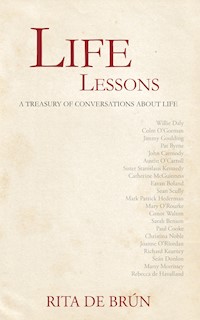
Life Lessons E-Book
Erhalten Sie Zugang zu diesem und mehr als 300000 Büchern ab EUR 5,99 monatlich.
- Herausgeber: New Island
- Kategorie: Sachliteratur, Reportagen, Biografien
- Sprache: Englisch
In Life Lessons, Rita de Brún interviews some of Ireland's most interesting characters. From judges, politicians and diplomats, to poets, commentators and campaigners, the contributors to this book come from a wide range of backgrounds and inhabit all walks of life. Despite their differences, there are uniting forces. All are fired by a drive to be true to who they are and follow their passions. All have their own life lessons to impart . . . As individuals we are all unique, but we are also very much the same. Our life circumstances and paths differ wildly, but behind the superficiality of class, status and wealth, most of us – at one time or another – ponder the same questions: what matters most, who are we at our very core and what has life taught us? In Life Lessons, which is composed of snippets of one-to-one conversations Rita de Brún had with twenty-one Irish women and men, the sameness and interconnectedness of us all becomes apparent, as does the inherent goodness, ordinariness, humbleness and spirituality that is central to the sheer extraordinariness of some of those that we admire the most.
Sie lesen das E-Book in den Legimi-Apps auf:
Seitenzahl: 443
Veröffentlichungsjahr: 2014
Das E-Book (TTS) können Sie hören im Abo „Legimi Premium” in Legimi-Apps auf:
Ähnliche




















LIFE
LESSONS
For my children,Julia, Karl, Sophie Rose and Zoë
LIFE
LESSONS
A TREASURY OF CONVERSATIONS ABOUT LIFE
RITA DE BRÚN
LIFE LESSONS: A TREASURY OF CONVERSATIONS ABOUT LIFE
First published in 2014
by New Island Books
16 Priory Hall Office Park
Stillorgan
County Dublin
Republic of Ireland
www.newisland.ie
Copyright © Rita de Brún, 2014.
Author image courtesy of Shane McCarthy.
Rita de Brún has asserted her moral rights.
PAPERBACK ISBN: 978-1-84840-380-2
EPUB ISBN: 978-1-84840-381-9
MOBI ISBN: 978-1-84840-382-6
HARDBACK ISBN: 978-1-84840-404-5
All rights reserved. The material in this publication is protected by copyright law. Except as may be permitted by law, no part of the material may be reproduced (including by storage in a retrieval system) or transmitted in any form or by any means; adapted; rented or lent without the written permission of the copyright owner.
British Library Cataloguing Data.
A CIP catalogue record for this book is available from the British Library.
Contents
Introduction
1.Willie Daly
2.Colm O’Gorman
3.Jimmy Goulding
4.Pat Byrne
5.John Carmody
6.Austin O’Carroll
7.Sister Stanislaus Kennedy
8.Catherine McGuinness
9.Eavan Boland
10.Sean Scully
11.Mark Patrick Hederman
12.Mary O’Rourke
13.Conor Walton
14.Sarah Benson
15.Paul Cooke
16.Christina Noble
17.Joanne O’Riordan
18.Richard Kearney
19.Seán Donlon
20.Marty Morrissey
21.Rebecca de Havalland
Acknowledgements
‘The real voyage of discovery consists not in seeking newlandscapes, but in having new eyes.’
– Marcel Proust
Introduction
As individuals we are all unique, but we are also very much the same. Our life circumstances and paths differ wildly, but behind the superficiality of class, status and wealth, most of us at one time or another ponder the same questions: what matters most, who are we at our very core, and what has life taught us?
In this collection, which is composed of snippets of one-to-one conversations I had with twenty-one Irish women and men, the sameness and interconnectedness of us all becomes apparent, as does the inherent goodness, humbleness and spirituality that is central to the sheer extraordinariness of some of those we admire the most.
If there is a central theme running throughout the conversations in this collection it is the human capacity for strength and the determination to accomplish great things. Of course, what is great for one person can be meaningless for another, but sometimes that is the point.
For some, the power of passion manifests itself in securing corporate success. For others, it is a matter of following a spiritual path and being of service to the poor, the sick or the vulnerable. For yet others, it is about poetic expression, creating great art, serving one’s country in diplomacy, administering justice, defending human rights, campaigning for the welfare of animals, fighting stigma, keeping the peace or introducing people to the love of their life. All of the contributors share determination and focus, and many have fought against prejudice of one form or another to be true to their own vision of who they are.
All of those whose words you read in these pages found within themselves the inner reserves to accomplish what it was they wanted, or felt driven, to achieve. In sharing so much about their personal journeys, their responses to the events that shaped them and what life taught them along the way, they inspire the rest of us to do the same.
To the contributors – all of whom generously shared so much of what is intrinsically personal – I am deeply grateful.
– Rita de Brún
Willie Daly
Third-generation traditional Irish matchmaker who has made more than 3,000 matches since he began matchmaking more than forty-seven years ago
A quiet American
One Sunday, an American man came into my house. He was 54 years of age. He had a palish complexion, and he wasn’t very good-looking. He told me he was looking for a woman, and he wanted her slim. He then added: ‘I’m in a strange situation – my wife is not dead.’ I was just thinking that, given his request, this wasn’t that handy at all, when he added that his wife had been in a coma for years and he didn’t think she had long left. I admired his honesty and wished I could have helped him in some way, but I had to explain that most of the women on my files wouldn’t want a man who was married.
Because our house was packed that morning, I was in conversation with several people at the same time. Just then, a man came into the house to buy a horse I had for sale. I guessed he wanted me to show him the horse, but as I was in conversation with the American, I gestured to the yard outside and said that if he wanted to go out and take a look, I’d follow him out when I could.
Out he went, only to put his head around the door two minutes later: ‘Which one are you selling?’ he called. ‘Are we talking about the one with the bare legs or the one with the hairy legs?’
‘Hairy legs’ I shouted back, at which point the American leaned closer, and, wholly in earnest, said: ‘I’d like you to know that I’d hate a girl with hairy legs.’ Just then the chap in the yard shouted in: ‘Can I ride her?’ ‘You can of course,’ I replied. ‘Ride her around the yard.’
At this point the pale American looked almost ashen. He had no idea that the other man and I were talking about horses. He seemed to think that our yard was filled with women who were looking for husbands and that I was in the habit of sending men out there to check them out.
Around that time I had been getting a lot of calls from an Irish woman and her daughter. They were constantly ringing to see if I knew of a rich man who might marry the daughter. In return, they wanted this man to buy a hotel, which was up for sale in their locality.
The duo were always together when they rang, and while they’d primarily be calling looking for a match for the daughter, every now and again the mother would pipe in to say that she wanted a man as well.
I was still explaining to the American that it was horses we had in the yard, not women, when the phone rang. It was the mother and her daughter, looking as always for a rich man to buy them the hotel of their dreams.
I thought for a minute and said: ‘I’ve an American gentleman sitting here beside me. I will put him on the phone to you and you can tell him what you’re looking for.’ I then turned to the American and explained a little about the ladies on the phone. ‘Is the daughter slim?’ was his only reply. I said that I’d never met either of the women, then laughingly added: ‘Judging by her voice, she’s slim.’ At that, he took the phone and I went out to the yard to sell the horse.
Sometime later the American met with the daughter, only to discover she was small and stout. Since he had a thing against fat, he had no interest in her, but he did fall in love with the mother, who was 47 (I met her sometime later and she was a lovely looking woman with green eyes – very Irish-looking) and he bought the hotel of her dreams.
The American’s wife later died, but as he and the Irishwoman weren’t getting on too well they didn’t marry. After a period they fell out with each other, and he returned to America. In fairness to the woman, she and her daughter were entirely upfront about what they wanted. There was nothing underhand about them.
From long black dresses to hot pants
I remember being at a horse fair in 1957 or 1958. That was a strange time in Ireland in so far as women’s fashion was evolving from long black dresses to hot pants.
I saw these two brothers – bold, skutty, small little lads – that I went to school with. They were dressed like Teddy boys, and they were with these two women who were wearing hot pants. Now these two women had big bulging legs, and every eye in the fair was on them. Just then a man I knew approached and said: ‘By God. They’re two fine women aren’t they? And showing some leg.’
‘As a man with seventeen kids, I’m sure you’ve seen a woman’s legs before,’ I replied. ‘I have, but I never saw my wife naked’ was his response. Now this was a man of 54 or 55 years of age. I knew his form, and I knew he was telling the truth.
Motivation for marriage
A man who lived with his father and mother in a small-sized house would be prudent enough to realise that if he were to get married when his mother was 47 or 48 – when she might be doing a great job around the house, cooking, washing and sewing – she and any young bride he might bring home might not get on well together.
Many found the motivation to find a wife after their mother’s death, when the dishes would start piling up unwashed, the darning wouldn’t be done and the shirts and socks would start to smell. In so far as housework was concerned, he’d be looking for a replacement for his mother. That still goes on, but less so than it did years ago.
The Irish
We Irish have always been a lovely, mild kind of nationality; a sweet, shy kind of people.
One hundred per cent Irish people are getting scarce. I feel that in seven years or so there won’t be enough one hundred per cent Irish men to go around.
There isn’t a nicer woman in the world than an Irish woman. If I were to marry one hundred times more I would choose an Irish woman every time. Irish women are happy, sweet and lovely to look at. They have a beautiful sincerity about them.
When American men think of Irish women they visualise these beautiful females, barefoot while walking through flower-filled fields, or down at a river, wringing sheets. They imagine them living in little thatched cottages with flowers in the window boxes and climbing roses covering the walls. They have these pictures in their minds. It’s a wonderful dream.
Dowry
When a new bride came to live with her husband’s family, she would usually bring money with her – typically somewhere between fifteen and forty pounds. Two pounds back then was something like 500 now. Women who had no money for a dowry sometimes brought livestock. Now while that was considered important from a food perspective, money was preferred.
The money the new bride brought into the house was divided between her husband’s sisters, so that when they married they’d have dowries. This was the norm in Ireland in the thirties, forties, fifties, sixties ... even into the seventies.
The search for an heir
When men in their sixties, seventies and eighties contact me looking for a wife, I think it’s marvellous that they’re still thinking like that at their stage of life. Men in their eighties tend to be particularly intent when they get that into their mind, and I hugely admire them for that.
I recently made a match for an 82-year-old bachelor. That was a tough one, because he said from the outset that he wanted a woman who would bear him a son and heir. I arranged for him to meet with many girls. Some said they would marry him, then decided against it. After a time, one London-based girl of 34 said she would. She wanted to come back home to Ireland, and she felt that this was her chance.
The discussions went on for three weeks. Eventually it was decided on a Tuesday that the bachelor would meet his bride-to-be on the Friday. Delighted, he was full of questions about what it would be like to have a woman living in the house with him. Unfortunately, he never found out as he died on the Thursday.
Looking for husbands
My father was a matchmaker, as was his father before him. While his work took him all over the place, he was a quiet man who preferred to be at home. One day he travelled to Ennis to make a match, and when he didn’t arrive home by nightfall we were very concerned for his safety. There were no streetlamps in the countryside back then, and the roads were so bad that there was a real fear that he might have fallen into a ditch or a bog hole as he travelled in total darkness. He eventually arrived, and when he did he explained that he had to walk home that night – a distance of twenty-three miles.
While he wasn’t a drinker, his matchmaking often took him to pubs. I often saw him throw whiskey onto turf fires rather than risk offending the person who had given him a drink. When he was out he was always the centre of interest because he would know of five or six young women whose fathers or uncles were trying to find husbands for them. He was paid something small for his work. Often he was paid in turf.
One November night in a pub in Milltown Malbay after a bad day at the fair (cattle prices were down), my father was approached by a small, nicely dressed little man of about sixty-four years of age. He was wearing a hat.
The man was telling my father that he had five daughters when someone who knew him came up and said: ‘Jesus, John, how are you going to find the money to wed five daughters with cattle prices the way they are?!’
When he heard that, the little man banged his hand hard on the counter and roared so the whole pub could hear: ‘What are you saying? My daughters’ faces are their fortunes. But let that stop no man. There’s one thousand pounds going with every one of them!’ At that everyone laughed; it was such a grand statement, but everyone knew he didn’t have that sort of money.
Before the night was over, three or four farmers in their late sixties came up with a view to getting their sons married off to that man’s daughters, who were indeed great beauties. They knew that while the girls, all of whom were in their late teens, wouldn’t be bringing dowries of one thousand pounds, they’d be bringing whatever they could, and that would have to do.
The plucking of the gander
When I was about 9 years of age my father and I cycled twenty miles to a house for what was known as ‘the plucking of the gander.’ This was the name given to the final negotiations – as in what came with the girl and what she could expect in return.
When we arrived the house was filled with people – a match being made for the man of the house was something of an event. He was tall, thinnish and kind of good-looking. While he was 64 years of age, the bride-to-be was a very pretty blue-eyed 26-year-old; a real country girl, with a lovely head of dark curly hair and rosy red cheeks. She seemed very happy about the match. I remember hearing her laughing – a lovely trait in a woman.
She had two representatives who negotiated on her behalf: an aunt and a neighbour. While the negotiations were going on she stayed in the kitchen with a bunch of oldish women. They were pinching her arms, breasts and backside while whispering to her. She was laughing at their antics. I had no idea what was going on, but my father told me later that they were probably explaining to her what she could expect when she was married.
In the corner of the room there were three or four old women. One was sewing a false bottom on a pair of trousers. At that time there was a superstition that if a man wanted his marriage to be lucky he would have to wear his trousers back to front in bed every night for the first five nights of the marriage, so as to ensure that nothing would happen between the couple.
Men went along with this custom as they were afraid that if they dismissed superstitions, or piseogs as they were called, they’d attract bad luck. The reinforced trousers provided an extra barrier to ensure the man physically couldn’t do anything even though he was wearing the garment back to front in bed.
Years later, when discussing that custom with my mother, she told me that it had been introduced by priests. The thinking behind it was that as it was common for men in their sixties to marry girls of 18 or 19, the avoidance of marital relations for the first few nights of the marriage might give the girl time to become accustomed to the company of her new husband. This helped because many a girl found herself married to an old man who had no real respect for her. Of those who did, few had any notion of what it meant to treat a woman well. The truth was that some of these men knew nothing of romance – all they would know was what animals do.
After the wedding
For many of those who got married in Ireland long ago, there was no such thing as a honeymoon. After the ceremony, and maybe a night away, the man would bring his new wife back to live in his family home. Apart from a kitchen, most houses had just two small rooms: one for the parents and the other for their children.
Because there was nowhere else for them, the new couple would sleep in the room with the groom’s brothers and sisters. There could be fourteen or sixteen sharing that room, with the boys on one side and their sisters on the other. The couple had no privacy. But there was always a lot of codding and teasing by the groom’s siblings, and that kept things light-hearted.
Sharing
Fear of sharing is something that has kept a lot of people from taking a partner.
A farm of land is no good for a man if he can’t share it. What good is anything if you can’t share it? What good is anything if you don’t have someone to love, or if you don’t have someone who will put their arms around you at night?
What women want
When I started, most of the women for whom I tried to find matches were aged between 18 and 35. Very few were older than 37. Quietly, they would be looking for someone who was handsome – someone with nice hair and teeth. But while they’d have that in their heads, they’d settle for less.
When discussing a match for a woman with her parents, it was often said of the man: ‘He’s secure. He has a nice farm of land. He has old money.’ All the while the woman would be imagining a handsome chap.
Every now and again, film projectors were set up in the towns and local girls would get to see the faces of Rock Hudson and Doug McClure, the actor who played Trampas in The Virginian, flickering across the screen. So, from the age of 14 or 15, many would get it into their heads that they wanted to marry someone with an actor’s good looks. It was hard for them when they finally saw the men they were to marry.
It was common to see young women with toothless old men for husbands, and to hear people ask one another: ‘How could a lovely girl like that get into bed with a man like him?’
The answer was simple: these men provided their wives with a home. Most of the women would have grown up in very large families, quietly dreaming of a time when they might have their own little home. So those who were offered marriage to a man with a decent place tended to go along with that. Some were in a position where they could and did choose less attractive men with nicer homes over attractive men with little to offer. They then had to live with the consequences of that decision.
While the husbands may not always have had the love of their wives, the decent ones had their respect. For many, it was only with the arrival of children that love entered the home.
Women who weren’t in love with their husbands often found happiness by refusing to dwell on their own needs, wants and desires. The words ‘me’ and ‘I’ were rarely spoken by them. There was no attitude of entitlement. Their thoughts were for their children.
Domestic violence
I think fear is often a cause of domestic violence. Sometimes, a man who fears that his wife may be attracted to another man will lash out on impulse in a bid to exert control, then regret it. Insecurity and jealousy would come into it, but most of it would be fear. Love brings fear. The two are closely connected.
Settling
Because life’s too short to compromise on love, I don’t think it’s ever a good idea to settle. Even at my age, I still have the patience to wait until I find magical love. But unfortunately, great love is not for everyone and not everyone finds it.
Intuition
Women are wise and intuitive. They have a remarkable ability to assess a man in an instant. But long ago, many a woman felt she couldn’t walk away from an offer of marriage to a man she felt wasn’t nice, even though she would have wanted to.
What life has taught me
The big thing that life has taught me is to have a lot of respect for people. No matter what their situation in life, they are all equally important. The best traits are not always visible; the worth of a man and a woman cannot be gauged by their dress or appearance.
A family of matchmakers
I have six daughters and two sons. They have all contributed in different ways to the matchmaking tradition of our family – and many still do. We all feel that if we can bring a bit of love, joy and happiness into the life of someone who might be in their fifties, sixties or seventies that is marvellous. After all, it’s perfectly natural for older people to want partners. Loneliness doesn’t evaporate once we reach a certain age.
When I was 28 my father made my match. Marie was 21 when she visited our pony-trekking school with some friends. When it started to rain, they came into our family home for shelter. While she was there, Marie heard my father (who was bedridden at the time) call for me. As I was out around the farm at the time, she peeped into the room where he was, and gingerly approached to see if she could be of any help. He asked her to pick up his pipe, which had fallen to the floor, and when she did he asked whether she would marry me. ‘I would,’ she replied, and we were married within six months.
While we drifted apart in recent years, we still have a wonderful family together. Ours was the last match my father ever made.
Lisdoonvarna
It’s a myth that most of the women looking for love at the Lisdoonvarna Matchmaking Festival are American. I’d say that at most, 7 per cent of them are from the US.
The women who come to Lisdoonvarna from America are not that young. Most have lovely heads of long, curly hair, so it’s only when they turn and you see their faces that you realise that they are older than you might have thought they would be.
American women who come to Ireland looking for husbands tend to look good for their years. Very many come looking for a third or fourth husband. This shouldn’t put Irish men off, but unfortunately it can.
Because these women are very often financially comfortable, what they’re looking for is a man to have fun with; a man who will dance, sing and play a few tunes.
Some American women work hard on improving their older Irish partners. They see them as a project. If the men have bad hair or teeth, and they’re out of shape, the women work hard to improve them. They never say at the outset that this is their plan, but many do it all the same.
Untidiness is a lovely quality in an Irish man, but once a woman overhauls a man like that, he loses that quality. Some women tend to take over the minds of the men they love to the extent that they don’t allow them to be their own men any more.
Very often these ladies feed up their men, and before you know it the Irishman looks very like an American person. By the time her work is done, the new Irish husband often looks a bit like the previous American husband, and when that happens it’s often time for the woman to embark on a new project. I say that in a light-hearted way, because I know from my experience of working with them that when an American woman loves, she loves completely.
Internet dating
Any system that helps people to find love is a good system, and while there’s no doubt that many find love through internet dating, it’s not for everybody. Even though the internet is driven by people, it operates via machine, and machines are cold. They’re also a little far removed from the warmness and tenderness and softness that love and romance is all about.
When I meet people who are looking for a match, we sit and we talk. During the course of the conversation, we might shake hands, or give or receive a touch on the arm or a pat on the back. The touch of human flesh has to be better than the touch of a machine, which is devoid of any real feeling or emotion. That is just one of the reasons why there will always be a role for the traditional matchmaker.
Soulmates
I used to think that everyone was searching for a soulmate. Now I am not so sure. I’d say that while the vast majority are, a very small percentage are more interested in repeatedly experiencing the excitement of being with someone new. These people are attracted by new energy. Some may have met their soulmates and not recognised the fact because their affections wouldn’t run that deep, and because they are always keen to move on to the next one.
What matters most
I think the most fantastic thing in the world is finding love. Not everyone has that experience, but all is not lost for them. There is an old expression: where there is no love, put love and you will find love.
It’s important not to be afraid of love. When you see someone you like a lot, you should never be afraid to go up and say: ‘I think you are gorgeous. I think I have fallen in love with you.’ It’s important to make some gesture. The worst thing that might happen is you might be ignored or told they are married, but the only true disaster would be to return home without knowing what might have happened.
Trust and monogamy
Women are born to be monogamous. Men are not. I think most men are better than they get credit for, especially young men. Older men, because they can’t do much, are usually assumed to be loyal.
I think that men are very honest and that women are more honest again, but where there is very rich love, very good love, there can be fear. I think what women don’t know they assume, and they are not always right in their assumptions.
I sincerely believe that if you totally trust someone they will never let you down. I don’t think that men stray much. But I also think that to be trustworthy at all a man must be trusted. When men are not trusted, and they know they are not trusted, they are more likely to do what they are accused of.
What older men want
It is a myth that most old men looking for brides want young ones. There are some that go to some parts of Asia looking for very young women, but they would be in the minority. When I tell people that I would like to meet a woman who is in her seventies or eighties, the general response is, ‘You must be joking.’ And it’s true. I am.
The appeal of the older woman
It is very common for young men to fall in love with women of a certain age. This is far more common than is known. I know of a 64-year-old woman who recently had two men chasing her. One was 24, the other 73. She asked my advice. I said to her: ‘An old man is like an old car. You’ll be all night trying to get the engine started.’ When I saw her in town a few days later I asked for an update. ‘I didn’t disappoint either of them’ was her reply.
One night when I was out in town with a group of people – one of whom was a woman of 62 years of age – we met a 30-year-old man I knew. She had a beautiful head of hair and very dark eyes. He was a clean, handsome, well-dressed, good-looking lad of about six foot two, with a lovely head of short, dark hair. When he saw her he immediately asked for an introduction, then he asked her to dance. After the first dance, they had another, and that time they danced very closely.
This man had come to me previously looking for help in finding a match. He spent over an hour telling me what he wanted in a woman – what he’d like, what he would not like. He had told me he wouldn’t want a woman who was older than 34 because he wanted kids. And here he was, clearly deeply attracted to this woman of 62. If I had said to him the day he came in to see me: ‘I have a grandmother of 62 on my files. I think she’d suit you,’ he would have thought I was mad.
Fear
I grew up hearing a lot of stories about haunted houses and ghosts and fairies, so I was really afraid of those when I was a young fellow. I am not completely over that fear.
We didn’t have electricity growing up, so when we needed to go to the toilet during the night we had to go out in the dark. I used to be terrified of the dark. Even now I prefer light.
Something strange
Thirty-seven years ago I saw something strange. It was 11.30 in the morning, and I was out digging potatoes. I heard a whirring sound, and when I looked up I saw a red car-shaped frame in the sky. I watched it flying in my direction. There appeared to be two people in it. I could just make out the contours of the vehicle, but not much more than that. It was two red rectangular frames: a smaller one, where the roof of a car might be, and a larger one representing the body of the car. I don’t know what that was. I did think though that it was something other-worldly. I don’t know where it came from. When I looked up it was simply there. I saw it coming towards me for about three seconds. Then it stopped, made a noise, turned and vanished.
Deepest source of comfort and solace
I have a modest farm in County Clare. To an outsider it’s a grand farm, but to me it’s a kind of heaven. There’s pure quietness there, and fields rolling down to the Atlantic. A lot of my matchmaking thinking is done in those fields. As life progresses we all get many a shock along the way. The company of others is always a great comfort. I find that both personally and through my work. As a farmer, I also take great comfort from the earth.
Life
Life has been magical for me. There is nowhere in the world where I would like to live other than where I do. There is nothing that I want to do in my life that I have not done.
What I fear
I have a big fear of dying and of the unknown. I also have a fear of confined spaces.
I have said to my family several times: ‘If ever I get into really bad health and there’s no hope of improvement, drive me up to the top of a mountain on a bad night, let me out, then drive away.’ To that they always say, ‘Don’t worry, we will,’ but I know they would never do that.
We have a family grave in the local church, but I tell my daughters I don’t want to be put in there when I’m dead because I would be confined by the church walls. They try to rationalise that it won’t matter to me then, but the fear remains.
According to my religion, everyone rises up on the last day. I wouldn’t have strong thoughts about that, apart from the question that if everyone rises up together, where would everyone fit?
I don’t often go to church these days, but I pray all the same. I pray to the Blessed Virgin Mary. I don’t think she has ever let me down. I hardly ever ask for anything for myself.
Something surprising about me
When I was in hospital four years ago, a ward nurse came over to me as I was being wheeled to theatre and asked my age. She said she had three different ages for me. I asked her to call out the ages she had, and when she did, I picked one and told her that was it. I picked because I don’t know what age I am. There were ten in my class at school. None of us were sure of our ages. Family details were recorded at our christenings, but for some reason our birth dates weren’t logged.
Many years ago I got a letter from an old classmate who had moved to England when we left school. None of us had heard from her since. She wrote to say she was getting married, and she wondered if I could get together with some of our old classmates, come up with an age for her and write her a letter saying that was the age we thought she was. She said it would be best if we could make her younger than we thought she might be, as she didn’t want her husband to be to be put off by what she supposed her true age to be. I met with some of the class, and we decided she was probably about 27 or 28 at the time, but even so, we wrote her a letter saying we thought she was 25.
Decades passed before she contacted me again. This time she sent a lovely letter to me at Daly’s, the family pub in Ennistymon. She said that as her husband had died, and her circumstances weren’t good, she wondered if I could possibly write her a letter saying I thought a mistake had been made years earlier in estimating her age, and that she was in fact a few years older. She wanted the letter to reflect her true age so she could claim her entitlements. I regret to this day that I was so busy at the time; her letter went out of my head and I never replied.
Love
Love is there for every one of us. It’s there if we want it. It won’t knock us down on the side of the street to get to us. We have to make a little effort to find it. I am very thankful to all of those who entrusted me with the important task of finding a partner for them to love, and this is something I hope to continue to do for as long as I can.
For those who are searching for love, it might help to remember that there’s no old shoe but there’s a stocking to fit!
Colm O’Gorman
Campaigner, author, executive director at Amnesty International Ireland, and ‘survivor’ of clerical sexual abuse
Toughest obstacle I’ve faced
Overcoming shame. And it wasn’t my own. The shame that I carried for so many years wasn’t my own. And for me that’s one of the terrible consequences in any particular scenario when a society refuses to name shameful things that have happened. What it does then instead is it leaves the victims of those terrible tragedies carrying the weight of society’s shame and of the perpetrator’s shame. And that’s an awful burden for anybody to carry and it really paralyses people. It paralysed me for years. So, realising that the shame I carried wasn’t my shame was incredibly liberating for me.
The most powerful negative force in the world
In my view it’s fear. Because it’s when people are responding to or reacting to fear rather than confronting it that they are more likely to do terrible things, and that’s when evil thrives.
Cruelty and disregard for human dignity
Fear and absence of love, both for oneself and for the other, breed cruelty and disregard for human dignity. I think if one truly loves oneself with honesty, humility and courage – because it takes courage to love yourself – then you can’t but love others.
If we can find the capacity to love ourselves, we find the powerful truth of how we love or how we’re compelled then to love others. When I say ‘compelled’ I don’t mean that that is something you necessarily work at; a lot of the time you have to remind yourself that you do.
Living on the streets
I spent some time living on the streets, and what that taught me was that I had to get off the streets as quickly as possible.
I remember working with a clinical supervisor who worked with homeless young men during the time when I was on the streets. He asked how it was that I never came across any of the services that were available to the homeless back then. He couldn’t believe that I hadn’t, nor could he understand how he had never come across me, even though he knew everyone of my age who was on the streets.
The reason he never came across me and that I was not known to those who provided services to the homeless was that I kept away from them. Keeping very separate was my way of trying to stay safe and secure, and of surviving the set of circumstances I was in.
Shame and fear played a role as well. I was terrified that if I was discovered I’d be sent home, and I couldn’t go home. I couldn’t go home where I’d have to face what I had become or where I was, and all of those things that I couldn’t even begin to intellectualise. I just knew that I couldn’t go home. I was terrified. Not because of how my father would react or because I was frightened of him or anything. It was because I was so ashamed, and so frightened of that shame, and of having to face him in that shame. It was a survival thing. ‘Just keep going’ was what I told myself to do.
For years afterwards I used to say that the one thing all of that had taught me was that nothing could defeat me, as I’d always be able to get up again. And I did learn that. That was one thing I learned. But that also was an awful delusion, as it wasn’t until later on that I learned the most important thing, and that is that you don’t always have to get up, as there are times when it’s a damn good idea to stay down or just rest.
It wasn’t a case of my having such incredible self-confidence that I could take anything on. It wasn’t that I could take anything on; it was more that I could survive anything that was done to me. And in a funny way that was an acceptance of the fact that really awful things had been done to me.
I used to tell myself, ‘It doesn’t matter because I will survive this. It doesn’t matter if you do this to me. I will survive it.’ And that then meant that I didn’t have to say ‘no’, or stand up, or stop, or protect, or push back. So, as important as learning that ‘I can survive this’ was, learning that ‘well, I shouldn’t have to’ and ‘I don’t have to’ and ‘I don’t have to tolerate certain things’ proved to be much more so.
The ‘survivor’ tag
One of the things that became incredibly important to me in my work as a therapist was the reason why I hated and still don’t have an awful lot of time for the ‘survivor’ tag. To me, it was laden with demands upon and expectations of people, and with the celebration of those who survive.
Well, what about those who didn’t, or couldn’t? Or those who could just about cope? Maybe we should celebrate coping as much as we should celebrate survival. For me, it’s much more about the fact that we should acknowledge and celebrate and love the humanity of the individual, whether they’ve survived, coped or fallen. And who’s to say that their decision or their outcome was right, or wrong, or better? It’s just their decision or outcome. It’s just wherever they’ve gotten to.
Being forever associated with clerical abuse
I had to do a thing recently where I had to do a Google search on myself. And I didn’t realise at the time that Google now displays images or photographs in association with searches. And when I did the search, an image of Brendan Comiskey, Sean Fortune and a bunch of others came up.
My book Beyond Belief came out in 2009. Sometime later I made a Would You Believe? film. After that, I remember getting a call from a member of Sean Fortune’s family. He was someone with whom I’d had some contact before. We had good conversations; real, human conversations, and I had a lot of regard for that family – the journey they’ve had to go on was awful, dreadful. This time when he rang he said to me, ‘When will this be over? When will this stop? When are you going to stop talking about this?’ And you know, I feel the same way about it myself very often.
If there is a value in talking about what happened, then I think it’s important that I do so, or that we do. At least, certainly I feel that responsibility – and I’m not talking here about a burden. Although, to acknowledge it, at times it actually is a big burden, because sometimes I’d really rather not talk about it. But it is a huge part of my life experience and it is a big part of what I’ve done, and the work that I’ve done around it has been a big part of my life. At its most simple, I suppose I took on that work because I felt a duty or responsibility to do it, and that is not something for which you can just abdicate responsibility. Of course I can make that choice. I can choose not to, and now I very often will choose not to do an interview about it. But if I can see that it has real value, real integrity, real purpose, and that it’s important, then I will.
Identity, marriage and our extraordinary capacity to be magnificent
I am not defined by what was done to me. What says much more about who we are as people is not what was done to us, but how we responded to and worked with that. Our responses say a lot about who we are.
Identity becomes fascinating. For me there’s also the sexuality element of all of that, and there have been times when I’ve had a very strong personal sense of frustration with the focus on sexual orientation.
It’s not the gender of the person you love that says anything about who you are; it’s the quality of how you love. It’s how you love, not who you love, that speaks of who you are. We should be able to celebrate love in whatever form it takes.
On the recent anniversary of marriage equality being introduced in New York, there was this great photo montage on Twitter. There were photos of great celebrations, of people being in love and getting married, of everything from young couples to those in their eighties and nineties. Some couples had been together 40 or 50 years before finally being able to get married. There were a load of shots from City Hall in Manhattan.
That’s where Paul and I went to get married in 2011, and what was lovely about the whole experience of getting married in New York was the celebration. There was just the two of us and two friends: a really good friend of mine and his wife. Because they live out there, they were with us on the day and they were witnesses and all that stuff.
City Hall in Manhattan is a civic office, but the buzz about the place is extraordinary. There are all of these couples there: young, old, gay and straight. They’re all there, getting married. You queue up and you get a little ticket. Then you get your marriage licence. Then you go and you queue up again. What was gorgeous about it was just the simple celebration of it. It was all about couples getting married because they loved each other – that was what was being celebrated. For me, that’s what I’m all about.
So, in relation to identity, we latch on to labels or differences, and sometimes I think that we do that so we can hold people up and say, ‘Oh look! Isn’t this person extraordinary?’ And we’re saying that because they’ve done these things they’re exemplary in some way. Whereas actually, in my experience, I’ve seen people demonstrate the most extraordinary capacity and ability and integrity and compassion and courage, in really ordinary, simple ways.
I was really very lucky to work as a therapist for as long as I was able to before I came back to Ireland. When I returned I wasn’t able to do much of that any more because of the public dimensions of what I was doing.
As a therapist, you sit in a consulting room with people and you see the capacity of women, men and children to achieve extraordinary things in the situations that they need to confront in their own lives, or in their capacity to find a way within themselves, back to love or to life, or to whatever.
We make the ordinary extraordinary rather than recognising that we have within us this extraordinary capacity to be magnificent, to live lives of extraordinary beauty and dignity and compassion and courage and meaning and value.
We are not taught, we are not nurtured in a way that says we should be extraordinary. Sometimes, in Ireland in particular, there’s that very idea of ‘Who do you think you are, getting ideas above yourself? Would you stop?’
It’s as though, somehow, it’s embarrassing to be extraordinary. And it’s not. It’s ordinary to be extraordinary. Life is extraordinary. It is an extraordinary miracle that we’re having this conversation. The fact that we are sitting here having this conversation is extraordinary. This is miraculous.
I think that every human being has the capacity to be extraordinary, to be truly wonderful, so there is something remarkably ordinary about that. Yet we have diminished our capacity to recognise that and to be that in ourselves. Or we have had it diminished.
Parenting plays a role there, and I mean parenting in its broadest sense – parenting by society as much as by individual parents – who suppress that capacity in the next generation. In some ways I think that happens because our capacity to be remarkable and wonderful has been suppressed in us, and we don’t want to see that.
So, there has been a brutalisation of that capacity to be brilliant, to be all that we might be. It has been brutalised, and that is a very significant wound, I think, for an awful lot of people; maybe on a global level too. And that wound is such that we keep repeating it because we don’t want to deal with it. We keep down the child who looks up and who challenges, or asks a question. ‘Who are you to ask a question?’ we demand. Who is a child to ask a question?
Why the concept of brilliance offends so many
In Ireland, we very often tell children off for being bold. Look at the language. Look at the word ‘bold’. If there was the use of a word I’d ban, it’s the use of the word ‘bold’ in the Irish context. The one thing we should be telling our children to be is bold.
But we tell them not to be. The words ‘bold’ and ‘brazen’ both mean courageous. Yet children in Ireland are told off for being either. Don’t be too much. Be invisible so that nobody else has to be upset by your brilliance. These are the messages that so many Irish children absorb at home.
And why would anyone else be upset by their brilliance? Well, because they are so wounded by their own inability or fear or anxiety about being equally brilliant. Or because they’re so insecure around it that they have to beat that down in other people. And that’s awful.
The fear of looking at the darkness that exists within our society, within our families, within ourselves – that fear is really based on the best of who we are. So often we are frightened of seeing it because we would be offended by it. Why would we be offended by it if we were okay with it? We would only be offended by it because we would abhor it, because we would reject it, because it would demand, immediately, that we change. And we are frightened of change. We are frightened of being something other than that which we have been conditioned to be, or told we must be. We are frightened of being beautiful. We are frightened of being courageous. We are frightened of saying the things that we feel at a very deep level, and so we don’t for fear of what we think is the worst of ourselves, for fear of our darkness, of our cowardice, or of our hatefulness; for fear of that, we deny the best of ourselves.
If we look at that, we will reject it and make different choices. And that has been my experience, not just in my own life, but with all of the other people with whom I’ve worked in different ways over the years.
As we face the darkness of who we are, we make different choices. And it’s only when we deny the darkness that it takes over and that it becomes rampant. Recognising that has, for me, been one of the really valuable life lessons.
Why knowing what must be done diminishes fear
Fear was not something I experienced in my journey to get to the truth. At times I did feel an anxiety or a concern or the bubbling up of fear, particularly when I decided to sue the pope. I remember that, having made that decision, all I could think of, initially, was your man hanging under Blackfriar’s Bridge: God’s Banker. And immediately I said to myself: oh for God’s sake, don’t even go to that place of ridiculousness, and all the rest of it.
But the one thing that always kept me focussed, and again this is going to sound very righteous, was that whenever you look baldly at whatever type of circumstance you’re in, if you’re as honest as you possibly can be, the way forward is usually pretty clear and pretty obvious. So, what led to my deciding to sue the pope was a chain of events that began with my going to the guards to name what had happened to me.




