


18,99 €
Mehr erfahren.
- Herausgeber: John Wiley & Sons
- Kategorie: Wissenschaft und neue Technologien
- Serie: Photo Workshop
- Sprache: Englisch
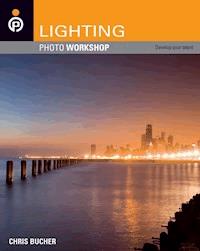
A rigorous practical guide to photographic lighting techniques, complete with hands-on assignments
Offering digital photographers a complete course in photographic lighting, this book covers everything from using flash systems and studio lights to working outdoors in bright or low-light conditions. Full-color examples show how the right lighting can enhance color, improve contrast, and open the door to new creative possibilities.
Sie lesen das E-Book in den Legimi-Apps auf:
Seitenzahl: 344
Veröffentlichungsjahr: 2011
Ähnliche

















Lighting Photo Workshop
Table of Contents
Lighting Photo Workshop
Chris Bucher
Published byWiley Publishing, Inc.111 River StreetHoboken, N.J. 07030www.wiley.com
Copyright © 2007 by Wiley Publishing, Inc., Indianapolis, Indiana
Published simultaneously in Canada
ISBN: 978-1-118-07926-3Manufactured in the United States of America
10 9 8 7 6 5 4 3 2
No part of this publication may be reproduced, stored in a retrieval system or transmitted in any form or by any means, electronic, mechanical, photocopying, recording, scanning or otherwise, except as permitted under Sections 107 or 108 of the 1976 United States Copyright Act, without either the prior written permission of the Publisher, or authorization through payment of the appropriate per-copy fee to the Copyright Clearance Center, 222 Rosewood Drive, Danvers, MA 01923, (978) 750-8400, fax (978) 750-4744. Requests to the Publisher for permission should be addressed to the Legal Department, Wiley Publishing, Inc., 10475 Crosspoint Blvd., Indianapolis, IN 46256, (317) 572-3447, fax (317) 572-4355, or online at http://www.wiley.com/go/permissions.
Limit of Liability/Disclaimer of Warranty: The publisher and the author make no representations or warranties with respect to the accuracy or completeness of the contents of this work and specifically disclaim all warranties, including without limitation warranties of fitness for a particular purpose. No warranty may be created or extended by sales or promotional materials. The advice and strategies contained herein may not be suitable for every situation. This work is sold with the understanding that the publisher is not engaged in rendering legal, accounting, or other professional services. If professional assistance is required, the services of a competent professional person should be sought. Neither the publisher nor the author shall be liable for damages arising herefrom. The fact that an organization or Web site is referred to in this work as a citation and/or a potential source of further information does not mean that the author or the publisher endorses the information the organization or Web site may provide or recommendations it may make. Further, readers should be aware that Internet Web sites listed in this work may have changed or disappeared between when this work was written and when it is read.
For general information on our other products and services or to obtain technical support, please contact our Customer Care Department within the U.S. at (800) 762-2974, outside the U.S. at (317) 572-3993 or fax (317) 572-4002.
Wiley also publishes its books in a variety of electronic formats. Some content that appears in print may not be available in electronic books.
Library of Congress Control Number: 2007926007
Trademarks: Wiley and the Wiley Publishing logo are trademarks or registered trademarks of John Wiley and Sons, Inc. and/or its affiliates. All other trademarks are the property of their respective owners. Wiley Publishing, Inc. is not associated with any product or vendor mentioned in this book.
About the Author
Chris Bucher is a freelance commercial photographer who has contributed to a number of award-winning projects in the dozen-plus years he’s been creating beautiful, marketable images. Although a resident of Indiana, he began his career in Arizona and retains an affinity for the desert Southwest, where his fascination with natural light is fed by the harsh but striking landscapes. His commercial images have appeared in countless national and regional magazines. On his own time, Chris loves racing mountain bikes and serving the Humane Society as a foster parent. But his favorite pastime, bar none, is watching the interaction of light with his favorite subject, his wife, Jennifer.
Credits
Acquisitions Editor
Kim Spilker
Senior Project Editor
Cricket Krengel
Project Editor
Kelly Dobbs Henthorne
Technical Editor
J. Dennis Thomas
Editorial Manager
Robyn Siesky
Vice President & Group Executive Publisher
Richard Swadley
Vice President & Publisher
Barry Pruett
Business Manager
Amy Knies
Book Designers
LeAndra HosierTina Hovanessian
Project Coordinator
Adrienne Martinez
Graphics and Production Specialists
Brooke GraczykJennifer MayberryShelley NorrisAmanda Spagnuolo
Quality Control Technician
Todd Lothery
Cover Design
Daniella RichardsonLarry Vigon
Proofreading and Indexing
Debbye ButlerRebecca R. Plunkett
Wiley Bicentennial Logo
Richard J. Pacifico
Acknowledgments
As with so many things, so much credit goes to so many people, and thanks to those who helped immeasurably to make this book happen. This book was made so much better with the contributions of these photographers: Jarod Trow, Holly Jordan, Lynne Stacey, Dave Edelstein, Marcos Dominguez, and Jonathon Juillerat. Their input and offerings were beyond helpful.
Thanks to the team of Kelly, Kelly, Laura, Cricket, and Denny for your insight and immense help in working with this hopeless writer on his first book, and I will never be able to thank Kim Spilker enough for her constant encouragement and faith in me throughout this process.
I need to acknowledge Sharlie Douglas Hall and Nikon Inc. for much help over many years and for gear that just plain works. The calls, e-mails, and support that I got from Erik, Jarod, Angie, Lisa, David, Matt, Tim, and Eric meant more than they’ll ever know.
A very special thank you goes to my parents and my siblings for their constant love and backing.
I also have the blessing to know that whenever I am in doubt or in need, that I always have the guidance of Butch Hall, Tom Casalini, and my Dad, Wes Bucher, for counsel and direction.
Finally, thank you to my wife and partner, Jennifer, for her patience and encouragement throughout this entire process.
For my wife, Jennifer
Introduction
To say that light is integral to photography is just scratching the surface. This book is just scratching the surface of all the angles and colors and direction that light can present to you in the viewfinder. As a photographer, you need light on the subject to create an image, but to create a great image, you need to get the best light you can on the subject.
Great light can come in many ways. Sometimes it just happens, and other times it takes time and patience to create or shape the light in your photographs. Take the time to wait for a few minutes to see whether the light changes, and savor the moments that you are shooting or waiting to shoot because you are not just seeing things through the camera, you are experiencing life happening before your eyes. Then you can take that slice of life home with you.
I hope that the images inspire you, if nothing more than to just take your camera with you or to keep it close to you for when the light is happening. Even more, I hope the images inspire you to try new things. Use the images here as guides and signposts so that you can recognize the things happening in your own images and better know how to capture the images that you see in your mind.
One of the goals that I had for this book was to show how it is possible to create better photographs with light that is there, no matter whether it is great light or not. This entails some testing and practice and trying new things, but that discovery is so exciting. When you begin to realize the skills that you are developing because you can better see and work with light, your photography becomes like second nature.
Chapter 1: Elements of Light
Understanding the Three Elements of Exposure
Dealing with Color Temperature
Setting White Balance
Using Contrast to Create Mood
Working with the Quality of Light
In some ways, photography is analogous to cooking: a certain temperature for a certain amount of time. So how is that like photography? If you substitute light for temperature, you have your answer. In this chapter, I tell you how light affects your camera and images.
Understanding the Three Elements of Exposure
Exposure is the balance of the amount of light allowed to fall on the photographic medium (digital sensor, film, glass plate, and so on). I use the word balance because you use many things to capture the correct exposure. You use three variables to create your exposure:
• ISO. The light sensitivity of the film or digital sensor.
• Aperture. A moving diaphragm within the lens that controls the amount of light passing through the lens and into the camera. F-stops are the numeric designations referring to the size of the aperture.
• Shutter. A mechanical device that opens and closes very quickly, letting light into the camera and in contact with the digital sensor (or film). The length of time the shutter is open is known as shutter speed.
Each incremental change in the exposure of any of these three things is measured in f-stops. A 1 stop difference in any of these three things either halves or doubles the amount of light for the exposure. For example, if you change your ISO from 100 to 200, you have increased your sensitivity 1 stop. If you adjust your shutter speed from 1/125 to 1/250, that is a 1 stop difference as well. Changing your aperture from f/8 to f/11 is also a change of 1 stop.
Lesen Sie weiter in der vollständigen Ausgabe!
Lesen Sie weiter in der vollständigen Ausgabe!
Lesen Sie weiter in der vollständigen Ausgabe!
Lesen Sie weiter in der vollständigen Ausgabe!
Lesen Sie weiter in der vollständigen Ausgabe!
Lesen Sie weiter in der vollständigen Ausgabe!
Lesen Sie weiter in der vollständigen Ausgabe!
Lesen Sie weiter in der vollständigen Ausgabe!
Lesen Sie weiter in der vollständigen Ausgabe!
Lesen Sie weiter in der vollständigen Ausgabe!




