


0,49 €
Niedrigster Preis in 30 Tagen: 1,99 €
Niedrigster Preis in 30 Tagen: 1,99 €
Mehr erfahren.
- Herausgeber: DigiCat
- Kategorie: Geisteswissenschaft
- Sprache: Englisch
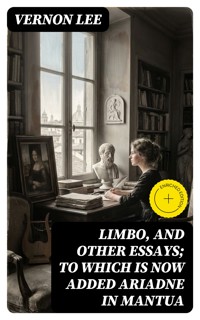
In "Limbo, and Other Essays; To which is now added Ariadne in Mantua," Vernon Lee explores the intricate interplay of art, aesthetics, and personal experience through a series of reflective essays that reveal her keen insights into the human condition. Lee employs a lyrical and evocative prose style, drawing heavily from her rich knowledge of European art and literature to weave complex philosophical themes into her writing. The collection presents not only her thoughts on the nature of beauty and the role of the artist but also situates these reflections within the broader cultural contexts of the late 19th and early 20th centuries, exploring how art shapes and is shaped by societal issues, emotions, and individual perception. Vernon Lee, the pseudonym of the British author and essayist Violet Paget, was deeply entrenched in the intellectual currents of her time. Her upbringing in a family of intellectuals and artists, alongside her extensive travels across Europe, played a significant role in shaping her views on aesthetics and cultural identity. Lee's unique perspective as a woman in a predominantly male literary landscape further enriches her exploration of themes related to gender, artistry, and existential thought in this collection. "Limbo, and Other Essays" is an essential read for those interested in the convergence of art and philosophy, offering profound insights that resonate even today. Readers will find Lee's eloquent prose both stimulating and enlightening, encouraging them to reflect on the transformative power of art and its intimate connection to the personal and the universal. This collection is a testament to Lee's enduring legacy and her profound influence on modern literary and aesthetic thought. In this enriched edition, we have carefully created added value for your reading experience: - A comprehensive Introduction outlines these selected works' unifying features, themes, or stylistic evolutions. - A Historical Context section situates the works in their broader era—social currents, cultural trends, and key events that underpin their creation. - A concise Synopsis (Selection) offers an accessible overview of the included texts, helping readers navigate plotlines and main ideas without revealing critical twists. - A unified Analysis examines recurring motifs and stylistic hallmarks across the collection, tying the stories together while spotlighting the different work's strengths. - Reflection questions inspire deeper contemplation of the author's overarching message, inviting readers to draw connections among different texts and relate them to modern contexts. - Lastly, our hand‐picked Memorable Quotes distill pivotal lines and turning points, serving as touchstones for the collection's central themes.
Das E-Book können Sie in Legimi-Apps oder einer beliebigen App lesen, die das folgende Format unterstützen:
Veröffentlichungsjahr: 2022
Ähnliche



Limbo, and Other Essays; To which is now added Ariadne in Mantua
Table of Contents
Introduction
This volume presents Vernon Lee’s Limbo, and Other Essays, to which is now added Ariadne in Mantua. As a single-author collection, it gathers a core group of Lee’s reflective pieces on place, art, and habit, alongside a compact dramatic work that complements her criticism with imaginative form. The purpose is not encyclopedic completeness but a representative constellation: essays that range from architectural affection and landscape perception to travel, leisure, and attentive natural observation, culminating in a myth-inflected stage meditation. Readers encounter Lee’s characteristic blend of erudition and sensibility, and the continuity she forges between lived experience, historical memory, and aesthetic understanding.
Across the collection the dominant genre is the essay: descriptive, analytical, and personal in measure, rooted in the traditions of travel writing, art criticism, and humane letters. These essays are joined by a dramatic piece, Ariadne in Mantua, which shifts mode while maintaining a shared concern with the shapes of feeling and the staging of cultural memory. The result is a mosaic of text types—topographical sketches, reflective arguments, and a work for voices and scenes—each shaped by Lee’s cultivated, cosmopolitan prose. No letters, diaries, or fictional short stories appear here; instead, the emphasis falls on essayistic inquiry and a single, self-contained drama.
Unifying the volume is Lee’s sustained preoccupation with how places teach us to see, and how art disciplines emotion without diminishing it. She writes as a close observer of Italy’s cities, gardens, and rooms, but also of habits—walking, travelling, resting—that mediate our contact with the past. Her stylistic signature is lucid, allusive, and gently ironic: classical and Renaissance references surface naturally amid concrete detail, while cadenced sentences guide perception rather than dictate conclusions. Throughout, ethical tact accompanies aesthetic delight. Lee invites readers to inhabit time-worn spaces attentively, to respect the slow work of history, and to recognize culture as a web of reciprocal responsibilities.
In Praise of Old Houses considers the moral and sensory education offered by dwellings that bear long use, while The Lie of the Land reflects on the interpretive fictions through which we read landscapes. Tuscan Midsummer Magic gathers seasonal impressions and folklore without confounding observation and belief, attentive to how rural custom frames the imagination. On Modern Travelling scrutinizes the speed and superficiality that can impoverish experience, proposing methods of movement that foster receptivity. Together these essays sketch Lee’s method: begin with things seen and touched, test them by memory and learning, and refuse both nostalgia and impatience in favor of thoughtful inhabitation.
Old Italian Gardens traces the dialogue between design and decay, seeing geometry softened by time as a kind of pedagogy in patience. About Leisure defends intervals of unassigned time as conditions for humane attention. Ravenna and Her Ghosts contemplates a city where art and empire have left palpable afterlives, weighing the claims of monument and mood. The Cook-Shop and the Fowling-Place turns to humbler spaces, noting how ordinary labor sustains culture. Acquaintance with Birds celebrates near-at-hand nature, where repeated, respectful watching becomes a school of perception. These pieces extend Lee’s central conviction that culture grows from practices of care, scale, and continuity.
Ariadne in Mantua, newly joined to the essays here, reveals Lee’s dramatic imagination addressing the Ariadne figure within an Italian setting resonant with courtly art. Without retelling myth for its own sake, the work explores abandonment, fidelity, and artistic voice as problems of staging and audience. Its dialogue proceeds with the same intellectual poise found in the essays, favoring clarity of movement and measured emotion. The piece tests, in another key, what the essays affirm: that feeling is sharpened—not dulled—by form; that the past speaks most clearly when approached through crafted situations; and that performance can renew the meaning of tradition.
Taken together, these writings display the breadth of Vernon Lee—pseudonym of Violet Paget—as an essayist of place and a maker of reflective drama. They consolidate her importance to Anglo-Italian cultural criticism and to a lineage of conscientious travel prose. Their ongoing significance lies in method as much as matter: cultivate slow attention; distinguish description from projection; temper enthusiasm with responsibility to sites and communities. At a time when heritage and mobility are frequently at odds, Lee offers resources for an ethical cosmopolitanism. This collection proposes neither escape nor monument worship, but a sustained practice of learned, sympathetic, and exact seeing.
Historical Context
Vernon Lee (Violet Paget, 1856–1935), British expatriate intellectual of the Anglo-Florentine milieu, composed most essays in this collection amid the fin‑de‑siècle revaluation of Italy’s past. After Italian unification (1861–71), cities like Florence underwent rapid modernization that unsettled admirers of premodern art and manners. Lee, long resident in Florence—she settled at Il Palmerino by 1889—absorbed debates shaped by John Ruskin’s conservationism and Walter Pater’s aestheticism, while conversing with scholars and connoisseurs active in Tuscany. The later inclusion of Ariadne in Mantua aligns the volume with contemporary revivals of early music and mythic drama, binding reflections on travel, heritage, and cultivated perception into a single late‑Victorian testament.
The essays that idealize houses and gardens emerge from preservation battles waged in Britain and Italy alike. William Morris founded the Society for the Protection of Ancient Buildings in 1877, opposing aggressive restoration associated with Eugène Viollet‑le‑Duc. In Florence, the Risanamento of 1885–95 eradicated medieval quarters to create the Piazza della Repubblica, a transformation lamented by conservationists. Simultaneously, antiquarian interest in Renaissance villa culture grew, with photographers and guidebooks drawing visitors to Boboli, the Medici villas, and Tivoli’s Villa d’Este. Lee’s advocacy of patina, proportion, and continuity reflects this cross‑Channel movement to safeguard lived historical environments rather than remake them to modern taste.
Her evocations of the Tuscan countryside intersect with late nineteenth‑century studies of folklore and rural economies. The Folklore Society was founded in London in 1878, while Italian collectors such as Giuseppe Pitrè compiled regional beliefs and songs, legitimizing peasant ritual as cultural evidence. At the same time, the mezzadria sharecropping system in central Italy persisted amid fits of modernization, and extensive land‑reclamation schemes—the bonifiche of the Maremma and coastal marshes—altered habitats and livelihoods. Lee’s attentive descriptions of seasons, charms, and fieldwork register both scholarly curiosity and anxiety that modernization, sanitation, and new markets would dissolve the rhythms that had shaped Tuscan life.
Her critique of modern travel belongs to the era when railways and guidebooks democratized the former Grand Tour. Thomas Cook’s company organized continental excursions from the 1860s, and Karl Baedeker’s red guides standardized routes through Italy from mid‑century. Engineering feats like the Fréjus (Mont Cenis) Tunnel of 1871 and, later, the Simplon Tunnel of 1906 collapsed distances and schedules. While these changes multiplied access, they also fostered hurried consumption of sights. Lee’s essays defend slow, educated looking and situational ethics of visiting, positioning her against commercial tourism while sympathetic readers in Britain’s periodical press debated the morality and manners of sightseeing.
Ravenna’s spectral past in the volume is anchored in concrete cultural politics. Formerly a Papal city, Ravenna entered the Kingdom of Italy in 1860; its early Christian basilicas and mosaics became symbols of national patrimony. The art historian Corrado Ricci, appointed to oversee Ravenna’s monuments from 1897, led scrupulous restorations and curated the city’s image for visitors. Simultaneous commemorations of Dante—whose tomb lies there, and whose 1865 birth‑centenary spurred new cults—deepened the city’s aura. Lee’s meditations on ghosts thus arise not from mere fancy but from a moment when archaeology, municipal pride, and nation‑building refashioned the historical imagination.
Essays attentive to cook‑shops, fowling, and birds intersect with contemporary debates on foodways and natural history. With national unification came a new interest in regional cuisines, crystallized by Pellegrino Artusi’s hugely influential Italian cookbook of 1891. Meanwhile, expanding markets and reclamation altered traditional hunting grounds in the Maremma and Po delta, even as bird‑catching for the table or for plumage drew criticism. In Britain, activists founded the Society for the Protection of Birds in 1889, part of a broader European movement for avian conservation. Lee registers these cross‑currents, juxtaposing ingrained practices with emergent ethics of protection and scientific observation.
Reflections on leisure correspond to debates on time, taste, and civic culture in the 1890s. The University Extension movement and proliferating journals encouraged self‑education, while the Arts and Crafts ethos dignified purposeful amateurism. Lee’s call for cultivated idleness thus addressed a readership negotiating expanding middle‑class leisure and anxieties about decadence. As a woman writing under a masculine pen name, she occupied a contested space in criticism; yet her erudition won interlocutors from Henry James to Bernard Berenson. Reviewers praised her style while faulting her anti‑commercial scruples, a reception that mirrors broader tensions between humanistic cultivation and the pace of modern life.
The appended Ariadne in Mantua situates Lee within the fin‑de‑siècle recovery of Italy’s early Baroque. Scholars and musicians were rediscovering Claudio Monteverdi, whose Orfeo (Mantua, 1607) and lost Arianna (1608) had inaugurated opera at the Gonzaga court. In Britain, the early‑music revival gathered momentum around figures like Arnold Dolmetsch in the 1890s, while symbolist drama reimagined myth for modern sensibilities. Lee’s Mantuan fantasia responds to both currents, fusing music‑historical learning with aesthetic psychology. Read alongside the essays, it reframes Italy as a laboratory where the past converses with the present, endorsing attentive, historically informed feeling over the speed and commerce of modernity.
Synopsis (Selection)
Italian Landscapes and Haunted Memory (The Lie of the Land; Tuscan Midsummer Magic; Old Italian Gardens; Ravenna and Her Ghosts)
These essays map Italy's terrains—from sunstruck Tuscan hills and formal gardens to the spectral streets of Ravenna—blending topography with cultural memory.
The tone moves from sensuous pastoral to gently uncanny meditation, tracing how art, history, and superstition shape a landscape's felt presence.
Travel, Leisure, and the Minor Arts of Life (On Modern Travelling; About Leisure; The Cook-Shop and the Fowling-Place)
Treating travel, idleness, and eating as arts of living, these pieces question modern speed and utility in favor of cultivated attention and measure.
Witty, urbane, and ethically minded, Lee uses everyday scenes to propose a humane standard for pleasure, discipline, and taste.
In Praise of Old Houses
A defense of timeworn dwellings that prizes patina, irregularity, and continuity over sterile innovation.
With tactile description and moral-aesthetic argument, Lee shows how habitation educates sensibility and links private space to cultural memory.
Acquaintance with Birds
A quiet study of birds as neighbors, balancing naturalistic notes with reflections on the observer’s own mood and responsibility.
Its contemplative clarity models Lee’s recurring motif of sympathetic seeing, where attention becomes an ethical relation to the nonhuman.
Ariadne in Mantua
A dramatic poem that transposes a classical myth into an Italian courtly ambience to explore fidelity, artifice, and the ache of remembrance.
Elevated and musical, it marks a shift from essayistic travel and aesthetics to psychological theater, extending the collection’s preoccupation with beauty into tragic reflection.




