


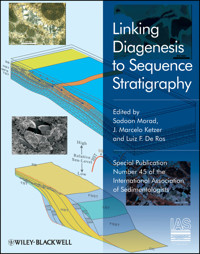
Linking Diagenesis to Sequence Stratigraphy E-Book
109,99 €
Mehr erfahren.
- Herausgeber: John Wiley & Sons
- Kategorie: Wissenschaft und neue Technologien
- Serie: International Association Of Sedimentologists Series
- Sprache: Englisch
Sequence stratigraphy is a powerful tool for the prediction of depositional porosity and permeability, but does not account for the impact of diagenesis on these reservoir parameters. Therefore, integrating diagenesis and sequence stratigraphy can provide a better way of predicting reservoir quality.
This special publication consists of 19 papers (reviews and case studies) exploring different aspects of the integration of diagenesis and sequence stratigraphy in carbonate, siliciclastic, and mixed carbonate-siliciclastic successions from various geological settings. This book will be of interest to sedimentary petrologists aiming to understand the distribution of diagenesis in siliciclastic and carbonate successions, to sequence stratigraphers who can use diagenetic features to recognize and verify interpreted key stratigraphic surfaces, and to petroleum geologists who wish to develop more realistic conceptual models for the spatial and temporal distribution of reservoir quality.
This book is part of the International Association of Sedimentologists (IAS) Special Publications.
The Special Publications from the IAS are a set of thematic volumes edited by specialists on subjects of central interest to sedimentologists. Papers are reviewed and printed to the same high standards as those published in the journal Sedimentology and several of these volumes have become standard works of reference.
Sie lesen das E-Book in den Legimi-Apps auf:
Seitenzahl: 1208
Veröffentlichungsjahr: 2012
Ähnliche




















Contents
Cover
Other Publications of the International Association of Sedimentologists
Special Publications
Reprint Series
Title Page
Copyright
Preface
Chapter 1: Linking Diagenesis to Sequence Stratigraphy: An Integrated Tool for Understanding and Predicting Reservoir Quality Distribution
Introduction
Sequence Stratigraphy: An Overview of the Key Concepts
Parameters Controlling Sediment Diagenesis
Basis for Linking Diagenesis and Sequence Stratigraphy
Distribution of Diagenetic Alterations Along Sequence Stratigraphic Surfaces
Distribution of Diagenetic Alterations Within Systems Tracts
Concluding Remarks
References
Chapter 2: The Occurrence of Glaucony in the Stratigraphic Record: Distribution Patterns and Sequence-Stratigraphic Significance
Introduction
Conclusions
Acknowledgements
References
Chapter 3: Sequence Architecture and Palaeoclimate Controls on Diagenesis Related to Subaerial Exposure of Icehouse Cyclic Pennsylvanian and Permian Carbonates
Introduction
Geologic Setting
Methods
Depositional Environments
Sequences
Diagenetic Alterations
Distribution of Fbo-Calcite Cement
Discussion
Conclusions
Acknowledgements
References
Chapter 4: Sequence Stratigraphic Influence on Regional Diagenesis of a Mixed Carbonate-Siliciclastic Passive Margin, Eocene, N.C., USA
Introduction
Background
Methods
Depositional Facies
Diagenetic Fabrics
Discussion
Conclusions
Acknowledgements
References
Chapter 5: Stratigraphic Controls on the Distribution of Diagenetic Processes, Quality and Heterogeneity of Fluvial-Aeolian Reservoirs from the Recôncavo Basin, Brazil
Introduction
Recôncavo Basin
Sergi Formation
Sampling and Analytical Methods
Petrology of Sergi Sandstones
Diagenetic Processes and Constituents
Discussion
Conclusions
Acknowledgements
References
Chapter 6: Diagenesis at Exposure Surfaces in a Transgressive Systems Tract in a Third Order Sequence (Lower Carboniferous, Belgium)
Introduction
Geological Setting
Methodology
Sedimentology and Sequence Stratigraphy
Diagenesis
Conclusions
Acknowledgements
References
Chapter 7: Diagenetic and Epigenetic Mineralization in Central Europe Related to Surfaces and Depositional Systems of Sequence Stratigraphic Relevance
Introduction
Geological and Geodynamic Settings
Diagenetic and Epigenetic Mineralizations in Central Europe and Their Sequence Stratigraphic Setting
Conclusions
Acknowledgements
References
Chapter 8: Distribution and Petrography of Concretionary Carbonate in a Falling-Stage Delta-Front Sandstone Succession: Upper Cretaceous Panther Tongue Member, Book Cliffs, Utah
Introduction
Geological and Stratigraphic Setting
Methods
Results
Data Interpretation
Conclusion
Acknowledgments
References
Chapter 9: Dolomite-Rich Condensed Sections in Overbank Deposits of Turbidite Channels: The Eocene Hecho Group, South-Central Pyrenees, Spain
Introduction
Geological and Stratigraphic Setting
Materials and Methods
Results
Discussion
Conclusions
Acknowledgments
References
Chapter 10: An Integrated Stratigraphic, Petrophysical, Geochemical and Geostatistical Approach to the Understanding of Burial Diagenesis: Triassic Sherwood Sandstone Group, South Yorkshire, UK
Introduction
Background
Outcrop Data
Results
Spatial Patterns
Discussion OF Spatial Patterns
Conclusions
Acknowledgements
References
Chapter 11: Geochemical Evidence for Meteoric Diagenesis and Cryptic Surfaces of Subaerial Exposure in Upper Ordovician Peritidal Carbonates from the Nashville Dome, Central Tennessee, USA
Introduction
Stratigraphic Context
Methods
Results
Discussion
Conclusions
Acknowledgements
References
Chapter 12: Distribution of Diagenetic Alterations in Relationship to Depositional Facies and Sequence Stratigraphy of a Wave- and Tide-Dominated Siliciclastic Shoreline Complex: Upper Cretaceous Chimney Rock Sandstones, Wyoming and Utah, USA
Introduction
Geological Setting and Sequence Stratigraphy
Samples and Methods
Results
Discussion
Summary Model of the Diagenetic Evolution
Conclusions
Acknowledgements
References
Chapter 13: Linking Diagenesis and Porosity Preservation versus Destruction to Sequence Stratigraphy of Gas Condensate Reservoir Sandstones; the Jauf Formation (Lower to Middle Devonian), Eastern Saudi Arabia
Introduction
General Geological Setting, Depositional Facies and Sequence Stratigraphy
Samples and Methods
Framework Composition of the Sandstones
Diagenetic Processes and Products
Discussion
Summary Model of the Diagenetic and Related Reservoir Quality Evolution Pathways
Conclusions
Acknowledgments
References
Chapter 14: Petrographic, Stable Isotope and Fluid Inclusion Characteristics of the Viking Sandstones: Implications for Sequence Stratigraphy, Bayhurst Area, SW Saskatchewan, Canada
Introduction
Geological Setting
Stratigraphy of the Viking Formation in the Study Area
Analytical Methods
Petrography
Carbon and Oxygen Isotopes of Carbonate Cements
Fluid Inclusions
Discussion
Conclusions
Acknowledgements
References
Chapter 15: Diagenetic Alterations Related to Falling Stage and Lowstand Systems Tracts of Shelf, Slope and Basin Floor Sandstones (Eocene Central Basin, Spitsbergen)
Introduction
Geological Setting
Depositional Environments
Sequence Stratigraphy
Samples and Methods
Results
Discussion
Conclusions
Acknowledgments
References
Chapter 16: Diagenetic Controls on Porosity Preservation in Lowstand Oolitic and Crinoidal Carbonates, Mississippian, Kansas and Missouri, USA
Introduction
Lithofacies
Stratigraphy
Discussion of Stratigraphy
Diagenesis
Conclusions
Acknowledgements
References
Chapter 17: Diagenetic Salinity Cycles: A link between Carbonate Diagenesis and Sequence Stratigraphy
Introduction
Hypotheses
Geological Settings
Methods
Results – Expressions of Diagenetic Salinity Cycles
Discussion
Conclusions
Acknowledgements
References
Chapter 18: Linkages between Tapho-Diagenesis and Sequence Stratigraphy in Cool-Water Limestones from a Pliocene Forearc Seaway, New Zealand
Introduction
Geological and Tectonic Setting
Methods
Sedimentology and Stratal Architectures
Taphonomy and Carbonate Diagenesis
Evolution of Contrasting Forearc Carbonate Factories
Eustatic Depositional – Carbonate Alteration Models
Conclusions
Acknowledgements
References
Chapter 19: Recognition and Significance of Paludal Dolomites: Late Mississippian, Kentucky, USA
Introduction
Methods
Description
Interpretation
Discussion
Conclusions
Acknowledgments
References
Index
Other Publications of the International Association of Sedimentologists
Special Publications
44 Sediments, Morphology and Sedimentary Processes on Continental Shelves
43 Quaternary Carbonate and Evaporite Sedimentary Facies and Their Ancient Analogues
42 Carbonate Systems During the Olicocene-Miocene Climatic Transition
41 Perspectives in Carbonate Geology
40 Analogue and Numerical Modelling of Sedimentary Systems
39 Glacial Sedimentary Processes and Products
38 Sedimentary Processes, Environments and Basins
37 Continental Margin Sedimentation From Sediment
36 Braided Rivers
35 Fluvial Sedimentology VII
34 Clay Mineral Cements in Sandstones
33 Precambrian Sedimentary Environments
32 Flood and Megaflood Processes and Deposits
31 Particulate Gravity Currents
30 Volcaniclastic Sedimentation in Lacustrine Settings
29 Quartz Cementation in Sandstones
28 Fluvial Sedimentology VI
27 Palaeoweathering, Palaeosurfaces and Related
26 Carbonate Cementation in Sandstones
25 Reefs and Carbonate Platforms in the Pacific and Indian Oceans
24 Tidal Signatures in Modern and Ancient Sediments
23 Carbonate Mud-mounds
Reprint Series
4 Sandstone Diagenesis: Recent and Ancient
3 Deep-water Turbidite Systems
2 Calcretes
This edition first published 2012 © 2012 by International Association of Sedimentologists
Cover images: Reproduced with permission of Sadoon Morad, J. Marcelo Ketzer, Luiz F. De Ros
Blackwell Publishing was acquired by John Wiley & Sons in February 2007. Blackwell's publishing program has been merged with Wiley's global Scientific, Technical and Medical business to form Wiley-Blackwell.
Registered office: John Wiley & Sons, Ltd, The Atrium, Southern Gate, Chichester, West Sussex, PO19 8SQ, UK
Editorial offices: 9600 Garsington Road, Oxford, OX4 2DQ, UKThe Atrium, Southern Gate, Chichester, West Sussex, PO19 8SQ, UK111 River Street, Hoboken, NJ 07030-5774, USA
For details of our global editorial offices, for customer services and for information about how to apply for permission to reuse the copyright material in this book please see our website at www.wiley.com/wiley-blackwell.
The right of the author to be identified as the author of this work has been asserted in accordance with the UK Copyright, Designs and Patents Act 1988.
All rights reserved. No part of this publication may be reproduced, stored in a retrieval system, or transmitted, in any form or by any means, electronic, mechanical, photocopying, recording or otherwise, except as permitted by the UK Copyright, Designs and Patents Act 1988, without the prior permission of the publisher.
Designations used by companies to distinguish their products are often claimed as trademarks. All brand names and product names used in this book are trade names, service marks, trademarks or registered trademarks of their respective owners. The publisher is not associated with any product or vendor mentioned in this book. This publication is designed to provide accurate and authoritative information in regard to the subject matter covered. It is sold on the understanding that the publisher is not engaged in rendering professional services. If professional advice or other expert assistance is required, the services of a competent professional should be sought.
Library of Congress Cataloging-in-Publication Data
Linking diagenesis to sequence stratigraphy / edited by Sadoon Morad, Marcelo Ketzer, Luis F. De Ros.
pages cm. – (Special publication number 45 of the International Association of Sedimentologists)
Summary: “Sequence stratigraphy is a powerful tool for the prediction of depositional porosity and permeability, but does not account for the impact of diagenesis on these reservoir parameters. Therefore, integrating diagenesis and sequence stratigraphy can provide a better way of predicting reservoir quality”– Provided by publisher.
Includes bibliographical references and index.
ISBN 978-1-118-48539-2 (hardback)
1. Diagenesis. 2. Reservoir sedimentation. 3. Sequence stratigraphy. I. Morad, Sadoon, editor of compilation. II. Ketzer, Marcelo, editor of compilation. III. De Ros, Luiz Fernando, editor of compilation.
QE571.L56 2012
552′.03–dc23
2012031369
A catalogue record for this book is available from the British Library.
Wiley also publishes its books in a variety of electronic formats. Some content that appears in print may not be available in electronic books.
Cover design by Code 5 Design
Preface
Diagenesis and sequence stratigraphy studies are conventionally performed as independent and isolated methods for the understanding and prediction of the spatial and temporal distribution of reservoir quality in sedimentary successions. Sequence stratigraphy focuses on the distribution of depositional facies and therefore of primary porosity and permeability of sedimentary successions promoted by the interplay between the rates of changes in relative sea level and in sedimentation. Diagenesis focuses on post-depositional processes causing modifications to depositional porosity and permeability at near-surface and during progressive burial of the successions, being commonly controlled by several parameters, which vary widely among the carbonate and siliciclastic successions.
Recently, several authors have demonstrated that the integration of diagenesis and sequence stratigraphy is a powerful tool for the understanding and prediction of the distribution of diagenetic alterations and of their impact on reservoir quality distribution and evolution. The successful application of the integrated approach is possible because the parameters controlling the distribution of early diagenetic (eogenetic) alterations also control the sequence stratigraphic framework. These parameters include: (i) changes in the relative sea level, which control changes in pore water chemistry (marine, meteoric and mixed); and (ii) rates of sedimentation, which control the residence time of the sediments under specific geochemical conditions, such as along surfaces of subaerial exposure (i.e. sequence boundaries) and at the seafloor (e.g. along marine flooding surfaces). The first papers, which have dealt with this integrated approach, apply to carbonate successions; usually carbonate sediments are far more reactive and sensitive to changes in pore water chemistry (marine, meteoric and mixed marine-meteoric compositions) than siliciclastic sediments.
This IAS Special Publication was assembled from a set of peer-reviewed papers by invited authors working with this research topic. Contributions cover the application of the integrated diagenesis-sequence stratigraphy approach to carbonate and siliciclastic successions from various geological settings.
This volume consists of 19 papers exploring different aspects of the integration of diagenesis and sequence stratigraphy in carbonate and siliciclastic successions, including review papers and case studies. The opening paper by Morad etal. is a general review of the links between diagenesis and sequence stratigraphy in carbonate and siliciclastic rocks and their applications to reservoir quality prediction. The second paper, by Amorosi, consists of a revision on the distribution patterns of glaucony in a sequence stratigraphic framework. The two following papers, by Caron etal. and Csoma & Goldstein, propose relationships between the diagenesis and the sequence stratigraphy of carbonate successions. Buijs & Goldstein, Smeester etal. and Railsback etal., present aspects of diagenetic alterations related to surfaces of subaerial exposure surfaces, while Ritter & Goldstein and Barnett etal. demonstrate examples of sequence stratigraphic controls on the diagenesis of carbonate successions. The influence of sequence stratigraphy on the diagenesis of mixed carbonate-siliciclastic successions is presented by Coffey.
The sequence stratigraphic controls on the diagenesis of siliciclastic, continental successions is explored by De Ros & Scherer, whilst controls on coastal and marine sucessions (including deep water turbidite deposits) are presented by Machent etal., Al-Ramadan etal. and Mansurbeg etal. and Marfil etal., McKinley etal. and Walz etal. present integrated studies applied to the understanding of burial diagenesis and to the application of diagenesis to sequence stratigraphy. The volume is completed with an example by Dill on the application of diagenesis and sequence stratigraphy integration to mineral exploration.
This volume is expected to interest various classes of readers, including: (i) sedimentologists and sedimentary petrologists who aim to understand the distribution of diagenetic alterations in siliciclastic and carbonate sedimentary rocks; (ii) sequence stratigraphers who wish to recognize key sequence stratigraphic surfaces based on their specific diagenetic signatures, aiding in the construction of the sequence stratigraphic framework of carbonate and siliciclastic successions, and (iii) petroleum geologists aiming to develop models for the spatial and temporal distribution of reservoir quality in these successions.
Linking Diagenesis to Sequence Stratigraphy: An Integrated Tool for Understanding and Predicting Reservoir Quality Distribution
S. Morad*,†, J.M. Ketzer‡ and L.F. De Ros§
*Department of Petroleum Geosciences, The Petroleum Institute, P.O. Box 2533, Abu Dhabi, United Arab Emirates; E-mail: [email protected]
†Department of Earth Sciences, Uppsala University, 752 36, Uppsala, Sweden
‡CEPAC Brazilian Carbon Storage Research Center, PUCRS, Av. Ipiranga, 6681, Predio 96J, TecnoPuc, Porto Alegre, RS, 90619-900, Brazil; E-mail: [email protected]
§Instituto de Geociências, Universidade Federal do Rio Grande do Sul - UFRGS, Av. Bento Gonçalves, 9500, Porto Alegre, RS, 91501-970, Brazil; E-mail: [email protected]
Abstract
Sequence stratigraphy is a useful tool for the prediction of primary (depositional) porosity and permeability. However, these primary characteristics are modified to variable extents by diverse diagenetic processes. This paper demonstrates that integration of sequence stratigraphy and diagenesis is possible because the parameters controlling the sequence stratigraphic framework may have a profound impact on early diagenetic processes. The latter processes play a decisive role in the burial diagenetic and related reservoir-quality evolution pathways. Therefore, the integration of sequence stratigraphy and diagenesis allows a proper understanding and prediction of the spatial and temporal distribution of diagenetic alterations and, consequently, of reservoir quality in sedimentary successions.
Introduction
The diagenesis of sedimentary rocks, which may enhance, preserve or destroy porosity and permeability, is controlled by a complex array of inter-related parameters (Stonecipher et al., 1984). These parameters range from tectonic setting (controls burial-thermal history of the basin and detrital composition of clastic sediments) to depositional facies and palaeo-climatic conditions (Morad, 2000; Worden & Morad, 2003). Despite the large number of studies (e.g. Schmidt & McDonalds, 1979; Stonecipher et al., 1984; Jeans, 1986; Curtis, 1987; Walderhaug & Bjorkum, 1998; Ketzer et al., 2003; Shaw & Conybeare, 2003) on the diagenetic alteration of sedimentary rocks, the parameters controlling their spatial and temporal distribution patterns in paralic and shallow-marine and particularly in continental and deep water sedimentary deposits are still not fully understood (Surdam et al., 1989; Morad, 1998; Worden & Morad, 2000, 2003).
Diagenetic studies have been used independently from sequence stratigraphy as a tool to understand and predict the distribution of reservoir quality in clastic and carbonate successions (e.g. Ehrenberg, 1990; Byrnes, 1994; Wilson, 1994; Bloch & Helmold, 1995; Kupecz et al., 1997; Anjos et al., 2000; Spötl et al., 2000; Bourque et al., 2001; Bloch et al., 2002; Esteban & Taberner, 2003; Heydari, 2003; Prochnow et al., 2006; Ehrenberg et al., 2006a).
The sequence stratigraphic approach, nevertheless, allows the prediction of facies distributions (Posamentier & Vail, 1988; Van Wagoner et al., 1990; Emery & Myers, 1996; Posamentier & Allen, 1999), providing information on the depositional distribution of primary porosity and permeability (Van Wagoner et al., 1990; Posamentier & Allen, 1999). Depositional reservoir quality is mainly controlled by the geometry, sorting and grain size of sediments. Sequence stratigraphy enables prediction of the distribution of mudstones and other fine-grained deposits that may act as seals, baffles and barriers for fluid flow within reservoir successions and as petroleum source rocks (Van Wagoner et al., 1990; Emery & Myers, 1996; Posamentier & Allen, 1999).
Although sequence stratigraphic models can predict facies and depositional porosity and permeability distribution in sedimentary successions, particularly in deltaic, coastal and shallow-marine deposits (Emery & Myers, 1996), they cannot provide direct information about the diagenetic evolution of reservoir quality. As most of the controls on early diagenetic processes are also sensitive to relative sea-level changes (e.g. pore water compositions and flow, duration of subaerial exposure), diagenesis can be linked to sequence stratigraphy (Tucker, 1993; South & Talbot, 2000; Morad et al., 2000, 2010; Ketzer et al., 2002, 2003). Hence, it is logical to assume that the integration of diagenesis and sequence stratigraphy will constitute a powerful tool for the prediction of the spatial and temporal distribution and evolution of quality in clastic reservoirs, as it has already been developed for carbonate successions (Goldhammar et al., 1990; Read & Horbury, 1993 and references therein; Tucker, 1993; Moss & Tucker, 1995; South & Talbot, 2000; Bourque , 2001; Eberli , 2001; Tucker & Booler, 2002; Glumac & Walker, 2002; Moore, 2004; Caron , 2005). This approach can also provide useful information on the formation of diagenetic seals, barriers and baffles for fluid flow, which may promote diagenetic compartmentalization of the reservoirs. A limited number of studies has been undertaken that illustrate how the spatial distribution of diagenetic features in various types of sedimentary successions can be better understood when linked to a sequence stratigraphic framework (Read & Horbury, 1993 and references therein; Tucker, 1993; Moss & Tucker, 1995; Morad , 2000; Ketzer , 2002, 2003a, 2003b, 2005; Al-Ramadan , 2005; El-Ghali , 2006, 2009).
Lesen Sie weiter in der vollständigen Ausgabe!
Lesen Sie weiter in der vollständigen Ausgabe!
Lesen Sie weiter in der vollständigen Ausgabe!
Lesen Sie weiter in der vollständigen Ausgabe!
Lesen Sie weiter in der vollständigen Ausgabe!
Lesen Sie weiter in der vollständigen Ausgabe!
Lesen Sie weiter in der vollständigen Ausgabe!
Lesen Sie weiter in der vollständigen Ausgabe!
Lesen Sie weiter in der vollständigen Ausgabe!
Lesen Sie weiter in der vollständigen Ausgabe!
Lesen Sie weiter in der vollständigen Ausgabe!
Lesen Sie weiter in der vollständigen Ausgabe!
Lesen Sie weiter in der vollständigen Ausgabe!
Lesen Sie weiter in der vollständigen Ausgabe!
Lesen Sie weiter in der vollständigen Ausgabe!
Lesen Sie weiter in der vollständigen Ausgabe!
Lesen Sie weiter in der vollständigen Ausgabe!
Lesen Sie weiter in der vollständigen Ausgabe!
Lesen Sie weiter in der vollständigen Ausgabe!




