


Erhalten Sie Zugang zu diesem und mehr als 300000 Büchern ab EUR 5,99 monatlich.
- Herausgeber: Fitzcarraldo Editions
- Kategorie: Gesellschafts- und Liebesromane
- Sprache: Englisch
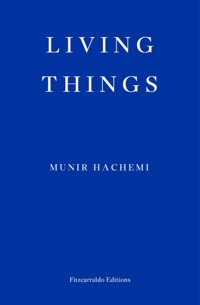
Living Things follows four recent graduates – Munir, G, Ernesto and Álex – who travel from Madrid to the south of France to work the grape harvest. Except things don't go as planned: they end up working on an industrial chicken farm and living on a campsite, where a general sense of menace takes hold. What follows is a compelling and incisive examination of precarious employment, capitalism, immigration and the mass production of living things, all interwoven with the protagonist's thoughts on literature and the nature of storytelling. A genre-bending and dystopian eco-thriller, Living Things is a punk-like blend of Roberto Bolaño's The Savage Detectives and Samanta Schweblin's Fever Dream, heralding an exciting new voice in international fiction.
Sie lesen das E-Book in den Legimi-Apps auf:
Seitenzahl: 176
Veröffentlichungsjahr: 2024
Das E-Book (TTS) können Sie hören im Abo „Legimi Premium” in Legimi-Apps auf:
Ähnliche


















123‘Startling, compulsive, and vibrant; Living Things reads like an ignition. The most honest thing I’ve read in a long time about being young and alive in a beautiful, horrible world.’
— Dizz Tate, author of Brutes
‘A sinister, suspenseful novel, Living Things exposes how the biotech industry will take the foundations of life and mutilate them into things untrustworthy as triffids. Hachemi wrangles form itself, making a sci-fi of what is ultimately extremely quotidian and true: Frankenstein creatures created as fodder to feed an increasingly undernourished world, and the refracted suffering that upholds such a system, in which living things – worker, plant and animal – are made consumable parts in helix. Hachemi deftly lays bare the cannibalistic bent at the heart of global capitalism.’
— Abi Andrews, author of The Word for Woman is Wilderness
‘Heady, diaristic and compulsively readable in Julia Sanches’s perfect translation, four reckless and stubborn college students get themselves caught in the hell of factory farming in Southern France. To say that Living Things is a superb eco-thriller is both true and yet falls short of just how magnificently unclassifiable Hachemi’s novel is.’
— Jacob Rogers, The Center for Fiction
‘Living Things is a short novel that changes its skin – and almost its genre – in each of its seven parts … A work of autofiction that not only defines the self against lived and narrated experience, but also functions as an indictment of social, political, economic and health systems … [T]he fact that this all happened to the author affects us not only as readers, but as human beings.’
— Carlos Zanón, El País4
5
LIVING THINGS
MUNIR HACHEMI
Translated by
JULIA SANCHES
CONTENTS
I. ARTIFICIAL RESPIRATION
‘We can’t change reality,
but we can change the subject.’
— James Joyce, as cited by Ricardo Piglia
The day I met my friend G, he told me that as a kid he devised a theory about short stories that stayed with him all his life. It shouldn’t come as a surprise that the purpose of stories is to classify, to impose order and hierarchy on the real world. But reality is a wilderness – a jungle or desert – a place that cannot be mapped. Every time something wild disrupted his life, my friend G would tell a story, any story, it didn’t matter what, anything would do. His parents would be screaming at each other at home, and he’d start talking about how the girl he liked had tripped in class, or how the baker had short-changed him, or whatever. He kept up this habit, or tic, as he got older – or maybe the truth is that he never lost it – and went on perfecting his theory. ‘Listen, the cut-off point between the way we cast light on the world and the world itself is the exact moment when that light is lost: death. Every civilization has built its identity – its cosmology or Weltanschauung – around this point. I can’t think of a single work of fiction where someone dies without saying or at least trying to say last words, words that are then subjected to interpretative violence, as if they were a summary or sublimation of everything that person had thought, felt and believed throughout the course of their life.’ I agreed with him because he was right, or at least I thought he was, and also because I always agreed with him. As the years passed, G took this argument to the extreme and said something that could have gone on to become his last words. Roughly, that ‘stories were born 10the moment our ancestors experienced great terror, the moment before one of them died, or when their camp was under siege, or when they lost a loved one’. That probably wasn’t what he said word for word; his exact phrasing no doubt did a better job of enshrining his thanatotic theory about short fiction. For him stories were intimately connected to death, and one could not be grasped without the other. With time, this theory impacted his relationship with the world, and he began to see proof that he was right all around him. Of course, the same applies to all theories, but among G’s various talents is an ability to drum up the most ingenious proofs, examples that linger in the minds of his listeners. I clearly remember him referring more than once to the scene in Pulp Fiction where Samuel L. Jackson has a gun pointed at him and starts talking about an epiphany he had, something his interlocutor finds incomprehensible and yet in that moment makes perfect sense to that character (and to the viewer). Stories as a way of momentarily forgetting death, stepping into death, or simply looking the other way as life carries on.
G would say that the story I’m about to tell is less a story than it is a prayer to ward off the horror that has been whispering to me for years. Maybe he’s right. But I’m going to tell my story – or our story – anyway, and even more rightfully, by hewing to the truth. So don’t expect to find any embellishments here beyond the ones imposed by language – which I realize are more than a few. A pessimist would insist that language inflicts so many nuances and misunderstandings – which, by the way, are not the collateral damage of language but the conditions of its existence – that the difference between the most straightforward writers and the most prolix, between the most sincere and the ones who take great pains to cut rubies out of lies, that this difference, I say – or rather, a 11pessimist would say – accounts for less than three or four per cent of all textual embellishment. I’m inclined to take a more positive approach, one less faithful or perhaps more straightforward, and start counting the flourishes at the point where language allows us to speak for ourselves: what you might call embellishment degree zero.
There are dozens of authors who have engaged in a cheap literary tradition that seems to take a variety of forms, all of them extremely poor. I’m talking about found manuscripts, false testimonies and mises en abyme. More than a few writers have dabbled in these sorts of gimmicks, convinced they were inventing literature anew when all they were doing was proving how little they cared about it. Paradoxically, I – who do not consider myself a writer (not any more) – will be the first to declare that the emperor has no clothes, the first to take the floor with the courage needed to flout the frills and artifice, the first to tell the story as it unfolded and nothing more. Time will banish the rest of them to the depths of history. For now, my act of revenge will be to withhold their names.
Before I begin my story, I should give a couple of examples of the kind of literature I want to avoid. In the pages after this preface, you may come across a sentence like ‘everything is covered in blood’. If that happens, don’t try to tease out any hidden meaning. I’m not saying that horror coats everything like a fine, invisible film; nor does the image signify sexual desire or the urge to kill. All you should understand is that everything is covered in blood. The snow, the gravel, the houses, the lamp posts. Everything. And not fresh blood either, but dry blood – extremely dry. Another example: if I describe a scene where a person is wearing a baseball cap, don’t try to tease out a metaphor. There is no metaphor. Just picture someone in a baseball cap. Whatever hermeneutic 12violence you unleash on this image should be no greater than the violence you unleash on the real world. In other words, this text is only a book inasmuch as everything is a book. That’s it. There is no intent, just storytelling. Embellishment degree zero. If you do your best to read it this way, then I should be able to tell you my story – the real story, what actually happened.
II. MEMORIES OF UNDERDEVELOPMENT
The car was parked on the street where three out of the four of us lived. The boot was open, and we were loading in our luggage while waiting for G. His being late surprised us less than the amount of stuff he had with him. He’d brought a flamenco guitar, a backpack full of books, and a load of random equipment that, if I’m remembering correctly, he’d found at his grandfather’s farm. We all laughed at the beekeeping gloves, the coveralls, the ridiculously high boots. That day – this much is true – everything made us laugh. For example, we cracked up when we noticed we had each packed at least one instrument. Keep in mind that Ernesto was a pretty serious guy, Alejandro wished he was, and G – probably the smartest of us four – lived and breathed militant Marxism the way some people do literature, that is, like a rare sin of youth, a categorical decision he didn’t remember making. It’s possible he kept analyzing things while we laughed. It’s possible he laughed with us while also thinking about how it wasn’t really a coincidence, that at the end of the day the four musicians in question were four middle-class guys (lower-middle, in his case; middle-middle in mine and Álex’s; upper-middle in Ernesto’s – in any event, back then everyone in Spain belonged to some variation of the middle class unless proven otherwise), that three of us had read the same subject at university – you’ll have guessed which of us by now – and, in short, that sociology had already concluded our similarities would far outweigh our differences. To the series of points G could have made, I’d add one that I knew about at the time but didn’t have the courage to voice: not one of us was travelling for financial gain.
It’s a well-known fact that all modern fiction is born out 14of market tension. Becoming an author entails acquiring money and fame, yet the line between the moment a person becomes an author and the moment, in so doing, they cease to be one is tenuous. Equally well-known is the theory that below the surface of every story lies another, purportedly deeper tale. This text – which is not a short story – does not have to fit this theory, while our life – a story we constantly tell ourselves – does. In a short piece by Hemingway – an author I otherwise despise – there is a couple arguing in a hotel room. The woman sees a cat on the street, I can’t remember whether before – while they were taking a walk or having a drink – or in that moment – through the window. The second iteration is superior by far, but this being a Hemingway story, the jury’s still out. Anyway. She wants to rescue the cat; he thinks doing so would be madness and offers a couple of far-fetched excuses. They argue. They don’t reach an agreement, and he gets his way – when there’s a draw, inertia always trumps action – and the cat stays on the street. She cries a bit. They lie down on opposite sides of the bed, back to back.
I doubt I’ve told the story right. The beauty or practicality of the iceberg theory, as some people call it, is that you can change the surface of a story – the metaphorical tip of the iceberg – without changing the overall meaning. The story underneath this piece by Hemingway is so plain you’ve surely worked it out by now: the cat is the child the couple will never have.
Story A in our case – the tip of the iceberg – had to do with money: we were travelling to the south of France for work. Saying it was about money also establishes that it was about our various literary aspirations, given that modern-day authors are always in pursuit of financial stability, a thing impossible to find. Yet, our story could 15also be seen as just another episode in an overarching narrative that existed in Spain at the time, which made it so that young men and women were forced to choose between three options. Namely, spending the summer mixing drinks at some beach bar on the Mediterranean coast, moving to London to make sandwiches or look after some adorable brat and – theoretically – learn English, or harvesting grapes in the south of France. Option three most aligned with our interests, since it would also help us meet several of the demands placed on young middle-class men back then: being lean and tanned, doing some form of manual labour (this is key, as it adds a whiff of social legitimacy to the CV of any middle-aged professor or lawyer – the cliché being ‘I too lived through tough times and had no choice but to work hard’), being financially solvent, etc. In a way, harvesting grapes would allow us to cultivate a future, or story for the future, but most of all (for me at least, or the person I was then), it was a volatile, hazy, ill-defined thing that we coined in the word experience.
Experience, we all know, is the sine qua non for creating literature. While I may not subscribe to the belief myself, the fact remains that this truism has permeated every literary decalogue in the field. Bolaño, for example – reading Bolaño being one of the unwritten commandments – declared that ‘a short-story writer should be brave’ and dive in headfirst. Piglia claimed his lifestyle defined his literary style. Augusto Monterroso urged young writers to ‘make the most of every disadvantage, whether insomnia, imprisonment or poverty; the first gave us Baudelaire, the second Silvio Pellico, and the third all your writer friends; avoid sleeping like Homer, living easily like Byron, or making as much money as Bloy.’ (I’ve always thought that last one should be ‘Bioy’ – although, unlike Léon 16Bloy, Bioy Casares didn’t so much ‘make’ money as have money.) With time and the proliferation of notes I jotted down in journals, diaries, and on scraps of paper, I developed my own decalogue of decalogues about experience as literary capital:
A short-story writer should be brave. Drop everything and dive in headfirst.Make the most of every disadvantage, whether insomnia, imprisonment or poverty; the first gave us Baudelaire, the second Silvio Pellico, and the third all your writer friends; avoid sleeping like Homer, living easily like Byron, or making as much money as Bloy.Remember that writing isn’t for cowards, but also that being brave isn’t the same as not feeling afraid; being brave is feeling afraid and sticking it out, taking charge, going all in.Don’t start writing poetry unless you’ve opened your eyes underwater, unless you’ve screamed underwater with your eyes wide open. Also, don’t start writing poetry unless you’ve burned your fingers, unless you’ve put them under the hot water tap and said, ‘Ahhh! This is much better than not getting burned at all.’Be in love with your own life.What sets a novelist apart is having a unique worldview as well as something to say about it. So try living a little first. Not just in books or in bars, but out there, in real life. Wait until you’ve been scarred by the world, until it has left its mark.Try living abroad.You’ve got to fuck a great many women / beautiful women / […] / drink more and more beer / […] 17attend the racetrack at least once.You’ve got to sell your heart, your strongest reactions, not the little minor things that only touch you lightly, the little experiences that you might tell at dinner.People in a novel, not skilfully constructed characters, must be projected from the writer’s assimilated experience, from his knowledge, from his head, from his heart and from all there is of him.The writers behind this advice – in strict disorder – are: Javier Cercas, Arturo Pérez-Reverte, Jack Kerouac, Ernest Hemingway, Paul Auster, Roberto Bolaño, Charles Bukowski, Hernán Casciari, F. Scott Fitzgerald and Augusto Monterroso. (Exercise: draw a line between each author and his advice.) As might be expected, all ten authors are men. In our culture, entrepreneurship, a spirit for adventure and self-advertising are qualities reserved for the male species. It’s not for nothing that sex workers have been tainted as ‘public women’, as opposed to ‘private women’, who are ‘goodwomen’.
If you think about it, the fact that these rules exist at all is evidence of a loss. During the Middle Ages it was possible to sing ballads about the end of experience and – more importantly – from the end of experience: i.e. prison. I’m talking about ‘The Prisoner’s Ballad’, which begins ‘in May, it was in May, when the weather is warm’, and (in its most famous iteration) tells a story in sixteen verses about a man who knows when it’s night and when it’s day thanks to the little bird that visits him like clockwork, until it is eventually slain by an archer. The ballad in question could easily have been written by someone with no real experience, since it doesn’t narrate experience so 18much as a human being’s primal experience: an awareness of solar cycles. Had a speaker not been implied in the language we could have posited that another animal species altogether had written the ballad, maybe even a sunflower. Though the experience itself is unfamiliar, the ballad gives us a glimpse into a lifetime of sorrow and joy by way of its sparing description of a prison cell and a bird. The difference between us and the author is crucial: he believes everything stands for something deeper, that his shallow account of two or three details conceals the same ulterior reality as the fourteen thousand verses of the Divine Comedy. He doesn’t go to the bother of describing the prison, or identifying the narrator with the author, or adding any depth whatsoever to the scene because he knows the depth is already there. And despite all this, he still makes us feel something.
In a way, every literary decalogue tells a writer’s hypothetical future. According to the iceberg theory, my decadecalogue or metadecalogue should conceal an underwater mountain, and it does: it presumes certain experiences are more valuable than others. During our current phase of late-stage capitalism, we know that the stuff life is made of (time or the memory of a time that may or may not have passed) has – much like everything else – become a commodity. Travelling around Latin America, Thailand or Canada; living in New York City, Madrid or Paris because ‘there are things going on there’; squandering our youth in the quest for a body that’s always beyond reach – these are all the minor consequences of applying economic theory to a new type of commodity: free time (a perverse expression by and of itself as it presupposes the existence of a time that isn’t free and belongs to somebody else). The investment is the price of a plane ticket, or rent, or a dozen pints of beer; the return is the 19optimization of a period of time that would have passed anyway had you spent it reading, ingesting or socializing. It’s not about maximizing that strange thing we call happiness so much as leading a better life. The people with the worst lives are the poor, who spend less and therefore barely move the machine of experience, who are always deader, greyer, harder to understand, less human.
Our underwater stories had a lot to do with that. Take me, for example. I was travelling because I knew I would write about our trip one day. Not like I am now, but the way – as I said before – I intend to avoid in these pages. Writing like a writer. It took six years for the corpse of fiction – which has been rotting inside me ever since those long months in the south of France – to turn to dust before I could tell the story of what really happened.




