


28,49 €
Mehr erfahren.
- Herausgeber: Crowood
- Kategorie: Lebensstil
- Sprache: Englisch
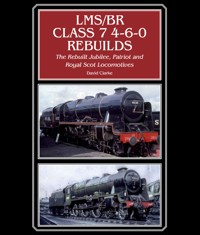
A comprehensive look at the LMS/BR Class 7 4-6-0 rebuilt locomotives, including the rebuilt Jubilees, the rebuilt Patriots and the rebuilt Royal Scots. The book includes hundreds of photographs and feedback from the original crews that operated the engines. Contents include:Origins of the rebuilt Class 7s in the 1940s and the design of the 2A boiler; Differences between the classes; Liveries, names and name plates; Detailed allocation tables; Rebuilt Class 7s to the rescue - the severe winter of 1962/3; Decline of the Class 7s and withdrawal in the 1960s; Preservation of the Class 7 rebuilds. Essential reading for all locomotive enthisiasts, illustrated with 240 colour photographs and includes feedback from the original crews.
Das E-Book können Sie in Legimi-Apps oder einer beliebigen App lesen, die das folgende Format unterstützen:
Seitenzahl: 322
Veröffentlichungsjahr: 2014
Ähnliche













LMS/BR CLASS 7 4-6-0REBUILDS
The Rebuilt Jubilee, Patriot andRoyal Scot Locomotives
David Clarke
THE CROWOOD PRESS
First published in 2014 by The Crowood Press Ltd Ramsbury, Marlborough Wiltshire SN8 2HR
www.crowood.com
This e-book first published in 2014
© David Clarke 2014
All rights reserved. No part of this publication may be reproduced or transmitted in any form or by any means, electronic or mechanical, including photocopy, recording, or any information storage and retrieval system, without permission in writing from the publishers.
British Library Cataloguing-in-Publication DataA catalogue record for this book is available from the BritishLibrary.
ISBN 978 1 84797 652 9
Photographic AcknowledgementsPhotographs are from the author’s collection unless statedotherwise.
CONTENTS
Acknowledgements
Introduction
1 Origins
2 Detail Differences
3 Liveries, Names and Nameplates
4 Testing and Experimentation
5 Allocations
6 Rebuilt Class 7s to the Rescue – The Severe Winter of 1962–3
7 Decline and Withdrawal
8 Maintenance of the Locomotives
9 Withdrawal and Disposal
10 Summary
11 Preservation
Appendices
Recommended Reading
Index
ACKNOWLEDGEMENTS
Producing a book is not a solitary process; a number of people have provided much help and assistance. Thanks are due to the following photographers for digging through their archives of photographs: Kenneth Tyler (and for his reminiscences of the rebuilds on the Buxton–Manchester services); Peter Groom; Norman Preedy; Malcolm Castledine; and David Cousins. Also thanks to RailOnline (www.railonline.co.uk) for the use of a number of photographs. To Angela Tarnowski and Mal Siddons of the Sherwood Foresters Museum, who provided access to the various plates used on 46112 Sherwood Forester. To Len Pinder, who sorted through a mass of slides and digitally copied them for me and to Steve Taylor for doing some excellent Photoshop work on the colour slides.
I also interviewed as many railwaymen who had direct experience of the class as possible, including: Chris Ward, a fireman at Annesley shed; Alan Newbury, also a fireman at Annesley; Granville Dobson, a fireman at Low Moor shed; and Mike Bentley, a fireman and driver at Buxton and who worked on the engines many, many times.
The published reminiscences of Eric A. Langridge, who was working in the Derby Drawing Office during the 1930s and 1940s, were an invaluable source of inside information. Eric was directly involved with the design of the Stanier locomotives and had a unique view of events and the background as to why things happened. He lived to be well over 100 and published his memories in a number of magazines and books.
Dave Cousins, for digging out some of his black-and-white photographs. Pete Skellon of the Bahamas Locomotive Society provided details of 46115 Scots Guardsman during its time when the Society undertook the restoration of the engine in the 1980s and also some of the modifications made to the rebuilt Scots when in BR service.
I also referred to various issues of Backtrack, Steam Days, Steam World and British Railway Illustrated magazines, which had reminiscences from former railway staff, again giving valuable insight into the working of these locomotives.
Finally, to my wife Glenis, who has put up with my endless hours of research and for helping with the proofreading.
INTRODUCTION
I am old enough to have seen many of the LMS (London, Midland and Scottish Railway) Class 7 rebuilds in traffic and was fortunate to have been pulled by a number of the locomotives on passenger trains as they were used on ‘fill-in’ turns from my local station, Trench Crossing between Stafford, Wellington (Shropshire) and Shrewsbury (where they would then work from Shrewsbury to Crewe). As a teenager in 1962, I went on a rock climbing holiday to Snowdonia, necessitating a rail journey from Wellington to Chester and then to Llandudno Junction and down the branch line to Blaenau Ffestiniog, where I left the train at Betws-y-Coed. The train from Chester to Llandudno Junction was hauled by 46163 Civil Service Rifleman and the return by 46152 The King’s Dragoon Guardsman, both doing the job they were designed for, that of express passenger trains. On one of my visits to Shrewsbury around 1962–3 I was allowed to climb up on the cab of 46125 3rd Carabinier, which had arrived from Crewe on a train destined for the route to Bristol and beyond. It was a real privilege to be on the footplate; I only wish I could have stayed on the locomotive on its journey south.
The saddest sighting for me was seeing one of Crewe North’s rebuilt Scots, 46155 The Lancer, arriving on freight at the military depot at Donnington (on the line between Wellington and Stafford) and, after some shunting, heading off towards Stafford; those 6ft 9in driving wheels were not really designed for mixed freight workings. My last sighting of a rebuilt Class 7 was on 7 February 1965 when visiting Crewe North depot (as part of a Warwickshire rail tour to Crewe Works and depots), where I found one of the last survivors, 46115 Scots Guardsman, standing out of steam in fairly shabby external condition and I feared the worst. I subsequently found out that the locomotive was used on a rail tour a week later and that Crewe North cleaned up the engine and made up some nice replica nameplates.
46124 London Scottish (rebuilt December 1943) is seen at Shrewsbury circa 1959–61 with what is likely to have been a stopping train to Stafford, which was a regular ‘fill-in’ for an 8A engine that would arrive at Shrewsbury with the 11.45 Manchester (London Rd)–Plymouth, where the engine would come off to be replaced by a Western Region engine. The rebuilt Class 7 would do a return trip to Stafford with three coaches and then work back from Shrewsbury to Crewe with another express passenger train. The overall station roof was removed during 1961–2.
46148 The Manchester Regiment (rebuilt July 1954) is seen in ex-Works condition at Stafford shed in the early 1960s, when the loco had acquired AWS (May 1959), speedometer drive (October 1960) and the overhead warning flashes (around 1960). Stanier bogie wheels have replaced the Fowler originals. It was common to see rebuilt Class 7s on Stafford shed as they would be used on ‘fill-in’ turns on the Shrewsbury–Stafford and return stopping services. The author was pulled by 46148 on such a train in 1963. The shed code is difficult to read, but the loco was allocated to Crewe North in April 1962, before moving to Llandudno Junction in September 1962, then on to Holyhead in December 1963. It returned to Llandudno in January 1964, before a final return to Holyhead in April 1964 and withdrawal in November 1964. After storage at Birkenhead shed for a month, it made the long journey to Birds Scrapyard in Morriston, near Swansea, for scrapping in January 1965.
46129 The Scottish Horse (rebuilt December 1944) is seen at Shrewsbury shed in the 1960s. The engine was a long-term resident of Crewe North shed until June 1961, when it was allocated to Carlisle, before being allocated to Crewe again, then going to Longsight Manchester in September 1962. It was withdrawn in June 1964 and scrapped at Central Wagon Company, Wigan, in November 1964. The locomotive has the overhead warning flashes, the additional handrail on the smoke deflectors and the automatic warning system (AWS), but not a speedometer drive. It is fitted with a rocker ash pan (the arm can be seen between the middle and trailing driving wheels), but subsequently in its last years of service it did not have this fitment. G. SHARPE
45526 Morecambe and Heysham (rebuilt February 1947) is seen at Greyrigg on a fitted freight in the autumn of 1964. The engine was allocated to Carlisle Upperby and freight duties were common for its rebuilt Class 7s at this time. The engine has acquired the yellow warning stripe applied at the end of August 1964 and still retains its nameplates and crests above the name. The engine is fitted with AWS (November 1959) and was also fitted with a speedometer (February 1961). The engine had been at Carlisle Upperby since June 1950 and was withdrawn from that shed in October 1964, before being scrapped in February 1965 at one of the scrapyards in the Glasgow area.A. E. DURRANT AND M. BOAKES
In my eyes, the rebuilt Class 7s had a more powerful look when compared to the far more common LMS Jubilees. They had quite a soft exhaust, but when pushed could produce a real ‘bark’ from the exhaust that more than matched their contemporaries, the Castles. The class was the mainstay of the West Coast Main Line from Euston to Glasgow; in reality, the London Midland Region needed more Pacifics, but in the absence of these the rebuilt Class 7s would fill the breach and they were regularly overloaded with fourteen-coach trains. They never seemed to hit the highspeed heights of some of their contemporaries, but the majority of the routes they ran on were not conducive to high-speed running. The valve events on the locomotives were specifically designed to operate at a lower speed range, which gave the locomotives ‘punch’ at lower speeds. This is best illustrated when members of the rebuilt Scots were transferred to Low Moor Bradford and were diagrammed to work a daily heavy Bradford to Southport semi-fast, usually loaded to ten coaches and with forty stops on a steeply graded route (as far as Manchester). The Low Moor crews were surprised how easy the locos, with their 6ft 9in drivers, could accelerate away with a heavy load and the ability of the boiler to generate massive amounts of steam on the hilly sections.
The LMS rebuilt 7s were nominally in three different classes (the rebuilt Jubilees, the rebuilt Patriots and the rebuilt Royal Scots), but they essentially formed one class, all sharing the same wonderful 2A boiler, but with detail differences both among the classes and within each class. Many of the detail changes between the various sub-types are very subtle and not always easy to spot in photographs. The Engine History Cards (EHC) have been analysed, but as with many other classes, the cards suffer from not being fully updated from the early 1960s onwards (and some engines that were on the North Eastern Region stopped having the changes recorded before others), so many of the later changes (such as speedometer, tender changes and Works visits) were not officially recorded.
There are also some anomalies on the EHCs; as an example, 46101 Royal Scots Grey is recorded as having a Light Classified repair between 18 December 1961 and 23 March 1961 and this is the last entry for repairs on the EHC. However, on the same EHC, boiler number 12665 was noted as being fitted on 23 March 1962, indicating a heavy repair at this later date. There are at least four other locos where this sort of discrepancy can be identified. In order to identify many of these later changes, I have used an extensive collection of photographs and observations from such as The Railway Observer, published by the Railway Travel and Correspondence Society (RCTS).
45535 Sir Herbert Walker, K.C.B. (rebuilt September 1948) is seen on a freight at Carlisle on 18 May 1963, when the engine was allocated to Carlisle Kingmoor and not long before it was withdrawn (in October 1963). The engine had been a long-term resident at Edge Hill, with eight years of service from that depot, and had received an overhaul at Crewe Works in April 1962, before its final move to Carlisle Kingmoor in November 1962. The engine had a long journey for its final disposal, as, following storage at Kingmoor, it travelled to William Rigley’s Wagon Works at Bulwell, near Nottingham, where it was scrapped in September 1964. RAILONLINE
Where I have used previously published lists for changes and variants I have validated this with photographic evidence and where the photograph contradicts the published data I have not used the published sources. In the course of doing the research for this book I came across a number of contradictory statements, so if there are any errors they are mine not a simple reiteration of ‘facts’ from an unknown source. The same applies to allocations. The Engine History Cards do not list all of the final allocations, so, for example, the last entry for 46164 The Artists’ Rifleman is an allocation to Crewe North in 1959; the EHC does not mention the subsequent allocation to 41C Millhouses Sheffield in February 1960 and there are many other examples.
The three separate classes have been well covered in book form compared to many other classes, but the three varieties of Class 7 rebuild locomotives have never been documented and treated as one class, whereas of course from the Operating Departments’ point of view they were the same. What does this book have to add to the story beyond the obvious one of having colour photographs? I have tried to summarize all the detailed changes in a compact format so that when viewing a photograph the reader should be able to identify any changes made to that particular locomotive. The key element of the book is to give a full picture of the locomotives in operation, covering all the depots to which they were allocated and the principal trains that the class worked, as well as the experiences of the driving and fitting staff.
45512 Bunsen (rebuilt July 1948). A magnificent shot taken in June 1964 at Willesden when Bunsen was visiting from its home depot of Carlisle Upperby, to which it had been allocated in May 1949 and where it remained until a move across the city to Carlisle Kingmoor in November 1964. The front bogie wheels are Stanier and the rear set is Fowler, whilst the leading and middle driving wheels are Stanier and the rear set is Fowler, with the usual Stanier-style balance weights. AWS was fitted in November 1959 and speedometer drive in February 1961. The engine survived until March 1965, before scrapping at Motherwell Machinery and Scrap, Wishaw, in July 1965. COLOUR-RAIL
The decline of the class and the allocation to some very unglamorous depots has not been covered in depth before, as well as their widespread use filling in for failed diesels during the early 1960s. The allocation to depots such as Wigan Springs Branch, Saltley, Low Moor and Annesley would appear not to make any sense, until one looks at and understands the traffic workings from those depots.
The photographs have been chosen to show as many of the possible variations through the classes. What surprised me, as I have been collecting photographs and slides of these engines for over thirty years, has been the paucity of good colour photographs, but the recent RailOnline collection has made the task a little easier. I have also tried, where possible, not to use photographs that have been used many times before; not an easy task, but I hope I have succeeded.
CHAPTER ONE
ORIGINS
William Stanier took over the Locomotive Department of the London Midland and Scottish Railway in 1932, bringing with him many of the progressive engineering and design influences from the Great Western Railway at Swindon. The most powerful engines in the LMS fleet at that time were the seventy Royal Scots introduced in 1927. Whilst these proved to be successful machines they were not without fault, principally with axle box failures, rough riding and smokeboxes that proved difficult to keep airtight (this was due to the design of the built-up smokeboxes). Stanier quickly initiated some modifications to the springing and axle boxes as well as the bogies, resulting in a considerable improvement in the reduction of hot boxes, the locomotives having been provided originally with Midland-style axle boxes.
Subsequently, new locomotives were designed and built under Stanier’s regime, with the Princess Royal 4-6-2s introduced in 1933 (thirteen locomotives) and the Coronation 4-6-2s introduced in 1937 (thirty-seven locomotives), both classes replacing the original Royal Scots on the heavy principal West Coast trains. In addition, new 4-6-0s such as the Jubilee, introduced in 1934 (187 locomotives), were supplementing the Royal Scots. Prior to Stanier’s arrival, Patriots (more popularly known as ‘Baby Scots’) had been introduced in 1930, the first two incorporating many parts from London and North West Railway (LNWR) Claughton 4-6-0s. Subsequent batches were built from 1932 and Stanier approved the building of more members of the class during 1933 and 1934, the latter batches incorporating some detail changes initiated by Stanier, finishing with a total of fifty locomotives.
So by the end of the 1930s, the LMS had upgraded its passenger fleet, with many engines designed the ‘Stanier way’. However, except for the minor modifications initiated by Stanier, the Royal Scots were very much as designed and built in 1927. As a result, they were gradually replaced on the very top services on the West Coast Main Line by the Princess and Coronation Pacifics. The issue of smokeboxes drawing air became more of a problem; the experience of the ‘drumhead’-type smokeboxes on the Stanier Jubilees and Black Fives pointed the way forwards. Cracked frames were also increasing on the Royal Scots. The following table (from a report by the LMS engineer E. S. Cox, who worked for Stanier) shows how the incidence of frame fractures had increased to a point where remedial action was urgently required.
The Royal Scots also had an additional operational constraint, in that they were too heavy to be used on the Midland Main Line. As early as 1934, the Locomotive and Electrical Committee, when discussing the reboilering of the experimental locomotive ‘Fury’ with a new design of taper boiler, noted that: ‘the alterations to include provision of a new boiler of the taper barrel type, which it was proposed to fit to the Royal Scot class as a whole’.
In 1942, Stanier addressed these problems by reporting that twenty of the Royal Scots should be rebuilt with new taper boilers (as per the two rebuilt Jubilees), new cylinders and a new design of smokeboxes. The resultant reduction in weight would also have the bonus of allowing the locos to operate over the Midland Main Line. However, before we move on to the rebuilding process of the Jubilees, Patriots and Royal Scots, we need to consider the development process that concluded with the design of the 2A boiler and the role played by the rebuilding of 6399 ‘Fury’ with its type 2 boiler.
6399 ‘Fury’. The high-pressure experimental locomotive is seen at the Derby Works before the decision was made to rebuild the locomotive with a more conventional boiler. The locomotive was in essence a Royal Scot, but was fitted with a high-pressure boiler. During testing in February 1930, it suffered a catastrophic blowback on to the footplate. The engine was steamed a number of times for further tests after the accident, but no advantages to this high-pressure boiler were revealed before Stanier made the decision to rebuild the locomotive.
The Rebuilding of the ‘Fury’ into British Legion
6399 ‘Fury’ had been built in 1930 and was effectively an additional Royal Scot fitted with an experimental ultra high-pressure boiler designed by Schmidt-Henschel and built by the Superheater Company. Steam at 900psi was fed to the middle cylinder, with the exhaust from the middle cylinder being mixed with steam at 250psi for the two outside cylinders. The testing of this unconventional locomotive had only just commenced when on 10 February 1930 one of the high-pressure tubes burst, resulting in the death of the representative of the Superheater Company (Mr Lewis Scofield) and causing injuries to the driver and fireman, as well as the inspector who was also on the footplate.
Following this accident and the results of an investigation, the high-pressure circuit was modified and the locomotive was tested in July 1931 when stationary. Subsequently, a number of stationary tests were conducted before some further road tests were carried out in 1934. The road tests showed that the steaming was poor and there was not the expected improvement in coal consumption. Stanier’s report of 1934 to the LMS Board said: ‘in spite of elaborate and prolonged trials, [it] had not proved successful, the steaming in every case having been unsatisfactory’. E. A. Langridge, in his recollections, stated that the original intention had been to reboiler ‘Fury’ with a standard Royal Scot parallel boiler, but with Stanier now at the helm more progressive ideas would prevail and as a result ‘Fury’ was provided with a new taper boiler, cylinders and single chimney.
46170 British Legion (rebuilt October 1935) arrives at Rhyl with a short express on 11 July 1958, when the engine was allocated to 1B Camden. The engine became familiar on the North Wales route, with periods spent at Crewe North and Holyhead, and was withdrawn from Llandudno Junction. BLENCOWE COLLECTION
6170 British Legion (rebuilt October 1935) is seen with the nameplate covered up the day before a ceremonial unveiling at Euston station on 12 November 1935, when Earl Jellico unveiled the name. The engine is fitted with the original single chimney and the backwards-sloping outside steam pipes, both of which subsequently changed. The boiler barrel of 6170 is 15in (381mm) longer than the subsequent 2A boilers, hence the sloping outside steam pipes. The front frames above the platform are a different shape to ‘Fury’, which points to new frames when rebuilt. The steaming of the No.2 boiler was problematic at first, but revisions improved matters considerably and these were incorporated into the 2A boilers fitted to the rest of the rebuilt Class7 locomotives. The front coupling rods are of the split-brass type.
6170 British Legion is seen after its naming ceremony and before the fitting of the double chimney. The wheels and motion are all Fowler and retain the split brasses on the leading crankpins, but in line with the rebuilt Scots these were replaced by the later circular type. The outside backwards-sloping steam pipes have also been replaced; the replacements shown here are vertical and much wider. The engine is also fitted with the BTH-type speedometer drive. These were removed during World War II and later replaced by the standard Smith-Stone type. The vacuum pump previously fitted has now been removed and the top feed was unique to this engine, being fitted close to the dome.
6170 British Legion. A front view of the engine following rebuilding, but still with the single chimney. The front ‘faces’ of the different classes that comprised the rebuilt Class 7s were all different. 6170 was also unique in that it was the only rebuilt Class 7 to carry the LMS red livery.
46170 British Legion (rebuilt October 1935) is seen outside the paint shop at Crewe Works in July 1949 and displays its double chimney, which replaced its original single chimney. Revisions to the boiler and the fitting of a double chimney improved the steaming of the engine so that it was similar to the rest of the rebuilt Class 7s. Thelivery is the LMS 1946, with the addition of British Railways on the tender and the changed cab side number. The BR smokebox looks like the short-lived ‘serif ’ style, which was later changed. The engine still has the split brasses on the leading axle coupling rods. It entered Works for a Heavy Intermediate overhaul on 9 June 1949 and left on 20 July 1949, so at the date of the photograph it had just entered Works. When boiler repairs were required, the engine would spend longer in Works than usual for the other rebuilt Class 7s, as the boiler was not interchangeable and the repaired frames would have to wait for their own boiler to be repaired rather than receiving an already overhauled one. Crewe built nine ‘spare’ boilers for the rebuilds, which served to keep the repair time down significantly. COLTAS TRUST
The LMS chief draughtsman at the time was the excellent T. F. (Tom) Coleman, who came from the Horwich Works. He would be the man responsible for turning Stanier’s outline schemes into practical and effective locomotives. Coleman was an intuitive engineer and because of his Horwich background was not stuck in the Derby or Crewe way of doing things. It was Tom Coleman who had been responsible for overseeing the detailed design of all the Stanier locomotives and although there had been some difficulties initially regarding the amount of superheating in locomotives such as the Black Fives and Jubilees, these subsequently became excellent machines.
Coleman produced a design for the No.2 boiler for 6399 ‘Fury’ with a sloping throat plate, a regulator in the dome and a barrel with a continuous taper. This boiler resembled a Swindon product more than anything previously designed by the LMS and it showed how the Crewe Drawing Office was keen to adopt Swindon ideas. Interestingly, the detailed boiler was designed by G. R. Nicholson, who came from Horwich, as also did Wilcocks, who designed the cylinders. For this new boiler the grate area was set at 31sq ft (2.9sq m) after various schemes had been considered and the firebox tube plate was recessed into the barrel by 1in (2.54mm), forming a small combustion chamber. The boiler was of a greater diameter than those fitted to the Jubilee; the 1934 LMS Board minutes indicated that the same boiler would be fitted to the rest of the Royal Scots.
Not only did 6399 ‘Fury’ receive a new boiler, but also new cylinders that reflected ideas from the French engineer Chapelon regarding the flow of steam through the cylinders. These cylinders were considered to be a distinct improvement over the original cylinders fitted to the Royal Scots. They were based on the cylinders used on the Jubilee, but with an easing of the sharp bends and combining in one casting the inside cylinder and the smokebox saddle containing all the exhaust passages for the inside and outside cylinders. The front frames on the rebuilt British Legion were a different shape to those fitted to ‘Fury’, so at least the front frames were replaced, or it is possible that a new set of frames was put under the rebuilt locomotive.
Initial response by crews to 6170 British Legion was positive, with the engine being considered a good puller and fast, if you could hang on. The engine was used regularly before the war on a heavy (fifteencoach) Birmingham –Euston train and when allocated to Longsight in 1935 was used on the Manchester to Euston expresses.
The 1934 LMS Board minutes said that the Royal Scots would be rebuilt, but the first rebuilds were actually two Jubilees.
The Rebuilt Jubilees
There had been much discussion in the LMS during the late 1930s regarding the provision of motive power and how to improve it. A number of proposals (DE16) were drawn up in 1937; one of them was effectively the No.2 boiler mounted on a 2-cylinder chassis similar to a Jubilee and fitted with 20in (508mm) cylinders. The LMS had experienced some problems, particularly with inside big ends on the Jubilees, and using 2 cylinders would eliminate this problem. The use of 2 cylinders would also keep the weight down and the proposal was to reboiler the Jubilees and make them a 2-cylinder engine. However, with changes to the Jubilee boiler and upgrades by the Civil Engineering Department the proposal was shelved. Also it would have been expensive to replace the Jubilee boilers, many of them being quite new; it was cheaper to modify the tube layouts and superheating.
The long discussions regarding the Jubilee boilers and their general performance also prompted some research into the internal streamlining of the steam ports and passages. Tom Coleman persuaded Stanier to go ahead with a scheme of combining the Jubilee chassis and a redesigned No.2 boiler. The Drawing Office at Derby had entries for the drawings for the conversion of two Jubilees in August and September 1939. During April and May 1939, 6170 British Legion was tested against an original Royal Scot and it is supposed that the results of these tests may have had some bearing on the design of the two rebuilt Jubilees. What is clear is that the drawings for the rebuilding of the Royal Scots were already in hand when these tests took place.
5735 Phoenix (built November 1936). This view (taken in 1939) shows the first of the two Jubilees before its rebuilding with the 2A boiler in April 1942. The Works order for the conversion was allocated in October 1939 and specified 2 Jubilee in the 5721-42 series. This would then free up two relatively young Long Firebox boilers back into the pool for the rest of the Jubilees. Even though the engine was relatively new, the cylinders were replaced as well as the new boiler, although the original boiler and cylinders could go into the ‘spare’ pool. M. BENTLEY
Under the supervision of Tom Coleman, the Derby Drawing Office was given the task of producing a revised No.2 boiler and fitting it to two Jubilees and also fitting the new style of cylinders. The starting point was the boiler designed at Crewe for British Legion, but to reduce the length of the boiler barrel by 1ft 3in (381mm). The revised boiler was to be referred to as 2A and was to be one of the finest steam raisers ever produced for a British railway. The new cylinders were based on the new ones fitted to British Legion, but because of differences in frames and so on the pattern used for British Legion had to be modified for the two Jubilee, meaning that if British Legion ever required a new middle cylinder one could not be cast!
Coleman then set out a scheme giving the 2A boiler to the Jubilee class, on the basis that some of the early engines in this class would soon require new boilers and that rebuilding two engines out of the later Long Firebox Jubilees would free up two ‘spare’ boilers that were comparatively young. For the Jubilees, the rebuilding process required the changes detailed below.
A new straight reversing reach rod (due to an increase in boiler diameter over the original) was fitted outside the intermediate splasher and also required a modified steady bracket.
New outside cylinders that were to be fitted were similar to the ones fitted to 6170 British Legion, but with small modifications due to the differences in motion centres. The cylinder diameter stayed the same as the original Jubilee at 17in (432mm), as all the motion parts that were retained had been stressed and loaded for that diameter and if the larger 18in (457mm) cylinders had been fitted, more of the motion parts and crankpins would have needed replacing to take the extra loads and stresses. The increase in the boiler diameter also meant that the new inside cylinder would have a different radius for the smokebox saddle.
A weight diagram for the two rebuilt Jubilees. Every class of locomotive was given a weight diagram, which gave the basic dimensions and axle weights for the class.
45736 Phoenix (rebuilt April 1942) is seen in its final condition, except for the addition of the yellow warning stripe. The engine has a 5A Crewe North shed plate; the engine was allocated there between September 1960 and September 1962, when it moved to Holyhead. The engine has a welded tender, whilst its sister, Comet, had a riveted tender. When first rebuilt, these two Jubilees were referred to by the Holbeck crews as ‘the heavenly twins’ – high praise indeed. The mountains of ash in the foreground indicate the running down of steam facilities and the difficulty of attracting shed staff in the early 1960s.
The drawings were issued to Crewe Works in early 1940 for parts to be made and for the boiler shop to build the boilers, which were completed in October 1941. The Works was engaged in war work as well as maintaining the existing fleet, which explains the length of time to produce the two new boilers.
5735 and 5736 were selected based on the mileages since they were last shopped. They had accumulated 130,000 miles (209,200km), which far exceeded others of the specified series that came to Crewe Works for repair. Jubilees were also repaired at Derby and St Rollox, so Crewe did not have a free choice of engines to rebuild.
5736 Phoenix was rebuilt with its original driving wheels, which had hollow axles, although all wheel sets were considered interchangeable, so solid axles could be seen on locomotives that previously had hollow ones. Rebuilding also meant new brake hangers and articulated twin brake blocks similar to those fitted to the later builds of the Black Fives (which had this feature from 1938 for new builds).
The original frames were retained, as were the motion and wheels, but some changes were made to the frame, including an extension welded to the top between the centre and trailing driving wheels. A new cab front was also required and the cab front windows were revised, being reduced in size due to the larger boiler. Because the boiler was pitched 4.5in (114mm) higher than the original Jubilee boiler the cab floor was raised by 7in (178mm) to accommodate the increased height of the fire-hole door. This in turn affected the tender shovel plate, which was 5’ above the floor, which meant that the tenders for the rebuilt Class 7s had to come from a pool of similar tenders; a standard Jubilee tender would not be suitable.
A double chimney based on the one experimentally fitted to Jubilees 5553 Canada and 5742 Connaught in 1940 was fitted, but had to be modified to reflect the fact that the boiler was pitched 4.5in (114mm) higher and the smokebox was 5in (127mm) larger in diameter.
5736 Phoenix was fitted with a BTH speedometer drive on the left trailing driving axle, but this was probably taken off in 1944 when the LMS removed all its BTH speedometer drives due to spares problems in wartime.
Both rebuilt Jubilees retained the Stanier 4,000gal (18,184ltr) tenders fitted when they entered Crewe Works for rebuilding, both being riveted versions. 5736 Phoenix subsequently acquired a welded version of the tender in 1952.
5736 Phoenix was released into traffic on 11 April 1942, followed by 5735 Comet on 14 May 1942.
As with 6170 British Legion, the two rebuilt Jubilees initially suffered from rough riding. An inspector riding on one of the two rebuilt Jubilees when joining the train asked the driver how he liked the engine. The driver’s response was ‘rough’ and when the inspector pointed out it was only a short time out of Works, the driver maintained ‘can’t help that, she is still rough’.
The Rebuilt Scots
After the rebuilding of the two Jubilees in 1942, a start was made in 1943 on rebuilding the Royal Scots. This should not be attributed to Stanier, as the work was initiated by C. E. Fairburn when Stanier was seconded to the Ministry of Munitions, although the latter had gained authorization for the work.
The rebuilding process followed the example set by the rebuilding of the two Jubilees. The cylinders were based on the new ones used for the rebuilt Jubilees, but because the Royal Scot motion was retained and all the bearing surfaces were bigger, the cylinders were bored out to 18in (457mm). The same 2A boiler as used for the rebuilt Jubilees was fitted, as well as a new middle cylinder incorporating a new smokebox saddle and new smokebox.
Many of the rebuilt Scots kept the original coupling rods, complete with split brasses in square ends for the leading crankpin, in addition to the coupling rods, crossheads and valve gear. New frames, which were deeper and more rounded at the front buffer beam, were provided, as well as new-style spring hangers and springs. The cab front was modified, although the rest of the original cab was retained.
The original valve spindle crosshead guides, which on the original locomotives were carried on an outrigger from the motion plate, were transferred to the rear valve chest covers and the outriggers were cut back.
6100 Royal Scot is seen inside Crewe Works in 1934 after the engine returned from a trip to America. The bell is still in place, but the holes in the smokebox for the headlamp required in America are being filled in. Except for the bell, the engine shows what an original Scot looked like before the extensive rebuilding that replaced the frames, cylinders and boiler. The wheels are of note, as they are fitted with a style of balance weights and webbing on the spokes adjacent to the crankpins usually seen on the later batches of Patriots and the Jubilees introduced in mid-1934.
46128 The Lovat Scouts (rebuilt June 1946) is seen at Patricroft shed, Manchester, on 1 December 1960. Rebuilt Class 7s could be seen regularly at Patricroft, as engines coming off trains at Manchester Exchange (from Bangor, Llandudno and so on) would be serviced at the depot, before working back out from Manchester. In later years, Carlisle’s rebuilt Class 7s would be seen on fitted freights from Carlisle–Manchester. At the time of the photograph, the engine was allocated to Crewe North (arriving on May 1957), before departing for Carlisle Upperby in August 1962. The AWS was fitted in February 1959 and a speedometer in May 1960. The driving wheels are Fowler originals, with the bogie wheels being Stanier. COLTAS TRUST
46100 Royal Scot (rebuilt June 1950) is seen under repair in 2012, displaying the new frames fitted when it was rebuilt. The frames and chassis parts were to the latest thinking of the LMS and show the reinforcing plates fitted over the frames around the axle horn guide. The locomotive is currently having major rectification work done at Crewe, following its overhaul at Southall. DAVID BURTON
46100 Royal Scot. This shows in detail how the smoke deflectors, which were fitted from 1950 to 1952 to all the rebuilt Class 7s, were attached to the engine, plus the handhold cups to assist staff climbing on the locomotive. DAVID BURTON
46100 Royal Scot. This shows the front of the engine whilst under repair at Crewe. The front of a rebuilt Scot is substantially different to that of a rebuilt Patriot. DAVID BURTON
46100 Royal Scot has been restored in LMS red livery, which none of the rebuilt class actually carried in service, but it makes an interesting change to BR green. The engine was only briefly in service following restoration, but a fire whilst being transported and a major problem with the axle boxes have meant that the loco has been in a dismantled state for a number of years. The large backing plate for the oversize nameplate can be clearly seen.DAVID BURTON
Weight diagram for the rebuilt Scots.
6115 Scots Guardsman




