


Locus Amoenus E-Book
21,99 €
Mehr erfahren.
- Herausgeber: John Wiley & Sons
- Kategorie: Geisteswissenschaft
- Serie: Renaissance Studies Special Issues
- Sprache: Englisch
Locus Amoenus provides a pioneering collection of new perspectives on Renaissance garden history, and the impact of its development. Experts in the field illustrate the extent of our knowledge of how the natural world looked and how humans related to their environment.
- A ground-breaking collection of new perspectives on garden history
- Essays demonstrate the extent of our knowledge of how the natural world looked and how humans related to their environment
- The book's broad coverage includes botany and herbals, literary reflections of changing ideas of landscape and nature, and human's place within it
- Contributors come from a wide range of experts, including archaeologists, scholars and the librarian and archivist to the Royal Horticultural Society
- Reflects the growing emergence of this field, which has been assisted both by archaeology and ideas from green studies and environmental criticism
- Richly illustrated throughout
Sie lesen das E-Book in den Legimi-Apps auf:
Seitenzahl: 379
Veröffentlichungsjahr: 2012
Ähnliche




















Table of Contents
Cover
Renaissance Studies Special Issue Book Series
Title page
Copyright page
Figure
Notes on contributors
Introduction Locus amoenus: gardens and horticulture in the Renaissance
WRITING GARDENS IN EARLY MODERN EUROPE: BOTANY, HORTICULTURE AND LITERATURE
POLITICAL LANDSCAPES
LITERARY ARCADIAS
FASHION FOR FLOWERS
AMERICAN IMPORTS
LOCUS AMOENUS AND GARDEN HISTORY
1 The world of the Renaissance herbal
HERBALS AND THE DEVELOPMENT OF BOTANY
BOTANICAL ART IN THE HERBALS
PUBLISHING HISTORY OF THE HERBALS
HERBALS AND THE GARDEN
THE DECLINE OF THE HERBAL
2 Clinging to the past: medievalism in the English ‘Renaissance’ garden
MEDIEVAL GARDENS
TUDOR AND EARLY STUART GARDENS
NEO-MEDIEVALISM
3 River gods: personifying nature in sixteenth-century Italy
ANCIENT SCULPTURE AND MODERN INSTALLATIONS
RIVER GODS IN LEONINE IMAGERY
NATURE AND CAPRICE IN THE JUDGEMENT OF PARIS
RIVERS AND BODIES OVERFLOWING
WATER IN THE GARDEN AT CASTELLO
4 Dissembling his art: ‘Gascoigne’s Gardnings’
5 ‘My innocent diversion of gardening’: Mary Somerset’s plants
‘STORYS OF PLANTS’: SOMERSET’S COLLECTIONS
MAKING EXPERIMENT MATTER: WRITING AND THE DIFFERENCE IT MAKES
6 Outdoor pursuits: Spanish gardens, the huerto and Lope de Vega’s Novelas a Marcia Leonarda
7 Experiencing the past: the archaeology of some Renaissance gardens
VALLERY
KENILWORTH
‘MANIE ASCENDINGS AND DESCENDINGS’
‘DIGING OF BORDERS’
Index
Renaissance Studies Special Issue Book Series
This series of special issue books is published in association with the journal Renaissance Studies. Both the journal and book series are multi-disciplinary and publish articles and editions of documents on all aspects of Renaissance history and culture. The articles range over the history, art, architecture, religion, literature, and languages of Europe during the period.
Also available:
Locus Amoenus: Gardens and Horticulture in the Renaissance
Edited by Alexander Samson
Re-thinking Renaissance Objects: Design, Function and Meaning
Edited by Peta Motture and Michelle O’Malley
The Renaissance Conscience
Edited by Harald E. Braun and Edward Vallance
Spaces, Objects and Identities in Early Modern Italian Medicine
Edited by Sandra Cavallo and David Gentilcore
Approaching the Italian Renaissance Interior: Sources, Methodologies, Debates
Edited by Marta Ajmar-Wollheim, Flora Dennis and Ann Matchette
Beyond the Palio: Urbanism and Ritual in Renaissance Siena
Edited by Philippa Jackson and Fabrizio Nevola
The Biography of the Object in Late Medieval and Renaissance Italy
Edited by Roberta J. M. Olson, Patricia L. Reilly and Rupert Shepherd
The Renaissance and the Celtic Countries
Edited by Ceri Davies and John E. Law
Asian Travel in the Renaissance
Edited by Daniel Carey
This edition first published 2012
Originally published as Volume 25, Issue 1 of Renaissance Studies
Chapters © 2012 The Authors
Editorial organization © 2012 The Society for Renaissance Studies and Blackwell Publishing Ltd
Blackwell Publishing was acquired by John Wiley & Sons in February 2007. Blackwell’s publishing program has been merged with Wiley’s global Scientific, Technical, and Medical business to form Wiley-Blackwell.
Registered Office
John Wiley & Sons Ltd, The Atrium, Southern Gate, Chichester, West Sussex, PO19 8SQ, United Kingdom
Editorial Offices
350 Main Street, Malden, MA 02148-5020, USA
9600 Garsington Road, Oxford, OX4 2DQ, UK
The Atrium, Southern Gate, Chichester, West Sussex, PO19 8SQ, UK
For details of our global editorial offices, for customer services, and for information about how to apply for permission to reuse the copyright material in this book please see our website at www.wiley.com/wiley-blackwell.
The right of Alexander Samson to be identified as the authors of the editorial material in this work has been asserted in accordance with the UK Copyright, Designs and Patents Act 1988.
All rights reserved. No part of this publication may be reproduced, stored in a retrieval system, or transmitted, in any form or by any means, electronic, mechanical, photocopying, recording or otherwise, except as permitted by the UK Copyright, Designs and Patents Act 1988, without the prior permission of the publisher.
Wiley also publishes its books in a variety of electronic formats. Some content that appears in print may not be available in electronic books.
Designations used by companies to distinguish their products are often claimed as trademarks. All brand names and product names used in this book are trade names, service marks, trademarks or registered trademarks of their respective owners. The publisher is not associated with any product or vendor mentioned in this book. This publication is designed to provide accurate and authoritative information in regard to the subject matter covered. It is sold on the understanding that the publisher is not engaged in rendering professional services. If professional advice or other expert assistance is required, the services of a competent professional should be sought.
Library of Congress Cataloging-in-Publication data is available for this book.
Locus amoenus : gardens and horticulture in the Renaissance / edited by Alexander Samson.
p. cm.
“Originally published as volume 25, issue 1 of Renaissance studies”–T.p. verso.
Includes bibliographical references and index.
ISBN 978-1-4443-6151-3 (paper)
ISBN 978-1-1182-3281-1 (epdf)
ISBN 978-1-1182-3280-4 (epub)
ISBN 978-1-1182-3279-8 (mobi)
1. Gardens–Europe, Western–History–16th century. 2. Gardens–Social aspects–Europe, Western–History– 16th century. 3. Gardening–Europe, Western–History–16th century. 4. Horticulture–Europe, Western–History–16th century. 5. Gardens, Renaissance–History. 6. Gardens in literature. 7. European literature–Renaissance, 1450-1600–History and criticism. 8. Renaissance. 9. Europe, Western–Social life and customs–16th century. 10. Europe, Western–Intellectual life–16th century. I. Samson, Alexander. II. Renaissance studies.
SB466.E92L63 2012
635.09′031–dc23
2011042245
A catalogue record for this book is available from the British Library.
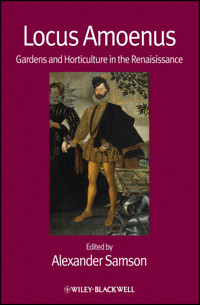
English School, detail of Portrait, probably Sir George Delves, 1577, oil on panel, 218 × 133.8 cm (© Walker Art Gallery, National Museums Liverpool)
Notes on contributors
Brian Dix is an archaeologist specializing in historic gardens and their landscapes. He has worked extensively throughout mainland Europe in addition to investigating major British sites. He is a former Course Tutor at the Architectural Association, London and co-author of Peopling Past Landscapes among other publications.
Brent Elliott is the Historian of the Royal Horticultural Society, having previously been its Librarian and Archivist for twenty-five years. He is the author of Victorian Gardens (1986), Flora (2001), and The Royal Horticultural Society: a History 1804–2004 (2004) among other works. Formerly the editor of Garden History, he is currently the editor of Occasional Papers from the RHS Lindley Library. Most recently, he has been editing for publication part of The Paper Museum of Cassiano dal Pozzo, due to appear in 2012 as series B Volume VII of that catalogue raisonnée under the title Flora: the Paris Manuscripts.
Paula Henderson is an independent architectural and garden historian. Her many publications include articles in Architectural History, Garden History and The British Art Journal, as well as essays in Albion’s Classicism: The Visual Arts in Britain, 1550–1660 and Patronage, Culture and Power: The Early Cecils, 1558–1612. Her first book, The Tudor House and Garden: Architecture and Landscape in the 16th and Early 17th Centuries, won the Berger Prize for British Art History. She is currently completing a book on gardens in Tudor and Stuart London.
Claudia Lazzaro is Professor of History of Art at Cornell University. She is the author of The Italian Renaissance Garden and many articles on villas and gardens, as well as co-editor of Donatello among the Blackshirts: History and Modernity in the Visual Culture of Fascist Italy. She is currently working on images of cultural identity in sixteenth-century Florence.
Jennifer Munroe is Associate Professor of English at the University of North Carolina at Charlotte, where she teaches courses on early modern literature and culture, Shakespeare, film, and literary theory. She is author of Gender and the Garden in Early Modern English Literature and editor of Making Gardens of Their Own: Gardening Manuals For Women 1550–1750. She is also co-editor of Ecofeminist Approaches to Early Modernity. Her current book project looks at the relationship between women and the natural world as it bears on the development of early modern science.
Alexander Samson lectures in Golden Age Literature in the Spanish and Latin American Studies department at University College London. He has published widely in the fields of Anglo-Spanish intercultural relations, Mary Tudor and her marriage to Philip II, translation, early modern travel writing and the comedia.
Susan C. Staub is Professor of English at Appalachian State University, where she teaches Early Modern literature. She is author of Nature’s Cruel Stepdames: Murderous Women in the Street Literature of Seventeenth Century England and various essays on Spenser, Shakespeare, and Gascoigne and is editor of The Literary Mother: Essays on Representations of Maternity and Childcare and Mother’s Advice Books, Volume 3 in The Early Modern Englishwoman: A Facsimile Library of Essential Works, series II. Her book-in-progress is on Shakespeare’s gardens.
Introduction Locus amoenus: gardens and horticulture in the Renaissance
Alexander Samson
Annihilating all that’s made
To a green thought in a green shade.
Andrew Marvell, ‘The Garden’.1
Gardens, horticulture and their literary representation intersected with many of the critical, defining social transformations of the early modern period; from shifting patterns of land use to evolving political discourses of magnificence and power, new scientific ideas about the natural world, botany and medicinal writing, religious changes and aesthetics. The natural world was invoked to justify and make sense of unprecedented social, cultural and political change. However, gardens also reflected new forms of self-fashioning, leisure and pleasure. Garden history has not been revolutionized by the emergence of environmental criticism, instead gardens have become intertwined in other disciplinary areas from archaeology to gender studies, art history to literary studies. This volume seeks to demonstrate the ubiquity of the garden in Renaissance culture, whether as metaphor, symbol or real space, as a site for contemplation, agricultural production or cultural inscription, and at the same time reflect the diversity and range of academic writing on the subject. Woodcut illustrations in herbals (medicinal treatises about plants) were pirated and reused to the point of being unrecognizable and of no practical use in the identification and classification of plants. This points to the persistent tension between experience and authority in the way the natural world was understood. The emergence of horticulture and botany as empirical sciences paralleled a broader dignification of gardening as a liberal rather than mechanical art. Attempts to read historic gardens aesthetically point to the inadequacy of art historical categories like ‘Renaissance’ or ‘Baroque’ and the differences not simply between national but also regional traditions. Changing fashions in flowers reflected a democratization of the garden and its appropriation for aesthetic, non-utilitarian ends, as a space for new forms of leisure, contemplation and moral improvement. The changing role gardens played in mediating between people and the natural world were reflected and appropriated in literature and art. The complex interplay between poetics and gardening saw art understood through metaphors drawn from the garden and the garden recast as a living form of art.
WRITING GARDENS IN EARLY MODERN EUROPE: BOTANY, HORTICULTURE AND LITERATURE
The explosion of writing on gardens and horticulture in the early modern period, beginning with translations and printings of classical authors, reflected the different ways in which the return to nature was used to ground and make sense of the shifting relationship between people and the natural environment. In the case of England, Xenophon’s treatise on household management and agriculture, the , for example, was published in a Latin translation as early as 1508 and then reprinted in five further editions by 1526, before being Englished in 1532. Virgil’s / and appeared in English in 1575 and 1589 in translations by Abraham Fleming. An underlying factor in the growing popularity of writings on agriculture and gardening was economic: low rents and labour costs alongside rising food prices as a result of the growing population persuaded landowners to end demesne and enter into commercial farming, taking closer economic control of how their estates were managed. This return to farming by magnates after generations without direct experience of agriculture was accompanied by a practical interest in classical writing on husbandry. Barnabe Googe, a kinsman of William Cecil, and major conduit for the dissemination of Spanish literary culture in England, translated in 1577 the German humanist and servant of the Duke of Cleves, Konrad Heresbach’s , first published in Latin 1570. At precisely this time, Cecil was expanding and developing ‘the most influential Elizabethan garden’ at Theobalds, which was overseen by the herbalist John Gerard, who dedicated his to Burghley in 1597.
Lesen Sie weiter in der vollständigen Ausgabe!
Lesen Sie weiter in der vollständigen Ausgabe!
Lesen Sie weiter in der vollständigen Ausgabe!
Lesen Sie weiter in der vollständigen Ausgabe!
Lesen Sie weiter in der vollständigen Ausgabe!
Lesen Sie weiter in der vollständigen Ausgabe!
Lesen Sie weiter in der vollständigen Ausgabe!
Lesen Sie weiter in der vollständigen Ausgabe!




