


17,99 €
Mehr erfahren.
- Herausgeber: John Wiley & Sons
- Kategorie: Wissenschaft und neue Technologien
- Sprache: Englisch
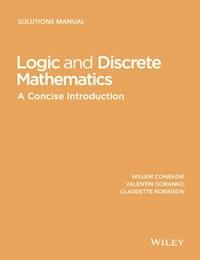
Solutions manual to accompany Logic and Discrete Mathematics: A Concise Introduction
This book features a unique combination of comprehensive coverage of logic with a solid exposition of the most important fields of discrete mathematics, presenting material that has been tested and refined by the authors in university courses taught over more than a decade.
Written in a clear and reader-friendly style, each section ends with an extensive set of exercises, most of them provided with complete solutions which are available in this accompanying solutions manual.
Sie lesen das E-Book in den Legimi-Apps auf:
Seitenzahl: 219
Veröffentlichungsjahr: 2015
Ähnliche


















Table of Contents
Cover
Title Page
Copyright
Preface
About the Companion Website
Chapter 1: Preliminaries
1.1 Sets
1.2 Basics of Logical Connectives and Expressions
1.3 Mathematical Induction
Chapter 2: Sets, Relations, Orders
2.1 Set Inclusions and Equalities
2.2 Functions
2.3 Binary Relations and Operations on Them
2.4 Special Binary Relations
2.5 Equivalence Relations and Partitions
2.6 Ordered Sets
2.7 An Introduction to Cardinality
2.8 Isomorphisms of Ordered Sets. Ordinal Numbers
2.9 Application: relational databases
Chapter 3: Propositional Logic
3.1 Propositions, Logical Connectives, Truth Tables, Tautologies
3.2 Propositional Logical Consequence. Valid and Invalid Propositional Inferences
3.3 Semantic Tableaux
3.4 Logical Equivalences. Negating Propositional Formulae
3.5 Normal forms. Propositional Resolution
Chapter 4: First-Order Logic
4.1 Basic Concepts of First-Order Logic
4.2 The Formal Semantics of First-Order Logic
4.3 The Language of First-Order Logic: A Deeper Look
4.4 Truth, Logical Validity, Equivalence and Consequence in First-Order Logic
4.5 Semantic Tableaux for First-Order Logic
4.6 Prenex and Clausal Normal Forms
4.7 Resolution in First-Order Logic
4.8 Applications of First-Order Logic to Mathematical Reasoning and Proofs
Chapter 5: Number Theory
5.1 The Principle of Mathematical Induction revisited
5.2 Divisibility
5.3 Computing Greatest Common Divisors. Least Common Multiples
5.4 Prime Numbers. The Fundamental Theorem of Arithmetic
5.5 Congruence Relations
5.6 Equivalence Classes and Residue Systems Modulo
5.7 Linear Diophantine Equations and Linear Congruences
5.8 Chinese Remainder Theorem
5.9 Euler's Function. Theorems of Euler and Fermat
5.10 Wilson's Theorem. Order of an Integer
5.11 Application: Public Key Cryptography
Chapter 6: Combinatorics
6.1 Two Basic Counting Principles
6.2 Combinations. The Binomial Theorem
6.3 The Principle of Inclusion – Exclusion
6.4 The Pigeonhole Principle
6.5 Generalized Permutations, Distributions and the Multinomial Theorem
6.6 Selections and Arrangements with Repetition; Distributions of Identical Objects
6.7 Recurrence Relations and Their Solution
6.8 Generating Functions
6.9 Recurrence Relations and Generating Functions
6.10 Application: Classical Discrete Probability
Chapter 7: Graph Theory
7.1 Introduction to Graphs and Digraphs
7.2 Incidence and Adjacency Matrices
7.3 Weighted Graphs and Path Algorithms
7.4 Trees
7.5 Eulerian Graphs and Hamiltonian Graphs
7.6 Planar Graphs
7.7 Graph Colourings
End User License Agreement
Pages
1
2
3
4
5
6
7
8
9
10
11
12
13
14
15
16
17
18
19
20
21
22
23
24
25
26
27
28
29
30
31
32
33
34
35
36
37
38
39
40
41
42
43
44
45
46
47
48
49
50
51
52
53
54
55
56
57
58
59
60
61
62
63
64
65
66
67
68
69
70
71
72
73
74
75
76
77
78
79
80
81
82
83
84
85
86
87
88
89
90
91
92
93
94
95
96
97
98
99
100
101
102
103
104
105
106
107
108
109
110
111
112
113
114
115
116
117
118
119
120
121
122
123
124
125
126
127
128
129
130
131
132
133
134
135
136
137
138
139
140
141
142
143
144
145
146
147
148
149
150
151
152
153
154
155
156
157
158
159
160
161
162
163
164
165
166
167
168
169
170
171
172
173
174
175
176
177
178
179
180
181
182
183
184
Guide
Cover
Table of Contents
Preface
Begin Reading
List of Tables
Chapter 2: Sets, Relations, Orders
Table 2.1
Table 2.2
Table 2.3
Table 2.4
Table 2.5
Table 2.6
Table 2.7
Table 2.8
Table 2.9
Chapter 7: Graph Theory
Table 7.1 Exercise 1(a)
Table 7.2 Exercise 1(b)
Table 7.3 Exercise 4(a)
Table 7.4 Exercise 4(b)
Logic and Discrete Mathematics
A Concise Introduction, Solutions Manual
Willem Conradie
University of Johannesburg, South Africa
Valentin Goranko
Stockholm University, Sweden
Claudette Robinson
University of Johannesburg, South Africa
This edition first published 2015
© 2015 John Wiley and Sons Ltd
Registered office
John Wiley & Sons Ltd, The Atrium, Southern Gate, Chichester, West Sussex, PO19 8SQ, United Kingdom
For details of our global editorial offices, for customer services and for information about how to apply for permission to reuse the copyright material in this book please see our website at www.wiley.com.
The right of the author to be identified as the author of this work has been asserted in accordance with the Copyright, Designs and Patents Act 1988.
All rights reserved. No part of this publication may be reproduced, stored in a retrieval system, or transmitted, in any form or by any means, electronic, mechanical, photocopying, recording or otherwise, except as permitted by the UK Copyright, Designs and Patents Act 1988, without the prior permission of the publisher.
Wiley also publishes its books in a variety of electronic formats. Some content that appears in print may not be available in electronic books.
Limit of Liability/Disclaimer of Warranty: While the publisher and author have used their best efforts in preparing this book, they make no representations or warranties with respect to the accuracy or completeness of the contents of this book and specifically disclaim any implied warranties of merchantability or fitness for a particular purpose. It is sold on the understanding that the publisher is not engaged in rendering professional services and neither the publisher nor the author shall be liable for damages arising herefrom. If professional advice or other expert assistance is required, the services of a competent professional should be sought
Library of Congress Cataloging-in-Publication Data
A catalogue record for this book is available from the British Library.
ISBN: 9781118762677
Preface
This manual contains answers and solutions to roughly three quarters of the exercises in Logic and Discrete Mathematics: A Concise Introduction by Willem Conradie and Valentin Goranko. Most solutions are worked out in full detail. In deciding which solutions to include we were guided by two principles: fundamental exercises were given preference above the more esoteric ones intended mainly for enrichment; where a number of very similar exercises occur in succession, complete solutions were given for a few while the others were omitted or provided with answers only. We trust that these solutions will be a very valuable resource to students and instructors using Logic and Discrete Mathematics.
About the Companion Website
This book is accompanied by a companion website:
www.wiley.com/go/conradie/logic
The website includes:
• Lecture Slides
• Quizzes
Lesen Sie weiter in der vollständigen Ausgabe!
Lesen Sie weiter in der vollständigen Ausgabe!
Lesen Sie weiter in der vollständigen Ausgabe!
Lesen Sie weiter in der vollständigen Ausgabe!
Lesen Sie weiter in der vollständigen Ausgabe!
Lesen Sie weiter in der vollständigen Ausgabe!
Lesen Sie weiter in der vollständigen Ausgabe!
Lesen Sie weiter in der vollständigen Ausgabe!
Lesen Sie weiter in der vollständigen Ausgabe!
Lesen Sie weiter in der vollständigen Ausgabe!
Lesen Sie weiter in der vollständigen Ausgabe!
Lesen Sie weiter in der vollständigen Ausgabe!
Lesen Sie weiter in der vollständigen Ausgabe!




