


41,99 €
Mehr erfahren.
- Herausgeber: John Wiley & Sons
- Kategorie: Wissenschaft und neue Technologien
- Sprache: Englisch
A concise yet rigorous introduction to logic and discrete mathematics.
This book features a unique combination of comprehensive coverage of logic with a solid exposition of the most important fields of discrete mathematics, presenting material that has been tested and refined by the authors in university courses taught over more than a decade.
The chapters on logic - propositional and first-order - provide a robust toolkit for logical reasoning, emphasizing the conceptual understanding of the language and the semantics of classical logic as well as practical applications through the easy to understand and use deductive systems of Semantic Tableaux and Resolution. The chapters on set theory, number theory, combinatorics and graph theory combine the necessary minimum of theory with numerous examples and selected applications. Written in a clear and reader-friendly style, each section ends with an extensive set of exercises, most of them provided with complete solutions which are available in the accompanying solutions manual.
Key Features:
- Suitable for a variety of courses for students in both Mathematics and Computer Science.
- Extensive, in-depth coverage of classical logic, combined with a solid exposition of a selection of the most important fields of discrete mathematics
- Concise, clear and uncluttered presentation with numerous examples.
- Covers some applications including cryptographic systems, discrete probability and network algorithms.
Logic and Discrete Mathematics: A Concise Introduction is aimed mainly at undergraduate courses for students in mathematics and computer science, but the book will also be a valuable resource for graduate modules and for self-study.
Sie lesen das E-Book in den Legimi-Apps auf:
Seitenzahl: 718
Veröffentlichungsjahr: 2015
Ähnliche


















Table of Contents
Cover
Title Page
Copyright
List of Boxes
Preface
Acknowledgements
About the Companion Website
Chapter 1: Preliminaries
1.1 Sets
1.2 Basics of logical connectives and expressions
1.3 Mathematical induction
Chapter 2: Sets, Relations, Orders
2.1 Set inclusions and equalities
2.2 Functions
2.3 Binary relations and operations on them
2.4 Special binary relations
2.5 Equivalence relations and partitions
2.6 Ordered sets
2.7 An introduction to cardinality
2.8 Isomorphisms of ordered sets. Ordinal numbers
2.9 Application: relational databases
Chapter 3: Propositional Logic
3.1 Propositions, logical connectives, truth tables, tautologies
3.2 Propositional logical consequence. Valid and invalid propositional inferences
3.3 The concept and use of deductive systems
3.4 Semantic tableaux
3.5 Logical equivalences. Negating propositional formulae
3.6 Normal forms. Propositional resolution
Chapter 4: First-Order Logic
4.1 Basic concepts of first-order logic
4.2 The formal semantics of first–order logic
4.3 The language of first-order logic: a deeper look
4.4 Truth, logical validity, equivalence and consequence in first-order logic
4.5 Semantic tableaux for first-order logic
4.6 Prenex and clausal normal forms
4.7 Resolution in first-order logic
4.8 Applications of first-order logic to mathematical reasoning and proofs
Chapter 5: Number Theory
5.1 The principle of mathematical induction revisited
5.2 Divisibility
5.3 Computing greatest common divisors. Least common multiples
5.4 Prime numbers. The fundamental theorem of arithmetic
5.5 Congruence relations
5.6 Equivalence classes and residue systems modulo
n
5.7 Linear Diophantine equations and linear congruences
5.8 Chinese remainder theorem
5.9 Euler's function. Theorems of Euler and Fermat
5.10 Wilson's theorem. Order of an integer
5.11 Application: public key cryptography
Chapter 6: Combinatorics
6.1 Two basic counting principles
6.2 Combinations. The binomial theorem
6.3 The principle of inclusion–exclusion
6.4 The Pigeonhole Principle
6.5 Generalized permutations, distributions and the multinomial theorem
6.6 Selections and arrangements with repetition; distributions of identical objects
6.7 Recurrence relations and their solution
6.8 Generating functions
6.9 Recurrence relations and generating functions
6.10 Application: classical discrete probability
Chapter 7: Graph Theory
7.1 Introduction to graphs and digraphs
7.2 Incidence and adjacency matrices
7.3 Weighted graphs and path algorithms
7.4 Trees
7.5 Eulerian graphs and Hamiltonian graphs
7.6 Planar graphs
7.7 Graph colourings
Index
End User License Agreement
Pages
xvii
xviii
xix
xxi
xxiii
1
2
3
4
5
6
7
8
9
10
11
12
13
14
17
18
19
20
21
22
23
24
25
26
27
28
29
30
31
32
33
34
35
36
37
38
39
40
41
42
43
44
45
46
47
48
49
50
51
52
53
54
55
56
57
58
59
60
61
62
63
64
65
66
67
68
69
70
71
72
73
74
75
76
77
78
79
80
81
82
83
84
85
86
87
88
89
90
91
92
93
94
95
96
97
98
99
100
101
102
103
104
105
106
107
108
109
110
111
112
113
114
115
116
117
118
119
120
121
122
123
124
125
126
127
128
129
130
131
132
133
134
135
136
137
138
139
140
141
142
143
144
145
146
147
148
149
150
151
152
153
154
155
156
157
158
159
160
161
162
163
164
165
166
167
168
169
170
171
172
173
174
175
176
177
178
179
180
181
182
183
184
185
186
187
188
189
190
191
192
193
194
195
196
197
198
199
200
201
202
203
204
205
206
207
208
209
210
211
212
213
214
215
216
217
218
219
220
221
222
223
224
225
226
227
228
229
230
231
232
233
234
235
236
237
238
239
240
241
242
243
244
245
246
247
248
249
250
251
252
253
254
255
256
257
258
259
260
261
262
263
264
265
266
267
268
269
270
271
272
273
274
275
276
277
278
279
280
281
282
283
284
285
286
287
288
289
290
291
292
293
294
295
296
297
298
299
300
301
302
303
304
305
306
307
308
309
310
311
312
313
314
315
316
317
318
319
320
321
322
323
324
325
326
327
328
329
330
331
332
333
334
335
336
337
338
339
340
341
342
343
344
345
346
347
348
349
350
351
352
353
354
355
356
357
358
359
360
361
362
363
364
365
366
367
368
369
370
371
372
373
374
375
376
377
378
379
380
381
382
383
384
385
386
387
388
389
390
391
392
393
394
395
396
397
398
399
400
401
402
403
404
405
406
407
408
409
410
411
412
413
414
415
416
417
419
420
421
422
423
424
425
426
Guide
Cover
Table of Contents
Preface
Begin Reading
List of Illustrations
Figure 2.1
Figure 2.2
Figure 2.3
Figure 2.4
Figure 2.5
Figure 2.6
Figure 2.7
Figure 2.8
Figure 6.1
Figure 6.2
Figure 6.3
Figure 6.4
Figure 6.5
Figure 6.6
Figure 7.1
Figure 7.2
Figure 7.3
Figure 7.4
Figure 7.5
Figure 7.6
Figure 7.7
Figure 7.8
Figure 7.9
Figure 7.10
Figure 7.11
Figure 7.12
Figure 7.13
Figure 7.14
Figure 7.15
Figure 7.16
Figure 7.17
Figure 7.18
List of Tables
Table 1.1
Table 2.1
Table 2.2
Table 2.3
Table 2.4
Table 2.5
Table 2.6
Table 2.7
Table 2.8
Table 2.9
Table 2.10
Table 2.11
Table 2.12
Table 2.13
Table 6.1
Table 6.2
Table 6.3
Logic and Discrete Mathematics
A Concise Introduction
Willem Conradie
University of JohannesburgSouth Africa
Valentin Goranko
Stockholm University, Sweden
This edition first published 2015
© 2015 John Wiley and Sons Ltd
Registered office
John Wiley & Sons Ltd, The Atrium, Southern Gate, Chichester, West Sussex, PO19 8SQ, United Kingdom
For details of our global editorial offices, for customer services and for information about how to apply for permission to reuse the copyright material in this book please see our website at www.wiley.com.
The right of the author to be identified as the author of this work has been asserted in accordance with the Copyright, Designs and Patents Act 1988.
All rights reserved. No part of this publication may be reproduced, stored in a retrieval system, or transmitted, in any form or by any means, electronic, mechanical, photocopying, recording or otherwise, except as permitted by the UK Copyright, Designs and Patents Act 1988, without the prior permission of the publisher.
Wiley also publishes its books in a variety of electronic formats. Some content that appears in print may not be available in electronic books.
Limit of Liability/Disclaimer of Warranty: While the publisher and author have used their best efforts in preparing this book, they make no representations or warranties with respect to the accuracy or completeness of the contents of this book and specifically disclaim any implied warranties of merchantability or fitness for a particular purpose. It is sold on the understanding that the publisher is not engaged in rendering professional services and neither the publisher nor the author shall be liable for damages arising herefrom. If professional advice or other expert assistance is required, the services of a competent professional should be sought
Library of Congress Cataloging-in-Publication Data
Conradie, Willem, 1978- author.
Logic and discrete mathematics : a concise introduction / Willem Conradie, Valentin Goranko.
pages cm
Includes index.
ISBN 978-1-118-75127-5 (pbk.)
1. Logic, Symbolic and mathematical–Textbooks. 2. Computer science–Mathematics–Textbooks.
I. Goranko, Valentin, author. II. Title.
QA9.C7423 2015
511.3–dc23
2014035964
A catalogue record for this book is available from the British Library.
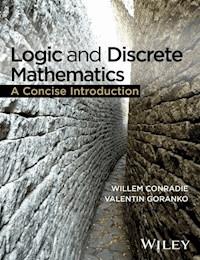
Front cover image: Narrow walkway inside the Great Enclosure at the Great Zimbabwe ruins. Reproduced by kind permission of Kenneth Meeks.
List of Boxes
1. Preliminaries
Paradoxes
2. Sets, Relations, Orders
Russell's paradox
Georg Cantor
The notation of set theory
Fuzzy sets
Zermelo–Fraenkel set theory
The axiom of choice
The continuum hypothesis
Hilbert's Hotel
Charles Sanders Peirce
3. Propositional Logic
Aristotle
George Boole
David Hilbert
Early proof theory
Augustus De Morgan
The Boolean satisfiability problem and NP-completeness
4. First-Order Logic
Gottlob Frege
Giuseppe Peano
Bertrand Russell
Alfred Tarski
Kurt Gödel
Thoralf Skolem
Alonzo Church
Alan Turing
5. Number Theory
Carl Friedrich Gauss
Pythagoras of Samos
Euclid of Alexandria
Primality testing
Richard Dedekind
Babylonian mathematics
Diophantus of Alexandria
Ancient Chinese mathematics
Pierre de Fermat
Ancient and Medieval Indian and Arabic mathematics
History of codes and ciphers
6. Combinatorics
Stirling's approximation of n!
Pascal's triangle
Venn diagrams
Lejeune Dirichlet
Braille
Blaise Pascal
Fibonacci
Combinatorial games: Nim
Fibonacci numbers and the golden ratio
Pierre-Simon de Laplace
7. Graph Theory
Leonhard Euler
Ramsey theory
Edsger Dijkstra
Paul Erdõs
William Hamilton
Graph theory and Sudoku
The four-colour problem
Preface
Discrete Mathematics1 refers to a range of mathematical disciplines that study discrete structures and phenomena, unlike other classical fields of mathematics, such as analysis, geometry and topology, which study continuous structures, processes and transformations. Intuitively put, discrete structures – such as the linear order of natural numbers or the set of cities and towns in a country together with the roads between them – consists of separable, discretely arranged objects, whereas continuous structures – such as the trajectory of a moving object, the real line, the Euclidian plane or a sphere – are densely filled, with no “gaps”. The more important distinction, however, is between the types of problems studied and solved in discrete and continuous mathematics and also between the main ideas and techniques that underly and characterize these two branches of mathematics. Nevertheless, this distinction is often blurred and many ideas, methods and results from each of these branches have been fruitfully applied to the other.
The intuitive explanation above is not meant to define what should be classified as Discrete Mathematics, as every such definition would be incomplete or debatable. A more useful description would be to list what we consider to be the basic mathematical disciplines traditionally classified as Discrete Mathematics and included in most university courses on that subject: the Theory of Sets and Relations, Mathematical Logic, Number Theory, Graph Theory and Combinatorics. These are the topics covered in this book. Sometimes textbooks and courses on Discrete Mathematics also include Abstract Algebra, Classical Probability Theory, Automata Theory, etc. These topics are not included here, mainly for practical reasons.
Logic was born in the works of Aristotle as a philosophical study of reasoning some 25 centuries ago. Over the past 150 years it has gradually developed as a fundamental mathematical discipline, which nowadays has deep and mature mathematical content and also applications spreading far beyond foundational and methodological issues. While the field of Mathematical Logic is often regarded as included in the broad scope of Discrete Mathematics, in this book it is treated essentially on a par with it.
As mathematical fields of their own importance, both Logic and Discrete Mathematics are relatively young and very dynamically developing disciplines, especially since the mid 20th century, when the computer era began. Many of the most exciting current developments in Logic and Discrete Mathematics are motivated and inspired by applications in Computer Science, Artificial Intelligence and Bioinformatics. We have accordingly included some such selected applications in the book.
About the book
The work on this book started more than a decade ago as a loose collection of lecture notes that we wrote and used to teach courses on Logic and Discrete Mathematics, partly because we could not find available suitable textbooks that would meet our needs and requirements. Eventually we decided to write a book of our own, which would best reflect the content and features we consider most important:
1.
Being logicians, we have provided a much more detailed and deeper treatment of Logic than is usual in textbooks on Discrete Mathematics. We believe that such a treatment is necessary for the proper understanding and use of Logic as a mathematical and general reasoning tool, and we consider it a distinguishing feature of the book.
2.
We included only what we consider to be the core disciplines within the field of Discrete Mathematics (without claiming that ours is the only good choice) but have treated these disciplines in considerable depth for an undergraduate text. That enabled us to keep the book within reasonable size limits without compromising on the content and exposition of the topics included.
3.
We have tried to keep the exposition clear and concise while still including the necessary technical detail and illustrating concepts and techniques with numerous examples.
4.
We have included comprehensive sets of exercises, most of them provided with answers or solutions in an accompanying solutions manual.
5.
We have also included “boxes” at the end of each section. Some contain mathematics titbits or applications of the content in the section. Others are short biographies of distinguished scientists who have made fundamental contributions to Discrete Mathematics. We hope the reader will find it inspiring to learn a little about their lives and their contributions to the fields covered in the book.
To the instructor
We have aimed this book to be suitable for a variety of courses for students in both Mathematics and Computer Science. Some parts of it are much more relevant to only one of these audiences and we have indicated them by introducing Mathematics Track and Computer Science Track markers in the text. We regard everything not explicitly on either of these tracks to be suitable for both groups.
In addition, the book can be used for designing courses on different undergraduate or lower graduate levels. Some material that could reasonably be omitted in courses at a lower undergraduate level is indicated with an Advances Track marker. These tracks are, of course, only suggestions, which should serve as our recommendations to the instructor.
The single stars shown in the exercises are deemed to be exercises that are more difficult, while the double stars are considered to be exercises that are challenging.
The whole book can be comfortably covered in two semester courses, or various selections can be made for a single semester course. Apart from assuming knowledge of the background material in the preliminary Chapter 1, the chapters are essentially independent and can be taught in any order. The only exception is Chapter 4 on first-order logic, which presupposes knowledge of the material on propositional logic covered in Chapter 3. Also, much of the content of Chapter 2 covers general mathematical background, useful for the rest of the book.
1
Not to be confused with discreetly done mathematics!
Acknowledgements
A number of people have contributed, one way or another, to our work on this book over the years.With the risk of inadvertently omitting some names, forwhich we apologize in advance, we would like to thank Gerhard Benadé, Thomas Bolander, Izak Broere, Ruaan Kellerman, Heidi Maartens, Chantel Marais and Claudette Robinson for helpful feedback, comments, technical or editorial corrections and some solutions to exercises. Besides them, thanks are due to many students at the University of Johannesburg, the University of theWitwatersrand and the Technical University of Denmark, who pointed out some errors in earlier versions of the manuscript.We thank Justin Southey for the use of the GraphScribe application authored by him, which greatly speeded up the drawing of some combinatorial graphs, and also for his suggestions on the applications of Graph Theory. Valentin is also grateful to Nina Ninova for her general support during the work on this book as well as help with collecting photos and references formany of the historical boxes.Willem would like to thank Dion Govender for his patience and support during the final months of intense work on the book. Last but not least, we wish to thank Richard Davies, Audrey Koh, Kathryn Sharples, Mark Styles and Jo Taylor from Wiley as well as Krupa Muthu from Laserwords for their kind support and technical advice during the work on this book.
About the Companion Website
This book is accompanied by a companion website:
www.wiley.com/go/conradie/logic
The website includes:
Lecture Slides
Quizzes
Chapter 1Preliminaries
1.1 Sets
1.2 Basics of logical connectives and expressions
1.3 Mathematical induction
Here we briefly review some minimal background knowledge that we will assume in the rest of the book. Besides a small amount of that nebulous quality called “mathematical maturity”, we only expect some basic concepts from set theory and mathematical indiction. The reader who is familiar with these concepts can safely skip on to the next chapter.
Some notation
We denote the set of natural numbers by . There is some inconsistency in the mathematical literature as to whether belongs to the natural numbers or not: some authors choose to include it, other do not. For our purposes it is convenient to include as a natural number. Other number sets which will be of importance to us include the sets of integers , positive integers , rational numbers , positive rational numbers , real numbers , and positive real numbers .
The product of the first positive integers turns up in many mathematical situations. It is therefore convenient to have a more compact notation for it. We accordingly define and , for . We read as ‘ factorial’. The definition of as is not supposed to carry any intuitive meaning: it is simply a useful convention.
1.1 Sets
Sets and elements
By a set we intuitively mean a collection of objects of any nature (numbers, people, concepts, sets themselves, etc.) that is considered as a single entity. The objects in that collection are called elements of the set. If an object is an element of a set , we denote that fact by
otherwise we write
We also say that is a member of the set or that belongs to. If a set has finitely many elements (here we rely on your intuition of what finite is), we can describe it precisely by listing all of them, for example:
We often rely on our common intuition and use ellipses, as in
We sometimes go further and use the same for infinite sets; for example, the set of natural numbers can be specified as
Further we will discuss a more universal method of describing sets.
Equality and containment of sets
Two sets are declared equal if and only if they have the same elements. In other words, the sets and are equal, denoted as usual by , if every element of is an element of and every element of is an element of . For example, the sets and are equal, and so are the sets , and .
A set is a subset of a set , denoted , if every element of is an element of . If , we also say that is included in, or that contains. For example, . Note that every set is a subset of itself.
The following facts are very useful. They are direct consequences of the definitions of equality and containment of sets.
Two sets
and
are equal if, and only if,
and
.
A set
is not a subset of a set
, denoted
, if, and only if, there is an element of
that is not an element of
.
A set
is not equal to a set
if
is not a subset of
or
if
is not a subset of
.
A set is a proper subset of a set , denoted or , if and . In other words, is a proper subset of if is a subset of and is not a subset of , i.e. if at least one element of is not in
Lesen Sie weiter in der vollständigen Ausgabe!
Lesen Sie weiter in der vollständigen Ausgabe!
Lesen Sie weiter in der vollständigen Ausgabe!
Lesen Sie weiter in der vollständigen Ausgabe!
Lesen Sie weiter in der vollständigen Ausgabe!
Lesen Sie weiter in der vollständigen Ausgabe!
Lesen Sie weiter in der vollständigen Ausgabe!
Lesen Sie weiter in der vollständigen Ausgabe!
Lesen Sie weiter in der vollständigen Ausgabe!
Lesen Sie weiter in der vollständigen Ausgabe!
Lesen Sie weiter in der vollständigen Ausgabe!
Lesen Sie weiter in der vollständigen Ausgabe!
Lesen Sie weiter in der vollständigen Ausgabe!
Lesen Sie weiter in der vollständigen Ausgabe!
Lesen Sie weiter in der vollständigen Ausgabe!
Lesen Sie weiter in der vollständigen Ausgabe!
Lesen Sie weiter in der vollständigen Ausgabe!
Lesen Sie weiter in der vollständigen Ausgabe!
Lesen Sie weiter in der vollständigen Ausgabe!
Lesen Sie weiter in der vollständigen Ausgabe!




