


Erhalten Sie Zugang zu diesem und mehr als 300000 Büchern ab EUR 5,99 monatlich.
- Herausgeber: Pocket Essentials
- Kategorie: Geisteswissenschaft
- Sprache: Englisch
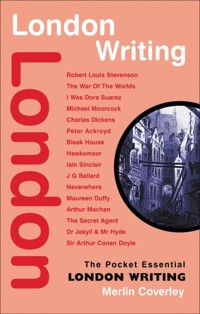
What do writers such as Charles Dickens and Peter Ackroyd, Iain Sinclair and Robert Louis Stevenson have in common? The answer lies in the use these authors make of London as a fictional setting. Yet in these works and in those of other London writers the city is much more than merely a backdrop, instead becoming a character in its own right and creating a sense of place that is both a reflection and a reworking of the city. Here London is presented as a living organism, a huge and mysterious labyrinth, and the source of endless imagination. A whole world is contained by the city and within it the entire spectrum of human experience. From Bleak House to Hawksmoor, from Dr Jekyll and Mr Hyde to White Chappell Scarlet Tracings, London has continued to generate a series of fantastic visions. The humorous and the tragic, the grotesque and the bizarre, everything is possible here. In this book, Merlin Coverley examines the major themes in the development of the London novel from its origins in the Victorian metropolis and onward to the present day and the revival of London writing. On the way he explores the Occult Tradition and London Noir, the Disaster Novel and the rise of Psychogeography, and alongside the recognised classics of the genre he recovers some of those lost London writers whose works have been unjustly neglected.
Sie lesen das E-Book in den Legimi-Apps auf:
Seitenzahl: 186
Veröffentlichungsjahr: 2012
Das E-Book (TTS) können Sie hören im Abo „Legimi Premium” in Legimi-Apps auf:
Ähnliche














LondonWriting
Merlin Coverley
POCKET ESSENTIALS
Acknowledgements
My thanks to Chris Sykes for providing the initial
momentum for this project, Ion Mills for his advice and
enthusiasm, and Catherine for her support throughout.
Contents
Introduction
1: The London Canon
Charles DickensBleak House, George GissingNew Grub Street, Joseph ConradThe Secret Agent, Virginia WoolfMrs Dalloway, Evelyn WaughVile Bodies
2: Occult London
Robert Louis Stevenson The Strange Case of Dr Jekyll and Mr Hyde, Arthur MachenThe Great God Pan, Peter AckroydHawksmoor, Iain SinclairWhite Chappell Scarlet Tracings, Neil GaimanNeverwhere
3: London in Ruins
Richard JefferiesAfter London, William MorrisNews From Nowhere, HG Wells The War of the Worlds, Henry GreenCaught, JG BallardThe Drowned World
4: Criminal London
Sir Arthur Conan DoyleA Study in Scarlet, Gerald KershNight and the City, Margery AllinghamThe Tiger in the Smoke, Derek RaymondI Was Dora Suarez, Anthony FrewinLondon Blues
5: Lost London Writing
Patrick HamiltonHangover Square, Elizabeth BowenThe Heat of the Day, Samuel SelvonThe Lonely Londoners, Alexander Baron The Lowlife, Maureen DuffyCapital
6: The London Revival
Michael MoorcockMother London, Martin AmisLondon Fields, Angela CarterWise Children, Christopher PetitRobinson, Nicholas RoyleThe Director’s Cut
7: The Thirty Essential London Novels
Further Reading
Copyright
Introduction
‘In this city everything connects.’Peter Ackroyd, London: The Biography
Where to begin? If there is one point on which London writers appear to agree, it is the fact that London is endless, illimitable, a world too huge and complex to be accurately captured by a single author, let alone a single text. Yet not only is the city regarded as an unknowable labyrinth, it is also eternal, defying chronological order through an endless cycle of decline and regeneration. If this is true of the city, then it is equally true of the writing it has inspired. Iain Sinclair has described the growth of London writing as similar to a viral culture, one writer both leading back toward his predecessors and anticipating those who are to follow; each text an accumulation of the past and a prediction for the future together creating new genres and traditions and branching off in new and unexpected directions. In a city where everything connects, where does one begin?
The writers that I wish to include here all treat London as something more than a mere backdrop. In these works, London becomes a character in its own right, whose presence is bound together with the lives that are lived within its fictional borders. Of course, in the absence of a rigorous definition of what constitutes London writing (as opposed to that which is simply writing about London), there must inevitably be a largely arbitrary and subjective nature to one’s choices, while others become necessary due to the limitations of this project. It is difficult to imagine a pocket that could find room for an overview of London writing in its entirety and so boundaries must be drawn. The most obvious way of achieving this seems to be to decide upon the type of writing to be included. The strongest and most clearly sustained tradition of London writing and the one that is most widely represented today is that of the novel. Poetry and plays, biography and history, essays and journalism all have had, and continue to have, a strong claim upon the history of London writing, but it is to the novel that I will confine myself in this book. Of course, this means that at a stroke some of the greatest names in London, and indeed world, literature are omitted, amongst them Chaucer and Shakespeare, Samuel Pepys and Dr Johnson, Spenser and Blake, De Quincey and Charles Lamb. Furthermore, not only am I choosing the most representative London novelists, but I am also choosing their most representative London novels and each writer will be confined here to a single entry. In this way, I will be able to draw up a shortlist of the 30 essential London novels.
In his book, The Soul of London (1905), Ford Madox Ford famously observed:
‘England is a small island The world is infinitesimal But London is illimitable.’
And writing almost a century later Peter Ackroyd echoed these comments:
‘London goes beyond any boundary or convention. It contains every wish or word ever spoken, every action or gesture ever made, every harsh or noble statement ever expressed. It is illimitable. It is infinite London.’
Now having chosen the novel as the most representative strand of London writing, it is necessary to decide which writers and which novels most closely reflect these sentiments.
If the starting point of the novel is taken to be the early eighteenth century, there are few obvious candidates who describe the city with a sufficient sense of place to be identified as having written the first London novel. Daniel Defoe in Moll Flanders (1722) and later Roxana (1724) records with great relish both London’s lowlife and the opulence of the King’s Court, but his best remembered account of London is that of the plague years of his youth in A Journal of the Plague Year (1722), which, while certainly in large part a work of fiction, was at least presented as a work of fact.
Henry Fielding and Tobias Smollett were both novelists whose work might be considered a suitable starting point for the London novel. Fielding’s Jonathan Wild (1743) offers a fictional account of one of the most famous Londoners of his day. Similarly, Tom Jones (1749) also deals with the underworld of Georgian London, contrasting urban scenes of vice and degradation with the honest simplicity of the rural existence beyond the city’s boundaries. Both novels provide significant descriptions of the London of that era, but here the city is never more than a part of a wider canvas and these are primarily morality plays in which London symbolises only one part of human behaviour, the seedier part, without the totalising sense of a self-contained world that is the hallmark of the true London novelist. In a similar vein, Smollett’s picaresque London adventures continue a fascination with London’s squalid underbelly that has rarely diminished since. But once again, neither The Adventures of Roderick Random (1748) nor The Expedition of Humphrey Clinker (1771) really reflect the stature of London as a world-city. To be fair, it is perhaps less a question of the stature of these novels than the stature of the city they are describing, for London in its Georgian incarnation was still a long way from attaining the unimaginable magnitude and complexity that was to define the Victorian megalopolis. If we are looking for a fictional representation that equates London with the world, then we must fast-forward to the nineteenth century and the birth of the city that remains in many respects the one that still exists today.
Once in the Victorian era, we can breathe a sigh of relief and immediately give up the pretence that anyone other than Charles Dickens is the man to begin a survey of the London novel. So huge and influential are his portrayals of London that one could easily devote this entire survey to his novels alone. Needless to say, once his name has been introduced, the novelists that precede him become little more than precursors who, while influential, seem rather lightweight by comparison. For just as Shakespeare is often said to have invented the English language, so Dickens appears to have not so much described London as to have invented our conception of it and it is to this source that almost all subsequent London fiction is indebted.
Having found a starting point, it is now necessary to devise a principle by which order can be brought to the chaotic mass of authors and novels that have since placed London at the heart of their work. At first, it is tempting to see London’s history and its parallel history in the novel as a straightforward narrative unfolding in a linear progression, but time in London appears to be governed by its own laws, operating at different speeds in different quarters of the city, seeming to progress only to relapse back to an earlier stage. In this way, events are repeated and different histories replayed as time moves in a circular fashion. In his mammoth biography of the city Peter Ackroyd notes:
‘There are many forms of time in the city, and it would be foolish of me to change its character for the sake of erecting a conventional narrative. That is why this book moves quixotically through time, itself forming a labyrinth. If the history of London poverty is beside a history of London madness, then the connections may provide more significant information than any historiographical survey.’
This conception of time will be my guiding principle too and accordingly this survey will be structured less by chronology than by theme.
If, then, time in London is seen as cyclical, so too is the fictional tradition that seeks to reflect it. In this manner, writers who are fêted by one generation may subsequently disappear without trace, often to reappear once again at a later stage. Thus while Dickens may now shape our perception of the Victorian city, it was his contemporary GWM Roberts who commanded the greater readership in the early part of Victoria’s reign. Yet who can honestly claim to have heard of, let alone read, his melodramatic novel The Mysteries of London (1845). Similarly, while William Pett Ridge was amongst the most famous literary Londoners of his day and remains vigorously championed by writers such as Michael Moorcock, his London novels have long since been consigned to oblivion. I shall be devoting a chapter of this survey to lost London writers whose works have, in my opinion, been unjustly neglected. Yet many writers require no such resurrection, their works apparently transcending the cyclical current that has submerged so many of their contemporaries. These figures are the giants of London writing whose works now form the established canon and who created not only new characters and visions of the city, but in some cases inaugurated entirely new genres.
Dickens’ heavyweight contenders include both William Thackeray and Anthony Trollope, but neither can be regarded as true London writers. For while Dickens’ imaginative universe is largely circumscribed by the city, Thackeray’s Vanity Fair (1847) treats London only as an oblique part of a larger whole and Trollope’s Palliser novels, whilst creating memorable observations of London’s political elites, remain less clearly realised than his rural Barsetshire. Elsewhere, however, the true inheritance of Dickens’ London gradually emerges as the bleak realism of London poverty is given voice in a range of novels from Arthur Morrison’s Tales of the Mean Streets (1894) and A Child of the Jago (1896) to Israel Zangwill’s Children of the Ghetto (1892), so raising awareness of the squalid plight of many Londoners. Meanwhile, the comic tradition is extended through George and Weedon Grossmith’s Diary of a Nobody (1892) and Jerome K Jerome’s Thames-side excursion Three Men in a Boat (1889) and on through GK Chesterton’s whimsical tale of a future London, The Napoleon of Notting Hill (1892).
Indeed, images of future Londons are widespread in the novels of the late nineteenth century and find their most utopian expression in News From Nowhere (1891) by William Morris, in which we are offered a curious blend of socialist and pastoral idyll as blushing maidens and strapping young men furiously weave and thatch their way to an egalitarian paradise. Such a vision of London’s future is of course a return to London’s pre-industrial past and taps into early anxieties regarding the dangers of industrialisation. In a similar vein Richard Jefferies’ After London (1885) describes a city that literally drowns in its own effluent, but he is more ambivalent about the merits of a return to the land. Such prophetic novels generally combine a political critique of London present alongside a steadfast belief in a brighter future, but in combining such hopes and fears with an awareness of the potential of technological progress, HG Wells ushered in the new genre of science fiction. Wells was to write extensively about London in a realist mode, both in Anna Veronica (1909) and Tono-Bungay (1909), in which he explores the claustrophobia of Edwardian class structures and anxieties over the huge expansion in London’s population alongside controversial issues of sex, marriage and independence. Yet it is in his earlier ‘scientific romances’ that his enduring appeal lies and where we find the finest examples of his use of London as a setting. In The Invisible Man (1897) the newly invisible narrator tries to negotiate a familiarly overcrowded Oxford Street, while in The War of the Worlds (1898) we can once again enjoy the peculiar pleasure of witnessing London’s violent destruction. This book is an early example of the disaster novel that was later to reappear with renewed force in novels such as John Wyndham’s The Day of the Triffids (1951) and JG Ballard’s The Drowned World (1962).
Wells’ most enduring legacy to the London novel, however, is a work that has very little overt connection with the city. The Time Machine (1895) takes the stark inequalities of Victorian London to their logical conclusion by portraying a distant future in which the indolent Eloi are both served and consumed by their bestial underground cousins, the Morlocks, and the idea of an environment in which surface normality is undercut by an underground city in parallel with it finds great currency in recent London writing. Contemporary examples such as Christopher Fowler’s Roofworld (1988), Neil Gaiman’s Neverwhere (1997) and Conrad Williams’ London Revenant (2004) all explore Londons behind, below and above the city of our everyday experience.
Science fiction is not the only new genre to emerge during this period, for through such novels as Wilkie Collins’ The Moonstone (1868) the detective novel was to gain enormous and enduring popularity and remains especially important to London writing. It has been argued that the detective genre is particularly suited to London and its labyrinthine streets through the requirement of the plot for specific and recognisable coordinates for the set pieces, yet it seems to me that in much of London’s finest detective fiction, it is London itself that becomes not only the setting but a part of the mystery itself. Nowhere is this more true than in the works of Sir Arthur Conan Doyle, whose creation Sherlock Holmes is so powerfully equated with the mythic London of swirling fog and hansom cabs that he is single-handedly responsible for much of the disappointment today’s tourists feel on encountering a city so conspicuously lacking in penny-farthings and deerstalkers. In novels such as A Study in Scarlet (1887) and The Sign of Four (1890), in addition to the numerous short stories, London is as much a puzzle as the crime itself; a maze that must be unravelled, and knowledge of the layout of the city is crucial to Holmes’ success.
A subtle mutation of the detective novel gave rise to the spy novel, and while Erskine Childers’ The Riddle of the Sands(1903) leads the way, Joseph Conrad’s magnificent The Secret Agent (1907), based on a real life Anarchist ‘outrage’ in Greenwich Park, offers a truly prescient image of the hypocrisy and twisted motives behind terrorism and lays bare the reality of a profession that was soon to acquire a veneer of exotic attraction for later practitioners of the genre.
So, now we can begin to chart the emergence of those themes that have dominated London fiction since its inception – here we have both the acknowledged heavyweights of the canon, as well as its less celebrated exponents. There is both comedy and fantasy alongside the harsh realities of urban life. The utopian vision is contrasted with apocalyptic renderings of future London and, along with science fiction, we find the worlds of the criminal and the spy. Finally, there is that strand of London writing that is perhaps most clearly associated with the London of the late nineteenth century and is once again so widely appropriated today – the occult.
The canonical text here is Robert Louis Stevenson’s The Strange Case of Dr Jekyll and Mr Hyde (1886). Originally published as a ‘shilling shocker’, this novel made Stevenson’s reputation and has been enormously influential upon other practitioners of the London Occult, from Oscar Wilde to Arthur Machen. Here, the central idea of the split personality is projected onto the fogbound London streets and in recalling the horrible fascination of Dickens’ portrayals of the London slums, Stevenson succeeds in transforming London into a reflection of the psychological states he is describing. In this, he has rightly been described as London’s first psychogeographer, portraying London in cinematic, even mythical, terms. Indeed, the fictional world of Mr Hyde was soon to find factual support in the figure of Jack the Ripper, fusing the London of fiction and reality in such a powerful way that the London of this time has effectively foreshadowed everything that was to follow. As a consequence, the London fictions of the twenties and thirties in many ways describe a city still recognisably the same. Right up until the outbreak of the Second World War, London writing still resonates with images of poorly lit streets and yellow fog obscuring shady characters.
As fog gaves way to smog, so occult themes gradually subsided as the ‘golden era’ of the crime novel arrived. Both Gerald Kersh’s Night and the City (1938) and later Margery Allingham’s The Tiger in the Smoke (1952) were to become films and both, with varying degrees of success, attempt to map the familiar routes of lowlife London, while the now totally forgotten works of James Curtis and Robert Westerby ensured that fictional crimes remained resolutely small time in their tales of failure and revenge in the boozers of pre-war London.
If much of the London writing between the wars is characterised by an obscurity in both its subject matter of invisible lives, as well as in the fate of these authors and their books, this period also produced markedly more memorable, or at least more widely remembered, fictions from a parallel London of picnics and blazers. For while small-time crooks were dreaming of a big heist, the 1920s and 1930s were, for the fictional characters celebrated by, amongst others, Evelyn Waugh, Aldous Huxley, Wyndham Lewis and Virginia Woolf, decades of seemingly unbroken leisure. Novels such as Mrs Dalloway (1925) and Point Counter Point (1928), Vile Bodies (1930) and The Apes of God (1930) recount, often in excruciating detail, the lives or sometimes simply the days of a small coterie of characters with artistic pretensions who wander between Bloomsbury and Mayfair on their way to an endless round of dinner parties.
In retrospect, the Second World War merely highlights the fragility of upper-class life in the London of this period, and certainly in post-war fiction the gulf between these two Londons of spivs and toffs is much less broad. The war may have continued class distinctions through the opposing ranks of officers and men, yet it also appears to have drawn together the more disparate strands of London fiction by producing its own easily recognisable sense of wartime dislocation. From Patrick Hamilton’s celebrated Hangover Square (1941) to Norman Collins’ less well-known London Belongs to Me (1945), the familiar London of pubs and boarding houses takes on a new sense of anxiety and unease in the face of the impending war. Elsewhere, Graham Greene’s The Ministry of Fear (1943) and Elizabeth Bowen’s The Heat of the Day (1945) explore the reality of the Blitz, during which life and relationships are overtaken by an eerie sense of disorientation as the familiar landscape of the city is reduced to rubble. Henry Green most vividly portrays this sense of heightened unreality in his novel Caught (1943), in which an account of the Blitz from the perspective of the London firefighters, of whom Green was a member, is surprisingly underscored by an increasingly bizarre account of the relationships between them. Soon a novel that one might expect to provide a conventional wartime account of heroism and camaraderie gives way to a much less wholesome subplot of sexual intrigue and mental imbalance.
If, then, the war is to be taken as a definitive break with the past, both culturally and politically, it follows that such a break should be apparent within the tradition of London writing. For some writers, however, the war had only a minor impact and they remained largely oblivious to it as they sat marooned in the pubs of Soho and Fitzrovia. The most representative writer of a group that also included Dylan Thomas, is Julian McLaren-Ross, whose limited artistic output was a result of a protracted bout of ‘Sohoitis’, the inability to translate increasingly grandiose plans into any kind of material reality. McLaren-Ross, whose memoirs were unsurprisingly difficult to recollect and remained unfinished at the time of his death, did, however, manage to produce a quantity of short stories whose London settings have recently found a new audience.




