



1,99 €
Mehr erfahren.
- Herausgeber: e-artnow
- Kategorie: Poesie und Drama
- Sprache: Englisch
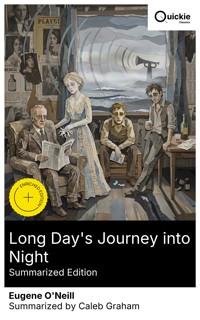
Long Day's Journey into Night unfolds as an intimate and deeply poignant exploration of a family's struggles with addiction, illness, and the relentless pursuit of understanding and redemption. Set in 1912, the Tyrone family—James, the patriarch; Mary, the matriarch; and their sons, Jamie and Edmund—confront their inner demons and familial tensions during the course of a fateful day. As the day unravels, secrets, regrets, and suppressed emotions rise to the surface, revealing the complexities of the Tyrone family dynamics. James Tyrone, a once-aspiring actor now tied to financial concerns, grapples with the weight of his past decisions. Mary Tyrone, haunted by memories and addiction, seeks solace in the past, drifting between moments of lucidity and haunting illusions. Jamie, the elder son, struggles with his own vices and a sense of futility, while the consumptive Edmund, the younger son, confronts the shadows cast by his family's struggles. The play unfolds as a powerful examination of the human condition, exploring themes of guilt, denial, and the profound impact of personal choices on the bonds that tie families together. A masterpiece of American drama, "Long Day's Journey into Night" is a testament to Eugene O'Neill's unparalleled skill in capturing the complexities of human relationships and the enduring repercussions of the past on the present.
Das E-Book können Sie in Legimi-Apps oder einer beliebigen App lesen, die das folgende Format unterstützen:
Veröffentlichungsjahr: 2024
Ähnliche
















Long Day’s Journey into Night
Table of Contents
Characters
JAMES TYRONE
MARY CAVAN TYRONE, his wife
JAMES TYRONE, JR., their elder son
EDMUND TYRONE, their younger son
CATHLEEN, second girl
Scenes
ACT 1
ACT 2, SCENE I
ACT 2, SCENE 2
ACT 3
ACT 4
Act One
SCENE
Living room of James Tyrone’s summer home on a morning in August, 1912.
At rear are two double doorways with portieres. The one at right leads into a front parlor with the formally arranged, set appearance of a room rarely occupied. The other opens on a dark, windowless back parlor, never used except as a passage from living room to dining room. Against the wall between the doorways is a small bookcase, with a picture of Shakespeare above it, containing novels by Balzac, Zoh, Stendhal, philosophical and sociological works by Schopenhauer, Nietzsche, Marx, Engels, Kropotkin, Max Stirner, plays by Ibsen, Shaw, Strindberg, poetry by Swinburne, Rossetti, Wilde, Ernest Dowson, Kipling, etc.
In the right wall, rear, is a screen door leading out on the porch which extends halfway around the house. Farther forward, a series of three windows looks over the front lawn to the harbor and the avenue that runs along the water front. A small wicker table and an ordinary oak desk are against the wall, flanking the windows.
In the left wall, a similar series of windows looks out on the grounds in back of the house. Beneath them is a wicker couch with cushions, its head toward rear. Farther back is a large, glassed-in bookcase with sets of Dumas, Victor Hugo, Charles Lever, three sets of Shakespeare, The World’s Best Literature in fifty large volumes, Hume’s History of England, Thiers’ History of the Consulate and Empire, Smollett’s History of England, Gibbon’s Roman Empire and miscellaneous volumes of old plays, poetry, and several histories of Ireland. The astonishing thing about these sets is that all the volumes have the look of having been read and reread.
The hardwood floor is nearly covered by a rug, inoffensive in design and color. At center is a round table with a green shaded reading lamp, the cord plugged in one of the four sockets in the chandelier above. Around the table within reading-light range are four chairs, three of them wicker armchairs, the fourth (at right front of table) a varnished oak rocker with leather bottom.
It is around 8.30. Sunshine comes through the windows at right.
As the curtain rises, the family have just finished breakfast. MARY TYRONE and her husband enter together from the back parlor, coming from the dining room.
Mary is fifty-four, about medium height. She still has a young, graceful figure, a trifle plump, but showing little evidence of middle-aged waist and hips, although she is not tightly corseted. Her face is distinctly Irish in type. It must once have been extremely pretty, and is still striking. It does not match her healthy figure but is thin and pale with the bone structure prominent. Her nose is long and straight, her mouth wide with full, sensitive lips. She uses no rouge or any sort of make-up. Her high forehead is framed by thick, pure white hair. Accentuated by her pallor and white hair, her dark brown eyes appear black. They are unusually large and beautiful, with black brows and long curling lashes.
What strikes one immediately is her extreme nervousness. Her hands are never still. They were once beautiful hands, with long, tapering fingers, but rheumatism has knotted the joints and warped the fingers, so that now they have an ugly crippled look. One avoids looking at them, the more so because one is conscious she is sensitive about their appearance and humiliated by her inability to control the nervousness which draws attention to them.
She is dressed simply but with a sure sense of what becomes her. Her hair is arranged with fastidious care. Her voice is soft and attractive. When she is merry, there is a touch of Irish lilt in it.
Her most appealing quality is the simple, unaffected charm of a shy convent-girl youthfulness she has never lost—an innate unworldly innocence.
JAMES TYRONE is sixty-five but looks ten years younger. About five feet eight, broad-shouldered and deep-chested, he seems taller and slenderer because of his bearing, which has a soldierly quality of head up, chest out, stomach in, shoulders squared. His face has begun to break down but he is still remarkably good looking—a big, finely shaped head, a handsome profile, deep-set light-brown eyes. His grey hair is thin with a bald spot like a monk’s tonsure.
The stamp of his profession is unmistakably on him. Not that he indulges in any of the deliberate temperamental posturings of the stage star. He is by nature and preference a simple, unpretentious man, whose inclinations are still close to his humble beginnings and his Irish farmer forebears. But the actor shows in all his unconscious habits of speech, movement and gesture. These have the quality of belonging to a studied technique. His voice is remarkably fine, resonant and flexible, and he takes great pride in it.
His clothes, assuredly, do not costume any romantic part. He wears a threadbare, ready-made, grey sack suit and shineless black shoes, a collar-less shirt with a thick white handkerchief knotted loosely around his throat. There is nothing picturesquely careless about this get-up. It is commonplace shabby. He believes in wearing his clothes to the limit of usefulness, is dressed now for gardening, and doesn’t give a damn how he looks.
He has never been really sick a day in his life. He has no nerves. There is a lot of stolid, earthy peasant in him, mixed with streaks of sentimental melancholy and rare flashes of intuitive sensibility.
Tyrone’s arm is around his wife’s waist as they appear from the back parlor. Entering the living room he gives her a playful hug.
TYRONE You’re a fine armful now, Mary, with those twenty pounds you’ve gained.
MARYSmiles affectionately. I’ve gotten too fat, you mean, dear. I really ought to reduce.
TYRONE None of that, my lady! You’re just right. We’ll have no talk of reducing. Is that why you ate so little breakfast?
MARY So little? I thought I ate a lot.
TYRONE You didn’t. Not as much as I’d like to see, anyway.
MARYTeasingly. Oh you! You expect everyone to eat the enormous breakfast you do. No one else in the world could without dying of indigestion.She comes forward to stand by the right of table.
TYRONEFollowing her. I hope I’m not as big a glutton as that sounds.With hearty satisfaction. But thank God, I’ve kept my appetite and I’ve the digestion of a young man of twenty, if I am sixty-five.
MARY You surely have, James. No one could deny that.
She laughs and sits in the wicker armchair at right rear of table. He comes around in back of her and selects a cigar from a box on the table and cuts off the end with a little clipper. From the dining room Jamie’s and Edmund’s voices are heard. Mary turns her head that way.
Why did the boys stay in the dining room, I wonder? Cathleen must be waiting to clear the table.
TYRONEJokingly but with an undercurrent of resentment.
It’s a secret confab they don’t want me to hear, I suppose. I’ll bet they’re cooking up some new scheme to touch the Old Man.She is silent on this, keeping her head turned toward their voices. Her hands appear on the table top, moving restlessly. He lights his cigar and sits down in the rocker at right of table, which is his chair, and puffs contentedly.
There’s nothing like the first after-breakfast cigar, if it’s a good one, and this new lot have the right mellow flavor. They’re a great bargain, too. I got them dead cheap. It was McGuire put me on to them.
MARYA trifle acidly.
I hope he didn’t put you on to any new piece of property at the same time. His real estate bargains don’t work out so well.
TYRONEDefensively.
I wouldn’t say that, Mary. After all, he was the one who advised me to buy that place on Chestnut Street and I made a quick turnover on it for a fine profit.
MARYSmiles now with teasing affection.
I know. The famous one stroke of good luck. I’m sure McGuire never dreamed—
Then she pats his hand.
Never mind, James. I know it’s a waste of breath trying to convince you you’re not a cunning real estate speculator.
TYRONEHuffily.
I’ve no such idea. But land is land, and it’s safer than the stocks and bonds of Wall Street swindlers.
Then placatingly.
But let’s not argue about business this early in the morning.
A pause. The boys’ voices are again heard and one of them has a fit of coughing. Mary listens worriedly. Her fingers play nervously on the table top.
MARY James, it’s Edmund you ought to scold for not eating enough. He hardly touched anything except coffee. He needs to eat to keep up his strength. I keep telling him that but he says he simply has no appetite. Of course, there’s nothing takes away your appetite like a bad summer cold.
TYRONE Yes, it’s only natural. So don’t let yourself get worried—
MARYQuickly.
Oh, I’m not. I know he’ll be all right in a few days if he takes care of himself.
As if she wanted to dismiss the subject but can’t.
But it does seem a shame he should have to be sick right now.
TYRONE Yes, it is bad luck.
He gives her a quick, worried look.
But you musn’t let it upset you, Mary. Remember, you’ve got to take care of yourself, too.
MARYQuickly.
I’m not upset. There’s nothing to be upset about. What makes you think I’m upset?
TYRONE Why, nothing, except you’ve seemed a bit high-strung the past few days.
MARYForcing a smile.
I have? Nonsense, dear. It’s your imagination.
With sudden tenseness.
You really must not watch me all the time, James. I mean, it makes me self-conscious.
TYRONEPutting a hand over one of her nervously playing ones.
Now, now, Mary. That’s your imagination. If I’ve watched you it was to admire how fat and beautiful you looked.
His voice is suddenly moved by deep feeling.
I can’t tell you the deep happiness it gives me, darling, to see you as you’ve been since you came back to us, your dear old self again.
He leans over and kisses her cheek impulsively—then turning back adds with a constrained air.
So keep up the good work, Mary.
MARYHas turned her head away.
I will, dear.
She gets up restlessly and goes to the windows at right.
Thank heavens, the fog is gone.
She turns back.
I do feel out of sorts this morning. I wasn’t able to get much sleep with that awful foghorn going all night long.
TYRONE Yes, it’s like having a sick whale in the back yard. It kept me awake, too.
MARYAffectionately amused.
Did it? You had a strange way of showing your restlessness. You were snoring so hard I couldn’t tell which was the foghorn!
She comes to him, laughing, and pats his cheek playfully.
Ten foghorns couldn’t disturb you. You haven’t a nerve in you. You’ve never had.
TYRONEHis vanity piqued—testily.
Nonsense. You always exaggerate about my snoring.
MARY I couldn’t. If you could only hear yourself once—
A burst of laughter comes from the dining room. She turns her head, smiling.
What’s the joke, I wonder?
TYRONEGrumpily.
It’s on me. I’ll bet that much. It’s always on the Old Man.
MARYTeasingly.
Yes, it’s terrible the way we all pick on you, isn’t it? You’re so abused!
She laughs—then with a pleased, relieved air.
Well, no matter what the joke is about, it’s a relief to hear Edmund laugh. He’s been so down in the mouth lately.
TYRONEIgnoring this—resentfully.
Some joke of Jamie’s, I’ll wager. He’s forever making sneering fun of somebody, that one.
MARY Now don’t start in on poor Jamie, dear.
Without conviction.
He’ll turn out all right in the end, you wait and see.
TYRONE He’d better start soon, then. He’s nearly thirty-four.
MARYIgnoring this.
Good heavens, are they going to stay in the dining room all day?
She goes to the back parlor doorway and calls.
Jamie! Edmund! Come in the living room and give Cathleen a chance to clear the table.
Edmund calls back, “We’re coming, Mama.” She goes back to the table.
TYRONEGrumbling.
You’d find excuses for him no matter what he did.
MARYSitting down beside him, pats his hand.
Shush.
Their sons JAMES, JR., and EDMUND enter together from the back parlor. They are both grinning, still chuckling over what had caused their laughter, and as they come forward they glance at their father and their grins grow broader.
Jamie, the elder, is thirty-three. He has his father’s broad-shouldered, deep-chested physique, is an inch taller and weighs less, but appears shorter and stouter because he lacks Tyrone’s bearing and graceful carriage. He also lacks his father’s vitality. The signs of premature disintegration are on him. His face is still good looking, despite marks of dissipation, but it has never been handsome like Tyrone’s, although Jamie resembles him rather than his mother. He has fine brown eyes, their color midway between his father’s lighter and his mother’s darker ones. His hair is thinning and already there is indication of a bald spot like Tyrone’s. His nose is unlike that of any other member of the family, pronouncedly aquiline. Combined with his habitual expression of cynicism it gives his countenance a Mephistophelian cast. But on the rare occasions when he smiles without sneering, his personality possesses the remnant of a humorous, romantic, irresponsible Irish charm—that of the beguiling ne’er-do-well, with a strain of the sentimentally poetic, attractive to women and popular with men.
He is dressed in an old sack suit, not as shabby as Tyrone’s, and wears a collar and tie. His fair skin is sunburned a reddish, freckled tan.
Edmund is ten years younger than his brother, a couple of inches taller, thin and wiry. Where Jamie takes after his father, with little resemblance to his mother, Edmund looks like both his parents, but is more like his mother. Her big, dark eyes are the dominant feature in his long, narrow Irish face. His mouth has the same quality of hypersensitiveness hers possesses. His high forehead is hers accentuated, with dark brown hair, sunbleached to red at the ends, brushed straight back from it. But his nose is his father’s and his face in profile recalls Tyrone’s. Edmund’s hands are noticeably like his mother’s, with the same exceptionally long fingers. They even have to a minor degree the same nervousness. It is in the quality of extreme nervous sensibility that the likeness of Edmund to his mother is most marked.
He is plainly in bad health. Much thinner than he should be, his eyes appear feverish and his cheeks are sunken. His skin, in spite of being sunburned a deep brown, has a parched sallowness. He wears a shirt, collar and tie, no coat, old flannel trousers, brown sneakers.
MARYTurns smilingly to them, in a merry tone that is a bit forced.
I’ve been teasing your father about his snoring.
To Tyrone.
I’ll leave it to the boys, James. They must have heard you. No, not you, Jamie. I could hear you down the hall almost as bad as your father. You’re like him. As soon as your head touches the pillow you’re off and ten foghorns couldn’t wake you.
She stops abruptly, catching Jamie’s eyes regarding her with an uneasy, probing look. Her smile vanishes and her manner becomes self-conscious.
Why are you staring, Jamie?
Her hands flutter up to her hair.
Is my hair coming down? It’s hard for me to do it up properly now. My eyes are getting so bad and I never can find my glasses.
JAMIELooks away guiltily.
Your hair’s all right, Mama. I was only thinking how well you look.
TYRONEHeartily.
Just what I’ve been telling her, Jamie. She’s so fat and sassy, there’ll soon be no holding her.
EDMUND Yes, you certainly look grand, Mama.
She is reassured and smiles at him lovingly. He winks with a kidding grin.
I’ll back you up about Papa’s snoring. Gosh, what a racket!
JAMIE I heard him, too.
He quotes, putting on a ham-actor manner.
“The Moor, I know his trumpet.”
His mother and brother laugh.
TYRONEScathingly.
If it takes my snoring to make you remember Shakespeare instead of the dope sheet on the ponies, I hope I’ll keep on with it.
MARY Now, James! You mustn’t be so touchy.
Jamie shrugs his shoulders and sits down in the chair on her right.
EDMUNDIrritably.
Yes, for Pete’s sake, Papa! The first thing after breakfast! Give it a rest, can’t you?
He slumps down in the chair at left of table next to his brother. His father ignores him.
MARYReprovingly.
Your father wasn’t finding fault with you. You don’t have to always take Jamie’s part. You’d think you were the one ten years older.
JAMIEBoredly.
What’s all the fuss about? Let’s forget it.
TYRONEContemptuously.
Yes, forget! Forget everything and face nothing! It’s a convenient philosophy if you’ve no ambition in life except to—
MARY James, do be quiet.
She puts an arm around his shoulder—coaxingly.
You must have gotten out of the wrong side of the bed this morning.
To the boys, changing the subject.
What were you two grinning about like Cheshire cats when you came in? What was the joke?
TYRONEWith a painful effort to be a good sport.
Yes, let us in on it, lads. I told your mother I knew damned well it would be one on me, but never mind that, I’m used to it.
JAMIEDryly.
Don’t look at me. This is the Kid’s story.
EDMUNDGrins.
I meant to tell you last night, Papa, and forgot it. Yesterday when I went for a walk I dropped in at the Inn—
MARYWorriedly.
You shouldn’t drink now, Edmund.
EDMUNDIgnoring this.
And who do you think I met there, with a beautiful bun on, but Shaughnessy, the tenant on that farm of yours.
MARYSmiling.
That dreadful man! But he is funny.
TYRONEScowling.
He’s not so funny when you’re his landlord. He’s a wily Shanty Mick, that one. He could hide behind a corkscrew. What’s he complaining about now, Edmund—for I’m damned sure he’s complaining. I suppose he wants his rent lowered. I let him have the place for almost nothing, just to keep someone on it, and he never pays that till I threaten to evict him.
EDMUND No, he didn’t beef about anything. He was so pleased with life he even bought a drink, and that’s practically unheard of. He was delighted because he’d had a fight with your friend, Harker, the Standard Oil millionaire, and won a glorious victory.
MARYWith amused dismay.
Oh, Lord! James, you’ll really have to do something—
TYRONE Bad luck to Shaughnessy, anyway!
JAMIEMaliciously.
I’ll bet the next time you see Harker at the Club and give him the old respectful bow, he won’t see you.
EDMUND Yes. Harker will think you’re no gentleman for harboring a tenant who isn’t humble in the presence of a king of America.
TYRONE Never mind the Socialist gabble. I don’t care to listen—
MARYTactfully.
Go on with your story, Edmund.
EDMUNDGrins at his father provocatively.
Well, you remember, Papa, the ice pond on Harker’s estate is right next to the farm, and you remember Shaughnessy keeps pigs. Well, it seems there’s a break in the fence and the pigs have been bathing in the millionaire’s ice pond, and Harker’s foreman told him he was sure Shaughnessy had broken the fence on purpose to give his pigs a free wallow.
MARYShocked and amused.
Good heavens!
TYRONESourly, but with a trace of admiration.
I’m sure he did, too, the dirty scallywag. It’s like him.
EDMUND So Harker came in person to rebuke Shaughnessy.
He chuckles.
A very bonehead play! If I needed any further proof that our ruling plutocrats, especially the ones who inherited their boodle, are not mental giants, that would clinch it.
TYRONEWith appreciation, before he thinks.
Yes, he’d be no match for Shaughnessy.
Then he growls.
Keep your damned anarchist remarks to yourself. I won’t have them in my house.
But he is full of eager anticipation.
What happened?
EDMUND Harker had as much chance as I would with Jack Johnson. Shaughnessy got a few drinks under his belt and was waiting at the gate to welcome him. He told me he never gave Harker a chance to open his mouth. He began by shouting that he was no slave Standard Oil could trample on. He was a King of Ireland, if he had his rights, and scum was scum to him, no matter how much money it had stolen from the poor.
MARY Oh, Lord!
But she can’t help laughing.
EDMUND Then he accused Harker of making his foreman break down the fence to entice the pigs into the ice pond in order to destroy them. The poor pigs, Shaughnessy yelled, had caught their death of cold. Many of them were dying of pneumonia, and several others had been taken down with cholera from drinking the poisoned water. He told Harker he was hiring a lawyer to sue him for damages. And he wound up by saying that he had to put up with poison ivy, ticks, potato bugs, snakes and skunks on his farm, but he was an honest man who drew the line somewhere, and he’d be damned if he’d stand for a Standard Oil thief trespassing. So would Harker kindly remove his dirty feet from the premises before he sicked the dog on him. And Harker did!
He and Jamie laugh.
MARYShocked but giggling.
Heavens, what a terrible tongue that man has!
TYRONEAdmiringly before he thinks.
The damned old scoundrel! By God, you can’t beat him!
He laughs—then stops abruptly and scowls.
The dirty blackguard! He’ll get me in serious trouble yet. I hope you told him I’d be mad as hell—




