


1,99 €
Mehr erfahren.
- Herausgeber: Quickie Classics
- Kategorie: Poesie und Drama
- Sprache: Englisch
Long Day's Journey into Night unfolds over a single August day in 1912 in the Tyrone family's seaside Connecticut home, compressing a lifetime of grievance into an evening of mounting confession. In a prose of lucid, brutal lyricism, O'Neill weds Ibsenite realism to a tragic cadence reminiscent of Greek drama: incremental revelations, ritual returns, and the insistent toll of the foghorn. Addiction, illness, miserliness, and thwarted ambition circulate through the family's dialogue, and the fog outside mirrors the moral and psychological obscurations within. The result is American drama's paradigmatic study of familial entanglement. O'Neill's own biography furnishes the play's pulse: son of a celebrated actor and a mother long dependent on morphine, he knew itinerant theatrical life, corrosive thrift, and the undertow of drink. Stricken with tuberculosis as a young man, he experienced the sanatorium discipline that shadows Edmund. A Nobel laureate and relentless experimenter, he wrote this work late, intending it for posthumous release, as if only death could authorize such unsparing self-scrutiny. Readers and theatergoers seeking the pinnacle of modern tragedy will find inexhaustible richness here: a master class in character, subtext, and time. Essential for students, actors, and anyone probing how families love, wound, and endure. Quickie Classics summarizes timeless works with precision, preserving the author's voice and keeping the prose clear, fast, and readable—distilled, never diluted. Enriched Edition extras: Introduction · Synopsis · Historical Context · Author Biography · Brief Analysis · 4 Reflection Q&As · Editorial Footnotes.
Das E-Book können Sie in Legimi-Apps oder einer beliebigen App lesen, die das folgende Format unterstützen:
Veröffentlichungsjahr: 2026
Ähnliche



















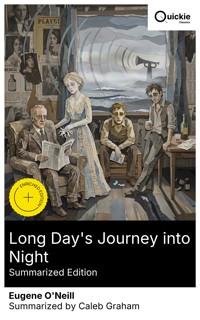
Long Day's Journey into Night (Summarized Edition)
Table of Contents
Introduction
Long Day’s Journey into Night charts how love, memory, and denial entangle a family until tenderness and truth become almost indistinguishable from harm. Eugene O’Neill’s landmark play unfolds over one day in a single household, distilling a lifetime of private history into an intimate, pressurized encounter. The result is not a sensational melodrama but a patient study of domestic life, rendered with a novelist’s psychological acuity and a dramatist’s ear. Readers encounter a work that feels at once monumental and immediate, the stage directions vivid and the dialogue restless and recurring. It is a tragedy of ordinary routines, in which breakfast tables and living-room chairs become instruments of fate.
As an autobiographical domestic tragedy rooted in American theatrical naturalism, the play is set in 1912 at a seaside summer home on the Connecticut coast. O’Neill wrote it in the early 1940s and directed that it be withheld during his lifetime; it was first published and staged posthumously in the mid-1950s. Its era-spanning creation and release give it the feel of a late testament, speaking from one generation to another. The action is concentrated and interior, and its four-act architecture moves from bright morning to night, matching the encroaching fog outside with a deepening inward gloom.
Within this house lives the Tyrone family: a once-celebrated actor father, a sensitive mother, and two adult sons whose temperaments clash and converge in equal measure, along with the household’s maid. The day begins with affectionate banter and plans for mundane chores, yet worry shadows the talk. Mary’s recent convalescence and Edmund’s troubling symptoms unsettle every exchange, and money, work, and reputation hover in the background. O’Neill’s scenes open outward through long, musical conversations that circle a subject before daring to touch it, creating a reading experience that is intimate, claustrophobic, often tender, and intermittently, surprisingly, funny.
The play’s central conflicts spring from the friction between self-protective illusion and the need to tell the truth. Each family member rehearses a version of the past that saves face or softens pain, and each, in turn, demands confession from the others. Because the patriarch’s career on the stage has shaped the household’s fortunes, performance becomes both metaphor and habit: they act for one another as much as they speak to one another. Long Day’s Journey into Night is widely regarded as O’Neill’s most autobiographical work, and that proximity generates a rare tonal blend of compassion, severity, and unsparing clarity.
Form and feeling are inseparable here. The single-day structure intensifies repetition, so that phrases recur like tides, drawing characters back to unresolved grievances and vulnerable admissions. The setting’s shoreline weather—especially the fog—operates as a palpable atmosphere and a symbol for emotional opacity, muffling sound, blurring distance, and isolating the house from the wider world. O’Neill’s stage directions are unusually evocative, guiding readers through gestures, silences, and the texture of a room as carefully as lines of speech. What results is a portrait of familial intimacy where love survives, but it does so alongside habits that erode trust and health.
Contemporary readers will recognize the play’s urgent concerns: the persistence of addiction and relapse, the strain of chronic illness, the costs of medical uncertainty, and the ways money anxiety distorts care. Its insight into communication—how people talk around pain, bargain with hope, and return to the same arguments—feels strikingly modern. It also interrogates artistic labor and the compromises families make to survive a volatile profession. Without prescribing solutions, O’Neill maps the cycles that shape many households, tracing how love can both shelter and enable. That persistence keeps the play alive as a mirror for present-day conversations about responsibility and repair.
Approached on the page, the drama rewards slow attention to rhythm, subtext, and the accumulating weight of small gestures; approached in performance, it offers the shock of recognition as private rituals become public. Either way, the experience is less about plot turns than about deepening knowledge—of a family, of a nation’s attitudes toward illness and ambition, and of the tender, stubborn selves that survive inside habit. Long Day’s Journey into Night endures because it renders suffering without spectacle and refuses to deny the love that persists beneath it, asking readers to face what hurts without turning away.
Synopsis
Long Day’s Journey into Night, Eugene O’Neill’s four-act play first published posthumously in 1956, unfolds over a single August day in 1912 at the Tyrone family’s seaside home in Connecticut. The work follows James Tyrone, a celebrated but cautious actor; his wife, Mary; and their sons, Jamie and Edmund, as ordinary routines expose long-buried wounds. O’Neill’s drama, often considered his most autobiographical, concentrates on conversations, pauses, and shifting alliances rather than plot mechanics. As the day progresses from bright morning to encroaching fog, the family’s efforts to hold to cheer and civility collide with illness, regret, and the uneasy coexistence of love and blame.
The morning begins with tentative hope. Mary has recently returned from treatment, and her family watches her with anxious optimism, praising small signs of steadiness while carefully avoiding certain subjects. Edmund, the younger son, is ill and awaiting a specialist’s opinion after months at sea, his cough an audible presence. Jamie, older and wry, cloaks concern in sarcasm. James maintains a brisk routine, guarding his schedule and expenses. Through casual banter and small domestic tasks, the Tyrone home feels both intimate and fragile, the characters’ shared affection persistently shadowed by the possibility of relapse, bad news, or renewed quarrels.
Domestic rhythms reveal fault lines. Mary’s nervous movements and retreats upstairs suggest an inner restlessness that contradicts her outward composure. Edmund prepares to visit the doctor, encouraging his parents to stay calm even as he minimizes symptoms. James reminisces about his career and properties, revealing a lifelong fear of poverty that informs every decision, from doctors to household comforts. The housemaid, Cathleen, enters briefly, providing ordinary chatter that underscores the family’s desire for normalcy. Outside, fog gathers along the shore, a literal and figurative veil that softens outlines and threatens to erase distances, echoing how memory and wishful thinking blur the present.
The play digs into the father-son dynamic as James debates medical choices with Edmund. Cost, trust in specialists, and the value of reputation clash with the urgency of timely care. James’s thrift, rooted in harsh beginnings and an actor’s insecurity, appears both prudent and paralyzing. Edmund’s artistic sensibility—his books, his affinity for the sea, his admiration for writers—marks a path at odds with James’s practical caution. Jamie drifts at the edges, at once protective of Edmund and resentful of perceived favoritism, wielding wit as a defense. Conversations circle, return, and break off, establishing the drama’s pattern of advance and retreat.




