


0,49 €
Niedrigster Preis in 30 Tagen: 1,99 €
Niedrigster Preis in 30 Tagen: 1,99 €
Mehr erfahren.
- Herausgeber: Booksell-Verlag
- Kategorie: Gesellschafts- und Liebesromane
- Sprache: Englisch
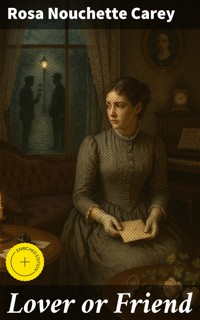
In her novel "Lover or Friend," Rosa Nouchette Carey intricately explores themes of love, loyalty, and friendship within the confines of Victorian social norms. The narrative weaves through the lives of its characters with a delicate yet poignant style, allowing readers to engage deeply with the emotional turmoil and societal pressures these individuals face. Carey's adept use of dialogue and vivid characterization provides a rich backdrop against which the complexities of human relationships unfold, revealing both the joys and burdens of affection in a time when personal choices were often fraught with consequence. Carey was a prominent figure in early 20th-century British literature, celebrated for her pioneering contributions to the genre of women's fiction. Having experienced the constraints of her era firsthand, she drew upon her own life experiences and observations of societal expectations, particularly regarding women's roles, to inform her storytelling. Her ability to navigate the intricacies of love and friendship reflects a keen understanding of the female psyche, positioning her as a significant voice in the discourse on women's autonomy and emotional identity. "Lover or Friend" is a compelling read that resonates with anyone interested in the subtleties of human connection. Carey's beautifully crafted narrative encourages readers to reflect on their own relationships, making this novel a must-read for fans of classic literature and contemporary explorations of friendship and love. In this enriched edition, we have carefully created added value for your reading experience: - A succinct Introduction situates the work's timeless appeal and themes. - The Synopsis outlines the central plot, highlighting key developments without spoiling critical twists. - A detailed Historical Context immerses you in the era's events and influences that shaped the writing. - A thorough Analysis dissects symbols, motifs, and character arcs to unearth underlying meanings. - Reflection questions prompt you to engage personally with the work's messages, connecting them to modern life. - Hand‐picked Memorable Quotes shine a spotlight on moments of literary brilliance. - Interactive footnotes clarify unusual references, historical allusions, and archaic phrases for an effortless, more informed read.
Das E-Book können Sie in Legimi-Apps oder einer beliebigen App lesen, die das folgende Format unterstützen:
Veröffentlichungsjahr: 2019
Ähnliche


















Lover or Friend
Table of Contents
Introduction
In a world where affection, loyalty, and social expectation jostle for precedence, the question of whether one’s deepest allegiance belongs to a lover or a friend drives both the heart and the plot.
Rosa Nouchette Carey (1840–1909), an English novelist of the Victorian era, built her reputation on domestic narratives that balance moral reflection with intimate social observation, and Lover or Friend belongs squarely to that tradition. First published in the late nineteenth century, the novel reflects the tastes and concerns of a period when circulating libraries and family reading shaped popular fiction. Its setting aligns with the everyday environments Carey favored—homes, parlors, and communities where reputation matters, choices reverberate, and character is tested gently but persistently against the pressures of convention and need.
Without venturing beyond its opening movement, the story orients readers around a close-knit circle in which trust, regard, and unspoken desires generate both tenderness and unease. The premise invites us to watch a young woman weigh the stability of abiding friendship against the allure and risk of romantic attachment, all under the watchful eyes of family and society. Carey’s voice is sympathetic and composed, favoring clear motives over sensational turns. The mood is warm but serious, the pace measured, and the effect is to draw readers into quiet rooms where small decisions carry lasting consequences.
As is characteristic of Carey’s fiction, the novel explores the moral texture of ordinary life: how duty competes with inclination, how loyalty is proven, and how the desire to be kind can conflict with the need to be honest. Friendship is not a simple refuge, and romance is not a simple answer; both demand self-scrutiny and courage. The book is attentive to the subtleties of reputation and the responsibilities individuals bear to one another. In this light, the title’s central opposition becomes a lens for examining trust, self-knowledge, and the delicate negotiations that sustain community.
Carey’s craft privileges closely observed relationships over external spectacle. Dialogue is purposeful and decorous, yet it reveals the tremors beneath polite surfaces. Confidences, visits, misunderstandings, and reconciliations advance the action in modest increments, allowing readers to track interior change as carefully as outward circumstance. The style is lucid and restrained, avoiding cynicism in favor of compassionate clarity. Secondary characters often serve as moral touchstones or foils, not to preach but to illuminate the central figure’s evolving judgment. The result is an immersive domestic canvas in which feeling is tested by time, habit, and the quiet persistence of everyday duty.
For contemporary readers, Lover or Friend offers more than a period portrait; it poses enduring questions about the forms of attachment that sustain a life. How do we balance personal desire with the claims of loyalty? When does preserving harmony defer necessary truth, and when does frankness become its own kind of care? The book’s interest in boundaries, mutual respect, and the ethics of choice resonates today, inviting reflection on what it means to commit without losing oneself. Its gentle seriousness also provides an antidote to more ironic treatments of love, affirming the dignity of sincerity.
To open this novel is to enter a conversation about constancy, compromise, and the courage to choose well. Readers can expect a contemplative, emotionally intelligent experience rooted in the textures of everyday living, where small acts have large meanings. Carey neither indulges melodrama nor denies feeling; instead, she calibrates hope and realism with steady hands. Lover or Friend rewards patience with insight, presenting a world in which the heart’s answer emerges from careful attention to character, circumstance, and conscience. It is, in the best sense, a domestic drama that still speaks to the complexities of modern attachment.
Synopsis
The novel opens with a young woman adjusting to a quieter life after family circumstances reduce former comforts. Moving with her mother and siblings to a small English town, she assumes new responsibilities that shape her outlook and routine. Everyday duties, parish visits, and modest social calls introduce a world where character is measured by constancy and kindness. The narrator’s voice remains observant and restrained, balancing affection for her family with a sober sense of duty. Early chapters establish the household’s finances, the rhythm of village life, and the underlying question that frames the story: what kind of attachment can be trusted to endure—passionate admiration or steady friendship?
Local society gathers around the rectory, a nearby great house, and a few old families whose histories extend into current conversations. Among them is a reserved neighbor whose self-command and reticence hint at disappointment, and a fragile young woman whose spirits oscillate with her health. The narrator’s visits bring her into closer contact with both, revealing quiet dependencies and unspoken needs. Tea tables, garden paths, and church gatherings provide occasions for muted tensions and small revelations. The heroine learns how considerate gestures build influence, and how words left unsaid can guide or unsettle a friendship. The setting’s orderliness conceals the inner conflicts that will shape choices ahead.
A sparkling visitor arrives, altering the balance with urban polish and persuasive charm. He gravitates to the liveliest rooms and most attentive listeners, and his stories furnish a counterpoint to the neighbor’s reserve. The narrator encounters him at a garden party and later in a sheltered lane, where hints of confidence encourage further meetings. Meanwhile, the reserved neighbor proves a practical ally in trifling emergencies—arranging a carriage, offering sound advice, lending books—without courting attention. These parallel presences, one animated and expansive, the other steady and self-contained, frame the title’s central dilemma. The narrator’s attentiveness sharpens as gestures begin to carry implications she hesitates to name.
Quiet complications gather. Rumors regarding the visitor’s past, obligations, and prospects spread discreetly. The delicate friend suffers a relapse that draws the narrator into night watches and anxious consultations. A mishap during a storm or late errand exposes the limits of charm and the utility of composure; practical help arrives from an unexpected quarter, leaving impressions more durable than compliments. The heroine’s household, pressed by fatigue and expense, must choose what engagements to honor and which to decline. Without open confrontation, loyalties form and falter. The contrast between appearance and reliability grows clearer, yet no decisive choice is made. The narrative preserves ambiguity as affection and gratitude intertwine.
Midway, letters and recollections bring past commitments into the present. A confidant admits to earlier entanglements, and the cost of past decisions is quietly reckoned. The narrator’s family faces a small crisis—an error in judgment by a younger member—that requires tact, humility, and outside assistance. In seeking help, she deepens ties with those whose counsel is measured rather than eloquent. Conversations touch on vocation, patience, and the meaning of promise; the idea of engagement is raised only to be set aside as premature. The heroine begins to distinguish excitement from endurance, recognizing how friendship carries a discipline that infatuation resists. Still, the narrative postpones resolution, preserving tension.
A misunderstanding widens into estrangement. Words repeated without context, visits missed through chance or pride, and a thoughtless display at a crowded gathering push several relationships off balance. A brief stay in London introduces distraction and possibility—a glimpse of rooms and pursuits that flatter ambition and suggest escape from village scrutiny. Plans are proposed, alluring in their speed and gloss, yet vague in their substance. Returning home unsettled, the narrator finds responsibilities sharpened by absence. The fragile friend suffers fresh distress, and a confidential appeal tests discretion. Uncertainty grows as generosity risks enabling error, and frankness risks wounding those already vulnerable.
A public incident forces decisions into action. An illness, an accident, or a sudden alarm summons neighbors at inconvenient hours, revealing capacities previously hidden. The reserved figure acts without display, arranging what needs to be done with unobtrusive authority. The worldly visitor, pressed by circumstance, shows strengths and limits not previously apparent. Reputations shift quietly as those who watch draw tentative conclusions. The heroine confronts her own motives in the aftermath, measuring comfort against conscience, and gratitude against trust. Invitations are offered and declined; a private conversation changes the direction of several lives. The novel maintains restraint, withholding definitive answers while clarifying stakes.
Consequences unfold in a quieter key. Explanations are made, apologies accepted, and certain mysteries of the past are resolved without sensational revelations. The community absorbs change as habits resume, altered by new perceptions of character. The narrator, steadier in judgment, weighs the claims of admiration, compassion, and daily companionship. Practical concerns—health, income, the care of dependents—align with moral insight, guiding choices more than impulse does. Some distances close while others become permanent. The tone remains measured, favoring reconciliation where possible and dignified silence where not. The narrative’s momentum draws toward an answer implicit in conduct rather than dramatic declarations.
The closing chapters return to the book’s guiding question in reflective scenes marked by calm assurance. The resolution, kept discreet, emphasizes how affection matured by patience becomes trustworthy, and how friendship tested by service may grow into something deeper. Without detailing final arrangements, the story affirms a preference for loyalty over display and for duty’s quiet satisfactions over fleeting excitement. Domestic order is restored, futures are suggested but not flaunted, and faith-inflected gratitude frames the heroine’s outlook. The novel’s central message emerges plainly: discernment, constancy, and everyday kindness determine lasting bonds, answering whether the truest companion proves lover, friend, or both.
Historical Context
Rosa Nouchette Carey situates Lover or Friend in the late Victorian milieu, largely within the genteel, Anglican middle class of London and the Home Counties. The setting reflects suburban expansion south and west of the capital, where railways knit together villa-lined streets, parish churches, and high streets. Domestic interiors, drawing rooms, and parsonage visits organize social time, while the London Season and seaside excursions frame respectable courtship. The temporal horizon is the 1880s–1890s, under Queen Victoria’s reign (1837–1901), when propriety, philanthropy, and a vigilant concern for reputation governed women’s choices. Carey’s locales echo commuter suburbs in Surrey and Kent, balancing metropolitan proximity with village intimacy.
The novel’s central dilemmas around marriage, trust, and a woman’s prudential choice between affection and reliable friendship resonate with legal reforms to women’s status in late nineteenth-century Britain. The Married Women’s Property Acts of 1870 and 1882 transformed coverture. The 1870 Act allowed wives to retain earnings and property acquired after marriage; the landmark 1882 Act granted married women a separate legal identity, enabling them to own, control, and dispose of property as if unmarried. Further clarifications followed in the 1890s, including the 1893 Act, which refined liabilities and protections. The Matrimonial Causes Act 1857 had already moved divorce from ecclesiastical to civil courts, making dissolution possible, though costs and an enduring double standard kept it rare. The Matrimonial Causes Act 1878 allowed magistrates to grant separation orders for aggravated assault, a modest but significant safeguard. The Guardianship of Infants Act 1886 advanced maternal rights in custody, reflecting changing beliefs about domestic authority. These statutes underpin the moral calculus historically faced by middle-class women contemplating marriage: the security of settlements and trust deeds, the perils of indebted suitors, and the consequences of rash engagements for reputation and livelihood. In Carey’s world, wills, inheritances, and the stewardship of female property are pivotal to social standing and ethical choice. Characters’ anxieties about a prospective husband’s solvency, the fairness of settlements, or the possibility of legal recourse mirror a culture newly alert to women’s contractual rights yet still constrained by convention. The tension between the legal capacity to act and the social compulsion to conform becomes a narrative engine: the title’s contrast between lover and friend is inseparable from an era that was redefining consent, obligation, and female economic agency within marriage.
Victorian educational reforms shaped the horizon of possibility for Carey's heroines. The Elementary Education Act 1870 created school boards and a national framework; the 1880 Act made attendance compulsory to age ten, and the 1891 Act introduced free elementary education. Women’s higher learning advanced through Girton College (Cambridge, 1869), Newnham (1871), and the University of London granting degrees to women in 1878. Respectable occupations—governessing, teaching, nursing (anchored by the Nightingale School at St Thomas’ Hospital from 1860)—offered limited independence. The novel reflects these pathways by portraying competent domestic management, pedagogic skills, and the social value of female diligence as viable, if constrained, routes to self-respect.
Rapid urbanization and the railway revolution frame the book’s social geography. The Metropolitan Railway opened in 1863, and suburban lines radiated to Croydon, Clapham, Surbiton, and beyond, enabling middle-class commuting and the diffusion of metropolitan manners into semi-rural parishes. The 1870s–1890s building boom produced terraces and villas with servants’ quarters, signaling status while enforcing hierarchies of service. Such environments cultivated routines of calling, chaperonage, and church-based sociability central to courtship plots. Lover or Friend mirrors this world of scheduled visits, discreet supervision, and reputational scrutiny heightened by proximity—where neighbors, clergy, and tradespeople collectively police propriety.
Public health and moral regulation marked everyday life. The Public Health Act 1875 consolidated sanitary powers, improving water, sewage, and street cleansing; local boards sought to prevent cholera and typhoid recurring from earlier outbreaks. Simultaneously, the Contagious Diseases Acts (1864, 1866, 1869) policed women in garrison towns; their repeal in 1886 followed Josephine Butler’s national campaign, exposing a sexual double standard. Temperance activism (United Kingdom Alliance, 1853; Band of Hope, 1847) addressed alcoholism’s social harms. In Carey’s fiction, prudential domesticity, attention to sickrooms, and concern for moral contagion echo these reforms, as characters navigate a culture equating health, sobriety, and feminine virtue with respectability.
Victorian voluntarism infused middle-class identity. The Charity Organization Society (London, 1869) systematized relief to distinguish the deserving from the undeserving poor; the Salvation Army (founded by William and Catherine Booth, 1865) brought evangelical outreach to urban slums; Toynbee Hall (Whitechapel, 1884) pioneered the settlement movement linking university men to East End poverty. Parish visiting, sewing circles, and hospital subscriptions were routine. These institutions contextualize the novel’s emphasis on duty, restraint, and benevolent intervention. Acts of visiting, discreet almsgiving, and moral counsel align with a social script that makes charity a stage for character, while also highlighting the limits and paternalism of respectable philanthropy.
Economic fluctuations during the Long Depression (circa 1873–1896) shadowed domestic decisions. Falling agricultural prices and volatile trade unsettled incomes, while the Baring Crisis of 1890—triggered by overexposure to Argentine securities and resolved by a Bank of England–led consortium—shook confidence among investors and professionals. Savings banks, life insurance, and trustee investments became vital safeguards for widows and daughters. Middle-class anxieties about speculation, debt, and the stability of annuities pervaded household talk. In this climate, Carey's characters weigh suitors’ probity, employment, and liabilities, and view marriage settlements not as romance-killing formalities but as essential bulwarks against the periodic failures of the market.
Against this backdrop, the book functions as a measured social critique. By dramatizing the stakes of courtship under evolving property and custody laws, it exposes how legal gains coexisted with coercive norms that disciplined women through reputation and economic dependence. The narrative scrutinizes class boundaries maintained by domestic service, philanthropic gatekeeping, and suburban surveillance, while revealing the moral double standard that outlived statutory reform. Its emphasis on prudent choice, financial transparency, and ethical friendship challenges performative gentility and speculative masculinity. In doing so, Lover or Friend quietly indicts structural inequities that made a woman’s safety contingent on contracts and character in a society still learning to honor both.
Lover or Friend
CHAPTER I
THE BLAKE FAMILY ARE DISCUSSED
'There is nothing, sir, too little for so little a creature as man. It is by studying little things that we attain the great art of having as little misery and as much happiness as possible.'—Dr. Johnson[1].
Everyone in Rutherford knew that Mrs. Ross was ruled by her eldest daughter; it was an acknowledged fact, obvious not only to a keen-witted person like Mrs. Charrington, the head-master's wife, but even to the minor intelligence of Johnnie Deans, the youngest boy at Woodcote. It was not that Mrs. Ross was a feeble-minded woman; in her own way she was sensible, clear-sighted, with plenty of common-sense; but she was a little disposed to lean on a stronger nature, and even when Geraldine was in the schoolroom, her energy and youthful vigour began to assert themselves, her opinions insensibly influenced her mother's, until at last they swayed her entirely.
If this were the case when Geraldine was a mere girl, it was certainly not altered when the crowning glories of matronhood were added to her other perfections. Six months ago Geraldine Ross had left her father's house to become the wife of Mr. Harcourt, of Hillside; and in becoming the mistress of one of the coveted Hill houses, Geraldine had not yet consented to lay down the sceptre of her home rule[2].
Mrs. Ross had acquiesced cheerfully in this arrangement. She had lost her right hand in losing Geraldine; and during the brief honeymoon both she and her younger daughter Audrey felt as though the home machinery were somewhat out of gear. No arrangement could be effected without a good deal of wondering on Mrs. Ross's part as to what Geraldine might think of it, and without a lengthy letter being written on the subject.
It was a relief, at least to her mother's mind, when young Mrs. Harcourt returned, and without a word took up the reins again. No one disputed her claims. Now and then there would be a lazy protest from Audrey—a concealed sarcasm that fell blunted beneath the calm amiability of the elder sister. Geraldine was always perfectly good-tempered; the sense of propriety that guided all her actions never permitted her to grow hot in argument; and when a person is always in the right, as young Mrs. Harcourt believed herself to be, the small irritations of daily life fall very harmlessly. It is possible for a man to be so cased in armour that even a pin-prick of annoyance will not find ingress. It is true the armour may be a little stifling and somewhat inconvenient for work-a-day use, but it is a grand thing to be saved from pricks.
Mrs. Harcourt was presiding at the little tea-table in the Woodcote drawing-room; there were only two other persons in the room. It was quite an understood thing that the young mistress of Hillside should walk over to Woodcote two or three afternoons in the week, to give her mother the benefit of her society, and also to discuss any little matter that might have arisen during her brief absence.
Mrs. Harcourt was an exceedingly handsome young woman; in fact, many people thought her lovely. She had well-cut features, a good complexion—with the soft, delicate colouring that only perfect health ever gives—and a figure that was at once graceful and dignified. To add to all these attractions, she understood the art of dressing herself; her gowns always fitted her to perfection. She was always attired suitably, and though vanity and self-consciousness were not her natural foibles, she had a feminine love of pretty things, and considered it a wifely duty to please the eyes of her lord and master.
Mrs. Harcourt had the old-fashioned sugar-tongs in her hand, and was balancing them lightly for a moment. 'It is quite true, mother,' she said decisively, as she dropped the sugar into the shallow teacup.
Mrs. Ross looked up from her knitting.
'My dear Geraldine, I do hope you are mistaken,' she returned anxiously.
Mrs. Ross had also been a very pretty woman, and even now she retained a good deal of pleasant middle-aged comeliness. She was somewhat stout, and had grown a little inactive in consequence; but her expression was soft and motherly, and she had the unmistakable air of a gentlewoman. In her husband's eyes she was still handsomer than her daughters; and Dr. Ross flattered himself that he had made the all-important choice of his life more wisely than other men.
'My dear mother, how is it possible to be mistaken?' returned her daughter, with a shade of reproof in her voice. 'I told you that I had a long talk with Edith. Michael, I have made your tea; I think it is just as you like it—with no infusion of tannin, as you call it'; and she turned her head slowly, so as to bring into view the person she was addressing, and who, seated at a little distance, had taken no part in the conversation.
He was a thin, pale man, of about five or six and thirty, with a reddish moustache. As he crossed the room in response to this invitation, he moved with an air of languor that amounted to lassitude, and a slight limp was discernible. His features were plain; only a pair of clear blue eyes, with a peculiarly searching expression, distinguished him from a hundred men of the same type.
These eyes were not always pleasant to meet. Certain people felt disagreeably in their inner consciousness that Captain Burnett could read them too accurately—'No fellow has a right to look you through and through,' as one young staff officer observed; 'it is taking a liberty with a man. Burnett always seems as though he is trying to turn a fellow inside out, to get at the other side of him'—not a very eloquent description of a would-be philosopher who loved to dabble a little in human foibles.
'I have been listening to the Blake discussion,' he said coolly, as he took the offered cup. 'What a wonderful woman you are, Gage! you have a splendid talent for organisation; and even a thorough-paced scandal has to be organised.'
'Scandal!—what are you talking about, Michael?'
'Your talent for organisation, even in trifles,' he returned promptly. 'I am using the word advisedly. I have just been reading De Quincey's definition of talent and genius. He says—now pray listen, Gage—that "talent is intellectual power of every kind which acts and manifests itself by and through the will and the active forces. Genius, as the verbal origin implies, is that much rarer species of intellectual power which is derived from the genial nature, from the spirit of suffering and enjoying, from the spirit of pleasure and pain, as organised more or less perfectly; and this is independent of the will. It is a function of the passive nature. Talent is conversant with the adaptation of means to ends; but genius is conversant only with ends."'
'My dear Michael, I have no doubt that all this is exceedingly clever, and that your memory is excellent, but why are we to be crushed beneath all this analysis?'
'I was only drawing a comparison between you and Audrey,' he replied tranquilly. 'I have been much struck by the idea involved in the word "genial"; I had no conception we could evolve "genius" out of it. Audrey is a very genial person; she also, in De Quincey's words, "moves in headlong sympathy and concurrence with spontaneous power." This is his definition, mark you; I lay no claim to it: "Genius works under a rapture of necessity and spontaneity." I do love that expression, "headlong sympathy"; it so well expresses the way Audrey works.'
Mrs. Harcourt gave a little assenting shrug. She was not quite pleased with the turn the conversation had taken; abstract ideas were not to her taste; the play of words in which Captain Burnett delighted bored her excessively. She detected, too, a spice of irony. The comparison between her and Audrey was not a flattering one: she was far cleverer than Audrey; her masters and governesses would have acknowledged that fact. And yet her cousin Michael was giving the divine gift of genius to her more scantily endowed sister; genius! but, of course, it was only Michael's nonsense: he would say anything when he was in the humour for disputation. Even her own Percival had these contentious moods. The masculine mind liked to play with moral ninepins, to send all kinds of exploded theories rolling with their little ball of wit; it sharpened their argumentative faculties, and kept them bright and ready for use.
'Mother and I were talking about these tiresome Blakes—not of Audrey,' she said in a calm, matter-of-fact tone. 'If you were listening, Michael, you must have heard the whole account of my conversation with Mrs. Bryce.'
'Oh, you mean Harcourt's sister, with whom you have been staying. Did I not tell you that I had heard every word, and was admiring your admirable tactics? The way in which you marshalled your forces of half-truths and implied verities and small mounted theories was grand—absolutely grand!'
Mrs. Harcourt was silent for a moment. Michael was very trying; he often exercised her patience most severely. But there was a threefold reason for her forbearance; first, he was her father's cousin, and beloved by him as his own son would have been if he had ever had one; secondly, his ill-health entitled him to a good deal of consideration from any kind-hearted woman; and thirdly, and perhaps principally, he had the reputation for saying and doing odd, out-of-the-way things; and a man who moves in an eccentric circle of his own is never on other people's plane, and therefore some allowance must be made for him.
Mrs. Harcourt could, however, have heartily endorsed Mrs. Carlyle's opinion of her gifted son, and applied it to her cousin—'He was ill to live with.' Somehow one loves this honest, shrewd criticism of the old North-Country woman, the homely body who smoked short black pipes in the chimney-corner, but whom Carlyle loved and venerated from the bottom of his big heart. 'Ill to live with'—perhaps Michael Burnett, with his injured health and Victoria Cross[3], and the purpose of his life all marred and frustrated, was not the easiest person in the world.
Mrs. Harcourt was silent for an instant; but she never permitted herself to be ruffled, so she went on in her smooth voice:
'I felt it was my duty to repeat to mother all that Edith—I mean Mrs. Bryce—told me about the Blakes.'
'Please do not be so formal. I infinitely prefer that fine, princess-like name of Edith,' remarked Michael, with a lazy twinkle in his eyes; but Mrs. Harcourt would not condescend even to notice the interruption.
'Mrs. Bryce,' with a pointed emphasis on the name, 'was much concerned when she heard that my father had engaged Mr. Blake for his classical master.'
'And why so?' demanded Captain Burnett a little sharply. 'He has taken a good degree; Dr. Ross seems perfectly satisfied with him.'
'Oh, there is nothing against the young man; he is clever and pleasant, and very good-looking. It is only the mother who is so objectionable. Perhaps I am putting it too strongly—only Mrs. Bryce and her husband did not like her. They say she is a very unsatisfactory person, and so difficult to understand.'
'Poor Mrs. Blake,' ejaculated her cousin, 'to be judged before the Bryce tribunal and found wanting!'
'Don't be ridiculous, Michael!' replied Mrs. Harcourt, in her good-tempered way; 'of course you take her part simply because she is accused: you are like Audrey in that.'
'You see we are both genial persons; but, seriously, Mrs. Blake's list of misdemeanours seems absurdly trifling. She is very handsome; that is misdemeanour number one, I believe.'
'My dear,' observed Mrs. Ross placidly at this point, for she had been too busy counting her stitches to concern herself with the strife of words, 'Geraldine only mentioned that as a fact: she remarked that Mrs. Blake was a very prepossessing person, that she had rather an uncommon type of beauty.'
'That makes her all the more interesting,' murmured Captain Burnett, with his eyes half closed. 'I begin to feel quite excited about this Mrs. Blake. I do delight in anything out of the common.'
'Oh, Edith never denied that she was fascinating. She is a clever woman, too; only there were certain little solecisms committed that made her think Mrs. Blake was not a thorough gentlewoman. They are undoubtedly very poor; and though, of course, that is no objection, it is so absurd for people in such a position to try and ignore their little shifts and contrivances. Honest poverty is to be respected, but not when it is allied to pretension.[1q]'
'My dear Gage, was it you or Mrs. Bryce who made that exceedingly clever speech! It was really worthy of Dr. Johnson; it only wanted a "Sir" to point the Doctor's style. "Sir, honest poverty is to be respected, but not when it is allied to pretension"—a good, thorough Johnsonian speech! And so the poor woman is poor?'
'Yes, but no one minds that,' returned Mrs. Harcourt, somewhat hastily. 'I hope you do not think that anything in her outward circumstances has prejudiced my sister-in-law against her. As far as that goes, Mrs. Blake deserves credit; she has denied herself comforts even to give her son a good education. No, it is something contradictory in the woman herself that made the Bryces say they would never get on with her. She is impulsive, absurdly impulsive; and yet at the same time she is reserved. She has a bad temper—at least, Edith declares she has heard her scolding her servant in no measured terms; and then she is so injudicious with her children. She absolutely adores her eldest son, Cyril; but Edith will have it that she neglects her daughter. And there is an invalid boy, too—a very interesting little fellow; at least, I don't know how old he is—and she is not too attentive to him. Housekeeping worries her, and she is fond of society; and I know the Bryces think that she would marry again if she got the chance.'
'Let the younger widows marry. I hope you do not mean to contradict St. Paul. Have we quite finished the indictment, Gage? Be it known unto the inhabitants of Rutherford that a certain seditious and dangerous person of the name of Blake is about to take up her residence in the town—the list of her misdemeanours being as follows, to wit, as they say in old chronicles: an uncommon style of beauty, an inclination to replace the deceased Mr. Blake[4], imperfect temper, impulsiveness tempered with reserve, unconventionality of habit, poverty combined with pretentiousness, and a disposition to slight her maternal duties—really a most interesting person!'
'Michael, of course you say that to provoke me; please don't listen to him, mother. You understand me if no one else does; you know it is Audrey of whom I am thinking. Yes,' turning to her cousin, 'you may amuse yourself with turning all my speeches into ridicule, but in your heart you agree with me. I have often heard you lecturing Audrey on her impulsiveness and want of common-sense. It will be just like her to strike up a violent friendship with Mrs. Blake—you know how she takes these sudden fancies; and father is quite as bad. I daresay they will both discover she is charming before twenty-four hours are over; that is why I am begging mother to be very prudent, and keep the Blakes at a distance.'
'You agree, of course, Cousin Emmeline?'
'Well, my dear, I don't quite like the account Geraldine gives me. Mrs. Bryce is a very shrewd person; she is not likely to make mistakes. I think I shall give Audrey a hint, unless you prefer to do so, Geraldine.'
'I think it will come better from me, mother; you see, I shall just retail Edith's words. Audrey is a little difficult to manage sometimes; she likes to form her own notions of people. There is no time to be lost if they are coming in to-morrow.'
'I thought your father said it was to-day that they were expected?'
'No; I am positive Percival said to-morrow. I know the old servant and some of the furniture arrived at the Gray Cottage two days ago.'
Captain Burnett looked up quickly, as though he were about to speak, and then changed his mind, and went on with his occupation, which was teaching a small brown Dachs-hund the Gladstone trick.
'Now, Booty, when I say "Lord Salisbury," you are to eat the sugar, but not before. Ah, here comes the bone of contention!' he went on in a purposely loud tone, as a shadow darkened the window; and the next minute a tall young lady stepped over the low sill into the room.
'Were you talking about me?' she asked in a clear voice, as she looked round at them. 'How do you do, Gage? Have you been here all the afternoon? How is Percival? No more tea, thank you; I have just had some—at the Blakes'.'
'At the Blakes'?' exclaimed her sister, in a horror-stricken tone, unable to believe her ears.
'Yes. I heard they had come in last night, so I thought it would be only neighbourly to call and see if one could do anything for them. I met father on the Hill, and he quite approved. Mrs. Blake sends her compliments to you, mother;' and as only an awful silence answered her, she continued innocently: 'I am sure you and Gage will like her. She is charming—perfectly charming! the nicest person I have seen for a long time!' finished Audrey, with delightful unconsciousness of the sensation she was creating.
CHAPTER II
AUDREY INTRODUCES HERSELF
'Indeed, all faults, had they been ten times more and greater, would have been neutralised by that supreme expression of her features, to the unity of which every lineament in the fixed parts, and every undulation in the moving parts of her countenance, concurred, viz., a sunny benignity, a radiant graciousness, such as in this world I never saw surpassed.'
De Quincey.
In this innocent fashion had Audrey Ross solved the Gordian knot of family difficulty, leaving her mother and sister eyeing each other with the aghast looks of defeated conspirators; and it must be owned that many a tangled skein, that would have been patiently and laboriously unravelled by the skilled fingers of Geraldine, was spoilt in this manner by the quick impulsiveness of Audrey.
No two sisters could be greater contrasts to each other. While young Mrs. Harcourt laid an undue stress on what may be termed the minor morals, the small proprieties, and lesser virtues that lie on the surface of things and give life its polish, Audrey was for ever riding full-tilt against prejudices or raising a crusade against what she chose to term 'the bugbear of feminine existence—conventionality.'
Not that Audrey was a strong-minded person or a stickler for woman's rights. She had no advanced notions, no crude theories, on the subject of emancipation; it was only, to borrow Captain Burnett's words, that her headlong sympathies carried her away; a passionate instinct of pity always made her range herself on the losing side. Her virtues were unequally balanced, and her generosity threatened to degenerate into weakness. Most women love to feel the support of a stronger nature; Audrey loved to support others; any form of suffering, mental or physical, appealed to her irresistibly. Her sympathy was often misplaced and excessive, and her power of self-effacement, under some circumstances, was even more remarkable, the word 'self-effacement' being rightly used here, as 'self-sacrifice' presupposes some consciousness of action. It was this last trait that caused genuine anxiety to those who knew and loved Audrey best; for who can tell to what lengths a generous nature may go, to whom any form of pain is intolerable, and every beggar, worthy or unworthy, a human brother or sister, with claims to consideration?
If Audrey were not as clever as her elder sister, she had more originality; she was also far more independent in her modes of action and thought, and went on her own way without reference to others.
'It is not that I think myself wiser than other people,' she said once to her cousin, who had just been delivering her a lecture on this subject. 'Of course I am always making mistakes—everyone does; but you see, Michael, I have lived so long with myself—exactly two-and-twenty years—and so I must know most about myself, and what is best for this young person,' tapping herself playfully.
Audrey was certainly not so handsome as her sister. She had neither Geraldine's perfection of feature nor her exquisite colouring; but she had her good points, like other people.
Her hair was soft and brown, and there was a golden tinge in it that was greatly admired. There was also a depth and expression in her gray eyes that Geraldine lacked. But the charm of Audrey's face was her smile. It was no facial contortion, no mere lip service; it was a heart illumination—a sudden radiance that seemed to light up every feature, and which brought a certain lovely dimple into play.
And there was one other thing noticeable in Audrey, and which brought the sisters into still sharper contrast. She was lamentably deficient in taste, and, though personally neat, was rather careless on the subject of dress. She liked an old gown better than a new one, was never quite sure which colour suited her best, and felt just as happy paying a round of calls in an old cambric as in the best tailor-made gown. It was on this subject that she and Geraldine differed most. No amount of spoken wisdom could make Audrey see that she was neglecting her opportunities to a culpable degree; that while other forms of eccentricity might be forgiven, the one unpardonable sin in Geraldine's code was Audrey's refusal to make the best of herself.
'And you do look so nice when you are well dressed,' she observed with mournful affection on one occasion when Audrey had specially disappointed her. 'You have a beautiful figure—Madame Latouche said so herself—and yet you would wear that hideous gown Miss Sewell has made, and at Mrs. Charrington's "at home," too.'
'How many people were affected by this sad occurrence?' asked Audrey scornfully. 'My dear Gage, your tone is truly tragical. Was it my clothes or me—poor little me!—that Mrs. Charrington invited and wanted to see? Do you know, Michael,' for that young man was present, 'I have such a grand idea for the future; a fashion to come in with Wagner's music, and æsthetics, and female lawyers—in fact, an advanced theory worthy of the nineteenth century. You know how people hate "at homes," and how bored they are, and how they grumble at the crush and the crowd.'
'Well, I do believe they are hideous products of civilisation,' he returned with an air of candour.
'Just so; well, now for my idea. Oh, I must send it to Punch, I really must. My proposition is that people should send their card by their lady's-maid, and also the toilette intended for that afternoon, to be inspected by the hostess. Can you not imagine the scene? First comes the announcement by the butler: "Lady Fitzmaurice's clothes." Enter smiling lady's-maid, bearing a wondrously braided skirt with plush mantle and bonnet with pheasant's wing. Hostess bows, smiles, and inspects garments through her eyeglasses. "Charming! everything Lady Fitzmaurice wears is in such perfect taste. My dear Cecilia, that bonnet would just suit me—make a note of it, please. My compliments to her ladyship." Now then for Mrs. Grenville, and so on. Crowds still, you see, but no hand-shaking, no confusion of voices; and then, the wonderful economy: no tea and coffee, no ices, no professional artistes, only a little refreshment perhaps in the servants' hall.'
'Audrey, how can you talk such nonsense?' returned her sister severely.
But Captain Burnett gave his low laugh of amusement. He revelled in the girl's odd speeches; he thought Audrey's nonsense worth more than all Geraldine's sense, he even enjoyed with a man's insouciance her daring disregard of conventionality.
How difficult it is for a person thoroughly to know him or her self, unless he or she be morbidly addicted to incessant self-examination! Audrey thought that it was mere neighbourliness that induced her to call on the Blakes that afternoon; she had no idea that a strong curiosity made her wish to interview the new-comers.
Rutherford was far too confined an area for a liberal mind like Audrey's. Her large and intense nature demanded fuller scope for its energies. With the exception of boys—who certainly preponderated in Rutherford—there were far too few human beings to satisfy Audrey. Every fresh face was therefore hailed by her with joy, and though perhaps she hardly went to Dr. Johnson's length when he complained that he considered that day lost on which he had not made a new acquaintance, still, her social instincts were not sufficiently nourished. The few people were busy people; they had a tiresome habit, too, of forming cliques, and in many ways they disappointed her. With her richer neighbours, especially among the Hill houses, Geraldine was the reigning favourite; Mrs. Charrington was devoted to her. Only little Mrs. Stanfield, of Rosendale, thought there was no one in the world like dear Audrey Ross.
Audrey would not have mentioned her little scheme to her mother for worlds. Her mother was not a safe agent. She had long ago made Geraldine her conscience-keeper, but she had no objection to tell her father when she met him walking down the hill with his hands behind him, and evidently revolving his next Sunday's sermon.
Dr. Ross was rather a fine-looking man. He had grown gray early, and his near-sight obliged him to wear spectacles; but his keen, clever face, and the benevolent and kindly air that distinguished him, always attracted people to him. At times he was a little absent and whimsical; and those who knew them both well declared that Audrey had got all her original ideas and unconventional ways from the Doctor.
'Father, I am going to call on the Blakes,' she observed, as he was about to pass her as he would a stranger.
'Dear me, Audrey, how you startled me! I was deep in original sin, I believe. The Blakes? Oh, I told young Blake to come up to dinner to-night; I want Michael to see him. Very well. Give my respects to Mrs. Blake; and if there be any service we can render her, be sure you offer it;' and Dr. Ross walked on, quite unconscious that his daughter had retraced her steps, and was following him towards the town. 'For I won't disturb him with my chatter,' she thought, 'and I may as well go to Gage to-morrow; she is sure to keep me, and then it would be rather awkward if she should take it into her head to talk about the Blakes. She might want to go with me, or perhaps, which is more likely, she would make a fuss about my going so soon. If you want to do a thing, do it quickly, and without telling anyone, is my motto. Father is no one. If I were going to run away from home, or do anything equally ridiculous, I should be sure to tell father first; he would only recommend me to go first class, and be sure to take a cab at the other end, bless him!'
Dr. Ross walked on in a leisurely, thoughtful fashion, not too abstracted, however, to wave his hand slightly as knots of boys saluted him in passing. Audrey had a nod and smile for them all. At the Hill houses and at the school-house Geraldine might be the acknowledged favourite; but every boy in the upper and the lower school was Audrey's sworn adherent. She was their liege lady, for whom they were proud to do service; and more than one of the prefects cherished a tremulous passion for the Doctor's daughter together with his budding moustache, and, strange to say, was none the worse for the mild disease.
A pleasant lane led from the Hill to the town, with sloping meadows on one side. It was a lovely afternoon in June, and groups of boys were racing down the field path on their way to the cricket ground. Audrey looked after them with a vivid interest. 'How happy they all look!' she said to herself. 'I do believe a boy—a real honest, healthy English boy—is one of the finest things in the creation. They are far happier than girls; they have more freedom, more zest, in their lives. If they work hard, they play well; every faculty of mind and body is trained to perfection. Look at Willie Darner running down that path! he is just crazy with the summer wind and the frolic of an afternoon's holiday. There is nothing to match with his enjoyment, unless it be a kitten sporting with the flying leaves, or a butterfly floating in the sunshine. He has not a care, that boy, except how he is to get over the ground fast enough.'
Audrey had only a little bit of the town to traverse, but her progress was almost as slow and stately as a queen's. She had so many friends to greet, so many smiles and nods and how-d'ye-do's to execute; but at last she arrived at her destination. The Gray Cottage was a small stone house, placed between Dr. Ross's house and the school-house, with two windows overlooking the street. The living-rooms were at the back, and the view from them was far pleasanter, as Audrey well knew. From the drawing-room one looked down on the rugged court of the school-house, and on the gray old arches, through which one passed to the chapel and library. The quaint old buildings, with the stone façade, hoary with age, was the one feature of interest that always made Audrey think the Gray Cottage one of the pleasantest houses in Rutherford. Audrey knew every room. She had looked out on the old school-house often and often; she knew exactly how it looked in the moonlight, or on a winter's day when the snow lay on the ground, and the ruddy light of a December sunset tinged the windows and threw a halo over the old buildings. But she liked to see it best in the dim starlight, when all sorts of shadows seemed to lurk between the arches, and a strange, solemn light invested it with a legendary and imaginative interest.
A heavy green gate shut off the Gray Cottage from the road. Audrey opened it, and walked up to the door, which had always stood open in the old days when her friends, the Powers, had lived there. It was open now; a profusion of packing-cases blocked up the spacious courtyard, and a black retriever was lying on some loose straw—evidently keeping watch and ward over them. He shook himself lazily as Audrey spoke to him, and then wagged his tail in a friendly fashion, and finally uttered a short bark of welcome.
Audrey stooped down and stroked his glossy head. She always made friends with every animal—she had a large four-footed acquaintance with whom she was on excellent terms—from Jenny, the cobbler's donkey, down to Tim, the little white terrier that belonged to the sweep. She had just lost her own companion and follower, a splendid St. Bernard puppy, and had not yet replaced him. As she fondled the dog, she heard a slight sound near her, and, looking up, met the inquiring gaze of a pair of wide-open brown eyes. They belonged to a girl of fourteen, a slight, thin slip of a girl in a shabby dress that she had outgrown, and thick dark hair tied loosely with a ribbon, and falling in a wavy mass over her shoulders, and a small sallow face, looking at the present moment very shy and uncomfortable.
'If you please,' she began timidly, and twisting her hands awkwardly as she spoke, 'mamma is very tired and has gone to lie down. We only moved in yesterday, and the place is in such a muddle.'
'Of course it is in a muddle,' replied Audrey in her pleasant, easy fashion. 'That is exactly why I called—to see if I could be of any assistance. I am Miss Ross, from the lower school—will you let me come in and speak to you? You are Miss Blake, are you not?'
'Yes; I am Mollie,' returned the girl, reddening and looking still more uncomfortable. 'I am very sorry, Miss Ross—and it is very good of you to call so soon—but there is no place fit to ask you to sit down. Biddy is such a bad manager. She ought to have got things far more comfortable for us, but she is old—and——'
'Miss Mollie, where am I to find the teapot?' called out a voice belonging to some invisible body—a voice with the unmistakable brogue. 'There's the mistress just dying for a cup of tea, and how will I be giving it to her without the teapot? and it may be in any of those dozen hampers—bad luck to it!'
'I am coming, Biddy,' sighed the girl wearily, and the flush of annoyance deepened in her cheek.
Somehow, that tired young face, burdened with some secret care, appealed to Audrey's quick sympathies. She put out her hand and gave her a light push as she stood blocking up the entry.
'My dear, I will help you look for the teapot,' she said in the kindest voice possible. 'You are just tired to death, and of course it is natural that your mother should want her tea. If we cannot find it, I will run round and borrow one from the Wrights. Everyone knows what moving is—one has to undergo all sorts of discomforts. Let me put down my sunshade and lace scarf, and then you will see how useful I can be'; and Audrey walked into the house, leaving Mollie tongue-tied with astonishment, and marched into the dining-room, which certainly looked a chaos—with dusty chairs, tables, half-emptied hampers, books, pictures, all jumbled up together with no sort of arrangement, just as the men had deposited them from the vans. Here, however, she paused, slightly taken aback by the sight of another dark head, which raised itself over the sofa-cushions, while another pair of brown eyes regarded her with equal astonishment.
'It is only Kester,' whispered Mollie. 'I think he was asleep. Kester, Miss Ross kindly wishes to help us a little—but—did you ever see such a place?' speaking in a tone of disgust and shrugging her shoulders.
'Mollie can't be everywhere,' rejoined the boy, trying to drag himself off the sofa as he spoke, and then Audrey saw he was a cripple.
He looked about fifteen, but his long, melancholy face had nothing boyish about it. The poor lad was evidently a chronic sufferer; there was a permanent look of ill-health stamped on his features, and the beautiful dark eyes had a plaintive look in them.
'Mollie does her best,' he went on almost irritably; 'but she and Cyril have been busy upstairs getting up the beds and that sort of thing, so they could not turn their hand to all this lumber,' kicking over some books as he spoke.
'Mollie is very young,' returned Audrey, feeling she must take them under her protection at once, and, as usual, acting on her impulse. 'Is your name Kester? What an uncommon name! but I like it somehow. I am so sorry to see you are an invalid, but you can get about a little on crutches?'
'Sometimes, not always, when my hip is bad,' was the brief response.
'Has it always been so?' in a pitying voice.
'Well, ever since I was a little chap, and Cyril dropped me. I don't know how it happened; he was not very big, either. It is so long ago that I never remember feeling like other fellows'; and Kester sighed impatiently and kicked over some more books. 'There I go, upsetting everything; but there is no room to move. We had our dinner, such as it was, in the kitchen—not that I could eat it, eh, Mollie?'
Mollie shook her head sadly.
'You have not eaten a bit to-day. Cyril promised to bring in some buns for tea; but I daresay he will forget all about it.'
A sudden thought struck Audrey: these two poor children did look so disconsolate. Mollie's tired face was quite dust-begrimed; she had been crying, too, probably with worry and over-fatigue, for the reddened eyelids betrayed her.
'I have a bright idea,' she said in her pleasant, friendly way, 'why should you not have tea in the garden? You have a nice little lawn, and it will not be too sunny near the house. If Biddy will only be good enough to boil the kettle I will run and fetch a teapot. It is no use hunting in those hampers, you are far too tired, Mollie. We will just lift out this little table. I see it has flaps, so it will be large enough; and if you can find a few teacups and plates, I will be back in a quarter of an hour with the other things.'
Audrey did not specify what other things she meant; she left that a pleasing mystery, to be unravelled by and by; she only waited to lift out the table, and then started off on her quest.
The Wrights could not give her half she wanted; but Audrey in her own erratic fashion was a woman of resources: she made her way quickly to Woodcote, and entering it through the back premises, just as her sister was walking leisurely up to the front door, she went straight to the kitchen to make her raid.
Cooper was evidently accustomed to her young mistress's eccentric demands. She fetched one article after another, as Audrey named them: a teapot, a clean cloth, a quarter of a pound of the best tea, a little tin of cream from the dairy, half a dozen new-laid eggs, a freshly-baked loaf hot from the oven, and some crisp, delicious-looking cakes, finally a pat of firm yellow butter; and with this last article Audrey pronounced herself satisfied.
'You had better let Joe carry some of the things, Miss Audrey,' suggested Cooper, as she packed a large basket; 'he is round about somewhere.' And Audrey assented to this.
Geraldine was just beginning her Blake story, and Mrs. Ross was listening to her with a troubled face, as Audrey, armed with the teapot, and followed by Joe with the basket, turned in again at the green gate of the Gray Cottage.
CHAPTER III
THE BLAKE FAMILY AT HOME
'Her manner was warm, and even ardent; her sensibility seemed constitutionally deep; and some subtle fire of impassioned intellect apparently burnt within her.'—De Quincey[5].
There was certainly a tinge of Bohemianism[6] in Audrey's nature. She delighted in any short-cut that took her out of the beaten track. A sudden and unexpected pleasure was far more welcome to her than any festivity to which she was bidden beforehand.[2q]
'I am very unlike Gage,' she said once to her usual confidant, Captain Burnett[7]. 'No one would take us for sisters; even in our cradles we were dissimilar. Gage was a pattern baby, never cried for anything, and delighted everyone with her pretty ways; and I was always grabbing at father's spectacles with my podgy little fingers, and screaming for the carving-knife or any such incongruous thing. Do you know my first babyish name for father?'
'I believe it was Daddy Glass-Eyes[8], was it not?' was the ready response, for somehow this young man had a strangely retentive memory, and seldom forgot anything that interested him.
Audrey laughed.
'I had no idea you would have remembered that. How I loved to snatch off those spectacles! "You can't see me now, Daddy Glass-Eyes," I can hear myself saying that; "daddy can't see with only two eyes."'
'You were a queer little being even then,' he returned, somewhat dryly. 'But I believe, as usual, we are wandering from our subject. You are a most erratic talker, Audrey. What made you burst out just now into this sisterly tirade?'
'Ah, to be sure! I was contrasting myself with Gage; it always amuses me to do that. It only proceeded from a speech the Countess made this afternoon'; for in certain naughty moods Audrey would term her elder sister the Countess. 'She declared half the pleasure of a thing consisted in preparation and anticipation; but I disagree with her entirely. I like all my pleasures served up to me hot and spiced—without any flavour reaching me beforehand. That is why I am so charmed with the idea of surprise parties and impromptu picnics, and all that kind of thing.'
Audrey felt as though she were assisting at some such surprise party as she turned in at the green gate, and relieved Joe of the basket. Mollie came running round the side of the house to meet her. She had washed her face, and brushed out her tangled hair and tied it afresh.
'Oh, what have you there?' she asked in some little excitement. 'Miss Ross, have you really carried all these things? The kettle is boiling, and I have some clean cups and saucers. Kester has been helping me. I think mamma is awake, for I heard her open her window just now.'




