


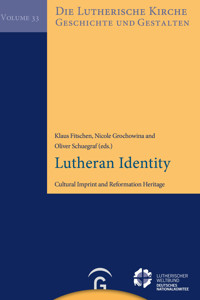
Lutheran Identiy E-Book
29,99 €
Mehr erfahren.
- Herausgeber: Gütersloher Verlagshaus
- Kategorie: Religion und Spiritualität
- Sprache: Deutsch
German edition of Volume 32 - Lutherische Kirche. Geschichte und Gestalten
Lutheranism has spread throughout the world in various ways. As a result, it has become at home in very different cultural contexts. But can there be a "Lutheran identity"? Or are there not rather "Lutheran identities," depending on the character? And what connects them, how does one live in a communion that makes possible numerous expressions of "Lutheran identity," and where are the challenges of this togetherness?
In its struggle for communion that is to be a living church community, the Lutheran World Federation faces these very questions. Reason enough to look for identity markers, for pillars of a common Lutheran identity that have relevance for history, the present and different cultural contexts, linking theology and history.
- englischsprachige Ausgabe von Band 32
- Verbindende Elemente im globalen Luthertum identifizieren
- Ein wichtiger Band im Kontext einer weltumspannenden Debatte
- Die Einheit des Luthertum im Kontext kultureller Vielfalt
Das E-Book können Sie in Legimi-Apps oder einer beliebigen App lesen, die das folgende Format unterstützen:
Seitenzahl: 301
Veröffentlichungsjahr: 2023
Ähnliche




















Lutheranism between Cultural Imprint and Reformation Heritage
Lutheranism has spread throughout the world in various ways. As a result, it has taken root in very different cultural contexts. But can there be one »Lutheran identity«? Or are there not rather »Lutheran identities« – depending on the respective imprint? And what connects them with one another? What is it like to live in a communion that enables numerous expressions of »Lutheran identity«, and where are the challenges of this togetherness?
As it strives for communion as a vibrant church community, the Lutheran World Federation is faced with these very questions. Reason enough to look for identity markers, for pillars of a common Lutheran identity which have relevance in history and the present within differing cultural contexts, and form a link between theology and history.
With contributions from Anne Burghardt, Klaus Fitschen, Nicole Grochowina, Claudia Jahnel, Susanne Lachenicht, Kenneth Mtata, Hilke Rebenstorf, Chad Rimmer, Gottfried Rösch, Oliver Schuegraf, Jerzy Sojka, Willhelm Wachholz, Jennifer Wasmuth and Christian Volkmar Witt.
The Editors:
PD Dr. Nicole Grochowina, Lecturer at the Friedrich-Alexander-Universität of Erlangen/Nuremberg (History of the Early Modern Period and Modern Church History); Vice-Chair of the Historical Commission of the GNC/LWF
Prof. Dr. Klaus Fitschen, Professor of Modern and Contemporary Church History at the University of Leipzig; Chair of the Historical Commission of the GNC/LWF
Dr. Oliver Schuegraf, Church Executive for Ecumenical and Theological Studies, German National Committee of the Lutheran World Federation (Hanover); Secretary of the Historical Commission of the GNC/LWF
Die Lutherische Kirche – Geschichte und Gestalten – Volume 33
Edited by the Historische Kommission des Deutschen Nationalkomitees des Lutherischen Weltbundes
Lutheran Identity
Cultural Imprint and Reformation Heritage
Edited by Klaus Fitschen, Nicole Grochowina and Oliver Schuegraf
If this publication contains links to websites of third parties, we do not assume any liability for their contents, as we do not adopt them as our own, but merely refer to their status at the time of initial publication.
The content of this e-book is protected by copyright and contains technical safeguards against unauthorized use. Removal of these safeguards and use by unauthorized processing, copying, distribution, or making available to the public, especially in electronic form, is prohibited and may result in criminal and civil penalties.
We have made every effort to locate all copyright holders of the listed quotations, to name them as is customary in publishing, and to honor them. If we have not succeeded in doing so in individual cases, please inform us of the copyright holder.
Copyright © 2023 Gütersloher Verlagshaus, Gütersloh,
in der Penguin Random House Verlagsgruppe GmbH,
Neumarkter Str. 28, 81673 München
Realization eBook: Greiner & Reichel, Köln
ISBN 978-3-641-31647-1V001
www.gtvh.de
Content
Foreword
Anne Burghardt
Introduction
Klaus Fitschen, Nicole Grochowina and Oliver Schuegraf
Identity?
What is Identity?
Answers from a social sciences perspective
Hilke Rebenstorf
Identity
Cultural and early modern concepts and perspectives
Susanne Lachenicht
Contextual Theology 3.0
From contextual theologies to transcultural, intersectional theologies and joint theological practice
Claudia Jahnel
Lutheran Identity / Identities?
Miniaturising the Holy Spirit?
Lutheran identity in pneumatological perspective
Jennifer Wasmuth
Lutheran Identity through Common Priesthood?
Reflections on doctrine and life in the 16th century
Nicole Grochowina
Lutheran Identity in the Diaspora
Klaus Fitschen
Is there a Lutheran Identity?
Reflections from a historical-theological perspective
Christian Volkmar Witt
Perspectives from the Worldwide Communio
Lutheran Identities in the Lutheran World Federation
Chad M. Rimmer
Lutheran Identity in Africa
Protest and prospect
Kenneth Mtata
Lutheranism in the Brazilian Multi-religious Context
Wilhelm Wachholz
Lutherans from Russia in the Land of the Reformation
Gottfried Rösch
Encountering the Gift of Freedom
Struggle for the identity of Polish Lutheranism after 1989
Jerzy Sojka
List of Contributors
Foreword
Anne Burghardt
Nowadays, identity is a controversial expression. The more one tries to define a certain identity, the less watertight it becomes. However, this in itself is not hopeless, but revealing. It is not the purpose of identity to set boundaries or to create a distance, as some critics would claim. It is true that there are movements which, for ideological reasons, would define the “question of identity” primarily in terms of demarcation from others. In the Lutheran World Federation (LWF), on the other hand, we have focused on the question of how to understand the plurality or coexistence of various identities within a communion as an enriching gift.
The study process on what “Lutheran identity” is, or what it means “to be Lutheran”, began in 2017 with the Twelfth Assembly of the Lutheran World Federation in Windhoek, Namibia. What does it mean “to be Lutheran” within the great diversity of cultures and national contexts that make up our global communion of 149 member churches?
Throughout its history, the LWF has engaged in study processes to deepen our common understanding of the theological identity of member churches through which we recognise and support each other. These study processes have focused on various theological questions from the field of hermeneutics to ecclesiology, on public witness, worship, and common service to our fellow humans.
As Lutherans we are united in our common confession that we are saved by God’s grace through faith in Jesus Christ. Justified by faith alone, we are freed to serve. Or, as Luther writes, good works flow freely from faith. Liberated by grace, we are called to love and serve our neighbours. We believe that these basic Lutheran values of freedom, love and service to others can increasingly serve as a counter-witness to the increasing narratives of discrimination, exclusion, and injustice in society.
However, being Lutheran is not a static identity. The complexity of the definition of “identity” leaves room for dynamics, one might say confessional dynamics. In 1530, the Augsburg Confession was written as an ecumenical testimony. As a document, the Augsburg Confession sought to define the still young reform movement, and thus made an ecumenical proposition to the church of its time. This confessional event defines Lutheran identity in all times and places.
Why do we speak of Lutheran identities in the plural? For the LWF, “to be Lutheran” means confessing the gospel in a way that on the one hand poses questions to conventional culture on the basis of the gospel, while on the other hand confessing the gospel within the respective context. Confessing means translating the gospel into a context with the aid of language and rituals, with word and sacrament. Confessing means being involved in these dynamics that show what the gospel has to say to people in every place. Naturally, such confessional dynamics come in many variations, thus displaying different identities.
Many questions, problems and possibilities related to the definition of identities are discussed in this book which you have before you. For the LWF, the study process on Lutheran identity (or identities) uncovers new forms of expression and finds creative ways to live grounded in our baptism, so that it is and will be a response to the challenges of our time. If we listen to the experiences of others, we can take a step back and recognise that diversity does not lead to confusion or hopelessness, but rather to a rich harmony of voices, to a great tapestry of humanity.
Introduction
What is Lutheran identity? Ever since the Reformation, this question has been raised – and it has always been a very complicated issue involving theology, self-understanding, the practice of piety, the relationship to the world and governmental power as well as to other denominations. But it is at the same time a matter of people’s own direct relationship to God. In addition, it comes to be recognised in various different contexts: in Reformation times this first occurred in the Electorate of Saxony, and thus under Martin Luther’s own ruler Frederick the Wise, and later under Elector John Frederick of Saxony. But in Hesse and other territories of the Holy Roman Empire of German Nation as well as in various (imperial) cities, the new doctrine was also able to become established and thus made the question of identity relevant. After the defeat in the Schmalkaldic War (1546/7), other players emerged, for example the city of Magdeburg with its claim to recognise and preserve Lutheran identity1 – this question became fully present after Martin Luther’s death in 1546. This marked, at the latest, the start of Protestant policy of remembrance,2 which had to be active in two directions: reassurance internally, and clear demarcation outwardly, so that the events of the Reformation should not degenerate into a historical episode as they were passed down to the second and third generation.
During the critical transition after the death of Luther, the crucial figure of identification, those problems3 came to the fore which had already been virulent in the debate on the formulation of a confession (1530). It was hardly possible to clarify what exactly constituted the “family of the Augsburg religion” (= “Augsburger Religionsverwandte”), even if its members called on the Confessio Augustana (CA); precisely because of these differences it was distributed in the versions “variata” and “invariata”. There were discrepancies, not only in the praxis pietatis, but also concerning basic theological positions and the stance with respect to secular authorities. That is exactly why it was considered necessary to strive for a common – and definitely broad – confessional basis, in order to be clearly recognisable as a unified counterpart to the Catholic Church and the secular authorities.
However, the result of these uncertainties was not just the attempt to find a common confession, but also the increasing number of disputes that broke out repeatedly, especially from the 1540s onwards. Alongside all the theological discussions, it was the question of identity which always came up as an issue. Closely linked to the controversy surrounding the introduction of the “Interim” (1548) was the “Interim Controversy”, which marked the “greatest crisis in German Protestantism”4. It concerned Lutheran doctrine in the shadow of the “Interim” and thus of the efforts to re-catholicise the Old Empire. The essential markers of identity in the emerging Lutheran Church were at stake: the doctrine of justification, the marriage of priests and the lay chalice. On the Lutheran side, meanwhile, there was a dispute about whether Catholic rites could be reintroduced without doing damage to Lutheran doctrine. Here there were different positions that wavered between realpolitik and the strict effort to assert one’s own understanding of the supposedly pure doctrine. This meant that the question of identity was particularly strongly represented. Philipp Melanchthon and Matthias Flacius Illyricus were the protagonists in this dispute, which developed around the question of which matters were to be understood as adiaphora. In the end, hardly any common identity was to be found here; instead, it came to a split within Lutheranism, with two main groups which can be called “Gnesio-Lutherans” on the one hand and “Philippists” on the other.5 Subsequent disputes – for example about the role of faith and the importance of “good works” – were also just as pronouncedly divisive as the “Interim Controversy”. All in all, all the later disputes indicate that in the 16th century there was no general agreement on the character of Lutheran identity that was generally binding and thus also unifying.6 From a theological and ecclesiastical point of view, it was more than necessary to come to an agreement here.
A key controversy, which also unfolded its power in the question of identity, is connected with the development of the Formula of Concord. The intention here was to overcome the divergences that had come to light and been sharply defined, and thus to come together again in unity. Only in this way could the nascent Lutheran Church survive amidst the political (and ecclesiastical) conflicts in which it found itself involved. The question of a common confession was also significant because it remained unclear who exactly subscribed to the Confessio Augustana. The reason why this question was important was that the “Peace of Augsburg” (1555) only gave legal recognition to the adherents of the “Augsburg Confession”. Thus the question of confession became existential,7 and was correspondingly fiercely negotiated. In the end (1577), a formula was reached that was subordinate to the CA and at the same time abandoned the more extreme positions on the side of the “Gnesio-Lutherans” and “Philippists”.8 Only in this way was it possible to reach a doctrinal agreement within a narrow political and theological framework that encompassed large parts of Lutheran theology. The essential point of reference here was Martin Luther. His views were widely consulted in order ultimately to resolve the disputes that had arisen.9 He and his writings continued to be one of the elements – indeed, probably the essential one – when it came to establishing a Lutheran identity based on a common doctrinal orientation. However, this inevitably led to further disputes revolving around the appropriation of his doctrine and views. Against this background, the Formula of Concord is to be understood as an essential attempt to bring order into the question of identity. This is not just due to the fact that agreement was reached here, but it is also important since this was achieved in the third generation after the Reformation. In general, this generation played a decisive role in clarifying the question of identity in the medium term, because it could not claim original experience, but was called upon to appropriate the historical events anew – on the basis of solid source work – and to make them fruitful for its own time and the future. This involved profound and often difficult “work on identity”, which was nonetheless decisive for the further course of the movement or indeed of the Church.10 Having said that, the question of Lutheran identity had not been fully resolved. Depending on the context, there were further decisive turns; one example was the Pietist reform movement in the “Old Empire”, which brought questions about the renewal of personal spiritual life, and thus of the innermost being, to the fore.
Another turning point, originating in the 17th century, was the confrontation with deistic and later rationalist attitudes, as the theology of the Enlightenment sought to find a solution in neology and thus in a specific connection between faith and reason.11 This also had an impact on the question of identity, since now something emerged which was to become opinio communis in the 21st century at the latest: church membership was no longer a matter of course, and there was no longer adequate provision for the appropriate socialisation. In other words, it was becoming increasingly possible to find and accept several available offers for finding meaning in life and thus – in view of growing individualisation in society – to formulate and practise one’s own personalised denominational identity. It may be assumed that this tendency was already in place in the early modern period and ultimately since the Reformation.12 However, the further development of church, state and society encouraged this differentiation – at least in the European context. In the global context, the forcible expansion of European powers led to a different development which can also be observed in the development of the mission churches.13 This emphasis on context indicates that the international perspective is indispensable in order to reach a proper understanding of Lutheran identity. Outside European contexts, the Lutheranism which the missionaries carried into other parts of the world underwent a transformation when it was to be brought together with the spiritual practices and the images of God which already existed there. These processes of transformation are of fundamental significance when taking a fresh look at the question of Lutheran identity in our time.
When the question of Lutheran identity arises, it makes sense to look at the roots in the Reformation period. At the same time, the question can never be answered if the global perspective is ignored, which takes serious consideration of regional contexts as well as the theology and the practice of piety developing there. The Lutheran World Federation (LWF) also follows this path, for it has repeatedly gone into the question of Lutheran identity in order to encourage self-assurance and reflection on what unites and sustains this worldwide communio of Lutheran churches. Various studies bear witness to this.14 At present, the question is being raised anew against the background of secularisation in Europe and the growing Lutheran churches in Africa, for example in Ethiopia and Tanzania. In addition, there are theological questions that arise from the respective, context-related praxis pietatis andconcern, for example, the role of the gifts of the Spirit or of the Holy Spirit in general, and taking this background to put the question of the role of the contexts and traditions in which Lutheran identity unfolds.15 This process includes a lively global exchange of views on traditions and perspectives, addressing common tasks such as the formation of faith and its practice.16
This book, which results from a conference of the Historical Commission of the German National Committee of the Lutheran World Federation, is part of this dialogue process investigating contemporary Lutheran identity. This interdisciplinary meeting took place in February 2022 in digital space and suited the current dialogue process of the LWF as it looked into the different markers of Lutheran identity.
It became clear in the lectures and discussions that the issue of present-day Lutheran identity cannot be solved without recourse to the foundations that lie in the past. Just as contexts shape the respective confessional identity, so too the precepts of the Annales school apply when looking at confession and identity, namely that everything that has evolved has a previous history17 – and therefore this very history must always be considered when looking at the present. Therefore this study is divided into three parts. Firstly, the question of identity is raised and examined from different perspectives, starting with the sociologist Hilke Rebenstorf. She shows that the development of identity is ultimately an active process; the interactions that play a role are fundamentally not free of expectations but aim to shape identity as consciously as possible. In this connection she also refers to the role of the context, taking the processes of social modernisation as an example. It becomes clear that any form of identity also needs concise identity management.
The historian Susanne Lachenicht locates the question of identity in the early modern context. She is concerned with the dispute on denominational affiliation, which can be understood as an essential marker of identity – as long as it is defined. In the early modern period, however, the phenomenon of “confessional ambiguity” was widespread. Using three examples from regional contexts (Cologne, Berlin, New York) and from the entire field of the early modern period, she shows that and how such newer perspectives not only help to deconstruct the paradigm of denominalisation. It also becomes clear that processes of identity formation in the early modern period must be understood to take place on a number of different levels. This applies especially to the dynamic processes of argumentation about concepts of God, theological convictions, spiritual practices and thus ultimately also about Lutheran identity.
Thus the importance of context is made abundantly clear. This is precisely the perspective which the theologian Claudia Jahnel expands upon by looking at contextual theologies on their way to a collective theological practice. Here the identities are first of all assertions of identity. They are clearly created, negotiated and sometimes also rejected. “Contextual theology” takes this seriously and thus ensures that topoi of Lutheran theology (doctrine of justification, priesthood of all believers, etc.) are reflected with respect to their context. On a global level, this is also accompanied by the critical reflection of hegemonic power, since this is colonial. Ultimately, such an approach denies that theology is a supposedly timeless matter of course. Theology makes itself an object of research in its temporal conditionality.
This basic recognition opens one’s eyes to take a closer look at claims of Lutheran identity, which is the topic of the second section of this book. It focuses specifically on Lutheran identity and how it has been shaped in the past and present. The theologian Jennifer Wasmuth discusses the claim that Lutheranism is a form of “Spirit-forgetfulness”. All too often, the Holy Spirit takes second place over against the scriptural principle which sees the Bible as a corrective in spiritual life. Wasmuth goes beyond Rudolf Otto and his widely received work “The Idea of the Holy” (1917) and takes Christian Henning and Christian Danz into consideration with their more recent approaches to understanding the Holy Spirit in Lutheran diction; she concludes that the Spirit does indeed have a firm place within Lutheran theology. This is not a concession to the renaissance of the Holy Spirit in the 21st century, but is derived appropriately from Lutheran pneumatology. Thus the Holy Spirit is to be taken into account when considering the question of identity, even if there are reservations in the practice of piety.
One theological token that is mostly understood as an essential marker of Lutheran identity is the “priesthood of all believers”. In his address to the “Christian Nobility of the German Nation”, Luther uses this expression pointedly in order to emphasise the authorities’ obligation to work vehemently for the renewal of the church. In this context, the individual relationship to God and – correspondingly – the individual responsibility for the world are made clear. However – as shown by the historian Nicole Grochowina in her article – this extensive theological concept also has limitations which lead at least to the suspicion that the “priesthood of all believers” may well have been understood too optimistically as a marker of Lutheran identity. It is recognisable that the basic conception was already subject to adjustments of content, but also at the times when it was adopted in particular cases, for example by the Peasants’ Revolt or the Anabaptist movement.
The theologian Klaus Fitschen introduces the context of the diaspora in order to ask about identity formation in the 19th century. For Lutheranism, the threat of becoming a minority, of remaining a minority or even of being completely annihilated as a church has certainly existed since the 16th century. These experiences came into play in the 19th century when Lutheranism was taken seriously in various minority situations and supported by diaspora organisations. In order to create and preserve identity, it is important to see that just this is largely the normal case, so that here one particular facet of the question of Lutheran identity is revealed. So here further processes of preserving identity were necessary, and they should be placed into comparison, especially in a global context.
The theologian Christian Witt concludes this second part of the book with reflections from the perspective of historical theology. They were made during a panel discussion, which explains the length and character of this article. Witt emphasises that there is no timeless and thus continuously recognisable Lutheran identity. Rather, one should speak of various constructions of Lutheran identity that can be assigned to specific time frames and whose effects can thus be assessed. The normative foundations of Lutheranism should also be placed in this scenario in order to recognise that their appropriation is also a dynamic process and by no means ahistorical, so that it is reasonable to speak of identity construction.
The third section demonstrates by examples from particular backgrounds how important the different contexts are. They can hardly be overestimated when it comes to the shaping of specific constructions of, or claims to, Lutheran identity. On the level of theology or devotional practice, these are sometimes almost completely disconnected from expressions of identity in other contexts, and this forms a challenge to the worldwide communio of Lutheran churches. The theologian Chad Rimmer starts off this global overview by tracing the dynamics that unfolded in the LWF as it began to address the question of Lutheran identity. Rimmer names the normative dimension of this identity, but also points to the extensive process of transformation that begins when such norms are appropriated. Finally, he refers to the recent survey sent to all churches within the LWF concerning their respective expressions of Lutheran identity. This raises new questions that focus on the formation of regional and congregational identities and also on much needed ways to deal with diversity in forms of expression and in the handling of ethical issues and spiritual gifts.
Four reports serve as examples to deepen these questions and add further observations. The first article mostly concerns the African continent. The Zimbabwean theologian Kenneth Mtata shows that African theologians were already influential for the Reformation. He then uses examples from the history of the Lutheran World Federation to demonstrate African contributions to Lutheran identity. He throws light on the way intercultural, political, missionary and pneumatological issues have been handled and emphasises the need for a holistic perspective.
The theologian Wilhelm Wachholz points to the challenges facing Lutheranism in Brazil and thus in a multi-religious society. To be precise, it is confronted by the challenge of not “swallowing” the surrounding culture, says Wachholz, while at the same time making sure that it is not itself “swallowed” by it.
The theologian Gottfried Rösch names another challenge in his contribution on Germans from Russia in Bavaria. The question of who exactly falls into this category is just as virulent as the question of language, the preservation of their existing identity and the formation of a new identity in a completely new context. In so-called “third spaces”, it is possible to combine what they find in their new surroundings with what they have brought with them, so that these spaces gain a special significance for the formation of identity.
And finally, the theologian Jerzy Sojka points to a particular challenge for Lutheranism in Poland, which – like the whole of Polish society – had to come to terms with the freedom it had won after 1989 and the transformations that went with it. Heritage, history and new possibilities were all present here, so that the process of creating identity and adapting to the rapidly transformed context wavered between them.
All these chapters emphasise the importance of context in place and time and of the different processes of appropriation and settlement of norms, which should hardly be underestimated. In all attempts to create binding frameworks, the different findings offer good reason to speak of constructions, assertions and ultimately also of formations of identity which are limited in time and place. Thus, the LWF has set itself an ambitious but highly important task in the goal of holding on to a communio of churches in the face of such differences and scope for action, despite the fact that this communio has a strong potential to separate rapidly, especially on ethical issues, due to prevailing conditions in the respective region and the resulting differences. Nevertheless, these potentials for conflict are counterbalanced by the fundamental goodwill of the churches of the LWF and their willingness not only to remain in this communio, but also to grow together more strongly than ever. This basis is indispensable and at the same time useful for considering and negotiating current questions of Lutheran identity and thus arriving at binding statements that allow us to take our place in the contemporary age as churches and as a world communion.
The editors would like to thank all those who have contributed to this book. First and foremost, these are the authors who were prepared to re-address and accentuate the question of Lutheran identity at the conference in February 2022 and in this publication.
Sincere thanks are also due to the General Secretary of the Lutheran World Federation, Anne Burghardt, for her foreword on the first pages. Thanks are also due to Diedrich Steen, editorial director of the Gütersloher Verlagshaus, for his guidance in the preparation of the book. Thanks go to Martina Kruse and Manuela Reineke for their careful proofreading. Finally, we owe thanks to Neville Williamson for translating the German texts so accurately, and above all, so expeditiously.
Selbitz / Leipzig / Hanover in January 2023
Sr. Nicole Grochowina / Klaus Fitschen / Oliver Schuegraf
1.Cf. Thomas Kaufmann: Das Ende der Reformation. Magdeburgs “Herrgotts Kanzlei” (1548-1551/2), Tübingen 2003; Anja Moritz: Interim und Apokalypse. Die religiösen Vereinheitlichungsversuche Karls V. im Spiegel der magdeburgischen Publizistik, 1548-1551/52, Tübingen 2009.
2.On policy of remembrance, cf. Thomas Fuchs: Protestantische Heiligen-memoria im 16. Jahrhundert, in: Historische Zeitschrift 267 (1998), 587-614. Cf. also for the wider context Astrid Erll: Kollektives Gedächtnis und Erinnerungskulturen. Eine Einführung, Stuttgart / Weimar 2005.
3.On the – in some cases polemical – opinions concerning Luther’s death and their significance for the culture of remembrance beyond the 16th century, cf. Nicole Grochowina: Kaiser und Kaiserin? Bilder von Martin Luther und Katharina von Bora im 17. Jahrhundert, in: Carlotta Israel / Camilla Schneider (eds.): Bild, Geschlecht, Rezeption. Katharina von Bora und Martin Luther im Spiegel der Jahrhunderte, Leipzig 2021, 64-113, here: 76-81.
4.Bernhard Lohse: Dogma und Bekenntnis in der Reformation. Von Luther bis zum Konkordienbuch, in: id. / Wilhelm Neuser / Günter Gaßmann et. al.: Handbuch der Dogmen- und Theologiegeschichte. Vol. 2: Die Lehrentwicklung im Rahmen der Konfessionalität, 2nd revised and supplemented edition, Göttingen 1998, 1-167, here: 109.
5.Cf. ibid., 112.
6.On the majorist, antinomist, synergist and Osiandrian controversy cf. ibid., 113-129.
7.Cf. ibid., 138.
8.Cf. ibid., 162.
9.Cf. Formula of Concord, in: Robert Kolb / Timothy J. Wengert (eds.): The Book of Concord. The Confessions of the Evangelical Lutheran Church, Minneapolis 2000, 486-660.
10.Cf. Michael Hochschild: Die Zukunft der geistlichen Bewegungen. Wie bleiben Bewegungen beweglich? Zürich 2016, 139-149. Here we also find the term “work on identity”.
11.Cf. Gustav Adolf Benrath / Gottfried Horning / Wilhelm Dantine et al.: Handbuch der Dogmen- und Theologiegeschichte. Vol. 3: Die Lehrentwicklung im Rahmen der Ökumenizität, 2nd revised and supplemented edition, Göttingen 1998.
12.Cf. on the comprehensive approach of confessional ambiguity, which can already be dated to the early modern period: Andreas Pietsch / Barbara Stollberg-Rilinger (eds.): Konfessionelle Ambiguität. Uneindeutigkeit und Verstellung als religiöse Pra-xis in der Frühen Neuzeit, Heidelberg 2013. Cf. also Kaspar von Greyerz / Manfred Jakubowski-Tiessen / Thomas Kaufmann / Hartmut Lehmann (eds.): Interkonfessionalität, Transkonfessionalität, binnenkonfessionelle Pluralität. Neue Forschungen zur Konfessionalisierungsthese, Heidelberg 2003.
13.This addresses a large thematic field that has taken on a new direction with the “post-colonial turn”. Cf. for example René Devisch / Francis Nyamnjoh (eds.): The Postcolonial Turn. Re-Imagining Anthropology and Africa, Leiden 2011; Ulrich von der Heyden / Jürgen Becher (eds.): Mission und Gewalt. Der Umgang christlicher Missionen mit Gewalt bei der Ausbreitung des Christentums in Afrika, Asien und Ozeanien in der Zeit von 1792 bis 1918/19, Berlin 2000; Andreas Nehring: Das “Ende der Missionsgeschichte” – Mission als kulturelles Paradigma zwischen klassischer Missionstheologie und postkolonialer Theoriebildung, in: Berliner Theologische Zeitschrift 27 (2010), 161-193; Judith Becker (ed.): European Missions in Contact Zones. Transformation through Interaction in a (Post-) Colonial World, Göttingen 2015
14.Cf. the contribution by Chad Rimmer in this book.
15.See in particular Chad Rimmer / Cheryl M. Peterson (eds.): We Believe in the Holy Spirit. Global Perspectives on Lutheran Identities, Leipzig 2021.
16.See the webinars in the LWF’s “Being Lutheran” series.
17.Cf. Matthias Middell / Steffen Sammler (eds.): Alles Gewordene hat Geschichte. Die Schule der Annales in ihren Texten 1929-1992, Leipzig 1994.
Identity?
What is Identity?
Answers from a social sciences perspective
Hilke Rebenstorf
The discourse around and about identity (identities) is more topical than it has been for a long time. Although the term “identity” is not necessarily mentioned in some of the current debates, it is often implicit. It is to be found in books on mindfulness and authenticity, which advise people to “be themselves”, express themselves, take care of themselves. Identity plays a role in the debate about the feeling of Heimat (“belonging”) that came up again a few years ago; Heimat is understood as a place where one is in good hands, a place to identify with and which has shaped one’s identity.
While in these cases identity has a positive connotation as a factor that is recognised as important for people as well as for entire societies, in other respects it has fallen into disrepute. The Cultural Studies which emerged in England as an emancipation movement in the 1950s led to the Cultural Turn in the social sciences.1 In its wake, there has been an increase in identity politics that go hand in hand with the demand for an environment free from discrimination. The best known protagonists are certainly the ethnic and religious minorities, queer people, women, “defenders” of the West. What some consider indispensable for an equal, democratic society is held by others to threaten and divide society, because in their view identity politics seem to heighten the boundaries between the familiar and the foreign, rather than lowering them. The example of identity politics, for which endless types can be found, makes it immediately clear that many of the thus formulated identities overlap; they are not singular, and indeed cannot be singular. What was already vividly formulated 40 years ago still applies:
“Identities are highly complex, tension-laden, contradictory symbolic entities – and only those who claim to have a simple, unambiguous, clear identity have an identity problem.”2
“In conclusion, the concept of self is a chimera […]. Or perhaps it is constructed by social experience and maintained by social role requirements […], or by the use of shared systems of meaning […], or by social reinforcements […]. Or the self is the cognitive structure which gives meaning and organisation to one’s experience. Or the self is the person’s own construction, the core of one’s responsibility and one’s moral being […].”3
Corresponding to this complexity of the phenomenon under discussion, the answer to the question of what identity is can only be somewhat complex, especially since the social sciences literature on the subject is hugely extensive. In order not to go beyond the given, necessarily limited, framework and yet to provide some basic answers which do justice to the complexity, this article is divided into the following steps: the first short section deals with the question whether identity should be spoken of in the singular or in the plural (1.) This is followed by a chapter on identity development – in its stages (2.1), as a process (2.2) and through interaction (2.3); the chapter is based on basic findings of developmental psychology, socialisation research and symbolic interactionism. In the following chapter, the question of the single or multiple identities is taken up again, explaining their complexity. This makes it evident that identity is not only something entirely one’s own, but is socially shaped and anchored (3.). This creates a two-fold challenge for the stability of identity (development). On the one hand, there is the “self” that one is – or believes to be – and that one wishes to represent; on the other hand, there is that which is anchored in society, that gives a person stability in their own identity, but which can be thrown out of balance when it comes to social changes (4.). Conclusions that follow from these observations are integrated into this last chapter.
1. Identity and / or identities
Identity is first of all the answer to the seemingly simple question: “Who am I?”, a question that has only emerged in the modern age. Our answer to this question is called personal identity. But that is not the only question that arises with regard to identity. Although we live in the society of individuals4, these are integrated into diverse networks of relationships which also have a formative effect on personality and behaviour, so that the question of identity must be supplemented by the question: “What is my relationship to others? What do others expect of me?” This is then the social identity. A further question follows almost immediately: “How do others see me?” If their image matches my own, I am lucky or simply good at identity management. However, there are often discrepancies, for example during puberty and young adulthood between the perceptions of parents and those of children, but they are particularly evident in prejudice discourses. What emerges in response to this question is ascribed




