


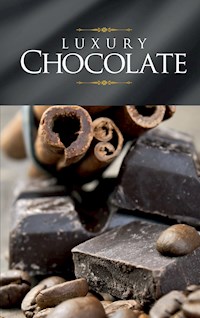
Luxury Chocolate E-Book
1,99 €
Mehr erfahren.
- Herausgeber: Naumann & Göbel Verlag
- Kategorie: Lebensstil
- Sprache: Englisch
Make all your chocolate dreams come true! Whether enjoyed in the form of fine chocolates, chocolate confectionery, creamy mousse or sumptuous cakes, the melting sweetness of chocolate is simply irresistible! This book contains numerous chocolate-based recipe ideas. Create your own chocolate truffles or cappuccino croquant pralines, try out some chocolate petit fours or chocolate caramel nuts and impress your friends and family with mousse au chocolat or creamy chocolate gateau. The chocolate creations contained in this book are guaranteed to include plenty for every sweet-toothed chocolate fan to enjoy. - Each recipe is accompanied by a stunning photo and simple, step-by-step instructions - Classic and creative recipes for chocolate fans
Das E-Book können Sie in Legimi-Apps oder einer beliebigen App lesen, die das folgende Format unterstützen:
Veröffentlichungsjahr: 2015
Ähnliche




















Luxury Chocolate
Whether in truffles or sauces, as a light sorbet or a rich cake – the melting sweetness of chocolate is irresistible and this book contains a variety of chocolate recipe ideas. Impress your friends and family by creating Chocolate truffles or Chocolate and egg liqueur tart, try out the Chocolate mousse or Chocolate fruits and garnish them with mini chocolate artworks. This recipe collection has something for every chocolate fan!
© Naumann & Göbel Verlagsgesellschaft mbHa subsidiary of VEMAG Verlags- und Medien AktiengesellschaftEmil-Hoffmann-Straße 1, 50996 Cologne (Germany)www.vemag-medien.deTranslation from German: First Edition Translations LtdProduction: Naumann & Göbel Verlagsgesellschaft mbHAll rights reservedISBN 978-3-8155-8790-4
LuxuryChocolate
Contents
Foreword
Chocolates and confectionery
Cakes and desserts
Foreword
Chocolate is a gift from the tropics. Cocoa trees are not particularly hardy and thrive best in the warm, humid regions to the north and south of the Equator, in the African rainforests between the Ivory Coast and Niger and on many Indonesian islands. However, cocoa’s true origins are found on the banks of the Orinoco and the Amazon in South America and stretch as far as Ecuador and Mexico. It was here that the Aztec god Quetzalcóatl personally presented the cocoa tree to the Maya and Aztec peoples. It was here, too, that the Spanish Conquistadores first drank xocolatl, a bitter chocolate drink. And it was here that the Criollo, the original cocoa bean used by the Maya, gained its legendary reputation.
Cocoa – and hence chocolate – can comprise a whole spectrum of different flavours, ranging from a hint of tropical fruits or liquorice, the aromas of tobacco or smoke to the sweet overtones of honey and caramel. The individual flavour depends, like wine, partly on the type of cocoa bean and partly on the climatic and geological conditions in which it was grown – and, last but not least, on the chocolate manufacturer in question. Pure chocolate should consist of no more than four constituents: cocoa paste and cocoa butter, which are extracted from the cocoa beans, sugar and, in some cases, soya lecithin as an emulsifying agent. The addition of milk turns the chocolate into milk chocolate. Chocolate can, of course, be flavoured in many different ways, for example by adding vanilla or other spices.
Cooking and baking with chocolate
The chocolate used in cooking and baking is generally dark chocolate or couverture chocolate with a cocoa content between 70–75 %. The difference between the two is determined by the cocoa butter content which is considerably higher in the case of couverture chocolate. The latter is generally easier to use when coating chocolates and cakes. Apart from that, the cocoa content has no bearing on the quality of the chocolate, it merely indicates how bitter or sweet it is. White chocolate contains no cocoa at all but consists simply of cocoa butter mixed with sugar and milk. If you are planning to make your own chocolate treats, always use the best-quality types of chocolate and couverture chocolate. The better the quality of the chocolate, the better the end product.
If you plan to use couverture chocolate to cover your cakes or chocolates, you should bear one important point in mind: the chocolate should first be tempered so that it crystallizes evenly and develops its characteristic shiny gloss. Failure to temper the chocolate will cause it to develop a white “bloom”, which is a common feature of chocolates which have not been stored properly or have been kept for too long.
There are various methods of tempering chocolate. The simplest method for the home cook is the so-called vaccination method, involving a warm bain-marie, a cooking thermometer and the chocolate couverture. It is carried out as follows: divide the amount of couverture into two portions. Finely grate one portion and break the other into small pieces, melting the latter in a bain-marie. The chocolate should not be allowed to exceed 40 °C. Remove the bowl from the water and stir in the grated portion of couverture chocolate, one spoonful at a time until the mixture begins to thicken and the temperature drops below 30 °C. The melted chocolate should then be reheated in the bain-marie until it reaches exactly 32 °C. It is now ready for use.
Lesen Sie weiter in der vollständigen Ausgabe!
Lesen Sie weiter in der vollständigen Ausgabe!
Lesen Sie weiter in der vollständigen Ausgabe!
Lesen Sie weiter in der vollständigen Ausgabe!
Lesen Sie weiter in der vollständigen Ausgabe!
Lesen Sie weiter in der vollständigen Ausgabe!
Lesen Sie weiter in der vollständigen Ausgabe!
Lesen Sie weiter in der vollständigen Ausgabe!
Lesen Sie weiter in der vollständigen Ausgabe!
Lesen Sie weiter in der vollständigen Ausgabe!
Lesen Sie weiter in der vollständigen Ausgabe!
Lesen Sie weiter in der vollständigen Ausgabe!
Lesen Sie weiter in der vollständigen Ausgabe!
Lesen Sie weiter in der vollständigen Ausgabe!
Lesen Sie weiter in der vollständigen Ausgabe!
Lesen Sie weiter in der vollständigen Ausgabe!
Lesen Sie weiter in der vollständigen Ausgabe!
Lesen Sie weiter in der vollständigen Ausgabe!
Lesen Sie weiter in der vollständigen Ausgabe!
Lesen Sie weiter in der vollständigen Ausgabe!
Lesen Sie weiter in der vollständigen Ausgabe!
Lesen Sie weiter in der vollständigen Ausgabe!
Lesen Sie weiter in der vollständigen Ausgabe!
Lesen Sie weiter in der vollständigen Ausgabe!
Lesen Sie weiter in der vollständigen Ausgabe!
Lesen Sie weiter in der vollständigen Ausgabe!
Lesen Sie weiter in der vollständigen Ausgabe!
Lesen Sie weiter in der vollständigen Ausgabe!




