


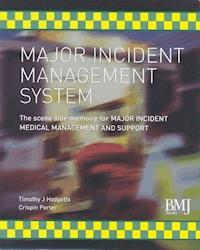
Major Incident Management System (MIMS) E-Book
65,99 €
Mehr erfahren.
- Herausgeber: John Wiley & Sons
- Kategorie: Fachliteratur
- Sprache: Englisch
This highly practical aid to management of major incidents is the refined and improved new edition of Prehospital Emergency Management Master. Concentrating on the essential elements in treatment and transport of the wounded in a major incident this new system provides easily assimilable information on:
- symbols and terminology; first actions; METHANE report; command; safety; communications; triage; treament; transport
- the system is produced on waterproof pages, and includes 12 separate action cards for use by auxiliary helpers, and a log for recording the facts.
The complete package comes in a handy sized ring binder, allowing users to add their own local notes. The use of colour and easily recognisable icons makes this a valuable aid even in the most difficult conditions.
Sie lesen das E-Book in den Legimi-Apps auf:
Seitenzahl: 42
Veröffentlichungsjahr: 2013
Ähnliche




















Contents
Symbol Key
1 FIRST ACTIONS
first ambulance at scene
first doctor at scene
2 METHANE report
METHANE report
CHALET report
3 COMMAND
tiers of command
tiers of command
precedence at the scene
SCENE ORGANISATION
personnel recognition
hierarchy of ambulance command
hierarchy of medical command
briefing for duty (1)
briefing for duty (2)
4 SAFETY
SAFETY
decontamination
5 COMMUNICATIONS
using a radio
key words
phonetic alphabet
alternative methods
common hand signals
dealing with the media
6 TRIAGE
triage sieve
triage sort
expectant category
paediatric triage: principles
paediatric triage protocol – 1
paediatric triage protocol – 2
paediatric triage protocol – 3
7 TREATMENT
treatment priorities
CCS layout
8 TRANSPORT
casualty evacuation principles
vehicle selection
landing site: selection
helicopter landing site: marking
helicopter landing site: marking
helicopter marshalling (1)
helicopter marshalling (2)
helicopter loading
ACTION CARDS
silver ambulance commander
bronze ambulance commander
CCS officer
CCS layout
communications officer
METHANE report
equipment officer
hierarchy of ambulance command
loading officer
helicopter loading
parking officer
helicopter landing site: selection
primary triage officer – 1
primary triage officer – 2
primary triage officer – 3
primary triage officer – 4
safety officer
decontamination
secondary triage officer
ACTION CARDS
silver medical commander
bronze medical commander
CCS commander
secondary triage officer
medical team leader – 1
treatment priorities
medical team leader – 2
treatment priorities
medical team leader – 3
treatment priorities
medical team leader – 4
treatment priorities
body holding area doctor
hierarchy of medical command
INCIDENT LOG
© BMJ Books 2002
BMJ Books is an imprint of the BMJ Publishing Group
All rights reserved. No part of this publication may be reproduced, stored in a retrieval system, or transmitted, in any form or by any means, electronic, mechanical, photocopying, recording and/or otherwise, without the prior written permission of the publishers.
First published in 2002Second impression 2003BMJ Books, BMA House, Tavistock Square, London WC1H 9JR
This book is the second edition of The Pre-Hospital Emergency Management Master published in 1995.
This book supports the popular Major Incident Medical Management and Support (“MIMMS”) course that provides the only international standard for medical management at the scene of a multiple casualty incident. Like the second edition of MIMMS (2002), this book is generic in its approach with principles that cross international and civilian-military boundaries.
British Library Cataloguing in Publication Data
A catalogue record for this book is available from the British Library
ISBN 0-7279-1614-9
Symbol Key
This page is relevant to AMBULANCE COMMANDER
This page is relevant to MEDICAL COMMANDER
Make a log entry
Send a message
Talk face-to-face
Go to page indicated
Terminology
This pocket aide memoire uses the generic terminology adopted by the international Major Incident Medical Management and Support system. For example, the term ‘AMBULANCE COMMANDER’ describes the role of the officer responsible for all ambulance assets at the scene, although it is recognised that other terminology may be used in individual countries.
1
FIRST ACTIONS
first ambulance at scene
Start a log and record time of arrival
Wear protective clothing
helmet
high visibility coat or tabard
Make METHANE assessment and send METHANE report
Consider where arriving ambulances should park
Consider where casualty clearing station should be placed
safe distance from incident (discuss with FIRE)
on vehicle circuit (discuss with POLICE)
on hard standing where possible
using available shelter
Consider place for helicopter landing site (discuss with POLICE) and ensure this is marked
Continue to assess and communicate with AMBULANCE CONTROL as details become available
Continue duties of SILVER AMBULANCE COMMANDER until relieved
first doctor at scene
Start a log and record time of arrival
Wear protective clothing
helmet
high visibility coat or tabard
Liaise with SILVER AMBULANCE COMMANDER and record his/her name
Receive and record METHANE brief
Obtain
radio, where issued
spare battery
headset or earpiece
call-sign for yourself and ambulance commander
tabard (vest) for medical commander
Assume duties of SILVER MEDICAL COMMANDER until relieved
2
METHANE report
METHANE report
M
My call-sign, or name and appointmentMajor incident STANDBY or DECLARED
E
Exact location • grid reference, or GPS where available
T
Type of incident
H
Hazards, present and potential
A
Access to scene, and egress route • helicopter landing site location
N
Number and severity of casualties
E
Emergency services, present and required
CHALET report
C
Casualties, number and severity
H
Hazards, present and potential
A
Access to scene, and egress route • helicopter landing site location
L
Location, exact • grid reference, or GPS where available
E
Emergency services, present and required
T
Type of incident




