


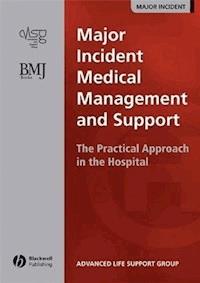
Major Incident Medical Management and Support E-Book
61,99 €
Mehr erfahren.
- Herausgeber: John Wiley & Sons
- Kategorie: Fachliteratur
- Sprache: Englisch
This is the course book for a new ALSG course on preparation for and medical management of major incidents within the hospital. It will be a companion volume to MIMMS, which deals with the prehospital situation, and will meet an ever increasing need as natural and other disasters affect hospital staff and administrators. The course aims to provide a systematic approach for all personnel who would be involved in managing a major incident in the hospital.
This title is now available for the PDA, powered by Skyscape - to buy your copy Click here
Sie lesen das E-Book in den Legimi-Apps auf:
Seitenzahl: 218
Veröffentlichungsjahr: 2013
Ähnliche




















Contents
Authors
Working group
Preface
Acknowledgements
Contact Details and Further Information
PART I: INTRODUCTION
Chapter 1: The epidemiology and incidence of major incidents
INTRODUCTION
THE EPIDEMIOLOGY OF MAJOR INCIDENTS IN THE UK
SUMMARY
Chapter 2: Are we ready for the next major incident?
INTRODUCTION
HOSPITAL PREPARATION FOR MAJOR INCIDENTS
CONCLUSIONS
SUMMARY
Chapter 3: The structured approach to the hospital response
INTRODUCTION
THE PHASES OF THE HOSPITAL MAJOR INCIDENT RESPONSE
SUMMARY
PART II: PREPARATION
Chapter 4: Planning for major incidents
PLANNING
IN-HOSPITAL PLANS
SUMMARY
Chapter 5: Major incident equipment
INTRODUCTION
MAJOR INCIDENT RESPONSE
STAFF PROTECTION
CLINICAL CARE
COMMUNICATIONS
SUMMARY
Chapter 6: Training
INTRODUCTION
SUMMARY
PART III: MANAGEMENT
Chapter 7: The collapsible hierarchy concept
THE RATIONALE FOR A COMMON FRAMEWORK FOR MAJOR INCIDENT PLANS
THE COLLAPSIBLE HIERARCHIES
SUMMARY
Chapter 8: The clinical hierarchy
THE ESSENTIAL CLINICAL ROLES
ADDITIONAL CLINICAL ROLES
NON-MANAGERIAL CLINICAL ROLES
SUMMARY
Chapter 9: The nursing hierarchy
THE ESSENTIAL NURSING ROLES
ADDITIONAL NURSING ROLES
SUMMARY
Chapter 10: The management hierarchy
THE ESSENTIAL MANAGEMENT ROLES
ADDITIONAL MANAGEMENT ROLES
OTHER ROLES IN THE MANAGEMENT HIERARCHY
SUMMARY
PART IV: SUPPORT
Chapter 11: Declaring a major incident and activating the plan
DECLARING A MAJOR INCIDENT
ACTIVATING THE PLAN
SUMMARY
Chapter 12: The reception phase
PREPARATION OF THE HOSPITAL
CLINICAL CARE
CLINICAL SUPPORT SERVICES
NON-CLINICAL SUPPORT SERVICES
MANAGEMENT SERVICES
OTHER SERVICES
SUMMARY
Chapter 13: Triage
INTRODUCTION
HISTORY
AIMS
TIMING
PRIORITIES
DEFINITIONS
TRIAGE METHODS
SUMMARY OF TRIAGE METHODS
TRIAGE AND ORDER OF INTERVENTION
TRIAGE LABELLING
SUMMARY
Chapter 14: The definitive care phase
THE SURGICAL RESPONSE
NON-SURGICAL (MEDICAL)
CLINICAL AND NON-CLINICAL SUPPORT SERVICES
SUMMARY
Chapter 15: The recovery phase
RESOLUTION
REFLECTION
AUDIT
SUMMARY
PART V: SPECIAL INCIDENTS
Chapter 16: Incidents involving hazardous chemicals
INTRODUCTION
RESPONSE
AFTER THE INCIDENT
Chapter 17: Incidents involving a large number of burns
INTRODUCTION
PREPARATION
PRE-HOSPITAL PHASE
RECEPTION PHASE
RECOVERY AND SUPPORT
SUMMARY
Chapter 18: Incidents involving a large number of children
INTRODUCTION
PREPARATION
RECEPTION PHASE
Glossary
Index
© 2005 by Blackwell Publishing Ltd
BMJ Books is an imprint of the BMJ Publishing Group Limited, used under license
Blackwell Publishing, Inc., 350 Main Street, Malden, Massachusetts 02148-5020, USA
Blackwell Publishing Ltd, 9600 Garsington Road, Oxford OX4 2DQ, UK
Blackwell Publishing Asia Pty Ltd, 550 Swanston Street, Carlton, Victoria 3053, Australia
The right of the author to be identified as the author of this work has been asserted in accordance with the Copyright, Designs and Patents Act 1988.
All rights reserved. No part of this publication may be reproduced, stored in a retrieval system, or transmitted, in any form or by any means, electronic, mechanical, photocopying, recording or otherwise, except as permitted by the UK Copyright, Designs and Patents Act 1988, without the prior permission of the publisher.
First published 2005
Library of Congress Cataloging-in-Publication Data
Carley, Simon.
Major incident medical management and support: the practical approach in the hospital / Advanced Life Support Group; by Simon Carley, Kevin Mackway-Jones.
p. ; cm.
Includes index.
ISBN-13: 978-0-7279-1868-0 (ring binder : alk. paper)
ISBN-10: 0-7279-1868-0 (ring binder : alk. paper)
1. Disaster medicine. 2. Hospitals. 3. Disaster hospitals.
[DNLM: 1. Disaster Planning-organization & administration.
2. Emergency Medical Services-Organization & administration.
3. Emergency Medicine-methods. 4. Emergency Service, Hospital-
organization & administration. WX 185 C2815m 2005] I. Mackway-Jones,
Kevin. II. Advanced Life Support Group (Manchester, England) III. Title.
RA645.5.C366 2005
362.18-dc22 2005005213
ISBN-13: 978-0-727918-68-0
ISBN-10: 0-727918-68-0
A catalogue record for this title is available from the British Library
Commissioning Editor: Mary Banks
Development Editor: Veronica Pock
Production Controller: Debbie Wyer
For further information on Blackwell Publishing, visit our Web site: http://www.blackwellpublishing.com
The publisher’s policy is to use permanent paper from mills that operate a sustainable forestry policy, and which has been manufactured from pulp processed using acid-free and elementary chlorine-free practices. Furthermore, the publisher ensures that the text paper and cover board used have met acceptable environmental accreditation standards.
AUTHORS
Simon Carley MPhil MD FRCS (Ed) FFAEM DipIMC (RCSEd) Consultant in Emergency Medicine, Manchester Royal Infirmary
Kevin Mackway-Jones MA FRCP FRCS FFAEM FAEM Professor of Emergency Medicine Consultant in Emergency Medicine, Manchester Royal Infirmary Honorary Civilian Consultant Adviser, Emergency Medicine, British Army Medical Director, Greater Manchester Ambulance Service.
WORKING GROUP
Simon Carley
Consultant in Emergency Medicine, Manchester Royal Infirmary, Manchester UK
Peter Driscoll
Consultant in Emergency Medicine, Hope Hospital, Manchester, UK
Peter Johnson
Advanced Practitioner in Critical Care, Royal Cornwall Hospital Truro UK
Celia Kendrick
Lead Nurse Emergency Department/Emergency Planning Nurse, Peterborough District Hospital Peterborough UK
Kevin Mackway-Jones
Professor of Emergency Medicine, Manchester Royal Infirmary, Manchester UK
Elaine Metcalfe
Project & Development Manager, Advanced Life Support Group, Manchester, UK
Brendan Ryan
Executive Medical Director and Consultant in Emergency Medicine, South Manchester University Hospitals NHS Trust Manchester UK
Steve Southworth
Consultant in Emergency Medicine, Stepping Hill Hospital, Stockport, UK
Polly Terry
Consultant in Emergency Medicine, Leighton Hospital, Crewe, UK
Sue Wieteska
Group Manager, Advanced Life Support Group, Manchester, UK
PREFACE
It is now nearly 10 years since the Advanced Life Support Group published its first book on major incident response. That book (Major Incident Medical Management and Support: the practical approach at the scene) and its accompanying course, affectionately known as MIMMS, are now established around the world as best practice guides. The CSCATTT approach to incidents has become a standard like ABC.
For some of us, however, the focus on the first phase of the response (the pre-hospital phase), while a good place to start, did not solve all our problems. Our practice was more likely to be delivering care within the hospital environment, and a course dedicated to this seemed badly needed.
This book has been written with the aim of promulgating the disciplines and lessons of MIMMS to the hospital provider. We hope that the multi-professional team needed for a successful response can use this text and its accompanying course (to be known as Hospital MIMMS) as successfully as their pre-hospital colleagues have used MIMMS. Certainly our pilot courses have suggested that the package does fill an unmet need. We hope that those of you who read it and train with us agree.
The days spent on courses are just part of a learning process; both skills and knowledge need continual reinforcement. At the end of your HMIMMS course you will receive a logbook for you to use back at your place of work.
K Mackway JonesS Carley
ACKNOWLEDGEMENTS
Candidates attending Hospital MIMMS courses have shared their thoughts on the text with us. We are grateful to those of you who have provided constructive feedback during the development process.
The authors wish to acknowledge Mary Harrison and Helen Carruthers for the use of their line diagrams within the text.
Thanks also go to Peter-Marc Fortune and Mahil Samuel for their help and feedback on the paediatric section and Ian Crawford for his input to the hazardous materials section.
CONTACT DETAILS AND FURTHER INFORMATION
ALSG: www.alsg.org
Best bets: www.bestbets.org
For details on ALSG courses visit the website or contact:
Advanced Life Support Group
ALSG Centre for Training & Development
29-31 Ellesmere Street
Swinton, Manchester
M27 0LA
Tel: +44 (0)161 794 1999
Fax: +44 (0)161 794 9111
Email: [email protected]
UPDATES
The material contained within this book is updated on a 4 yearly cycle. However, practice may change in the interim period.
We will post any changes on the ALSG website, so we advise that you visit the website regularly to check for updates (url: www.alsg.org/updates). The website will provide you with a new page to download and replace the existing page in your book.
REFERENCES
References are available on the ALSG reference centre www.alsg.org/references.
ON-LINE FEEDBACK
It is important to ALSG that the contact with our providers continues after a course is completed. We now contact everyone six months after the course has taken place asking for on-line feedback on the course. This information is then used whenever the course is updated to ensure that the course provides optimum training to its participants.
PART I INTRODUCTION
CHAPTER 1
The epidemiology and incidence of major incidents
INTRODUCTION
A major incident is said to have occurred when an incident requires an extraordinary response by the emergency services. While major incidents may affect any of the emergency services, the health service’s focus is the resulting casualties. A major incident cannot, however, simply be defined in terms of the number of casualties—the resources available at the time of the incident are also relevant. For example, a road traffic accident in a remote area producing five multiply injured casualties may overwhelm the immediately available local resources. However, a similar incident in a major urban conurbation may require little or no additional resources. Thus, the same incident in different localities may produce a major incident in one but not in the other.
Lesen Sie weiter in der vollständigen Ausgabe!
Lesen Sie weiter in der vollständigen Ausgabe!
Lesen Sie weiter in der vollständigen Ausgabe!
Lesen Sie weiter in der vollständigen Ausgabe!
Lesen Sie weiter in der vollständigen Ausgabe!
Lesen Sie weiter in der vollständigen Ausgabe!
Lesen Sie weiter in der vollständigen Ausgabe!
Lesen Sie weiter in der vollständigen Ausgabe!
Lesen Sie weiter in der vollständigen Ausgabe!
Lesen Sie weiter in der vollständigen Ausgabe!
Lesen Sie weiter in der vollständigen Ausgabe!
Lesen Sie weiter in der vollständigen Ausgabe!
Lesen Sie weiter in der vollständigen Ausgabe!
Lesen Sie weiter in der vollständigen Ausgabe!
Lesen Sie weiter in der vollständigen Ausgabe!
Lesen Sie weiter in der vollständigen Ausgabe!
Lesen Sie weiter in der vollständigen Ausgabe!
Lesen Sie weiter in der vollständigen Ausgabe!
Lesen Sie weiter in der vollständigen Ausgabe!
Lesen Sie weiter in der vollständigen Ausgabe!
Lesen Sie weiter in der vollständigen Ausgabe!
Lesen Sie weiter in der vollständigen Ausgabe!
Lesen Sie weiter in der vollständigen Ausgabe!




