


76,99 €
Mehr erfahren.
- Herausgeber: John Wiley & Sons
- Kategorie: Wissenschaft und neue Technologien
- Sprache: Englisch
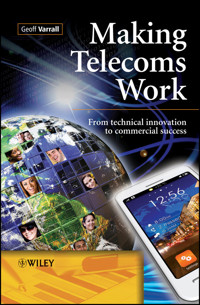
Bridging the industry divide between the technical expertise of engineers and the aims of market and business planners, Making Telecoms Work provides a basis for more effective interdisciplinary analysis of technology, engineering, market and business investment risk and opportunity. Since fixed and mobile broadband has become a dominant deliverable, multiple areas of transition and transformation have occurred; the book places these changes in the context of the political, social and economic dynamics of the global telecommunications industry.
Drawing on 25 years of participative experience in the mobile phone and telecommunications industry, the author closely analyses the materials, components and devices that have had a transformative impact. By presenting detailed case studies of materials innovation, such as those shown at success story Apple, the book shows how the collaboration of technological imagination with business knowledge will shape the industry’s future.
- Makes a link between the technical aspects and the business practice of the telecoms industry, highlighting the commercial and economic significance of new developments
- Gives a historical analysis of past successes and failures in order to identify future competitive advantage opportunities
- Supplies detailed case studies of supply chain disconnects and the impact these have on industry risk and profitability
- Brings together technological detail with analysis of what is and is not commercially important, from the implications of energy and environmental networks to the technical details of wireless network hardware.
Sie lesen das E-Book in den Legimi-Apps auf:
Seitenzahl: 864
Veröffentlichungsjahr: 2011
Ähnliche




















Contents
Cover
Title Page
Copyright
Foreword
List of Acronyms and Abbreviations
Acknowledgements
Chapter 1: Introduction
1.1 Differentiating Technology and Engineering Innovation
1.2 Differentiating Invention and Innovation
1.3 The Role of Standards, Regulation and Competition Policy
1.4 Mobile Broadband Auction Values – Spectral Costs and Liabilities and Impact on Operator Balance Sheets
1.5 TV and Broadcasting and Mobile Broadband Regulation
1.6 Technology Convergence as a Precursor of Market Convergence?
1.7 Mobile Broadband Traffic Growth Forecasts and the Related Impact on Industry Profitability
1.8 Radio versus Copper, Cable and Fibre – Comparative Economics
1.9 Standardised Description Frameworks – OSI Seven-Layer Model as a Market and Business Descriptor
1.10 Technology and Engineering Economics – Regional Shifts and Related Influence on the Design and Supply Chain, RF Component Suppliers and the Operator Community
1.11 Apple as an Example of Technology-Led Market Innovation
Part One: User Hardware
Chapter 2: Physical Layer Connectivity
2.1 Differentiating Guided and Unguided Media
2.2 The Transfer of Bandwidth from Broadcasting to Mobile Broadband
2.3 The Cost of Propagation Loss and Impact of OFDM
2.4 Competition or Collaboration?
2.5 The Smith Chart as a Descriptor of Technology Economics, Vector Analysis and Moore’s Law
2.6 Innovation Domains, Enabling Technologies and their Impact on the Cost of Delivery
2.7 Cable Performance Benchmarks
2.8 Hybrid Fibre Coaxial Systems
2.9 The DVB-S Satellite Alternative
2.10 Terrestrial TV
2.11 Copper Access – ADSL and VDSL Evolution
2.12 The Copper Conundrum – the Disconnect between Competition Policy and Technical Reality
2.13 OFDM in Wireless – A Similar Story?
2.14 Chapter Summary
Chapter 3: Interrelationship of the Physical Layer with Other Layers of the OSI Model
3.1 MAC Layer and Physical Layer Relationships
3.2 OFDM and the Transformative Power of Transforms
3.3 The Role of Binary Arithmetic in Achieving Sensitivity, Selectivity and Stability
3.4 Summary
3.5 Contention Algorithms
3.6 The WiFi PHY and MAC Relationship
3.7 LTE Scheduling Gain
3.8 Chapter Summary
Chapter 4: Telecommunications Economies of Scale
4.1 Market Size and Projections
4.2 Market Dynamics
4.3 Impact of Band Allocation on Scale Economics
4.4 The Impact of Increased RF Integration on Volume Thresholds
4.5 The RF Functions in a Phone
4.6 Summary
Chapter 5: Wireless User Hardware
5.1 Military and Commercial Enabling Technologies
5.2 Smart Phones
5.3 Smart Phones and the User Experience
5.4 Summary So Far
5.5 RF Component Innovation
5.6 Antenna Innovations
5.7 Other Costs
5.8 Summary
Chapter 6: Cable, Copper, Wireless and Fibre and the World of the Big TV
6.1 Big TV
6.2 3DTV
6.3 Portable Entertainment Systems
6.4 Summary of this Chapter and the First Five Chapters – Materials Innovation, Manufacturing Innovation, Market Innovation
Part Two: User Software
Chapter 7: Device-Centric Software
7.1 Battery Drain – The Memristor as One Solution
7.2 Plane Switching, Displays and Visual Acuity
7.3 Relationship of Display Technologies to Processor Architectures, Software Performance and Power Efficiency
7.4 Audio Bandwidth Cost and Value
7.5 Video Bandwidth Cost and Value
7.6 Code Bandwidth and Application Bandwidth Value, Patent Value and Connectivity Value
Chapter 8: User-Centric Software
8.1 Imaging and Social Networking
8.2 The Image Processing Chain
8.3 Image Processing Software – Processor and Memory Requirements
8.4 Digital Camera Software
8.5 Camera-Phone Network Hardware
8.6 Camera-Phone Network Software
8.7 Summary
Chapter 9: Content- and Entertainment-Centric Software
9.1 iClouds and MyClouds
9.2 Lessons from the Past
9.3 Memory Options
9.4 Gaming in the Cloud and Gaming and TV Integration
9.5 Solid-State Storage
Chapter 10: Information-Centric Software
10.1 Standard Phones, Smart Phones and Super Phones
10.2 Radio Waves, Light Waves and the Mechanics of Information Transfer
10.3 The Optical Pipe and Pixels
10.4 Metadata Defined
10.5 Mobile Metadata and Super-Phone Capabilities
10.6 The Role of Audio, Visual and Social Signatures in Developing ‘Inference Value’
10.7 Revenues from Image and Audio and Memory and Knowledge Sharing – The Role of Mobile Metadata and Similarity Processing Algorithms
10.8 Sharing Algorithms
10.9 Disambiguating Social Mobile Metadata
10.10 The Requirement for Standardised Metadata Descriptors
10.11 Mobile Metadata and the Five Domains of User Value
10.12 Mathematical (Algorithmic Value) as an Integral Part of the Mobile Metadata Proposition
Chapter 11: Transaction-Centric Software
11.1 Financial Transactions
11.2 The Role of SMS in Transactions, Political Influence and Public Safety
11.3 The Mobile Phone as a Dominant Communications Medium?
11.4 Commercial Issues – The End of the Cheque Book?
Part Three: Network Hardware
Chapter 12: Wireless Radio Access Network Hardware
12.1 Historical Context
12.2 From Difference Engine to Connection Engine
12.3 IP Network Efficiency Constraints
12.4 Telecoms – The Tobacco Industry of the Twentyfirst Century?
12.5 Amortisation Time Scales
12.6 Roads and Railways and the Power and Water Economy – The Justification of Long-Term Returns
12.7 Telecommunications and Economic Theory
12.8 The New Wireless Economy in a New Political Age?
12.9 Connected Economies – A Definition
12.10 Inferences and Implications
12.11 The Newly Connected Economy
Chapter 13: Wireless Core Network Hardware
13.1 The Need to Reduce End-to-End Delivery Cost
13.2 Microwave-Link Economics
13.3 The Backhaul Mix
13.4 The HRAN and LRAN
13.5 Summary – Backhaul Options Economic Comparisons
13.6 Other Topics
Chapter 14: Cable Network and Fibre Network Technologies and Topologies
14.1 Telegraph Poles as a Proxy for Regulatory and Competition Policy
14.2 Under the Streets of London
14.3 Above the Streets of London – The Telegraph
14.4 Corporate Success and Failure – Case Studies – The Impact of Regulation and Competition Policy
14.5 The Correlation of Success and Failure with R and D Spending
14.6 Broadband Delivery Economics and Delivery Innovation
Chapter 15: Terrestrial Broadcast/Cellular Network Integration
15.1 Broadcasting in Historical Context
15.2 Digital Radio Mondiale
15.3 COFDM in DRM
15.4 Social and Political Impact of the Transistor Radio
15.5 Political and Economic Value of Broadcasting
15.6 DAB, DMB and DVB H
15.7 HSPA as a Broadcast Receiver
15.8 Impact of Global Spectral Policy and Related Implications for Receiver Design and Signal Flux Levels
15.9 White-Space Devices
15.10 Transmission Efficiency
15.11 Scale Economy Efficiency
15.12 Signalling Efficiency
15.13 Power Efficiency Loss as a Result of a Need for Wide Dynamic Range
15.14 Uneconomic Network Density as a Function of Transceiver TX and RX Inefficiency
15.15 Cognitive Radios Already Exist – Why Not Extend Them into White-Space Spectrum?
15.16 An Implied Need to Rethink the White-Space Space
15.17 White-Space White House
15.18 LTE TV
15.19 Summary
15.20 TV or not TV – That is the Question – What is the Answer?
15.21 And Finally the Issue of Potential Spectral Litigation
15.22 Technology Economics
15.23 Engineering Economics
15.24 Market Economics
15.25 Business Economics
15.26 Political Economics
15.27 Remedies
Chapter 16: Satellite Networks
16.1 Potential Convergence
16.2 Traditional Specialist User Expectations
16.3 Impact of Cellular on Specialist User Expectations
16.4 DMR 446
16.5 TETRA and TETRA TEDS
16.6 TETRAPOL
16.7 WiDEN
16.8 APCO 25
16.9 Why the Performance Gap Between Cellular and Two-Way Radio will Continue to Increase Over Time
16.10 What This Means for Two-Way Radio Network Operators
16.11 Lack of Frequency Harmonisation as a Compounding Factor
16.12 The LTE 700 MHz Public-Safety-Band Plan
16.13 The US 800-MHz Public-Safety-Band Plan
16.14 Policy Issues and Technology Economics
16.15 Satellites for Emergency-Service Provision
16.16 Satellites and Cellular Networks
16.17 The Impact of Changing Technology and a Changed and Changing Economic and Regulatory Climate – Common Interest Opportunities
16.18 And Finally – Satellite and Terrestrial Hybrid Networks
16.19 Satellite Spectrum and Orbit Options
16.20 Terrestrial Broadcast and Satellite Coexistence in L Band
16.21 Terrestrial DAB Satellite DAB and DVB H
16.22 World Space Satellite Broadcast L Band GSO Plus Proposed ATC
16.23 Inmarsat – L Band GSO Two-Way Mobile Communications
16.24 Thuraya 2 L Band GSO Plus Triband GSM and GPS
16.25 ACeS L Band GSO Plus Triband GSM and GPS
16.26 Mobile Satellite Ventures L Band GSO Plus ATC
16.27 Global Positioning MEOS at L Band GPS, Galileo and Glonass
16.28 Terrestrial Broadcast and Satellite Coexistence in S Band
16.29 XM and Sirius in the US – S Band GEO Plus S Band ATC
16.30 Mobaho in Japan and S DMB in South Korea – S Band GSO Plus ATC
16.31 Terrestar S Band in the US – GSO with ATC
16.32 ICO S Band GSO with ATC
16.33 ICO S Band MEO at S Band with ATC
16.34 Eutelsat and SES ASTRA GSO – ‘Free’ S Band Payloads
16.35 Intelsat C Band Ku Band and Ka Band GSO
16.36 Implications for Terrestrial Broadcasters
16.37 Implications for Terrestrial Cellular Service Providers
16.38 The Impact of Satellite Terrestrial ATC Hybrids on Cellular Spectral and Corporate Value
16.39 L Band, S Band, C Band, K Band and V Band Hybrids
16.40 Summary
Part Four: Network Software
Chapter 17: Network Software – The User Experience
17.1 Definition of a Real-Time Network
17.2 Switching or Routing
17.3 IP Switching as an Option
17.4 Significance of the IPv6 Transition
17.5 Router Hardware/Software Partitioning
17.6 The Impact of Increasing Policy Complexity
17.7 So What Do Whorls Have to Do with Telecom Networks?
17.8 Packet Arrival Rates
17.9 Multilayer Classification
Chapter 18: Network Software – Energy Management and Control
18.1 Will the Pot Call the Kettle Back?
18.2 Corporate M2M
18.3 Specialist M2M
18.4 Consumer M2M
18.5 Device Discovery and Device Coupling in Consumer M2M Applications and the Role of Near-Field Communication
18.6 Bandwidth Considerations
18.7 Femtocells as an M2M Hub?
18.8 Summary
Chapter 19: Network Software – Microdevices and Microdevice Networks – The Software of the Very Small
19.1 Microdevices – How Small is Small?
19.2 Contactless Smart Cards at 13.56 MHz – A Technology, Engineering and Business Model?
19.3 Contactless Smart Cards and Memory Spots – Unidirectional and Bidirectional Value
19.4 Contactless Smart Cards, RF ID and Memory Spots
19.5 Contactless Smart Cards, RF ID, Memory Spot and Mote (Smart Dust) Applications
19.6 The Cellular Phone as a Bridge Between Multiple Devices and Other Network-Based Information
19.7 Multiple RF Options
19.8 Multiple Protocol Stacks
19.9 Adoption Time Scales – Bar Codes as an Example
19.10 Summary
Chapter 20: Server Software
20.1 The Wisdom of the Cloud?
20.2 A Profitable Cloud?
20.3 A Rural Cloud?
20.4 A Locally Economically Relevant Cloud?
20.5 A Locally Socially Relevant Cloud?
20.6 A Locally Politically Relevant Cloud – The China Cloud?
20.7 The Cultural Cloud?
Chapter 21: Future Trends, Forecasting, the Age of Adaptation and More Transformative Transforms
21.1 Future Forecasts
21.2 The Contribution of Charles Darwin to the Theory of Network Evolution
21.3 Famous Mostly Bearded Botanists and Their Role in Network Design – The Dynamics of Adaptation
21.4 Adaptation, Scaling and Context
21.5 Examples of Adaptation in Existing Semiconductor Solutions
21.6 Examples of Adaptation in Present Mobile Broadband Systems
21.7 Examples of Adaptation in Future Semiconductor Solutions
21.8 Examples of Adaptation in Future Cellular Networks
21.9 Specialisation
21.10 The Role of Standards Making
21.11 The Need for a Common Language
21.12 A Definition of Descriptive Domains
21.13 Testing the Model on Specific Applications
21.14 Domain Value
21.15 Quantifying Domain-Specific Economic and Emotional Value
21.16 Differentiating Communications and Connectivity Value
21.17 Defining Next-Generation Networks
21.18 Defining an Ultralow-Cost Network
21.19 Standards Policy, Spectral Policy and RF Economies of Scale
21.20 The Impact of IPR on RF Component and Subsystem Costs
21.21 The Cost of ‘Design Dissipation’
21.22 The Hidden Costs of Content – Storage Cost
21.23 The Hidden Costs of User-Generated Content – Sorting Cost
21.24 The Hidden Cost of Content – Trigger Moments
21.25 The Hidden Cost of Content – Delivery Cost
21.26 The Particular Costs of Delivering Broadcast Content Over Cellular Networks
21.27 Summary – Cost and Value Transforms
Index
This edition first published 2012 © 2012 John Wiley & Sons, Ltd
Registered OfficeJohn Wiley & Sons Ltd, The Atrium, Southern Gate, Chichester, West Sussex, PO19 8SQ, United Kingdom
For details of our global editorial offices, for customer services and for information about how to apply for permission to reuse the copyright material in this book please see our website at www.wiley.com.
The right of the author to be identified as the author of this work has been asserted in accordance with the Copyright, Designs and Patents Act 1988.
All rights reserved. No part of this publication may be reproduced, stored in a retrieval system, or transmitted, in any form or by any means, electronic, mechanical, photocopying, recording or otherwise, except as permitted by the UK Copyright, Designs and Patents Act 1988, without the prior permission of the publisher.
Wiley also publishes its books in a variety of electronic formats. Some content that appears in print may not be available in electronic books.
Designations used by companies to distinguish their products are often claimed as trademarks. All brand names and product names used in this book are trade names, service marks, trademarks or registered trademarks of their respective owners. The publisher is not associated with any product or vendor mentioned in this book. This publication is designed to provide accurate and authoritative information in regard to the subject matter covered. It is sold on the understanding that the publisher is not engaged in rendering professional services. If professional advice or other expert assistance is required, the services of a competent professional should be sought.
Library of Congress Cataloging-in-Publication Data:
Varrall, Geoffrey. Making telecoms work : from technical innovation to commercial success / Geoff Varrall. p. cm. Includes index. ISBN 978-1-119-97641-7 (cloth)– ISBN 978-1-119-96714-9 (epub) 1. Telecommunication systems. 2. Technological innovations. I. Title. TK5101.V328 2012 621.3845′ 6–dc23 2011038098
A catalogue record for this book is available from the British Library.
Print ISBN: 9781119976417
Foreword
We were delighted when the Science Museum was approached about a new publication that would look at the technical aspects of the telecoms industry, with a nod to the developments and experience of the past.
The ambition of this publication fits with our own development of a major new gallery in information and communications technology. Our planned gallery will trace the dramatic change since the invention of the telegraph, the laying of the first transatlantic cable, the creation of the first digital electronic computer, the development of mobile communications and the advent of the World Wide Web.
This publication, and the gallery, will provide an important record for questioning the speed of change and developing broader narratives on telecommunications history.
Tilly Blyth Curator of Computing and Information Science Museum, London October 2011
List of Acronyms and Abbreviations
3GPP3G Partnership ProjectACK/NACKAcknowledgement/Negative AcknowledgementAFAutofocusAMAmplitude ModulationAMPDAverage Margin Per DeviceAMPUAverage Margin Per UserAMR NBAdaptive Multirate NarrowbandAMR-WBAdaptive Multirate WidebandAPAccess PointARPUAverage Revenues Per UserATCAncillary Terrestrial ComponentATSCAdvanced Television Systems CommitteeAVCAdaptive Variable Source CodingB GANBroadband Global AccessCAMContent Addressable MemoryCCDCharge Coupled DeviceCDMACode Division Multiple AccessC/ICarrier to Interference RatioCIFCommon Intermediate FormatCMOSComplementary Metal-Oxide-SemiconductorCQIChannel Quality IndicationCTSClear To SendDANDevice Access/Device Area NetworkDCTDiscrete Cosine TransformDFTDiscrete Fourier TransformDPSKDifferential Binary Phase Shift KeyingDRMDigital Radio MondialeDSSSDirect Sequence Spread SpectrumDWDMDense Wavelength Division MultiplexingEXIFExchangeable Image Format FileFDNFrequency Dependent NoiseFEXTFar-End CrosstalkFHTFast Hadamard TransformGaAsGallium ArsenideGEOGeostationaryGIFGraphic Interchange FormatGSOGeostationaryGSOGeosynchronousHCHybrid CoordinatorHDMIHigh Definition Multi Media InterfaceHDSLHigh Bit Rate DSLHLEO‘High’ Low-Earth OrbitsHRANHigh Radio Access NetworkHWIHHear What I HearI/OInput And OutputIDFTInverse Discrete Fourier TransformIFIntermediate FrequencyIFHTInverse Fast Hadamard TransformISDInformation Spectral DensityISMIndustrial Scientific MedicalLEOLow-Earth OrbitLLULocal Loop UnbundlingLNALow-Noise AmplifierLPDDR2Low-Power Double Data Rate 2LRANLower Radio Access NetworkM2MMachine To MachineMACMedium Access ControlMEMSMicroelectrical Mechanical SystemMEOMedium EarthMIDPMobile Information Device ProfileMIMOMultiple Input Multiple OutputMIPIMobile Industry Processor InterfaceMMSMulti Media SubsystemNEXTNear-End CrosstalkNRENonrecurring ExpenditureOfcomOffice Of CommunicationsOFDMOrthogonal Frequency Division MultiplexingOFDMAOrthogonal Frequency Division Multiple AccessOOKOn/Off KeyingOTAOver The AirP25Project 25PAPower AmplifierPALPhase Alternating LinePANPersonal Area NetworkPARPeak To Average RatioPCPoint CoordinationPIFAPlanar Inverted F AntennaPMDPolarisation Mode DispersionPPDRPublic Protection And Disaster ReliefQEQuantum EfficiencyQoSQuality Of ServiceRF BOMRF Bill Of MaterialROIReturn On InvestmentRSSIReceived Signal Strength IndicationRTSRequest To SendSC-FDMASingle-Carrier Frequency Division Multiple AccessSDHSynchronous Digital HierarchySHDSLSingle Pair HDSLSiGeSilicon GermaniumSIMSubscriber Identity ModuleSIMOSingle Input Multiple OutputSIPSession Initiation ProtocolSONETSynchronous Optical NetworkSTiMISatellite And Terrestrial Interactive Multi Service InfrastructureSWISSee What I SeeTDDTime-Division DuplexedTDM PONTime Division Multiplexed Passive Optical NetworkTEDSTetraenhanced Data ServiceTISIsotropic SensitivityTRPTotal Radiated PowerTSPECTraffic SpecificationUDPUnacknowledged Datagram ProtocolUSIMUniversal Subscriber Identity ModuleVCOVoltage-Controlled OscillatorVGAVideo Graphics ArrayVOGVideo Object GroupingsVOLVideo Object LayersVOPVideo Object PlanesVOSVideo Object SequenceWDMWavelength Division MultiplexingWEPWireline Equivalent PrivacyWPAWiFi Protected AccessAcknowledgements
Having coauthored three previous technical books on telecom related topics, The Mobile Radio Servicing Handbook in 1989, Data Over Radio in 1992 and 3G Handset and Network Design in 20031 it occurred to me that it might be useful to write a fourth book documenting the changes that have occurred in the past eight years and the related implications for the industry looking forward.
It then occurred to me that this was a massive amount of work for a minimal return and the idea was shelved until this week end when I read an interview2 in the Guardian Week End Review section on Michael Moorcock, a prolific author of Science Fiction. On a good day Mr Moorcock can apparently produce 15 000 words of breathless prose and once authored a complete book in three days.
On the basis that as each year passes telecoms seems to more closely resemble science fiction I decided I should not be a wimp and get down to writing.
A few phone calls to some of my previous coauthors established that they were less than enthusiastic at joining me again in a technical publishing venture and asked why didn’t I do this one on my own.
So at this point I would like to acknowledge with thanks my previous coauthors Mr Mike Fitch, now with British Telecom Research at Martlesham Heath, Mr David Ogley, now working in the psychiatric profession, an industry increasingly closely aligned with our own and my ex-codirector and business partner Roger Belcher with whom miraculously I am still on talking terms after nearly thirty years of close technical and commercial cooperation.
Roger’s crucial role at RTT and on all previous book projects has been to spot and correct gross errors of a technical nature.
His absence as an arbiter of this particular work is therefore alarming but I am assuming that after thirty years of working on engineering projects in the industry I should be able to correct most mistakes on my own, an assumption that I hope does not prove to be misguided.
And rather than attempt this particular literary Everest completely solo and without the aid of extra oxygen I have called on the services of my other friend John Tysoe of the Mobile World to provide relevant financial analysis and market and business statistics that I hope will help integrate the technology and engineering story that we have to tell with the market and business dynamics of our industry today. Thanks are also due to my close friend and business colleague Jane Zweig who has been patiently helpful at explaining why the US continues to be bafflingly different from the rest of the world. Thanks also to Tony Hay for unearthing useful articles on battery technology from the British Library.
John Liffen and Tilly Blyth in the telecommunications and computing curatorial department at the Science Museum have also been a great source of inspiration. In particular they have demonstrated that the Museum has case study resources that document with great detail the reasons why some innovations succeed and some fail. These resources have direct relevance to the formulation of present day industrial strategy in the telecommunications industry.
I would also like to thank the GSM Association for permission to reproduce some of the study work undertaken for them in 1997, Peregrine Semiconductor, Ethertronics, Antenova, Avago and Quintel for their permission to use specific product data references and the team at Nokia Siemens Networks who under Harri Holma’s guidance produce such excellent technical books on LTE that this particular work does not aspire to emulate.
Other thanks are due to my long-suffering family, Liz, Tom and Hannah, though they are onerously familiar with my tendency to engage in projects that are interesting but seem to make little apparent financial sense. I have also found myself drawing on my father’s work and experience gained over a fifty-year career in telecommunications engineering. Some of his knowledge can be found in the Newnes Telecommunications Pocket Book that he coauthored with his business colleague Ted Edis, published posthumously in 1992.
And finally my thanks to Mark Hammond, Susan Barclay, Sandra Grayson and the production team at John Wiley who I am anticipating will be their usual helpful selves in guiding me towards the production of a final manuscript that passes market muster.
I did suggest that approaching the writing of this work as a homage to Mr Moorcock might result in a work that sold in the tens of thousands thereby making us all exceedingly rich.
Mark pointed out that on the basis of my previous publishing history this outcome, though much to be wished for, was unfortunately exceedingly unlikely.
Still, it’s always good to start these projects with a healthy dose of enthusiasm, though I have just noticed that it has taken me 45 minutes to write the 1000 words of this initial opening piece, which suggests that 15 000 words a day might be overoptimistic. But onwards and upwards, a job begun is a job half done – with 149 000 words to go how can that possibly be true?
Good heavens it’s tea time already.
Geoff Varrall 4.00 Monday 4 February 2011
1 Copies of these books can be bought either from Amazon or American Book Exchange http://www. abebooks.co.uk/.
2http://www.guardian.co.uk/books/2011/feb/04/michael-moorcock-hari-kunzru Hari Kunzru Interview with Michael Moorcock, Guardian 4 February 2011.
1
Introduction
1.1 Differentiating Technology and Engineering Innovation
This book is about technology and engineering analysed in the context of the impact of invention and innovation on the political, social and economic dynamics of the global telecommunications industry, tracing the transition and transformation that has occurred particularly since fixed and mobile broadband has become such a dominant deliverable. The occasional unapologetic excursion is made into the more distant past as and when relevant and valid.
The subject focus is technical but the ambition is to make the content relevant and accessible to as wide an audience as possible. It is common to find engineers who have an absorbing interest in the humanities. It is less common to find managers with a humanities background developing a similar passion for engineering. This is possibly because some engineering books can be dull to read. Our mission is to try and remedy this disconnect between two disciplines that in reality are closely interrelated.
Another myth that we attempt to dispel is the notion that somehow technology change is occurring faster today than in the past. This is a false flattery. Technology change viewed through the prism of the present appears to be tumultuous but is more accurately considered as part of a continuing process of transition. The past remains surprisingly relevant, can inform present judgement and should be used to help forecast the future. This is our excuse or rather, our reason for raiding the Science Museum archives and picture collection that are referenced in most subsequent chapters.
The derivation of the word science is from the Latin ‘Scientia’ meaning knowledge. The word physics is from the Greek ‘Physis’ meaning nature. A recurring narrative of this book is that informed decision making is contingent on studying knowledge and well-evidenced opinion from the past. However, any decision taken has to obey the fundamental laws of physics. Our understanding of those laws changes over time. A present example is the science of the very small, how the behaviour of materials change when constructed at molecular scale. The ability to understand the potential usefulness of a physical property is a skill that can transform the world. Newcomen’s observation of steam and Edison’s observation of the behaviour of a carbon filament in a vacuum are two prior examples. Paul Dirac’s work on quantum mechanics is a near contemporary example and the work of Stephen Hawking on string and particle theory a contemporary example. The study of ‘prior art’ is often today the job of the patent attorney, but would be more beneficially encompassed as an engineering rather than legalistic discipline.
Lesen Sie weiter in der vollständigen Ausgabe!
Lesen Sie weiter in der vollständigen Ausgabe!
Lesen Sie weiter in der vollständigen Ausgabe!
Lesen Sie weiter in der vollständigen Ausgabe!
Lesen Sie weiter in der vollständigen Ausgabe!
Lesen Sie weiter in der vollständigen Ausgabe!
Lesen Sie weiter in der vollständigen Ausgabe!
Lesen Sie weiter in der vollständigen Ausgabe!
Lesen Sie weiter in der vollständigen Ausgabe!
Lesen Sie weiter in der vollständigen Ausgabe!
Lesen Sie weiter in der vollständigen Ausgabe!
Lesen Sie weiter in der vollständigen Ausgabe!
Lesen Sie weiter in der vollständigen Ausgabe!
Lesen Sie weiter in der vollständigen Ausgabe!
Lesen Sie weiter in der vollständigen Ausgabe!
Lesen Sie weiter in der vollständigen Ausgabe!
Lesen Sie weiter in der vollständigen Ausgabe!
Lesen Sie weiter in der vollständigen Ausgabe!
Lesen Sie weiter in der vollständigen Ausgabe!
Lesen Sie weiter in der vollständigen Ausgabe!
Lesen Sie weiter in der vollständigen Ausgabe!
Lesen Sie weiter in der vollständigen Ausgabe!
Lesen Sie weiter in der vollständigen Ausgabe!
Lesen Sie weiter in der vollständigen Ausgabe!
Lesen Sie weiter in der vollständigen Ausgabe!




