


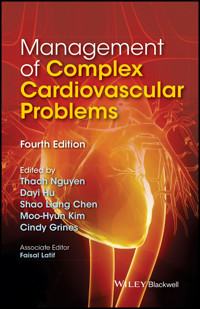
Management of Complex Cardiovascular Problems E-Book
70,99 €
Mehr erfahren.
- Herausgeber: John Wiley & Sons
- Kategorie: Fachliteratur
- Sprache: Englisch
Patients with complex cardiovascular problems pose a special management challenge for both the specialist and the non-specialist. This book helps you approach difficult cases with the confidence to strategically map care, understand the risk profile of your patient, and make effective treatment decisions.
- Dependable and succinct content provides high yield information for the busy cardiologist
- Take home call outs, and critical thinking boxes provide candid advice on incorporating guidelines and evidence based medicine into your practice
- New convenient pocket-sized format
- New chapter addressing cardiovascular problems in women
- Discussion of high risk factors for and strategic care mapping encourage clinical focus
- Clinical pearls offer expert advice on topical issues
- Includes emerging trends and clinical trials keeping you up to date
Sie lesen das E-Book in den Legimi-Apps auf:
Seitenzahl: 702
Veröffentlichungsjahr: 2016
Ähnliche




















Management of Complex Cardiovascular Problems
FOURTH EDITION
EDITED BY
Thach Nguyen, MD, FACC FSCAI
Director of Cardiovascular Research Methodist Hospital Merrillville IN 46410
Dayi Hu, MD FACC FHRS FESC
Director of the Intervention Center at Peking University People’s Hospital, President, Chinese College of Cardiovascular Physician (CCCP), Beijing, China
Shao Liang Chen MD
Professor of Cardiology Professor of Internal Medicine Deputy President, Nanjing First Hospital, Nanjing Medical University Director of Catheterization Laboratories, Nanjing First Hospital Chief of Cardiology Nanjing First Hospital Nanjing, China
Moo-Hyun Kim, MD, FACC
Associate Professor of Medicine Director, Cardiology Department Dong A University Busan, Korea
Cindy Grines, MD
Vice President Academic and Clinical Affairs, Detroit Medical Center Heart Hospital Detroit, MI
ASSOCIATE EDITOR
Faisal Latif, MD
Associate Professor of Medicine, University of Oklahoma, OKC, OK
This edition first published 2016 © 2016 by John Wiley & Sons Ltd
Registered office: John Wiley & Sons, Ltd, The Atrium, Southern Gate, Chichester, West Sussex, PO19 8SQ, UK
Editorial offices: 9600 Garsington Road, Oxford, OX4 2DQ, UK The Atrium, Southern Gate, Chichester, West Sussex, PO19 8SQ, UK 111 River Street, Hoboken, NJ 07030-5774, USA
For details of our global editorial offices, for customer services and for information about how to apply for permission to reuse the copyright material in this book please see our website at www.wiley.com/wiley-blackwell
The right of the author to be identified as the author of this work has been asserted in accordance with the UK Copyright, Designs and Patents Act 1988.
All rights reserved. No part of this publication may be reproduced, stored in a retrieval system, or transmitted, in any form or by any means, electronic, mechanical, photocopying, recording or otherwise, except as permitted by the UK Copyright, Designs and Patents Act 1988, without the prior permission of the publisher.
Designations used by companies to distinguish their products are often claimed as trademarks. All brand names and product names used in this book are trade names, service marks, trademarks or registered trademarks of their respective owners. The publisher is not associated with any product or vendor mentioned in this book. It is sold on the understanding that the publisher is not engaged in rendering professional services. If professional advice or other expert assistance is required, the services of a competent professional should be sought.
The contents of this work are intended to further general scientific research, understanding, and discussion only and are not intended and should not be relied upon as recommending or promoting a specific method, diagnosis, or treatment by health science practitioners for any particular patient. The publisher and the author make no representations or warranties with respect to the accuracy or completeness of the contents of this work and specifically disclaim all warranties, including without limitation any implied warranties of fitness for a particular purpose. In view of ongoing research, equipment modifications, changes in governmental regulations, and the constant flow of information relating to the use of medicines, equipment, and devices, the reader is urged to review and evaluate the information provided in the package insert or instructions for each medicine, equipment, or device for, among other things, any changes in the instructions or indication of usage and for added warnings and precautions. Readers should consult with a specialist where appropriate. The fact that an organization or Website is referred to in this work as a citation and/or a potential source of further information does not mean that the author or the publisher endorses the information the organization or Website may provide or recommendations it may make. Further, readers should be aware that Internet Websites listed in this work may have changed or disappeared between when this work was written and when it is read. No warranty may be created or extended by any promotional statements for this work. Neither the publisher nor the author shall be liable for any damages arising herefrom.
Library of Congress Cataloging-in-Publication Data:
Names: Nguyen, Thach, editor. | Hu, Dayi, editor. | Chen, Shao Liang, editor. | Kim, Moo-Hyun (Cardiologist), editor. | Grines, Cindy, editor. Title: Management of complex cardiovascular problems / edited by Thach Nguyen, Dayi Hu, Shao Liang Chen, Moo-Hyun Kim, Cindy Grines ; associate editor, Faisal Latiff. Description: Fourth edition. | Chichester, West Sussex, UK ; Hoboken, NJ : John Wiley & Sons Inc., 2016. | Includes bibliographical references and index. Identifiers: LCCN 2015035763 (print) | LCCN 2015036342 (ebook) | ISBN 9781118965030 (cloth) | ISBN 9781118965047 (Adobe PDF) | ISBN 9781118965054 (ePub) Subjects: | MESH: Cardiovascular Diseases--therapy. | Evidence-Based Medicine. Classification: LCC RC671 (print) | LCC RC671 (ebook) | NLM WG 120 | DDC 616.1/2--dc23 LC record available at http://lccn.loc.gov/2015035763
A catalogue record for this book is available from the British Library.
Wiley also publishes its books in a variety of electronic formats. Some content that appears in print may not be available in electronic books.
Cover image: gettyimages.com © Janulla
CONTENTS
List of Contributors
Foreword to the Third Edition
Preface
PRACTICING CARDIOLOGY IS LIKE CAR RACING AT THE INDY 500
Acknowledgements
CHAPTER 1 Hyperlipidemia
BACKGROUND
CHALLENGES
STRATEGIC MAPPING
HIGH-RISK MARKERS
INVESTIGATIONS
MANAGEMENT
MANAGEMENT OF PATIENTS NOT ON THE RECOMMENDATION LIST OF THE ACC/AHA GUIDELINES
HYPERTRYGLYCERIDEMIA
REFERENCES
CHAPTER 2 Hypertension: Implications of Current JNC 8 Guidelines on Treatment
BACKGROUND
CHALLENGES
STRATEGIC PLANNING
HIGH-RISK MARKERS
HIGH-RISK PREDICTORS
INVESTIGATIONS
MANAGEMENT
INFLUENCE OF COMORBID CONDITIONS
SECONDARY CAUSES OF HYPERTENSION
REFERENCES
CHAPTER 3 Stable Coronary Artery Disease
BACKGROUND
CHALLENGES
STRATEGIC MAPPING
RISK PROFILING
HIGH-RISK PREDICTORS
INVESTIGATIONS
FUNCTIONAL ASSESSMENT OF ISCHEMIC RISK
ANATOMICAL ASSESSMENT OF ISCHEMIC RISK
DIAGNOSIS
MANAGEMENT
REFERENCES
CHAPTER 4 Acute Coronary Syndrome
BACKGROUND
CHALLENGES
STRATEGIC MAPPING
HIGH-RISK PROFILING
HIGH-RISK PREDICTORS
INVESTIGATIONS
MANAGEMENT
SYMPTOM RELIEF AND REDUCTION OF MYOCARDIAL ISCHEMIA
MANAGEMENT OF PATIENTS WITH MAJOR CO-MORBIDITIES
SPECIAL SITUATIONS
REFERENCES
CHAPTER 5 ST Segment Elevation Myocardial Infarction
BACKGROUND
CHALLENGES
STRATEGIC MAPPING
HIGH-RISK MARKERS
HIGH-RISK PREDICTORS
INVESTIGATIONS
SMART TESTING
MANAGEMENT
COMPREHENSIVE MANAGEMENT
PREFERENTIAL MANAGEMENT
REFERENCES
CHAPTER 6 Heart Failure (Stages A, B and C)
STAGE A: ASYMPTOMATIC HEART FAILURE RISK FACTORS
BACKGROUND
CHALLENGES
STRATEGIC MAPPING
HIGH-RISK MARKERS
HIGH-RISK PREDICTORS
INVESTIGATIONS
SMART TESTING
MANAGEMENT
STAGE B: ASYMPTOMATIC LEFT VENTRICULAR REMODELING
BACKGROUND
CHALLENGES
STRATEGIC MAPPING
HIGH-RISK MARKERS
HIGH-RISK PREDICTORS
MANAGEMENT
STAGE C: HEART FAILURE
BACKGROUND
CHALLENGES
STRATEGIC MAPPING
HIGH-RISK MARKERS
HIGH-RISK PREDICTORS
INVESTIGATIONS
SMART TESTING
MANAGEMENT
REFERENCES
CHAPTER 7 Acute Decompensated and Chronic Stage D Heart Failure
NEW UNDERSTANDINGS
STRATEGIC MAPPING
HIGH-RISK MARKERS
HIGH-RISK PREDICTORS
INVESTIGATIONS
SMART TESTING
DIAGNOSES
MANAGEMENT
SYSTEM-BASED PRACTICE: DISCHARGE
SYSTEM-BASED PRACTICE: EARLY AND RECURRENT READMISSION
ADVANCED (STAGE D) HEART FAILURE
REFERENCES
CHAPTER 8 Atrial Fibrillation
BACKGROUND
CHALLENGES
STRATEGIC MAPPING
HIGH-RISK MARKERS
HIGH-RISK PREDICTORS
INVESTIGATIONS
SMART TESTING
ACUTE MANAGEMENT
CHRONIC MANAGEMENT
INVASIVE MANAGEMENT
MANAGEMENT OF COMPLEX PROBLEMS OR HIGH-RISK PATIENT SUBSETS
REFERENCES
CHAPTER 9 Ventricular Tachycardia
BACKGROUND
CHALLENGES
STRATEGIC MAPPING
HIGH-RISK PROFILING
HIGH-RISK PREDICTORS
SMART TESTING
DIAGNOSES
MANAGEMENT
REFERENCES
CHAPTER 10 Syncope
BACKGROUND
CHALLENGES
STRATEGIC MAPPING
HIGH-RISK MARKERS
HIGH-RISK PREDICTORS
INVESTIGATIONS
WORKING DIAGNOSES
SMART TESTING
MANAGEMENT
REFERENCES
CHAPTER 11 Aortic Stenosis
BACKGROUND
CHALLENGES
HIGH-RISK MARKERS
HIGH-RISK PREDICTORS
INVESTIGATIONS
SMART TESTING
MANAGEMENT
REFERENCES
CHAPTER 12 Mitral Regurgitation
BACKGROUND
CHALLENGES
STRATEGIC MAPPING
HIGH-RISK MARKERS
HIGH-RISK PREDICTORS
INVESTIGATIONS
PRIMARY MITRAL REGURGITATION
SECONDARY MITRAL REGURGITATION
ACUTE MITRAL REGURGITATION
REFERENCES
CHAPTER 13 Cardiovascular Problems in Elderly Patients
BACKGROUND
CHALLENGES
STRATEGIC MAPPING
HIGH-RISK MARKERS
HIGH-RISK PREDICTORS
INVESTIGATIONS
SMART TESTING
MANAGEMENT
REFERENCES
CHAPTER 14 Cardiovascular Problems in Women
BACKGROUND
CHALLENGES
HIGH-RISK MARKERS
STRATEGIC MAPPING
INVESTIGATIONS
SMART TESTING
INVASIVE TESTING
MANAGEMENT
REFERENCES
Index
EULA
List of Tables
Chapter 1
Table 1.1
Table 1.2
Table 1.3
Table 1.4
Table 1.5
Table 1.6
Table 1.7
Table 1.8
Table 1.9
Table 1.10
Table 1.11
Table 1.12
Chapter 2
Table 2.1
Chapter 3
Table 3.1
Table 3.2
Table 3.3
Table 3.4
Table 3.5
Table 3.6
Table 3.7
Table 3.8
Table 3.9
Chapter 4
Table 4.1
Table 4.2
Table 4.3
Table 4.4
Chapter 5
Table 5.1
Table 5.2
Table 5.3
Table 5.4
Table 5.5
Table 5.6
Table 5.7
Table 5.8
Table 5.9
Table 5.10
Table 5.11
Chapter 6
Table 6.1
Table 6.2
Table 6.3
Table 6.4
Table 6.5
Table 6.6
Table 6.7
Table 6.8
Table 6.9
Table 6.10
Table 6.11
Chapter 7
Table 7.1
Table 7.2
Table 7.3
Table 7.4
Table 7.5
Table 7.6
Table 7.7
Table 7.8
Table 7.9
Table 7.10
Table 7.11
Table 7.12
Table 7.13
Chapter 8
Table 8.1
Table 8.2
Table 8.3
Table 8.4
Table 8.5
Table 8.6
Table 8.7
Table 8.8
Table 8.9
Table 8.10
Table 8.11
Chapter 9
Table 9.1
Table 9.2
Table 9.3
Table 9.4
Table 9.5
Table 9.6
Table 9.7
Table 9.8
Chapter 10
Table 10.1
Table 10.2
Table 10.3
Table 10.4
Table 10.5
Table 10.6
Table 10.7
Table 10.8
Table 10.9
Table 10.10
Table 10.11
Chapter 11
Table 11.1
Table 11.2
Table 11.3
Table 11.4
Table 11.5
Table 11.6
Chapter 12
Table 12.1
Table 12.2
Table 12.3
Table 12.4
Table 12.5
Table 12.6
Table 12.7
Table 12.8
Table 12.9
Table 12.10
Table 12.11
Chapter 13
Table 13.1
Table 13.2
Chapter 14
Table 14.1
Table 14.2
Table 14.3
Table 14.4
Table 14.5
Table 14.6
Table 14.7
Table 14.8
Table 14.9
Table 14.10
List of Illustrations
Chapter 1
Figure 1.1
Schema for selection of patients to be treated for hyperlipidemia (adapted from Stone et al [1]).
Chapter 7
Figure 7.1
EKG before the index emergency room visit.
Figure 7.2
EKG on the index visit (diffuse T waves inversion in all leads V1-V6, I and AvL).
Figure 7.3
EKG 3 months later (The T waves changes reversed to normal upright).
Chapter 8
Figure 8.1
Strategy for management of atrial fibrillation.
(CI: contraindication; LAA: left atrial appendage; BB: beta-blocker; CCB: non-dihydropyridine receptor calcium channel blockers; AAD: anti-arrhythmic drugs.
Chapter 10
Figure 10.1
Tilt training (Standing training). Source: Benditt 2009 [50]. Reproduced with permission of Elsevier.
Figure 10.2
Physical maneuvers to counter an imminent vasovagal or orthostatic faint. Source: Benditt 2009 [50]. Reproduced with permission of Elsevier.
Chapter 12
Figure 12.1
Proximal isovelocity surface area (PISA) approximation for effective orifice area (EROA) and regurgitant volume (RV). (A) Schematic of PISA calculation. (B) Transesophageal interrogation of the regurgitant jet and measurement of the radius (r) of flow convergence. (C) Measurement of MR peak velocity (PkVreg) and velocity time integral (MR-VTI). (D) Calculation for the EROA and RV based on measured values for this case. Based on the calculations, the patient has severe MR. Note that this example used the highest values, given the atrial fibrillation, there may be a need for averaging several beats. Source: Zoghbi 2003. Reproduced with permission of Oxford University Press. Chapter 12, Reference [5].
Figure 12.2
Multi-planar assessment of estimated regurgitant orifice area (EROA) using 3-dimensional (3D) Doppler. (A and B) Systolic long-axis views are optimized to visualize the MR (MR) jet. The largest systolic proximal isovelocity surface area (PISA) is used to adjust the short-axis plane (blue line) to obtain an
en face
view of the base of the PISA (C and D). (E) The color Doppler baseline is adjusted to 39.6 cm/s. (F) Multiple orthogonal view can be generated (C and D, red planes) to obtain the largest 2-dimensional PFCR. The radius, length, and width measurements are shown (A and D) and the longest PISA radius is shown (F). Source: Thavendiranathan et al. 2012. Reproduced with permission of Elsevier. Chapter 12, Reference [28].
Figure 12.3
Percutaneous mitral clipping of the mitral valve using the MitraClip ® and associated clip delivery system (CDS) (Abbott Vascular, Santa Clara, CA). (A) Alfieri surgical technique performed to create a double orifice mitral valve and reduce regurgitation. (B) Trans-septal access, optimization and orientating a MitraClip with the middle scallops of the anterior and posterior leaflets, A2 and P2 respectively. (C) Successful grasping of the leaflet edges to complete an edge-to-edge repair.
Guide
Cover
Table of Contents
Preface
Pages
vii
viii
ix
x
xi
xii
xiii
xiv
xv
xvii
xix
xx
xxi
1
3
4
5
6
7
8
9
11
12
13
14
15
16
17
18
19
20
21
22
23
24
25
26
27
28
29
30
31
32
33
34
35
36
37
38
39
40
41
42
43
44
45
46
47
48
49
50
51
52
53
54
55
56
57
58
59
60
61
62
63
64
65
66
67
68
69
70
71
72
73
74
75
76
77
78
79
80
81
82
83
84
85
86
87
88
89
90
91
92
93
94
95
96
97
98
99
100
101
102
103
104
105
106
107
108
109
110
111
112
113
114
115
117
118
119
120
121
122
123
124
125
126
127
128
129
130
131
132
133
134
135
136
137
138
139
140
141
143
144
146
147
148
149
150
151
152
153
154
155
156
157
158
159
160
161
162
163
164
165
166
167
168
169
170
171
172
173
174
175
177
178
179
180
181
182
183
184
185
186
187
188
189
190
191
192
193
194
195
196
197
198
200
201
202
203
204
205
206
207
209
210
212
213
214
215
217
218
220
221
222
224
225
226
227
228
229
230
231
232
233
234
235
236
237
238
239
240
241
242
243
244
245
246
247
248
249
250
251
252
253
256
257
258
259
260
261
262
263
264
265
266
268
269
270
271
272
273
274
275
276
277
278
279
280
281
282
283
284
285
286
287
288
289
291
292
293
294
295
296
297
298
299
300
301
302
303
304
305
306
307
308
309
311
312
313
314
315
316
317
318
319
320
321
322
323
324
325
326
327
328
329
330
331
332
333
334
339
340
341
342
343
344
345
346
347
348
349
350
351
352
353
354
355
356
357
358
359
360
361
362
363
364
365
366
367
368
369
370
371
372
373
374
375
376
377
378
379
380
381
382
383
384
386
387
388
389
390
391
392
393
394
395
396
397
398
399
400
401
402
403
404
405
406
List of Contributors
NABEEL ALI, MD
Xavier University School of Medicine, Aruba
HY TAT AN
MS Class of 2020 Tan Tao University School of Medicine
Tan Duc E-City, Duc Hoa – Long An Vietnam
KHALID NUMAN AL AZZA, MD
Jordan University of Science and Technology
Irbid, Jordan
AMAN M. AMANULLAH, MD, PhD, FACC, FAHA
Clinical Professor of Medicine
Sidney Kimmel Medical College of Thomas Jefferson University
Section Chief, Noninvasive Cardiology, Albert Einstein Medical Center
Philadelphia, PA 19141
AMSA ARSHAD, MD
Xavier University School of Medicine, Aruba
NISA ARSHAD, MD
Xavier University School of Medicine, Aruba
Christopher M. Bianco, MD
Cardiology Fellow
The Brody School of Medicine at East Carolina University
Greenville, NC
THOMAS BUMP, MD
Clinical Associate Professor, University of Chicago
Clinical Assistant Professor, University of Illinois at Chicago
Chicago, IL
PATRICK T. CAMPBELL, MD
Advanced Heart Failure Fellow
Section of Cardiomyopathy & Heart Transplantation
Ochsner Heart and Vascular Center, New Orleans
Mihail G. Chelu, MD, PhD, FHRS
Assistant Professor University of Utah School of Medicine
Electrophysiology Division Salt Lake City, UT
SHAO LIANG CHEN, MD, PhD, FACC
Professor of Cardiology
Professor of Internal Medicine
Deputy President, Nanjing First Hospital, Nanjing Medical University
Director of Catheterization Laboratories, Nanjing First Hospital
Chief of Cardiology, Nanjing First Hospital
Nanjing, China
NGUYEN DUC CONG, MD, PhD
Professor of Medicine
Director of Thong Nhat Hospital
Director of Geriatric Department of Pham Ngoc Thach Medical University
Vice Director of Geriatric Department, The University of Medicine and Pharmacy
Vice Director Department of Internal Medicine, School of Medicine, the National University of Hochiminh City, Hochiminh City, Vietnam
VIJAY DAVE, MD
Director of Medical Education
St Mary Medical Center Hobart, IN
HO THUONG DUNG, MD, PhD, FSCAI
Vice Director of Thong Nhat Hospital, HCM City
Vice Chairman of Interventional Cardiology Association of HCM City
Hochiminh City, Vietnam
MARVIN H. ENG, MD
Structural Heart Disease Fellowship Director
Center for Structural Heart Disease, Division of Cardiology
Henry Ford Health System, Detroit, MI
DANIEL FORMAN, MD
Professor of Medicine, University of Pittsburgh
Chair, Geriatric Cardiology Section, University of Pittsburgh Medical Center
Director, Cardiac Rehabilitation, VA Pittsburgh Healthcare System
Pittsburgh, PA
RUNLIN GAO, MD, FACC, FESC, FSCAI
Professor of Medicine
Member, Chinese Academy of Medical Sciences
Chief Cardiologist, Fuwai Hospital Beijing, China
C. MICHAEL GIBSON, MD
Director, TIMI Data Coordinating Center; and Associate Professor
Harvard Medical School; and Chief of Clinical Research, Cardiovascular
Division, Beth Israel Deaconess Medical Center, Boston, MA
CINDY GRINES MD
Vice President Academic and Clinical Affairs, Detroit Medical Center Heart Hospital
Professor of Medicine, Wayne State University School of Medicine, Detroit MI
RAJIV GOSWAMI DO
Assistant Professor of Medicine, Baylor College of Medicine
Ben Taub Hospital, Houston, Texas
NGUYEN LAN HIEU, MD, PhD
Vice director, Heart Center
Hanoi Medical University Hospital
Hanoi, Vietnam
BAO V. HO, MD, MSC
New York Institute of Technology, College of Osteopathic Medicine
Old Westbury, NY
DAYI HU, MD, FACC, FESC
Director of the Heart Center at Peking University People's Hospital, Beijing China
President of the China Heart Federation Beijing China
PHAM MANH HUNG, PhD, MD, FACC, FESC
Associate Professor, Hanoi Medical University
Secretary General, Vietnam National Heart Association
Director, Cardiac Catheterization Laboratories Vietnam National Heart Institute
Hanoi, Vietnam
PHAM NHU HUNG, MD, PhD, FACC, FASCC
Consultant of Cardiology and Electrophysiology
Director of Electrophysiology Laboratories, Hanoi Heart Hospital
Hanoi, Vietnam
PHAN NAM HUNG, MD
General Secretary, the Internal Medicine Society of Vietnam
Vice Chief, Cardiovascular Medicine Department, Binh Dinh General Hospital
Qui Nhon, Vietnam
AN HUYNH
MS Class of 2019, Tan Tao University School of Medicine
Tan Duc E-City, Duc Hoa – Long An Vietnam
HUNG D. HUYNH
Senior Research Associate, Community Healthcare System, St Mary
Medical Center, Hobart, IN; and Webmaster, Riverside, CA
KIM N. HUYNH
Honor Student, Miss Hall's School
Vice President, International Student Alliance
Pittsfield, MA
KAHROBA JAHAN MD
Division of Cardiology, Sarver Heart Center
Banner University Medical Center South Campus
University of Arizona, Tucson, AZ
Deepak Joshi, MD
Cardiology Fellow
The Brody School of Medicine at East Carolina University
Greenville, NC
MOO-HYUN KIM, MD, FACC, FSCAI
Director, Global Clinical Trial Center
Professor, Dept. of Cardiology, Dong-A University Hospital
Busan, Korea
NEAL KLEIMAN MD
Professor, Department of Medicine
Weill Cornell Medical College of Cornell University
Director, Applied Platelet Physiology Lab
Director, Cardiac Catheterization Laboratories
Houston Methodist DeBakey Heart & Vascular Center
Houston, TX
SELIM R. KRIM, MD
Staff, Section of Cardiomyopathy & Heart Transplantation
Ochsner Heart and Vascular Center, New Orleans LA
FAISAL LATIF, MD, FACC, FSCAI
Associate Professor of Medicine
Associate Program Director, Cardiology Fellowship Program
University of Oklahoma Health Sciences Center
Director, Cardiac Catheterization Laboratories
VA Medical Center, Oklahoma City, OK
SORIN LAZAR, MD
Electrophysiologist
Methodist Hospital, Merrillville, IN
DAN D. LE, MD
Cardiology Fellow
The Brody School of Medicine at East Carolina University
Greenville, NC
TRONG HA LE
MS Class of 2019 Tan Tao University School of Medicine
Tan Duc E-City, Duc Hoa – Long An Vietnam
KWAN S. LEE, MD FACC FSCAI
Medical Director of Cardiology
Director Cardiac Catheterization Laboratory
Banner University Medical Center South Campus
Sarver Heart Center, Banner University Medical Center South Campus
University of Arizona Tucson, AZ
XIAN KAI LI, MD, PhD
Cardiology Department
Shanghai Tenth People's Hospital of Tongji University
Shanghai, China
TUNG DINH MAI, DO
Resident, Department of Internal Medicine
Detroit Medical Center – Sinai Grace Hospital
Wayne State University – School of Medicine, Detroit, Michigan
Clinical faculty, Department of Medicine
Michigan State University – College of Osteopathic Medicine
East Lansing, Michigan
ARAVINDA NANJUNDAPPA, FACC, FSCAI, RVT
Professor of Medicine and Surgery
Director of TAVR Program
West Virginia University, Charleston, WV
CHISALU NCHEKWUBE, MD
Internal Medicine Residency Program
Department of Internal Medicine
University of Illinois Hospital and Health Sciences System
Chicago, IL
RAJASEKHAR NEKKANTI, MD FACC FASE CCDS
Associate Professor of Medicine
Program Director, Cardiology Fellowship Program
Director, Continuing Medical Education-Cardiovascular Series
East Carolina Heart Institute
The Brody School of Medicine at East Carolina University
Director, Echocardiography Laboratories
East Carolina Heart Institute at Vidant Medical Center
Greenville, NC
Tam Ngo, MD
Resident in ophthalmology
University of Medicine and Pharmacy, Ho Chi Minh City, Viet Nam
LAN NGUYEN, MD
Universidad Autonóma de Guadalajara
Guadalajara, MX
NGUYEN PHUC NGUYEN, MD
Cardiology Department
St Mary Medical Center, Hobart, IN
NGOC-QUANG NGUYEN, MD, Phd, FASCC, FSCAI
Department of Cardiology, Hanoi Medical University
Head of Coronary Care Unit (C7), Vietnam National Heart Institute
Bach Mai Hospital, Hanoi, Vietnam
QUANG TUAN NGUYEN, MD, PhD, FACC, FSCAI
CEO, Hanoi Heart Hospital
Medical Director, Hanoi Heart Hospital
Associate professor, Hanoi Medical University
President, Vietnam Interventional Cardiology Society
President, Hanoi Heart Association, Hanoi, Vietnam
THACH NGUYEN, MD, FACC, FSCAI
Deputy Editor-in-chief, Interventional Cardiology Grand Rounds, NYC, NY, and Associate-editor-in-chief, Journal of Geriatric Cardiology, Beijing, China; and Editorial Consultant, Journal of Interventional Cardiology; Hoboken, NJ, and Chinese Medical Journal, Beijing, China, and Honorary Professor of Medicine, Hanoi Medical University, and Vietnam Heart Institute, Hanoi, Vietnam, and Capital University of Medical Sciences, Beijing, China; and The Institute of Geriatric Cardiology, 301 Hospital of the Chinese People's Liberation Army, Beijing, China; and Friendship Hospital, Beijing, and the Tenth People's Hospital, Shanghai, China, and Visiting Professor, Nanjing First Hospital, Nanjing Medical University, Nanjing, China; and Clinical Assistant Professor of Medicine, Indiana University Northwest, IN, USA, Director of cardiovascular research Methodist hospital, Merrillville, IN; and Director of Cardiology, Community Healthcare System, St Mary Medical Center, Hobart, IN, USA
TUAN D. NGUYEN, DO
Candidate, Class of 2017
New York Institute of Technology, College of Osteopathic Medicine
Old Westbury, NY
ALI OTO, MD, FESC, FACC, FHRS
Professor of Cardiology
Chairman, Department of Cardiology,
MHG, Memorial Ankara Hospital
Ankara, Turkey
PHAN DINH PHONG, MD, PhD
Head of Training Center
Vietnam National Heart Institute
Bach Mai Hospital, Hanoi, Vietnam
DUANE PINTO, MD FACC FSCAI
Associate Professor of Medicine, Harvard Medical School
Director, General Cardiology Fellowship Program
Director, Cardiac Intensive Care Unit, Beth Israel Deaconess Medical Center
Boston MA
GIANLUCA RIGATELLI, MD, PhD, EBIR, FACP, FACC, FESC, FSCAI
Cardiovascular Diagnosis and Endoluminal Interventions Unit
Rovigo, General Hospital, Rovigo, Italy
MICHAEL RINALDI, MD
Interventional Cardiology and Vascular Medicine
Director, Clinical Research, Sanger Heart and Vascular Institute
Professor of Medicine, Carolinas HealthCare System
Charlotte, NC
MADHUR ROBERTS, MD
Cardiovascular Fellow, PGY 6
University of Tennessee Medical Center
Knoxville, TN
AINOL SHAREHA SAHAR, MD FACC FSCAI FNHAM SCIM
Senior Consultant Cardiologist
Deputy Head, Department of Cardiology
Penang General Hospital
Penang Malaysia
SARA SHAH
Honor Student, Munster High School
National Society of High School Scholar
Delegate, the Congress of Future Medical Leaders
2015 Nominee, National Youth Leadership Forum in Medicine
EVGENY SHLYAKHTO, MD, PhD, FESC, FACC
President, Russian Society of Cardiology
Director, Federal Almazov Heart Blood Endocrinology Centre
St Petersburg, Russian Federation
UDHO THADANI, MD, MRCP, FRCPC, FACC, FAHA
Professor Emeritus of Medicine University of Oklahoma Health Sciences Center
Consultant Cardiologist Oklahoma University Medical Center and VA Medical Center
Oklahoma City, OK
LÊ HOÀNG ĐÚ'C TOÀN
MS Class of 2019 Tan Tao University School of Medicine
Tan Duc E-City, Duc Hoa – Long An Vietnam
LÊ THỊ NGỌC TRÂM
MS Class of 2019, Tan Tao University School of Medicine
Tan Duc E-City, Duc Hoa – Long An Vietnam
HAU TRAN, MD, DO
New York Institute of Technology, College of Osteopathic Medicine
Old Westbury, NY
PHILLIP TRAN, DO
Cardiology fellow
Mercy Medical Center – North IA
HUÝNH THỊ THU TRÚC
MS Class of 2019 Tan Tao University School of Medicine
Tan Duc E-City, Duc Hoa – Long An Vietnam
VIEN THANH TRUONG, MD
Resident in Internal Medicine
Junior Lecturer, Internal Medicine Department
Pham Ngoc Thach University of Medicine, Ho Chi Minh City, Vietnam
M. HARIS U. USMAN, MD, MS
Interventional Cardiology Fellow
Detroit Medical Center, Wayne State University
Detroit MI
HECTOR O. VENTURA, MD, FACC, FACP
Director, Section of Cardiomyopathy & Heart Transplantation
Ochsner Heart and Vascular Center, New Orleans
New Orleans, LA
VÕ MINH VIỆT
MS Class of 2019 Tan Tao University School of Medicine
Tan Duc E-City, Duc Hoa – Long An Vietnam
YIDONG WEI, MD, FACC
Professor, Chief, Department of Cardiology
Shanghai Tenth People's Hospital of Tongji University
Shanghai, China
NANETTE K. WENGER, MD, MACC, MACP, FAHA
Professor of Medicine (Cardiology) Emeritus
Emory University School of Medicine
Consultant, Emory Heart and Vascular Center
Atlanta, GA
BO XU, MBBS
Director, Catheterization Laboratory
Fu Wai Hospital, National Center for Cardiovascular Diseases
Beijing, China
HAN YALING, MD, FACC, FESC
Academician of Chinese Academy of Engineering
President, Institute of Cardiovascular Medicine of PLA
Director, Department of Cardiology
General Hospital of Shenyang Military Region
Shenyang, Liaoning China
Foreword to the Third Edition
The modern cardiologist is confronted with a bewildering amount of new information. At last count there were more than one hundred cardiology journals. Many cardiology textbooks, covering every aspect of the field and dozens of symposia are published each year. The major cardiovascular centers all have their ‘in house’ publications, which emphasize their local accomplishments. In addition, industry bombards cardiologists with many reviews, each placing the sponsor's project and trial in the best light.
What the practicing cardiologist really needs is a text that emphasizes unbiased, up to date information and that places this information into an appropriate context. The third edition of Management of Complex Cardiovascular Problems, carefully edited by Dr. Nguyen, does precisely this.
Particularly new, reader friendly, features are the boxes of ‘Take Home Messages’ [Action Points in the Fourth Edition] which give succinct summaries of each chapter, together with Critical Thinking (new concepts); Evidence-Based Medicine (the key results of important clinical trials); and Clinical Pearls (advice from master clinicians).
This unique format provides busy cardiologists with an approach to deal with information overload and will thereby enhance the quality of care delivered to the cardiac patient. Thus, Dr. Thach Nguyen and his talented authors have again provided us with important ammunition for the war against heart disease. This fine book describes clearly some of the most difficult problems that cardiovascular specialists face, and it provides enormously helpful directions in dealing with them. This eminently readable book should be equally valuable to practicing cardiologists in the front lines of the battle against the global scourge of cardiovascular disease and to trainees in the field.
Eugene Braunwald, M.D.
Boston, Massachusetts
Preface
PRACTICING CARDIOLOGY IS LIKE CAR RACING AT THE INDY 500
When driving to work, do you drive in the fast lane? When using the internet, do you use a shortcut to open a new window? For short and quick communication, do you text or pick up the phone? In 2016, do cardiologists still work with 20th century mentality or do they see and work through a 21st century lens or Google Glass? In this fourth edition of Management of Complex Cardiovascular Problems, the authors and editors offer new strategic views and tactical maps similar to the ones used in car racing; they are presented, however, with the wit of a young broker in the middle of the New York Stock Exchange pit.
When confronting a cardiac problem, the first strategy is to identify the challenges. How long is the race? Where are there dangerous turns? Which slippery slope could dump the best and most promising rider? If this vital information is available ahead of the game, the practicing cardiologists could program their brain, rewire the shortcuts, and reserve enough adrenaline needed for the run.
The second strategy when examining a patient is to risk profile the patient thereby discriminating the sickest from the less sick. By doing so, more resources, time, and manpower could be allocated for the small number of patients who need it the most without compromising quality of care for the entire group.
Then the authors and editors would offer a strategic map which prioritizes the process of investigation and management. Which is the straight line to the target (direct tests to confirm a clinical diagnosis)? How does one rule out the most important differential diagnoses? Which option offers the best cost and time effective (most fuel efficient) treatment? At the same time, signposts warning of imminent risks or end of danger zones are positioned in strategic locations dotting the horizons. Signs predicting the near future (or prognostic factors) are also prominently posted. Metrics which monitor the progress (follow-up) and evaluate the performance of the operators (practicing cardiologists) are positioned on large billboards or LED screens along the track. All of these signs are transparently posted for the practicing cardiologists without a paternalistic overtone.
Instead of arguing for a preferred solution to a particular problem, the authors and editors provide raw data in the form of abstracts detailing important randomized clinical trials; this enables the practicing cardiologist readers to scrutinize the main results and understand their differences. By so doing, they are able to intelligently select the best between multiple options. There is no need to spoonfeed readers with digested and regurgitated data. The numbers speak for themselves. However, the editors and authors do give practical pearls (which are shortcuts in real life) in order to cut time and cost.
Information is provided by the writers and editors utilizing short paragraphs so that readers will be able to store them in their short-term memory and analyze them before storing them in different compartments of their long-term memories. The strategy is to tailor these messages for today's cardiologists who may be overbooked, impatient, and/or hyperactive.
To all of our readers: The authors and editors of this book have shared many of your trials and tribulations. We have experienced the many sleepless nights. We labor every day in the hospital, at the patient's bedside, like yourself. We too have felt the need for the practical advices found in this book; indeed, that is why we have written them. We are, like all of you, our colleagues, both experienced and beginners, young and old, men and women; there are no divisions of class, age, sex, or race here. This book is not written from an ivory tower perspective – we aim to practice what we preach. Although much practical information and suggestions are given, we have also written from our subjective experience and from our hearts. After all, there is much drama and many ups and downs occurring daily on every cardiac floor in every healthcare facility across the globe. Hopefully, the outcome of our care and treatment will always be a happy and beneficial one for the patients. The bottom line is that we practice cardiology to the best of our ability in a responsible manner that is both cost-effective and time-effective and provides excellent patient-centered care. We are all equal in our quest of striving for the best management and clinical success.
That is the goal of this handbook. To give you, the cardiologist (racing car driver), the tools, the data, and the resources that you need to successfully navigate the race to the finishing line.
Acknowledgements
For the completion of this book, we owe much to our teachers, friends, colleagues, families, staff and patients. I (TNN) am indebted to Dr Eugene Braunwald, who wrote the foreword of the first to the third editions, for his invaluable encouragement, very kind words and advices. My deepest appreciation goes to my fellow editors and contributors and to my family, with the dedicated support of Huang Weitao, NNG CN; my parents Sau N. Nguyen (+ 2012) and Hanh T.H. Tran, and my family in Irvine CA and La Porte IN, especially Robert Luscomb Jr, Le Cong Dinh JD, Lê Gia Long and Lê Trung Húng, SGN, VN; Dr Huynh Duong Hung, Webmaster Riverside CA; Professor Bui Duy Tam, SFO, Lê Hoàng Đú'c Toàn, Võ Minh Viêt, Hu***nh Tr**ng Ân, Lê Tr**ng Hà, Hu**nh Th** Thu Trúc, Lê Th** Ng**c Trâm, Hy Tat An, Hoàng Quôc B**o, Truyên Thiên Tâ´n Trí Tài of Tan Tao University School of Medicine, Long An, Vietnam; special assistance was given by Cindy Macko at the Library of St Mary Medical Center, Hobart, IN and Yin Rong-Xiu at the Institute of Cardiovascular Disease, Capital University of Medical Sciences, Beijing, China. Above all, we are indebted to our patients – the purpose of our care, the source of our quests, the inspiration of our daily work. To them we give our heartfelt thanks.
CHAPTER 1Hyperlipidemia
Vien T. Truong, Kim N. Huynh, Tam Ngo, Sara Shah, Hau Van Tran, Chisalu Nchekwube, Nabeel Ali and Faisal Latif
Lesen Sie weiter in der vollständigen Ausgabe!
Lesen Sie weiter in der vollständigen Ausgabe!
Lesen Sie weiter in der vollständigen Ausgabe!
Lesen Sie weiter in der vollständigen Ausgabe!
Lesen Sie weiter in der vollständigen Ausgabe!
Lesen Sie weiter in der vollständigen Ausgabe!
Lesen Sie weiter in der vollständigen Ausgabe!
Lesen Sie weiter in der vollständigen Ausgabe!
Lesen Sie weiter in der vollständigen Ausgabe!
Lesen Sie weiter in der vollständigen Ausgabe!
Lesen Sie weiter in der vollständigen Ausgabe!
Lesen Sie weiter in der vollständigen Ausgabe!
Lesen Sie weiter in der vollständigen Ausgabe!
Lesen Sie weiter in der vollständigen Ausgabe!
Lesen Sie weiter in der vollständigen Ausgabe!




