


64,99 €
Mehr erfahren.
- Herausgeber: John Wiley & Sons
- Kategorie: Wissenschaft und neue Technologien
- Sprache: Englisch
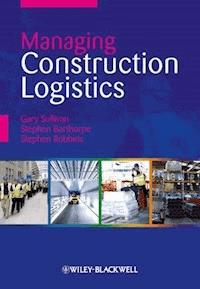
Every major industry except construction uses logistics to improve its bottom line... Poor logistics is costing the construction industry at least £3 billion a year according to a report - 'Improving Construction Logistics' - published by the Strategic Forum for Construction. Additional costs arise as a result of operatives waiting for materials, and skilled craftsmen being used for unskilled jobs. Inadequate management of logistics also has an adverse effect on quality, causes delays to projects, and adds to the health and safety risks on site. This practical book highlights the benefits of good logistics as well as the use of consolidation centres on projects. It shows how reduction in transport movements, less money tied up in stock, less waste, and the more efficient use of skilled craftsmen will reduce the cost of projects, reduce construction time, improve quality, reduce risks to health and safety, improve environmental performance and generally improve the image of the industry. The authors offer practical ways of achieving these benefits through integrated project teams and supply chains and the increased adoption of information technology including electronic communications, bar coding, and electronic tagging for tracing products. They also show how specific roles for each part of the industry can help to improve logistics. * Practical, clear and accessible * First book to address logistics in construction * Written by the industry-recognized logistics experts * Tackles issues of key concern: efficient use of labour; sustainability; waste and supply chain management
Sie lesen das E-Book in den Legimi-Apps auf:
Seitenzahl: 475
Veröffentlichungsjahr: 2011
Ähnliche




















Table of Contents
Cover
Table of Contents
Title page
Copyright page
Foreword
Preface
About the Book
About the Authors
Dedication and Acknowledgements
Glossary of Abbreviations
Introduction
Part 1: Contextualising Logistics for Construction
Chapter 1 The Origins of Logistics
Definitions and origins of logistics
The military origins of logistics
Modern military logistics
Parallel lines: construction and the military
Part 2: Construction Logistics in Practice
Chapter 2 Construction Logistics in Practice
Development of logistics
Construction industry logistics
Comparing construction with manufacturing
Construction industry: traditional approach to logistics
Construction industry: dedicated approach to logistics
Cultural barriers to implementing integrated logistics in the construction industry
Resistance to change
Logistics constraints
Chapter 3 An Introduction to Practical Logistics
Planning is everything
Waste not, want not?
Communication is the key
Standardisation and pre-assembly in construction
Creating professional logistics operations in the construction industry
Small sites
Practical completion
Chapter 4 Mobilisation and Resourcing the Team
Mobilisation and site set-up
Resourcing the logistics team
The background
Contractual norms and logistics management
Issues in current practice
The specialist construction logistics contractor
Employment and training
Chapter 5 Materials Delivery and Handling
Contractual issues and current practice
Getting materials to the site
Common user plant: tower cranes
Common user plant: lifts and hoists
The scope and potential of common user plant
Couriers
Alternative forms of transport
Distribution
Batching plants or concrete deliveries?
Barcodes and radio-frequency identification
Consolidation centres
Chapter 6 Transport and Communications
Introduction to traffic management
Managing construction traffic on the highways
Managing access points
Car parking
Managing haul roads
Wheel washes
An overview of communications
The site logistics meeting
Learning from the site
Communication tools
Signage
Chapter 7 Managing Critical Risks
Importance of fire management
Causes of fire
The fire safety plan
Evacuation plans
Fire marshals and fire wardens
Contractual barriers to a seamless response
Introduction to first aid and occupational health
Creating the right level of first-aid provision
First-aid equipment
Dealing with emergencies
Occupational health
Chapter 8 Security
The remit of the security team
Managing access to site
Night security
Dogs
Alarms
Special measures
Chapter 9 Coordinating Infrastructure and Services
Catering
Temporary accommodation
Temporary services
Chapter 10 Waste Management and Good Housekeeping
Procurement of waste management services
What is waste?
Challenges to good housekeeping on site
A professional approach to waste management
Potential for further improvement
Housekeeping
Sanitary facilities
Achieving good housekeeping
Part 3: The Future of Construction Logistics
Chapter 11 Construction Consolidation Centres
Consolidation centre concept
Construction logistics consolidation centres: an outline
The benefits of using a consolidation centre
The challenges of pricing the logistics element of a contract
Change management
The consolidation centre methodology
Warehouse management systems
Materials identification and tagging systems
Value stream mapping
The cost benefits of a consolidation centre
Increasing the availability of materials
Advantages offered to materials suppliers: better use of delivery vehicles
Realising cost savings
Non-financial benefits of the consolidation centre
Increased accountability
Environment
The social benefits of good supply chain management and logistics techniques
Socially responsible supply chain management and logistics
Considering the future application of the consolidation centre methodology
Important considerations for the future
Chapter 12 Case Studies
Introduction
Case Study 1: Construction Logistics: The Heartbeat of a Project
Case Study 2: Prescription to Reduce Waste: AstraZeneca
Case Study 3: Consolidated Loads: The Answer to Space- and Access-constrained Sites
Case Study 4: Come Up and See Me Some Time: The Value of Occupational Health
Case Study 5: Terminal 5: Delivering Europe’s Largest Construction Project Just in Time
Case Study 6: Security Services at Tate Modern and Tate Britain
Case Study 7: Refurbishment at Unilever House: Delivering Sustainability
Conclusion: The Argument for Change
Index
This edition first published 2010
© 2010 Gary Sullivan, Stephen Barthorpe and Stephen Robbins
Blackwell Publishing was acquired by John Wiley & Sons in February 2007. Blackwell’s publishing programme has been merged with Wiley’s global Scientific, Technical, and Medical business to form Wiley-Blackwell.
Registered office
John Wiley & Sons Ltd, The Atrium, Southern Gate, Chichester, West Sussex, PO19 8SQ, United Kingdom
Editorial offices
9600 Garsington Road, Oxford, OX4 2DQ, United Kingdom
2121 State Avenue, Ames, Iowa 50014-8300, USA
For details of our global editorial offices, for customer services and for information about how to apply for permission to reuse the copyright material in this book please see our website at www.wiley.com/wiley-blackwell.
The right of the author to be identified as the author of this work has been asserted in accordance with the Copyright, Designs and Patents Act 1988.
All rights reserved. No part of this publication may be reproduced, stored in a retrieval system, or transmitted, in any form or by any means, electronic, mechanical, photocopying, recording or otherwise, except as permitted by the UK Copyright, Designs and Patents Act 1988, without the prior permission of the publisher.
Wiley also publishes its books in a variety of electronic formats. Some content that appears in print may not be available in electronic books.
Designations used by companies to distinguish their products are often claimed as trademarks. All brand names and product names used in this book are trade names, service marks, trademarks or registered trademarks of their respective owners. The publisher is not associated with any product or vendor mentioned in this book. This publication is designed to provide accurate and authoritative information in regard to the subject matter covered. It is sold on the understanding that the publisher is not engaged in rendering professional services. If professional advice or other expert assistance is required, the services of a competent professional should be sought.
Library of Congress Cataloging-in-Publication Data
Sullivan, Gary, 1959–
Managing construction logistics / Gary Sullivan, Stephen Barthorpe, Stephen Robbins.
p. cm.
Includes bibliographical references and index.
ISBN 978-1-4443-9041-4 1. Building–Superintendence–Data processing. 2. Construction industry–Management–Data processing. 3. Business logistics– Data processing. 4. Production scheduling–Data processing. I. Barthorpe, Stephen. II. Robbins, Stephen, 1979– III. Title.
TH437.S83 2010
624.068′7–dc22
2009048117
A catalogue record for this book is available from the British Library.
Foreword
How do you get a supply line to work efficiently? All industries have to tackle that question in order to succeed, but it has, to date, proved a particularly thorny issue for the construction industry.
There are many complex and interrelated reasons for this. The industry has a low entry requirement in terms of capital, and many sizable firms have grown incrementally from the humblest beginnings. Despite the capital required to fund a major project, the industry is not perceived as capital-intensive, and thus fails to get the business attention and investment that is accorded to many comparable sectors. Furthermore, the fragmentation of the industry creates a silo mentality, where everyone is focused on their own area of expertise rather than investing their resources into achieving excellence in the project as a whole.
For these reasons, a kind of amateurishness persists in the construction of many projects. If you walk past the average building site, the wastage is immediately apparent. New materials have been damaged before they could ever be used and lie abandoned in skips. Even those materials that are used are often dented or scratched en route because of poor management processes. These damaged items can be repaired, but they will never again be pristine. In effect, the client is paying for a second-hand building.
These issues are certainly not new. When I began collaborating with Gary Sullivan in the late 1980s, I was increasingly keen, as a client, to improve the way building sites were managed. Gary was providing site security at Bovis Construction and was starting to become interested in improving the efficiency of both this function and other prelim services on site.
I suggested that we asked the security staff to be helpful and welcome people, and to start making a proactive contribution to site organisation. I wanted them to be seen as people who helped with the core business of the project rather than as an obstructive presence that impeded progress. Gary took on the challenge of improving their effectiveness and providing them with additional skills. Before long, we had started to look at real logistics in earnest, exploring ideas and solutions from other industries to see how they could be adapted for construction. He ultimately developed this to the point where we were finding better ways of managing the infrastructure of entire projects, including vastly improved handling of both materials and waste.
Since then, Gary has become a leader in translating ideas from other sectors to make them work in construction. His passion has driven many important developments, and he’s invested immense amounts of time and money to get new solutions to work. Some enlightened clients have adopted these techniques, and are reaping the benefits.
However, twenty years after we realised what a professional approach to logistics could achieve, there are still vast swathes of the industry that are failing to grasp this opportunity to improve their performance. Too often, logistics contractors become vulnerable to budget cuts, because, despite their contribution to productivity, they’re not perceived as core to the project. The decision-makers involved simply don’t realise that this function can often determine the difference between the on-time delivery of a gleaming new building and one where damage, delay and claims are the predominant feature.
Since the adoption of professional logistics in construction has been both piecemeal and slow, the casual observer might be tempted to conclude that widespread change will never occur in this most traditional of industries. That conclusion, I firmly believe, is wrong.
Perhaps the best analogy that I can draw is with the shipbuilding industry. Radical change to delivery methods arrived in the form of containers, rendering traditional practices redundant. Still, when the American entrepreneur Malcolm McLean introduced them in 1956, ‘no one anticipated that his initiative, which traditional ocean carriers considered utter folly, would transform the packing and carrying of general cargoes worldwide’1. The technology had already been in existence for several decades, although it had not been widely adopted. Suddenly, a combination of circumstances relating to both market forces and labour relations triggered its adoption by a critical mass of shipping operators. Once this happened, docks that were unable to adapt would not survive.
The parallels are striking. Until a critical mass of businesses adopted it, the container had been ignored for decades by an industry content to use technologies that would have not have been unfamiliar to the ancient world. Once the critical mass was reached, however, no one could ignore it or compete against it. The industry changed forever.
In just the same way, the construction industry will reach a critical mass in its adoption of professional logistics, and I believe it will do so sooner rather than later. When this momentum really begins to build, the step-change will dwarf all the developments to date.
The multi-skilled logistics and security team is now a proven benefit. So far, we have been able to achieve a certain amount of efficiency through the use of construction consolidation centres. Still, at the time of writing, there is only one operating in central London. In the future, we, as an industry, will need five or six centres around London, to which all materials coming into the capital will be delivered. The revolutionary effect on the road system alone can only be imagined. Instead of half-empty juggernauts struggling through narrow and congested streets, smaller and more nimble lorries will deliver consolidated work packs across the city. After decades of development, the consolidation centre, just like the container ship, will suddenly become an overnight success. No organisation that fails to buy into this newly efficient and environmentally friendly incarnation of the industry will survive. Its wastage levels will be too high, in comparison to its peers, for it to continue.
I believe that constructors ignore this book at their peril. These techniques will soon be essential to every construction business. The only question for industry decision-makers is to decide whether they want to get ahead of the curve by changing now or wait until a streamlined and competitive industry forces them to adapt just to remain viable. As a client, I know what I’d recommend.
Note
1 Donovan A (1999) Longshoremen and mechanisation: A tale of two cities. Journal of Maritime Research December issue.
Peter Rogers CBE
Chairman of the UK Green Building Council
Preface
Readers of this book will not have failed to notice the proliferation of transport company vehicles that operate on our motorways that feature the word ‘logistics’ in their name and logo. What was, for decades, known appropriately as ‘Smith & Son Transport’ has inexplicably evolved into ‘Smith & Son Logistics’ – without any apparent diversification of the services offered. ‘Logistics’ has inaccurately become synonymous with ‘transport’ and as such misrepresents and significantly undervalues the scope of true logistics – especially when applied to the construction industry. The following pages of this book will demonstrate that logistics is multi-faceted, with many interdependent functions and, if managed properly, will make a significant contribution to the successful completion of construction projects.
Managing Construction Logistics is aimed at everyone interested in making construction site logistics work more smoothly. Construction delivers complex bespoke projects, often in challenging and constrained environments, so it has much need of professional logistics solutions. Despite this, logisticians have paid but sparse attention, to date, to the construction industry, and very little has been written about the best way of organising and supplying a project. This both reflects and perpetuates the lack of collaboration between the professional communities of logistics and construction.
This book is perhaps the first sustained attempt to remedy this situation, having been co-authored by professionals from both disciplines. Gary Sullivan, a professional logistician who has specialised in construction for twenty years, has written Section Two, which gives insights into the best way of managing site logistics from a practitioner’s perspective. Stephen Barthorpe and Stephen Robbins, both construction professionals with strong academic credentials, were jointly responsible for the contextualisation of logistics in Section One, and for the analysis of future trends offered in Section Three. It is hoped that this juxtaposition of the practical and theoretical will make this work of use to both practitioners and students.
Inspiration for this book evolved following the authors’ collaboration on a research project investigating ‘The Potential for Transferring the Heathrow Consolidation Centre Methodology to other areas of the Construction Industry’. The project was jointly funded by the Department of Trade and Industry, Wilson James, Mace and BAA and culminated in the publication of a final report, Consolidating Construction Materials: Transferring the Methodology, in 2004.
Some readers may notice that there is no health and safety chapter in the following pages. That is because the authors firmly believe that a commitment to health and safety should be part of every activity on site. As we have tried to make clear, good logistics can have a hugely beneficial effect on the safety performance of a project, as well as minimise the risk of long-term injuries through poor manual-handling practices. When functioning at their best, logistical solutions can even ameliorate the stress that a major project can engender. Therefore, health and safety has not been tucked away in a discrete chapter. Awareness of the need to keep everyone on site healthy and injury-free is at the heart of this text, just as it should be at the heart of any construction project.
About the Book
Section 1: Contextualising Logistics for Construction
This section introduces the concept of logistics and provides definitions and an overview of its origins and development. From its original military applications, where battles were often won or lost depending on how well the logistical support was implemented, to the more recent, universally applied supply chain resource applications, logistics has developed and become generally accepted as an integral facet of modern business practice, particularly in the retail and manufacturing industries.
Logistics involves the strategic and cost-effective storage, handling, transportation and distribution of resources. It is an essential process that supports and enables the primary business activity (e.g. a construction project) to be accomplished.
Traditionally, insufficient attention has been given to logistics. Seminal reports and reviews by Latham (1994), Egan (1998), Bourn (2001) and the Strategic Forum for Construction (2002) have drawn attention to the UK construction industry’s wasteful procedures, poor productivity performance and inefficiencies. Improved logistics is highlighted among their numerous recommendations for improvement. The Strategic Forum for Construction Logistics report Improving Construction Logistics in 2005 identified many reasons for why the UK construction industry has not universally adopted dedicated logistics, notably the fragmentation of the industry and the one-off, bespoke nature of construction projects that militate against implementing long-term change.
This section also introduces the concept of a dedicated approach to logistics and the emergence of a specialised logistics management approach for the construction industry. Effective logistics management is crucial to the success of modern businesses, especially businesses or projects that rely on extended supplier networks and just-in-time deliveries. The global sourcing of products and services has introduced additional complications, exacerbating the logistical challenges. Dedicated construction logistics has developed into an essential support service and has led to the emergence of dedicated, specialist logistics service providers like Wilson James Ltd.
Section 2: Construction Logistics in Practice
This section describes more fully the diverse range of support service applications of construction-specific dedicated logistics management. It is written from a professional practitioner’s viewpoint and as such provides practical guidance on implementing successful logistics on complex and challenging construction projects. The author of this section is uniquely qualified and offers a candid, pragmatic and often acerbic analysis of working in an industry that could justifiably be described as dysfunctional.
Using a dedicated logistics management approach either by employing a specialist logistics contractor or by utilising a directly employed logistics team enables the principal contractor to concentrate on its primary construction business and have the non-core, albeit essential, construction logistical issues managed by specialists more effectively.
The range of site-based logistical support is varied and includes essential functions such as security, materials handling and delivery, waste management, traffic management, temporary works, welfare, emergency services liaison, catering and housekeeping. Although these functions could be considered non-core construction activities, unless they are effectively planned and successfully implemented the overall project performance will suffer.
Section 3: The Future of Construction Logistics
This section introduces the consolidation centre concept and methodology (CCM) and provides a compelling argument for applying it to the construction industry based on its successful use over many years in the retail and manufacturing industries.
The first example of a dedicated logistics facility for a major construction project in the UK is the consolidation centre (CC) at London’s Heathrow Airport. This innovative facility was the subject of a Department of Trade and Industry (2004) research project undertaken by the authors to investigate the potential for transferring the CCM to other areas of the construction industry.
CCs are essentially storage facilities that hold materials or equipment for a limited period prior to delivering them to the point of use on the construction site, on a just-in-time basis. Unlike warehouses that may store things for long periods, CCs intentionally provide short-term buffer storage to reduce congestion, potential theft or damage and inconvenience when otherwise transported directly to site and stored. The CC ideally suits sites that have restricted access due to their geographical location, restricted access or high levels of security (airports, prisons, law courts, military projects, pharmaceutical establishments etc.).
The logistical, environmental and social benefits of using a CC are compelling, and these are described in detail in this section.
Although three distinct types of CC are proposed in this book, a hybrid version of two or all three could also be considered:
Concealed consolidation centre The concealed consolidation centre derives its name from its intended location as it is concealed within the boundary of a site’s perimeter. This is the most basic form of CC and is usually operated by the principal contractor managing the project.
Communal Consolidation Centre The communal consolidation centre is aptly named because of its intended purpose of serving numerous single-client or single-contractor projects, typically no more than about 5 km from each other.
Collaborative Consolidation Centre The collaborative consolidation centre derives its name from the collaborative nature of its shared use between different clients and contractors. It is the largest and most sophisticated type of CC and would be intended to serve multiple sites simultaneously over a wide geographical area and be operated by a specialist logistics contractor.
Section 3 also provides seven case study examples demonstrating how innovative logistics has been successfully used on construction projects in the UK.
The book concludes by proposing a compelling argument for change through implementing a dedicated logistics management approach and by applying CCM to the construction industry.
References
Bourn J (2001) Modernising Construction. National Audit Office, The Comptroller and Auditor General, London.
Department of Trade and Industry (2004) Consolidating Construction Materials: Transferring the Methodology: Final Report. DTI, London.
Egan J (1998) Rethinking Construction. The Report of the Construction Task Force to the Deputy Prime Minister, John Prescott, on the Scope for Improving the Quality and Efficiency of UK Construction, Department of Environment, Transport and Regions. HMSO, London.
Latham M (1994) Constructing the Team. HMSO, London.
Strategic Forum (2002) Accelerating Change. Rethinking Construction, London.
Strategic Forum for Construction Logistics Group (2005) Improving Construction Logistics. Construction Products Association, London.
Stephen Barthorpe
About the Authors
Gary Sullivan MBA is co-founder of Wilson James Ltd, which provides a range of support services to industry, commerce and government, some of which include logistics, security, construction consolidation centres consultancy to many blue-chip clients across the UK. Wilson James Ltd employs over 2,000 people nationwide.
After leaving the armed forces, Gary worked freelance in a variety of industries, including petrochemical, pharmaceutical, event management and construction.
In the early 1990s, he joined the United Nations High Commission for Refugees as part of the team that set up humanitarian aid and logistics in war-torn Yugoslavia.
Gary is Chairman of the Thames Gateway South Essex Partnership, a Board member of Renaissance Southend and Chairman of the Essex Strategic Board for Legacy for the Olympic Games.
Stephen Barthorpe BSc, MSc is the Corporate Responsibility Manager for MITIE Group PLC, a major strategic outsourcing and asset management company. He is responsible for implementing the Group’s corporate responsibility strategy throughout the UK.
Prior to joining MITIE in 2005, Stephen was a principal lecturer at the University of Glamorgan for 13 years, researching, publishing and teaching strategic management topics, including corporate social responsibility, corporate culture and environmental issues. Stephen’s construction-related interests focused on construction project management, with a particular interest in logistics, and he was the first academic to embed this important topic into the undergraduate construction management curriculum in 1993.
Stephen was a founding director and monitor of the Considerate Constructors Scheme, and assessed constructors’ corporate responsibility performance against the Code of Considerate Practice on over 400 construction projects.
Before his academic career, Stephen worked in various senior project and contract management roles in the construction industry for 14 years in the UK and Zambia.
Stephen is a Chartered Builder, Chartered Building Engineer and Chartered Environmentalist.
Stephen Robbins BSc (Hons) MPhil graduated from the University of Glamorgan in 2003. He then worked as a researcher for Wilson James Ltd, authoring a commissioned report, Consolidating Construction Materials: Transferring the Methodology, for the Department of Trade and Industry. This was published in October 2004.
Stephen then returned to the University of Glamorgan, where he completed an MPhil thesis entitled Revolutionising Construction Logistics by Implementing the Consolidation Centre Methodology.
Since 2005, Stephen has been employed by Laing O’Rourke, where, as off-site production manager, he has had the opportunity to use his knowledge in the development and implementation of logistics strategies for a number of challenging projects, both at tender and at contract stage.
As the emphasis on corporate social responsibility within the construction industry grows, Stephen is becoming particularly interested in the social benefits of implementing logistics management on sites that are constrained by their location, focusing on the need to reduce the negative impact of materials delivery on neighbouring stakeholders working or living near the site.
Dedication and Acknowledgements
To Paul, Devon, Sean, Ali and Dobbo
Acknowledgements
It’s fair to say that the book wouldn’t have been written, and construction logistics would not be as advanced, if I’d not received a huge range of support from project teams, principal contractors and clients. Many people have helped, but it would be somewhat ungracious not to acknowledge a few people by name. In no particular order, I’d like to thank Mark Reynolds and Ian Eggers for their enthusiasm for logistics, and for teaching me about construction and its politics. I would also like to thank Steve Pycroft for his support in our early days, Dr John Connaughton for his rigour in exploring the benefits of consolidation centres and construction logistics, Paul Sims for his encouragement and support (but most of all because he gets it) and of course my personal holy trinity of Peter, Paul and Steve at Stanhope. Last but not least, this book would not have been written without Ruth Bonner and Caroline Collier.
Gary Sullivan
Glossary of Abbreviations
ASN
advance shipment notice
CC
consolidation centre
CCM
consolidation centre methodology
CCS
Considerate Constructors Scheme
CDM
Construction (Design and Management) Regulations 2007
CMA
construction management agreement
COSHH
control of substances hazardous to health
CPA
Construction Products Association
CSCS
(Construction Skills Certification Scheme) card
CSR, aka CR
corporate social responsibility
HCC
Heathrow Consolidation Centre
ICT
information and communication technology
IFRIT
infrared identification tagging
JIT
just-in-time (delivery)
LOLER
Lifting Operations and Lifting Equipment Regulations 1998
MDUs
mains distribution units
MEWPs
mobile elevating work platforms
MHE
manual-handling equipment
PAT
portable appliance testing
PIR
passive infrared lighting
PPE
personal protective equipment
RFID
radio-frequency identification
SCM
supply chain management
SIA
Security Industry Authority
SMEs
small- and medium-size enterprises
SWMP
site waste management plan
UIN
unique identification number
VSM
value stream mapping
WMS
warehouse management systems
WRAP
Waste and Resources Action Programme
Introduction
The purpose of this introduction is to give readers some insight into the philosophy – and experiences – behind this book.
I first learnt the importance of good logistics in the army. This was then reinforced by my civilian career, which took me in a variety of directions connected to the security industry. Security and logistics go hand in hand: where moving high-risk shipments or people are concerned, meticulous route planning and organisation are essential to successful protection.
Lesen Sie weiter in der vollständigen Ausgabe!
Lesen Sie weiter in der vollständigen Ausgabe!
Lesen Sie weiter in der vollständigen Ausgabe!
Lesen Sie weiter in der vollständigen Ausgabe!
Lesen Sie weiter in der vollständigen Ausgabe!
Lesen Sie weiter in der vollständigen Ausgabe!
Lesen Sie weiter in der vollständigen Ausgabe!
Lesen Sie weiter in der vollständigen Ausgabe!
Lesen Sie weiter in der vollständigen Ausgabe!
Lesen Sie weiter in der vollständigen Ausgabe!
Lesen Sie weiter in der vollständigen Ausgabe!
Lesen Sie weiter in der vollständigen Ausgabe!
Lesen Sie weiter in der vollständigen Ausgabe!
Lesen Sie weiter in der vollständigen Ausgabe!




